Speaker Identification using Mel-frequency
Cepstrum Coefficient
Lalit G. Patil
Department of Electrical Engineering
The M.S.University of Baroda, Gujarat, India
ABSTRACT
Now a days, Speaker identification is most popular technology and there is a much little research on it for practical application. When a human speaks any word, it contains certain frequency and amplitude. Speaker identification is the technology in which developed algorithm recognizes a word spoken by user, and it deals with identification of a person. Its applications are device control like laptop, door opening, Voice based dialing, and other security purpose also. This technology deals with signal processing. Different features are extracted from spoken words and this is the most important stage with which a programmer have to deal.
Key words- Speaker identification, Signal Processing, DCT, FFT, MFCC
1. INTRODUCTION
Speech or word given by user depends on various factors like as we know Speech is Time-varying signal, Well-structured communication process, Depends on known physical movements, distinct units, is
different for every speaker, May be fast, slow, or varying in speed, May have high pitch, low pitch, or be whispered, Has widely-varying types of environmental noise, May not have distinct boundaries between units, has an unlimited number of words. Linear predictive coding is a one of the technique to recognize the speech.
A Human can speak at maximum of 10 kHz frequency and minimum at 70Hz. These are the minimum and maximum values and it changes for every person. The magnitude of sound is expressed in db. A normal human speech is between the interval of 100Hz to 3200Hz and its magnitude is in 30 db-90 db. Human can hear a frequency range between 16Hz and 20k Hz.
2. PROPOSED ALGORITHM
matches then only access of device is given to that user otherwise access will be denied.
FEATURE EXTRACTION
Obtaining the characteristics of the speech signal is referred to as Feature Extraction. Feature Extraction is used in both training and testing phases. It has following Algorithm.
Figure 1: Algorithm for Speaker identification
The important amount of sound if frequency. The sounds are discriminated from each other based on frequency. When the frequency of a sound increases, the sound gets high-pitched and irritating. When the frequency of a sound
decreases, the sound gets deepen. Sound waves are the waves that occur from vibration of the materials. In start of this algorithm a word spoken by user is recorded by recording machine. That word contains certain amount of frequency and amplitude as shown below in figure:
Figure 2 : Speech Signal of Word “Baroda”
SILENCE DETECTION
Figure 3: Speech Signal of Word “Baroda” after silence detection
HAMMING WINDOWING
= 0.54 − 0.46 ∗ cos 2 , 0 ≤ ≤
The Window length is L = N + 1.
Hamming window is to smooth the speech signal.
Figure 4: Speech Signal of Word “Baroda” after hamming windowing
FAST FOURIER TRANSFORM
It transform signal to frequency domain
X(k) = ∑
X(k) = ∑ !
Where,
= "#$%&' Is an Nth root of unity.
Figure 5: Speech Signal of Word “Baroda” after FFT
MEL-FREQUENCY WARPING
As we know that a human ear can perceive a sound of logarithmic nature. So, frequency is a linear scale, and mel is the logarithmic scale. So, we taken a mel-frequency into consideration and Linear to Mel frequency scale conversion and equation for it will be:
Figure 6: Speech Signal of Word “Baroda” after mel-warping
DISCRETE COSINE TRANSFORM
It Determine DCT of Log of the spectrum energies.
y(k) = w(k)
∑ cos ( )*) ! = 1,2,3, …
*
Where,
w(k) = . √
! = 1
0) 2 ≤ ! ≤
Figure 7: Speech Signal of Word “Baroda” after DCT
VECTOR QUANTIZATION
Now vector book is required to find a minimum distance between trained word database and test word database. There is a well-known algorithm, namely LBG algorithm [Linde, Buzo and Gray, 1980], for clustering a set of L training vectors into a set of M codebook vectors.
To generate this code book we need to Cluster the training vector. So, its algorithm follows the sequence as below:
1. Design a one vector code book, means centroid of training data set by finding a mean. Here we developed a code for 16centroids.
2. Doubling the size of each code book by splitting each current code book.
r+ = r*(1+e) r- = r*(1-e)
Here e = 0.0003
3. Searching for Nearest-Neighbor Search: for each training vector.
4. Centroid Update t = t + x(q); x = Distance for each training data vectors
5. Repeat steps 3 and 4 until the average distance falls below a pre-set Threshold
6. Repeat steps 2, 3 and 4 until a codebook is designed
Figure 8: Vector Quantization generated using LBG Algorithm
3. EXPERIMENTAL RESULT
Two code books are generated, one for training data set and one for test data set. And determine the Mean squared error. Based on it user is selected and “Access Granted” is output if within threshold or “Access Denied” is output in case of a failure. So a correct person gets recognized or identified.
The output of a matched person is sent to the COM port of computer or at output port of DSP Processor, and accordingly application is controlled. This algorithm is itself fast
enough, but for higher speeds one can go for higher processor.
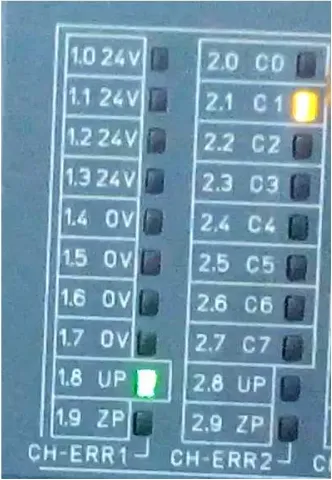
Here speaker 2 is found the authenticated user, its user id is sent by MATLAB to PLC and the changes of value on PLC is shown below.
Figure 9: Data received
And according to the data sent the output on PLC is shown below. From the image provided below a one can see that at right column user two is detected and at first column accordingly device eight is being controlled.
This is DC 523 which is used as data out port whatever data is sent to the plc according to the program it sends the output on it and a LED shows the status of each pin.
4. CONCLUSION
For speaker identification, the proposed method is perfectly accurate. By much trial and error its threshold and tracking accuracy has been determined accurately for particular users. This algorithm works much fast enough and error rate is much low. And this algorithm works with practical implementation of hardware device control.
5. APPLICATIONS
Speaker identification system has many applications in almost all range of areas related with engineering and technology. Some of the applications of speaker identification systems are:
Time and Attendance Systems Access Control Systems Telephone-Banking/Broking
Biometric Login to telephone aided shopping systems
Information and Reservation Services Security control for confidential information
Forensic purposes
6. FUTURE SCOPE
The proposed focus is on Isolated Word recognition. This research can be extended for continuous speech recognition for numerous applications.
7. REFERENCES
[1] Balwant A. Sonkamble1* D. D. Doye2, Speech Recognition Using Vector Quantization through Modified K-means LBG Algorithm, Computer Engineering and Intelligent Systems ISSN 2222-1719 (Paper) ISSN 2222-2863 (Online) Vol 3, No.7, 2012
[2] Davis, S.; Mermelstein, P.: “Comparison of Parametric Representations for Monosyllabic Word Recognition in Continuously Spoken Sentences”, IEEE Transactions on Acoustics, Speech, and Signal Processing, vol. 4 (1980).
[3] DR. H. B. Kekre , VaishaliKulkarni, Ph.D. Research Scholar , Performance Comparison of Speaker Recognition using Vector Quantization by LBG and KFCG International Journal of Computer Applications (0975 – 8887)Volume 3 – No.10, July 2010 32
[4] Hakkani-Tur, D.; Oflazer, K.; Tur, G: “Statistical Morphological Disambiguation for Agglutinative Languages”, Technical Report, Bilkent University, (2000).
[6] Md. Rashidul Hasan, Mustafa Jamil, Md. GolamRabbani Md. SaifurRahman , Speaker identification using mel-frequency cepstrul coefficients, 3rd International Conference on Electrical & Computer Engineering ICECE 2004, 28-30 December 2004, Dhaka, Bangladesh ISBN 984-32-1804-4 565
[7] Wei Han, Cheong-Fat Chan, Chiu-Sing Choy and Kong-Pang Pun – “ An Efficient
MFCC Extraction Method in Speech Recognition”, Department of Electronic Engineering, The Chinese University of Hong Kong, Hong, IEEE – ISCAS, 2006