Controlling the Level of Linear Process Using
Different PID Technique
B.Suganya1, P Sandia2, H.Kala3, R.Suresh Kumar4, V.Sabari5
UG Scholar, Dept of ICE, Saranathan College of Engineering, Trichy, India 1,2,4,5
Assistant Professor, Dept of ICE, Saranathan College of Engineering,Trichy, India 3
ABSTRACT: Controlling the level in the process is very tedious one in industries .For controlling the level in the process, different types of controller tuning methods is used by many researches. The most common type of the tuning is PID tuning for the closed loop process. Here in this process we have used ZN and CC method for controlling the level of the process, which are implemented using MATLAB environment, and are, compared on the basis of time domain specification and performance indices.
KEYWORDS:PID controller, Set point tracking, Load Rejection, Level process MATLAB.
I.INTRODUCTION
This
During the period of 1930, we have three modes of controller such as proportional, integral, derivative called as PID. These PID actions are commercially accessible and gained worldwide industrial adoption. These types of controllers are still the most extensively used controllers in process industries. This succeed is a technique which is highly appreciated in many researches. The admiralty of PID controller is due to the functional clarity, dependability and cost effectiveness. This prosper is a relevance of this algorithm such as simplicity, robustness and applicability. A PID controller enhances the transient response of a system by diminishing the overshoot and by holding the settling time of a system. Though we have a lot of methods to be offered for the tuning of PID controller, their manipulation is finite due to strained emerges at the time of execution.In a paper researcher perform PID controller tunning and concluded that ZN tuning has better performance. From the paper titled comparison of tuning methods of PID controllers for FOPTD system Tyreus-luyben method is concluded to be the best.From the papertitled comparison of PID controller tuning methodsZ-N(closed loop) method is concluded to be the best. From the paper titled “comparison of PID controller tuning techniques for temperature process IMC method is concluded to be the best. From the paper titled tuning of controller for non-linear process using intelligent technique genetic algorithm method was proved to be the best.II.PROCESS SETUP
Fig. 1Piping and instrumentation diagram and block diagram of level process
III. MATHEMATICAL MODEL FOR FIRST ORDER SYSTEM
Thus the transfer function for the real time level process are determined by step response curve
.
Fig. 2 Response of Level Process
The gain K is obtained by calculating the ratio of output and input of the process, in which the delay is determined by calculating the time taken for the proc3ess to reach 63.2% of the final steady state. The transfer function for process is obtained by above curve in which the s-curve method are implemented to determining the transfer function.
G(S)=.. .
IV.CONTROLLER TUNING
The PID controller tuning methods are classified into two main categories Closed loop methods and Open loop methods Closed loop tuning techniques refer to method that tune the controller during automatic state in which the plant is operating in closed loop. The open loop techniques refer to methods that tune the controller when it is in manual state and the plant operates in open loop. The closed loop methods considered for simulation are listed below.
A.TYREUS-LUYBEN:
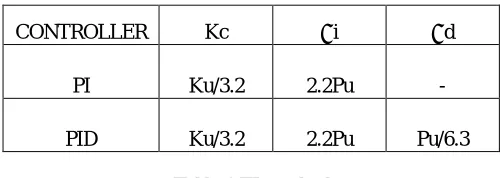
CONTROLLER Kc Ʈi Ʈd
PI Ku/3.2 2.2Pu -
PID Ku/3.2 2.2Pu Pu/6.3
Table 1:TL method
loop parameters derived from measurements. The period Pu of the oscillation frequency at the stability limit, the gain margin Ku for loop stability with the goal of achieving good regulation.
B.CHIEN, HRONES &RESWICH METHOD:
0%LoadRejection 20% LoadRejection
CONTROLLER Kc Ʈi Ʈd Kc Ʈi Ʈd
P (0.3/Km)*(Ʈm/d) -
-
(0.7/Km)*(Ʈm/d) -
-
PI (0.6/Km)/*(Ʈm/d) 4d - (0.7/Km)/*(Ʈm/d) 2.3d -
PID (0.95/Km)/*(Ʈm/d) 2.4d 0.42d (1.2/Km)/*(Ʈm/d) 2d 0.42d
Table 2: 0%LoadRejection and 20%Setpoint Tracking
Table 3: 0%LoadRejection and 20%Setpoint Tracking
The C-H-R method focuses on set point response and disturbance response. This method provides formulas for 0% and 20% load rejection and set point tracking. The proportional gain (Kc) integral gain (Ki) and derivative gain for different tuning methods are calculated from the given tabulation. The corresponding proportional integral derivative values are calculated. To tune the controller according to the C-H-R method the parameters of first order plus dead time same for the Z-N method. The tuning rules based on the20% overshoot design criterion are quite similar to the Z-N method. However when the 0% overshoot criteria is used, the gain and the derivative time are smaller than the integral time. So the integral time is larger
C.SKOGESTED METHOD:
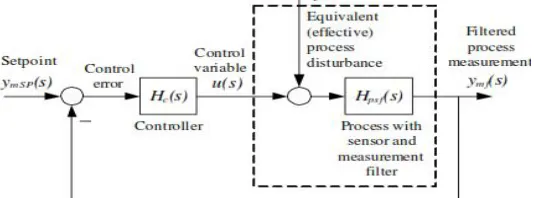
Skogested’s PID tuning method is a model –based tuning method where the controller parameters are expressed as functions of the process model parameters. It is assumed that the control system as a transfer function block diagram.
Fig 3:Block diagram of PID tuning with skogested method
0% Setpoint Tracking 20%Setpoint Tracking
CONTROLLER Kc Ʈi Ʈd Kc Ʈi Ʈd
P (0.3/Km)*(Ʈm/d) - - (0.7/Km)*(Ʈm/d) - -
PI (0.3/Km)/*(Ʈm/d) 1.2Ʈm - (0.6/Km)/*(Ʈm/d) Ʈm -
The design principle of skogested‘s method is as follows. The control system tracking transfer commission T(s),which is the transfer function from the set point to the (filtered)process measurement, is specified as a first order transfer function with delay:
Originally, skogested define the factor c in table gives good set point tracking .But the disturbances compensation may become quite sluggish. To obtain faster disturbances compensation, you can use c=1.5.
The drawback of such a reduction of c is that there will be more overshoot in the set point step response, and that the stability of the control will be reduce, Tc=Ʈ.The values of the parameters of the transfer functions in Table 1 can be found from a mathematical model based on physical principles. The parameter values can also be found from a step-response experiment withthe process.
Process type Hpsf(s) process KP Ʈ Ʈd
Integrator+ delay
K Se
1
K(T +Ʈ)
C(TS+Ʈ) 0
Time constant with delay
K
ƮS + 1e
T
K(T +Ʈ)
Min[T,c(TC+Ʈ]
0
Table 4: Skogested method
D.IMC Method:
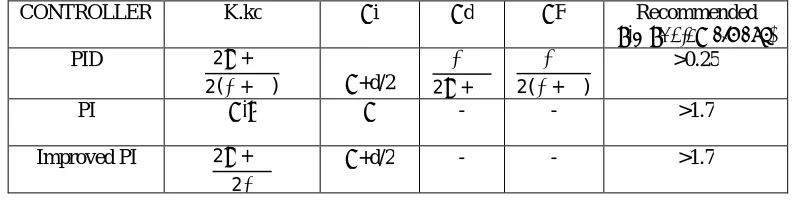
The methods is the Internal Model Control(IMC) tuning method. Sometimes called Lambda tuning. It offers a stable and robust alternative to other techniques, such as the famous Ziegler-Nichols method, that usually aim for speed at the expense of stability.The Ziegler-Nichols open loop and Cohen-Coon methods give large controller gain and short integral time,which isn’t conducive to chemical engineering applications.The IMC method relates to closed-loop control and doesn’t have overshooting or oscillatory behavior.The IMC methods however are very complicated for systems with first order dead time.
CONTROLLER K.kc Ʈi Ʈd ƮF Recommended
λ/d(λ>0.2Ʈ always)
PID 2Ʈ+
2( + ) Ʈ+d/2 2Ʈ+ 2( + )
>0.25
PI Ʈ/λ Ʈ - - >1.7
Improved PI 2Ʈ+
2
Ʈ+d/2 - - >1.7
Table 5:Internal model control
The IMC approach has two important advantages: (1) it explicity takes into account model uncertainity and (2) it allows the designer to trade – off control system roubstness to process changes and modeling errors the IMC approach is based on the block diagrams. In this diagram Gp is the transfer function of the process model. Also Gc1 is the IMC controller transfer function.
Fig4:Internal Model Control (a) basic structure (b) equivalent feedback
V. RESULT
Thus the overall response for IMC,TL,C-H-R(load rejection&set point tracking),skojested mathods has been studied.Fromthese methods skojested tuning response has given the fast response.so it reaches the settling time easily and it has good stability when compared to other tuning response.
Fig5:Response of all tunings
COMPARISION OF TIME DOMAIN SPECIFICATIONS:
Tuning Methods Rise Time Peak over-
Shoot
Settling Time
Peak Time
Skogested method 1 integrator+delay
2 1.3 23 3
Skogested method 2 time -constant+delay
2 0.9 6 0.8
Tyreus-luyben method
2 1.08 7.5 3
IMC method
2 1.5 20 6
C-H-R method load rejection for 0%
6 1.15 13 8
C-H-R method load rejectionor 20%
4 1.08 16 3
C-H-R method setpoint tracking for 0%
3 1 10 1.1
C-H-R method setpoint tracking for 20%
4 1.2 9 1.1
VII.CONCLUSION
Simulation based auto tuning of PID controller in extended mode design and conventional type were designed and implemented by MATLAB environment. The performances of controllers were studied on the basis of rise time (Tr), settling time (Ts) and overshoot are tabulated in table 8.The skogested method for time constant delay has given the less rise time, peak time, peak overshoot, settling time. So it is the better tuning compare the IMC, TL, C-H-R 0%, 20% Lode rejection and set point tracking.
REFERENCES
1) Astrom K, J, T. Hagllund;”PID controllers Theory, Design and Tuning”, 2nd edition, Instrument Society of America, 1994 2) Chen C.L.,”A Simple Method for Online Identification and Controller Tuning”, AIChe J, 35, 2037 (1989)
3) Coughanowr D.R.;”Process System Analysis and Control”, 2nd edition McGrawHill, 1991
4) Erickson K.T., J.L. Hedrick;”Plant wide Process Control” John Wiley & Sons, 1999
5) Hang C.C., J.K. Astrom, W.K. Ho;”Refine- ments of Ziegler Nichols Tuning formula”,IEE Proceedings, 138(2), 111(1991) 6) Jutan A.;”A Comparison of Three Closed Loop Tuning Method Algorithms”, AIChe J, 35, 1912 (1989)
7) Krishnaswamy P.R., B.E Mary Chan., and G.P, Rangaish;”Closed- Loop Tuning of Control Systems”, Chem. Eng.Sci.42, 2173(1987) 8) Lee J.;”Online PID Controller Tuning For A Single Closed Test”, AIChe J, 32(2), 329(1989)