Solar PV Integration in Smart Grid - Issues
and Challenges
T. Kaur
1Associate Professor, Department of Electrical Engineering, PEC University of Technology, Chandigarh, India1
ABSTRACT: Smart grid technology is the key for a reliable and efficient use of distributed energy resources. The recent resurgence of interest in use of renewable energy is driven mainly by the need to reduce the high environmental effects of fossil based energy systems and diminishing fossil fuel reserves. Amongst all the renewable sources solar power takes the prominent position due to its availability in abundance. From technological point of view, solar PV has reached maturity. The challenges faced by grid operators now have less to do with core technology and more to do with integrating PV system to the grid. Recently, the concept of smart grid has been successfully applied to the electric power systems. Smart Grids can integrate solar sourced electricity such as Rooftop solar PV along with traditional power generation allowing higher flexibility to have localized and right sized power plants with reduced transmission loss, zero environmental concerns and higher efficiency. This paper discusses smart grid infrastructure issues and challenges of integrating Solar PV sourced electricity in the smart grid.
KEYWORDS:Distributed generation, Solar energy, Smart grid, Sustainable development, Information Technology
.
I.INTRODUCTION
The energy landscape is changing. Global warming, finite fossil fuel resources, rising energy demands, cyber-attack risks, power shortage sand new load types such as plugin electric vehicles are just some of the drivers for the energy
sector to embark on a journey to move to sustainable energies. Three major aspects are integral parts of a
transformation strategy toward a sustainable energy system.
i. Increased reliance on Renewable energy.
ii. Energy efficiency in all sectors and at all levels.
iii. Lesscarbon intensive fossil fuel energy conversion.
The relative importance of these options and the order in which they become relevant depends on the stage of development of the region as well as on the availability of the natural resources and technologies. The share of renewable energy for primary energy use in 2011 was only 13%. [1]. The current resurgence of interest in the use of renewable energy is mainly driven by the need to reduce the high environmental impact of fossil-based energy systems.Harvesting of renewable energy on a large scale is undoubtedly one of the main challenges of our time. Conventional power systems involve centralized power generation, transmission and distribution, thus lacking in flexibility for distributed power generation. They do rely on control, communication and computation for ensuring efficient, stable and reliable operations. Generators rely on governors and automatic voltage regulators (AVRs) to mitigate the effect of disturbances and on power system stabilizers (PSSs) for damping. Flexible AC transmission system (FACTS) devices, such as unified power flow controllers (UPFC) and high-voltage DC (HVDC) systems rely on feedback control to enhance system stability. At a higher level, energy management systems (EMSs) use supervisory control and data acquisition (SCADA) to collect data from expansive power systems and sophisticated analysis tools to ensure secure economic operating conditions. Automatic generation control (AGC) is a distributed closed-loop control scheme of continental proportions that optimally reschedules generator power set points to maintain frequency and tie-line flows at their specified values [2,3]. However most of these grids have been designed and installed before the advent of microprocessor era and are yet to updated with recent technology enhancements.
difficulties involved in communicating (with sufficient bandwidth) with consumers. The conventional grid must evolve in many ways to adapt to increased penetration of PV and other intermittent electricity generation sources. Today we are living in Smart Grid era. The core concept of smart grid is about integrating Information Technology with electrical generation, transmission, distribution, storage and consumer [2]. Smart Grid technology has a key for reliable operation and efficient utilization of distributed energy resources. The following section discusses smart grid technologies and some of the challenges related to solar pv generation and its integration with the grid.
II.SOLAR POWER GENERATION
Solar-sourced electricity can be generated either directly using photovoltaic (PV) cells (Figure 1)
Fig. 1Block Diagram for Solar PV technology
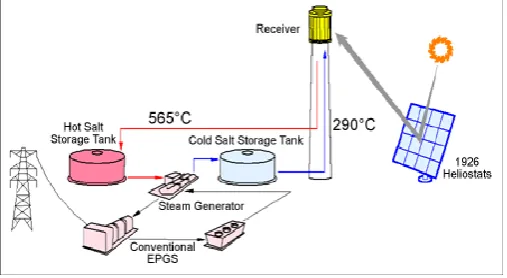
or indirectly by collecting and concentrating the solar radiations to produce steam, which in turn drives a turbine connected to a generator to provide electric power (CSP). (Figure -2)
Fig. 2Block Diagram for Solar thermal CSP technology
III. CHALLENGES WITH SOLAR PV INTEGRATION
Although solar energy is an infinite energy source derived from the environment, its supply is intermittent, yet its availability is less than predictable and is outside human control as compared to conventional power plants. Continuous research and development are going on to meet the challenges pertaining to solar power generation. viz. high initial
cost, variability, requirement of space for PV panel installation, less efficient energy conversion to name a few . Solar
power is not always available where and when needed. Unlike conventional sources of electric power, solar resources are not ―dispatchable‖—the power output cannot be controlled. Daily and seasonal effects and limited predictability result in intermittent generation. This poses many challenges for the Grid integration. Some of these challenges are given in the next section [5, 6, 7].
1. Intermittent Generation
The intermittent nature of solar resource and limited dis-patchability require grid operators to maintain additional spinning reserves. Accurate hourly and sub hourly solar generation forecasting is required to allow for unit commitment and spinning reserves , scheduling and dispatch.
2. Transmission System issue
Large scale solar plants (100 MW and above) may be located in places distant from any existing transmission lines. Planning for transmission expansion to support increasing level of solar generation in dispersed areas is essential to the growth of the solar power sector. Planning and system studies are required to determine seasonal requirements for up -regulation, down – regulation and ramping capacities. Long term resource adequacy issues also need to be addressed.
The interconnection protocols and standards may needed to be modified to address greater level of power factor control and low voltage ride through to mitigate any transient stability issues.
3. Distribution system issues
The increasing penetration of institutional and residential solar generation imposes challenges on the existing distribution infrastructure. Grid operators are facing shifts in peak demand, load pattern resulting in a scenario where in generators are being called upon to ramp up their output more than before and for which they may have not been designed [8], New control strategies to enhance distribution automation and microgrid capabilities , voltage and var management are the need of the hour. Integration of renewable energy into the smart grid with innovative energy storage is the key to smooth this variability’s, partially alleviate some of these challenges and achieve greater reliability in delivery. Future energy sustainability depends heavily on how the renewable energy problem is addressed in the next few decades.
4. Integrating Energy storage
An excellent style m Electric Energy storage although is a well establishedpractice , its use in PV systems is usually for Standalone systems.
Fig. 3Power vs Discharge Duration of Energy storage Technologies
A Standalone PV system has little effect on the overall quality or reliability of grid power. However in case of grid integration where PV penetration reaches high levels 5 to 20%, the intermittent nature of PV generation have noticeable negative effect on the entire grid. Both, the rate of change of output and the magnitude of output is important. Fig 4 illustrates the transient nature of PV generation as clouds pass over a typical residential system during the course of a day. [10]
Fig. 4Example -PV system output on 2 days with passing clouds
In few seconds, PV system can go from full output to zero and back again. This can wreak havoc on utility operation due to fluctuations in grid voltage power and power factor. The distributed nature of PV does help to mitigate the negative consequences to some degree. However utilities still need to address worst case possibilities. When transients are high , area regulation will be required to ensure that adequate voltage and power quality are maintained . Also as utilities require spinning reserve, the amount of spinning reserve necessary will increase with the amount of distributed pv generation that is bought online. The energy storage can keep the plants output within required range by drawing power from the storage device when cloud moves in and cut off some of the plant output after it passes. This can be done inverter start-up or defocusing trackers. The power electronics and control strategies are required for ensuring all parts of grid connected distribution sources and storage system work.
Energy storage is becoming more appealing in smart grids. It can be used for frequency regulation, voltage regulation, capacity firming and islanding operation in micro-grids apart from ramping.
peak shaving, the system controller must be able to dispatch power from the storage system if PV is unavailable to meet the load.
ii. Load Shifting:Many peak loads occur late in the day, after the peak for PV generation has passed. Storage can be combined with PV to reduce demand for utility power during late-day, higher rate times by charging a storage
system with PV generated energy early in the day or to support a load later in the day.
iii. Demand Response: While both residential and commercial PV storage system have the inherent capability to
manage demand response requirements, control systems capable of reacting to demand response demands will have to be developed.
iv. Outage Protection: Smart grids insulate end users from loss of power or failure of one part of the energy network. This is ensured by intelligent distribution topologies the flow of which changes in real time to meet the goals of better delivery, cheap generation, and cheap distribution, and of anticipating, detecting, and responding to system problems, and automatically avoiding or mitigating various kinds of power disruptions.
v. Grid Power Quality Control: Power quality ensures constant voltage, phase angle adjustment and removal of extraneous harmonic content from the electric grid. The common problem is voltage sag in which the UPS can supply the energy needed to return the voltage to the desired level. UPS functions can be added to PV storage system in the power conditioning system by designing it to handle high power applications including necessary control functions.
VI.CONCLUSION
The world is moving toward sustainable energies. Electrical utilities all over the world are increasingly incorporating clean and green sources of energy. As part of go green imitative, the Indian government too has mandated RPOs for solar power generation. Solar energy though available in abundance, is intermittent and variable and therefore non dispatch able. Conventional electrical utilities are centralized and lack flexibility to distributed generation. Some of these issues and challenges of high solar PV penetration and other intermittent electricity generation sources have been discussed in this paper. The lack of involvement of distributed generation is largely a consequence of the technical difficulties involved in communicating (with sufficient bandwidth) with consumers. The conventional grid must evolve in many ways to adapt to these challenges. The smart grid can help us reach the goal of clean air and energy independence by utilizing renewable power such as solar energy transitions from central control to a collaborative network.
REFERENCES
[1] World Energy Outlook. www.worldenergyoutlook.org
[2] Smart Grid: Reinventing the Electric Power System. IEEE Power and Energy Magazine for Electric Power Professionals. USA: IEEE Power and Energy Society, 2011.
[3] F. Eduardo,Camacho et al , ―Control of Renewable Energy and Smart Grids,‖www.ieeecss.org/sites/ieeecss.org/files/documents
[4] M .Dakkak, K Hatori, T.Ise,―The concept of distribution flexible network PV system.‖ Renewable Energy, vol. 31, no.12,pp.1916-33,2006,. [5] S.Kohsri, B. Plangklang,―Energy Management and Control System for Smart Renewable Energy Remote Power Generation,‖ Energy
Procedia,vol. 9, pp.198-206,2011.
[6] M.Alonso,H.Amaris,C. Alvarez-Ortega,―Integration of renewable energy sources in smart grids by means of evolutionary optimization algorithms,‖ Expert Systems with Applications, vol.39, no.5,pp.5513-22,2012.
[7] B.B.Alagoz,A.Kaygusuz,A.Karabiber,―A user-mode distributed energy management architecture for smart grid applications. Energy, vol.44 no.1,pp.167-77.
[8] ―Using Smart Grids to Enhance Use of Energy-Efficiency and Renewable Energy Technologies.‖ APEC Energy Working Group, 2011. [9] Solar Energy Grid Integration System – Energy Storage. www1.eere.energy.gov.
[10] Vladimir. C, et al, ―Considerations on the Modelling of Photovoltaic Systems for Grid Impact Studies,‖ www.smooth.pv.info/doc
[11] B.B.Alagoz, A .Kaygusuz,A. Karabiber,―A user-mode distributed energy management architecture for smart grid applications,‖ Energy; vol.44, no.1, PP.167-77,2012.
[12] S.Kohsri, B. Plangklang,―Energy Management and Control System for Smart Renewable Energy Remote Power Generation,‖ Energy Procedia; vol. 9, pp.198-206,2011.
[13] W. Wang and Y.Xu and M. Khanna, ―A survey on the communication architectures in smart grid‖, Computers Networks ,pp.3604-3629, 2011. [14] V.Namboodiri, V.Aravithan and W.Jewell,―Communication Needs and Integration Options for ANI in the smart grid‖, white paper,(2012)May. [15] V.C.Gungor, D.Sachin, T.Kochak and S.Ergut, ― Smat Grid Technologies; Communication Technologies and Standards,‖ IEEE Transaction
Industrial Information, vol.7, no.4, pp.529-539, 2011.