On Constructing One-Way Permutations
from Indistinguishability Obfuscation
Gilad Asharov∗ Gil Segev∗
Abstract
We prove that there is no black-box construction of a one-way permutation family from a one-way function and an indistinguishability obfuscator for the class of all oracle-aided circuits, where the construction is “domain invariant” (i.e., where each permutation may have its own domain, but these domains are independent of the underlying building blocks).
Following the framework of Asharov and Segev (FOCS ’15), by considering indistinguisha-bility obfuscation for oracle-aided circuits we capture the common techniques that have been used so far in constructions based on indistinguishability obfuscation. These include, in particu-lar,non-black-boxtechniques such as the punctured programming approach of Sahai and Waters (STOC ’14) and its variants, as well as sub-exponential security assumptions. For example, we fully capture the construction of a trapdoor permutation family from a one-way function and an indistinguishability obfuscator due to Bitansky, Paneth and Wichs (TCC ’16). Their construc-tion is not domain invariant and our result shows that this, somewhat undesirable property, is unavoidable using the common techniques.
In fact, we observe that constructions which are not domain invariant circumvent all known negative results for constructing one-way permutations based on one-way functions, starting with Rudich’s seminal work (PhD thesis ’88). We revisit this classic and fundamental problem, and resolve this somewhat surprising gap by ruling outallsuch black-box constructions – even those that are not domain invariant.
∗
School of Computer Science and Engineering, Hebrew University of Jerusalem, Jerusalem 91904, Israel. Email:
Contents
1 Introduction 1
1.1 Our Contributions . . . 1
1.2 Related Work . . . 2
1.3 Overview of Our Results . . . 4
1.3.1 Capturing Non-Black-Box Constructions viaiO for Oracle-Aided Circuits . . 4
1.3.2 Warm-up: Rudich’s Attack in the Random-Oracle Model . . . 5
1.3.3 Attacking Domain-Invariant Permutation Families Relative to Our Oracle . . 6
1.3.4 Attacking Non-Domain-Invariant Permutation Families in the Random-Oracle Model . . . 7
1.4 Paper Organization . . . 8
2 Preliminaries 8 2.1 Oracle-Aided One-Way Permutation Families . . . 8
2.2 Indistinguishability Obfuscation for Oracle-Aided Circuits . . . 9
3 Impossibility for Constructions Based oniO and One-Way Functions 9 3.1 The Class of Constructions . . . 9
3.2 Proof Overview and the Oracle Γ . . . 11
3.3 Attacking Domain-Invariant Permutation Families Relative to Γ . . . 13
3.4 f is a One-Way Function Relative to Γ . . . 19
3.5 iO is an Indistinguishability Obfuscator Relative to Γ . . . 19
3.5.1 Simulating the OracleEval . . . 20
3.5.2 From Distinguishing to Hitting . . . 23
3.5.3 Concluding the proof . . . 24
3.6 Proof of Theorem 3.3 . . . 25
4 Impossibility for Constructions Based on One-Way Functions 26 4.1 Attacking Non-Domain-Invariant Permutation Families in the Random-Oracle Model 27 4.2 Proof of Theorem 4.2 . . . 29
1 Introduction
One-way permutations are among the most fundamental primitives in cryptography, enabling elegant constructions of a wide variety of central cryptographic primitives. Although various primitives, such as universal one-way hash functions and pseudorandom generators, can be constructed based on any one-way function [Rom90, HIL+99], their constructions based on one-way permutations are much simpler and significantly more efficient [BM84, NY89].
Despite the key role of one-way permutations in the foundations of cryptography, only very few candidates have been suggested over the years. Whereas one-way functions can be based on an extremely wide variety of assumptions, candidate one-way permutation families are significantly more scarce. Up until recently, one-way permutation families were known to exist only based on the hardness of problems related to discrete logarithms and factoring [RSA78, Rab79]. Moreover, the seminal work by Rudich [Rud88], within the framework of Impagliazzo and Rudich [IR89], initiated a line of research showing that a one-way permutation cannot be constructed in a black-box manner from a one-way function or from various other cryptographic primitives [CHL06, KSS11, MM11, Mat14].
Very recently, a one-way (trapdoor!) permutation family was constructed by Bitansky, Paneth and Wichs [BPW16] based on indistinguishability obfuscation [BGI+12, GGH+13] and one-way
functions. Their breakthrough result provides the first trapdoor permutation family that is not based on the hardness of factoring, and motivates the task of studying the extent to which indistin-guishability obfuscation can be used for constructing one-way permutations. Specifically, their work leaves completely unresolved the following question, representing to a large extent the “holy grail” of constructing one-way permutations:
Is there a construction of a one-way permutation over {0,1}n
based on indistinguishability obfuscation and one-way functions?
While exploring this intriguing question, one immediately identifies two somewhat undesirable properties in the construction of Bitansky, Paneth and Wichs:
• Even when not aiming for trapdoor invertibility, their approach seems limited to providing a
familyof permutations instead of a singlepermutation1.
• Their construction provides permutations that are defined over domains which both depend on the underlying building blocks and are extremely sparse2.
From the theoretical perspective, one-way permutation families with these two properties are typ-ically still useful for most constructions that are based on one-way permutations. However, such families lack the elegant structure that makes constructions based on one-way permutations more simple and significantly more efficient when compared to constructions based on one-way functions.
1.1 Our Contributions
Motivated by the recent construction of Bitansky et al. [BPW16], we study the limitations of using indistinguishability obfuscation for constructing one-way permutations. Following the framework
1
Moreover, Bitansky et al. note that their permutations do not seem certifiable. That is, they were not able to provide an efficient method for certifying that a key is well-formed and describes a valid permutation. In contrast, a single permutation is certifiable by its nature.
2Each permutation in their construction is defined over a domain of elements of the form (x,PRF
K(x)), wherePRF
of Asharov and Segev [AS15], we consider indistinguishability obfuscation fororacle-aided circuits, and thus capture the common techniques that have been used so far in constructions based on indistinguishability obfuscation. These include, in particular, non-black-box techniques such as the punctured programming approach of Sahai and Waters [SW14] and its variants, as well as sub-exponential security assumptions. For example, we fully capture the construction of a trapdoor permutation family from a one-way function and an indistinguishability obfuscator due to Bitansky et al. [BPW16]. We refer the reader to Section 1.3.1 for an overview of our framework and of the type of constructions that it captures.
Our work considers three progressively weaker one-way permutation primitives: (1) a domain-invariantone-way permutation, (2) a domain-invariant one-way permutationfamily, and (3) a one-way permutation family (which may or may not be domain invariant). Roughly speaking, we say that a construction of a one-way permutation (or a one-way permutation family) is domain invariant if the domain of the permutation is independent of the underlying building blocks (in the case of a permutation family we allow each permutation to have its own domain, but these domains have to be independent of the underlying building blocks).
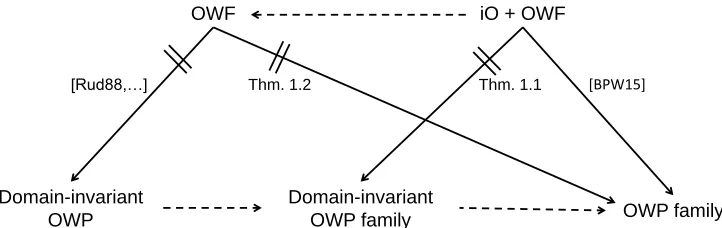
Within our framework we prove the following two impossibility results, providing a tight char-acterization of the feasibility of constructing these three progressively weaker one-way permutation primitives based on one-way functions and indistinguishability obfuscation using the common tech-niques (we summarize this characterization in Figure 1).
iO+OWF 6⇒ domain-invariant OWP family. Bitansky et al. [BPW16] showed that any sub-exponentially-secure indistinguishability obfuscator and one-way function imply a one-way per-mutation family which is not domain invariant. We show that using the common techniques (as discussed above) one cannot construct the stronger primitive of a domain-invariant one-way per-mutation family (even when assuming sub-exponential security). In particular, we show that the above-described undesirable properties of their construction are unavoidable unless new non-black-box techniques are introduced.3
Theorem 1.1. There is no fully black-box construction of a domain-invariant one-way permutation family from a one-way function f and an indistinguishability obfuscator for the class of all oracle-aided circuits Cf.
OWF 6⇒ OWP family. In fact, we observe that constructions which are not domain invariant circumvent the known negative results for constructing one-way permutations based on one-way functions, starting with Rudich’s seminal work [Rud88, KSS11, MM11, PTV11]. We revisit this classic and fundamental problem, and resolve this surprising gap by ruling out all black-box con-structions of one-way permutationfamiliesfrom one-way functions – even those that arenotdomain invariant.
Theorem 1.2. There is no fully black-box construction of a one-way permutation family (even a non-domain-invariant one) from a one-way function.
1.2 Related Work
The recent line of research focusing on new constructions based on indistinguishability obfuscation has been extremely fruitful so far (see, for example, [GGH+13, BST14, BCC+14, BCT+14, BZ14,
3
OWF iO + OWF
Domain-invariant OWP
Domain-invariant
OWP family OWP family
[BPW15]
[Rud88,…] Thm. 1.2 Thm. 1.1
Figure 1: A dashed arrow from a primitiveAto a primitiveB indicates thatAimpliesB by definition. Bitansky et al. [BPW16] showed that any sub-exponentially-secure indistinguishability obfuscator and one-way function imply a one-one-way permutation family (which is not domain invariant), and we show that one cannot construct the stronger primitive of adomain-invariantone-way permutation family unless new non-black-box techniques are introduced (even when assuming sub-exponential security).
The line of research starting with Rudich [Rud88] showed that one cannot construct adomain-invariant one-way permutation from a one-one-way function in a black-box manner. We improve this result, showing that one cannot construct the weaker primitive of a one-way permutationfamily(even one that isnotdomain invariant) from a one-way function in a black-box manner (again, even when assuming sub-exponential security).
BR14, CLP14, GGG+14, GGH+14, CGP15, DKR15, GP15, HSW14, KMN+14, SW14, ABS+15, AJ15, BP15, BPW16, BPR15, BV15, CTP15, CLT+15, Wat15] and the references therein). How-ever, the extent to which indistinguishability obfuscation can be used as a building block has been insufficiently explored. Our approach for proving meaningful impossibility results for constructions based on indistinguishability obfuscation is based on that of Asharov and Segev [AS15] (which, in turn, was inspired by that of Brakerski, Katz, Segev and Yerukhimovich [BKS+11]). They showed that the common techniques (including non-black-box ones) that are used in constructions based on indistinguishability obfuscation can be captured by considering the stronger notion of indis-tinguishability obfuscation for oracle-aided circuits (see Section 1.3.1 for an elaborate discussion). Generalizing the work of Simon [Sim98] and Haitner et al. [HHR+15], they showed that using these common techniques one cannot construct a collision-resistant hash function family from a general-purpose indistinguishability obfuscator (even when assuming sub-exponential security). In addition, generalizing the work of Impagliazzo and Rudich [IR89] and Brakerski et al. [BKS+11], they showed a similar result from constructing a perfectly-complete key-agreement protocol from a private-key functional encryption scheme (again, even when assuming sub-exponential security).
It is far beyond the scope of this paper to provide an overview of the lines of research on black-box impossibility results in cryptography (see, for example, [IR89, Sim98, GMR01, HR04, RTV04, GGK+05, GMM07, Wee07, BM09, DLM+11, MP12, BBF13, CLM+13, DMM14a, MMP14, BB15, BFM15] and the references therein). Impossibility results for constructing one-way permutations start with the seminal work of Rudich [Rud88]. This line of research has successfully shown that one-way permutations cannot be based on a variety of fundamental cryptographic primitives (e.g., [CHL06, KSS11, MM11, Mat14]). However, these impossibility results capture only constructions of asinglepermutation that isdomain invariant, and do not seem to capture more general constructions (such as the construction of Bitansky et al. [BPW16] producing a permutation familywhich is not
domain invariant).
the outcome of the protocol is completely independent of the specific one-way function that is used.
1.3 Overview of Our Results
In this section we provide a high-level overview of our two results. First, in Section 1.3.1 we describe the framework that enables us to prove a meaningful impossibility result for constructions that are based on indistinguishability obfuscation. Next, in Section 1.3.2 we describe Rudich’s attack for inverting any domain-invariant permutation relative to a random oracle. Extending Rudich’s approach, we then discuss the main technical ideas underlying our results: In Section 1.3.3 we present an attack on any domain-invariant permutation family relative to our, significantly more structured, oracle, and in Section 1.3.4 we generalize Rudich’s attack to non-domain-invariant permutation families in the random-oracle model.
1.3.1 Capturing Non-Black-Box Constructions via iO for Oracle-Aided Circuits The fact that constructions that are based on indistinguishability obfuscation are almost always
non-black-box makes it extremely challenging to prove any impossibility results. For example, a typical such construction would apply the obfuscator to a function that uses the evaluation circuit of a pseudorandom generator or a pseudorandom function, and this requiresspecific implementations
of its underlying building blocks.
However, as observed by Asharov and Segev [AS15], most of the non-black-box techniques that are used on such constructions have essentially the same flavor: The obfuscator is applied to functions that can be constructed in a fully black-box manner from a low-level primitive, such as a one-way function. In particular, the vast majority of constructions rely on the obfuscator itself in a black-box manner. By considering the stronger primitive of an indistinguishability obfuscator fororacle-aided
circuits (see Definition 2.4), Asharov and Segev showed that such non-black-box techniques in fact directly translate into black-box ones. These include, in particular, non-black-box techniques such as the punctured programming approach of Sahai and Waters [SW14] and its variants (as well as sub-exponential security assumptions – which are already captured by most frameworks for black-box impossibility results).
Example: The Sahai-Waters approach. Consider, for example, the construction of a public-key encryption scheme from a one-way function and a general-purpose indistinguishability obfuscator by Sahai and Waters [SW14]. Their construction relies on the underlying one-way function in a non-black-box manner. However, relative to an oracle that allows the existence of a one-way functionf and indistinguishability obfuscationiOfororacle-aided circuits, it is in fact a fully black-box construction. Specifically, Sahai and Waters use the underlying indistinguishability obfuscator for obfuscating a circuit that invokes a puncturable pseudorandom function and a pseudorandom generator as sub-routines. Given that puncturable pseudorandom functions and pseudorandom generators can be based on any one-way function in a fully black-box manner, from our perspective such a circuit is a polynomial-size oracle-aided circuit Cf – which can be obfuscated using iO (we refer to reader to [AS15, Sec. 4.6] for an in-depth technical treatment).
on the obfuscator itself in a non-black-box manner (e.g., [BP15])4, or constructions that rely on zero-knowledge techniques and require using NP reductions5.
The oracle. Our first result is obtained by presenting an oracle Γ relative to which the following two properties hold: (1) there is no domain-invariant one-way permutation family, and (2) there exist an exponentially-secure one-way function f and an exponentially-secure indistinguishability obfuscator iO for the class of all polynomial-size oracle-aided circuits Cf. Our oracle is quite intuitive and consists of three functions: (1) a random function f that will serve as the one-way function, (2) a random injective length-increasing function O that will serve as the obfuscator (an obfuscation of an oracle-aided circuit C is a “handle”O(C, r) for a uniformly-chosen string r), and (3) a function Eval that enables evaluations of obfuscated circuits (Eval has access to both f and O): Given a handleO(C, r) and an inputx, it “finds”C and returnsCf(x). We refer the reader to Section 3.2 for more details.
The vast majority of our effort is in showing that relative to Γ there is no domain-invariant one-way permutation family. Specifically, as for the second part, our oracle Γ is somewhat similar to the oracle introduced by [AS15], relative to which they proved the existence of an exponentially-secure one-way function and an exponentially-secure indistinguishability obfuscator (see Section 3.2 for the differences between the oracles).
In the remainder of this section we first provide a high-level overview of Rudich’s attack on any single domain-invariant permutation in the random-oracle model. Inspired by this attack, in Sections 1.3.3 and 1.3.4 we explain the main challenges in extending Rudich’s attack to domain invariant constructions relative to our oracle, and to non-domain invariant constructions in the random-oracle model. We again refer the reader to Figure 1 which summarizes our characterization of the feasible constructions.
1.3.2 Warm-up: Rudich’s Attack in the Random-Oracle Model
Following [Rud88, KSS11, MM11] we show that for any oracle-aided polynomial-time algorithm P, if Pf implements a permutation over the same domain D for all functions f (i.e., P is domain invariant), then there exists an oracle-aided algorithm A that for any function f inverts Pf with probability 1 by querying f for only a polynomial number of times. The algorithm A is given some string y∗ ∈ D and oracle access to f, and is required to find the unique x∗ ∈ D such that
Pf(x∗) = y∗. It first initializes a set of queries/answers Q, which will contain the actual queries made byA to the true oraclef. It repeats the following steps polynomially many times:
1. Simulation: Afinds an inputx0∈ D and a set of oracle queries/answersf0 that is consistent withQ (i.e.,f0(w) =f(w) for everyw∈Q) such thatPf0(x0) =y∗.
2. Evaluation: A evaluates Pf(x0) (i.e., evaluation with respect to the true oracle f). If the output isy∗, it terminates and outputsx0.
3. Update: A asksf for all queries inf0 that are not inQ, and updates the setQ.
The proof relies on the following observation: In each iteration, either (1)Afinds the pre-image
x∗ such thatPf(x∗) =y∗ or (2) in the update phase,A queriesf with at least one new query that is also made by P during the computation ofPf(x∗) =y∗.
4
With the exception of obfuscating a function that may invoke an indistinguishability obfuscator in a black-box manner. This is captured by our approach – see [AS15, Sec. 3.1].
5
Intuitively, if neither of the above holds, then we can construct a “hybrid” oraclefethat behaves like f in the evaluation of Pf(x∗) = y∗ and behaves like f0 in the evaluation of Pf0(x0) = y∗. This hybrid oracle can be constructed since the two evaluationsPf0(x0) andPf(x∗) have no further intersection queries rather than the queries which are already inQ. According to this hybrid oracle
e
f it holds that Pfe(x0) =Pfe(x∗) = y∗ but yetx∗6=x0, and thus relative to
e
f the value y∗ has two pre-images, in contradiction to the fact that P always implements a permutation. Using this claim, since there are only polynomially many f-queries in the evaluation of Pf(x∗) = y∗, the algorithm A must output x∗ after a polynomial number of iterations (more specifically, after at most q+ 1 iterations, where q is the number of oracle gates in the circuitP).
1.3.3 Attacking Domain-Invariant Permutation Families Relative to Our Oracle
We extend the attack described above in two different aspects. First, we rule out constructions of domain-invariant permutation families and not just a single permutation. Second, we extend the attack to work relative to our oracle, which is a significantly more structured oracle than a random oracle and therefore raises new technical challenges. Indeed, by the discussion in Section 1.3.1, relative to our oraclethere exists a non-domain-invariant construction of one-way permutation family [BPW16]. This mere fact represents the subtleties we have to deal with in our setting. In the following overview we focus our attention on the challenges that arise due to the structure of our oracle, as these are the most important and technically challenging ones.
Recall that our oracle Γ consists of three different oracles: A length-preserving function f, an
injective length-increasing function O, and an “evaluation” oracle Eval that depends on both f
and O. We now sketch the challenges that these oracles introduce. The first challenge is that the evaluation oracle Eval is not just a “simple” function. This oracle performs (by definition) exponential time computations (e.g., an exponential number of queries tof and O) which may give immense power to the constructionP. Specifically, unlike in Rudich’s case, here it is no longer true that the computation PΓ(x∗) performs a polynomial number of oracle queries (although P itself is of polynomial size). The second challenge is that since the oracle Eval depends on both f and O, each query to Eval determines many other queries to f and O implicitly, which we need to make sure that they are considered in the attack. Specifically, given the structured dependencies between
f,O and Eval, in some cases it may not be possible to construct a hybrid oracle even if there are no more intersection queries (in Rudich’s case a hybrid oracle always exists).
Finally, the third challenge is the fact that O is injective, which causes the following problem (somewhat similar to [MM11]). In our case, we are forced to assume thatPΓ is a permutation only whenO is aninjective length-increasing function and not just any arbitrary function as in Rudich’s case (as otherwise our obfuscator may not preserve functionality). Therefore, when constructing the hybrid oracleOe, we must ensure that it is alsoinjective in order to reach a contradiction. However, the hybrid oracle Oe might be non-injective when there is some overlap between the images of the true oracle O and the sampled oracleO0 on elements that are not in Q.
it, and almost any Eval query can be simulated by the construction P itself. Finally, due to the dependencies between the oracles, for dealing with the second challenge, the algorithmA will have to sample additional, carefully-chosen, queries that do not necessarily appear in the evaluations
PΓ(x∗) =y∗ orPΓ0(x0) =y∗, but are related to the set of queries that appears in these evaluations. This results in a rather involved proof, where we carefully define this set of queries, and extend the analysis accordingly.
As expected, our proof does not extend to constructions that are not domain invariant. For example, in such constructions for two distinct (injective) functions Γ and Γ0, the domain of the permutationsPΓ andPΓ0 may be completely distinct, and this forces additional restrictions on the number of oracles Γ0 that are “valid” (i.e., can be used to construct the hybrid oracleΓ as above).e As a result, while in the original proof of Rudich all of the oracles Γ0 that the adversary may pick are valid, and while in our case all but some exponentially-small amount of oracles Γ0 are valid, here the number of valid oracles may be significantly smaller and therefore the attack may succeed with only a negligibly small probability.
1.3.4 Attacking Non-Domain-Invariant Permutation Families in the Random-Oracle Model
At a first sight, it seems that a natural approach towards ruling out non-domain-invariant families relative to a random oracle, is to reduce them to the case of a single permutation. That is, the adversary receives some index α of some permutation in the family, together with the challenge elementy∗ ∈ Dfα which it needs to invert (note that now the respective domain Dαf may depend on
both f and α). A natural approach is to apply Rudich’s attack to the single permutation Pf(α,·). However, this approach seems somewhat insufficient due to the following reasons. First, since the construction is not domain invariant, the set of valid indices depends on the underlying primitive, and the set of valid indices for the true oracle f may be completely different than the set of valid indices for the oracle f0 that will be sampled by A in each iteration (e.g., α might even not be a valid index with respect to the sampled f0).
Second, when A inverts y∗ relative to f0, it may be that the pre-image x0 that it finds is not even in the domain Dαf of the permutationPf(α,·) that it needs to invert. That is, it may be that
even when the indexα is valid relatively to both f and f0, the domain of the permutation indexed by α relative tof is completely different than the domain relative to f0. One can try restricting A to samplingx0 from the domainDfα, but conditioning onPf
0
(α, x0) =y∗ it is not clear that such an
x0 even exists (and, even if it exists, Awould typically need an exponential number of queries to f
for finding it – since Ahas no “simple” representation of the setsDfα and Dfα0).
Finally, even whenx0 is the pre-image of y∗ relative tof0 and x∗ is the pre-image of y∗ relative tof, we have no guarantee that neither x0 orx∗ are even in the domain of the permutation indexed by α when considering the hybrid oracle fe. Therefore, the fact that Pf(α, x∗) = Pf
0
(α, x0) and
x∗ 6=x0 may not indicate any contradiction.
In Section 4 we show how to overcome these obstacles. Intuitively, when sampling some function
a hybrid oracle ferelative to which there exist an indexα and two distinct inputs x∗ and x0 in the domain of α such thatPfe(α, x∗) =Pfe(α, x0). L
1.4 Paper Organization
The remainder of this paper is organized as follows. In Section 2 we introduce the cryptographic primitives under consideration in this paper, oracle-aided one-way permutation families and indis-tinguishability obfuscation for oracle-aided circuits, as well as some standard notation. In Section 3 we present our negative result for constructing domain-invariant one-way permutation families from indistinguishability obfuscation and one-way functions. Then, in Section 4 we present our negative result for constructing one-way permutation families from one-way functions.
2 Preliminaries
In this section we present the notation and basic definitions that are used in this work. For a distribution X we denote by x ← X the process of sampling a value x from the distribution X. Similarly, for a set X we denote by x ← X the process of sampling a value x from the uniform distribution over X. For an integer n ∈ N we denote by [n] the set {1, . . . , n}. A function negl :
N→R+ is negligible if for every constant c >0 there exists an integer Nc such thatnegl(n) < n−c
for all n > Nc. Throughout the paper, we denote bynthe security parameter.
2.1 Oracle-Aided One-Way Permutation Families
We consider the standard notion of a one-way permutation family (see, for example, [Gol01]) when naturally generalized to the setting of oracle-aided algorithms (as required within the context of black-box reductions [IR89, RTV04]). We start by formalizing the notion of an oracle-aided permu-tation family, and then introduce the standard one-wayness requirement.
Definition 2.1. Let (Gen,Samp,P) be a triplet of oracle-aided polynomial-time algorithms. We say that (Gen,Samp,P) is an oracle-aided permutation family relative to an oracle Γ if the following properties are satisfied:
• Index sampling: GenΓ(·) is a probabilistic algorithm that takes as input the security param-eter 1n and produces a distribution over indices α. For every n ∈
N we denote by InΓ the
support of the distribution GenΓ(1n), and we letIΓ def= S
n∈NInΓ.
• Input sampling: SampΓ(·) is a probabilistic algorithm that takes as input an index α∈ IΓ,
and produces a uniform distribution over a set denoted DΓ α.
• Permutation evaluation: For any index α∈ IΓ, PΓ(α,·) is a deterministic algorithm that
computes a permutation over the set DΓ α.
Definition 2.2. An oracle-aided permutation family(Gen,Samp,P) is one way relative to an oracle
Γ if for any probabilistic polynomial-time algorithmA there exists a negligible function negl(·) such that
PrAΓ(α,PΓ(α, x)) =x≤negl(n)
2.2 Indistinguishability Obfuscation for Oracle-Aided Circuits
We consider the standard notion of indistinguishability obfuscation [BGI+12, GGH+13] when nat-urally generalized to oracle-aided circuits (i.e., circuits that may contain oracle gates in addition to standard gates). We first define the notion of functional equivalence relative to a specific function (provided as an oracle), and then we define the notion of an indistinguishability obfuscation for a class of oracle-aided circuits. In what follows, when considering a classC={Cn}n∈Nof oracle-aided circuits, we assume that each Cn consists of circuits of size at mostn.
Definition 2.3. Let C0 and C1 be two oracle-aided circuits, and let f be a function. We say that
C0 and C1 are functionally equivalent relative tof, denotedC0f ≡C1f, if for any inputx it holds that
C0f(x) =C1f(x).
Definition 2.4. A probabilistic polynomial-time algorithm iO is an indistinguishability obfuscator relative to an oracle Γ for a class C = {Cn}n∈N of oracle-aided circuits if the following conditions
are satisfied:
• Functionality. For all n∈N and for all C ∈ Cn it holds that
PrhCΓ≡CbΓ : Cb←iOΓ(1n, C) i
= 1.
• Indistinguishability. For any probabilistic polynomial-time distinguisherD= (D1, D2)there
exists a negligible function negl(·) such that
AdviOΓ,iO,D,C(n)def=
PrhExpiOΓ,iO,D,C(n) = 1i−1 2
≤negl(n)
for all sufficiently large n ∈ N, where the random variable ExpiOΓ,iO,D,C(n) is defined via the
following experiment: 1. b← {0,1}.
2. (C0, C1,state)←DΓ1(1n) where C0, C1 ∈ Cn and C0Γ≡C1Γ.
3. Cb←iOΓ(1n, Cb).
4. b0 ←D2Γ(state,Cb).
5. If b0 =b then output 1, and otherwise output 0.
3 Impossibility for Constructions Based on iO and One-Way Functions
In this section we present our negative result for domain-invariant constructions of a one-way permu-tation family from from a one-way function and an indistinguishability obfuscator. In section 3.1 we formally define the class of constructions to which our negative result applies. Then, in section 3.2 we present the structure of our proof, which is provided in Sections 3.3–3.5.
3.1 The Class of Constructions
based on indistinguishability obfuscation. As discussed in Section 1.3.1, these include, in particular,
non-black-boxtechniques such as the punctured programming approach of Sahai and Waters [SW14] and its variants.
We now formally define the class of constructions considered in this section, tailoring our defi-nitions to the specific primitives under consideration. We remind the reader that two oracle-aided circuits,C0 andC1, are functionally equivalent relative to a functionf, denotedC0f ≡C
f
1, if for any
inputx it holds thatC0f(x) =C1f(x) (see Definition 2.3). The following definition is based on those of [AS15] (which, in turn, are motivated by [Lub96, Gol00, RTV04]).
Definition 3.1. A fully black-box construction of a one-way permutation family from a one-way function and an indistinguishability obfuscator for the class C = {Cn}n∈N of all polynomial-size
oracle-aided circuits, consists of a triplet of oracle-aided probabilistic polynomial-time algorithms
(Gen,Samp,P), an oracle-aided algorithm M that runs in time TM(·), and functions M,1(·) and
M,2(·), such that the following conditions hold:
• Correctness: For any function f and for any function iO such that iO(C;r)f ≡Cf for all C∈ C andr ∈ {0,1}∗, the triplet (Gen,Samp,P) is a permutation family relative to the oracle
(f, iO) (as in Definition 2.1).
• Black-box proof of security: For any functionf, for any functioniOsuch thatiO(C;r)f ≡
Cf for all C ∈ C and r ∈ {0,1}∗, for any oracle-aided algorithm A that runs in time TA =
TA(n), and for any functionA =A(n), if
PrhAf,iO(α,Pf,iO(α, x)) =xi≥ A(n)
for infinitely many values of n ∈ N, where the probability is taken over the choice of α ← Genf,iO(1n),x←Sampf,iO(α), and over the internal randomness ofA, then either
PrhMA,f,iO(f(x))∈f−1(f(x))i≥M,1 TA(n)·A−1(n)·M,2(n)
for infinitely many values ofn∈N, where the probability is taken over the choice ofx← {0,1}n and over the internal randomness of M, or
Pr h
ExpiO(f,iO),iO,MA,C(n) = 1 i
− 1 2
≥M,1 TA(n)·−A1(n)
·M,2(n)
for infinitely many values of n ∈N (see Definition 2.4 for the description of the experiment
ExpiO(f,iO),iO,MA,C(n)).
The “security loss” functions. Black-box constructions are typically formulated with a reduc-tion algorithm M that runs inpolynomialtime and offers apolynomialsecurity loss. In our setting, as we are interested in capturing constructions that may be based on super-polynomial security assumptions, we allow the algorithm M to run in arbitrary time TM(n) and to have an arbitrary
security loss.
In general, the security loss of a reduction is a function of the adversary’s running time TA(n), of its success probability A(n), and of the security parameter n ∈ N. Following Luby [Lub96]
and Goldreich [Gol00], we simplify the presentation by considering Levin’s unified security measure
lossM,2(n). By considering arbitrary security loss functions, we are indeed able to capture
construc-tions that rely on super-polynomial security assumpconstruc-tions. For example, in the recent construction of Bitansky et al. [BPW16] (and in various other recent constructions based on indistinguishability obfuscation), the adversary-dependent loss is polynomial whereas the adversary-independent loss is sub-exponential6.
Domain-invariant constructions. We now define the notion ofdomain invariancewhich allows us to refine the above class of constructions. Recall that for an oracle-aided permutation family (Gen,Samp,P) and for any oracle Γ, we denote by IΓ
n the support of the distribution GenΓ(1n) for
everyn∈N, and we letIΓ def= S
n∈NInΓ (i.e., IΓ is the set of all permutation indices). In addition,
for any permutation index α∈ IΓ we denote by DΓ
α the domain of the permutation PΓ(α,·).
Definition 3.2. An oracle-aided one-way permutation family (Gen,Samp,P) is domain invariant relative to a setSof oraclesif there exist sequences{In}n∈Nand {Dα}α∈I such that for every oracle Γ∈S the following conditions hold:
1. IΓ
n =In for every n∈N (i.e., a permutation indexα is either valid with respect to all oracles in Sor invalid with respect to all oracles in S).
2. DΓ
α=Dα for everyα∈Sn∈NIn (i.e., the domain of PΓ(α,·) is the same for all Γ∈S).
3.2 Proof Overview and the Oracle Γ
Our result in this section is obtained by presenting a distribution over oracles Γ relative to which the following two properties hold: (1) there is no domain-invariant one-way permutation family (Gen,Samp,P), and (2) there exist anexponentially-secureone-way functionf and an exponentially-secure indistinguishability obfuscator iO for the class of all polynomial-size oracle-aided circuits
Cf. Equipped with the notation and terminology introduced in Section 3.1, we prove the following theorem:
Theorem 3.3. Let(Gen,Samp,P, M, TM, M,1, M,2)be a fully black-box domain-invariant
construc-tion of a one-way permutaconstruc-tion family from a one-way funcconstruc-tion f and an indistinguishability obfus-cator for the class of all polynomial-size oracle-aided circuitsCf. Then, at least one of the following propertied holds:
1. TM(n)≥2ζn for some constant ζ >0 (i.e., the reduction runs in exponential time).
2. M,1(nc)·M,2(n)≤2−n/4 for some constant c >1 (i.e., the security loss is exponential).
In particular, the theorem implies that if the running time TM(·) of the reduction is
sub-exponential and the adversary-dependent security lossM,1(·) is polynomial as in the vast majority
of constructions (and, in particular, as in the construction of Bitansky et al. [BPW16]), then the adversary-independent security lossM,2(·) must be exponential (thus ruling out even constructions
that rely on sub-exponential security assumptions – as discussed in Section 3.1).
In what follows we describe the oracle Γ (more accurately, the distribution over such oracles), and then explain the structure of our proof.
6
The oracle Γ. The oracle Γ is a triplet f,O,Evalf,O
that is sampled from a distribution S
defined as follows:
• The functionf ={fn}n∈N. For everyn∈N, the functionfnis a uniformly chosen function
fn:{0,1}n→ {0,1}n.
Looking ahead, we will prove thatf is a one-way function relative to Γ.
• The functionsO={On}n∈NandEvalf,O ={Evalf,nO}n∈N. For everyn∈Nthe function
Onis an injective functionOn:{0,1}2n→ {0,1}10nchosen uniformly at random. The function
Evalf,nO on input (C, xb ) ∈ {0,1}10n× {0,1}n finds the unique pair (C, r) ∈ {0,1}n× {0,1}n such that On(C, r) = Cb, where C is an oracle-aided circuit and r is a string (uniqueness is guaranteed since On is injective). If such a pair exists, it evaluates and outputs Cf(x), and
otherwise it outputs⊥.
Looking ahead, we will use O and Eval for realizing an indistinguishability obfuscator iO relative to Γ for the class of all polynomial-size oracle-aided circuits Cf.
The structure of our proof. Our proof consists of two parts: (1) showing that relative to Γ there is no domain-invariant one-way permutation family, and (2) showing that relative to Γ the function f is an exponentially-secure one-way function and that the pair (O,Eval) can be used for implementing anexponentially-secureindistinguishability obfuscator for oracle-aided circuits Cf.
The vast majority of our effort in this proof is in showing that relative to Γ there is no domain-invariant one-way permutation family. Specifically, as for the second part, our oracle Γ is some-what similar to the oracle introduced by [AS15], relative to which they proved the existence of an exponentially-secure one-way function and an exponentially-secure indistinguishability obfusca-tor. The main difference between the oracles is that the function O in their case is a permutation, whereas in our case it is an injective length-increasing function. Since our aim here is to rule out constructions of one-way permutations, then clearly we cannot allow O to be a permutation. This requires us to revisit the proof of [AS15] and generalize it to the case whereOis injective and length increasing.
In what follows, we say that an algorithm A that has oracle access to Γ is aq-query algorithmif it makes at most q queries to Γ, and each of its queries to Eval consists of a circuit of size at most
q (see Definition 3.12).
Part 1: Inverting any domain-invariant construction. Building upon and generalizing the work of Rudich [Rud88], we show that relative to the oracle Γ there are no domain-invariant one-way permutations families. As discussed in Section 1.3.2, Rudich presented an attacker that inverts any
single domain-invariant permutation that has oracle access to a random function. Here we need to deal with constructions that have oracle access to a significantly more structured functionality7,
and that are permutation families. Nevertheless, inspired by the main ideas underlying Rudich’s attacker we prove the following theorem in Section 3.3:
Theorem 3.4 (simplified). Let (Gen,Samp,P) be an oracle-aided domain-invariant permutation family. Then, there exist a polynomial q(·) and a q-query algorithmA such that
PrAΓ(α,PΓ(α, x)) =x≥1−2−10
for any n ∈ N, where the probability is taken over the choice of Γ ← S, α ← GenΓ(1n), x ← SampΓ(α), and over the internal randomness of A. Moreover, the algorithm A can be implemented in polynomial time given access to a PSPACE-complete oracle.
Part 2: The existence of a one-way function and an indistinguishability obfuscator. As discussed above, by refining the proof of [AS15] we prove thatf is an exponentially-secure one-way function relative to Γ, and we construct an exponentially-secure indistinguishability obfuscatoriO. Our obfuscator is defined as follows: For obfuscating an oracle-aided circuit C ∈ {0,1}n (i.e., we denote by n =n(C) the bit length of C’s representation), the obfuscator iO samples r ← {0,1}n uniformly at random, computes Cb = On(C, r), and outputs the circuit Eval(C,b ·). That is, the obfuscated circuit consists of a single Eval gate with hardwired input Cb. We prove the following theorem in Sections 3.4 and 3.5:
Theorem 3.5 (simplified). For any oracle-aided2n/4-query algorithmA it hold that
Pr
AΓ(f(x))∈f−1(f(x))
≤2−n/2 and
PrhExpiOΓ,iO,A,C(n) = 1i= 1− 1 2
≤2−n/4
for all sufficiently large n∈N, where the probability is taken over the choice of Γ←Sand internal randomness of A for both cases, in addition to the choice of x← {0,1}n in the former case and to
the internal randomness of the challenger in the latter case.
3.3 Attacking Domain-Invariant Permutation Families Relative to Γ
We show that relative to the oracle Γ there are no domain-invariant one-way permutations families. As discussed in Section 1.3.2, Rudich presented an attacker that inverts anysingledomain-invariant permutation that has oracle access to a random function. Here we need to deal with constructions that have oracle access to a significantly more structured functionality. We prove the following theorem:
Theorem 3.6. Let (Gen,Samp,P) be an oracle-aided permutation family that is domain invariant relative to the support of the distribution S. Then, there exist a polynomial q(·) and a q-query algorithmA such that
Pr
AΓ(α,PΓ(α, x∗)) =x∗
≥1−2−10
for any n ∈ N, where the probability is taken over the choice of Γ ← S, α ← GenΓ(1n), x∗ ← SampΓ(α), and over the internal randomness of A. Moreover, the algorithm A can be implemented in polynomial time given access to a PSPACE-complete oracle.
We first provide additional notation definitions that we require for the proof of the above theorem, and then we provide its formal proof.
The event spoof. The event spoof will help up show that the oracleEval does not provide the construction with any significant capabilities. We formally define this event and then state an important claim that will help up to prove our theorem.
Definition 3.7. For any oracle-aided algorithm M, consider the following event spoofn that may occur during an execution of MΓ(1n): The algorithm makes a query Evaln(C, ab ) with |Cb| = 10n
whose output is not ⊥, yetCb was not an output of a previous On-query.
In Section 3.5 we prove the following claim:
Claim 3.8. For any n∈N, for any f and O−n ={Om}m∈N,m6=nm and for any q-query algorithm
M, the probability that spoofn occurs in an execution of MΓ(1n) satisfies
Pr On
Notation. Denote byT the support of the distributionSfrom which our oracle Γ = (f,O,Evalf,O) is sampled. Note that the oracleEvalis fully determined given f andO, and therefore it is enough to consider the choice of the latter only. For everyn∈Nwe letIn denote the support ofGenΓ(1n),
which is the same for every Γ∈ T due to the domain invariant assumption, and we letI =S
n∈NIn.
In addition, we letD={Dα}α∈I be the set of domains (which is again the same for any Γ∈ T). We let Partial(Γ0) denote the set of oracle queries that our adversary A will sample in each iteration. We letQdenote the set of actual queries that made byAto the true oracle Γ. We write, e.g., [On(C, r) =Cb] ∈Q to denote that Q contains an On-query with input (C, r) and output Cb. Likewise, [fn(x) =y]∈Partial(Γ0) denotes that there is somefnquery inPartial(Γ0) with inputxand
outputy. We also use the symbol?to indicate an arbitrary value, for instance [Eval(C, ab ) =?]∈Q denotes thatAmade anEvalcall to Γ on the pair (C, ab ), but we are not interested in the value that was returned by the oracle.
The set of queries/answers that the adversary samples. Our adversary A will sample in each iteration some oracle queries/answers Partial(Γ0) = (f0,O0,Eval0) that are consistent with the actual queriesQit made so far. However, since the oracles (f,O,Eval) have some dependencies, we want that these dependencies will appear explicitly in the set of queries/answers that the adversary samples (looking ahead, by doing so, we will be able to construct a hybrid oracle Γ). Formally, wee define:
Definition 3.9 (Consistent oracle queries/answers). Let Partial(Γ0) = (f0,O0,Eval0) be a set of
queries/answers. We say it is consistentif for every m∈N it holds that:
1. For every query
Evalm(C, ?b ) =?
∈Eval0, there exists a query
Om(?) =Cb
∈ O0.
2. For every query Evalm(C, ab ) = β
∈ Eval0 with |Cb| = 10m and |a| = m, let
Om(C, r) =
b
C∈ O0 that is guaranteed to exist by the previous requirement. Then, the oracle f0 contains also queries/answers sufficient for the evaluation of Cf0(a), and the value of this evaluation is indeed β.
Augmented oracle queries. For the analysis, we consider the queries that are associated with the execution of PΓ(α, x∗) = y∗, for some α ∈ I. In fact, the set that we consider may contain some additional queries that do not necessarily appear in the execution of PΓ(α, x∗), but are still associated with this execution. Let RealQ(Π,Γ, α, x∗) denote the set of actual queries to Γ in the evaluation ofPΓ(α, x∗). We define:
Definition 3.10(Augmented oracle queries). The set of extended queries, denotedAugQ(Π,Γ, x∗), consists of the following queries:
1. All the queries in RealQ(Π,Γ, α, x∗).
2. For every query [Evalm(C, ab ) =β]∈ RealQ(Π,Γ, α, x∗) with |Cb|= 10m, |a|=m and b 6=⊥,
let C, r ∈ {0,1}m be the unique pair such that Om(C, r) = Cb. Then, the set AugQ(Π,Γ, x∗)
contains all thef-queries/answers sufficient to for the evaluation of Cf(a).
Looking ahead, all the circuits that will be evaluated by the oracle Evalare of some polynomial size in the security parameter,and therefore each evaluation adds some polynomial number of oracle queries tof. Therefore, the overall size ofAugQ(Π,Γ, x∗) is some polynomial. Let `=`(n)> n be an upper bound of |AugQ(P,Γe, x)|for all possibleeΓ∈ T and allx∈Dα.
Equipped with the above notation and definitions, we are now ready to prove Theorem 3.6.
Proof of Theorem 3.6. Let Π = (Gen,Samp,P) be an oracle-aided permutation family that is domain invariant relative to the support of the distribution S. Consider the following oracle-aided algorithm A:
The algorithm A.
• Input: An index α∈ I and a value y∗ ∈Dα.
• Oracle access: The oracle Γ.
• The algorithm:
1. Initialize an empty list Q of oracle queries/answers to Γ (looking ahead, the list Q will always be consistent with the true oracleΓ).
2. Avoidingspoofm for small m. Let t= log(16`). The adversaryA queries the oracle fm on all inputs |x| =m for all m ≤t. It queries Om(C, r) for all |C|= |r|= m ≤t;
and queries Evalm(C, ab ) on all m ≤t with |Cb|=m/10 and |a|=m. Denote this set of
queries by Q∗.
3. Run the following for `+ 1 iterations:
(a) Simulation phase: A finds a value x0 ∈ Dα and a set Partial(Γ0) of consistent
oracle queries/answers that is consistent with the list of queries/answers Q, such that PPartial(Γ0)(α, x0) =y∗ as follows: 8
i. A samples an oracle Γ0 = (f0,O0,Eval0) uniformly at random from the set of all oracles that are consistent with Q. That is, f0 and O0 are sampled uniformly at random conditioned on Q, and then Eval0 is defined accordingly.
ii. A inverts y∗ relative to Γ0. Specifically, A enumerates over Dα and find the
unique input x0 ∈Dα for which PΓ
0
(α, x0) =y∗.
iii. A sets Partial(Γ0) to be all the queries in Q, and all the queries included in the evaluation of PΓ0(α, x0).
(b) Evaluation phase: The adversary evaluates PΓ(α, x0). If the output of the
evalua-tion is y∗, it halts and outputsx0.
(c) Update phase: Otherwise, A makes all the queries in Partial(Γ0)\Q to the true oracle Γ, and continues to the next iteration.
4. In case the adversary has not halted yet, it outputs ⊥.
Analysis. We show that in each iteration the adversary either finds x∗ or learns some query associated with the evaluationPΓ(α, x∗). We now define these two “bad” events and show that they occur with small probability. We then proceed to the analysis conditioned that these two bad events do not occur.
8
Note that the set of queries/answersPartial(Γ0) may be inconsistent with the true oracle Γ on all queriesPartial(Γ0)\
The event spoof. For any m∈N, definespoofm to be the event where
h
Evalm(C, ab )6=⊥ i
∈AugQ(Π,Γ, x∗), but hOm(?, ?) =Cb i
6∈AugQ(Π,Γ, x∗)∪Q∗ .
LetspoofΓ =W
mspoofm. By construction,Q∗ contains all possible Om-queries for everym≤t,
and therefore spoofm cannot occur for m≤t. Moreover, by Claim 3.8, we have that
Pr [spoofΓ ]≤Pr W
mspoofm
≤
∞ X
m=t
Pr [ spoofm ]≤ ∞ X
m=log 16`
`·2−8m≤2·`·2−8 log 16` ≤2−31 .
Letspoof0mbe the event where the adversaryAqueries the real oracle Γ some query [Evalm(C, ?b )], receives a value differ than⊥, but Cb was not an output of Γ on some previous query ofA toOm. Let spoofA = W
mspoof
0
m. Similarly to the above, the probability of spoofA is bounded by 2−31. Finally, we let spoof=spoofΓ∨spoofA, and this probability is bounded by 2−30.
The event fail. The second bad event that we consider is the event fail. This event occurs whenever A samples an oracle Γ0 that has some contradiction with the oracle Γ, and therefore the hybrid oracleΓ cannot be constructed.e
Let T(Q) be the set of all oracles Γ0 that are consistent with Q (namely, each query in Q is answered the same for all Γ0 ∈ T(Q), with the same answer as Γ). In each iteration, the adversaryA samples the oracle Γ0 which is consistent with the true oracle queriesQ. LetT-admissibledenote the set of “valid” oracles thatAmay sample; the setT-admissiblecontains all oracles Γ0 = (f0,O0,Eval0) such that:
• Γ0 is consistent with Q.
• Γ0 avoids the outputs of O. For every m ∈ N, the true oracle Om and the sampled oracle
O0
m should have disjoint outputs (except for the queries in Q). Formally, let QOm = {x ∈
{0,1}2m | [Om(x) = ?] ∈ Q}. Then, we require that for every x, y 6∈ QOm it holds that
Om(x)6=O0m(y).
• Γ0 avoids invalid Eval-queries. That is, for every
Evalm(C, ab ) = ⊥
∈ AugQ(Π,Γ, x∗), with |Cb|= 10m, for every C, r∈ {0,1}m it holds that O0m(C, r)6=Cb.
Notice that the first two conditions relate to the set of queriesQ, whereas the third condition relates to the set AugQ(Π,Γ, x∗). Moreover, note that the second condition defines 22m − |Q| outputs of O0
m that are invalid, and the third condition defines at mostq invalid outputs. Therefore, there are
overall at most 22m outputs of Om0 that are invalid.
Note that between iterations, the set Q varies. We define by Invalid-Im(i)m the set of all invalid
outputs forO0
m, in theith iteration. In all iterations, the setInvalid-Im (i)
m is bounded by 22m.
Let fail(i)m denote the event where A samples an invalid oracle Om0 in some iteration i. Let
fail(i)=W
mfail (i)
m, and let fail=Wifail(i). For every m, we have that:
Pr O0
m
h
fail(i)m i = Pr O0
m
h
∃x∈ {0,1}2m s.t.Om0 (x)∈Invalid-Im(i)m i
≤ 22m· Invalid-Im (i) m 210m−22m ≤2
−5m .
As a result, we get that the probability that samplingO fails for some lengthm > t is bounded by
Pr O0
h
fail(i) i≤ ∞ X
m=t
We therefore conclude that the probability that in some of the `+ 1 iterations, the adversary A samples some oracle Γ06∈ T-admissible is bounded by
Pr [fail]≤
`+1
X
i=1
Pr h
fail(i)
i
≤(`+ 1)·2·2−5t= 2(`+ 1)· 2−4·`−15≤2−19 ,
where recall thatt= log(16`). We are now ready for the main claim of the analysis.
Claim 3.11. Assume thatfail and spoof do not occur. Then, in every iteration at least one of the following occurs:
1. A finds the pre-image x∗ such that PΓ(α, x∗) =y∗.
2. During the update phase A queriesΓ with at least one of the queries inAugQ(Π,Γ, x∗).
Proof. Assume that neither one of the above conditions hold. Then, we show that there exists an oracle eΓ ∈ T that behaves like the true oracle Γ on PeΓ(α, x∗) = PΓ(α, x∗) = y∗, and on the other hand, it behaves like Γ0 in the evaluation of PeΓ(α, x0) = PPartial(Γ0)(α, x0) = y∗. According to this
oracleΓ, the following hold:e
1. Since Π is a domain-invariant construction, and since Γe ∈ T, there exists some randomness
r∈ {0,1}∗ such that GenΓe
(1n;r) =α.
2. Since Π is a domain-invariant construction, it holds that Im(SampeΓ
(α)) = Im(SampΓ(α)) = Im(SampPartial(Γ0)(α)) =Dα. As a result, there exists some randomness r0 ∈ {0,1}∗ such that
SampΓe
(α;r0) =x0 and SampeΓ
(α;r∗) =x∗.
3. As mentioned above, PeΓ(α, x0) =y∗ and PeΓ(α, x∗) =y∗.
Since the first condition in the statement does not hold, we conclude thatx0 6=x∗but stillPeΓ(α, x0) = PΓe(α, x∗), in contradiction to the assumption thatPΓe(α,·) defines a permutation.
We now show that the oracle eΓ = (f ,eOe,Evalg) as above can be constructed. Recall that we assume that the both conditions of the statement of the claim do not hold, and therefore in particular it holds thatAugQ(Π,Γ, x∗)∩Partial(Γ0)⊆Q.
The oracle fe. Note that for every m ≤ t, the set of queries Q∗ contains all the functions {fm}m≤t and thus agrees completely with f (i.e., also withf0). We therefore set fem =fm.
For every m > t, we define the function fem as follows. For every x such that [fm(x) = y0] ∈
AugQ(Π,Γ, x∗), we set fem(x) = y0. For every [fm(x) = y] ∈ Partial(Γ0), we set fem(x) = y. Since
AugQ(Π,Γ, x∗)∩Partial(Γ0) ⊆Q, we have that there is no contradiction, i.e, there are no input x
and outputsy, y0 such that y6=y0 and [fm(x) =y0]∈f0 and [fm(x) =y]∈AugQ(Π,Γ, x∗). For any
other valuex6∈Partial(Γ0)∩AugQ(Π,Γ, x∗), we setfem(x) = 0m.
Before we continue to define the oracle Oe, we first define some set of output values that Oe will have to avoid. For every m > t, we define the setavoid-Om as
avoid-Om =nCb∈ {0,1}10m | ∃[Evalm(C, ?b ) =?]∈AugQ(Π,Γ, x∗)∪Partial(Γ0) o
The oracle Oe. The oracle is already defined for everym≤t. For every m > t, we define the functionOem as follows. For every [Om(x) =y]∈AugQ(Π,Γ, x∗), we set Oem(x) =y. Likewise, for every [Om(x) =y]∈Partial(Γ0), we setOem(x) =y. SinceAugQ(Π,Γ, x∗)∩Partial(Γ0)⊆Q, we have that there is no contradiction, that is, there is no pre-image that has two possible outputs. Moreover, since fail does not occur, it holds that Γ0 ∈ T-admissible, the two functions Om and (the partially defined function)Om0 do not evaluate to the same output, and so the partially defined function Oem is injective. We continue to defineOem on the additional values, such thatOm is injective and avoids the set avoid-Om.
The oracle Evalg. We define the oracle Evalg using the oracles feand Oe exactly as the true oracle Eval is defined using the true oracles f and O. We now show that Evalg is consistent with
AugQ(Π,Γ, x∗) andPartial(Γ0). That is, that every query [Evalm(?, ?)]∈AugQ(Π,Γ, x∗)∪Partial(Γ0)
has the same answer with Evalg, and therefore PΓ(α, x∗) = PΓe(α, x∗) and PΓ 0
(xα, x0) = PeΓ(α, x0).
We have:
1. Assume that there exists [Eval(C, ab ) =β]∈Eval0for someβ6=⊥. Since the oraclePartial(Γ0) = (f0,O0,Eval0) is consistent (recall Definition 3.9), then there exists a queryOm(C, r) =Cb
∈ Partial(Γ0) and f0 contains all the necessary queries/answers for the evaluation ofCf0(a), and it also holds thatCf0(a) =β. However, since any (f0,O0)-queries inPartial(Γ0) has the exact same answer with (f ,eOe), it holds thatCfe(a) =βandOe(C, r) =Cb, and so, from the definition of Evalg it holds that Evalg(C, ab ) =β as well.
2. Assume that there exists [Eval(C, ab ) =β]∈AugQ(Π,Γ, x∗) for some β 6=⊥. Since spoof does not occur, there exists a query [O(C, r) = Cb] ∈ AugQ(Π,Γ, x∗) as well, and AugQ(Π,Γ, x∗) contains also all thef-queries necessary for the evaluationCf(a). Since these queries appear in
AugQ(Π,Γ, x∗), it holds thatfeandOeagree on the same queries, and thereforeEvalg(C, ab ) =β, as well.
3. For every query [Eval(C, ab ) = ⊥]∈ Partial(Γ0)∪AugQ(Π,Γ, x∗) we show thatEvalg(C, ab ) =⊥ as well. Specifically, it suffices to show that there do not existC andr for whichOe(C, r) =Cb. Assume towards a contradiction that there exist suchCandr, then there is inconsistency only ifOe(C, r) =Cb but [Eval(C, ab ) =⊥]∈Partial(Γ0)∪AugQ(Π,Γ, x∗). However, this cannot occur since the oraclesO andO0 do not contradict, and
e
Oavoids allEval-queries in bothPartial(Γ0) and AugQ(Π,Γ, x∗), since it avoids the setavoid-O.
This completes the proof of claim 3.11.
From the previous claim we conclude that:
Pr
Γ←S
α←GenΓ(1n)
x∗←SampΓ(α)
AΓ(α,PΓ(α, x∗)) =x∗ | fail ∧ spoof = 1.
Since Pr [fail] + Pr [ spoof ]≤2−10, it holds that:
Pr
Γ←S
α←GenΓ(1n)
x∗←SampΓ(α)
AΓ(α,PΓ(α, x∗)) =x∗ ≥1−2−10.
Finally, we observe thatAmakes at most a polynomial number of oracle queries to Γ, and all other computations that are done byA can be done using a polynomial number of queries to aPSPACE -complete oracle (as in the work of Impagliazzo and Rudich [IR89]): In each iteration, samplingx0
3.4 f is a One-Way Function Relative to Γ
In this section we prove that f is one way relative to the oracle Γ. This is a rather standard proof, relying on the fact that each query toEvalleads to a bounded number of queries tof. We first define the notion of aq-query algorithm, and then prove that f is one way relative to Γ for q(n) = 2Θ(n).
Definition 3.12. Let A be an oracle-aided algorithm that interacts with the oracleΓ. Then A is a
(qf, qO, qEval)-query algorithmif for every n∈Nand for every input y∈ {0,1}n, the algorithm A(y) makes at most qf(n) ,qO(n) and qEval(n) queries to the oracle f, O and Eval, respectively, and its queries to Eval are with circuits of size at most qEval(n). In addition, A is a q-query algorithm if it is (q, q, q)-query algorithm.
Claim 3.13. For any q-query algorithm A it holds that:
PrAΓ(fn(x))∈fn−1(fn(x))
≤ q(n)
2
2n
for any n∈N, where the probability is taken over the choice of Γ← S, x ← {0,1}n, and over the internal randomness of A.
Proof. We show that the claim in fact holds for any fixing ofO and f−n={fm}m∈N,m6=n, where the probability is taken over the choice of x← {0,1}n,fn :{0,1}n→ {0,1}n and over the internal
randomness of A. An execution of a q-query algorithm A can be simulated using an adversary B that makes at mostq(n)2 oracle queries to fn, an unlimited number of queries to f−n and O, and
no oracle queries toEval. Specifically, B follows the computation of AΓ(f
n(x)) and responds to its
oracle queries as follows:
• WheneverAqueriesf orO, the algorithmBsimply forwards the query and delivers back the result.
• Whenever A queriesEval with some input (C, ab )∈ {0,1}10m× {0,1}m, for some m ∈N, the algorithmBenumerates over all possible pair (C, r)∈ {0,1}2mand check whetherOm(C, r) =
b
C. If so, it evaluates the circuitCf(a), which may lead to at most additional q queries to f
and returns the result toA. Otherwise, it returns ⊥toA.
Since A is aq(n)-query algorithm, it makes (by definition) at most q(n) queries to fn and toEval,
and each Eval query is bounded to circuits of size at most q(n). Therefore, B makes at mostq(n)2 queries to fn. Since fn is a random function, any such B can outputs an inverse of fn(x) with
probability at most q(n)2/2n.
3.5 iO is an Indistinguishability Obfuscator Relative to Γ
In this section we show that relative to Γ there exists an exponentially-secure indistinguishability obfuscator iO for the class C of all polynomial-time oracle-aided circuits Cf. We first formally describe the construction of the obfuscator, and then prove its security relative to Γ.
Construction 3.14. The (randomized) algorithm iO(C) is given as input an oracle-aided circuit C (represented as n-bit string for some n ∈ N), chooses a random r ← {0,1}n, and computes
On(C, r) =Cb. Then, it outputs the oracle-aided circuit Eval(C,b ·).
Functionality. From the fact thatOis an injective function, it is easy to see that the construction always preserves the functionality of the underlying circuitC. That is, for any oracle-aided circuit
Indistinguishability. Since the output ofiO is a circuit consists of a singleEval-gate with some hardwired valueCb, when proving indistinguishability of two obfuscated circuits, we show indistin-guishability of these two hardwired values and ignore the wrapping Eval-gate (i.e., the wrapping circuits). We prove the following theorem:
Theorem 3.15. For every n∈Nand for every 2n/4-query algorithm A it holds that
Pr h
ExpiOΓ,iO,A,C(n) = 1 i
−1 2
≤2−n/4,
where the probability is taken over the choice of Γ←S.
In fact, we show that the above holds for any fixing of the functionsf andO−n={Om}m∈N,m6=n. From this point and forward, we fixn∈Nand the functions f,O−n.
The proof of Theorem 3.15 consists of two somewhat independent parts. First, in Section 3.5.1 we show that the evaluation oracleEvaldoes not provide the adversary with any significant capabilities, and it can almost always be simulated by the adversary itself. Specifically, since the output space of the function On is much larger than its input space, the adversary should not be able to find a valid output ofOn without querying it beforehand. As a result, with an overwhelming probability,
all queries to Eval on values that were not obtained from previous queries to On can be replied to
with⊥.
Then, in Section 3.5.2, we show that the only way in which an adversary can obtain any advantage in the experiment ExpiOΓ,iO,A,C(n) without accessing the evaluation oracle Eval is by “hitting” the randomnessr∗ used for generating the challenge obfuscated circuit in one of itsO-queries. We then show that since the adversary makes a bounded number of such queries (specifically, at most 2n/4), the probability of hittingr∗ is very small.
3.5.1 Simulating the Evaluation Oracle Eval
The eventspoof will help up show that the oracleEvalcan be simulated by the adversary itself. We formally define this event and then show that it occurs with very small probability. We have:
Definition 3.16. For any oracle-aided algorithm M, consider the following event spoofn that may occur during an execution of MΓ(1n): The algorithm makes a query Eval
n(C, ab ) with |Cb| = 10n
whose output is not ⊥, yetCb was not an output of a previous On-query.
We prove that for any q-query algorithm (recall Definition 3.12), the eventspoofn occurs with probability that in linear in q and inverse exponential in n.
Claim 3.17. For any n∈ N, for any f and O−n ={Om}m∈N,m6=n and for any q-query algorithm
M, the probability that spoofn occurs in an execution of MΓ(1n) satisfies
Pr On
[ spoofn ]≤q·2−8n .
Proof. FixM, n, f andO−n. The input space ofOnis of size 22nwhereas its output space is 210n.
Since Onis chosen uniformly at random, there are at most 22nelements in the range On and these are distributed uniformly in a space of size 210n. Any query to On reveals one point in the range of On, but gives no information about other points in the range. Similarly, any Eval query may give
Formally, we follow the computation ofMΓ(1n). During this computation, we store a tableT of oracle queries and answers forOn, initialized to∅. We now show that the oracleOn can be chosen during the computation ofMΓ, where we reply to M’s queries as follows:
• Each fn-query of M can be answered since this oracle is fixed and this does not trigger the
eventspoofn.
• With each On query on some input (C, r) ∈ {0,1}2n, we first check in T whether (C, r) was queries before. If so - we answer the stored value inT. Otherwise, we choose a random output
b
C∈ {0,1}10n that does not appear in T.
• With each Evaln-query (C, ab ), with |Cb| = 10n and |a| =n, we check whether there exists a valid pair ((C, r),Cb)∈T with (C, r)∈ {0,1}n× {0,1}n, or an invalid pair (⊥,Cb)∈T. If there does not exist such pairs, then we toss a coinα with probabilitypj = (22n−j)/210n
to be 1, where j is the number of valid pairs in T. Ifα = 1, we choose a uniformly random (C, r)∈ {0,1}n×{0,1}nsuch that (C, r)6∈T and add it toT. Otherwise, we store (⊥,Cb)∈T. Now, in T there is a pre-image of Cb. If this pre-image is ⊥, we reply ⊥ to the adversary. Otherwise, let (C, r) be the valid pre-image, and return the evaluationCf(a) to the adversary.
Note that spoofn occurs whenever α = 1. With eachEvaln query, this coin may be tossed at most
once. Since there are at mostqqueries overall, using union bound the probability that in one of the queriesα= 1 is bounded by:
Pr On
[spoofn ]≤ q 28n .
In what follows, recall thatExpiOΓ,iO,B,C(n) denotes the indistinguishability experiment associated with the obfuscatoriO and a distinguisherB(see Definition 2.4). We denote byExpiOΓ,iO,B,C(n;b, r∗) this experiment when using specific values b and r∗, where b is the bit chosen in step 1 of the experiment, andr∗ is the randomness used by the algorithmiO to obfuscating the challenge circuit in step 3.
In addition, we denote byExpg
iO
Γ,iO,B,C(n;b, r∗) an execution of the experiment, where the distin-guisher Bhas an oracle access to f ,O and Eval−n, but has no access to the oracleEvaln. We show
that if there exists an algorithm A that its advantage in the experiment ExpiOΓ,iO,A,C(n;b, r∗) is , then there exists an algorithm Bthat does not use the oracle Evaln at all, and its advantage in the
experimentExpg
iO
Γ,iO,B,C(n;b, r∗) is very close to .
Claim 3.18. For every n∈N, if there exists aq-query algorithm A withq(n)≤2n/2 such that
Pr On,(b,r∗)←{0,1}n+1
h
ExpiOΓ,iO,A,C(n;b, r∗) = 1 i − 1 2
> ,
then there exists a q2-query algorithm B that does not make any queries to Evaln, such that
Pr On,(b,r∗)←{0,1}n+1
h g
ExpiOΓ,iO,B,C(n;b, r∗) = 1i−1 2
> −2−7n .
Proof. Fix n. Given the algorithm A, we build an algorithm B that makes no oracle queries to
Evaln. As long asspoofn does not occur, all oracle queries toEvalncan be answered by the previous