Burning Flint Hills Range’
WILFRED E. McMURPHY AND KLING L. ANDERSON Former Graduate Research Assistant, Kansas State Uni- versity, now Assistant Professor of Agronomy, Okla- homa State University, Stillwater; and Professor of Range Management, Department of Agronomy, Kansas State University, Manhattan, respectively.
Highlight
Laie spring burning on May 1 was less detrimental than burning in fall or in early or mid-spring. Lafe spring burning, however, reduced infilfra- fion rate, soil moisture, and forage yield, as compared with unburned range. Advantages of late spring burning over not burning were an increase in big bluesiem, control of Kentucky bIuegrass and other less desirable plants, and more rapid beef gains.
Burning has played an impor- tant role in the past manage- ment of Flint Hills range and still is common in that area. Old arguments against burning have been concerned with reduction of forage yield and water runoff (Elwell et al., 1941). It has been the purpose of this study to in- vestigate the effects of burning bluestem range at various winter and spring dates on soil moisture from small plot studies and on range condition under stocking at a moderate rate with cattle.
One of the first studies of range burning in the Flint Hills was that of Hensel (1923) who found no difference in forage production due to burning. Al- dous (1934) reported more soil moisture in unburned than in burned plots and noted that time of burning may affect soil mois- ture. Further studies by Hanks and Anderson (1957) verified that soil in winter burned plots contained less moisture than soil in any other treatment. They were fortunate in having sam- pled before a 4.47-inch rain which came in an intense storm in late September. Subsequent sampling showed that unburned plots retained 83% of that pre-
lcontribution No. 917, Department of Agronomy, Kansas Agricultural Experiment Station, Manhattan.
cipitation, the burned ones only 37 to 46%,. That was five months after burning, with a full sea- son’s top growth present. Sub- sequent investigations showed infiltration rates on unburned plots to be about 4.5 in/hr for the first 70 minutes, decreas- ing to about 1.4 in/hr at 100 min- utes. Infiltration rates on the burned plots were less than 3.00 in/hr at 30 minutes, 2.75 at 70 minutes, and 1.70 in/hr at 100 minutes. Decreased infiltration rates resulted from burning re- gardless of time of burning, and the effect continued all season.
Bieber and Anderson (1961) concluded that early burnings reduced soil moisture content but that differences in soil mois- ture between unburned plots and those burned extremely late in the spring were not signifi- cant.
Aldous (1934) found that burned plots had higher soil temperatures in the spring than unburned ones, and that appar- ently stimulated earlier growth. It tended to increase forage yields early in the growth pe- riod, but after mid-June the un- burned plots had more forage than the burned ones. Effects of the higher soil temperature and earlier plant growth on soil moisture were not discussed.
Perhaps the strongest argu- ment for burning has been in- creased steer gains from burned pastures (Smith et al., 1963)) al- though that argument may not be valid in a long-range pro- gram.
Methods
The experiments were con- ducted near Manhattan, Kansas,
265
Herbel and Anderson (1959). The major grasses were big blue- stem (Andropogon gerardi Vit- man), little bluestem (Andropo- gon scoparius Michx.) , indian- grass (Sorghastrum nutans (L.) Nash), switchgrass (Panicurn
virgatum L.) Kentucky blue-
grass (Poa pratensis L.) , and sideoats grama (Bouteloua cur- tipendula (Michx.) Torr.) .
Aldous (1934) had initiated studies in 1928 on two sets of five plots, one set burned annually and one biennially. The treat- ments were winter burned
(about December l), early- spring burned (about March 20)) mid-spring burned (about April lo), late-spring burned (about May 1) , and unburned. The soil, a silty clay loam on a nearly level ridge top, was classified as an Ordinary Upland range site. The experiments were continued until wartime labor shortages forced their suspension in 1944. Treatments were resumed in 1950, all plots being burned an- nually to give two replications of each treatment. The plots have been protected from graz- ing from the beginning of the experiment.
.
In 1959 one aluminum access tube was installed in each plot and soil moisture readings were taken at intervals throughout the season with a neutron moisture gauge. Results that year were re- ported by Bieber and Anderson
(1961). One more aluminum ac- cess tube was installed in each plot early in 1960 to permit two observations per plot. Precipita- tion in 1960 and 1961 was above
the 32-inch mean. .
October 1. A moderate stocking rate of 5.0 acres per animal unit was used, and livestock gains are reported by Smith et al. (1963). Range sites in the pastures were described by Anderson and Fly (1955). The major range site was Ordinary Upland, but Lime- stone Breaks and a small amount of Claypan also occurred. Infor- mation reported here is from the Ordinary Upland site.
Botanical composition measur- ing basal area was taken in the ungrazed Aldous plots and the grazed pastures using the ran- domized line transect described by Anderson (1942).
Resulfs and Discussion Soil Moisture. -As many as 1500 individual soil moisture readings were taken in both 1960 and 1961 with a neutron gauge. Results are summarized in Table 1. Total moisture in the entire 5- foot soil profile was greatest in the check plots and significantly less for each earlier date of burn- ing except early and mid spring burned plots. Within the soil pro- file greatest reductions in mois- ture content occurred in the fourth and fifth feet of the win- ter burned treatment. All burn- ings reduced soil moisture, but late spring burning reduced it least.
Average moisture does not ex- plain why forage yields seem to be affected by burning in some
Table 1. Average soil moisture in inches of wafer per foot of soil in the Aldous ungrazed plots for 1960-1961.
Soil Time of Burning Depth Dee Mar Apr May Feet 1 20 10 1 Check First 4.00b 3.91c 4.01b 4.06a 4.08a Second3.65e 3.75d 3.80~ 4.00b 4.09a Third 3.44e 3.54d 3.69c 3.77b 3.95a Fourth3.2ld 3.74b 3.66~ 3.74b 4.07a Fifth 2.72e ,3.7Oc 359d 3.85b 3.90a Entire
5 feet 3.41d 3.73~ 3.75~ 3.89b 4.02a IMeans within each foot of soil fol- lowed by the same letter are not significantly different at the .05 level.
seasons and not in others. The effect, timing, and location of moisture differences within the soil profile vary with each sea- son.
Infiltration Rate. - Precipita-
tion during the first three months of 1960 came as 45 inches of snow. Soil moisture readings were taken as soon as the snow had melted and the ground had become firm. At that time, all plots had over 4 inches of water per foot of soil in the surface 3 feet. However, the fourth and fifth feet of the soil profile in the winter burned plots had 3.23 and 2.67 inches of water, respectively, while all other plots had over 4.00 inches of water per foot at those depths. The plots were small (33 x 66 feet) , and snow was drifted uniformly over all plots. The snow melted rapidly in March, and more water ran off winter burned plots than off others. Soil moisture in the fifth foot of the winter burned plots did not change throughout the 1960 growing season and ap- parently contributed very little to plant growth.
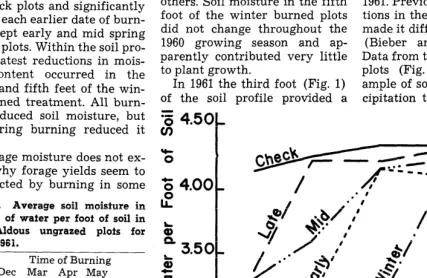
In 1961 the third foot (Fig. 1) of the soil profile provided a
% 4.50,
v,
%
‘5 4.00 -
ILO
k
a 3.50,
ii
E
s 3.00,
good insight into moisture dif- ferences which apparently were influenced by differential inf il- tration rates. In January only the check had had its soil mois- ture replenished, followed in February by the late burned plots. By March all except the winter burned plots had had their soil moisture restored in the third foot. The fifth foot of the winter burned treatment failed that entire season to de- velop the moisture reserve at- tained by the other plots. It is the failure to replenish moisture in the lower part of the soil pro- file that can influence plant- water relationships during dry seasons. Moisture storage at low- er depths greatly prolongs growth activities when upper soil moisture becomes depleted.
Soil Moisture Utilization. - A definite pattern of water re- moval from the soil developed in 1961. Previously extreme fluctua- tions in the first and second feet made it difficult to evaluate data (Bieber and Anderson, 1961). Data from the mid-spring burned plots (Fig. 2) serve as an ex- ample of soil moisture use. Pre- cipitation that summer was be-
1
LSD = 0.42
1
Jon.
Feb.
18
I5
MClr.
17
Apr.
17
MQY
9
24
k$----
9 24 June Jul 2772b August 9 24
Figure 2. Soil moisture removal. low average and much of it fell in light showers. Clark (1940) found that grasses were able to intercept as much as 50% of a 0.5-inch rain in a 30-minute period. Therefore, the effective- ness of small rains is reduced.
Moisture was removed more rapidly from near the surf ace than from deeper lev .els. As mois- ture near the surface became de- pleted, water from deeper levels was used more rapidly. In previ- ous years frequent rains would replenish moisture in the surface soil, and this moisture would then be removed quickly by growing plants (Bieber and An- derson, 1961).
That pattern of soil moisture use probably helps explain the lack of annual plants in excellent range. An annual plant would have to possess rapidly growing roots to remain in soil with al- ternately adequate and inade- quate moisture for growth in the upper profile.
Since plants take moisture from the upper soil profile first, a deficit in the lower soil horizon may be relatively unimportant in seasons of adequate, timely precipitation which keeps soil moisture replenished in the upper soil profile. Burning might
also have a limited influence in a dry growing season preceded by enough precipitation for soil moisture storage throughout the soil profile in all treatments.
Forage Production.-The long- term forage yield average through 1960 has been summarized by McMurphy and Anderson (1963) . Forage production in lb/acre of forage from these plots in 1960 was as follows: check, 3960; late- spring burned, 3449; mid-spring burned, 3536; early-spring burned, 2770; and winter burned, 2667. The unburned check pro- duced significantly more than early spring or winter burned plots. In 1961 no significant dif- ferences occurred in forage pro- duction, which ranged from a low of 2401 pounds from winter burned to a high of 3224 lb/acre from the late spring burned plots.
Forage production from the grazed pastures has followed the same general long-time trend, the unburned pasture producing the greatest, and the early-spring burned one the smallest yield.
Vegetation.-Persistence of the desirable forage species in the ungrazed Aldous plots after 30 burnings in 36 years bears testi- mony to the indestructability of prairie by fire; however, the botanical composition of the plots has been influenced by fire (Table 2). In the first few years
of the experiment little bluestem increased in the burned plots (Aldous, 1934)) but that trend has now disappeared. Big blue- stem has become the dominant species in the winter burned and late-spring burned treatments. Burning earlier than May 1 was detrimental to indiangrass, but prairie junegrass (Koeleria cris- tutu (L.) Beauv.) was favored by winter burning. Late spring burning appeared to reduce the forb population, and all burnings were detrimental to Kentucky bluegrass.
The grazed pastures showed the same general trend in botani- cal composition changes as the ungrazed plots except that the early-spring burned one has been reduced in range condition. Big bluestem, a very palatable grass, increased in the mid and late- spring burned pastures (Table 3). During the drought of the 1950’s density of the vegetation dropped to about one-third that of the predrought level. Even the number of big bluestem plants per line declined, but less than total vegetation. Therefore, the percentage of big bluestem in- creased near the end of the drought, and when good soil moisture returned, big bluestem quickly moved into unoccupied areas and increased in actual number as well as percentage.
Table 2. Botanical composiCon1 of the ungrazed
Of fofal plant populafion. 1957-1961 mean.
Aldous plofs in percentage
Time of Burning
Species ~_I_ Dee 1 Mar 20 Apr 10 May 1 Check
Big bluestem 45.4a 29.7b 26.5b 43.6a 13.8~
Little bluestem 12.3~ 30.0ab 38.4a 26.7b 34.7ab
Indiangrass 1.9d 3.6~ 8.lb 16.9a 17.3a
Prairie junegrass 8.6a 3.7b 1.2c 0.4d 0.5d
Grass Decreaserss 67.7~ 70.2bc 75.3b 87.la 68.5~
Sideoats grama 11.8a 8.8a 11.6a 6.9a 9.8a
Kentucky bluegrass 0.3b 0.3b O.lb 0.4b 6.4a
Grass Increasers2 19.0ab 14.oc 15.7bc 9.2d 19.7a
Perennial Grasses 87.8~ 84.4d 91.lb 96.4a 88.7bc
Sedges (Carex spp.) 7.0b 10.3a 6.0bc 1.3d 4.2~
Perennial forbs 4.4a 4.3a 2.5b 2.lb 4.2a
Annual grasses 0.8 1.0 0.4 0.2 2.9
IMeans for each species-followed by the same letter are not significantly different at the .05 level.
Table 3. Big bluesfeml percentage of fofal plant population, Ordinary Upland range site in grazed pas- tures.
Time of Burning
Mar Apr May
Year 20 10 1 Check
1950 26a 23a 21a 19a
1951 28a 22a 25a 18a
1952 24a 26a 25a 17a
1953 24a 24a 20a 17a
1954 23a 23a 23a 18a
1955 22ab 26ab 28a 17b
1956 32a 34a 32a 18b
1957 28a 26a 27a 18a
1958 25ab 29a 34a 16b
1959 34a 41a 42a 22b
1960 26ab 33a 34a 19b
1961 27ab 32a 36a 18b
IValues within a year followed by the same letter are not significantly different at the .05 level.
The unburned pasture has con- sistently had a greater percent- age of little bluestem than the burned pastures. This species was greatly reduced in the early burned pasture, and it appears that any burning may be detri- mental to little bluestem.
The dominant increaser in the early burned pasture was side- oats grama, while the unburned pasture contained Kentucky bluegrass plus some Japanese brome (Bromus japonicus
Thunb.) which reduced its range condition rating. Range condition was estimated on the basis of the percentage of original vegetation present as proposed by Dykster- huis (1949). This estimate was based on the botanical composi- tion as determined by the line transect data. Range condition of all pastures declined during the drought of the early 1950’s (Table 4)) but the mid- and late- spring burned pastures recovered rapidly after the drought while the one burned in early spring failed to do so.
Controlled burning was not de- structive to vegetation of the True Prairie as evidenced by data from the ungrazed Aldous plots. An attempt was made to
burn only when the soil surface was wet, thus minimizing dam- age to the living portion of the grass plants. There is ample evi- dence to show that accidental fires, which usually occur when the soil surface is dry, can be quite damaging to the vegetation (Hopkins et al., 1948; Launch- baugh, 1964). Fire may be a use- ful tool in range management to control the introduced weeds, Kentucky bluegrass and Japa- anese brome. It may also be use- ful in livestock distribution, since animals prefer to graze previously burned areas of the range. However, the implica- tions of reduced infiltration rates and probable reductions in for- age yield must not be ignored. It appears that to prevent overutili- zation, a lower stocking rate may be necessary following burning. Fire apparently favored big bluestem and leadplant (Amor-
pha canescens Pursh) , both valu-
able decreasers, but fire also fa- vored smooth sumac (Rhus
glabra L.), an undesirable
shrub. Buckbrush (Symphori-
carpos orbiculatus Moench) was
controlled by late spring burn- ing. There may be other unde- sirable species that would be favored by burning and become problems but which are not pres- ent in the experimental area.
Burning plus overgrazing probably reduces range condi- tion fast er than overgrazing without fire. Burning removes the protective mulch, and its re- moval increases water runoff and allows seedlings of invaders to become established more easily. An example was a large number of American elm (Ulmus
americana L.) seedlings in the
late burned pasture at the end of 1961. If adequate fuel is avail- able the fire will remove them. Smooth sumac and the other weedy species undoubtedly ben- efit from the reduced competi- tive ability that results from overgrazing the desirable spe- cies.
Table 4. Range condition estimates1 for Ordinary Upland range site in grazed pastures based on percen- tage of original vegetation present as determined by line transect data.
Time of Spring Burning
Mar Apr May
Year 20 10 1 Check
1950 74a 73a 76a 83a
1951 77a 76a 84a 80a
1952 68a 76a 84a 74a
1953 61a 71a 71a 71a
1954 54b 65ab 76a 71ab
1955 55b 76a 76a 70ab
1956 55b 72a 69ab 61ab
1957 54a 65a 61a 64a
1958 48c 66ab 77a 60bc
1959 6Oc 87ab 88a 70bc
1960 55b 83a 77a 71ab
1961 56b 83a 83a 70ab
1 Values within a year followed by the same letter are not significantly different at the .05 level.
Summary
Late spring burning (May l), which sometimes was just after growth commenced, was the least detrimental of the burnings tested. The problem could thus be narrowed to a comparison of late-spring burning and no burn- ing.
LITERATURE CITED ALDOUS, A. E. 1934. Effects of burn-
ing on Kansas bluestem pastures. Kans. Agr. Expt. Sta. Bull. 38. 65 p. ANDERSON, KLING L. 1942. A com-
parison of line transects and per- manent quadrats in evaluating composition and density of pasture vegetation on the tall prairie grass type. J. Amer. Sot. Agron. 34: 805- 822.
ANDERSON, KLINC L. AND C. L. FLY. 1955. Vegetation-soil relationships in Flint Hills bluestem pastures. J. Range Manage. 8: 163-169. BIEBER, G. L. AND KLING L. ANDERSON.
1961. Soil moisture in bluestem grassland following burning. J. Soil and Water Conserv. 16: 186- 187.
CLARK, 0. R. 1940. Interception of
rainfall by prairie grasses, weeds, and certain crop plants. Ecol. Monog. 10: 243-277.
DYKSTERHUIS, E. J. 1949. Condition and management of range land based on quantitative ecology. J. Range Manage. 2: 104-115.
ELWELL, H. M., H. A. DANIEL AND F. A. FENTON. 1941. The effects of burning pasture and woodland vegetation. Okla. Agr. Expt. Sta. Bull. 247. 14 p.
HANKS, R. J. AND KLING L. ANDERSON. 1957. Pasture burning and moisture conservation. J. Soil and Water Conserv. 12: 228-229.
HENSEL, R. L. 1923. Effect of burning on vegetation in Kansas pastures. J. Agr. Res. 23:641-647.
HERBEL, C. H. AND KLING L. ANDER- SON. 1959. Response of True Prairie vegetation on major Flint Hills
range sites to grazing treatment. Ecol. Monog. 29: 171-186.
HOPKINS, H., F. W. ALBERTSON AND A. RIEGEL. 1948. Some effects of burning upon a prairie in west central Kansas. Kans. Acad. Sci. Trans. 51: 131-141.
LAUNCHBAUGH, J. L. 1964. Effects of early spring burning_ on yields of native vegetation. J. Range Man- age. 17: 5-6.
MCMURPHY, W. E. AND KLING L. AN- DERSON. 1963. Burning bluestem range-Forage yields. Kans. Acad. Sci. Trans. 66: 49-51.
SMITH, E. F., K. L. ANDERSON, F. W. BOREN AND C. L. DRAKE. 1963. Dif- ferent methods of managing blue- stem pastures. Livestock Feeder’s Day Progress Report. Kans. Agr. Expt. Sta. Bull. 460:27-60.
Grazing Conditions in Kenya Masailand’
GEOFFREY M. 0. MALOIY and HAROLD F. HEADY Division of Animal Science, University of British Co- lumbia, Vancouver, B.C., and School of Forestry, Uni- versity of California, Berkeley, respectively.
Highlight
Brief descriptions of landscape, herding methods, forage values, live- stock numbers, efforts to control grazing, and livestock-game relation- ships are presented as background for a suggested range development program in this part of East Africa.
Before the coming of Europe- ans, the Masai with their herds of cattle, sheep, goats, and don- keys roamed the open grasslands from Lake Rudolf in the north to central Tanganyika. Today, Masai herdsmen occupy the southern region of Kenya and adjacent parts of Tanganyika. The Kenya part of Masailand to which this paper is restricted covers an area of 15,296 square miles (Fig. 1) . Tsetse flies, tick- born diseases, and barren condi- tions reduce the usable area to about 11,000 square miles.
Coffee, pyrethrum, beans, 1 Thanks are extended to Mr. R. W. Lewis, Assistant Director, Dept. Veterinary Services, Ngong, Kenya, for data on livestock numbers and to the Kenya Government Informa- tion Services which supplied the phbtograph.
maize, and sugarcane are grown on small areas at Loitokitok on the slopes of Mount Kilimanjaro, at Ngong near Nairobi, and at Syabei, north of Narok. Migrant herds of livestock and wild game prevail throughout the region and constitute the major re-
sources. The objectives of this paper are to describe the tradi- tional grazing practices, efforts to improve livestock and range, and to suggest a program for im- provement.
The Landscape. - Although rainfall records are scanty, pre- cipitation in Kenya Masailand probably averages between 10 and 40 inches per year (Table 1). The eastern side is the drier part with the major rainfall in two seasons, November-Decem- ber and March-May. The west- ern region is characterized by