Authenticated Encryption with Small Stretch
(or, How to Accelerate AERO)
⋆Kazuhiko Minematsu
NEC Corporation, Japan [email protected]
Abstract. Standard form of authenticated encryption (AE) requires the ciphertext to be expanded by the nonce and the authentication tag. These expansions can be problematic when messages are relatively short and communication cost is high. To overcome the problem we propose a new form of AE scheme,MiniAE, which expands the ciphertext only by the single variable integrating nonce and tag. An important feature ofMiniAEis that it requires the receiver to be stateful not only for detecting replays but also for detecting forgery of any type. McGrew and Foley already proposed a scheme having this feature, called AERO, however, there is no formal security guarantee based on the provable security framework.
We provide a provable security analysis forMiniAE, and show several provably-secure schemes using standard symmetric crypto primitives. This covers a generalization of AERO, hence our results imply a provable security of AERO. Moreover, one of our schemes has a similar structure as OCB mode of operation and enables rate-1 operation, i.e. only one blockcipher call to process one input block. This implies that the computation cost ofMiniAEcan be as small as encryption-only schemes. Keywords: Authenticated Encryption, Stateful Decryption, Provable Security, AERO, OCB
1
Introduction
Authenticated encryption (AE) is a symmetric-key cryptographic function for communication which provides both confidentiality and integrity of messages. A standard form of AE requires the ciphertext to be expanded by the amount of nonce, a never-repeating value maintained by the sender, and the authentication tag. This holds for popular schemes, such as CCM [2] and GCM [3]. The amount of expansion is small, say several dozen bytes. Nevertheless, it can be problematic when the messages are quite short. A typical example is wireless sensor network (WSN). For WSN, communication is much more energy-consuming than computation, and thus network packets are required to be very short. In fact, McGrew [4] provided examples of such real-life wireless protocols having maximum payload size ranging from 10 to 1K bytes. Struik [5] suggested that saving 8 bytes in communication may justify making encryption ten-times more expensive for WSN. Similar observation was given by Seys and Preneel [6]. Detailed energy cost evaluations for communication and cryptographic computation are given by [7,8].
As a solution to this problem, we proposeMiniAE, a class of AE having smaller stretch than normal AEs. Its ciphertext is only expanded by the amount of single variable integrating nonce and tag. When ciphertext ofMiniAEis stretched bysbits, it provides (about)s-bit authenticity and can securely encrypt at most 2smessages, while nonce-based AE (NAE) needs 2s-bit stretch for this purpose. A key difference from NAE is that MiniAErequires both sender and receiver to maintain a state (say counter), whereas NAE basically needs only the sender to be stateful. At first sight this might seem a big disadvantage, however, we remark that even NAE needs a stateful receiver when one wants to detect replays. In fact, replay detection via stateful receiver is employed by most of Internet protocols and wireless networks, such as Zigbee1and Bluetooth low energy (BLE)2. An important feature ofMiniAEis that a receiver’s state is
not only used to detect replays but to detect forgeries of any other types. McGrew and Foley [9,4] already showed a similar idea and proposed a scheme called AERO. It can be seen as an encryption following encode-then-encipher (ETE) approach by Bellare and Rogaway [10], using XCB mode of operation [11] as its internal large keyed permutation. The approach of AERO is intuitively sound, however [9,4] do not provide a formal security analysis. As a consequence, it is not clear if ETE is essential for achieving the
⋆
The proceeding version of this paper appears in ACISP 2016 [1]. This is the full version.
1
http://www.zigbee.org
2
goal, i.e. small stretch. This is undesirable since these schemes are likely to be used by resource-constrained devices.
We provide a formal model ofMiniAEand basic security notions, namely the confidentiality, integrity and replay protection, and show provably secure constructions. Our model is different from Bellare, Kohno and Namprempre [12], which proposes a security model with stateful decryption tailored to analyze (a generalization of) SSH Binary Packet Protocol. More specifically, we propose threeMiniAEschemes with concrete security proofs. The first scheme is based on ETE and can be seen as a simple generalization of AERO. This shows that AERO is indeed secure for our security notions. The second scheme, which we
call MiniCTR, is similar to a generic composition [13,14]. If it is instantiated by CTR mode encryption
and a polynomial hash function, the computation cost of MiniCTRis almost the same as GCM [3]. The third scheme tries to further improve the efficiency. It is calledMiniOCB for its structural similarity with OCB [15,16,17]. As well as OCB it is defined as a mode of tweakable blockcipher (TBC), and TBC can be instantiated by a blockcipher. It is parallelizable and rate-1, that is, it requires one blockcipher call for processing one plaintext block. The last two schemes show that ETE is not the exclusive approach to
MiniAE, and a secureMiniAEcan be as fast as nonce-based (unauthenticated) encryptions. We here stress
that, unlike most NAEs, all our schemes are not capable of on-line encryption, and thus not desirable to handle long messages.
We remark that our basic security notions in Section 3.2 are extensions of standard NAE security notions, hence do not consider misuse. According to [9] AERO is expected to have a certain misuse-resistance beyond NAE. To fill the gap, Section 5 provides a short security analysis involving extended security notions covering misuse, and show a separation between the proposed schemes if we require these extended notions in addition to the basic ones.
2
Preliminaries
Let {0,1}∗ denote the set of all binary sequences including the empty string, ε. For X ∈ {0,1}∗, we write |X| to denote the bit length of X, and let |X|n
def
= ⌈|X|/n⌉. For X, Y ∈ {0,1}∗ we write X∥Y to denote their concatenation. The first (last) i bits of X is denoted by msbi(X) (lsbi(X)). We have
msb0(X) =εand ε⊕X =εfor any X. For any s >0, a partition of X into s-bit blocks is written as
(X[1], . . . , X[x]) ←s X, where |X[i]| =s for i < x and |X[x]| ≤ s. For X = ε, we let X[1] ←s X with X[1] =ε. Moreover, for X and Y such that|X| ≤ n and |X|+|Y| ≥ n we write (X, Y)↼n (X, Y) to denote the parsing into X =X∥msbn−|X|(Y) and Y =lsb|Y|−(n−|X|)Y. The inverse parsing is written
as (X, Y) ↽m (X, Y), where |X| ≥ m and X = msbm(X), Y = lsb|X|−m(X∥Y). By writing X10∗ for 0≤ |X|< nwe mean a padding 10n−|X|−1 toX. We haveX10∗=X when|X|=n, andε10∗= 10n−1.
For a finite setX we writeX ← X$ to mean the uniform sampling ofX overX.
For keyed functionF:K × X → Ywith keyK∈ K, we may simply writeFK :X → Y if key space is obvious, or even write asF :X → Y if being keyed is obvious. IfEK :X → X is a keyed permutation, or a blockcipher, EK is a permutation overX for everyK∈ K. Its inverse is denoted byEK−1. A tweakable keyed permutation or TBC [18],EeK :T × X → X, is a family of keyed permutation overX indexed by tweakT ∈ T and its encryption is written asC =EeT
K(M) for plaintextM, tweak T and ciphertextC. The decryption is written asM =EeK−1,T(C). We considerX to be either a set of fixed length strings or variable length strings (though the original definition [18] assumes the fixed length). The latter is also called tweakable enciphering scheme (TES).
Random Functions. Let Func(n, m) be the set of all functions{0,1}n→ {0,1}m, and let Perm(n) be the set of all permutations over{0,1}n. A uniform random function (URF) havingn-bit input andm-bit output is a function family uniformly distributed over Func(n, m). It is denoted byR←$ Func(n, m). An n-bit uniform random permutation (URP), denoted by P, is similarly defined as P←$ Perm(n). We also define tweakable URP. LetT be a set of tweak and PermT(n) be the set of all functions such that for any f ∈PermT(n) andt∈ T,f(t,∗) is a permutation. A tweakable n-bit URP with tweakT ∈ T is defined as eP←$ PermT(n).
Pseudorandom Function.Forcoracles, O1, O2, . . . , Oc, we write AO1,O2,...,Oc to represent the
adver-saryAaccessing thesecoracles in an arbitrarily order. IfOandO′are oracles having the same input and output domains, we say they are compatible. LetFK :{0,1}n→ {0,1}mandGK′ :{0,1}n → {0,1}mbe
Abe an adversary trying distinguish them using queries. Then the advantage ofAis defined as
AdvcpaF
K,GK′(A) def
= Pr[AFK ⇒1]−Pr[AGK′ ⇒1],
AdvccaFK,G
K′(A) def
= Pr[AFK,FK−1⇒1]−Pr[AGK′,G− 1 K′ ⇒1],
where the latter is defined ifF andGare keyed permutation, and probabilities are defined over uniform samplings of keys and internal randomness ofA. IfFandGare tweakable, a tweak for a query is arbitrarily chosen by the adversary for both Advcpa and Advcca. For URF R compatible to F, let AdvprfF
K(A) def =
AdvcpaF
K,R(A). In a similar manner, let tweakable URPPe compatible to TBCEeK. Then we define
Advtprpe
EK
(A)def=Advcpae
EK,eP
(A), andAdvtsprpe
EK
(A)def=AdvccaEe
K,eP(A),
We further extends these notions to the functions (or permutations) having variable-input length (VIL). For example, if FK is a VIL keyed function : {0,1}∗ → {0,1}n we define AdvprfFK(A) as AdvcpaFK,R∗(A),
where R∗ is an URF compatible toFK which can be implemented by lazy sampling.
Time Complexity. If adversary A is with time complexity t, it means the total computation time and memory of A required for query generation and final decision, in some fixed model. If there is no description on time complexity of A, it means A has no computational restriction. Conventionally we sayFK is a pseudorandom function (PRF) ifAdvprfFK(A) is negligible for all practical adversaries (though the formal definition requires FK to be a function family). Similarly we say FK is a pseudorandom permutation (PRP) ifAdvprpFK(A) is negligible andFK is invertible. Strong PRP (SPRP), tweakable PRP (TPRP) and tweakable SPRP (TSPRP) are defined in a similar manner.
Universal Hash Function.LetH :K × X → {0,1}n be a keyed function, where keyKis uniform over
K andX ⊆ {0,1}∗. We sayHK isϵ(x)-almost XOR universal (AXU) if
max
c∈{0,1}nPrK[HK(X)⊕HK(X
′) =c]≤ϵ(x) (1)
holds for any distinctX, X′ ∈ X with max{|X|n,|X′|n} =xand for some ϵ(∗). If input is divided into two parts, e.g.X = (X1, X2),|X|n means|X1|n+|X2|n.
Building TBC. All our constructions will use TBC. It can be built from scratch [19,20,21] or from a blockcipher. Suppose we want a TBC of n-bit block and tweak space (which is assumed to be a set of binary strings) T. From the result of [18], using an n-bit blockcipher EK and an independently-keyed ϵ(x)-AXU hash function,HK′ :T → {0,1}n, we can build TBC as
e
EK,KT ′(M) =EK(S⊕M)⊕S, where S=HK′(T) (2)
for encryption of plaintext M and tweak T. This has a TSPRP-advantage of O(ϵ(ℓ)·q2) plus a CCA-advantage ofEK, for any adversary withqCCA queries using tweak of maximum block lengthℓ. Typically we can use a polynomial hash function defined over GF(2n) as a universal hash fulfilling (1) withϵ(x) = x/2n. Alternatively we can use PRF as a computational counterpart, say CMAC. In some cases the use of two keys in (2) can be reduced to one [16,22].
3
Definition of
MiniAE
3.1 Basic Model
(A′, L′, C′), the stateful decryption function first computes the decrypted nonceN′∈ Naeusing the key, and outputs the decrypted plaintextM′ ifN′ is considered as valid, otherwise the default error symbol,
⊥. The validity of N′ is determined by comparison with the receiver state. Here stateful decryption is essential to detect replays, and we assume the receiver state is uniquely determined by the nonce in the previous successful decryption (thus a state is an element of Nae), which is typical in many replay protection schemes including AERO [9]3. More generally, the receiver has a set of expected nonce values for each decryption. The set is defined as a function of the receiver state, and we write the function as ρ: Nae → 2Nae, where 2Nae is the power set of Nae. The function ρ is public, and when N′ is the value obtained by the decryption andNb is the last nonce accepted as valid,N′ is determined as valid iff N′∈ρ(Nb) holds true. In this paper we assume|ρ(N)| ≤ωholds for anyN, whereωis calledverification range size. Let us writei-th nonce used at encryption asNi(e.g.N2=µ(N1)). Naturally we require that
Ni+1(=µ(Ni))∈ρ(Ni) for anyito accept the genuine ciphertext, andNj̸∈ρ(Ni) for anyj≤ito reject replays without fail. In practiceρdetermines the resilience against packet loss. If the synchronization is perfect between the sender and receiver, the simplest setting as ρ(N) = µ(N) with ω = 1 works fine. However we often need to include{Nj}for somej > i+ 1 forρ(Ni) when packets can lost in the channel. In this caseρ(N) ={µ(N), µ(µ(N)), ...}to tolerate the loss of consecutiveω−1 packets. This will increase a chance of success at forgery, roughly by a factor of ω.
Nonce Shorter than Block.As all of our constructions are defined overn-bit blocks for somen(say 128), we require ν ≤n, and |N|+|M| ≥nholds, which means if ν < nwe have a nonzero limit on the minimum plaintext length, or, in practice we may pad as [9]. Throughout the paper, we may implicitly use (N , M) to denote the result of parsing (N , M) ↼n (N, M), provided N and M are clear from the context. Similarly we may use (L, C) to denote the result of parsing (L, C)↼n (L, C). We remark that whenν =n, we haveN =N,M =M andL=L,C=C.
3.2 Security Notions
Following NAE security notions, we introduce two security notions, namely privacy and authenticity, to model the security of MiniAE. Here privacy notion reflects the pseudorandomness of ciphertexts, and authenticity notion reflects the hardness of forgery even if the receiver state are chosen by the adversary. We think this form of authenticity will be beneficial for its simplicity, strong assurance, and independence of the details of state management4. LetMiAEbe anMiniAEwithν-bit nonce (with some keyK← K$ ). The encryption and decryption algorithms areMiAE-E andMiAE-D. Following Section 3.1,MiAE-E takes (N, A, M) and returns (L, C) with |M| = |C| and |N| =|L| =ν. MiAE-D takes (N , Ab ′, L′, C′) with|Nb|=|L′|=ν, whereNb is a receiver state (i.e. a decrypted nonce) guessed by adversary. In practice
b
N is not sent over the communication channel.MiAE-Dthen computes the decrypted nonce, N′, and see ifN′∈ρ(Nb). If true it returns a decrypted message M′∈ Mae and otherwise⊥. Thus we have
(L, C)←MiAE-E(N, A, M)
M′/⊥ ←MiAE-D(N , Ab ′, L′, C′).
Privacy notion. Let A be a Priv-adversary who accesses MiAE-E using q encryption queries with distinct nonces (i.e. nonce-respecting). Here we assume nonces are not necessarily updated5 byµ, in the
same manner to [23]. The privacy notion for Priv-adversary Ais defined as
AdvprivMiAE(A)def= Pr[AMiAE-E ⇒1]−Pr[A$⇒1], (3)
where random-bit oracle, $, takes (N, A, M) and returns (L, C)← {$ 0,1}ν× {0,1}|M|.
Authenticity notion. Let A be an Auth-adversary against MiAE. We write q encryption queries as (N1, A1, M1), . . . ,(Nq, Aq, Mq), and q′ decryption queries as (Nb1, A′1, L′1, C1′), . . . ,(Nbq′, A′q′, L′q′, Cq′′). We may say verification queries instead of decryption queries. We also let (L1, C1), . . . ,(Lq, Cq) be the corresponding oracle answers for encryption queries. We assumeAfollows the two conditions.
3 Decryption of [9] also maintains the most recent invalid nonce, in order to do resynchronization. 4
In this sense our notions are similar to Rogaway’s nonce-based encryption [23] as it allows a provable security analysis without taking into account the details of nonce generation.
5
Condition 1: Adversary is nonce-respecting for encryption queries (i.e.Ni̸=Nj for anyi̸=j)
Condition 2: For alli= 1, . . . , q′, (A′i, L′i, Ci′)̸= (Aj, Lj, Cj) holds for allj-th encryption queries before thei-th decryption query.
As well as the privacy notion, nonces in the encryption queries are not necessarily generated byµ. The second condition excludes the adversary’s trivial win including a replay, that is, a decryption query (N , Ab ′, L′, C′) with (A′, L′, C′) = (A, L, C) withN∈ρ(Nb) for some previous encryption query (N, A, M) and response (L, C). This is because a replay is always detected at the decryption side in actual use
of any MiniAE scheme following Section 3.1. We also excluded the caseN ̸∈ρ(Nb), as it will be always
rejected (thus trivial loss). The authenticity notion is defined as
AdvauthMiAE(A)
def
= Pr[AMiAE-E,MiAE-D forges ], (4)
where Aforges ifMiAE-Dreturns output other than⊥for a decryption query.
For both privacy and authenticity notions, we write the total input blocks, denoted byσ, to mean
∑
i|Ni|n+|Ai|n+|Mi|n for the privacy notion, and
∑
i|Ni|n+|Ai|n+|Mi|n +
∑
j|L′j|n+|A′j|n+|Cj′|n for the authenticity notion.
MiniAE as a large tweakable random permutation.SinceMiAEis a tweakable keyed permutation
in general (where tweak is used for AD), we write AdvtprpMiAE(A) and AdvtsprpMiAE(A) to denote TPRP and TSPRP advantages of the underlying tweakable keyed permutationEe. Note thatEe is not always required to be strong with respect to these notions. In fact our results show that it can be much weaker.
IV-based Encryption. We also define IV-based encryption scheme: ΠK : I × M → M which is a permutation overM determined byK∈ K and fixed-length initialization-vector (IV)I∈ I. Here IV is sampled uniformly random for every encryption. Let ΠK oracle as the encryption oracle take M ∈ M and return (I, C), where I ← I$ and C →ΠK(I, M). We remark that the adversary is not allowed to see I before querying M. We define the PRIV$ advantage as the indistinguishability of ΠK from the random-bit oracle ($), which returns|I|+|M|-bit random sequence, i.e.,
Advpriv$ΠK (A)def= Pr[AΠK ⇒1]−Pr[A$⇒1]. (5)
We say the total input block of Ato mean the total number of plaintext blocks.
3.3 Remarks
Comparison with NAE security notions. Our security notions are quite similar to NAE security notions, e.g. [13,24]. For privacy notion, both NAE and MiniAE require that the outputs of encryption oracle are pseudorandom. For authenticity notion, both NAE and MiniAErequire that a forgery is hard for nonce-respecting adversary. The standard authenticity notion for NAE considers stateless receiver, however if a certain NAE scheme is secure with respect to the standard authenticity notion, then it certainly detects replays if receiver is stateful and nonce is dealt withµandρas described at Section 3.1. We remark that, when the receiver loses state NAE still can detect forgeries other than replays, while
MiniAEcan not: only unverified decryption is possible.
Comparison with alternative solutions.If sender and receiver are completely synchronized, we can use NAE and simply omit the nonce to be sent to save bandwidth (also called implicit sequence num-ber [4]). However this is problematic when packets may lost. A mitigation is to send a partial information. This technique is employed by some popular protocols as [4] shows. Therefore it basically works for some settings, however it makes the messaging format dependent on the number of tolerable packet lost, which depends on the network condition and application and sometimes hard to determine in practice. Moreover, once the receiver loses the state, even the unverified decryption becomes impossible. In contrast,MiniAE
allows ad-hoc mechanisms to handle packet lost without changing the message format, and unverified decryption without state, and allows efficient built-in resynchronization as shown by AERO.
Another solution to suppress expansion is Deterministic AE (DAE) proposed by Rogaway and Shrimp-ton [25]. In DAE there is no nonce and for plaintextM the encryption output is (C, T) where|C|=|M| and T is the authentication tag of fixed length6. Since DAE encryption is deterministic, the standard privacy notion is impossible to achieve. DAE can prevent replay if the receiver keeps (hash values of)
6
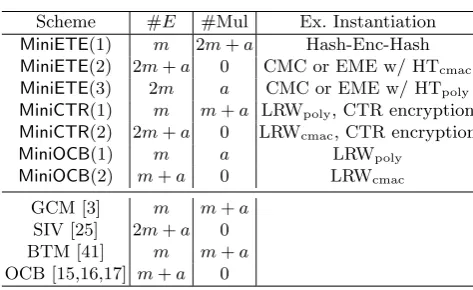
all received ciphertexts, or using Bloom filter allowing some false negatives. Either option requires much larger memories or computations than the verification ofMiniAE. Table 1 summarizes encryption schemes in the presence of stateful receiver for replay protection.
Table 1.Comparison of Encryption Schemes.
Scheme Expansion Privacy Authenticity Replay Protect Dec w/o state
nonce-based Enc |N| ✓ - ✓ ✓
NAE |N|+|T| ✓ ✓ ✓ ✓
DAE |T| - ✓ difficult ✓
NAE+Nonce omit |T| ✓ ✓ ✓
-MiniAE |N| ✓ ✓ ✓ ✓
3.4 Applications to Low-power Wireless Sensor Network
To suppress communication overhead, link-layer security protocols for low-power WSN often employed NAE having a short nonce and short tag (see [26] for a good survey). We here present some examples.
– Zigbee for IEEE 802.15.4 uses AES-CCM. Typically a nonce is a concatenation of 4-byte frame counter (FC), 8-byte source address (SA) and 1-byte security control (SC), total 13 bytes, and tag has 4 bytes [27].
– BLE also uses AES-CCM with 13-byte nonce consisting of 39-bit counter, 1-bit direction indicator, and two 32-bit device IDs for sender and receiver devices. The tag is 4 bytes.
– Lightweight link-layer security protocols such as [28,29,30,31] use AEs with 2-byte counter and several other information to form nonce and has 4-byte tag.
For all of the above cases nonceN consists of a counterctr and supplemental informationsup. Here
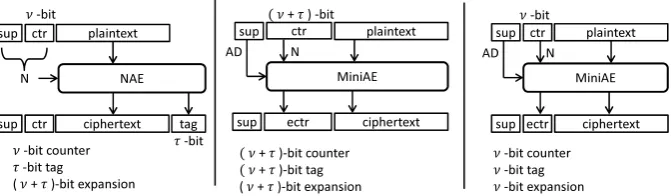
sup should not be encrypted and possibly repeated, hence it is rather attributed as AD. Suppose we have an NAE with |ctr| = ν, |sup| = a, and tag length |tag| = τ. This expands the ciphertext by ν+τ bits (Baseline, left of Fig. 1), excluding AD. Then there are two application scenarios of MiniAE. First, if bothν-bit counter andτ-bit tag are considered too short, MiniAEhaving (ν+τ)-bit nonce will enlarge the counter and tag spaces, keeping the same expansion (Scenario 1, middle of Fig. 1). Heresup
is moved to AD. If ν-bit counter is sufficiently long and τ ≤ ν, MiniAE with ν-bit nonce will remove the expansion caused by tag, without harming the authenticity strength (Scenario 2, right of Fig. 1). For example, keeping Zigbee’s communication overhead,MiniAEof scenario 1 realizes 64-bit counter and 64-bit authenticity, and for BLE, MiniAE of scenario 2 reduces the 4-byte expansion from each packet keeping the use of 39-bit counter. For the security protocols of [28,29,30,31]MiniAEof scenario 1 allows 48-bit counter and 48-bit authenticity. We finally remark that [9] suggests to use AERO for reducing the overhead of Internet protocols : for IPsec, using a standard such as ESP AES-GCM would cause more than 24-byte expansion, while AERO can reduce it to 12-byte. A secure MiniAEscheme has the same effect.
4
Building
MiniAE
In this section we provide constructions of MiniAE. Throughout the section all schemes are assumed to have nonce of ν bits and verification range size ω. We assume ν and ω are fixed parameters, and also assumeν≤nfor some fixed block lengthn, and plaintextM used in a scheme satisfies|M| ≥ν−n.
4.1 MiniAE from large tweakable blockcipher
We start with a naive solution based on ETE approach mentioned earlier. We call the scheme MiniETE. More specifically, let Ee :T × M → M be a TBC, whereM=∪i≥n{0,1}i. The encryption ofMiniETE
sup plaintext
tag NAE
ciphertext ctr
sup ctr
sup plaintext
MiniAE
ciphertext ctr
sup ectr AD N sup plaintext
MiniAE
ciphertext ctr
sup ectr
AD N
N
-bit counter
-bit tag
( + )-bit expansion
( + )-bit counter
( + )-bit tag
( + )-bit expansion
-bit
-bit
( + ) -bit
-bit counter
-bit tag -bit expansion
-bit
Fig. 1. (Left) Baseline, a nonce-based AE in WSN whose counter and tag may be short. (Middle) Scenario 1,MiniAE with a longer counter enables larger counter space and stronger authenticity while keeping the same overhead. (Right) Scenario 2,MiniAEhas the same counter as Baseline, but reduces the overhead without harming the authenticity if counter is not shorter than tag.
Proposition 1. LetMiniETE[Ee]beMiniETEusingEe. IfAis a Priv-adversary withqencryption queries andσ total input blocks and time complexityt, we have
Advpriv
MiniETE[Ee](A)≤Adv tprp
e
E (B) +
q2
2n+1,
where Buses qencryption queries with σtotal input blocks and time complexity t′ =t+O(σ).
Proposition 2. Let A be an Auth-adversary withq encryption and q′ decryption queries, σtotal input blocks and time complexityt. We assume(q+q′)<2ν−1. Then we have
Advauth
MiniETE[Ee](A)≤Adv tsprp
e
E (B) +
2(q+q′)(ω+q′)
2ν ,
whereBusesqencryption queries andq′ decryption queries withσtotal input blocks and time complexity t′=t+O(σ).
For instantiations ofEe, we could use known schemes [32,33,34,35] as internal wide-block TBC. As men-tioned, this scheme is in fact a generalization of AERO which uses XCB [11] with AES-128. That is, AERO is provably secure in our security model, although there are minor differences and additional features7.
MiniETEalso has some similarities with ETE-based AE schemes, such as AEZ [36] and PIV [35].
4.2 MiniAE from encrypted counter
MiniETEis conceptually simple, however actual computation cost is rather high. A popular approach to
e
E shown by the seminal paper by Naor and Reingold [37] uses two universal hashing layers with one encryption layer, called Hash-Enc-Hash [32,38,39]. EME and CMC [33,34] do not use universal hash but require two blockcipher calls for each n-bit input block.
To improve the efficiency, we present a two-pass scheme which we call MiniCTR. The name comes from that it consists of encryption of nonce and an additive encryption. Specifically, MiniCTR uses an n-bit block, variable-length tweak TBC EeK :T × {0,1}n→ {0,1}n and a keyed function ofn-bit input and variable-length output, FK′ :{0,1}n → {0,1}∗. Here we assumeT is sufficiently large to encode a pair (A, M). Two keys,KandK′, are assumed to be independent. The algorithms ofMiniCTRare shown in Fig. 2 and the encryption is also shown in Fig. 3. We writeΠ[FK′] to denote the underlying additive encryption, where Lis used as n-bit IV. In Theorems 1 and 2 below, we prove the security ofMiniCTR
whenEe is TSPRP-secure and Π[FK′] is PRIV$-secure.
AlgorithmMiniCTR-EE,Fe (N, A, M)
1. (N , M)↼n (N, M) 2. L←Ee(A,M)(N)
3. C←F(L)⊕M
4. (L, C)↽ν (L, C) 5. return(L, C)
AlgorithmMiniCTR-DE,Fe (N , Ab ′, L′, C′)
1. (L′, C′)↼n (L′, C′) 2. M′←F(L′)⊕C′
3. N′←Ee−1(A′,M′)(L′)
4. if msbν(N′)∈ρ(Nb) then
5. (N′, M′)↽ν (N′, M′) 6. returnM′
7. else return⊥
Fig. 2.Encryption and decryption algorithms ofMiniCTR[E, Fe ]
Fig. 3.The encryption algorithm ofMiniCTR[E, Fe ], except the pre- and post-parsings.
Security.LetMiniCTR[E, Fe ] beMiniCTRusing TBCEeKandFK′. The security bounds forMiniCTR[E, Fe ] are presented in the following theorems.
Theorem 1. If Ais a Priv-adversary withq encryption queries andσtotal input blocks and time com-plexity t, we have
Advpriv
MiniCTR[E,Fe ](A)≤Adv tprp
e
E (B) +Adv
priv$
Π[F](C) +
q2 2n+1.
whereB usesq queries with total input blocksσand time complexityt′=t+O(σ), andC uses qqueries andσ total input blocks with time complexityt′=t+O(σ).
Theorem 2. Let Abe an Auth-adversary withqencryption queries,q′ decryption queries,σtotal input blocks, and time complexity t. We assume (q+q′)<2ν−1. Then we have
AdvauthMiniCTR[E,Fe ](A)≤Advtsprpe
E (B) +
2(q+q′)(ω+q′)
2ν ,
where Buses qencryption queries andq′ decryption queries, having time complexityt′=t+O(σ).
We remark that the authenticity does not require any security property ofF here: the reason is simple, since the authenticity of N is guaranteed even when adversary can access the key of F. The proofs of Theorems 1 and 2 are presented in Appendix A.
Instantiation.Typically,Ee is instantiated byn-bit blockcipher andn-bit polynomial hash with (2) and F is instantiated by CTR mode, e.g.C=Π[FK′](L, M) withC[i] =EK′(N ⊕i)⊕M[i] for i= 1,2, . . . using blockcipher EK′. In this case, the computation cost of MiniCTR for each n-bit plaintext block is one GF(2n) multiplication and one blockcipher call, which is roughly the same as GCM. Combined with [18,22] and standard security result for CTR mode, e.g. [43], we can prove the birthday-type bounds
of MiniCTR comparable to those of GCM [44] both for privacy and authenticity8. For GCM, 12-byte
nonce and 16-byte tag is a popular setting, and MiniCTR with 16-byte nonce will reduce the ciphertext expansion from 28 to 16 bytes keeping a comparable level of security.
7
For instance AERO’s nonce is a sequence number, and appended to the plaintext. Moreover the receiver additionally keeps the most recent sequence number value which was rejected, in order to do resynchronization.
8
AlgorithmMiniOCB-EEe(N, A, M)
1. (N , M)↼n (N, M)
2. (M[1], M[2], . . . , M[m])←n M
3. Σ←M[1]⊕. . .⊕M[m−1]⊕M[m]10∗ 4. if |M[m]|=nthen d←0
5. else d←1
6. L←Ee(Σ,A,m,d)(N) 7. for i= 1to m−1do 8. C[i]←Ee(L,A,i,2)(M[i]) 9. pad←msb|M[m]|(Ee(L,A,m,2)(0n)) 10. C[m]←M[m]⊕pad
11. C←(C[1], . . . , C[m]) 12. (L, C)↽ν (L, C) 13. return(L, C)
AlgorithmMiniOCB-DEe(N , Ab ′, L′, C′)
1. (L′, C′)↼n (L′, C′) 2. (C′[1], . . . , C′[m′])←n C′
3. if |C′[m′]|=n then d′←0 4. else d′←1
5. for i= 1 tom′−1do 6. M′[i]←Ee−1(L′,A′,i,2)(C′[i]) 7. pad′←msb|C′[m′]|(Ee(L
′,A′,m′,2)
(0n))
8. M′[m′]←C′[m′]⊕pad′
9. Σ′←M′[1]⊕. . .⊕M′[m′−1]⊕M′[m′]10∗ 10. N′←Ee−1(Σ′,A′,m′,d′)(L′)
11. if msbν(N′)∈ρ(Nb) then
12. M′←(M′[1], . . . , M′[m]) 13. (N′, M′)↽ν (N′, M′) 14. returnM′
15. else return⊥
Fig. 4.Encryption and decryption algorithms ofMiniOCB[Ee].
4.3 MiniAE from OCB mode
The computation cost of MiniCTR is similar to the generic composition of NAE, and thus there is still a significant difference from the nonce-based unauthenticated encryption. A natural question here is if we can further reduce the computation cost. We positively answer this question by showing a scheme achieving rate-1 operation, i.e. one blockcipher call per one input block. We call our proposal MiniOCB
since the design is based on OCB [15,16,17].MiniOCBis parallelizable for both encryption and decryption.
MiniOCB usesn-bit TBC, Ee, having variable-length tweak in T ={0,1}n× Aae×N× {0,1,2} where N={1,2, . . .}. The encryption and decryption algorithms of MiniOCBare shown in Figs. 4 and Fig. 5. It needs one TBC call to process one input block, and if TBC is instantiated by a blockcipher it is still rate-1 with respect to the underlying blockcipher (see below).
Design. While MiniOCB is based on OCB, it has an important difference. OCB uses a TBC (which is instantiated by XEX mode [16]) that takes a tweak involving the nonce, whereas MiniOCB can not explicitly use the nonce as a part of a tweak. This is because the nonce can not be present clear in a ciphertext and the decryption should be done so that any small change to a ciphertext will make the decrypted nonce random. Instead we use encrypted nonce L to be a part of tweaks for plaintext encryption, and Lis derived from an encryption of nonce with tweak involving the plaintext checksum, i.e., XOR of plaintext blocks, in the similar manner to OCB. A tweak ofMiniOCBalso containsd= 0,1,2 which is used to separate the roles of TBC calls. We remark that ν ≤n is required, as well as previous schemes.
Fig. 5.The encryption algorithm of MiniOCB[Ee].Σ denotes the plaintext checksum, anddfor encryption ofN
is 0 when|M[m]|=nand 1 otherwise.
Theorem 3. Let Ee be a TBC with n-bit block with tweak space T = {0,1}n × A
ae×N× {0,1,2}, and let MiniOCB[Ee] be MiniOCB using Ee with ν-bit nonce and verification range sizeω. Then, for any Priv-adversary A with q < 2n−1 encryption queries and σ total input blocks and time complexity t, we
have
Advpriv
MiniOCB[Ee](A)≤Adv tprp
e
E (B) + q2 2n,
for an adversary Busingσ encryption queries with t+O(σ)time.
Theorem 4. For any Auth-adversaryAwithq <2n−1encryption queries withσinput blocks, and single decryption query withσ′ input blocks, and time complexityt, we have
AdvauthMiniOCB[Ee](A)≤Advtsprpe
E (B) + 2.5q2
2n + 2ω 2ν,
for an adversary Busingσ encryption queries andσ′ decryption queries witht+O(σ+σ′)time.
The proofs of these theorems are presented in Appendix B.
A blockcipher-based instantiation ofEe used in MiniOCB can use the construction of (2). One may wonder if every tweak update of Ee in MiniOCB requires computation proportional to |A|, since A is a part of tweak. However this is not true for most universal hash functions and PRFs, as we can cache the intermediate result depending only on A (e.g. CMAC). Tweak update with respect to third and fourth coordinates can be done without needing additional blockcipher calls (say) by using GF doubling technique [16]. Therefore once we processA, the cost of tweak update is quite small. In Appendix C we provide a brief complexity analysis of our proposals with existing schemes.
5
Misuse resistance
Our security notions do not consider resistance against misuse, while it is an active topic in recent studies. We here consider nonce-misuse and decryption-misuse, as most common concepts thus far. The former was introduced by Rogaway and Shrimpton [25] which refers to the use of repeated nonce in encryption. The latter, a.k.a releasing unverified plaintext (RUP) introduced by Andreeva et. al. [45], refers to the setting that decryption oracle returns unverified plaintext in addition to the result of authentication, which is possible when decryption side has small memory while messages are long. In this section, we provide an analysis of proposed schemes from the viewpoint of misuse. We remark that AERO [9] claims security against these misuses but does not present a formal proof for them. Before we proceed, we point out that there should be a treading-off between strength of security notion and achievable efficiency. We should also think about inherent problem caused by nonce-misuse, i.e. false positive at replay detection even though the corresponding plaintexts are different. In addition, the possibility of decryption-misuse is small when messages are short (except implementation errors) and low-power WSN sometimes consists of unidirectional link from low-end sensors to (a much more powerful) aggregation server.
For our analysis we consider the following three misuse-related security notions and show a security separation between the proposed schemes according to the proposed notions. Though these notions are quite close to what have been discussed for standard nonce-based AE, they need to be explicitly defined due to the difference in the model (i.e. the stateful receiver). In this sense our notions are not new and variants can be considered.
Nonce-misuse. The first is nonce-misuse privacy (NM-Priv) written as Advnm-privMiAE(A). It is essentially the same asAdvprivMiAE(A), however,Ahas no restriction onN in queries and is only required to make each query (N, A, M) distinct. It is similar to deterministic privacy (detPriv) defined for DAE privacy [25].
Indistinguishability from large random permutation. The second is indistinguishability from tweakable random permutation, or TSPRP-security described at the end of Section 3.2. This notion is related to the decryption-misuse since the adversary can obtain the unverified plaintext, and also simi-lar to the plaintext awareness 2 (PA2) [45], however a stronger one in the sense thatAcan repeat nonce, and unverifiedtag is also given in the decryption query.
two oracles, that is, we define three oracles,
(L, C)←MiAE-E(N, A, M)
M′←MiAE-De(N , Ab ′, L′, C′)
⊤/⊥ ←MiAE-V(N , Ab ′, L′, C′),
where the combination of MiAE-De and MiAE-V is the ordinary decryption oracle. Here ⊤ denotes the acceptance of ciphertext. We note that De and V are always uniquely determined for any MiAE, i.e., MiAE-De returns the result of underlying inverse permutation except the first ν bits corresponding decrypted nonce. We define
Advnmdm-authMiAE (A)def= Pr[AMiAE-E,MiAE-De,MiAE-V forges ], (6)
where A forges means that A receives ⊤ from MiAE-V. Here A is required to satisfy (Condition 2) of Authenticity notion for MiAE-V, that is, A never queries (N , Ab ′, L′, C′) to MiAE-V such that (A′, L′, C′) = (A, L, C) andN ∈ρ(Nb) ifAalready queried (N, A, M) toMiAE-E and received (L, C). Note that Ahas no limitation on queries toMiAE-De, and(Condition 1)is not required.
Proposition 3. TSPRP-security implies NM-Priv and NMDM-Auth. More concretely we have
Advnm-privMiAE(A)≤AdvtprpMiAE(A) + q
2
2n+1.
Advnmdm-authMiAE (A)≤AdvtsprpMiAE(A) +2(q+q
′)(ω+q′)
2n .
for anyMiAEand any adversaryAusingqencryption for the first bound, and in additionq′ decryption queries toMiAE-De for the second bound.
The first claim is trivial. For the second claim we have
Advnmdm-authMiAE (A)≤Advnmdm-authe
P (A) +Adv
tsprp MiAE(A′)
where Pe is tweakable URP over (N, M) with tweakA. The first term of right hand side is bounded by
2(q+q′)(ω+q′)
2n with a similar analysis as the proof of Theorem 2. With Proposition 3, we show the following security separation results about our schemes.
Theorem 5. Assuming components ofMiniETE, andMiniCTR andMiniOCBare ideal, we have
1. MiniETEis TSPRP-secure, thus it is also secure with respect to NM-Priv and NMDM-Auth.
2. MiniCTRandMiniOCB are not TSPRP-secure.
3. MiniCTRis secure w.r.t. NM-Priv and NMDM-Auth, andMiniOCBare not secure w.r.t. both notions.
Proof. (sketch.) The first claim is trivial from Proposition 3. For the second claim, an adversary first performs encryption query to obtain (N, A, M, L, C) and then decryption query (N , Ab ′, L′, C′) withA′= A,L′ =L, C′ =C⊕δ for some differentialδ. For the third,MiniCTR’s NM-Priv proof is just the same as the proof of Theorem 1, from the fact that L is pseudorandom whenever (N, A, M) is distinct. For proving NMDM-Auth we extend the proof of Theorem 2 such that Cond1 in the proof can be relaxed to (Ni, Ai, Mi) ̸= (Nj, Aj, Mj) without changing the following analysis. Decryption-misuse has already been incorporated in the proof.
6
Conclusion
In this paper, we have presented a new form of authenticated encryption scheme, called MiniAE, whose ciphertext expansion is the same as the length of single variable integrating nonce and tag, with the help of stateful decryption. While McGrew and Foley’s AERO has the same feature, there is no formal treatment on the provable security. Focusing on the most fundamental security properties, i.e., pseudorandomness of ciphertexts under unique nonce, and a basic form of integrity protection including replay detection, we proposed three constructions of MiniAE, called MiniETE, MiniCTR and MiniOCB, where MiniETE is a generalization of AERO. Notably MiniOCB is based on OCB mode of operation and achieves rate-1 parallelizable encryption. This implies that MiniAE can be as efficient as nonce-based unauthenticated encryption.
Acknowledgements
The author would like to thank the anonymous reviewers of ACISP 2016 for useful comments, and Tetsu Iwata for fruitful discussions.
References
1. Minematsu, K.: Authenticated Encryption with Small Stretch (or, How to Accelerate AERO). In: ACISP (2). Volume 9723 of Lecture Notes in Computer Science., Springer (2016) 347–362
2. Dworkin, M.: Recommendation for Block Cipher Modes of Operation: The CCM Mode for Authentication and Confidentiality . NIST Special Publication 800-38C (2004)
3. Dworkin, M.: Recommendation for Block Cipher Modes of Operation: Galois/Counter Mode (GCM) and GMAC. NIST Special Publication 800-38D (2007)
4. McGrew, D.: Low power wireless scenarios and techniques for saving bandwidth without sacrificing security. NIST Lightweight Cryptography Workshop 2015 (2015)
5. Struik, R.: Revisiting design criteria for AEAD ciphers targeting highly constrained networks. DIAC: Direc-tions in Authenticated Ciphers (2013)http://2013.diac.cr.yp.to/.
6. Seys, S., Preneel, B.: Power consumption evaluation of efficient digital signature schemes for low power devices. In: WiMob (1), IEEE (2005) 79–86
7. Singel´ee, D., Seys, S., Batina, L., Verbauwhede, I.: The communication and computation cost of wireless security: extended abstract. In: WISEC, ACM (2011) 1–4
8. de Meulenaer, G., Gosset, F., Standaert, F., Pereira, O.: On the Energy Cost of Communication and Cryp-tography in Wireless Sensor Networks. In: WiMob, IEEE Computer Society (2008) 580–585
9. McGrew, D., Foley, J.: Authenticated Encryption with Replay prOtection (AERO). Internet-Draft (2013) 10. Bellare, M., Rogaway, P.: Encode-Then-Encipher Encryption: How to Exploit Nonces or Redundancy in
Plaintexts for Efficient Cryptography. In: ASIACRYPT. Volume 1976 of Lecture Notes in Computer Science., Springer (2000) 317–330
11. McGrew, D.A., Fluhrer, S.R.: The Security of the Extended Codebook (XCB) Mode of Operation. In: Selected Areas in Cryptography. Volume 4876 of Lecture Notes in Computer Science., Springer (2007) 311–327 12. Bellare, M., Kohno, T., Namprempre, C.: Breaking and provably repairing the SSH authenticated encryption
scheme: A case study of the Encode-then-Encrypt-and-MAC paradigm. ACM Trans. Inf. Syst. Secur. 7(2) (2004) 206–241
13. Bellare, M., Namprempre, C.: Authenticated Encryption: Relations among Notions and Analysis of the Generic Composition Paradigm. In: ASIACRYPT. Volume 1976 of Lecture Notes in Computer Science., Springer (2000) 531–545
14. Bellare, M., Namprempre, C.: Authenticated Encryption: Relations among Notions and Analysis of the Generic Composition Paradigm. J. Cryptology21(4) (2008) 469–491
15. Rogaway, P., Bellare, M., Black, J.: OCB: A block-cipher mode of operation for efficient authenticated encryption. ACM Trans. Inf. Syst. Secur.6(3) (2003) 365–403
16. Rogaway, P.: Efficient Instantiations of Tweakable Blockciphers and Refinements to Modes OCB and PMAC. In: ASIACRYPT. Volume 3329 of Lecture Notes in Computer Science., Springer (2004) 16–31
17. Krovetz, T., Rogaway, P.: The Software Performance of Authenticated-Encryption Modes. In: FSE. Volume 6733 of Lecture Notes in Computer Science., Springer (2011) 306–327
18. Liskov, M., Rivest, R.L., Wagner, D.: Tweakable Block Ciphers. In: CRYPTO. Volume 2442 of Lecture Notes in Computer Science., Springer (2002) 31–46
20. Ferguson, N., Lucks, S., Schneier, B., Whiting, D., Bellare, M., Kohno, T., Callas, J., Walker, J.: Skein Hash Function. SHA-3 Submission (2008)http://www.skein-hash.info/.
21. Jean, J., Nikolic, I., Peyrin, T.: Tweaks and Keys for Block Ciphers: The TWEAKEY Framework. In: ASIACRYPT (2). Volume 8874 of Lecture Notes in Computer Science., Springer (2014) 274–288
22. Minematsu, K.: Improved Security Analysis of XEX and LRW Modes. In: Selected Areas in Cryptography. Volume 4356 of Lecture Notes in Computer Science., Springer (2006) 96–113
23. Rogaway, P.: Nonce-Based Symmetric Encryption. In: FSE. Volume 3017 of Lecture Notes in Computer Science., Springer (2004) 348–359
24. Bellare, M., Rogaway, P., Wagner, D.: The EAX Mode of Operation. In: FSE. Volume 3017 of Lecture Notes in Computer Science., Springer (2004) 389–407
25. Rogaway, P., Shrimpton, T.: A Provable-Security Treatment of the Key-Wrap Problem. In: EUROCRYPT. Volume 4004 of Lecture Notes in Computer Science., Springer (2006) 373–390
26. Jr., M.A.S., de Oliveira, B.T., Barreto, P.S.L.M., Margi, C.B., Carvalho, T.C.M.B., N¨aslund, M.: Comparison of Authenticated-Encryption schemes in Wireless Sensor Networks. In: LCN, IEEE Computer Society (2011) 450–457
27. Yuksel, E., Nielson, H.R., Nielson, F.: ZigBee-2007 Security Essentials. Proceedings of 13th Nordic Workshop on Secure IT-systems (2008)
28. Casado, L., Tsigas, P.: ContikiSec: A Secure Network Layer for Wireless Sensor Networks under the Contiki Operating System. In Jøsang, A., Maseng, T., Knapskog, S.J., eds.: Identity and Privacy in the Internet Age, 14th Nordic Conference on Secure IT Systems, NordSec 2009, Oslo, Norway, 14-16 October 2009. Proceedings. Volume 5838 of Lecture Notes in Computer Science., Springer (2009) 133–147
29. Vitaletti, A., Palombizio, G.: Rijndael for Sensor Networks: Is Speed the Main Issue? Electr. Notes Theor. Comput. Sci.171(1) (2007) 71–81
30. Karlof, C., Sastry, N., Wagner, D.: TinySec: a link layer security architecture for wireless sensor networks. In Stankovic, J.A., Arora, A., Govindan, R., eds.: Proceedings of the 2nd International Conference on Embedded Networked Sensor Systems, SenSys 2004, Baltimore, MD, USA, November 3-5, 2004, ACM (2004) 162–175 31. Vading, E., Enander, G.: An evaluation of low power, low-rate wireless data communication technologies for
battery powered sensor networks. Master’s Thesis, Lund University (2014)
32. Chakraborty, D., Sarkar, P.: HCH: A New Tweakable Enciphering Scheme Using the Hash-Encrypt-Hash Approach. In: INDOCRYPT. Volume 4329 of Lecture Notes in Computer Science., Springer (2006) 287–302 33. Halevi, S., Rogaway, P.: A Tweakable Enciphering Mode. In: CRYPTO. Volume 2729 of Lecture Notes in
Computer Science., Springer (2003) 482–499
34. Halevi, S., Rogaway, P.: A Parallelizable Enciphering Mode. In: CT-RSA. Volume 2964 of Lecture Notes in Computer Science., Springer (2004) 292–304
35. Shrimpton, T., Terashima, R.S.: A Modular Framework for Building Variable-Input-Length Tweakable Ci-phers. In: ASIACRYPT (1). Volume 8269 of Lecture Notes in Computer Science., Springer (2013) 405–423 36. Hoang, V.T., Krovetz, T., Rogaway, P.: Robust Authenticated-Encryption AEZ and the Problem That It
Solves. In: EUROCRYPT (1). Volume 9056 of Lecture Notes in Computer Science., Springer (2015) 15–44 37. Naor, M., Reingold, O.: On the Construction of Pseudorandom Permutations: Luby-Rackoff Revisited. J.
Cryptology12(1) (1999) 29–66
38. Wang, P., Feng, D., Wu, W.: HCTR: A Variable-Input-Length Enciphering Mode. In: CISC. Volume 3822 of Lecture Notes in Computer Science., Springer (2005) 175–188
39. Halevi, S.: Invertible Universal Hashing and the TET Encryption Mode. In: CRYPTO. Volume 4622 of Lecture Notes in Computer Science., Springer (2007) 412–429
40. Iwata, T., Yasuda, K.: HBS: A Single-Key Mode of Operation for Deterministic Authenticated Encryption. In: FSE. Volume 5665 of Lecture Notes in Computer Science., Springer (2009) 394–415
41. Iwata, T., Yasuda, K.: BTM: A Single-Key, Inverse-Cipher-Free Mode for Deterministic Authenticated En-cryption. In: Selected Areas in Cryptography. Volume 5867 of Lecture Notes in Computer Science., Springer (2009) 313–330
42. Desai, A.: New Paradigms for Constructing Symmetric Encryption Schemes Secure against Chosen-Ciphertext Attack. In: CRYPTO. Volume 1880 of Lecture Notes in Computer Science., Springer (2000) 394–412 43. Bellare, M., Desai, A., Jokipii, E., Rogaway, P.: A Concrete Security Treatment of Symmetric Encryption.
In: FOCS, IEEE Computer Society (1997) 394–403
44. Niwa, Y., Ohashi, K., Minematsu, K., Iwata, T.: GCM Security Bounds Reconsidered. In: FSE. Volume 9054 of Lecture Notes in Computer Science., Springer (2015) 385–407
46. Coron, J., Dodis, Y., Mandal, A., Seurin, Y.: A Domain Extender for the Ideal Cipher. In Micciancio, D., ed.: Theory of Cryptography, 7th Theory of Cryptography Conference, TCC 2010, Zurich, Switzerland, February 9-11, 2010. Proceedings. Volume 5978 of Lecture Notes in Computer Science., Springer (2010) 273–289 47. Minematsu, K., Iwata, T.: Tweak-Length Extension for Tweakable Blockciphers. In Groth, J., ed.:
Cryptog-raphy and Coding - 15th IMA International Conference, IMACC 2015, Oxford, UK, December 15-17, 2015. Proceedings. Volume 9496 of Lecture Notes in Computer Science., Springer (2015) 77–93
A
Proofs of Theorem 1 and Theorem 2
We here provide information-theoretic bounds where components are ideal. Deriving computational coun-terparts is standard.
Authenticity bound.We first considerMiniCTR1def=MiniCTR[Pe,R], wherePeis ann-bit block tweakable URP with variable-length tweak, andRis ann-bit input, variable-length output URF. However, it turns out that the authenticity ofMiniCTR1 is hold even we let the adversary freely access the oracle computing
R. Therefore we considerMiniCTR1′ which omits the computation ofRofMiniCTR1. It is a sort of MAC function, and usingMiniCTR1′ we think tagging oracle which takes a tagging query (t-query) (N , A, M) to returnL, andverification oracle which takes a verification query (v-query) (N , Ab ′, L′, M′) to return⊤ ifN′ ∈ρ(Nb) holds for the decrypted nonceN′, and otherwise⊥. For anyF compatible toMiniCTR1′ we define AdvauthF (A) as the probability of obtaining⊥by accessing tagging and verification oracles, where underlying Akeeps the two conditions of the authenticity notion in Section 3.2 (by internally producing C). As M andC are one-to-one givenL, this implies thatAdvauthMiniCTR1(A)≤AdvauthMiniCTR1′(B) for someB
usingq t-queries andq′ v-queries.
For simplicity we first prove the case for ν = n, hence we have N = N, M =M and L =L. We abbreviate (A, M) asV for t-query and (A′, M′) asV′ for v-query. We also fix the adversary. By writing (Ni, Vi, Li) we mean thei-th query is a t-query (Ni, Vi) and the response isLi, and by writing (Nbj, L′j, Vj′)
we mean thej-th query is a v-query (Nbj, L′j, Vj′). The response for (Nbj, L′j, Vj′) is based onNj′ defined as
e
P−1,V
′
j
(L′j). Here the index sequence is shared for both t- and v-queries, thus it ranges from 1 toq+q′, and there may be undefined variables,e.g., if we perform t-query and then v-query, we have (N1, V1, L1)
and (Nb2, L′2, V2′) but (N2, V2, L2) is undefined.
LetV be the set of possible values forV orV′. For anyv∈ V, we denote the set of index for t-queries using V =v byI[v] and the set of index for v-queries using V′=v byI′[v]. From the requirements for the adversary shown in Section 3.2 we only need to consider adversaries with following conditions:
Cond1 Ni ̸=Nj for anyi̸=j
Cond2 if we have (Ni, Vi, Li) and (Nbj, L′j, Vj′),Vi=Vj′ fori < j, we haveL′j̸=Li.
Note that we already excluded repeated queries, however a repeat (L′i, Vi′) = (L′j, Vj′) is possible, and
makes sense if Nbi ̸=Nbj. We then define event E which corresponds to either (1) there is a verification query with response⊥, or (2) there is an index pair (i, j),j < i such that Ni=Nj′ with Vi =Vj′. Here (1) corresponds to a successful forgery and (2) also implies it, by having one more v-query. We denote the event thatE occurred in the firstiqueries byEi, and evaluate the conditional probability Pr[Ei|Ei−1]
given the fixed transcript up to (i−1)-th query-response pairs (with responses to v-queries fixed to⊥) andi-th query, where the probability space is defined byeP.
First we consider the case that i-th query is a v-query (Nbi, L′i, Vi′). To evaluate Pr[Ei|Ei−1] we need
to bound maxx∈{0,1}nPr[Ni′ = x|Ei−1]. From the property of Pe, we observe that Pr[Ni′ = x|Ei−1] is independent of queries using V or V′ different from Vi. Let Ai = {j ∈ I[Vi], j < i} and Bi = {k ∈
I′[Vi], k < i}be the set of indexes for t- and v-queries usingV, V′ =Vi done before (Nbi, L′
GivenEi−1, we know thatNi′ ̸=Nj for anyj∈Ai, andNi′̸=Nk′ for anyk∈Bi. Thus we have
Pr[Ni′ =x|Ei−1]
≤ ∑
xj∈{0,1}n ,j∈Ai, x′k∈{0,1}n:k∈Bi
Pr[Ni′ =x|Ei−1, Nj =xj, j∈Ai, Nk′ =xk′, k∈Bi] Pr[Nj =xj, j∈Ai, Nk′ =x′k, k∈Bi]
(7)
≤ max xj∈{0,1}n ,j∈Ai, x′k∈{0,1}n:k∈Bi
Pr[Ni′ =x|Ei−1, Nj =xj, j∈Ai, Nk′ =x′k, k∈Bi] (8)
≤ 1
2n−(|A
i|+|Bi|)
≤ 1
2n−(q+q′)≤ 2
2n (9)
where the third inequality follows from the property of ePand the last follows from the assumption. As we are successful in forgery ifNi′is in a set of sizeωspecified byρ(Nbi), in this case Pr[Ei|Ei−1] is at most
2ω/2n.
Secondly we consider that case that i-th query is a t-query (Ni, Vi). Then Pr[Ei|Ei−1] = Pr[Ni = Nj′, for some j∈Bi|Ei−1], which is at most
∑
k∈Bi
Pr[Nk′ =Ni|Ei−1]≤
∑
k∈Bi max x∈{0,1}nPr[N
′
k=x|Ei−1]≤ |
Bi| 2n−(|A
i|+|Bi|)≤ 2q′
2n (10)
from the same analysis as the first case and the assumption onq+q′. Therefore, we have
AdvauthMiniCTR1′(A)≤
∑
i=1,...,q+q′
Pr[Ei|Ei−1]≤
2(q+q′)(ω+q′)
2n , (11)
which concludes the caseν=n. Forν < n, we substitute N,N′,L, andL′ in the above analysis withN andN′ and so on (but keeping Cond1 and Cond2), and we obtain the bounds of (9) and (10) as those of N′j. In casei-th query is a v-query, the adversary is only required to guess the firstνbits ofN′i, therefore Pr[Ei|Ei−1] is at most 2ω/2ν. For the same reason, in case i-th query is a t-query, the probability is at
most 2q′/2ν. ThusAdvauthMiniCTR1′(A) is bounded by 2(q+q′)(ω+q′)/2ν, which concludes the proof.
Privacy bound.For proving privacy bound, we consider the indistinguishability ofMiniCTR2def=MiniCTR[Pe, F] andΠ[F], which returns (L, C) whereLis random andC=F(L)⊕M. Then we have
Advpriv
MiniCTR[E,Fe ](A)≤Adv tprp
e
E (B) +Adv
cpa
MiniCTR2,Π[F](C′) +Adv cpa
Π[F],$(C) (12)
≤Advtprpe
E (B) + q2
2n+1 +Adv priv$
Π[F](C), (13)
forB,C, andC′usingqqueries. This follows from the observation that the distinguishing advantage ofPe
outputs taking distinct inputs (and arbitrarily tweaks) from random are at mostq2/2n+1andAdvcpa
Π[F],$(C)
is essentially equivalent toAdvpriv$Π[F](C). This concludes the proof.
B
Proofs of Theorem 3 and Theorem 4
We only consider information-theoretic bounds in the same manner as Appendix A.
![Fig. 2. Encryption and decryption algorithms of MiniCTR[ E, F�]](https://thumb-us.123doks.com/thumbv2/123dok_us/7928827.1316537/8.595.255.339.235.334/fig-encryption-decryption-algorithms-minictr-e-f.webp)
![Fig. 4. Encryption and decryption algorithms of MiniOCB[ E�].](https://thumb-us.123doks.com/thumbv2/123dok_us/7928827.1316537/9.595.164.428.596.668/fig-encryption-decryption-algorithms-miniocb-e.webp)