Multi-mode Cryptocurrency Systems
Tuyet Duong
Virginia Commonwealth University [email protected]
Alexander Chepurnoy
Ergo Platform and IOHK Research [email protected]
Hong-Sheng Zhou
Virginia Commonwealth University [email protected]
ABSTRACT
In the past years, the security of Bitcoin-like protocols has been intensively studied. However, previous investigations are mainly focused on thesingle-modeversion of Bitcoin protocol, where the
protocol is running among full nodes (miners). In this paper, we initiate the study ofmulti-modecryptocurrency protocols. We
gen-eralize the recent framework by Garay et al. (Eurocrypt 2015) with new security definitions that capture the security of realistic cryp-tocurrency systems (e.g. Bitcoin with full and lightweight nodes). We provide the first rigorous security model for addressing the “blockchain bloat” issue. As an immediate application of our new framework, we analyze the security of existing blockchain prun-ing proposals for Bitcoin aimprun-ing to improve the storage efficiency of network nodes by pruning unnecessary information from the ledger.
ACM Reference Format:
Tuyet Duong, Alexander Chepurnoy, and Hong-Sheng Zhou. 2018. Multi-mode Cryptocurrency Systems. InProceedings of ACM Conference (Con-ference’17).ACM, New York, NY, USA, 14 pages. https://doi.org/10.1145/ nnnnnnn.nnnnnnn
1
INTRODUCTION
Bitcoin [13] is a decentralized digital cash system built on top of a distributed, append-only public transaction ledger. The public ledger is maintained by a network of nodes via the proof-of-work mechanism, and only valid transactions are supposed to be recorded in the ledger. The techniques behind have proven to be very promis-ing. Besides cryptocurrencies, many interesting applications, such as decentralized crowdfunding and decentralized autonomous or-ganization, come to the reality.
Bitcoin-like cryptocurrencies are often multi-mode systems: some network nodes are running in “full mode”, and each full-mode node records and checks the complete history of transactions, and is capable of verifying the integrity of history and the validity of new transactions by itself; while the remaining nodes may run in certain “light modes”, and they might store only a partial history of trans-actions. More concretely, Bitcoin has multiple modes by design: in its whitepaper by Nakamoto [13], a light mode called “SPV (Simple Payment Verification)” mode has been introduced1. Later, in the
1Please see Section 8 of the whitepaper [13] for details.
Permission to make digital or hard copies of all or part of this work for personal or classroom use is granted without fee provided that copies are not made or distributed for profit or commercial advantage and that copies bear this notice and the full citation on the first page. Copyrights for components of this work owned by others than ACM must be honored. Abstracting with credit is permitted. To copy otherwise, or republish, to post on servers or to redistribute to lists, requires prior specific permission and/or a fee. Request permissions from [email protected].
Conference’17, July 2017, Washington, DC, USA © 2018 Association for Computing Machinery. ACM ISBN 978-x-xxxx-xxxx-x/YY/MM. . . $15.00 https://doi.org/10.1145/nnnnnnn.nnnnnnn
version 0.11 of Bitcoin Core [1], another light mode called “prun-ing” mode has been introduced. Similarly, Ethereum [22] is also a multi-mode system. For example, Parity clients [20] for Ethereum blockchain can be run in a light mode called “WarpSync” mode [21]. The advantage of having multiple modes is very clear. First, it partially addresses the very urgent issue of “blockchain bloat”: when more transactions are made, the blockchain has more data to record, and if it grows too large, it becomes difficult to download or store it; as a result, the scope of Bitcoin blockchain is very limited. Compressing the transaction history in a light mode will directly reduce the effort of storing blockchain transactions. Second, having multiple modes allows more players, especially those with limited storage, to join the system. This apparently will make multi-mode Bitcoin like cryptocurrencies more popular.
Rigorous security analysis of Bitcoin protocols has been recently developed. Garay et al. [5] proposed the first cryptographic frame-work and investigated the security of the Bitcoin backbone protocol. More concretely, Garay et al. investigated a single mode version of Bitcoin protocol where all the nodes are running in a full-mode, and they showed that several important security properties can be achieved under the assumption that the majority of the full-mode nodes are honest. This result has been further extended; see [6, 16]. However, the security of Bitcoin, as a multi-mode system, has not been investigated, to the best of our knowledge. This motivates the following question:
What security properties can the current multi-mode Bitcoin system achieve?
1.1
Our contributions
We answer the above question by making the following contribu-tions.
Formal treatment for the multi-mode Bitcoin system.We are
the first to propose a rigorous model and analysis for multi-mode cryptocurrency systems. More specifically, we first define security properties for lightweight nodes (running in light modes) in Bitcoin system. Note that, in the previous efforts [5, 16], all transactions are faithfully recorded, and certain security properties (e.g, persistence and liveness) can be naturally defined. Now in a light mode, lots of information of the transactions will be eliminated. Unlikely, the previous security definitions will work in all light modes. We begin by introducing a generalized notion of ledger calledsnapshot. Based
on the notion of snapshot, we define the relaxed security definitions:
snapshot persistenceandsnapshot liveness.
Once the security definitions for light modes have been defined, we need to further study the security for systems with multiple modes. It is possible that nodes in different modes may not be able to work together. If that is the case, the entire system may be insecure. Therefore, a new security definition, namely,
modes are compatible. Intuitively, for each new transaction, nodes in the full mode and nodes in the light modes should make the same decision on whether to accept the new transaction or reject it.
Applications.As an immediate application of our analysis
frame-work, we for the first time, provide security analysis for the two-mode version of Bitcoin (and also Ethereum) which consists of full-mode nodes and prune-mode nodes. See the pruning propos-als from Bitcoin/Ethereum community; there, network nodes are allowed to be in the prune-mode, where, instead of storing the complete history of transactions, each prune-mode node keeps a succinct archive for the transaction history. These proposals have been widely adopted in cryptocurrency community. However, their security has not been investigated yet. We show that, under as-sumption that if each honest player in prune-mode faithfully keeps its succinct archive, then the Bitcoin/Ethereum pruning proposals can achieve the relaxed security properties. Note that the relaxed security properties are sufficient for typical blockchain applications such as cryptocurrency. More details can be found in Sections 5,6, and 7.
1.2
Related work
Cryptocurrency client modes.Multi-mode paradigm was
in-troduced in the original Bitcoin whitepaper [13]: it describes a “full” mode node design, and also introduces a lighter mode called “SPV (Simple Payment Verification)” mode (see Section 8 of the whitepaper for details). A full node is checking everything in the blockchain: proofs of work, correctness of inter-block pointers, sig-natures and semantic rules for all the transactions, forking rules etc. Since version 0.11 of Bitcoin Core [1], a node can be run in another lighter mode called “pruning” mode. A node in this mode is downloading and processing all the blocks, and then leaves only a fixed-sized suffix of the blockchain assuming that some other nodes in the network store the prefix. To relax this assumption (and also to support better SPV clients), Ethereum [22] has representation of transaction validation state being fixed by the protocol with an authenticating digest to be included into a block. Some implemen-tations of the protocol are using the digest to obtain a verifiable state snapshot from peers without building it by processing blocks from genesis. WarpSync [15] mode in Parity [20] is the example of such an implementation, it could be seen as the development of the pruning mode in Bitcoin, as a node running in this mode is not only storing a suffix of the blockchain, but also processing only fixed number of last blocks after checking block headers and downloading authenticated validation state before the full blocks. The underlying assumption is that there are network nodes storing authenticated validation states buried deep enough in the history. The scheme lacks rigorous security analysis.
Blockchain security analysis.The security of Bitcoin protocol
has been extensively analyzed in both rational ([3, 4, 8, 14, 17, 18]) and cryptographic ([5, 9, 10, 16, 19]) settings. Three crucial security properties, namelycommon prefix([5], [16]),chain growth( [9]) and
chain quality([5]) have been considered for blockchain protocols.
For our study we adopt the stronger variant of the common prefix property by Pass et al. [16] together with the chain quality and chain growth from [5, 9].
Organization:We introduce the model in Section 2. Then we
in-troduce the proof of work blockchain in Section 3. Our major con-tributions can be found in Section 4 for generalized ledger and the security definitions, and in Section 5, 6, and 7, for the analysis of full mode, prune mode, and multi-mode, respectively. Additional materials for those sections can also be found in appendices.
2
MODEL
Based on the previous modeling efforts [5, 16], we consider a frame-work withstatefulminers, in the sense that they are required to
store blockchain information locally; in this way, only blocks, not the entire blockchains, appear in the broadcast channels. We also consider different roles among the players: some players will record the complete history of transactions, and some may record a com-pressed version of the history. Our modeling choice is consistent with the reality.
2.1
The model of protocol execution
Network communication.We consider a standard multi-player
communication setting with the relaxation that(i)all nodes are
con-nected via single- or multi-hop communication channels;(ii)these
communication channels are reliable but not authenticated, and the adversary may “spoof” the source of a message in a communication channel and impersonate the (honest) sender of the message; and
(iii)the messages between honest players can be delayed by at most
∆number of execution rounds for some∆∈R+, and the adversary is not allowed to stop the messages from being delivered.
We use Broadcast to denote the atomic unauthenticated broad-cast functionality in this asynchronous networks with∆-bounded delay; here an adversarial sender may abuse Broadcast by sending inconsistent messages to different honest miners to confuse them. The adversary is “rushing” in the sense that in any given round the adversary is allowed to see all honest miners’ messages before deciding his strategy.
The execution of proof-of-work blockchain protocol.We
con-sider the execution of a multi-party protocolΠamong a setPof miners that is directed by an environmentZ(1κ), whereκ is a security parameter. Each player will have the following phases.
All miners are created by the environmentZ. Once created, the minerP ∈ Pbecomes active with initial state which consists of the genesis block and mode information. Here the mode informa-tion specifies which role the minerPwill play in the multi-party protocol.
Preparation phase. Any active minerP, before participating in the mining process, will obtain additional information from the system based on its initial state. More concretely, if the minerP
is in the full mode, thenPwill obtain the entire blockchain infor-mation from the system, and store the blockchain inforinfor-mation in its full-mode storage. IfPis in a light mode, then it will obtain a compressed version of the blockchain information, and then store the compressed blockchain in its light mode storage.
Execution phase. Any active minerPcan join the mining process after the preparation phase. The mining process consists of multiple rounds. In each round, the environmentZprovides inputs for all miners and receives outputs from these miners, and the miners communicate with each other. More concretely, in each round,
each honest miner receives an input from the environmentZ, and potentially receives incoming network messages (delivered by the adversaryA), and then updates its local storage; then based on the stored information, it carries out some mining operations; in the case that a new block is generated, the miner sends out the new block via Broadcast which will be guaranteed to be delivered to all miners in the beginning of the next round. Note that, at any point of the execution, the environmentZcan communicate with the adversaryAor access the local information of the miners.
For simplicity, we consider the static computing power setting (where the total amount of computing power invested to the proto-col will not change over time). We further assume all miners have the same amount of computing power, and there arennumber of active miners. Moreover, we assume players remain in the same mode during the execution (i.e., no mode changing). Note that, in each execution round, all miners have access to a random oracle
hash(·).
We consider adaptive adversaries who are allowed to take control of protocol players on the fly. At any point of the execution,Zcan send message(Corrupt,P)to adversaryA. From that point,Ahas access to the party’s local state and controlsP.
Let{ViewPΠ,A,Z(κ,z)}κ∈
N,z∈ {0,1}∗denote the random variable
ensemble describing the view of a minerPafter the completion of an execution with environmentZ, running protocolΠ, and adversaryA, on auxiliary inputz∈ {0,1}∗and security parameter κ. For simplicity, the parametersκandzare often dropped if the
context is clear, and we describe the ensemble by ViewPΠ,A,Z(κ,z).
The concatenation of the view of all miners⟨ViewPΠ,A,Z⟩P∈ Pis
denoted by ViewΠ,A,Z.
3
PROOF-OF-WORK BLOCKCHAIN
In this section, we provide definitions for a proof-of-work blockchain. The definitions are similar to previous works [5, 16]. Developing their approach, we put details into block and blockchain definitions which allow us to build different modes of operation for a protocol participant.
3.1
Building block: Authenticated data
structure
An authenticated data structure such as Merkle tree [11] is simply a binary tree over inputsx1, . . . ,xj, such as the inputs are placed in the leaves of the tree (ifjis not a power of two, we add null-elements up to a closest power of two), and the value of each internal node then is the hash of values of its two children. It is easy to see that the tree is of length log(j)and has a single authenticating digest at the top. A Merkle tree is collision-resistant. By using a Merkle tree it is possible to prove membership of any element in a set by providing logarithmic in a size of the set number of hashes. We are interested in collision-resistance only, and we define a generalized notion of anauthenticated data structureover a data structure.
Definition 3.1. An authenticated data structureΣauis a pair of
deterministic polynomial-time algorithms(Root,CheckRoot), with security parameterκ, such that:
The digest generation algorithmRoottakes a data structurex
and outputs a digestτ∈ {0,1}κ. We write this asτ:=Root(x).
The digest verification algorithmCheckRoottakes a data struc-turex∈ {0,1}∗, and a digestτ∈ {0,1}κ. It outputs a bitb, with b=1 meaning valid andb=0 meaning invalid. We write this asb:=CheckRoot(x,τ).
We require the authenticated data structureΣau=(Root,CheckRoot) to be collision-resistant.
Definition 3.2. An authenticated data structureΣau=(Root,CheckRoot)
is collision-resistant if for all ppt adversairesA, it holds that
Pr[Auth-collA,Σau(κ)=1]≤negl(κ)
whereAuth-collA,Σau(κ)is an collision-finding experiment
de-fined as follows.
The adversaryAis given input 1κ, and outputsx,x′.
The output of the experiment is defined to be 1 if and only ifx,x′,Root(x)=Root(x′)=τ, andCheckRoot(x,τ)=1
andCheckRoot(x′,τ)=1. In such a case we say thatAhas
found a collision.
3.2
A block and a blockchain
To capture the real-world Bitcoin system, we define a block asBj =
⟨headj,xj⟩, whereheadj is aheaderof the block, andxjis a block payload. The header is defined asheadj =⟨hj,τj,wj⟩, wherehj = hash(headj−1)andheadj−1is the header of the previous block is a
link to a previous block,τjdenotes the one-way digest ofxj(in the
Bitcoin protocol it is generated by an authenticated data structure
πau, see Definition 3.1 further), andwj is a proof-of-work puzzle
solution. The header should satisfy the inequalityhash(headj)<t,
where t is the work target setting hardness of a proof-of-work puzzle solution.
Ablockchainis a sequence of ordered and linked blocksB∅,B1,B2, . . . ,Bℓ, so for any blockBj, its header contains correct linkhj = hash(hj−1). We denote the blockchain asC=B∅||B1||B2||. . .||Bℓ,
where operation “||” indicates the concatenation between any two blocks. Here, we denoteB∅as the genesis block.
Blockchain payload and payload validation predicate.Ablockchain
payloadis concatenation of blockchain block payloads. In details,
for blockchainC, blockchain payload isxC = ⟨x1, . . . ,xℓ⟩. The
validation of the blockchain payload depends on the concrete ap-plications on top of the blockchain protocol. In our blockchain protocol, participants are validating the puzzle solutions via check-ing the hash inequality, the links between blocks via the hash chain, and the payloads via a deterministic predicateV(·). Next, we will define the predicateV(·).
Definition 3.3 (Payload validation predicate). Consider a blockchain
Cof lengthℓ∈N, with payloadxC =⟨x1, . . . ,xℓ⟩. We say
deter-ministicV(·)is apayload validation predicatefor blockchainC, if
all the following conditions hold (1)V(ϵ)=1, (2) ifV(xC)=1, then
there exists a new payloadxsuch thatV(xC,x)=1.
The first constraint says that blockchain development must be started in a correct initial state. The second constraint means that making progress in constructing a blockchain is always possible. With these constrains applied, a blockchain protocol can achieve its properties (namely Chain Growth, Common Prefix and Chain Quality). In this section, we leave predicateV(·)undetermined. In
following sections we will instantiate the predicateV(·) with a concrete blockchain application in mind.
3.3
Stable and unstable blockchain payload.
We term the sequence of all payloads except the lastκpayloads (the confirmed portion) as thestable blockchain payload, and the
sequence of the lastκpayloads (the unconfirmed portion) as the
unstable blockchain payload. We formally define these terms as
follows.
Definition 3.4 (Stable and unstable blockchain payload). LetB∅,B1, . . . ,Bℓ be the ordered sequence of blocks in a given round, for
ℓ∈N, whereBj =⟨headj,xj⟩, forj∈[1, . . . , ℓ]. Letκbe the
secu-rity parameter. We then say⟨x1,x2, . . . ,xℓ−κ⟩is astable blockchain payloadand⟨xℓ−κ+1,xℓ−κ+2, . . . ,xℓ⟩is anunstable blockchain pay-load.
We recall that a blockchainCis constituted by processing a sequence of blocks,B∅,B1,B2, . . . ,Bℓ. However, for the sake of
presentation, we structure the blockchain in a different but equiva-lent way. In more detail, we decompose the blockchainCof length
ℓinto three components: (1)the header-chain(denotedHℓ), (2)
the stable blockchain payload(denoted ¯xC), and (3)the unstable
blockchain payload(denoted ˜xC); here, the header-chainHℓ :=
⟨head1, . . . ,headℓ⟩, the stable payload ¯xC := ⟨x1,x2, . . . ,xℓ− κ⟩, and the unstable blockchain payload ˜xC:=⟨xℓ−κ+1,xℓ−κ+2, . . . ,xℓ⟩.
That is, we can write a blockchainCof lengthℓasC:=⟨Hℓ,x¯C,x˜C⟩.
Note that, for the sake of presentation, we use the notationC[j,m] to indicateHℓ[j,m], forj≥1 andm≤ℓ, in the next section. We also abuseC⪯C′(whereC′:=⟨Hℓ′,x¯′
C,x˜ ′
C⟩) to sayHℓ⪯ H ′ ℓ.
Extending the stable and unstable blockchain payload.We
then investigate how to extend the unstable blockchain payload. As defined, the unstable blockchain payload of a blockchainCof length
ℓis formed and updated via a sequence of the lastκpayloads, i.e., ˜
xC:=⟨xℓ−κ+1,xℓ−κ+2, . . . ,xℓ⟩. In addition, the number of payloads
to form the unstable blockchain payload sequence is defined by the security parameterκ. Therefore, whenever a new blockBℓ+1with a new payloadxℓ+1is introduced in the system, the oldest payload
in the unstable blockchain payload no longer belongs to the last
κpayloads. This payload will therefore be appended to the stable blockchain payload. In the meantime, the new coming payloadxℓ+1
is appended to the unstable blockchain payload.
This intuition is captured by the operation
▲
, which is for-mally defined in Algorithm 1. Specifically, for the sequence ˜xC:= ⟨xℓ−κ+1,xℓ−κ+2, . . . ,xℓ⟩, the operation appends the new payload xℓ+1, and then removes the payloadxℓ−κ+1from the sequence toproduce an updated sequence ˜x′
C :=⟨xℓ−κ+2, . . . ,xℓ,xℓ+1⟩, and
then returns a payloadxℓ−
κ+1. Please refer to Algorithm 1.
Algorithm 1Operation
▲
.1: function ▲( ˜xC,xℓ+1)
2: ⟨xℓ−κ+1,xℓ−κ+2, . . . ,xℓ⟩ ←x˜C 3: x˜′
C:=⟨xℓ−κ+2, . . . ,xℓ,xℓ+1⟩ ▷concatenatexℓ+1and remove xℓ−κ+1
4: return⟨x˜′ C,xℓ−κ+1⟩ 5: end function
Compressed stable blockchain payload.Recall that we treat
the blockchainCas a set of a header-chain, a stable blockchain payload, and an unstable blockchain payload, i.e.,C=⟨Hℓ,x¯C,x˜C⟩.
As the next step, we allow miners to compress the stable blockchain payload of the blockchainC(of lengthℓ) to a succinct version, calledcompressed stable blockchain payloadand denoted¯x
C. Now,
the blockchainCconsists of (1) a header-chain, (2) a compressed stable blockchain payload, and (3) an unstable blockchain payload , i.e.,C:=⟨Hℓ,¯xC,x˜C⟩.
In more detail, the stable blockchain payload ¯xC:=⟨x1,x2, . . . ,xℓ− κ⟩ is compressed to¯xCvia an operation “
⋄
”. We write,¯xC:=x1⋄
x2⋄
. . .⋄
xℓ−κ. We stress that, this operation is instantiated later dependingon the application on top of the blockchain. For example, if miners want to keep all payloads of the blockchain, the operation
⋄
can be instantiated as a concatenation operation, i.e., “||”. On the other hand, if miners want to only storepartialinformation, it can beinstantiated as the operation
◦
(see Section 6.1). For the sake of pre-sentation, we defer the details of these operations to next sections. Note that, the compressed stable blockchain payload¯xCis initiallydefined by¯x∅; here,¯x∅ could be set as empty, or it may contain some initial information needed for an application.
Here, the compressed stable blockchain payload is validated via
acompressed payload validation predicate. Formally, the compressed
payload validation predicate is defined as follows.
Definition 3.5 (Compressed payload validation predicate).
Con-sider a chainC:=⟨Hℓ,¯xC,x˜C⟩of lengthℓ∈N, with an operation
“
⋄
". Let¯x∅be the initial compressed stable blockchain payload. We say deterministicV(·)is acompressed payload validation predicate,if the following conditions hold (1)V(¯x∅) =1, (2) ifV(¯xC)=1,
then there exists a new payloadxsuch thatV(¯xC,x)=1.
3.4
Security properties for the blockchain
In [5] (and then [9, 16], several important security properties,
com-mon prefix property[5, 16],chain quality property[5], andchain
growth property[9], have been defined for Bitcoin blockchain
pro-tocols. Please refer to Appendix A for details on the execution of the blockchain protocol.
Definition 3.6 (Chain growth). Consider a blockchain protocol
ΠCamong a setPof players. The chain growth propertyQcgwith
parameterд∈Rstates that for any honest playerP∈ Pwith the local chainCof lengthℓin roundrandC′of lengthℓ′in roundr′, wherer′−r>0, in ViewΠ
C,A,Z. It holds thatℓ
′−ℓ≥д·(r′−r)
forд>0.
Definition 3.7 (Chain quality). Consider a blockchain protocol
ΠCamong a setPof players. The chain quality propertyQcqwith
parametersµ ∈ RandT ∈ Nstates that for any honest player P ∈ Pwith a local chainCof lengthℓin ViewΠ
C,A,Z, it holds
that for large enoughTconsecutive blocks ofCthe ratio of honest
headers is at leastµ.
Definition 3.8 (Common prefix). Consider a blockchain protocol
ΠC among a setPof players. The common prefix propertyQcp
with parameterκ ∈Nstates that for any two honest players,P′
with a best local chainC′of lengthℓ′in roundr′, andP′′with a best local chainC′′of lengthℓ′′in roundr′′, in ViewΠ
whereP′,P′′ ∈ P,r′ ≤ r′′, it holds thatC′[1,l] ⪯ C′′where l=ℓ′−κ.
Jumping ahead, the three properties can also be defined for the header-chain.
4
LEDGER AND ITS GENERALIZATION
4.1
Preliminary: Transaction
Transaction generation and verification.Transactions are
data-grams that are produced and consumed by the users. By adigital
signature scheme[7], the users are able to create accounts and sign
transactions.
Transaction format and data structure. We are now giving
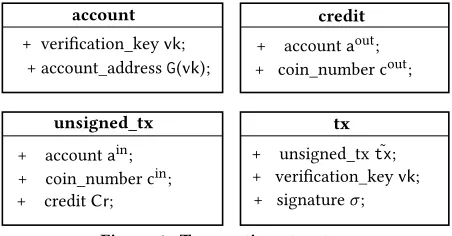
more details on our proposed data structures for account, credit, signed and unsigned transactions in Figure 1. The account contains a verification keyvk, and its addressG(vk). The credit stores an output account and the number of coinscout; thus,coutwill be transfered from an input account toaout. The unsigned transaction includes a debited/input account, and the number of debited coins
cinfrom the input account. The signed transaction consists of the corresponding unsigned transaction, a verification key and the signature of this transaction.
+ verification_keyvk; + account_addressG(vk);
account
+ accountaout; + coin_numbercout;
credit
+ accountain; + coin_numbercin; + creditCr;
unsigned_tx
+ unsigned_tx ˜tx; + verification_keyvk; + signatureσ;
tx
Figure 1: Transaction structure
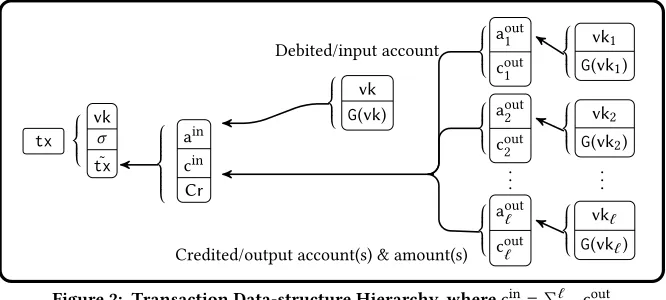
In Figure 2, we present the format of aregular transaction(the
txbox). We employ the “dot” notation to indicate the access to an element of a data structure. For instance, if we want to access the input account in the data structure shown in Figure 2, we would refer to it astx.tx˜.ain. The signed transactiontxconsists of three fields: a public keyvk, an unsigned transaction ˜txfor verification, and the signatureσ of ˜tx. The unsigned transaction ˜txcontains an input/debited account, and the number of debited coinscin,ℓ credited/output accounts.
Non-conflicting transactions.We define what it means for two
transactions to be non-conflicting. We assume that the debited accounts need to transfer all coins they have to credited accounts; therefore, those accounts cannot be debited accounts again in any other transactions. If there is a transactions inCsuch that its input account is the same as that in the considered transaction, then the examined transaction is a conflicting transaction. Otherwise, it is a non-conflicting transaction.
Definition 4.1 (Non-conflicting Transaction). Consider a chainC
of the lengthℓ∈ Nwhich contains a blockchain payloadxC := ⟨tx1, . . . ,txm⟩for somem ∈ N. We say a transactiontxisnot
conflictingwithxCif and only if predicateNonConflict(xC,tx)=1,
where
NonConflict(xC,tx)=
(
1 ∀i∈[m], txi.tx˜.ain,tx.tx˜.ain
0 otherwise
Traceable transactions.Transactions have a one-to-many
rela-tionship that represents the transfer of coin(s) from a single input account to potentially many output accounts. In order to make sure that a new transaction is valid, we need to ensure that the input account of that transaction has a valid balance (i.e.,cin).
Definition 4.2 (Traceable Transaction). Consider a chainCof
the lengthℓ ∈ Nwhich contains a blockchain payloadxC := ⟨tx1, . . . ,txm⟩for somem∈N. We say a transactiontxistraceable
with respect toxCif and only if predicateTraceable(xC,tx)=1,
where
Traceable(xC,tx)=
1 ∃i∈[m],∃t ∈[ℓi]s.t.
(1),txi.tx˜.Cr.aoutt =tx.tx˜.ain,
and(2),txi.tx˜.Cr.coutt =txi.tx˜.cin
0 otherwise
whereℓi is the number of output accounts in transactiontxi.
Spent and unspent transaction output accounts.We next
de-fine two types of transaction output accounts that are useful for our construction in next section, namely,spent transaction output
accountandunspent transaction output account. Roughly speaking,
a transaction output account is considered as spent if it becomes a transaction input account in a later transaction. On the other hand, if it is not a transaction input account of any following transactions, we call it an unspent transaction output account. To simplify the presentation, we simply call transaction input accounts as trans-action inputs. Similarly, we call transtrans-action output accounts as transaction outputs. We formally define them as follows.
Definition 4.3 (Spent Transaction Output). Consider a chainC
of the lengthℓ∈ Nwhich contains a blockchain payloadxC := ⟨tx1, . . . ,txm⟩for somem∈N. We say a transaction outputaout
of a transactiontxjforj ∈[m]isspentwith respect toxCif and
only if predicateSpent(xC,aout)=1, where
Spent(xC,aout)=
(
1 ∃i∈[m], txi.tx˜.ain=aout
0 otherwise
Definition 4.4 (Unspent Transaction Output). Consider a chain
Cof the lengthℓ∈Nwhich contains a blockchain payloadxC:= ⟨tx1, . . . ,txm⟩for somem∈N. We say a transaction outputaout
of a transactiontxjforj∈[m]isunspentwith respect toxCif and
only if predicateUnSpent(x
C,aout)=1, where
UnSpent(xC,aout)=
(
1 ∀i∈[m], txi.tx˜.ain,aout
0 otherwise
4.2
Preliminary: Ledger
Since we are interested in transactions as the content of the ledger, the payloadxis instantiated as a set of transactions,x:=⟨tx1,tx2, . . . ,txe⟩
for somee∈N. We writetx∈xto denote a transactiontxthat is
in the transaction setx. If we particularly consider a transaction
set in thei-th block, we writexi.
The input inserted at each block of the chainCis a set of trans-actions, i.e.,x := ⟨tx1,tx2, . . . ,txe⟩. We then term the stable
tx
vk σ
˜
tx
ain
cin Cr
vk G(vk)
Debited/input account
Credited/output account(s) & amount(s)
aout1
cout1
aout2
cout2
.. .
aoutℓ coutℓ
vk1
G(vk1)
vk2
G(vk2) .. .
vkℓ
G(vkℓ)
Figure 2: Transaction Data-structure Hierarchy, wherecin=Pℓ
i=1ciout.
blockchain payload (in this case, the stable blockchain transac-tion) of the chain asledger. Letκdenote the security parameter. We
formally present the definition of a ledger as follows.
Definition 4.5 (Ledger). Letκbe the security parameter. Consider
a chainCof the lengthℓ∈Nwhich contains a blockchain payload
xC :=⟨x1, . . . ,xℓ⟩. We sayLℓ is the ledger (of lengthℓ) ofC, if Lℓ=⟨x1, . . . ,xℓ−κ⟩.
Informally, we have a ledger of lengthℓ∈Nconsists of all trans-actions except the lastκtransaction sets, i.e.,xC:=⟨x1, . . . ,xℓ−κ⟩,
wherexiis the input of thei-th block inCandxi :=⟨tx1,tx2, . . . ,txe⟩.
In addition, it should hold thatV(Lℓ)=1, whereV(·)is a payload validation predicate (Definition 3.3).
Here we follow the work by Pass et al. [16], and define the stable blockchain payload as the ledger. That is, in a ledger, the lastκnumber of transaction sets of the blockchain will be simply truncated.
4.3
Generalizing ledger: Snapshot
We here relax the definition of ledger so that more efficient realiza-tions can be allowed. Note that, for many important applicarealiza-tions such as cryptocurrency, a properly relaxed version of ledger may be sufficient.
Snapshot.Now, we still consider input inserted at each generalized
block of the generalized chainCis a sequence of transactions; that is,x:=⟨tx1,tx2, . . . ,txe⟩. However, from the generalized chain
Cof the lengthℓ, we obtain a generalized ledger, calledsnapshot
and denotedSSℓ. Informally, the snapshot is constituted by apply-ing a general operation
⋄
to the stable blockchain payload (in this case, stable blockchain transaction— the sequence of transaction setstruncating the lastκtransaction sets), i.e.,SSℓ=x1⋄
. . .⋄
xℓ−κ,wherexi :=⟨tx1,tx2, . . . ,txe⟩is the input. In other words, the
snapshotSSℓis the compressed stable blockchain payload. More-over, it should hold thatV(SSℓ)=1, whereV(·)is a compressed payload validation predicate (Definition 3.5). We formally define a snapshot as follows.
Definition 4.6 (Snapshot). Letκbe the security parameter.
Con-sider a generalized chainC:=⟨Hℓ,¯xC,x˜
C⟩of lengthℓ∈N, with
an operation “
⋄
" , where¯xC:=x1⋄
x2⋄
. . .⋄
xℓ−κ. We saySSℓis thesnapshot (of lengthℓ) ofC, ifSSℓ=¯xC.
Generalized operation rules.The snapshotSSℓofCis
consti-tuted by a sequence of transaction sets via the operation“⋄". We call the operation along with the compressed payload validation predicateV(·),an operation rule, denoted(⋄,V(·)). More formally,
we definean operation ruleas follows.
Definition 4.7 (Generalized operation rule). LetB∅,B1, . . . ,Bℓbe
the ordered sequence of blocks. Consider a generalized blockchain
Cof the lengthℓ∈N, with the corresponding snapshotSSℓand the operation⋄. LetV(·)be a compressed payload validation predicate. Letκbe the security parameter. We say(⋄,V(·))is ageneralized
operation ruleif for any generalized chainC, it holds that (1)SSℓ=
x1⋄. . .⋄xℓ−κwherexiis the payload of blockBifori∈[1, . . . , ℓ],
and (2)V(SSℓ)=1.
Security properties for snapshot.Once the snapshot has been
defined we inext nvestigate how to define the relaxed security properties for the ledger protocol when nodes are running in the snapshot mode to snapshot persistence and snapshot liveness. Snapshot-persistence. Intuitively, the snapshot-persistence prop-erty implies, during a time period, the recorded information (i.e., transactions) on two different snapshots of any pair of honest par-ties should be consistent with each other. This means if a snapshot of lengthℓof a player is progressed by a transaction setx, then
snapshots of any other players atthe same lengthshould also be
pro-gressed bythe same transaction set. Formally, we state the definition
as follows.
Definition 4.8 (Snapshot persistence). Consider a generalized ledger
protocolΠLwith the operation rule(⋄,V(·)). Letκbe the security
parameter. Let∆denote the upper bound on network latency. Let
SS1ℓbe the resulting snapshot at roundr1of the lengthℓreported
by playerP1, forℓ∈Nandℓ >κ.
Here snapshot persistence property states that, if snapshotSS1ℓ
is extended by a transaction setxsuch thatSS1
ℓ+1:=SS1ℓ⋄x, then
for any playerP2with the reported snapshotSS2ℓ(by playerP2)
of the lengthℓ, in a roundr2wherer2 ≥ r1+∆, it holds that
SS2ℓ+1:=SS2ℓ⋄x.
Snapshot-liveness. Intuitively, the liveness guarantees that any new transactions, that do not conflict with the recorded information, will be definitely recorded on the ledger after a certain number of
rounds. Similarly, snapshot liveness guarantees that the new trans-actions, if they do not conflict with the snapshot, will be accepted and incorporated into the updated snapshot, after a certain number of rounds.
Definition 4.9 (Snapshot liveness). Consider a generalized ledger
protocolΠLwith the operation rule(⋄,V(·)). Letκbe the security
parameter. Consider a “wait time” parametert.
Here snapshot liveness property states that, if a valid transaction
txis given as input to every honest playerPcontinuously fort
rounds from a given roundr, then there exist snapshotsSSℓ,SSℓ+1
and a transaction setx(reported byP) of the lengthℓ >κ, in round r′≤r+t, such thatSSℓ+1:=SSℓ
⋄
xandtx∈x.4.4
From single mode to multi-mode
In a multi-mode protocol, denotedΠmulti, there exist multiple types of modes. These modes should be compatible with each other so that the system can run stably and securely. Moreover, each mode is associated with an operation rule. Here, each operation rule is defined by an operation anda multi-mode snapshot validation
predicate. Consider a modeiwherei∈[m], the operation rule in
this mode is defined as(
⋄
i,Vi), whereVi denotes a multi-mode snapshot validation predicate and⋄
i denotes the general operation in modei.Similar to the compressed payload validation predicate in Sec-tion 3, we require constraints onthe multi-mode snapshot validation
predicate. In addition to the constrains for the compressed payload
validation predicate, a multi-mode snapshot validation predicate in the multi-mode system should hold that, different snapshots gener-ated from the same stable blockchain payload (transaction) should be rejected/accepted in the same way, and also always able to make progress. We formally define a multi-mode snapshot validation predicate as follows.
Definition 4.10 (Multi-mode snapshot validation predicate).
Con-sider a multi-mode ledger protocolΠmultiwithmmodesM1,M2, . . . ,Mm. For each modeMi with operation rule(
⋄
i,Vi(·)), the correspond-ing initial snapshot isSSMi∅ . Consider a generalized blockchainC
of lengthℓ, with the corresponding snapshotSSMi
ℓ, in modei-th,
wherei∈[m]. We say(V1, . . . ,Vm)are a set ofmulti-mode
snap-shot validation predicates, if the following conditions hold for the
same generalized blockchainC
•for any modeMi, wherei∈[m], it holds thatVi(SSM∅i)=1.
•for any modeMi, wherei∈[m], it holds that, ifVi(SSMℓi)=1, then there exists a new payloadxsuch thatVi(SSMi
ℓ ,x)=1, •for any pair of modesMi andMj, wherei,j ∈[m], it holds
thatVi(SS
Mi
ℓ )=Vj(SS
Mj ℓ ).
A multi-mode system is composed bymmodes where each
mode-i, for 1≤i≤m, is an instantiation of the generalized ledger with the operation rule(
⋄
i,Vi(·)); concretely, for each mode, we need to instantiate the content of the state of snapshot, the content of the snapshot, along with its operation rule(⋄
i,Vi(·)).Defining security for incorporating multiple modes.There
are multiple types of nodes, running in different modes, in our multi-mode protocol. Intuitively, these nodes should be compati-ble. We formalize this intuition via a security property,multi-mode
system soundness. More concretely, we need to provide the security
guarantee that new transactions should be accepted/rejected in the same way by all nodes in different modes. That means, when applying the operation rule to thei-th mode nodes and to thej -th mode nodes, wherei,j ∈ [m], the output should be the same. This property can be trivially achieved if there is only a single mode. However, this property is critical for designing multi-mode cryptocurrencies that has more than one mode (e.g.,PRUNE sys-tem in the next section). Without this security requirement, trivial protocols could be allowed.
Definition 4.11 (Multi-mode soundness). Consider a multi-mode
ledger protocolΠmulti. Letmbe the total number of modes inΠmulti. Consider any pair of a modei-th with the multi-mode operation rule(
⋄
i,Vi(·))and a modej-th with the multi-mode operation rule(⋄
j,Vj(·))inΠmulti, wherej,i ∈ [m]. Letκbe the security parameter. Let∆denote the upper bound on network latency. LetSSMi
ℓ be the snapshot of playerP1in the modei-th of the length ℓ >κ(note that,ℓ∈N) at roundr1.
Here multi-mode soundness property states that, for any player
P2in the modej-th with resulting snapshotSSℓMjat roundr2≥r1+∆
of the lengthℓ, it holds that,Vi(SSMℓi,x) = Vj(SSMj
ℓ ,x), for any
inputx.
5
F ULL-MODE
5.1
Instantiating snapshot to F ULL-mode
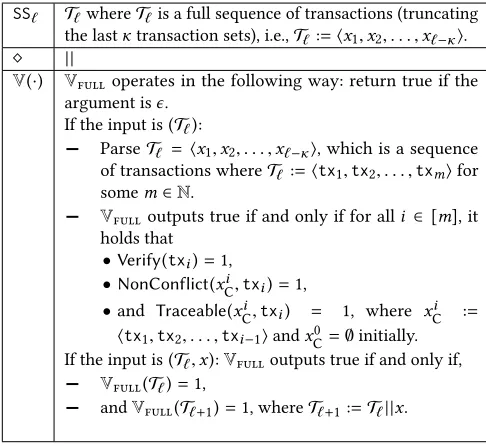
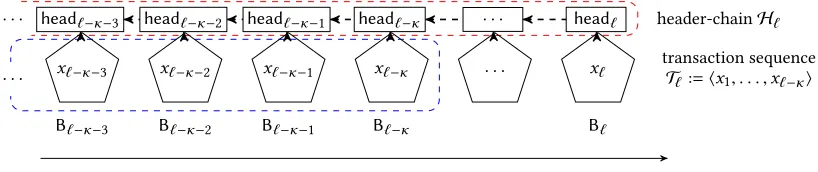
We useΠFULLto denote the ledger protocol in the FULL-mode. InΠFULL, players are expected to store full sequence of historical transaction sets. Please refer to Table 1 for how we instantiate to the FULL-mode, and please also refer to Figure 3 for an illustration of Table 1.
Table 1: Snapshot Instantiation: F ULL-modeΠF ULLover the
blockchain protocolΠC(see Appendix A.1) via the
specifica-tion ofSSℓ,
⋄
, andV(·).SSℓ TℓwhereTℓis a full sequence of transactions (truncating the lastκtransaction sets), i.e.,Tℓ:=⟨x1,x2, . . . ,xℓ−
κ⟩.
⋄
||V(·) Vfulloperates in the following way: return true if the
argument isϵ. If the input is(Tℓ):
ParseTℓ =⟨x1,x2, . . . ,xℓ−
κ⟩, which is a sequence of transactions whereTℓ:=⟨tx1,tx2, . . . ,txm⟩for
somem∈N.
Vfulloutputs true if and only if for alli ∈[m], it
holds that
•Verify(txi)=1,
•NonConflict(xi
C,txi)=1, •and Traceable(xi
C,txi) = 1, where xCi := ⟨tx1,tx2, . . . ,txi−1⟩andx0
C=∅initially.
If the input is(Tℓ,x):Vfulloutputs true if and only if,
Vfull(Tℓ)=1,
andVfull(Tℓ+1)=1, whereTℓ+1:=Tℓ||x.
Time
header-chainHℓ
transaction sequence
Tℓ:=⟨x1, . . . ,xℓ−κ⟩
headℓ−κ−3 headℓ−κ−2 headℓ−κ−1 headℓ−κ . . . headℓ
xℓ−κ−3
Bℓ−κ−3
xℓ−κ−2
Bℓ−κ−2
xℓ−κ−1
Bℓ−κ−1
xℓ−κ
Bℓ−κ
. . . xℓ
Bℓ
. . .
. . .
Figure 3: The illustration of the blockchain in F ULL-mode.
Since we are interested in transactions as the content of the ledger, we instantiate the payloadxin a block as a set of
trans-actions, and writex :=⟨tx1,tx2, . . . ,txe⟩. We usexi to denote
the payload of thei-th block. We then have a full sequence of transaction sets of the lengthℓexcept the lastκtransaction sets
Tℓ :=⟨x1,x2, . . . ,xℓ−κ⟩. Intuitively, if there is a new transaction
set (returned by operation
▲
, see Algorithm 1), then the sequence of transaction sets is concatenated by one more transaction set such that the new transaction sequence is valid with respect to a multi-mode snapshot validation predicate. Note that, we need instantiate the predicateV(·)toVfull(·) in this FULL-mode. Inmore detail, from Table 1, for any transaction setx(returned by
op-eration
▲
), it should follow thatSSℓ+1:=SSℓ⋄
xandVfull(SSℓ+1),where
⋄
:=||. This implies,Tℓ+1 :=Tℓ||x=⟨x1,x2, . . . ,xℓ− κ,x⟩;here, the updated transaction sequence is valid with respect to data validation predicateVfull(·), i.e.,Vfull(Tℓ+1)=1 (see Table 1). In
a nutshell, the predicateVfull(·)checks(1)the conflict between
any pair of transactions, and(2)the integrity of every transaction from its input. Details are provided in Table 1.
5.2
Security analysis for F ULL-mode
We begin by showing that the execution in FULL-mode satisfies the snapshot persistence, with an overwhelming probability inκ
(see Section 4.4, Definition 4.8). The proof is essentially based on the common-prefix property of the underlying header-chain and the collision-resistance of the authenticated data structure used in this mode.
Technical challenges.Different from the proof in [5], we need the
collision-resistance of the authenticated data structure to show the security since our blockchain data structure is different from theirs. More precisely, we include the one-way digestτof transaction setxinto the header-chain. Therefore, we must ensure that each
transaction set corresponds to only a single header. In other words, there should not be two different transaction sets having the same header. If there exist those transaction sets, adversarial miners can always rewrite the confirmed and processed transactions. This is guaranteed by the collision-resistance of the authenticated data structure. Thus, we need to reduce the security of the snapshot pro-tocol to the collision-resistance of the authenticated data structure. We first formally state the theorems as follows.
Theorem 5.1 (FULL-mode persistence). Consider the protocol
ΠF ULL
(see Section 5.1). Letκbe the security parameter. Assume the
au-thenticated data structureΣau(see Definition 3.1) is collision-resistant.
Assume thatγ =λβandλ>1. Then, it holds that the execution in
F ULL-modeΠF ULLsatisfies the snapshot persistence property, with
probability at least1−ϵ(κ), whereϵ(·)is a negligible function.
Proof can be found in Appendix B.1.
Note that snapshot persistence property (see Section 4.4, Defini-tion 4.9) in FULL-mode is useful but not enough to ensure that the players in FULL-mode makes progress, i.e., that transactions are eventually accepted (or recorded). This is captured by the snapshot liveness property in FULL-mode. The snapshot liveness property in FULL-mode is formally stated in Theorem 5.2. Proof can be found in Appendix B.2.
Theorem 5.2 (FULL-mode liveness). Consider the protocolΠF ULL
(see Section 5.1). Letκbe the security parameter. Assume the
authen-ticated data structureΣau(see Definition 3.1) is collision-resistant.
Assume thatγ =λβandλ >1. Then, it holds that the execution
in F ULL-modeΠF ULLsatisfies the snapshot liveness property where
t=(1+δ)2κ
γ , forδ >0, with probability at least1−ϵ(κ)whereϵ(·) is a negligible function.
6
PRUNE-MODE
6.1
Building block: UTXO-set
Algorithm 2UTXO operation
◦
.1: function ◦(Uℓ,xℓ+1) 2: Uℓ+1:=Uℓ
3: for eachtransactiontxinxℓ+1do ▷transactions are stored in temporal order
4: for eachainintxdo 5: ifain<Uℓ+1then
6: return⊥
7: else
8: removeainfromUℓ+1
9: end if
10: end for
11: add all transaction outputsaoutintxtoUℓ+1
12: end for 13: returnUℓ+1
14: end function
In Bitcoin, each output of a particular transaction can only be spent once; the outputs of all transactions included in the blockchain can be categorized as either unspent transaction outputs [2, 12] or spent transaction outputs (see Definition 4.4). For a payment to be
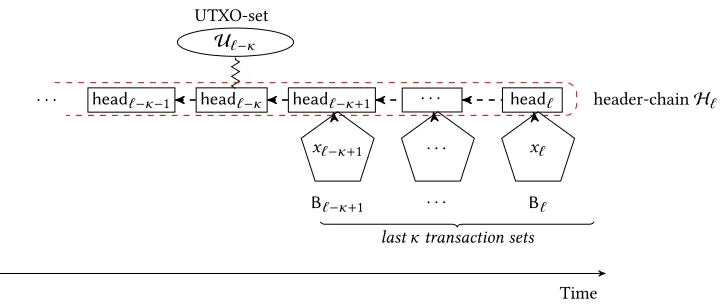
Uℓ−κ UTXO-set
lastκtransaction sets
Time
header-chainHℓ headℓ−κ−1 headℓ−κ headℓ−κ+1 · · · headℓ
xℓ−κ+1
Bℓ−κ+1
· · ·
· · ·
xℓ
Bℓ . . .
Figure 4: The illustration of the blockchain in PRUNE-mode.
valid, it must use previously unspent outputs as inputs. Therefore, spent transaction outputs are not necessary to be stored, and a set of unspent transaction outputs could be abstracted and represented
as aUTXO-set, denotedU:=⟨aout
1 ,aout2 , . . . ,aoutn ⟩for somen∈N.
Now, instead of storing all historical and unnecessary transactions, miners are expected to store a UTXO-set.
Jumping ahead, each UTXO-set corresponds to a blockchain length. Letℓdenotes the current length. Intuitively, a UTXO-setUi
of any playerPdenotes the UTXO set with the lengthi, wherei∈
[ℓ]. An initial UTXO-set, denoted asU0can be updated into a new
setU1by incorporating a set of transactionsx1, i.e.,U1:=U0
◦
x1,where operation
◦
is defined by Algorithm 2. Similarly, the first UTXO-setU1can be further updated into the second UTXO-setU2by incorporating another set of transactionsx2, i.e.,U2:=U1
◦
x2,and furtherUℓ+1:=Uℓ
◦
xℓ+1for any transaction setxℓ+1. If wedo not interest in a particular length, we ignore the subscript and writeU. Also, if we interest in a particular playerPj ∈ P, where
j∈[n] andnis the total number of miners, we writeUj.
6.2
Instantiating snapshot to PRUNE-mode
Table 2: Snapshot instantiation: PRUNE-modeΠPRUNEover
the blockchain protocolΠC(see Appendix A.1) via the
spec-ification ofSSℓ,
⋄
, andV(·).SSℓ Uℓ−κwhereUℓ−κis the(ℓ-κ)-th UTXO-set.
⋄
◦
V Vprune()operates in the following way: return true if the
argument isϵ.
If the input is(Uℓ−κ): If parseUℓ−κ as a sequence of transaction outputs whereUℓ−κ:=⟨a1out,aout2 , . . . ,aoutn ⟩
for somen∈N, then returns true.
If the input is(Uℓ−κ,x): Parsexas a sequence of
trans-action⟨tx1,tx2, . . . ,txe⟩for somee ∈ N.Vprune
out-puts true if and only if for all i ∈ [e], it holds that
txi.tx˜.ain∈ Uℓ−κ.
This design goal is captured by the following instantiation of the snapshot to PRUNE-modeΠPRUNE(see Table 2). Letℓ∈Ndenote the current blockchain length. InΠPRUNE, players are expected to store the{ℓ-κ}-th UTXO-set. In Table 2, we instantiate the snapshot
SSℓ of any playerP. (We writeSSℓj, if we are interested in the snapshot of a particular playerPj, where 1≤j ≤n.) Please also refer to Figure 4 for an illustration of Table 2.
LetU0denote the initial UTXO-set such thatVprune(U0) =
1. Forℓ < κ, we setUℓ−κ := U0. From Table 2, for any new transaction setx(returned by operation
▲
, see Algorithm 1), itshould follow thatSSℓ+1:=SSℓ
⋄
xandVfull(SSℓ+1), where⋄
:=◦
.This implies,Uℓ−κ+1:=Uℓ−κ
◦
x.Without lost of generality, we assume that the initial UTXO set is valid with respect to the initialization of the ledger in the FULL-mode. Our instantiation ofSSℓin the PRUNE-mode follows certain rules which could be specified by a multi-mode snapshot validation predicateVprune. This predicate is used to validate a snapshot. If
it receives as inputUℓ−κ, the predicate returnsTrueif and only if
Uℓ−κis a valid UTXO-set to the application’s point of view.
6.3
Security analysis for PRUNE-mode
Similar to the proofs for the snapshot persistence and snapshot liveness in FULL-modeΠFULL, the proofs for the snapshot persis-tence and snapshot liveness properties in PRUNE-modeΠPRUNE
(see Section 4.4, Definitions 4.8 and 4.9), are essentially based on the common-prefix property, chain-quality property, and chain growth property for the header-chains together with the collision-resistance of the authenticated data structure used in this mode.
We begin by introducing an important lemma to prove the se-curity. Informally, the lemma states that if any pair of players has the same UTXO-sets, then when the UTXO-sets are extended, they are identical. The lemma is formally state as follows. (Proof can be found in Appendix C.1. )
Lemma 6.1. Consider the protocolΠPRUNE(see Section 6.2). Letκ be the security parameter. Assume the authenticated data structure
Σau(see Definition 3.1) is collision-resistant. Assume thatγ =λβand
λ>1. Assume thatU1
ℓ−κ =Uℓ2−κ, for any two honest playersP1
andP2. It holds thatU1
ℓ−κ+1 =Uℓ2−κ+1with probability at least
1−ϵ(κ), whereϵ(·)is a negligible function inκ.
We are now ready to prove the snapshot persistence considering the execution in PRUNE-mode as follows.
Theorem 6.2 (PRUNE-mode persistence). Consider the protocol
ΠPRUNE
(see Section 6.2). Letκbe the security parameter. Assume
the authenticated data structureΣau(see Definition 3.1) is
collision-resistant. Assume thatγ =λβandλ>1, it holds that the execution
in PRUNE-modeΠPRUNEsatisfies the snapshot persistence property,
with probability at least1−ϵ(κ), whereϵ(·)is a negligible function.
Proof can be found in Appendix C.2.
Theorem 6.3 (PRUNE-mode liveness). Consider the generalized
ledger protocolΠPRUNE(see Section 6.2). Letκbe the security
param-eter. Assume the authenticated data structureΣau(see Definition 3.1)
is collision-resistant. Assume thatγ =λβandλ>1. It holds that
the execution in PRUNE-modeΠPRUNEsatisfies the snapshot liveness
property with probability at least1−ϵ(κ), whereϵ(·)is a negligible function.
Proof can be found in Appendix C.3.
7
PRUNE
: A MULTI-MODE SYSTEM WITH
F ULL AND PRUNE MODES
There are two modes, FULL-modeΠFULL(see Section 5), and PRUNE-modeΠPRUNE(see Section 6) in thePRUNEsystem, and we write
Πmulti =(ΠFULL,ΠPRUNE). Both modes are instantiations of the generalized ledger. We remark that ourPRUNEsystem can be viewed as an abstract presentation of the Bitcoin Pruned proposal (in-troduced in Bitcoin Core version 0.11 [1]). We also remark that, ourPRUNEcan be easily modified to capture the Ethereum Pruned proposal [21]. As an initial study and to simplify the analysis, we assume that players will not change modes in the execution.
7.1
Security analysis for incorporating
F ULL-mode and PRUNE-mode
In this section, we prove the multi-mode system soundness (see Sec-tion 4.4, DefiniSec-tion 4.11). Intuitively, the multi-mode system sound-ness property says that any transaction should be accepted/rejected in the same way as by the PRUNE-mode players or by FULL-mode players. The proof is essentially based on the snapshot persistence property for PRUNE-mode and FULL-mode. Before going to the details of the proof of multi-mode system soundness, we state a lemma to show that unspent transaction outputs are as useful as the full set of transactions. More precisely, new transactions should be accepted/rejected in the same way with respect to the snapshot in FULL-mode (generated from the full sequence of all processed trans-actions truncating the lastκtransaction sets), and to the snapshot in PRUNE-mode (containing the set of unspent transaction outputs). This implies the multi-mode snapshot validation predicates in both PRUNE and FULL mode should return the same output.
Note that, to distinguish the snapshots and the corresponding operations in FULL-mode from PRUNE-mode, we denoteSSfℓand
⋄
f as the snapshot of lengthℓand operation in FULL-mode,re-spectively. Similarly, we denoteSSpℓand
⋄
pas the snapshot andoperation in PRUNE mode, respectively. If we are interested in the snapshot of a particular playerPi, we writeSSfℓ,i(orSSpℓ,i).
Lemma 7.1. ConsiderPRUNEsystemΠmulti=(ΠPRUNE,ΠF ULL).
Letκbe the security parameter. Consider a snapshotSSf
ℓ :=Tℓin F ULL mode whereTℓ := ⟨x1,x2, . . . ,xℓ−κ⟩, andSSp
ℓ = Uℓ−κ in PRUNE mode, whereUℓ−κ :=U0
◦
x1◦
. . .xℓ−κ. It holds that for any transaction set x ,Vfull(SSfℓ⋄
fx)=Vprune(SSp
ℓ
⋄
px)where⋄
f:=|| and⋄
p:=◦
.Proof can be found in Appendix D.1.
Armed with Lemma 7.1 and Lemma 6.1 in Section 6.3, we are now ready to prove our main theorem as follows.
Theorem 7.2 (Multi-mode soundness). ConsiderPRUNE sys-temΠmulti = (ΠPRUNE,ΠF ULL)in Section 7. Letκbe the security
parameter. Letκbe the security parameter. Assume the authenticated
data structureπau(see Definition 3.1) is collision-resistant. Assume
thatγ =λβandλ>1, it holds thatPRUNEsystemΠmultisatisfies
the multi-mode soundness property with probability at least1−ϵ(κ),
whereϵ(·)is a negligible function.
Proof can be found in Appendix D.2
REFERENCES
[1] Bitcoin core version 0.11.0 released. https://bitcoin.org/en/release/v0.11.0. [2] Bitcoin developer guide – UTXO definition. https://bitcoin.org/en/
developer-guide#term-utxo.
[3] Ittay Eyal. The miner’s dilemma. In2015 IEEE Symposium on Security and Privacy, pages 89–103. IEEE Computer Society Press, May 2015.
[4] Ittay Eyal and Emin Gün Sirer. Majority is not enough: Bitcoin mining is vulner-able. In Nicolas Christin and Reihaneh Safavi-Naini, editors,FC 2014, volume 8437 ofLNCS, pages 436–454. Springer, Heidelberg, March 2014.
[5] Juan A. Garay, Aggelos Kiayias, and Nikos Leonardos. The bitcoin backbone protocol: Analysis and applications. In Elisabeth Oswald and Marc Fischlin, editors,EUROCRYPT 2015, Part II, volume 9057 ofLNCS, pages 281–310. Springer, Heidelberg, April 2015.
[6] Juan A. Garay, Aggelos Kiayias, and Nikos Leonardos. The bitcoin backbone protocol with chains of variable difficulty. InCRYPTO, 2017. https://eprint.iacr. org/2016/1048.
[7] Shafi Goldwasser, Silvio Micali, and Ronald L Rivest. A digital signature scheme secure against adaptive chosen-message attacks.SIAM Journal on Computing, 17(2):281–308, 1988.
[8] Aggelos Kiayias, Elias Koutsoupias, Maria Kyropoulou, and Yiannis Tselekounis. Blockchain mining games. InProceedings of the 2016 ACM Conference on Economics and Computation (EC), pages 365–382, 2016.
[9] Aggelos Kiayias and Giorgos Panagiotakos. Speed-security tradeoffs in blockchain protocols. Cryptology ePrint Archive, Report 2015/1019, 2015. http://eprint.iacr.org/2015/1019.
[10] Aggelos Kiayias and Giorgos Panagiotakos. On trees, chains and fast transactions in the blockchain. Cryptology ePrint Archive, Report 2016/545, 2016. http: //eprint.iacr.org/2016/545.
[11] Ralph C. Merkle. A certified digital signature. In Gilles Brassard, editor, CRYPTO’89, volume 435 ofLNCS, pages 218–238. Springer, Heidelberg, August 1990.
[12] Andrew Miller. Storing utxos in a balanced merkle tree. 2012. https://bitcointalk. org/index.php?topic=101734.0.
[13] Satoshi Nakamoto. Bitcoin: A peer-to-peer electronic cash system. 2008. https: //bitcoin.org/bitcoin.pdf.
[14] Kartik Nayak, Srijan Kumar, Andrew Miller, and Elaine Shi. Stubborn mining: Generalizing selfish mining and combining with an eclipse attack. Cryptology ePrint Archive, Report 2015/796, 2015. http://eprint.iacr.org/2015/796. [15] Parity Wiki. Warp sync. 2017. https://github.com/paritytech/parity/wiki/
Warp-Sync.
[16] Rafael Pass, Lior Seeman, and Abhi Shelat. Analysis of the blockchain protocol in asynchronous networks. InEUROCRYPT, 2017. https://eprint.iacr.org/2016/454. [17] Ayelet Sapirstein, Yonatan Sompolinsky, and Aviv Zohar. Optimal selfish mining strategies in bitcoin. InInternational Conference on Financial Cryptography and Data Security, 2016.
[18] Okke Schrijvers, Joseph Bonneau, Dan Boneh, and Tim Roughgarden. Incentive compatibility of bitcoin mining pool reward functions. InInternational Conference on Financial Cryptography and Data Security, 2016.
[19] Yonatan Sompolinsky and Aviv Zohar. Secure high-rate transaction processing in bitcoin. In Rainer Böhme and Tatsuaki Okamoto, editors,FC 2015, volume 8975 ofLNCS, pages 507–527. Springer, Heidelberg, January 2015.
[20] Parity Technologies. Fast, light, robust ethereum implementation. https://github. com/paritytech/parity.
[21] Parity Wiki. Warp sync snapshot format. https://github.com/paritytech/parity/ wiki/Warp-Sync-Snapshot-Format.
[22] Gavin Wood. Ethereum: A secure decentralized transaction ledger. 2014. http: //gavwood.com/paper.pdf.
A
SUPPORTING MATERIAL FOR SECTION 3
A.1
The execution of miners
The blockchain protocolΠC. We are now ready to describe the blockchain protocolΠC(Algorithm 3). First, each miner copies
all the new blocks received from the network into his local state. Then the miner updates set of stored blokchainsCwith the blocks
and selects the best blockchain from the set by calling theBestChain
function (Algorithm 6). Every updated blockchain must be valid,
thusBestChainis calling chain validation functionValidate
(Algo-rithm 4) under the hood. Then the miner tries to extend the best blockchain by running randomized algorithmPow(Algorithm 5)
which is issuing a single query to idealized hash function per round. The pseudocode of main miner loop is provided in Algorithm 3.
Algorithm 3The blockchain protocolΠC.
1: C:=ϵ
2: whileTruedo
3: B←all blocks from the network.
4: ⟨C,C⟩ ←BestChain(C,B)
5: ⟨x,τ⟩ ←a new payload and its corresponding digest from
the environment.
6: ⟨Hℓ,¯xC,x˜C⟩ ←C ▷the length ofCisℓ 7: ⟨head1,head2, . . . ,headℓ⟩ ← Hℓ
8: headℓ+1←Pow(headℓ,τ) 9: ifheadℓ+1,ϵthen
10: B:=⟨headℓ+1,x⟩
11: Hℓ+1:=⟨head1,head2, . . . ,headℓ,headℓ+1⟩ 12: ⟨x˜′
C,x
′⟩:=x˜C▲x 13: ¯x′C:=¯xC
⋄
x′ 14: C′:=⟨Hℓ+1,¯xC′,x˜′C⟩
15: C:=(C\ {C})∪ {C′}
16: Broadcast(B)
17: end if
18: round:=round+1
19: end while
Algorithm 5The proof of work functionPow, parametrized by t
and hash functionhash(·). 1: functionPow(headℓ,τ) 2: h←hash(headℓ) 3: w← {0,1}κ 4: headℓ+1:=ε
5: ifhash(h,τ,w)<tthen
6: headℓ+1:=⟨h,τ,w⟩
7: end if
8: returnheadℓ+1
9: end function
Algorithm 4Validation functionValidate, parameterized by a
tar-get t, a hash functionhash(·), and compressed payload validation
predicateV(·).
1: functionValidate(C) 2: ⟨Hℓ,¯xC,x˜C⟩ ←C 3: b:=V(¯xC)
4: ifbthen
5: ⟨head1,head2, . . . ,headℓ⟩ ← Hℓ▷the length ofCisℓ
6: h′:=0
7: for eachiin 1, . . . , ℓdo
8: parseheadiinto⟨hi,τi,wi⟩
9: if(hi =h′)∧(hash(headi)<t)then
10: h′←hash(headi)
11: else
12: return(b=0)
13: end if
14: end for
15: end if
16: return(b)
17: end function
Algorithm 6Best chain functionBestChain. 1: functionBestChain(C,B)
2: for eachB∈B(reordered by using hash-links) do
3: ⟨head,x⟩ ←B▷iterating overBto append new blocks
4: for eachCinCdo
5: ⟨Hℓ,¯xC,x˜C⟩ ←C ▷the length ofCisℓ 6: Hℓ+1:=⟨Hℓ,head⟩
7: ⟨x˜′
C,x
′⟩:=x˜C▲x 8: ¯xC′ :=¯xC
⋄
x′ 9: C′:=⟨Hℓ+1,¯x′C,x˜′C⟩
10: ifC′,⊥ ∧Validate(C′)then
11: C:=(C\ {C})∪ {C′}
12: end if
13: end for
14: end for
15: return⟨C,Cwith a longest header-chain inC⟩
16: end function
A.2
Security analysis for the blockchain
The underlying header-chain in the blockchain is the same as the Bitcoin blockchain in [5] except that we specify each payloadxi
as the digestτi of a transaction xi. Indeed, the security of our
header-chain is implied from the security of the blockchain in Bitcoin backbone; therefore, by the security of Bitcoin backbone shown in [5], the blockchain protocolΠC(Section A.1) achieves
the three security properties.We begin by recalling the following two quantities introduced in [5, 16]. Consider the total number of players isn, the portion of malicious computing power isρ, andp=2tκ is the probability of success in a single PoW function
invocation.
Letα=1−(1−p)(1−ρ)nbe the probability that at least one honest players mines a block successfully in a round.