Acknowledgements
This case study is based on research conducted in 2013 by A/Prof Kitty te Riele, Dr Dorothy Bottrell and Dr Vicky Plows from The Victoria Institute at Victoria University, for the project Putting the jigsaw together: innovative learning engagement programs in Australia. Luke Swain, Esther Chan and Hendrik Jacobs contributed to preparing the case study reports.
We are grateful for the major funding provided by the Ian Potter Foundation and for the additional support from Dusseldorp Skills Forum, and from The Victoria Institute through the Australian Government’s Collaborative Research Network.
The research would not have been possible without the considerable assistance of coordinating staff in each case study site – and all the staff, students, community stakeholders, and graduates who made us feel welcome and offered us insights into their experiences and viewpoints.
Please note: All individual names are pseudonyms.
Creative Commons Licence
This publication is licensed under a Creative Commons Attribution 3.0 Australia Licence.
Attribution-NonCommercial-No Derivatives CC BY-NC-ND
Creative Commons Attribution 3.0 Australia Licence is a standard form license agreement that allows you to redistribute this publication, provided that you attribute the work. The reference for attribution is below. A summary of the licence terms is available from http://creativecommons.org/ licenses/by-nc-nd/3.0/au/. The full licence terms are available from http://creativecommons.org/ licenses/by-nc-nd/3.0/au/legalcode.
Please cite this report as: Te Riele, K., Plows, V. and Bottrell, D. (2014). SEDA Sports Development
Program Darwin. Case study. Melbourne: The Victoria Institute for Education, Diversity and Lifelong Learning
For other products from this research project and related information, and to download this report please visit the website dusseldorp.org.au/priorities/alternative-learning/
CONTENTS
ACKNOWLEDGEMENTS 2
INTRODUCTION 6
ABOUT SEDA SDP DARWIN: BACKGROUND AND OVERVIEW 7
Context 7
Program governance and aims 8
Students 9
Staff 10
Curriculum 10
Timetable 11
Facilities 12
Key Dimensions 14
VALUED OUTCOMES 14
Valuable credentials and pathways 14
Engagement with learning 16
Personal growth 16
Benefits for partner organisations 18
Impacts on the wider community 19
ACTIONS 21
Relevant learning 21
Positive and supportive environment 23
Encouraging student responsibility 23
PRINCIPLES 27
Strength-based approach 27
Adult treatment and authenticity 28
Collaborative approach 30
CONDITIONS 32
Strong partnerships 32
Flexibility 33
Experienced and committed staff 35
SUMMING UP: REMARKABLE AND DISTINCTIVE FEATURES 36
1) Collaborative approach with partner organisations 36
2) Strong foundation for future pathways 36
3) Sport as the hook 36
4) Sports club as classroom 37
5) Small size 37
INTRODUCTION
This case study is based on research conducted in 2013 by A/Prof Kitty te Riele, Dr Dorothy Bottrell and Dr Vicky Plows from The Victoria Institute at Victoria University, for the project Putting the jigsaw together: innovative learning engagement programs in Australia. The project was majority-funded by the Ian Potter Foundation and also supported by Dusseldorp Skills Forum and by The Victoria Institute through the Australian Government’s Collaborative Research Network.
The research project explored options for marginalised young people to complete secondary schooling (Year 9-12 or equivalent) through innovative, flexible and/or alternative learning programs.
PHASE 1 - Investigated the provision and diversity of such programs across Australia, with the results
(listing over 850 sites) available through the Dusseldorp Forum website1.
PHASE 2 - Analysed publicly available documentation from about 20 programs to generate insight in
how they work and the outcomes they achieve. Short vignettes of each program are also on the Dusseldorp Forum website2.
PHASE 3 - Involved more in-depth research with eight of those ‘vignette’ sites. For each program one
member of the research team collected additonal documentation and spent 3-4 days on-site to observe activities and interview staff, students, community stakeholders and, where possible, graduates3.
ABOUT SEDA SDP
DARWIN: BACKGROUND
AND OVERVIEW
Context
Darwin is the capital of the Northern Territory (NT) and is situated in the central far-north of Australia. About 72,000 people live in the Darwin Local Government Area (LGA). The Darwin LGA has a much higher percentage of Indigenous Australians when compared to national averages. The proportion of Indigenous young people aged 15 to 19 years residing in the area is over three times larger than the national average (15.2 percent compared to 4.2 percent nationally), as is the proportion of Indigenous people across all ages (8.4 percent compared to 2.5 percent nationally)4.
Figure 1: Labour force status, percentage of age group5
The labour market situation in Darwin is relatively good when compared to the whole of Australia. The full-time employment rate for young people aged 15-24 is considerably higher than the Australian average (53.4 percent compared to 40.4 percent nationally) as well as for all age groups (69.2 percent compared to 59.7 percent, see Figure 1)6. Rates for unemployment and for being outside the labour force are also much lower in Darwin compared to national averages, for both young people and across the population7.
Employment in Darwin is concentrated in the Public Administration and Safety sector (21.6 percent), with the sectors of Healthcare and Social assistance (9.3 percent), Construction (9.1 percent) and Retail Trade (8.6 percent) also holding many jobs. The sector Arts and Recreation Services, which is relevant to SEDA’s focus on sport and recreation, employs 2 percent or over 1,200 people in the greater Darwin area8.
0% 10% 20% 30% 40% 50% 60% 70%
AUSTRALIA ALL AGES
DARWIN LGA ALL AGES
AUSTRALIA 15-24
DARWIN LGA 15-24
Not in Labour Force Unemployed
The Darwin LGA has 25 primary schools (19 public and 6 private), 4 public middle schools (Years 7 to 9), 2 public senior colleges (Years 10 to 12), 5 private colleges and 2 special needs schools9. There is one university in the Darwin LGA – Charles Darwin University (CDU) – which is located in the suburb of Casuarina. As a multi-sector tertiary institution, CDU also delivers TAFE. The SEDA Sports Development Program Darwin currently operates from a building on the university campus.
Figure 2: Highest year of school completed, percentage of 20-24 year olds10
The rate of Year 12 or equivalent completion for 20-24 year olds in the Darwin LGA is lower than the national average (60.1 percent compared to 69.9 percent nationally, see Figure 2)11. The Year 10 or equivalent completion rate is also lower than the national average (10.6 percent compared to 11.6 percent nationally), yet the Year 11 or equivalent completion rate is higher (11.6 percent compared to 8.0 percent nationally)12.
Program governance and aims
The Sports Education Development Australia (SEDA) program was established in 2007 in Victoria. The aim of the program is to “engage, educate and empower young people” as they transition from school to work or further study, especially for young people who engage better with an applied and context relevant learning curriculum13. Initially SEDA set up provisions focusing specifically on sporting-related interests and qualifications, but expanded to include arts-related provisions in 2012. In 2013, SEDA programs were set up outside of Victoria in both Western Australia and the Northern Territory.
The program in Darwin has a ‘multi-sport’ focus – meaning it is focused on sport rather than art, and that it incorporates a range of sports rather than a single one (as is the case with many SEDA programs in Victoria). This report uses the abbreviation ‘SEDA SDP Darwin’ or simply ‘SEDA’ to refer to the Sports Education Development Australia Sports Development Program Darwin. SEDA SDP Darwin is a non-school senior secondary educational provider delivered in partnership with the Northern Territory Department of Education, Casuarina Senior College in Darwin, and Charles Darwin University14.
SEDA students are formally enrolled through Casuarina Senior College, with funding flowing from the school to SEDA through a contract with the Northern Territory Department of Education. SEDA SDP Darwin delivers VET certificates in an auspicing arrangement with Charles Darwin University (CDU) and as such
3% 2.6% 11.6%
10.6% 8%
11.6% 69.9%
60.1% AUSTRALIA
DARWIN LGA
YR9 OR LESS YR10 OR EQ
to specialist staff who run clinics and workshops to support the curriculum. In addition, students pay a fee of $800 per year. Students, or their families, who hold concession cards are able to access additional fee rebates from the government.
The umbrella SEDA group, which is based in Victoria, oversees much of the administration for the SEDA SDP Darwin program.
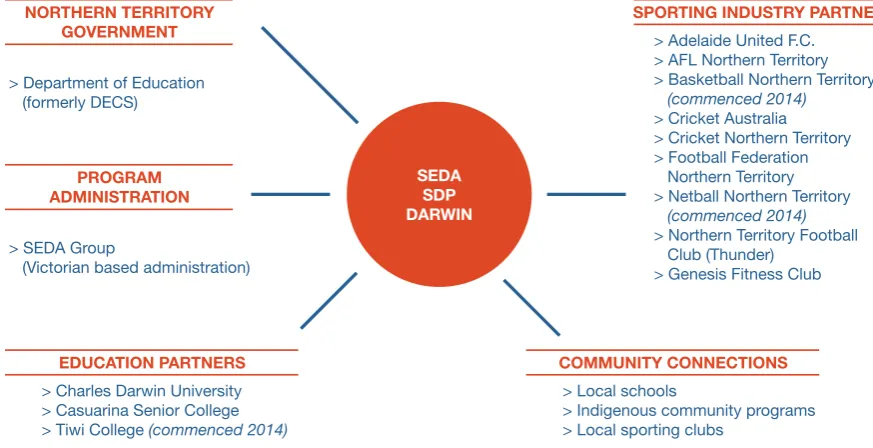
Figure 3: Overview of different types of partnerships with SEDA SDP Darwin
SEDA SDP Darwin has partnerships with national and state-based sporting organisations, local council and sporting clubs as well as other Registered Training Organisations15. SEDA students and staff collaborate with a wide range of staff in these organisations, including players, coaches, administrators, development officers, and operations and marketing managers. Partnerships with local sporting clubs and schools have been formulated for students to apply their learning in ways that benefit the local community. A major approach for this is through sports clinics run by the SEDA students, on a weekly basis over a school term for a primary school, or as one-off events for local community organisations who work with Indigenous people and with people with disabilities. Participating partner schools that host SEDA clinics include public and private schools and special schools16. In addition, SEDA students are involved with events organised by local sporting organisations. Figure 3 presents a simplified diagram of the range of partnerships that SEDA SDP Darwin has formulated since it started in 2013.
Students
Student numbers have grown rapidly since the SEDA program started in 2007 in Victoria. There were 20 students studying in the SEDA program in 2007, and this has increased to over 2,000 students in 201417. Around 70 percent of students in the SEDA program are male, and the program attracts students from many different cultural and social backgrounds across urban and regional areas of Australia18.
In 2013, the first year of operation in the Northern Territory, there were 22 students - 20 males and 2 females - studying Year 11 or 12 in the SEDA SDP. All students were aged 16 to 18 years, and four male students were Indigenous19. Many lived locally and had previously attended the host school, Casuarina Senior College, but some travelled from other parts of Darwin and Palmerston. Over half of the students were formally in the Australian Football League (AFL) program, with the others in the soccer and cricket
SEDA SDP DARWIN
SPORTING INDUSTRY PARTNERS
> Adelaide United F.C. > AFL Northern Territory > Basketball Northern Territory (commenced 2014)
> Cricket Australia > Cricket Northern Territory > Football Federation Northern Territory > Netball Northern Territory (commenced 2014)
> Northern Territory Football Club (Thunder)
> Genesis Fitness Club
COMMUNITY CONNECTIONS
> Local schools
> Indigenous community programs > Local sporting clubs
EDUCATION PARTNERS
> Charles Darwin University > Casuarina Senior College > Tiwi College (commenced 2014)
PROGRAM ADMINISTRATION
> SEDA Group
(Victorian based administration)
NORTHERN TERRITORY GOVERNMENT
program20. However, the multi-sport nature of SEDA SDP Darwin meant all students participated in activities across all sports. Students required a ‘pass’ grade for Year 10 to be accepted into the program, alongside an interest in sports and recreation. Sporting ability, however, is not a pre-requisite for entry into the program. In 2014, the program has doubled in size, with the addition of students working at Year 10 level.
Staff
The SEDA organisation has grown considerably from one teaching staff member in 2007 to 89 registered teachers across Australia in 2013. Overall, 161 staff members are employed in 2013 by the SEDA Group, with roles ranging from teaching, IT support, student wellbeing, literacy support, careers and pathways support, outdoor recreational specialists, administration and office positions21.
In 2013, SEDA SDP Darwin employed one staff member as a program facilitator (teacher) and one as a combined State Operations Manager, program coordinator and teacher. In 2014 this has grown to four staff members: a state operations manager, a program coordinator and two program facilitators22. Staff in SEDA SDP Darwin are all qualified as secondary teachers in the subject areas of Physical Education and Health and/or English or Mathematics.
Curriculum
SEDA SDP Darwin offered Year 11 and 12 in 2013. As of 2014, this has expanded to include Year 10. Students studying in the program can achieve their Northern Territory Certificate of Education and Training (NTCET) while simultaneously working towards VET Certificates II, III or IV in Sport and Recreation23. Additional Qualifications that can be gained through the program include a Level 2 First Aid Certificate, Level 1 or 2 Coaching accreditations, as well as umpiring and refereeing certifications24.
Students’ shared interest in sport and recreation is used as the hook for the course curriculum for SEDA SDP Darwin, which includes: career planning, coaching and teaching practices, event management, exercise science, first aid, fitness instruction, literacy and numeracy, marketing, occupational health and safety, sports and recreational law, sport and recreational industry focus, sports management, sports psychology, as well as work placement25. Students undertake work placement for one day per week during Terms 2, 3 and 4, and some students may be able to gain paid school-based traineeships26. Sports clinics, to engage people in games and teach them sport-related skills, are run by SEDA students in local primary schools and community organisations throughout Terms 2, 3 and 4 as well. Students are also required to undertake at least 20 hours of voluntary work each year outside of the SEDA program27. Reflection on their learning from this range of activities is a core component of the curriculum.
In addition, SEDA assists students to access external programs that inform and promote positive decisions related to issues that affect young people. These programs include: cyber safety and bullying; drug and alcohol awareness; gambling awareness; mental health awareness; mentoring and leadership; prevention of street violence; prevention of violence against women; Reach Foundation workshops; respectful relationships; road safety; sexual health; and social, life and coping skills28.
Timetable
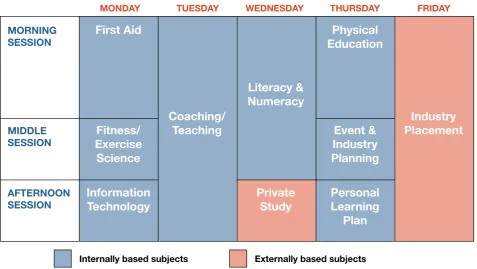
runs 9am to 3pm Monday to Friday (except Wednesdays which run from 9am until 12.30pm) across standard school term weeks in the Northern Territory, and the curriculum is delivered in a variety of ways including standard classes, online sessions, lectures and practical sessions29. Figure 4 provides an example of a typical student weekly timetable, which is taken from SEDA’s 2015 NT Program Guide and reproduced here with permission.
Figure 4: Example of a typical weekly timetable for SEDA SDP Darwin30
Source: SEDA 2015 NT Program Guide
Facilities
The main location of SEDA SDP Darwin is in the Pirates Rugby Club building on-site at the Casuarina Campus of Charles Darwin University. The Casuarina Campus of the university is approximately 12
kilometres north of the Darwin CBD. Rental of this space is a major cost for the program. The main bar area in the clubhouse contains standard tables and chairs, high bar stools and tables, and armchairs. These are re-arranged for classroom purposes, and often need to be put back in their original place at the end of the day when the club has a function that evening or the next day. This main room also has a moveable whiteboard and a large television screen which can be connected to the teacher’s laptop to display learning materials. There is no separate space for the teachers here, but they can access office space at the host school once a week to complete administrative tasks. In addition to the main room, the clubhouse has a kitchen, and a gymnasium with lockers and showers that students can use. Since SEDA is a guest in this space, there are no permanent displays of student work or learning resources. All materials are on laptops, in the online learning space, or portable. Staff bring much of this, including a wireless modem.
Students are provided with a notebook computer with internet access, course curriculum information, a personal program email address, access to the Work Skills Logbook through the SEDA Online System, as well as a SEDA student ID card which makes them eligible for free travel on public transport around Darwin and Palmerston31.
MONDAY
Internally based subjects
First Aid
Fitness/
Exercise
Science
Coaching/
Teaching
Placement
Industry
Literacy &
Numeracy
Private
Study
Personal
Learning
Plan
Event &
Industry
Planning
Physical
Education
Information
Technology
TUESDAY WEDNESDAY THURSDAY FRIDAY
MORNING SESSION MIDDLE SESSION AFTERNOON SESSION
Key Dimensions
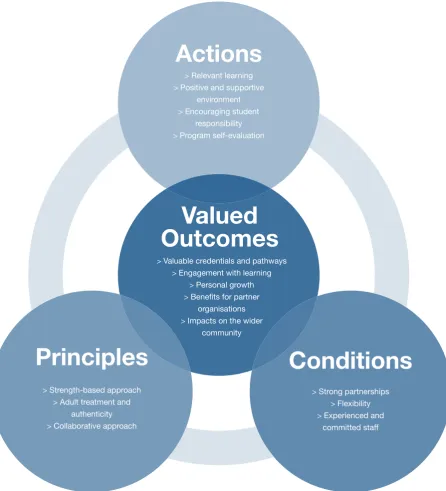
The remainder of this case study will report on four key dimensions of the work of alternative or flexible learning programs: Valued Outcomes, Actions, Principles and Conditions. These dimensions are interrelated, which means some specific aspects (eg. relevant learning) may appear in several sections. Figure 5 schematically represents the dimensions.
Figure 5: Key dimensions - SEDA Sports Development Program Darwin
Conditions
Principles
Actions
> Relevant learning
> Positive and supportive environment
> Encouraging student responsibility
> Program self-evaluation
Valued
Outcomes
> Valuable credentials and pathways
> Engagement with learning
> Personal growth
> Benefits for partner organisations
> Impacts on the wider community
> Strength-based approach
> Adult treatment and authenticity
> Collaborative approach
> Strong partnerships
> Flexibility
> Experienced and committed staff
These dimensions address aspects that are of relevance across alternative or flexible learning programs for marginalised young people. The specific detail within each dimension varies for each program and case study. The dimensions are:
• Valued outcomes: this addresses outcomes from the program that count as ‘success’ in the perspectives of key stakeholders: students, graduates, staff and community members. Evidence is provided for achieving those outcomes, based on interviews, fieldwork observations, and program documentation.
• Actions: this dimension refers to the actions carried out through the program that support the achievement of the valued outcomes. This offers practical insights in how successes are realised.
• Principles: underpinning the program’s practices are principles that produce a foundation for actions. These principles together form the (implicit or explicit) philosophy or vision of the program.
• Conditions: this dimension includes various conditions that enable or hinder people in a program to act on its principles and achieve valued outcomes.
Rather than pre-determining what counts as success, this section is based on the perspectives of students, staff and key stakeholders. We identified five major categories of valued outcomes from SEDA SDP Darwin, which are discussed in detail below.
Valuable credentials and pathways
SEDA has a strong focus on instrumental outcomes: providing students with valuable qualifications and supporting students into positive ongoing pathways in terms of further study or work. Finishing Year 12 and gaining their Northern Territory Certificate of Education and Training (NTCET) is particularly important for students, even if it is just “to have something to fall back on” (Jackson, student). However, it is the combination of gaining the NTCET alongside many other credentials that is most valued by students. Jaicob (student) points out “I got coaching qualifications and I got first aid qualifications as well, which also helps your CV builder”. Students also gain a Certificate II, III or IV in Sport and Recreation, which Kelly (student) sees as a major benefit: “if I didn’t want to go to uni, I’ve got a qualification. I can just go out and get a job straight away”. Community member Dianne recognises the attraction of these multiple qualifications:
I think that its selling point is the fact that you can actually get your [Year 12] Certificate by doing the VET qualifications plus some of the NTC subjects to go where you want to, whether it’s actually straight into employment or whether it’s into a university pathway. There are lots of options around it.
In 2013, all 15 students in the Year 12 program completed all requirements for the NTCET, and graduated alongside Year 12 students at the host school, Casuarina Senior College32.
Graduation is not the end goal, however. There is also a strong focus on formulating and planning for positive future pathways post-SEDA. Simon (staff) says this is evident in the fact that students “are actually looking at what they want to do when they finish”. He further expands on the impact the program has on students:
I guess we’ve taken a lot of students that potentially would have been at risk of not completing
VALUED OUTCOMES
Valued
Outcomes
> Valuable credentials and pathways
> Engagement with learning
> Personal growth
> Benefits for partner organisations
at further study and jobs; changing their mindset around work […] From dropping out of school and looking at part-time jobs, where one student was unloading containers in a warehouse and another was working unpacking stuff and putting it on shelves, to now having them both looking at being PE teachers is quite amazing. (Simon, staff)
Will is one of the students who aims for university: “after I complete Year 12 I hope to follow footsteps and going to university and trying to maybe get a teaching degree to be a PE teacher”. Calvin (student) is hoping to go into a sports science course at Charles Darwin University. But not all students plan to continue in a sports-related field. Jaicob (student) explains that he aims to go to university “to do media, digital media and media production”. SEDA is supporting him to gain a Certificate IV, which offers “automatic entry. So that gets you in regardless of which Cert IV it actually is”.
In terms of employment, Peter (community member) suggests: “The longer they stay in the education system, the more likely they are able to get a job”. The work experience opportunities for SEDA students are seen by community members as valuable for future employment outcomes for students and sporting organisations alike:
With these young individuals getting skills through schooling, I’m hoping that perhaps in the future when we do advertise a development officer job or whatever that we might see some of these people putting their hand up who are local and already have some skills to step into the role. (Gary, community member)
In the week of the research visit, staff gave students information about two upcoming job opportunities with Basketball NT and AFL NT. Positive career pathways are not just for the future, however, but can start while students are still at SEDA. Joel (staff) notes that through running sessions like the primary school clinics, SEDA students “get an understanding of what a teacher does and looks like, and consequently a lot of them have got after-school paid work”. Jackson (student) confirms this: “I’ve been offered jobs through other schools that we’ve worked at”. Jaicob (student) also already has a part-time job:
I’ve actually gained part-time work through this with Active After-Schools. So you run hour long sessions once a day. […] You’re representing the sport area of the government. We run sports for an hour. You get paid a fair bit for it as well.
Engagement with learning
The ability of the SEDA program to engage, and in many cases re-engage, young people with learning is not only an action that leads to the credentials and pathways outlined above, but also a valued outcome in its own right. Jaicob (student) notes that “a lot of people in the class were going off the tracks as far as school was concerned, and they’ve completely turned around with the program”. Gary (community member) illustrates how SEDA can help students get back on track:
There is one particular kid that I’d like to use an example. He’s been in our junior performance programs for years and now he would be a 17-18 year old young man. The last few years he had started to drop off our programs, stopped playing, getting interested in other things, flunking school. He went into the SEDA program with that going on in his life and this year we’ve seen a significant difference in him as a person. I think that’s a real success case for what SEDA can bring someone in his shoes.
Many students viewed SEDA as a second chance at finishing school and experiencing educational success. Will (student) believes he “would have probably dropped out” of secondary schooling without SEDA. As Sally (community member) notes, “they still want to be part of the educational process, and SEDA is a stepping stone [that’s] been wonderful for those type of kids”. Jackson (student) is an example
of this process:
I wasn’t really enjoying high school, I wasn’t doing well, I kind of dropped out at the end of the year. I heard about this program and thought it would be more suited to what I needed, otherwise just get a full-time job. So I’m doing this because I still want to become a sport teacher so this gives me the opportunity to, it’s like a second chance. […] It was the biggest second chance I could ever ask for. I mean it saved me pretty much and it’s given me all these new opportunities.
Simon (staff) explains how important it is that disengaged students are given an alternative option for reconnecting with learning when young people reach the non-compulsory age for education:
The past experience with students in similar situations was that they would have got to the point of being post-compulsory, which is 17, and then school would have asked them to leave, which still currently happens. So then they don’t have formal education, they don’t have a job, and it can be quite a downhill spiral for some of them.
Successful re-engagement can be traced to the increase in students’ personal commitment and motivation in SEDA. Jackson (student) explains that “last year I was hiding stuff from my mum, not completing
schoolwork. But I don’t really have to hide it anymore”. At his previous school he does not think he would have completed Year 12 because “I just wasn’t motivated to get up in the morning and go”. Will (student) also had no motivation to attend his old school, but finds SEDA much more enjoyable: “I love being [at SEDA] and I like what I’m doing, so it makes everything much better and easier for me”. Joel (staff) explains a mother’s amazement about her son’s learning achievements: “She can’t believe that he’s producing work and that he is doing it to a satisfactory or competent level”.
Personal growth
his previous school, but in SEDA “we’ve all become generally more outgoing”. Simon (staff) suggests such confidence increases gradually over the course of the SEDA program:
One particular student from last year did not submit one piece of work to his school. He’s nearly finished all his work to date this year, and it took probably a good term and a half for him to realise that he was capable of doing that […] there’s no stopping him at the moment. He’s doing really, really well. (Simon, staff)
Joel (staff) argues that this change comes about through “a lot of positive reinforcement” to improve “your own personal pride and connection to the community”. Simon (staff) agrees that students become “really drawn into adulthood, responsibility, ownership and belonging to the group”. Joel (staff) describes how, earlier in the year, they asked students:
To give us a sense of how they are viewed amongst each other, and how they’re viewed when they walk down the street, or when in the primary schools, or when working with the sporting bodies. They came up with pride, strength and respect. They were the three words that they thought were really important for them.
The pride of SEDA students is evident in their wearing of the SEDA sports uniform. Simon (staff) explains that, unlike most schools elsewhere in the country, senior high schools in the Northern Territory do not have a school uniform. It is therefore remarkable that “our students wear them every day and are quite proud of having those uniforms and having their SEDA ID, and being different to everyone else in a positive way” (Simon, staff).
Their own increased maturity becomes obvious to students in comparison to peers at their old school. SEDA students occasionally choose to study in the SEDA office at the host school, for example to get a specific task finished. In this context, Simon illustrates:
We had one student working with me at his old school, and he said “can I go to lunch”? And I said, “Absolutely, you can do what you like”. He was out for about ten minutes and came back and said “I’m not into that anymore”. His headspace had shifted away from that school mentality.
They get huge amounts of experience from working with kids and being in front of a classroom of kids which isn’t easy […] The difference I’ve seen has been enormous, especially for a couple of them who were really shy at the beginning. It’s very clear that they’ve grown a great deal in self-esteem and confidence.
Supporting people less fortunate than themselves contributes to students’ growth as well. In relation to the sports clinics for disabled persons, Elliott (student) says “making them happy makes me happy as well”. Increased confidence and maturity also supports the development of leadership skills:
You can really see they’ve developed some really good leadership skills. I would say their leadership skills are much more advanced and developed than a lot of other students of a similar age […] Every time they were given the opportunity to take some leadership and come up with ideas themselves they took it on board without a doubt. They jumped in and were keen to do as much themselves as they could. (Peter, community member)
Benefits for partner organisations
A hallmark of all SEDA programs is that they work closely with local sports organisations, community groups and schools. Partnerships with SEDA SDP Darwin bring substantial benefits, especially for various sporting organisations in the Northern Territory and for local primary schools. Peter (community member) argues that having SEDA students available for work experience has allowed sporting organisations “to run more sessions in the community and expose their sport to more local kids and school groups”. Joel (staff) agrees: “the sporting partners and people who support the SEDA program now have this really nice big volunteer workforce”. As a result, staff in such organisations are freed up to expand activities not just in Darwin, but also in remote communities:
Development officers sometimes get tied up in Darwin and surrounds running school activities at times when it’s not a strategic priority to us, it’s more just generating a target number in terms of I suppose a KPI. But it would be a lot more effective and beneficial to us as an organisation to be out doing remote work […] The fact that we’ve got four SEDA kids who can run programs in schools kind of frees the permanent staff up to do that sort of travel. (Gary, community member)
Community members further argue that the quality of the sport programs that local organisations offer has improved, not just the number:
I’d say the biggest success we got out of this year was not necessarily the quantity of programs we now do but the quality of what we’re doing. One program we’ve been running for two years now, and there was a significant difference in the quality of the program we put out this year, and that was simply because on four mini-fields we had at least one person on the field that has got the skills to engage the young kids. It makes a big difference to the fun the younger kids are having when you’ve got the support of a 17-18 year old that is into what they’re doing and making it fun.
(Gary, community member)
Photo provided by SEDA SDP Darwin for use in public domain: http://dusseldorp.org.au/priorities/alternative-learning/case-studies/ seda-sports-development-program-darwin/
The SEDA program also benefits local primary schools, where SEDA students run weekly sport clinics. Sally (community member) enthuses that having the SEDA students at her school once a week has been “fantastic”, and her students “love it”. She explains that her students “like to have other people teaching them and they develop a rapport really quickly with those older students. I call them ‘coaches’ and that’s how I introduce them to my students”. SEDA staff also recognise that having the SEDA students running clinics at primary schools provides the younger children with positive role models:
For some of them, there is a person that is connecting with them and that might not happen very often for quite a few of them. So there’s a bit of role modelling. […] They’re acting out a healthy lifestyle and being positive and having fun. […] There’s over seven or eight hundred young people in and around this area through all the clinics and all the major events that they’ve done, that they’ve made contact with, and maybe just show them one skill or maybe just ask them their name. So that can only be a really powerful thing. (Joel, staff)
These benefits for partner organisations are not an accidental side-effect, but rather purposely built into the program through the curriculum and timetabling (also see the section on Actions).
Impacts on the wider community
Beyond the partner organisations, the activities of SEDA students also provide strong benefits to the community at large. By “actively engaging [primary] students in sports and fitness” (Simon, staff) the clinics promote improved community health. There are also other social knock-on effects:
There are a couple of young boys doing some really good work in and around their community where they do have a real role and they live in that community. […] A really big part of their culture is becoming a man and earning money and that sort of stuff. That’s a huge benefit for that individual community. (Joel, staff)
which, in itself, has benefits in terms of crime reduction and health and all those kind of boxes that governments looks for. (Gary, community member)
Moreover, as Jaicob (student) explains, “everyone in the program has to do at least 20 volunteer hours” which “can help the wider community in heaps of ways”. Students embrace opportunities to contribute to the community:
We’ve run a lot of events this year and we’re finding from these SEDA kids that they’re volunteering to do jobs as well so it’s not only about that they have to do. They’re actually engaged in the community and giving back to the community. (Gary, community member)
The students also get involved in the community in ways not to do with sport. Will (student) says that they “have been doing a lot of charity work. We’ve been helping people with disabilities. We did shave for a cure”.
ACTIONS
Actions
> Relevant learning
> Positive and supportive environment
> Encouraging student responsibility
> Program self-evaluation
To achieve the outcomes that are valued, SEDA SDP Darwin staff members use a range of actions. Many of these are familiar from across many alternative and flexible learning programs – although each is given its own shape within the program. Grouped into four categories, these actions are outlined below.
Relevant learning
The active approach to learning is popular with SEDA students. Kelly (student) argues that the most important factor is that “it’s really hands-on” because she “hated just sitting in class writing all the time”. Brendon (student) says he “cannot really work in a classroom at a normal school” because he “has to be moving”. The specific nature of the curriculum at SEDA, connected to students’ interest in sport, ensures that this active learning is meaningful and relevant. Will (student) explains that his work placement in a primary school “means that I can learn the life of a PE teacher, learning what they do in a real one on one, hands-on way”. Jackson (student) also enjoys having relevant learning opportunities:
I do more subjects that are suited to me. We’re not always stuck inside. We do a bit of sports but sports related to our work […] when we go out and do a clinic that is going to help us. It’s not just sport for fun; its sport that we’re going to use tomorrow when we run it for the little kids.
This is evident one morning, when students start with some games on the field outside. Once back in the room, Joel explains how they can vary those activities to suit different age groups, for the primary school clinics or their work placement or part-time work with sports organisations . As Joel (staff) points out, the focus on practical experience is entirely intentional:
The practical, coaching and fitness take up a big percentage of the week […]. Work skills are then tied in with their work placement in the second semester. It is all about ‘you’ in the real world, ‘you’ as a person who can be employed.
umpiring, coaching and keeping score . The fact that the event was held at the high profile TIO stadium was a bonus for both the primary school girls and the SEDA students.
The following day, Joel congratulates students on “a strong finish for probably the last event we are involved in this year”. He then puts up a slide listing eight employability skills (communication, teamwork, problem soling, initiative, planning, self management, learning, and technology) and comments that these were in evidence during the AFL day.
Working with community organisations enables SEDA students to gain relevant learning experiences beyond running events as well. Charles (community member) sees this as “a great way to give the kids a very practical view of work”. To achieve this, staff and community members encourage students to engage not only in running activities, but also in the work that sits behind those:
They can see what working in the industry looks like, so that exposure to three different sporting organisations that they know and are familiar with but also that they actually understand what it is like behind closed doors, in an office or administration, and not just kicking a ball. (Joel, staff)
There’s a lot of work obviously with all the running around and sorting out the venues, so we try to get them involved in that planning process as well to show them that we don’t just turn up on the day and it happens to work. There’s a huge amount of organising, particularly when there’s multiple schools involved, the logistics of buses and transport arrangements, venue hire, making sure the equipment is suitable […] It’s taking a step back and saying “Okay, now how can we take this to the next level? What do we hope to achieve out of this session?” […]. Having more of a look at why we’re actually running the program and again where does that funding come from, does that reach the indicators we’re looking for with that funding. So it’s looking at the program as a whole rather than just that individual hour that we’re running around playing the sport. (Peter, community member)
Positive and supportive environment
SEDA SDP Darwin works to creating strong and respectful relationships between all members of staff and students. This is supported by the practice of having a single class with only two teachers, as Calvin (student) explains, because “you bond really well with everybody”. Robyn (community member) agrees that always having the same teachers is useful:
I think it’s the stability of it all, because they’re not getting thrown around five or six different classes. They’ve got just that one class and I think [my son] enjoys that. I think there are a few students that do.
The actual approach by those two teachers matters too. Will (student) says the teachers are easy-going and approachable: “You can talk to them whenever you want. You can text them and say ‘I will be late’ or ‘I feel a bit sick’ so that’s pretty good”. In addition, students describe the strength of relationships among students. Kelly (student) believes that “it’s so much more relaxed here because we’re in one small class. Simon (staff) illustrates how such strong bonds formed amongst the students early into the program, and also sees the single class as an important contributor to this:
We wanted words to describe SEDA after a few weeks. So we gave them a bit of time and they actually came up with – it’s a Hawaiian word – ‘ohana’, SEDA Ohana, it means family. So that’s how the students described it, because they felt really connected to each other and knew each other really well. […] They all felt really comfortable with each other, and there was one class, they were together all the time, which is more like primary school. So I think it was quite different to what they’d all been used to.
The provision of learning support is also a positive action for students. Brendon (student) states that he “finds it much easier to work because we get more help and extra help if we want it”. Joel (staff) explains that part of the support process involves offering positive praise and feedback to keep students engaged with their studies:
A lot of understanding, patience and work is needed to make them feel valued and important, a lot of positive praise. Particularly in the early days, in things like the clinics, your best pitch it to really hone in on making them feel connected and doing a lot of work after the clinic to get them to identify what they did really well and what impact that can have.
Jackson (student) explains that teachers “don’t hold us by the hand but if you want to be here they’ll help you. If we come, we do what we have to do”. This links to the next action identified in the analysis, in terms of the responsibility and independence that is fostered by staff.
Encouraging student responsibility
Setting high expectations and encouraging students to take responsibility is particularly pushed by SEDA staff members. This is underpinned by providing potential students (and their parents/carers) right from the start with sufficient information and opportunities to explore why or how the program might be right for them:
up student interviews and students have to bring along their resumes, references from someone in the community – whether sporting or not – as to why they’d be a good candidate for SEDA. They then go through a more detailed explanation of why they want to be involved. We talk about our expectations […] Students are aware of that at the end of the process, which gives them the opportunity not to continue if they don’t want to. (Simon, staff)
The main point of this process is to let students know where they stand at all times. From here on, students are encouraged to take on responsibility for their own learning. Simon (staff) explains that this expectation grows as they move deeper into the program:
Initially to do an item of work they would have to ask for assistance and we would step them
through every single piece. Now it’s independent. Now they log on, they can get their work, they can complete it, upload it, submit it, and they know the level of expectation we want. They know if they are submitting work that is to a satisfactory standard.
Staff support students to recognise and develop their capacities for self-directed learning. As the year is drawing to an end, Joel (teacher) uses a colour coded system to show students where they are at with each of their assignments, ranging from ‘red cherries’ meaning due to SEDA and not yet submitted, to ‘green apples’ meaning submitted and assessed as satisfactory . He encourages students to plan on which day they are going to finish which tasks. Kelly (student) appreciates this support for taking responsibility:
It then really gets into your head what you have done throughout the year and what you haven’t done so it’s like your own path of what you’ve got to do to get through.
There are really high expectations of student attendance, participation and independence. We’re not running around and chasing them or doing things for them […] they find their own transport, they travel to venues, they phone in when they’re sick; they are responsible for themselves. (Simon, staff)
This approach is backed up by the way sporting partners engage with the students, demonstrating a high level of trust in the SEDA organisation and students:
I felt it was better if they came up with their own activities, as long as they were different activities and I provided feedback after the session on which ones went well and which ones didn’t go so well and why they went well or not. It was to put the onus back onto them to come up with those activities and then to learn more through trial and error rather than us telling them that this is how we want it done […] we encourage them to take that leadership role. To be honest we put it out there initially but there were no reservations whatsoever, so every time I could I gave them the chance to organise themselves. (Peter, community member)
Within the cohort, students voted for two peers to act as leaders for the group – both to represent them on public occasions and to support students to take responsibility for their learning and actions. Joel (staff) gives an example of the role played by these group leaders:
They showed an ability to say, “well that’s not good enough, that’s not what we expect of the group” […]. There was one really good example of when, it might have been Active After School Care came in and did a qualification for them and really looked after the program, and there was a period through the day where they actually got carried away with the games and, you know, were doing their own thing. So that was a really good example of pulling them up the next day, writing an apology, “what did we do wrong?”. […] So we got all the students to write down their role in what happened, what could we do differently, and then they wrote an apology as if they were representing the group, and then we compiled all those. The team leaders sat down, chose the best, and then wrote an email to apologise on behalf of the group, and then they got a really good response back.
As this example shows, high expectations are backed up by staff through scaffolding: supporting the two group leaders as well as the whole class to take responsibility and live up to these expectations.
Program self-evaluation
Finally, staff and sporting partners also take responsibility for their learning, in terms of how the program is going. Joel (staff) says “we do a lot of self-review” and points to the flexibility staff have to vary the program in order to make it work:
The day-by-day structure can vary. You’re not bound by anything really. […] We’ve found mixing it up, short bursts has worked really, really well. But yes, we’ve changed the sequence of what we’re teaching.
This year’s students are generally relatively disengaged. They are at the lower end academically, so they did some testing with numeracy/literacy, and most of our cohort, as a percentile, would probably operate sort of 40% or under […]. In a bit of a contrast to that, next year’s cohort are not the same. So there are some in that situation, but […] I think next year’s cohort will be much stronger academically which will be a really interesting group to have. (Simon, staff)
In addition, by adding netball as a sport the 2014 cohort includes more girls, compared to only two girls out of 22 students in 2013. Existing sports partners also actively contribute to planning for the next year:
The question we’re sorting through with SEDA at the moment is what will be the percentage of new students next year and which ones are current students that already have a level of skill, so we can tailor our program according to the new students. So to pretty much replicate what we’ve done this year but with our own learning points of how we can improve it and how we can continue the learning for people who already have a year under their belt. (Charles, community member)
Gary (community) acknowledges the success the program has already had but also argues that the capabilities of the program are not yet completely known:
We’re all learning how it works in so many different ways and we’ve just got to be willing to adapt and go with it and see where it takes us. There is nothing that stands out that was terrible this year, but I think we’re still learning what the program can do in the wider spectrum.
The outcomes that are valued and actions taken by SEDA SDP Darwin are underpinned by several principles. These principles are discernable mostly in comments from staff and community. Some are explicitly formulated in interviews; others were determined through our analysis of the data. We identified three key categories of principles in the program.
Strength-based approach
It is common for innovative learning engagement programs to be underpinned by a strength-based approach, with curriculum connecting with students’ talents. This is facilitated in SEDA by the fact that all students (and indeed staff) share a common interest in sport. The way this works is highlighted by Dianne (community member):
It’s the practical nature of it and the engagement with the community around specific interests of theirs. Working with primary schools and sporting associations and being part of sporting events is practical and authentic learning.
This means, as Gary (community member) argues, that SEDA “is not for everybody but for some people I think it’s a great road to go down”. Peter (community member) explains how the strengths that SEDA builds on are different from conventional schooling:
For the students involved in SEDA that is the avenue they want to go down because sport is a big part of their life. They might express themselves in a physical way rather than in an academic way and that’s clearly their expertise, so to ask them to sit in a classroom for another two or three year might not be the right aim for the majority of them.
Sally (community member) agrees that the SEDA program on the whole is “a great opportunity to engage those students who are at that senior level but are not finding success within the normal parameters of Year 11 and 12”. As Gary (community member) explains:
PRINCIPLES
Principles
> Strength-based approach
> Adult treatment and authenticity
If you’re a kid who has never seen a great lot of success academically it can get a little bit difficult. I’ve seen a couple of the boys have really flourished in a very different environment to the normal school.
Dianne does not believe that SEDA is necessarily “picking up at-risk students” per se, but that “it’s actually picking up the students with some academic ability but also very much with a sport focus”. Importantly, all that is necessary to enrol is an interest in sport. Students do not need to have special sporting abilities and although many are interested in sport-related further study, but that is not required either. Jaicob (student) intends to go on to a media-related university degree. His choice to enrol in SEDA corroborates the strength-based approach: he had completed Year 12 the previous year “but it wasn’t a great standard” so he decided to try a different route to university entry and “I just like sports and I’m good at it, so I thought I’d use that to my advantage”. Sally (community member) offers an example of another student who
benefits from being able to draw on his talent for sport:
I often ask them “What would you like to do with this SEDA programme once you finish?” and they say ‘Go to uni’ and I say ‘well, the pathway is there’. […] The young gentleman that I speak of, my young student here, he says that if it wasn’t for them [SEDA] it got too hard for him in the end. He wasn’t fulfilling his attendance requirement, he felt like he was only fulfilling the 40% not the 80% of attendance and then workload got too much for him. He felt overwhelmed which caused him to fall further and further behind and then he basically thought ‘what’s the use?’. I said ‘So you were lucky that SEDA came along’ and he goes ‘Yes I was’. So having their gift in their sport they were able to reignite and marry that up with education.
The ‘young gentleman’ that Sally speaks of has particular “expertise in soccer” which he can use for his learning in SEDA. Community member Peter, however, argues that talent for a specific sport is less important than the students’ general passion for sport which enables transfer of skills:
They’re passionate about sport, so often that can be translated from one sport, even if they’re an AFL player they can translate up to cricket or football or swimming very easily by the sounds of it. Because from what we’ve experienced those skills of working with your younger kids is well developed and they’re very confident around a group of kids and that can often be the hardest thing.
Adult treatment and authenticity
Alongside the recognition of students’ strengths, sits a further principle of treating students as adults in the context of authentic work. As Kelly (student) highlights, students feel they are taken seriously as (young) adults:
We’re treated like adults. We’re given the work that we’ve got to do and if we don’t do it, it’s on our heads. [They] don’t chase you up for it. They tell you what you’ve got to get done but then it’s your own responsibility.
Adult treatment is also evident in the expectation for student responsibility (see the previous section on Actions in this report). This is facilitated by the authenticity of the work that students undertake. Within the classroom, for example, literacy is taught in relation to relevant tasks:
We have two sessions of literacy […] but that is sort of again practical learning where they’re not reading books. They might be tidying up or drafting a resume and cover letter, or reading short stories, or looking at issues in the news, or doing some public speaking. (Joel, staff)
In other words, even literacy and numeracy use authentic tasks relevant to their lives and their interests. Authenticity is visible in the SEDA uniform, which is very similar to the outfits worn by staff in the various partner sports organisations. Outside the classroom, learning experiences take place in real work contexts, whether as part of their work placement on Fridays, the primary school clinics, or special events for sports organisations. This is emphasised by community member Dianne:
It’s the practical nature of it and it is the engagement with the community around a specific interest of theirs. I think the working with the primary schools, working with the associations, being part of sporting events, all of those, it’s practical, it’s authentic learning.
The examples given by sporting organisations of the activities SEDA students engage in confirm this authenticity. For example, Peter (community member) lists in relation to events: “on the actual day […] umpires, assistants, helpers on each pitch” providing “one on one assistance for those students that require that extra help” and assisting “with all the set up and the pack up and all those sort of things as well”. Peter’s organisation also offers work experience to SEDA students, which means they:
Basically work alongside our recreation officer. So they start work the same time as our recreation officer, they attend the programmes, if the recreation officers are back doing planning, contacting schools they’re working alongside them, they finish the same time.
Collaborative approach
A third foundation for SEDA SDP Darwin is its collaborative approach. This is evident in the classroom through teamwork. For example, teachers joining students for sport activities and students working in pairs or small groups when running clinics and events. The sense of belonging and group identity is strong, supported by the positive environment (see the previous section on Actions in this report). Kelly (student) describes SEDA as “a little family” and Will (student) summarises it as a “mateship of peers” because “we all get along”. Many of the curriculum activities are group-based (such as fitness and physical education, first aid, and clinics and events) but many of the assignments are individual, such as reflection on those activities as well as literacy and numeracy task. Even in the latter, however, the collaborative spirit is obvious:
We might be under the pump to get a task completed, they’ll help each other out with those tasks. Some students will actually, if they’re finished, they’ll sit around […] and work with other students. So maths is probably quite unpopular as a subject for some reason, and we had some students that were quite good at maths and numeracy tasks and they would be completed ahead of everyone else. But rather than sit there and do nothing they would, without me initiating anything, go and work with some of the students who are struggling, explain the task to them and help them through it. Not just giving them the answers, but actually like a mini tutoring system, which then happened across every single activity once it started. (Simon, staff)
The collaborative approach extends to the relationship with partner organisations. The day before the AFL event for primary school students, the local AFL development officer drops by the class in the Pirates Rugby club to check all is ok from SEDA’s point of view and to make final arrangements. When he mentions that his staff will be at the stadium early to set up equipment, several students immediately volunteer to help out . Staff work closely with colleagues in partner organisations to provide worthwhile learning experiences for SEDA students that also benefit the partners. This includes evaluation and planning (see the previous section on Actions in this report) as Peter (community member) illustrates:
you run it, how would you organise this event, who would you invite, who would you ring to book the venue?”. So actually getting them involved more in that process of the whole event than just the running on the day.
Several conditions enable (and/or constrain) the ability of SEDA SDP Darwin to undertake the actions outlined above, in order to meet the outcomes that are valued within the program. Some of these conditions are similar to conditions for other alternative learning programs, but others are shaped by the specific context of SEDA SDP.
Strong partnerships
A key to SEDA’s success is strong partnerships, with sport organisations, local schools and (in terms of accreditation and funding) the state department of education. The authenticity and relevance of the curriculum relies on collaboration with partners, but the strength of the partnership is that the benefit is mutual – it is a genuine two-way street:
I think we can provide a lot towards each other. […] our biggest challenge is resources, like really hands-on man hours, it’s as simple as that. That’s an issue we face a lot of the time and I think they [SEDA] have that and probably the assistance they need […] some feedback to their students about how they’re going and also some clear objectives and some clear programs for their students to work on. So I think the partnership can be very advantageous to both of us.
(Peter, community member)
Both Sally and Dianne (community members) see the partnership as good ‘public relations’ for both SEDA and their own organisation. Sally points out SEDA has permission to publicly use material (such as videos) from the students’ work in her organisation. Dianne says: “we can bring them into our environment in different ways and it showcases them, it showcases us”.
Many of the organisations themselves also work together. Peter (community member) points out: “that’s the advantage of a small community like Darwin, people tend to know everyone else’s sports quite well and I think SEDA fits into that really well”. A shared vision is useful, as Gary (community member) points out:
People don’t work in sport for the money because there is no money. We’re there because we’re
CONDITIONS
Conditions
> Strong partnerships
> Flexibility
things that I’m aligned to as a person, not necessarily as an organisation, and that’s the reason why I’m so willing to make it happen. Because it’s not just about us, it’s more about the individuals on the program and the successes it can bring to their life for me. So if we can be a piece of the jigsaw in that happening, then that’s a win.
As mentioned earlier, SEDA SDP Darwin is expanding to include Year 10 in 2014, and that is supported by the partnership with the host school, Casuarina Senior College, and with the Northern Territory Department of Education. The latter partnership does have some challenges, as Simon (staff) explains:
[The Department of Education] will only fund 60 students. […] We have had some conversations about lifting that cap, and really the only caveat around lifting the cap of 60 students then becomes funding, so it does become a money issue after that. They were happy to look at numbers beyond 60 as long as it was cost neutral to the Department.
Dianne agrees that “those sorts of logistical issues will always I think be a challenge, particularly in tight financial times”. Without the contract with the Northern Territory Department of Education, which enables funding to follow students from the host school Casuarina Senior College (where they are formally enrolled) to SEDA, the program would not be viable.
Finally, the relationship between SEDA SDP Darwin and its mother organisation SEDA is also a kind of partnership. Having a solid framework that has shown considerable success in another state has helped SEDA SDP Darwin achieve considerable success in only its first year of operation. Despite minor administrative issues that may arise when conducting a program that answers to a larger organisation in another state, being able to draw on SEDA head office expertise and processes from the beginning enables the Darwin-based staff members to implement and tweak as they go, rather than having to invent a program from scratch.
Flexibility
Community members and staff interviewed express the need to remain reasonably flexible with the curriculum to suit SEDA students and keep them engaged in the program. Ryan (staff) reflects on the importance of such flexibility:
Being flexible with timelines and course structures is necessary to suit students as the year progresses, to keep their engagement levels high. For Joel (staff), teachers in this type of provision need to always ask “what’s going to be best for these guys”. Simon (staff) provides an example of how the program changes what is taught through the year as the confidence levels of the students grow:
I think initially they were quite excited about being in the program. So we had that sort of
‘honeymoon period’ where everything was running really well […] we did a lot of physical activity to encourage them to come, because that’s what they love to do. By the end of Term 2 it had sort of set in that they were actually still doing schoolwork, so they sort of struggled a little bit towards the end of Term 2, but we got them through […] They came into work placement in Term 3, which is another thing they were really looking forward to. So we’ve sort of finished the term off again on
a high.
As is common among alternative and flexible programs, the timetable is flexible, in sharp contrast to the rigid use of short (40 or 50 minute) periods governed by the school bell in most conventional school settings. This allows for better integration of learning and more discretion for the teacher to ‘read the play’ and mix up the day to keep students engaged. The structure of having a single class, shared by two teaching staff, further enables this flexibility. For example, the AFL event for primary school girls during the research visit took place on a Wednesday. Joel (staff) later explains that Wednesdays are usually a classroom day but when the AFL asked SEDA to help out with the event, staff swapped the schedule for Tuesday and Wednesday around for that week. Simon (staff) agrees:
Not being in a school environment gives us the flexibility to do different things during the day. If you wanted to change your lunch hour to your break times or session times you can do that simply.
A drawback of the small size is that usually only one staff member is with the class, and therefore needs to look after all students by himself. The growth to two classes, with a teacher each, in 2014 is something that Joel (staff) looks forward to, as it increases their capacity to be flexible:
Another thing that would benefit next year is having extra staff […]. If I’ve got extra support, I can take a student away and have a conversation there and then, rather than waiting for a break, judging when I’m going to do that and still trying to manage. So that will be a real benefit […] That’s probably where we’ve been limited is when there’s just one on the ground.
Flexibility has also been necessary in adapting SEDA as originally a Victorian program to the Northern Territory. This includes altering administrative rules coming out of the Victorian head office that are not relevant locally. Jackson’s (student) experience illustrates this:
I had my [driving] license already coming into the program. A couple of other boys had to catch the bus at the beginning of the year because SEDA had a rule where you were only allowed to have one extra passenger due to the road laws in Melbourne. Now they’ve changed it so we can follow our road rules in Darwin, and now I can give my friends a lift.