VICTORIA UNIVERSITY
Evaluation of the School Breakfast Clubs
Program
Final report
Febr
uary 2019
Dr Fiona MacDonald
vu.edu.au
Evaluation of the School
Breakfast Clubs Program
FINAL REPORT
FEBRUARY 2019
Dr Fiona MacDonald
Acknowledgements
I respectfully acknowledge the Traditional Owners of country throughout Victoria and pay respect to the ongoing living cultures of First People. I acknowledge the Elders, their families and forebears who are the Traditional custodians of Victorian land for many centuries. I acknowledge that the land on which we work is the place of age old ceremonies of celebration, initiation and renewal and that the First Nation people’s continuous living culture has played a significant and unique role in the life of this region.
Thanks to the following for their contribution to the evaluation research and the Final Report:
School Breakfast Clubs Program schools
Case study schools: Benalla P-12 College, Broadmeadows Special Developmental School, Glengala Primary School, Meadowglen Primary School, Stratford Primary School and Talbot Primary School
Foodbank Victoria
Monitoring and Evaluation Committee, School Breakfast Clubs Program
Department of Education and Training Victoria
Associate Professor Julie White, Principal Research Fellow, Institute for Sustainable Industries and Liveable Cities, VU Research, Victoria University
Karen Rosauer, Lirata Consultant
Catherine Palmer, Projects and Administrative Officer, AVID Australia, Victoria University
Dr Philippa Moylan, Research Manager, Institute for Sustainable Industries and Liveable Cities, VU Research, Victoria University
Ben Harris, Manager, National Policy and Strategy, Australian Health Policy Collaboration, Victoria University
Dr Anna Vassadis, Research Assistant, Victoria University
Claire Brown, Director AVID Australia, Victoria University
Rosemary Calder, Director of the Australian Health Policy Collaboration, Victoria University
3
About
The Institute for Sustainable
Industries and Liveable Cities, VU
Research, Victoria University
The Institute for Sustainable Industries and Liveable Cities (ISILC) aims to create
resilient built environments, globally competitive industries and socially inclusive
communities.
We have a cross-disciplinary approach that draws on the expertise of academic leaders to
create solutions for today's social, economic, environmental and technological challenges.
Our researchers have diverse experience in collaborating with government and industry to
find innovative ways of addressing a broad range of crucial issues. They are drawn from a
pool of leading computer scientists, educators, engineers, economists, environmental
scientists, lawyers, policy influencers and social investigators who conduct important
research to produce first-rate outcomes.
ISILC undertakes applied and translational research to create healthier, smarter and
Contents
Acknowledgements ... 2
Contents
... 4
Figures
... 7
Abbreviations
... 10
Executive Summary
... 11
Introduction ... 11
Evaluation research of the School Breakfast Clubs Program ... 11
Key findings ... 11
Frequency and attendance ... 11
Improved student learning... 12
Operational practices ... 13
Connectedness and Relationships ... 13
Recommendations ... 14
Introduction
... 15
Current Knowledge
... 16
The Early Years ... 16
Diet ... 16
Food programs in schools ... 17
Breakfast at school ... 17
School Breakfast Clubs Program
... 18
3.1 The Victorian Government commitment ... 18
3.2 The role of Foodbank Victoria ... 19
3.3 Delivering the program in schools ... 20
Evaluation Research
... 21
4.1 Evaluation research aims ... 21
4.2 Study design ... 21
Methodology and data collection ... 22
Sample of 48 schools... 22
Teacher survey ... 22
Case study research ... 22
Student wellbeing survey ... 23
Impact of the School Breakfast Clubs Program
... 24
5.1 Before the School Breakfast Clubs Program ... 24
5.2 School Breakfast Clubs Program food ... 26
Foodbank Victoria products ... 26
5
5.2.3 Additional food ... 28
5.2.4 Creating a menu ... 29
Source of additional food ... 30
Student appreciation of the School Breakfast Clubs Program menu ... 31
Emergency lunches ... 31
Excess food ... 32
5.3 Frequency of breakfast clubs ... 33
5.3.1 Building on existing programs ... 34
5.3.2 Responsiveness to need ... 34
5.4 Attendance at breakfast clubs ... 35
5.4.1 Frequency of operation by the daily average attendance at breakfast clubs ... 37
5.4.2 Average weekly attendance ... 38
5.4.3 Student motivation ... 39
5.5 Learning outcomes ... 40
Impact on education factors ... 40
Great start to learning ... 43
Special Schools: doing things differently ... 44
Impact on student behaviour ... 44
5.6 School punctuality and school attendance ... 45
5.7 Wellbeing outcomes ... 47
Wellbeing staff involvement ... 47
Nurturing, caring environments ... 48
Healthy nutrition ... 49
Student Wellbeing Survey ... 50
5.8 Shame and stigma ... 51
5.8.1 Stigma for parents and families ... 51
Shame for children ... 52
Reducing stigma ... 52
5.9 Connectedness ... 52
Developing relationships and connecting with students ... 52
Getting to know students ... 53
The benefits of eating with friends ... 54
Student helpers and breakfast club captains ... 55
5.10 Engagement with school communities and local communities ... 56
A communal breakfast ... 56
Promoting the School Breakfast Clubs Program ... 57
Volunteering for breakfast clubs ... 58
Anticipated level of involvement ... 59
Community volunteers ... 60
Operational practices
... 63
6.1 Staffing breakfast clubs ... 63
Level of staff involvement: comparison from pre-program to 2018 ... 63
Level of staff involvement with breakfast clubs by average attendance and school size 65
Level of staff involvement by school type ... 65
Barriers to frequency ... 66
Number of staff and volunteers running breakfast clubs ... 66
Paying staff ... 67
School staff commitment to breakfast clubs ... 68
Education, welfare and wellbeing staff ... 68
The challenges of family, school community and community involvement ... 69
6.2 Barriers to attendance... 70
6.2.1 Barriers ... 70
6.2.2 Monitoring attendance ... 71
6.3 Operational model ... 72
Conflicting demands ... 72
Timing of breakfast clubs ... 74
6.4 Cost to schools of the School Breakfast Clubs Program ... 75
Staffing costs ... 75
Incorporating breakfast clubs into staff workloads ... 75
Weekly costs ... 75
Setting up costs ... 76
Additional items/infrastructure ... 77
Discussion
... 79
7.1 Introduction ... 79
7.2 The evaluation research approach ... 79
7.3 Overall findings ... 80
7.4 The research questions ... 80
Key findings ... 80
Areas for improvement ... 81
Key findings ... 81
Areas for improvement ... 82
Key Findings ... 82
Areas for improvement ... 83
7.5 Recommendations ... 83
Appendix
... 85
8.1 Teacher survey ... 85
Survey instructions ... 85
8.2 Impact graphs from teacher survey ... 86
Educational factors ... 86
Wellbeing Factors ... 89
Nutrition Factors ... 91
Social and Environmental Factors... 92
Discipline Factors ... 94
7
Figures
Figure 1. Schools currently participating in the School Breakfast Clubs Program, by school type 18
Figure 2. Participants for case study school interviews and focus groups 23
Figure 3. Timeline of products introduced to the School Breakfast Clubs Program 27
Figure 4. Volume of food distributed (kgs) by years and product 27
Figure 5. Additional food provided by schools at breakfast clubs 29
Figure 6. Source of additional food provided at breakfast clubs 30
Figure 7. Level of demand in schools for emergency lunches 31
Figure 8. Frequency of breakfast clubs, pre-program to 2018 33
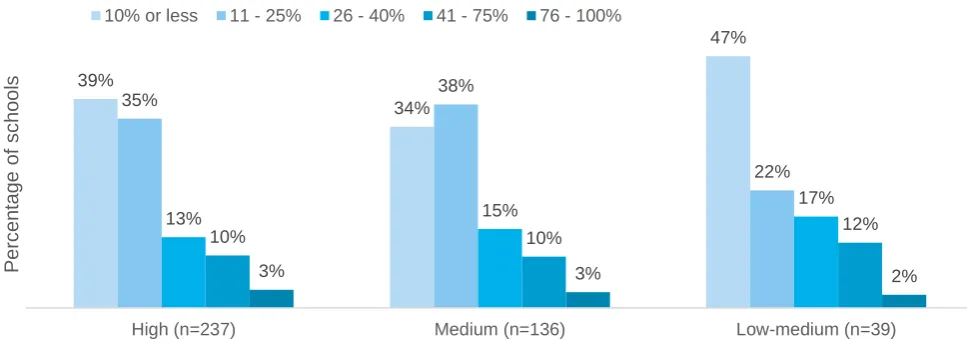
Figure 9. Frequency of breakfast clubs by Student Family Occupation
Education (SFOE) index 35
Figure 10. Average number of students attending breakfast clubs each day of operation 35
Figure 11. Comparison of average attendance at breakfast clubs by Student Family
Occupation Education (SFOE) index 36
Figure 12. Comparison of average attendance at breakfast clubs between metropolitan and
non-metropolitan schools 37
Figure 13. Frequency of breakfasts clubs by percentage of student enrolment attending 38
Figure 14. Comparison of the number of breakfasts served every school week, based on average
number of students attending breakfast clubs, from pre-program to 2018 39
Figure 15. Impact of breakfast clubs on student concentration,
reported by teachers and school staff 41
Figure 16. Impact of breakfast clubs on student social skills 41
Figure 17. Impact of the breakfast clubs on student academic outcomes 42
Figure 18. Impact of breakfast clubs on removal from class 45
Figure 19. Impact of breakfast clubs on student punctuality 46
Figure 20. Informal learning linked to breakfast clubs 49
Figure 22. Findings from student wellbeing survey 51
Figure 23. Impact of breakfast clubs on social relations between students and school staff 53
Figure 24. Number of schools with students helping at breakfast clubs 55
Figure 25. Comparison of parent, school community and local community involvement with breakfast
clubs, pre-program to 2018 58
Figure 26. Impact of breakfast clubs on social relations between students and
community volunteers 61
Figure 27. Comparison of school staff involvement with breakfast clubs,
from pre-program to 2018 63
Figure 28. Level of staff involvement comparison of Student Family Occupation Education (SFOE)
index 64
Figure 29. Level of staff involvement with breakfast clubs, compared by average attendance 65
Figure 30. Barriers to increasing the frequency of breakfast clubs 68
Figure 31. Number of weekly hours spent on breakfast clubs by frequency of operation 68 Figure 32. Role of staff spending time on running and co-ordinating breakfast clubs 68
Figure 33. Reasons that students do not attend breakfast clubs 70
Figure 34. Operational days for schools offering their breakfast club less than five days a week 73
Figure 35. Finishing times of breakfast clubs 74
Figure 36. Weekly spending on breakfast clubs reported by principals 76
Figure 37. Approximate cost of additional items or infrastructure for schools 77
Figure 38. Impact of School Breakfast Clubs Programs on student concentration 86
Figure 39. Impact of School Breakfast Clubs Programs on student punctuality 86
Figure 40. Impact of School Breakfast Clubs Programs on student attendance 87
Figure 41. Impact of School Breakfast Clubs Programs on student academic outcomes 87
Figure 42. Impact of School Breakfast Clubs Program on student behaviour 88 Figure 43. Impact of School Breakfast Clubs Program on student social skills 88
Figure 44. Impact of School Breakfast Clubs Program on student engagement with
class activities 89
Factor 45. Impact of School Breakfast Clubs Program on the mental health of students 89
Figure 46. Impact of School Breakfast Clubs Program on the physical health of students 90
9 Figure 48. Impact of School Breakfast Clubs Program on student awareness of healthy eating 91
Figure 49. Impact of School Breakfast Clubs Program on student food selection and food
preparation skill 91
Figure 50. Impact of School Breakfast Clubs Program on student eating behaviours generally 92
Figure 51. Impact of School Breakfast Clubs Program on social relations between students and
school staff 92
Figure 52. Impact of School Breakfast Clubs Program on the health promoting environment of the
school 93
Figure 53. Impact of School Breakfast Clubs Program on social relations between students
and community members 93
Figure 54. Impact of School Breakfast Clubs Program on student removal from class 94
Figure 55. Impact of the School Breakfast Clubs Program on student detention 94
Figure 56. Impact of the School Breakfast Clubs Program on student short suspension 95
Figure 57. Impact of the School Breakfast Clubs Program on student long suspension 95
Abbreviations
DET Department of Education and Training Victoria
SBCP School Breakfast Clubs Program
SS Special School1
SFOE Student Family Occupation Education
Executive Summary
Introduction
This the final report from the evaluation research of the School Breakfast Clubs Program (SBCP). In 2015, the Victorian Government committed $13.7 million to partner with Foodbank Victoria and establish breakfast clubs in 500 of Victoria’s most disadvantaged primary schools. The overarching aim of this evaluation research was to evaluate how well the program achieved its stated purpose of tackling the disadvantage students experience through hunger and poverty, to help student learning and
engagement with school, and to build connections between students, families, school communities and local communities.
Evaluation research of the School Breakfast Clubs Program
The research investigated the implementation and operation of breakfast clubs, identifying effective aspects of the program and aspects that require improvement. The evaluation research investigated the impact of the program on student learning and connectedness to school and how schools built
connections between breakfast clubs, school communities and local communities. The Monitoring and Evaluation Committee (SBCP M&E), comprising representatives from Foodbank Victoria and the Department of Education and Training Victoria, provided guidance and feedback on the evaluation research, including assistance with the refinement of data collection instruments. The data were collected and analysed by the report author in consultation with colleagues from Victoria University as acknowledged.
The evaluation research was guided by the following questions:
1. How does the SBCP address the needs of students who attend school without eating breakfast and provide them with the opportunity to participate and engage with all aspects of school?
2. How does the SBCP improve student learning and connectedness to school?
3. How effective is the SBCP and how can it be improved and evaluated in the future?
Key findings
Frequency and attendance
Foodbank Victoria, in partnership with the Department of Education and Training Victoria (DET) has established breakfast clubs in 500 Victorian government schools. Many schools had identified a need to provide food to students who arrived at school hungry. Schools were responding to the need as best they could. Some schools handed out muesli bars or a piece of fruit while others provided cereal, toast, or juice served at a sit down breakfast.
Foodbank Victoria guarantees delivery of healthy, nutritious long-life and fresh food to schools twice a term. Between 2016 and 2018, Foodbank Victoria delivered over 1.8 million kilograms of food to SBCP schools.
12
Over 50,000 breakfasts are served every school week in SBCP schools.
More than 40% of SBCP schools conduct their program five days a week. The frequency of breakfast clubs in SBCP schools has increased consistently between 2016 and 2018.
On average, every SBCP school serves 33 students, each day the breakfast club is conducted. The overall attendance at breakfast clubs represents 21% of the total enrolments in SBCP schools.
The findings suggest that breakfast clubs are meeting the needs of more than the one in five children identified by welfare agencies who arrive at school without eating breakfast.10,11,12,13,59
Non-metropolitan schools provide breakfast for more of their students: 40% of non-metropolitan schools serve breakfast to over 25% of their student population, compared to 12% of metropolitan schools.
Schools with the highest level of disadvantage, as determined by their Student Family Occupation Education (SFOE) index, have been the most responsive to student need with 51% of the 237 schools with the highest SFOE index conducting their program five days a week. The frequency of breakfast clubs is consistent across metropolitan and non-metropolitan schools.
Approximately 165 schools conduct their program one or two days a week. The findings indicate that staffing is the greatest barrier to offering their program more frequently. Other issues include insufficient space to run the program and storage for the food provided by Foodbank Victoria.
Improved student learning
Teachers report that breakfast clubs have had a significant impact on student learning:
95% of teachers note an improvement in concentration
90% have observed greater levels of engagement and focus for students who attend
88% of teachers report improvements in student’s social skills
85% of teachers note a positive impact on the academic outcomes of students who attended breakfast club.
Teachers indicate that the combined improvement in concentration, engagement, social skills and other educational factors has had a positive effect on students’ capacity to learn and educational attainment.
Increased attendance and punctuality to class are attributed to the SBCP by 85% of teachers. They have observed an improvement in students’ attitudes toward school and their readiness to learn at the start of the day.
Students also recognise the benefits of the SBCP, linking the healthy food they eat at breakfast club with an improvement in their capacity to learn.
Breakfast clubs enable schools to teach children about the benefits of eating breakfast, healthy nutrition to their learning and overall development:
89% of schools use breakfast clubs to teach the importance of breakfast
89% of teachers note improvements in student’s awareness of healthy eating
92% of teachers report that breakfast clubs have a positive impact on the health-promoting environment of their school.
Operational practices
Foodbank Victoria provides an extensive menu, including grab-and-go options such as fruit cups or an apple, to schools who are able to order as much food as they need to conduct their breakfast club.
The flexibility of the SBCP is acknowledged as a significant strength of the program. The capacity to adapt breakfast club practices to the unique needs of their school community is highly valued by schools, contributing to the positive response to the invitation to participate in the SBCP.
Staffing the breakfast club is the most significant challenge for schools, over 72% identify this as an ongoing barrier to the frequency and reach of their breakfast club. Despite this barrier, schools have made a significant commitment to running breakfast clubs.
The findings show that school staff are largely responsible for delivering the program, with 88% of breakfast clubs conducted by school staff. Teachers are supportive of the program however the findings indicate that education support and wellbeing staff have made the greatest commitment to operating breakfast clubs.
Many schools engage volunteers from their school community and local community to assist with the running of breakfast club. Schools with regular volunteers are very appreciative of their commitment to the breakfast club.
The findings indicate that some schools prefer not to engage volunteers with their breakfast club with 30% reporting that they prefer to run the program with their own staff.
Around 25% of schools report that they pay staff to conduct the program.
Schools have created leadership roles for senior primary school students at breakfast clubs with over 50% of schools reporting that students assist with daily operations.
More than 85% of schools provide additional food at their breakfast club. Schools report that their
students prefer breakfast food that is not part of the Foodbank Victoria menu, with toast and spreads the most popular additional item. Preparing toast adds to the preparation time of breakfasts clubs.
Approximately 40% of schools have entered into partnerships with local businesses to donate the additional food for their breakfast club, over 75% purchase items from school funds, with some doing both.
Connectedness and Relationships
The evaluation research shows that the SBCP successfully addresses aspects of disadvantage for students. Nutrition is the focal point of breakfast clubs, responding to the immediate hunger needs of students, but the wrap around benefits of the program provide greater avenues for connection and engagement with students improving their capacity to learn.
Breakfast clubs enable schools to create nurturing, caring environments, where students can start the day having eaten a healthy breakfast and be better prepared for learning.
Schools report that breakfast clubs strengthen relationships:
95% of teachers observe a positive impact on social relations between students and school staff
89% of teachers report a positive impact on social relations between students and community members
14
The case study research demonstrated the commitment of schools to the inclusive nature of the SBCP, breaking down the shame and stigma that children and families living with disadvantage experience.14,16
The food provided by Foodbank Victoria is vital to the success of breakfast clubs but the invaluable support and assistance provided through its staff, induction program and communication is highly valued by SBCP schools.
Recommendations
The following recommendations for the SBCP emerged directly from the evaluation research findings:
Recommendation 1: That the Department of Education and Training and Foodbank Victoria investigate the possibility of providing additional practical assistance to schools to reduce the time required to prepare food for breakfast clubs. The aim is to reduce the time commitment for schools and make breakfast clubs more efficient. For example, the provision of larger (4 slice) or commercial sized toasters to schools would cut the preparation time for schools offering toast.
Recommendation 2: That the DET and Foodbank Victoria investigate ways to support schools to increase the frequency of breakfast clubs and provide breakfast to students every day where possible. For example, the DET could increase the scope of Foodbank Victoria to provide more support, or facilitate funding, for schools who are finding it difficult to offer their breakfast club more frequently.
Recommendation 3 That schools be encouraged to consider the days of the week they offer breakfast clubs when not operating every school day. The aim is to recognise the challenges for children going without food for extended days when breakfast clubs do not run every school day. For example, the Foodbank Victoria toolkit and induction program could be amended to include information to encourage schools to consider the impact of long periods between breakfast club for students living with hunger and poverty.
Recommendation 4: That schools be encouraged to keep accurate records of attendance numbers. The aim is to support schools to monitor their own breakfast club and implement a quality improvement program to ensure the program continues to meet the needs of their school community. The records would also assist with future evaluation of the overall program.
Introduction
This is the final report from the evaluation research of the Victorian Government’s School Breakfast Clubs Program (SBCP). The program, run in partnership with Foodbank Victoria, established breakfast clubs in 500 primary schools across Victoria. The findings reported here draw from the 4122 annual
surveys completed by principals or coordinators in 2018 and the teacher survey completed by 735 school staff in 2018. The following questions guided the evaluation research of the School Breakfast Clubs Program:
1. How does the SBCP address the needs of students who attend school without eating breakfast and provide them with the opportunity to participate and engage with all aspects of school? 2. How does the SBCP improve student learning and connectedness to school?
3. How effective is the SBCP and how can it be improved and evaluated in the future?
The aim of the final report is to:
1. Provide a full description of the Victorian program 2. Locate the program in the international literature
3. Provide Foodbank with insight into the implementation and impact of the SBCP on students and school communities in 500 Victorian primary schools, and to identify effective school level practices and aspects that need improvement.
4. Convey the views of students, principals, teachers, school staff and volunteers and the parents who participated in the case study research
5. Provide Foodbank Victoria and the Victorian Government with evidence about the impact of the SBCP on the significant disadvantage experienced by students living with hunger
6. Make recommendations for improvement and future evaluation research
Current Knowledge
The Early Years
Adequate nutrition is vital for students’ physical, mental, social, emotional, language and cognitive health and development, particularly in the early years.1,2 The physical, mental and social development
acquired in a child’s early years are prerequisites for success in education, the workplace and community.1 Adverse effects in the early years, including hunger and poverty, extend into adulthood,
impacting on wellbeing, mental health, physical development, literacy and numeracy proficiency and economic participation across the life course.1,2,3 In the context of Australia’s education systems, the
early years have largely been aligned with the pre-school years, for example, The Early Years Compact4
and the Early Years Learning Framework,5 yet the science of early childhood development and the
World Health Organisation defines the early years as pre-natal through to the age of eight.1,2 The
Victorian Early Years Learning and Development Framework recognises the significance of the first eight years of children’s development and extends programs into primary schools where possible.
Emotional wellbeing and social competence underpin the basic foundation of human development.1
Alongside the nutritional benefits of food, research has identified responsive caregiving and learning environments have a significant impact on children’s healthy development.3 Research suggests that
behavioural issues are more likely to emerge in students who are living in poverty.6 The negative effect
of family social and economic resources contribute to differences in children’s wellbeing.3 There is
evidence that nurturing care provided by caregivers and communities alongside families can have a positive impact on student’s health, growth and development.7
Diet
Concern about childhood nutrition in western nations has increased in recent decades as research suggests that children’s diet has deteriorated.7,8,9 Additional concerns about the negative consequences
for students living with hunger and poverty, and the impact on their health and capacity to learn, have been raised by welfare advocacy organisations across Australia, including Foodbank10, Anglicare11,12,
and the Australian Council of Social Service.13,50 A UNICEF review of Australia’s progress on the United
Nations Convention on the Rights of the Child revealed that 603,000 students live below the poverty line and that social disadvantage is entrenched in certain communities, both urban and rural.15 It has been
reported that as many as one in five Australian students live in a food insecure household.10,11,13 A
similar number of students go to school without breakfast at least once a week and 15% go to school without lunch.10 Going hungry can be considered as a measure of absolute poverty. Access to adequate
food is a basic need and a child’s experience of hunger is not a relative condition.16 While the provision
of food in schools is not a Victorian public health policy, the Department of Education and Training Victoria (DET) encourages government schools to adopt a healthy eating culture.27
Increasingly, schools are responding to the hunger needs of their students and provide emergency food or have established regular food programs when needed.18,19,20 Internationally, the provision of breakfast
at school has been likened to an increase in household income as children’s needs are looked after outside the home.62 In the United Kingdom, the provision of food in schools is part of public health policy
and is predicated on the understanding that school meals are one of the most obvious policy interventions in students’ diet.8 The decision to turn to schools to address hunger needs is part of a
17
Food programs in schools
Breakfast is widely considered to be the most important meal of the day with a range of health benefits that support cognitive development, enabling students to concentrate and become more engaged in their learning.22,23,24 With one in five students unable to access breakfast food at home, or missing this
important meal, some state governments around Australia have supported the establishment of breakfast club programs in schools.18,20,25,26,27The aim of breakfast programs in Australian schools is to
provide healthy, nutrient rich food than enhances student’s growth and development.28,29 Breakfast
skipping is also a concern and is more prevalent in students from lower socioeconomic backgrounds.23,61
Food programs in schools provide students with practical learning about the importance of nutrition for health. School gardens, such as the Stephanie Alexander Kitchen Garden Foundation30, or those
created by school communities28,30, help students to learn about where food comes from, how to grow
vegetables and herbs, as well as the importance of organic produce, compost, waste and sustainability. Free range chickens have become a familiar sight in many schools, teaching students about the care of animals and providing fresh eggs to be used in breakfast clubs or cooking classes.31 The literature also
reports on the positive benefits of communal eating and the social dynamics of food.17,31 The benefits of
providing food at school to support students and young people with complex social and learning needs is also evident and many alternative learning environments incorporate food and meal times into their daily activities.32 The provision of food is also part of a larger debate around the responsibility of parents and
the position of students as health advocates in families.19,33
Breakfast at school
Breakfast programs operate in schools around Victoria and throughout Australia18,20,27,34. Programs are
generally provided through the state based Foodbank organisations, although other welfare agencies and local communities also provide food in schools. The nutritional benefits of eating breakfast are evident, however the benefits of providing breakfast at school extend beyond the student’s immediate nutrition and physical health needs. Assessment of successful breakfast programs point to the
significance of social dynamics and cultural dimensions of food.29,31 Extensive research has investigated
the impact of breakfast at school on social skills, concentration, friendships, relationships, connection to school, welfare and wellbeing.18,20,31,35 A large body of evidence demonstrates that students who are
well nourished perform better at school.1,7,22,36 Teachers have reported that students are unable to
concentrate and have reduced capacity to learn every day when they come to school hungry.63 However,
the benefits of providing breakfast at school are not conclusive.20,36 The challenge for schools, systems
and funding bodies is that many factors may contribute to improvements in student performance. However, some studies of breakfast programs in schools have shown an improvement in academic performance,8,37,38,39 cognitive function, 22,23 attendance,8 and behaviour.37,38 It has been asserted that the
benefits are greater for nutritionally at-risk and undernourished students and for those who participated in a breakfast program more regularly.36
When examining the relationship between food and learning, it is widely acknowledged that school communities are reflective of their broader community and the need to provide breakfast in schools should not be considered in isolation.2,34 Research shows that children and young people avoid
environments where they experience shame or social exclusion.14,16 Research shows that the negative
consequences of hunger and poverty can easily result in marginalisation at school, As the impact of not having breakfast is considered, it is important to remember that students have very little control over their home lives, including what, how, and when they eat.31 Providing breakfast as a whole-school approach,
without constraints or the targeting of specific students, creates an environment where students can eat without shame and the stigma of admitting to being hungry or living in poverty.35,40,41,42 Studies show that
School Breakfast Clubs Program
3.1 The Victorian Government commitment
The School Breakfast Clubs Program (SBCP) commenced in 2015 when the Victorian Government committed $13.7 million over four years to establish breakfast clubs in 500 government primary schools. The establishment of breakfast clubs in schools acknowledges that some Victorian students live with hunger and poverty which has a negative impact on their capacity to learn.44 In partnership with
Foodbank Victoria, the SBCP provides breakfast food to students in 500 of Victoria’s most
disadvantaged primary schools. The program began in Term 1, 2016 and the current funding cycle will conclude at the end of Term 2, 2019.
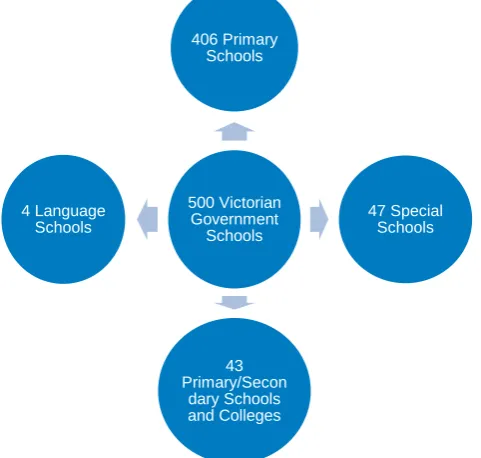
Figure 1. Schools currently participating in the School Breakfast Clubs Program, by school type3,4
The aim of the SBCP is to establish breakfast clubs to tackle disadvantage and make sure that every student, regardless of their circumstances, has the opportunity to reach their potential.45 Delivery of the
program is designed to help student learning and attendance and to assist in building connections between students, families, school communities and local communities. The provision of a healthy, nutritious breakfast aims to enable students, regardless of their circumstances, to fully participate and engage in all aspects of their learning.46 The Department of Education and Training Victoria (DET)
identifies schools for the program based on the Student Family Occupation Education (SFOE) index. The program is an opt-in initiative, with eligible schools invited to participate.
3 Prep-12 Colleges, Special Schools and Language Schools are eligible for the program due to their primary component. For the purpose of this report, ‘primary schools’ refers to all 500 schools participating in the School Breakfast Clubs Program.
4 In this report, Special Schools refers to all schools who provide special education for students with moderate to severe disabilities, autism spectrum disorder, and physical, mental or health impairment. These include specialist development schools, schools for Deaf Children and Schools for Autism.
500 Victorian Government
Schools 406 Primary
Schools
47 Special Schools
43 Primary/Secon
dary Schools and Colleges 4 Language
19
3.2 The role of Foodbank Victoria
The Victorian Government partnered with Foodbank Victoria, the largest food charity and provider of food relief in the state, to deliver the SBCP to schools. The SBCP commenced in Term 1 2016 with a staggered implementation, and by Term 3, 2016, the 500 schools had commenced operation.
Foodbank Victoria acts as a centralised food distribution service, sourcing and delivering a menu of healthy food options to schools using their existing warehouse, storage and freight networks. All SBCP schools are able to order the amount of food required to meet the hunger needs of their students. In addition to delivering healthy breakfast food supplies to all 500 schools, Foodbank Victoria plays a significant role in providing support to schools to assist them to establish their programs. The following is an overview of the role of Foodbank Victoria in the SBCP.
The process for this initiative begins with a school accepting the invitation to participate. Once Foodbank Victoria is notified, they arrange an induction to the program session with the nominated SBCP
coordinator. Foodbank Victoria provides schools with a Toolkit that contains detailed information about how to run a breakfast club, ordering practices, recruitment of volunteers and common issues that may arise. As part of their agreement with schools, Foodbank Victoria provide an ongoing and regular supply of nutritious and healthy food, originally once a term but delivery increased to twice a term as fresh produce was introduced on a regular basis.
Foodbank Victoria organises the delivery of food to schools around Victoria, managing the logistical challenge of delivering to metropolitan, regional and remote schools. Products are packed onto pallets at the Melbourne warehouse twice a term, although schools can place emergency orders if they run out of products or have an increased level of attendance.
Foodbank Victoria plays a significant role in the ongoing support and development of every breakfast club. The Foodbank Victoria Coordinators are committed to developing relationships with SBCP schools. Schools are contacted to ensure that the program is running efficiently and products received.
Foodbank Victoria provides assistance with issues raised by the schools, which can include insufficient volunteers, inefficient delivery, decreased attendance and limited physical space to operate the breakfast club. Coordinators also make annual visits to schools. Foodbank Victoria produces a newsletter that is distributed to all 500 schools, once a term. The newsletter includes information about new products, ordering and delivery timeframes, case studies of unique approaches as well as photos and quotes from students.
Foodbank Victoria’s pro-active response to the needs of schools ensures the program has evolved and grown over the first three years of operation. Comments from principals and coordinators show that the support of Foodbank Victoria and their response to the issues and barriers that schools face undoubtedly contributes to the success of the program.
3.3 Delivering the program in schools
The program model at school level is flexible, with local decisions made about the frequency of breakfast clubs, food offered, operating times, staffing needs, and the role of students. The approach gives school the autonomy to make their own decisions, based on the need of their students and school community, about how to implement and conduct their breakfast club. This has proven to be successful for the Western Australian breakfast program, which has been running since 2001.18,34
The overall aim of the SBCP is to run breakfast clubs as inclusive programs, allowing all students to attend, regardless of their family circumstances. The breakfast-for-all approach is significant as it enables all students to attend without the fear of being labelled as different from their classmates who eat breakfast at home. While schools encourage those in need to attend, the overall inclusive nature is designed to remove the shame for children and stigma for families living with hunger and poverty.14,16
Schools are encouraged to conduct their breakfast program as often as possible, but the frequency is determined by schools who take into consideration the needs of students, staffing requirements for the program, cost to the school budget and the school’s operational practices. Foodbank Victoria
Coordinators provide schools with assistance to support the frequency of breakfast clubs.
The food provided by Foodbank Victoria enables schools to run, 1) sit down breakfasts, where students share a communal meal sitting down to eat with their peers and breakfast club volunteers, 2) grab and go options, including fruit cups, apples and 200ml milk cartons, for students who arrive late at school and have not eaten breakfast, 3) classroom options, where the breakfast club is available in individual
classrooms so children can eat and participate in class activities at the same time.
Principals and coordinators determine the level of staffing required to run their breakfast club and are able to decide the most appropriate staffing model for their school. The coordinator of the SBCP is often a staff member however the research shows that teaching staff are not always involved in the daily delivery of the breakfast program. Schools have adopted a variety of approaches to staff their breakfast program, including:
A volunteer or volunteers from the school community, who may be parents, grandparents or carers, or a member of staff who undertakes this role outside their paid duties
A member of staff, in many cases wellbeing or education support staff, who is paid to undertake the role
Additional volunteers, who do not run the program, but provide assistance to the coordinator to conduct the program. These can include volunteers from community organisations, church groups, local council programs
Students, mainly senior students in Year 5-6, who work with a member of staff to run the program.
Schools can order food for their students without limits, with the exception of vegemite and honey, ensuring they can respond to the hunger needs for students. SBCP food can be used by schools to provide emergency lunches for students and surplus food can be sent home to families who are recognised as being in need of additional support.
Evaluation Research
Foodbank Victoria engaged Victoria University to conduct an independent evaluation research of the School Breakfast Clubs Program. The evaluation research has been undertaken over the first three years of operation, from 2016 – 2018, using a combination of quantitative and qualitative methods.
4.1 Evaluation research aims
The aim of the evaluation research was to provide evidence about the impact of the SBCP and rich insights into program implementation and outcomes at school level. The research was designed to identify effective aspects of the program, aspects that needed improvement, and the impact of the program on students and school communities. The project aimed to build on the existing evaluation tools used by Foodbank Victoria, including the baseline pre-SBCP survey and the evaluation of a School Breakfast Program being run by Foodbank WA.48 The evaluation research analysed both quantitative
and qualitative data collected from SBCP schools during 2016-2018, and was guided by the following research questions:
1. How does the SBCP address the needs of students who attend school without eating breakfast and provide them with the opportunity to participate and engage with all aspects of school? 2. How does the SBCP improve student learning and connectedness to school?
3. How effective is the SBCP and how can it be improved and evaluated in the future?
4.2 Study design
The evaluation research was originally designed to incorporate three components of research with SBCP schools:
1) Analysis of the baseline survey conducted by Foodbank Victoria with principals or SBCP coordinators, followed up by annual surveys, completed online, with all participating schools in 2016, 2017 and 2018.
2) In-depth analysis of data collected from 48 schools in 2016, 2017 and 2018, including school level data for individual students attending breakfast clubs, an online children’s wellbeing survey and an online teacher survey to analyse their professional judgement of the impact of the
program; and
3) In-depth case studies, with four SBCP schools in 2017.
School leaders and staff face many competing demands. Due to the extent of time required in the original design and as a result of feedback from participant schools, the data collection methods were redesigned in 2017, in consultation with Foodbank Victoria. The redesigned data collection methods included:
22
Methodology and data collection
From 2016 – 2018, principals in all 500 schools received an annual email inviting them, or their SBCP Coordinator, to complete an online annual survey. The survey took approximately ten minutes to complete. The 2016 survey was developed from Foodbank Victoria’s baseline survey and incorporated additional questions to investigate the implementation, operating practices and impact of the SBCP. The 2017 and 2018 versions responded to findings from the first two years of operation, in addition to
operational practices and challenges identified during the case study visits in 2017. The 2018 survey also identified the respondent as principal or vice-principal and staff member, parent, carer, grandparent or community volunteer to enable the annual survey to ask principals and vice-principals questions around managing volunteers and the overall cost to schools of running the SBCP. The response rate to the annual survey was high, with 395 schools participating in 2016, 407 schools in 2017 and 412 schools in 2018, representing a response rate of over 80%.
Sample of 48 schools
In 2016, emails were sent to principals in 48 schools, identified by Foodbank Victoria, inviting them to participate in the in-depth analysis of their breakfast club and the attendance of individual students. While the feedback was that this level of data was excessive, nine schools responded, representing 2% of SBCP schools. A total of 189 children’s wellbeing surveys and 93 teacher surveys were received although only one school provided some of the school level data requested. Based on the feedback received from the 48 schools this data collection method was not repeated.
Teacher survey
In 2017 and 2018, emails were sent to principals asking them to invite teachers to participate in an online survey that invited them to provide their professional judgement of the impact of the SBCP on students in their class who attend. The survey took approximately ten minutes to complete and covered five key areas: educational, wellbeing, nutrition, discipline and social and emotional factors. The response rates to the teacher survey were good, with 376 responses in 2017 representing 26% of participating schools and 735 responses in 2018 representing 47% of SBCP schools.
Case study research
Based on criteria (outlined in 4.2 Study Design), developed in consultation with Foodbank Victoria, the lead researcher on this project emailed six principals in 2017, inviting their schools to participate in the case studies research. Of the first six approached, five agreed to participate and the sixth declined on the basis that their school was particularly busy at the proposed time. The seventh school approached agreed to participate. The schools represented the four Department of Education and Training Victoria Regions. Of the six schools who participated, three schools were located in metropolitan Melbourne and three were located in regional Victoria. The case studies also represented a range of school types with four primary schools, one P-12 College and one Special Developmental School included in the sample.
The lead researcher visited each of the six schools for two or three days in term two and three of 2017. The data collected included observational notes, interviews with principals, teachers, parents and volunteers, focus groups with students and an analysis of school level documentation. While schools were paid the equivalent of one day casual relief teacher (CRT) payment in recognition of the work required to set up interviews and focus groups, the schools found it difficult to gain consent from parents for their children to participate and to locate parents who would agree to be interviewed. Despite these limitations, the case study evaluation research has provided rich insights into the implementation,
The breakfast club coordinators in the case study schools invited their school community to participate in the research. The aim was to conduct interviews with the principal, teachers, volunteers and parents and to run focus groups with the students. Engaging the school community with the research proved difficult for some schools. The stigma for some parents and families of admitting to schools that they could not provide breakfast for their children was evident. The parents interviewed all reported having breakfast food at home but said that their children preferred to eat at school with their friends.
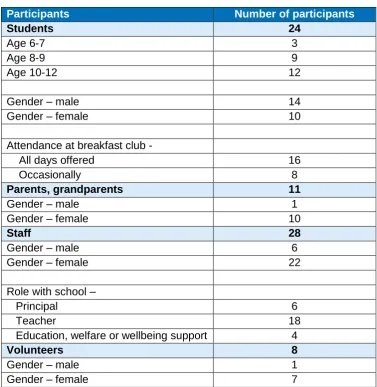
The following is a list of participants in the case study research. Insights from the 24 students, 11 parents and grandparents, 28 staff and 8 volunteers made a significant contribution to this report and informed the development of additional questions for the 2018 annual and teacher surveys.
Figure 2. Participants for case study school interviews and focus groups
Participants Number of participants
Students 24
Age 6-7 3
Age 8-9 9
Age 10-12 12
Gender – male 14
Gender – female 10
Attendance at breakfast club -
All days offered 16
Occasionally 8
Parents, grandparents 11
Gender – male 1
Gender – female 10
Staff 28
Gender – male 6
Gender – female 22
Role with school –
Principal 6
Teacher 18
Education, welfare or wellbeing support 4
Volunteers 8
Gender – male 1
Gender – female 7
Student wellbeing survey
The student wellbeing survey was designed for primary school aged children, 5 – 12 years old. 5 A
sliding bar response was required, with students asked to move a face along a five point scale. The five point scale included very happy, happy , through to not happy or unhappy, to unhappy or very unhappy. In 2016, 189 students from nine schools participated in the survey.
Impact of the School Breakfast
Clubs Program
This section provides evidence of the impact of the SBCP across a range of factors. The section begins with an overview of the hunger needs of students identified by schools prior to the Victorian Government SBCP. Evidence of the impact of the initiative across the state is provided through detailed analysis of the food delivered by Foodbank Victoria to SBCP schools, the frequency of breakfast clubs and the numbers of students attending. This section demonstrates how breakfast clubs improved student learning and educational attainment and connectedness between students and the school, their peers and local communities. The impact of the breakfast-for-all approach on the welfare and wellbeing programs of schools is also detailed in this section.
5.1 Before the School Breakfast Clubs Program
Prior to joining the program, over 65% of the SBCP schools identified that some of their students arrived at school without having eaten breakfast. Schools had responded to this perceived need, providing food to students as best they could. Some schools provided food in an informal way (e.g. by providing fruit and muesli bars in class), others reported that they were running a breakfast program on a regular basis.
Some students receive toast and cereal when they arrive at school. This is served in the classroom. Some parents provide the food and sometimes the school provides the
food (Baseline survey).
While the schools responded to the immediate hunger needs of some students, it meant that others who had not had breakfast were not identified. Some schools provided food but faced challenges that
included sourcing a regular supply of food and staffing the program. These challenges, alongside the cost borne by school budgets, restricted the frequency of some programs.
I would like to run it every day, but getting volunteers is for us - the issue (Baseline survey).
We often feel that we could be offering more than we are but are held back by funding and time constraints (Baseline survey).
25
food provided, schools recognised that the support provided by the Victorian Government and Foodbank Victoria would enable them to better meet the learning needs of their students.
We were approached by Foodbank Victoria. Given that our school breakfast club has been quite popular, having donations from the program will significantly help with
school budget allocated to Breakfast Club (Baseline survey).
To assist us with healthy food items to better support our students and set them up for a successful day having had a good breakfast. The convenience of having items
5.2 School Breakfast Clubs Program food
Food is a central component of the SBCP. The need to provide breakfast at school for hungry students acknowledges the negative impact of hunger on children’s learning. The SBCP recognises that nutrient rich, healthy food is fundamental for children’s health and development. Foodbank Victoria provides schools with a balanced menu of predominately green rated foods (rated according to the Healthy Eating Advisory Service).6 In 2017, the decision was made to include only products that are produced locally in
Victoria.
Providing quality nutritious food to ensure all SBCP schools serve a healthy breakfast to students is the key focus of Foodbank Victoria. The guaranteed delivery of healthy breakfast food by Foodbank Victoria enables all 500 schools to conduct their breakfast club, safe in the knowledge that food will be delivered to them twice a term with the option to place additional orders if demand increases.
We are thankful for the deliveries and donations provided to our school. The support and food provided from Foodbank has allowed us to develop and create an inviting, friendly and popular place for our students to start the day. Our numbers have grown significantly and we are serving up anywhere between 250-400 snacks/breakfasts per
week (Annual survey).
Foodbank Victoria products
The range of food provided by Foodbank Victoria evolved over the first three years of operation. The program commenced in 2016 with a small base menu of long-life milk, Vita Brits, oats and canned fruit. The food is delivered at the beginning of each term with an additional mid-term delivery if required. The menu expanded as new products, aligned with the green foods rating,6 were introduced by Foodbank
Victoria. In addition to the original menu, Foodbank Victoria introduced Wholegrain Cheerios, baked beans, muesli, fruit cups and fresh apples. Honey and vegemite were also added to the menu at the beginning of 2018 and a new product, 200ml milk (fruit box size) was introduced in Term 3, 2018. The menu provides students with a broad range of products which can be used for sit-down breakfasts or as grab-and-go options. The grab-and-go options enable schools to respond to the needs of students who arrive late at school. The fresh apples, delivered twice a term, are a welcome addition to the menu. To ensure the freshness of this produce the second, mid-term delivery was formalised in 2017.
We love the fresh apples. When we get the 10 boxes we hand them out to all the children and they love receiving a fresh juicy apple (Annual survey).
27 Figure 3. Timeline of products introduced to the School Breakfast Clubs Program
Students in the case study schools acknowledge the nutritional aspect of the food provided by Foodbank Victoria for what they describe as the most important meal of the day. The students also appreciate the yumminess of the menu that is offered to them at breakfast club.
That it’s really, really yummy (Student focus group).
Breakfast is one of the most important meals of the day, because it energises you for the day (Student focus group).
The volume of food distributed by Foodbank Victoria increased over the first two years of operation as breakfast clubs were established and the menu expanded. The quantity of food required for the program levelled out in year two and three.
Figure 4. Volume of food distributed (kgs) by years and product
Milk VitaBrits Canned Fruit Oats Term 1 2016 Term 2 2016 Baked Beans Term 3 2016 Term 4 2016 Cheerios Muesli Fruit Cups Term 1 2017 Term 2 2017 Term 3 2017 Term 4 2017 Apples Term 1 2018 Term 2 2018 Honey Vegemite Term 3 2018 Term 4 2018 200ml milk 50,000 100,000 150,000 200,000 250,000 300,000 350,000
2016 2017 2018
Food distributed (kgs) by product
Apples
5.2.2 Ordering food
The online system allows schools to make choices from the menu items and to order food that their students prefer. There are a number of favourites reported by schools, but for the most part schools use the full range of products. The evaluation research did not ask schools about the ordering and delivery process or quality of food products delivered. However, the qualitative responses indicate that schools have minimal complaints with the service Foodbank Victoria provide.
We are so appreciative of the food we receive. It helps us enormously to provide for so many disadvantaged children, in a number of ways. We have also been able to assist
families in times of hardship, by providing a parcel of food, with cereal, milk, etc (Annual survey).
Thank you for providing the food for our students. Even feeding one student is positive! (Annual survey).
5.2.3 Additional food
While Foodbank Victoria provides schools with an extensive menu of breakfast products, over 85% of schools provide additional food for students. Schools report that their students prefer other breakfast foods and they need to provide additional food to encourage attendance at the breakfast club. The most popular additional item is bread, with over 75% of schools offering toast to their students. Schools indicate that students prefer toast for breakfast and purchase bread, margarine and spreads to accommodate their students’ needs.
With the influx of all the bread and things that we were donated by Coles, we [were] donated a fridge and freezer and that’s where that gets stored, so we’ve always got plenty of gear for the kids. The kids never go hungry (Volunteers, case study school).
Bread is not one of the products Foodbank Victoria provides to schools. Bread has a limited shelf life and schools did not have the storage capacity for the amount required for each term. Sourcing bread from their local community has enabled the delivery of fresh bread to schools on a daily or weekly basis, removing the requirement to store or freeze large quantities. Over 75% of schools report that they purchase additional food from school budgets.
Many of our students only like toast, so we are having to use money from our welfare budget to fund the extra food required, although it was good to hear that vegemite and
honey is now being supplied (Annual survey).
29 Figure 5. Additional food provided by schools at breakfast clubs (n=353)
Multiple options allowed, graph does not add up to 100%
The introduction of toast as an additional food adds to the preparation time for breakfast clubs. Staff and volunteers in the case study schools offering toast as an additional food arrived as early as 7.45am to prepare sufficient quantity to meet the influx of students and short delivery time. In contrast, a case study school offering the food provided by Foodbank Victoria, arrive at 8.15 to set up for the morning. For schools offering toast, many of whom report that they used two slice toasters, the additional time commitment is considerable.
5.2.4 Creating a menu
While many schools offer the program menu (11 items) to students in the original form a number of schools had been creative with their menu, creating their own recipes. Schools incorporate the SBCP food into school cooking classes and programs. Fresh produce from school gardens and the eggs from chickens is used to make items such as muesli bars or muffins with the food provided by Foodbank Victoria. In many Special Schools, the Foodbank Victoria products have been incorporated into life skills programs. 10% 20% 21% 22% 28% 55% 79% 91% Fresh Milk Other Eggs Juice Fresh Fruit Milo Spreads Bread P erc en tag e of s c ho ol s
Stratford Primary School
The dedicated parent coordinator of the breakfast club at Stratford
Primary School integrated the food provided by Foodbank Victoria into
school cooking classes.
Source of additional food
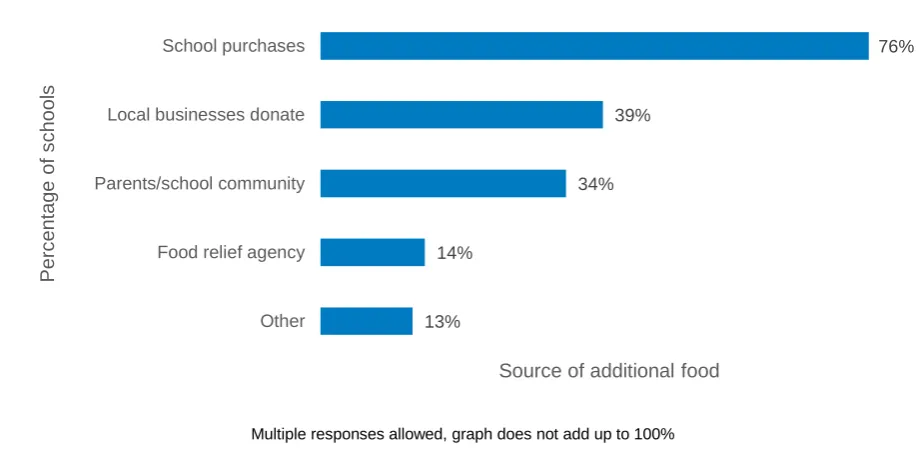
Schools source their additional food from a range of locations. Approximately 40% of schools have established relationships with supermarkets and bakeries as well as local banks and community
organisations to donate food or additional funds to spend on their breakfast club. Schools who previously operated a breakfast club, or offered food to students, are more likely to have established relationships with local businesses, with 38% of those with an existing program having food donated by local
businesses compared to 22% of those who had not offered food to students prior to the SBCP
Figure 6. Source of additional food provided at breakfast clubs (n=353)
Multiple responses allowed, graph does not add up to 100%
We are allowed $20 a week from the local Bendigo Bank to spend at our local supermarket (Annual survey).
A further 34% of schools indicate that parents and other members of the school community donate the additional food for the breakfast club. Over 75% of schools report that they are purchasing additional food from the school budget. There is also evidence that principals or school staff are purchasing additional food from their own funds.
I purchase them out of my own pocket (Annual survey).
Schools reveal that they incorporate products from their own kitchen gardens into the breakfast club. Some schools indicate that Stephanie Alexander gardens provide additional produce for their breakfast club. Schools with their own community gardens also incorporate the fresh produce into their breakfast club menu. School chickens are popular amongst SBCP schools and their eggs were often used in breakfast clubs.
13% 14%
34% 39%
76%
Other Food relief agency Parents/school community Local businesses donate School purchases
Source of additional food
P
erc
en
tag
e
of
s
c
ho
ol
31
Additional products are often used when schools run a ‘special breakfast’ for students. In some schools this occurs regularly, on a weekly basis, and in other schools this occurs once a term. Food offered to students includes eggs, cheese toasties, and pancakes as well as the baked beans and fresh apples provided by Foodbank Victoria.
We also have special breakfast days e.g. Pancake day once a term and cultural breakfast days (Annual survey).
Student appreciation of the School Breakfast Clubs Program menu
Students are appreciative of the food they eat at breakfast clubs. There is evidence that some products have become favourites and the introduction of wholegrain Cheerios in 2017, was a welcome addition. The overall feedback on the food is favourable and students report that this is a primary reason for attending breakfast clubs. Students do not however distinguish between the food provided by Foodbank Victoria and the additional food sourced by their school.
They give you a lot of choices. They have vegemite toast and jam toast and plain toast and got your fruits, your cereals (Student focus group).
Emergency lunches
The consistent demand for emergency lunches in SBCP schools demonstrates the ongoing level of need in these schools and their local communities.44,58 In 2018, 77% of schools report that the demand for
emergency lunches has remained steady over the three years the SBCP has operated. In addition to providing breakfast, many schools use the food provided by Foodbank Victoria for student lunches. The SBCP food enables some schools to provide more suitable lunches for students than they could before joining the initiative.
Figure 7. Level of demand in schools for emergency lunches (n=409)
74% 12%
10% 3%
Demand remained steady
We are a school with high welfare needs and this has saved the school money as we can provide breakfast and lunches to students in need (Annual survey).
Excess food
The food provided by the SBCP enables schools to better respond to the needs of families who are experiencing hunger or poverty. Approximately 85% of schools donate their excess food to families in need.
We deliver excess Breakfast Program food items to those families which we have identified in need, so they can have breakfast before school and on weekends (Annual
survey).
The school is grateful for the provisions for our breakfast program and that we can use food to support families. It has been really helpful when families have to go to emergency/safe houses to give them food to take, including cereals and milk and
33
5.3 Frequency of breakfast clubs
The level of need in some Victorian communities is clear, creating a level of inequality that impacts on children’s capacity to fully engage with their learning.44The SBCP is designed to address this inequality
and provide schools with sufficient food for all students, every school day if required.
I think a lot of kids in our population come from quite fractured families, substance issues and violence; domestic violence is rife through the community, not just ours; a lot of lower socio-economic problems, families have very limited support and that sort of thing. So our kids, I think a lot of them do it quite tough. Refugee families as well come here, there’s no support whatsoever and no family here, so really difficult sort of
circumstances (Social Worker, case study school).
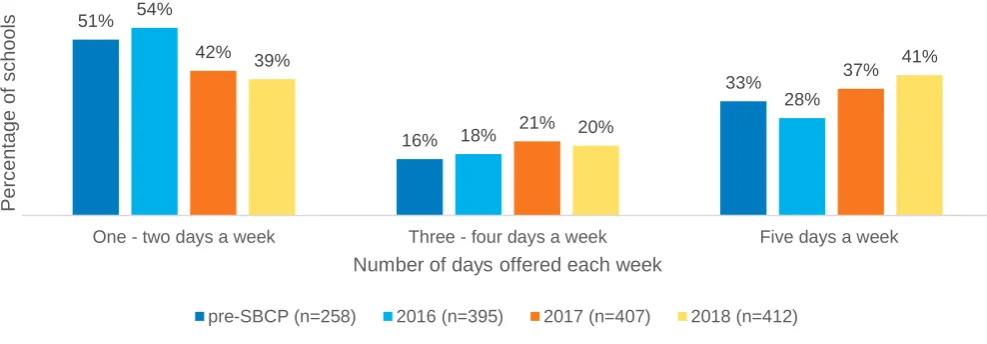
In 2018, all 500 schools conduct their program on a regular basis, ranging from one day a week for 15% of schools through to 41% of schools who run their breakfast club five days a week.
Over the first three years of operation, schools consistently increased the number of days they
conducted their breakfast clubs. In 2018, 165 schools offer their breakfast club every school day. This represented a 94% increase from the 85 schools who were able to offer breakfast food to students every school day prior to the implementation of the SBCP.
Figure 8. Frequency of breakfast clubs, pre-program to 2018
*In the pre-program baseline survey, 72 schools did not indicate the number of days they offered breakfast to students.
In 2018, 39% of schools offer their breakfast club one to two days a week. The findings show there are a number of factors that restrict the frequency of breakfast clubs. There is evidence that some schools make decisions around the frequency of programs based on the school’s operational demands rather than the hunger needs of students. Barriers reported by schools include difficulty staffing the program, the cost of staff or additional food, and conflicts with dual space and other school activities. The findings indicate that the infrequency of some breakfast clubs impacts on the school’s ability to meet the hunger needs of students.
51% 16% 33% 54% 18% 28% 42% 21% 37% 39% 20% 41%
One - two days a week Three - four days a week Five days a week
P erc en tag e of s c ho ol s
Number of days offered each week