Universal Forgery and Multiple Forgeries of
MergeMAC and Generalized Constructions
Tetsu Iwata1, Virginie Lallemand2, Gregor Leander2, and Yu Sasaki3
1 Nagoya University, Nagoya, Japan,[email protected] 2 Horst G¨ortz Institute for IT Security, Ruhr-Universit¨at Bochum, Germany,
3 NTT Secure Platform Laboratories, Tokyo, Japan,
Abstract. This article presents universal forgery and multiple forg-eries against MergeMAC that has been recently proposed to fit scenar-ios where bandwidth is limited and where strict time constraints apply. MergeMAC divides an input message into two parts,mkm˜, and its tag is computed byF(P1(m)⊕ P2( ˜m)), whereP1 and P2 are PRFs andF
is a public function. The tag size is 64 bits. The designers claim 64-bit security and imply a risk of accepting beyond-birthday-bound queries. This paper first shows that it is inevitable to limit the number of queries up to the birthday bound, because a generic universal forgery against CBC-like MAC can be adopted to MergeMAC.
Afterwards another attack is presented that works with a very few num-ber of queries, 3 queries and 258.6 computations of F, by applying a
preimage attack against weakF, which breaks the claimed security. The analysis is then generalized to a MergeMAC variant where F is replaced with a one-way functionH.
Finally, multiple forgeries are discussed in which the attacker’s goal is to improve the ratio of the number of queries to the number of forged tags. It is shown that the attacker obtains tags ofq2messages only by making
2q−1 queries in the sense of existential forgery, and this is tight when q2 messages have a particular structure. For universal forgery, tags for 3qarbitrary chosen messages can be obtained by making 5q queries.
Keywords: MergeMAC, universal forgery, multiple forgeries, public fi-nalization, preimage, splice-and-cut, Hellman’s time-memory tradeoff
1
Introduction
of lightweight block ciphers (like Present [9], Prince [10], SKINNY [5], CLE-FIA [19] and Simon [4] just to name a few). While in comparison the design of other primitives seems less popular, some lightweight stream ciphers and hash functions were also proposed4. The design of Message Authentication Codes was also addressed, with the publication of SipHash [3], Chaskey [16], of the MAC mode LightMAC [15] and very recently of MergeMAC [1].
MergeMAC was proposed by Ankele, B¨ohl and Friedberger at ACNS18. As for all the Message Authentication Codes, it is meant at providing integrity and authenticity by producing a fixed-length tag from a message and a secret key. MergeMAC was designed to fit extremely constrained environments with strict time requirements and limited bandwidth, and in particular for the Controller Area Network (CAN) bus5. The necessity to bring authentication for this later scenario comes from the fact that some of the components at play are also con-nected to the Internet, creating remote attack opportunities. The MAC construc-tion proposed by Ankele et al. is based on 3 components: 2 variable input-length Pseudo-Random Functions (parameterized by independent keys), and a so-called Merge function. Each PRF modifies one part of the input message, and the two outputs are recombined by the merge function.
Our Contributions. In this paper, we investigate the resistance of MergeMAC against forgery attacks in different scenarios.
First, we show that an attacker can take advantage of its special structure and forge messages by adapting the universal forgery attack proposed by Jia et al. at CANS09 [14], and this regardless of the choice of the PRF or of the
Mergefunction. This first technique has a data complexity slightly higher than the limit set by the designers, which shows its tightness.
Our second results is a universal forgery that breaks the security claim of MergeMAC by only requiring 3 queries to forge a tag. This attack exploits the details of theMergefunction (in particular its low diffusion and its feed-forward structure) to perform a perimage attack using the splice-and-cut Meet-in-the-Middle technique [2].
We also discuss the possibility of forgery attacks in the situation where
the Merge function is an ideal one-way function. We call this construction
MergeMACOW. By using the fact that it is public and can be evaluated offline, we deduce possible tradeoffs that can be more practical than the generic attack, but still less efficient than the one using the specificities of theMergefunction. Our last contribution is the analysis of MergeMAC to forge multiple tags: first in the case of existential forgeries, and next in the case of universal ones. The problem is known as the MAC reforgeability [8], where one takes advantage of the computational efforts for the first forgery to reduce the complexity for the subsequent forgeries. In the case of existential forgery, we show that it is
4 We refer to [7] for a thorough review of lightweight constructions.
5 The CAN bus is the standard message system used in most modern cars to connect
possible to forge (q−1)2 tags by making 2q
−1 queries, i.e., we can obtain more forgeries than the number of queries. We also discuss the tightness on the number of queries. In the case of universal forgery, we show that we can forge
q tags by making 2q−1 queries, and we also show that this can be improved when q is divisible by 3. We remark that no security claim has been made by the designers regarding multiple forgeries, and hence our analyses give the first insight about the security of MergeMAC in this attack scenario.
Paper Outline. Section 2 introduces specification of MergeMAC. Section 3 presents universal forgery against MergeMAC. Section 4 generalizes the analysis to MergeMACOW. Section 5 discusses multiple forgeries.
2
Specification of MergeMAC
MergeMAC is a new MAC construction that has been recently proposed by Ankele, B¨ohl and Friedberger [1] to fit scenarios where bandwidth is limited and where strict time constraints apply. More precisely, the designers aim for an ef-ficient solution for authenticating messages on the CAN6bus, a communication system widely used in modern cars to manage the different electronic compo-nents. In addition to the bandwidth constraint inherent to the CAN technology, the fact that the components in questions are as critical as brakes or airbags makes it plain that the MAC must have a low latency.
To meet these requirements, the solution proposed by Ankele et al. uses different techniques7: for instance, it saves bandwidth by not transmitting some low-entropy bits of the message, and it can be build from lightweight ciphers such as Prince[10] to limit the latency. One of the design ideas that impacted the most their construction was the wish to speed up MAC verifications by storing frequently needed intermediate parts in the cache instead of computing them again. This point leads them to a construction that combines the output of two PRFs (each operating on a part of the input message) into a merging function (see Figure 1). The authors propose to precompute and cache the PRF outputs, and stress that this solution only requires simple computations, an advantage in comparison to other cache-able construction.
In what follows, we use the same notation as in the specification. As shown in Figure 1, the input of MergeMAC is first split in two parts, m and ˜m, each entering one of the PRFsP1, P2. These PRFs are of variable input length and depend on twok-bit keysK1,K2. Then-bit outputs ofP1,P2are denoted byρ and ˜ρ, respectively, and both enter theMergefunction which returns then-bit
tag.
The authors state that any MAC scheme that is a secure PRF (as for example AES-CMAC or Chaskey) can be used to instantiateP1andP2. To fit in with the constrained environment use-case, they propose to use Present [9] or Prince [10]
6 Controller Area Network.
m m˜
P1 P2
ρ ρ˜
Merge
K1 K2
tag
ρ ρ˜
tag
π
Fig. 1. MergeMAC construction (left) andMergefunction (right).
in CMAC mode. TheMergefunction follows a Davies-Meyer construction with
ρ⊕ρ˜as input: tag =π(ρ⊕ρ˜)⊕(ρ⊕ρ˜), where π is a permutation on n bits. The authors defineπas a 3-round variant ofChaskey[16] operating on 64-bit blocks (note that the reduced block size is required to achieve compatibility with the block size of Present/Prince). The other changes made to the round function can be read in Figure 2.
≪15
≪5
v1 v0
≪8 v3
v2
≪15
≪5
≪8
v1 v0 v2 v3
Fig. 2. One round of theπ function used inMerge. Each wire represents 16 bits.
𝜋
𝜌 𝜌
𝑡𝑎𝑔 ℎ𝑎𝑠ℎ
Fig. 3.Another view ofMerge.
Security Claim. The authors claim that their construction is a provably secure MAC, and in particular that it reaches n-bit security against forgery attacks. Their proof requires that P1 and P2 are secure PRFs and that the Merge function satisfies Random Input Indistinguishability.
To prove this last point, they provide a security analysis of the Merge
function with respect to various types of attacks. An argument that they use repeatedly in the discussion is that, since the input of the Mergefunction is unknown and comes from a PRF, an attacker cannot force a specific property on it, which removes the threat of many attacks such as the ones based on differentials.
The authors also claim that finding a preimage ofMergeis“as hard as ex-haustively guessing the internal state after the initial PRFs”so that MergeMAC is resistant to attacks based on Meet-in-the-Middle techniques. They justify the resistance to more advanced MitM attacks by the fact that “MergeMAC does not implement an inverse function for the merging functionMerge”8.
The designers claim the security for each underlying primitive as in Table 1. The designers also notice the risk of using a small block size against birthday attacks demonstrated by the Sweet32 attack [6], and suggest that the amount of data blocks that are processed by the initial PRFs of MergeMAC must be limited appropriately. Although the designers do not specify the details of the appropriate level, Table 1 may be interpreted as security claims under the condi-tion that key is renewed after the number of queries reaches the birthday bound.
Table 1.Security claims according to the underlying primitives [1, Table 1].
Underlying BC Block size Key size Existential forgery resistance
Present 64 80 2−64
Present 64 128 2−64
Prince 64 128 2−64
3
Universal Forgery against MergeMAC
In Sect. 3.1, we show that limiting the number of queries up to the birthday bound is almost tight because a generic universal forgery can be applied irrele-vant to the choice of PRFs and theMergefunction. In Sect. 3.2, we present an attack only with 3 queries by exploiting the weak mixing effect ofπ.
3.1 Generic Attacks with High Data Complexity
Jia et al. proposed universal forgery with the birthday-bound complexity that generally works against CBC-like MACs and PMAC-like MACs [14]. The attack can be directly applied to MergeMAC. Letmkm˜ be a challenged message. The goal of the attacker is producing the tag t for this message without querying
mkm˜. The attack works as follows.
1. For distinctxi,1≤i≤2n/2, queryxikm˜ to obtain a tagti. 2. For distinct ˜yj,1≤j≤2n/2, querymky˜j to obtain a tagtj.
3. Find a collision of ti andtj. Let ˆi,ˆj be the indices of the colliding pair. 4. Query xˆiky˜ˆj to obtain the corresponding tag t0.
5. Output t0 as a valid tag formkm˜.
Analysis. We viewMergeas Fig. 3. We first evaluate the attack by replacing the hash function in Merge with a permutation. Then, a collision of the tag implies a collision of the XOR of two PRF’s outputs, namely
P1(xˆi)⊕ P2( ˜m) =P1(m)⊕ P2(˜yˆj). (1) Therefore,
P1(xˆi)⊕ P2(˜yˆj) =P1(m)⊕ P2( ˜m), (2) which shows that the tag for mkm˜ is equal to the tag forxˆiky˜ˆj.
The attack requires 2·2n/2+ 1 queries, which is roughlyO(2n/2) queries (and the computational cost of O(2n/2) memory accesses to operate on the data).
Consideration of Error Probability. We now evaluate the case withMerge
following the actual construction. Then, a collision of ti andtj does not imply Eq. (1). Suppose that P1(xˆi)⊕ P2( ˜m) = α,P1(m)⊕ P2(˜yˆj) = β, α 6= β and
Merge(α) =Merge(β). Then Eq. (2) becomes
P1(xˆi)⊕ P2(˜yˆj) =P1(m)⊕ P2( ˜m)⊕α⊕β, with unknownαandβ. Hence, a tag formkm˜ cannot be computed.
This issue can be solved by iterating the attack (finding a collision between
ti and tj) several times until the attacker probabilistically hits the case with
α = β. For an n-bit to n-bit function, the number of multicollisions can be upper bounded by n. Hence, by iterating the entire attack procedure n times, the attacker can predict the correct tag with probability 1/n. The attack can be improved slightly. When the attacker makes 2n/2queries ofx
ikm˜ andmky˜j, the attacker can make 2n/2·n/2 queries. This generates n pairs of ˆi,ˆj, which is sufficient for the attack. In the end, the complexity of the application of the generic attack is upper bounded byO(n2n/2).
Complexity for MergeMAC. In MergeMAC,nis 64. Hence, the attack com-plexity is aboute·232
≤234. Given that the authors imply to limit the number of queries up to an appropriate level in the context of the Sweet32 attack, the generic universal forgery may not break the claimed security but show the tight-ness of their bounding data complexity.
3.2 Universal Forgery with Very Low Data Complexity
In this section we present a universal forgery with a very low data complexity but with a higher offline computational cost than that of the generic attack.
Attack Overview. The idea is to exploit the fact that the Mergefunction mixes the data very lightly. To be more precise, we present a preimage attack against the 3-round variant of Chaskey with the feed-forward operation used in MergeMAC.
Recall that the core idea of the generic attack is to obtain some information on the input to theMergefunction by finding collisions of the tag. To reduce the data complexity, we avoid searching for a collision (with many queries), instead invert the Merge function by spending offline computational cost. Note that this strategy can only be applied when the finalization function is public, hence the following attack shows another feature particular to MergeMAC.
Suppose thatmkm˜ is a target. If the attacker recoversP1(m)kP2( ˜m), the tag can be forged by processingMergefunction offline. We notice thatP1(m)kP2( ˜m) can be recovered by 3 queries and 3 executions of the preimage attack. Letxand ˜
ybe the former half and the latter half of an arbitrary chosen message. Then, the attacker queries three messagesxkm˜,mky˜andxky˜to obtain the corresponding tagst1,t2, andt3that are expressed as follows.
t1←π(P1(x)⊕ P2( ˜m))⊕ P1(x)⊕ P2( ˜m)
t2←π(P1(m)⊕ P2(˜y))⊕ P1(m)⊕ P2(˜y)
t3←π(P1(x)⊕ P2(˜y))⊕ P1(x)⊕ P2(˜y)
Suppose that for a giveno, the attacker can execute a preimage attack to findi
such thato←π(i)⊕i. Then, by finding preimages oft1,t2, andt3, the attacker obtains P1(x)⊕ P2( ˜m), P1(m)⊕ P2(˜y) andP1(x)⊕ P2(˜y). The sum of those 3 values equals toP1(m)⊕ P2( ˜m), then the attacker can compute the tag offline. Preimage attacks on cryptographic functions have been discussed deeply. We follow the framework of meet-in-the-middle preimage attacks [2,18]. Due to the construction, the attack framework is closer to the preimage attack against the block-cipher based compression functions first demonstrated against AES in the Davies-Meyer mode [17].
Meet-in-the-Middle Preimage Attacks. Meet-in-the-Middle (MitM) attack [11] was originally proposed to recover a key of a block cipher. When a ciphertext
k1andk2, i.e.c=E2,k2◦E1,k1(p),k1andk2can be recovered with a complexity min{|k1|,|k2|}instead of|k1|+|k2|.
Sasaki [17] presented a framework to apply the MitM attack tot=P(x)⊕x
for recovering unknown x for a given t, where P consists of an iteration of a round functionRwith imperfect diffusion. Suppose thatRconsists ofrrounds, namelytis computed from xas
V0←x, Vi← R(Vi−1) fori= 1,2,· · · , r, t←Vr⊕V0. The splice-and-cut technique [2] allows the attacker to regard the first and the last rounds as consecutive rounds. Indeed, t is computed by Vr⊕V0. For any fixedt, computingV0 (resp.Vr) immediately fixesVr (resp.V0).
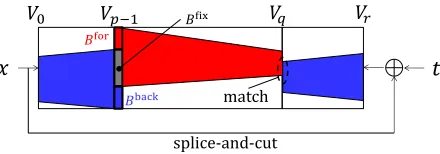
The overview of the attack framework is illustrated in Figure 4. The attacker first determines a starting roundpand matching roundq, such that the compu-tation fromVp−1 to Vq (forward computation) and the computation from Vp−1 to V0, Vr = t⊕V0, and from Vr to Vq (backward computation) can be inde-pendently performed. The results of the two computations are matched onVq.
𝑥
𝑡
𝑉0 𝑉𝑝−1 𝑉𝑞 𝑉𝑟
𝐵for
𝐵back
splice-and-cut
𝐵fix
match
Fig. 4.Overview of meet-in-the-middle preimage attacks fort=H(x)⊕x.
More precisely, each bit of the stateVp−1is classified into three groups:
Bfor : all possible values are examined during the forward computation.
Bback : all possible values are examined during the backward computation.
Bfix : the value is fixed during the independent computations.
Suppose that the value of Bfix is fixed. The attacker, for each possible value of Bfor, proceeds the forward computation without using the value of Bback. BecauseBbackis unknown, the forward computation cannot compute all bits of the state. However, when the diffusion ofRis imperfect, the partial computation can be performed for a few rounds (until round q). Independently, the attacker computes the backward computation by examining all possible values ofBback without using the value of Bfor (up to V
q). For a correct combination of Bfix,
Bfor, Bback, the partially computed values always match atV
Algorithm 1Meet-in-the-middle preimage attack fort=P(x)⊕x
Require: t,p,q,Bfix,Bfor,Bback
Ensure: x
1: forall candidates ofBfix do
2: forall candidates ofBfor do
3: Partially computeVi← R(Vi−1) fori=p, p+ 1,· · ·, q, and store the result
in a listL. 4: end for
5: forall candidates ofBbackdo
6: Partially computeVi−1← R−1(Vi) fori=p−1, p−2,· · ·,1.
7: Partially computeVr←V0⊕t.
8: Partially computeVi−1← R−1(Vi) fori=r, r−1,· · ·, q+ 1.
9: if the computed value exists inLthen
10: Setvp−1 ←(Bfix,Bfor,Bback), and compute correspondingV0 andVr.
11: if V0⊕Vr=T then 12: return V0.
13: end if 14: end if 15: end for 16: end for
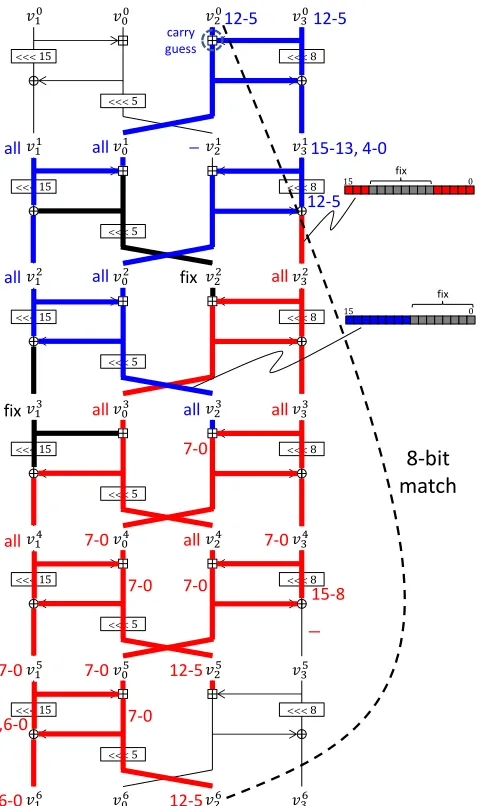
Attacks on 3-Round Chaskey with Feed-Forward. As shown in Fig-ure 2, one round ofπconsists of two iterations of the half-round transformation. Hence, 3-round transformation ofπ is regarded as 6-round half-transformation of π. Let (vi
1, v0i, vi2, v3i) denote a 64-bit internal state which is an input to the
ith half-transformation (or an output from the i−1th transformation, where
i = 0,1,· · ·,6. We divide this transformation into two independent computa-tions. Readers may refer to Figure 5 for the illustration of the independent computations.
Choices of Bfor, Bback, Bfix. In Figure 4, the starting round is defined as an input state to some round. However, we can choose 64 bits of the state in different rounds as the starting position, as long as they fix the entire transformation. In our attack, we choose (v3
1, v23, v22, v23) as a starting position. It is easy to see that all the possible internal state values can be simulated by exhaustively examining 264values of (v3
1, v32, v22, v32). We then choose Bfor,Bback, andBfix as follows.
Bfor : bit positions 0 to 4 and 13 to 15 ofv2
3 (total 8 bits)
Bback : bit positions 8 to 15 ofv3
2 (total 8 bits)
Bfix : v3
1, v22and bit positions 5 to 12 ofv32and bit positions 0 to 7 of v23 The forward computation partially computes (v6
1, v26, v26, v63)⊕tand the backward computation partially computes (v0
1, v20, v02, v03). We match the results of two independent computations in 8 bits.
Forward computation. All bits ofv3
1, v22 andv23 are known, while bit positions 8 to 15 ofv3
<<< 15 <<< 8
<<< 5
𝑣12 𝑣02 𝑣22 𝑣32
<<< 15 <<< 8
<<< 5
𝑣11 𝑣01 𝑣21 𝑣31
<<< 15 <<< 8
<<< 5
𝑣10 𝑣00 𝑣20 𝑣30
<<< 15 <<< 8
<<< 5
𝑣15 𝑣05 𝑣25 𝑣35
<<< 15 <<< 8
<<< 5
𝑣14 𝑣04 𝑣24 𝑣34
<<< 15 <<< 8
<<< 5
𝑣13 𝑣03 𝑣23 𝑣33
𝑣16 𝑣06 𝑣26 𝑣36
fix
fix
15 fix 0
fix
15 0
7-0
all all all
all 7-0 all 7-0
7-0 7-0
−
12-5
6-0 12-5
31,6-0 7-0
7-0 7-0 15-8
all all all
all all 15-13, 4-0
12-5
−
12-5 12-5
carry guess
8-bit
match
Fig. 5.Details of two independent computations forπ(x)⊕x.
the 8 LSBs of v04. Similarly, v43 ← v04⊕(v33 ≪ 8) can be computed only in 8 LSBs. With the same analysis, as shown in Figure 5, the forward computation can compute 8 bits of v6
Backward computation. All bits ofv3
1, v22andv23are known, while bit positions 0 to 4 and 13 to 15 ofv2
3 are unknown. All bits ofv10can be computed while we can compute only 8 bits (bit positions 0 to 4 and 13 to 15) of v1
3←(v23⊕v20)≫8. This allows us to compute only 8 bits (bit positions 5 to 12) ofv0
3←(v01⊕v13)≫ 8. Finally, we computev0
2 ←v01v03in bit positions 5 to 12, whereis a modular subtraction. We do not know the carry from bit position 4 to 5. Hence, we guess the carry and computev0
2in both cases. Thus, we have 29results of the backward computation.
Complexity Evaluation. For each fixed choice ofBfix, we obtain 28and 29results from two computations. They can match in 8 bits. Correct Bfor, Bback, Bfix always match, thus we obtain (28
·29)/28 = 29 candidates, which needs to be tested further. The procedure is iterated for exhaustive guesses of Bfix. Hence, the complexity to find a preimage is 248
·29= 257computations ofπ. The attack requires 28 amount of memory to store the results of the forward computation.
Summary of Attacks and Error Probability. The attack requires 3 queries and 3 executions of the preimage attack. Hence, the data, time and memory complexities are 3, 258.6(
≈3×257) and 28, respectively.
Let us finally discuss the error probability. As discussed before, each target hase preimages on average. The MitM preimage attack exhaustively examines all internal state values (in an efficient way), hence it collects all ofepreimages with 1 execution. When we sum up preimages of t1, t2 and t3, we have e3 combinations on average. This can be regarded that the success probability of our attack ise−3≈0.0498. We can also store thosee3values as candidates, and iterate the attack for another choice ofxand ˜yto obtain anothere3 candidates. The correct internal state is included in bothe3pools of candidates. In this case, the data and time complexities become 6 and 259.6, respectively.
4
Analysis on MergeMAC
OWIn this section, the attack against MergeMAC is extended to MergeMACOW, in which theMergefunction of MergeMAC (3-round-Chaskey with feed-forward) is replaced with an ideal one-way functionH.
The generic universal forgery discussed in Sect. 3.1 still works even ifH is invertible. Our approach here is to exploit the feature that H is public, and thus can be evaluated offline. We preprocess Hfor various inputs and make a look-up table so that the attacker can look-up the input xefficiently from the observedH(x). Namely, a precomputation phase is introduced to trade the data complexity in the online phase by the offline computational cost.
4.1 Definition of MergeMACOW
LetP1,P2be two PRFs andHbe a public one-way function. For a given message
mkm˜, MergeMACOWcomputes a tagtas follows.
ρ← P1(m), ρ˜← P2( ˜m), t← H(ρ⊕ρ˜).
4.2 Tradeoff between Time and Data
As in Sect. 3, we first explain the attack by assuming thatHis injective. Offline Phase
1. For 2` distinctz, compute
H(z) and store (z,H(z)) in a listLp.
Online Phase
2. For distinct xi,1≤i ≤23(n−`)/2, query xikm˜ to obtain the tag tx. Iftx is included inLp, storexi and the correspondingP1(xi)⊕ P2( ˜m) in a listLx. 3. For distinct ˜yj,1≤j ≤23(n−`)/2, query mky˜j to obtain the tagty. Ifty is included inLp, store ˜yj and the correspondingP1(m)⊕ P2(˜yj) in a listLy. 4. For all combinations of xi and ˜yj in Lx and Ly, query xiky˜j to obtain the
corresponding tagt0 untilt0 is included inL
p and thus the attacker obtains the value ofP1(xi)⊕ P2(˜yj).
5. ComputeP1(m)⊕ P2( ˜m) by
P1(xi)⊕ P2( ˜m)⊕ P1(m1)⊕ P2(˜yj)
⊕ P1(xi)⊕ P2(˜yj)
.
Computet=H P1(m)⊕ P2( ˜m), and outputt as a tag formkm˜.
Evaluation and Tradeoff.
– In the offline phase (Step 1), time and memory complexities are 2`. – In Step 2, 23(n−`)/2queries are made. Each tag is included inL
pwith prob-ability 2n−`, thus 2(n−`)/2x
i are stored inLx. – In Step 3, 23(n−`)/2 queries are made and 2(n−`)/2 y˜
– In Step 4, 2(n−`) queries are made and there exists one pair of (x
i,y˜j) such thatt0 is included inL
p.
Let Toff, D, and N be offline computational cost (2`), data complexity (23(n−`)/2), and a cardinality of the tag space (2n), respectively. The tradeoff curve is represented as
Toff3/2·D=N3/2. (3) Setting Toff >22n/3 leads toD <2n/2, i.e. the number of online queries can be reduced compared to the generic attack in Sect. 3.1.
The attack requires to store 2`, 2n−`, 2n−` values forL
p,Lx andLy, respec-tively. WhenToff >22n/3,M =Toff. The online computational complexity,Ton, is only for processing queried data, thus equals to D. As long as Toff >22n/3,
Tonis negligible.
Example. MergeMAC supposes that N = 264. By spending T
off = 248 computational cost and memory amount, the number of online queries is reduced toD = 224with online computational costT
on= 224, which is more practical than the general attack withD= 232 queries.
Remarks. The dedicated low data complexity attack against MergeMAC in Sect. 3.2 succeeds with Toff = 258.6 and D = 3. This is more efficient than the generic attack against MergeMACOW. As long as it is available, using the preimage attack againstHis more efficient.
4.3 Reducing Memory Requirement
In this section, we reduce the memory requirement of the above attack by in-troducing Hellman’s time-memory tradeoff [13]. The overall idea is depicted in Figure 6. Namely, during the offline phase in order to generate the look-up table
Lp, we process many inputs to make chains of values.
𝑧10
𝑧20
𝑧30
𝑧𝑀0
𝑧1𝑊
𝑧2𝑊
𝑧3𝑊
𝑧𝑀𝑊
𝑀
𝑊
(𝑧10, 𝑧 1𝑊)
(𝑧20, 𝑧 2 𝑊)
(𝑧30, 𝑧 3 𝑊)
(𝑧𝑀0, 𝑧 𝑀𝑊)
Firstly, we choose an input value denoted byz0
1 from the tag space{0,1}n, and compute zi
1 ← H(z1i−1) for i = 1,2,· · · , w. We then only store the first and last values z0
1 and z1w in the look-up table Lp. This procedure is iterated
M times by starting fromM distinct starting value z0
1, z20, . . . , zM0 . During the online phase, whenever we look-up the preimage of the obtained tag t, we set
z0 ←t and processzi ← H(zi−1) for i= 1,2,3,· · · untilzi matches one of the end points in the look-up table. This increases the online computational costw
times.
Figure 6 indicates that the tradeoff Eq. 3 is a special case of Figure 6 with
M = T (or W = 1). Remember that with the setting of Eq. 3, the online computational cost is negligible compared to the offline computational cost. The idea in Figure 6 can be interpreted that we increase the online computational cost (as high as the offline computational cost) in order to reduce the memory requirement.
We begin with the previous example,N = 264, Toff = 248, Ton = 224 and
D= 224. When we processT
off = 248values to make a look-up table, we generate 224chains in which the length of each chain is 224. Namely, we setM = 224and
W = 224 and stay with T
off = 248. Then for each ofD = 224 queries in Steps 2 and 3 of the online phase, we need to compute the chain at mostW times, which makes the entire online computational complexityTon= 224×W = 248. In the end, Toff and Ton are now balanced at 248, and the memory amount is reduced to 224, which is a square root of the straightforward construction of the look-up table.
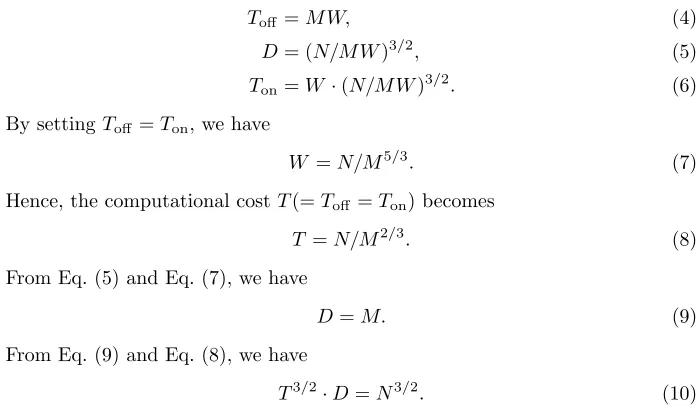
We now start the general analysis. By applying the same attack procedure as in Sect. 4.2, the attack complexity becomes as follows.
Toff =M W, (4)
D= (N/M W)3/2, (5)
Ton=W·(N/M W)3/2. (6) By settingToff =Ton, we have
W =N/M5/3. (7)
Hence, the computational costT(=Toff =Ton) becomes
T =N/M2/3. (8)
From Eq. (5) and Eq. (7), we have
D=M. (9)
From Eq. (9) and Eq. (8), we have
T3/2
·D=N3/2. (10)
This equation is only different from the tradeoff in the previous section Eq. (3) in terms ofToff andT, but the tradeoff now ensuresD=M. Namely, by increasing
5
Multiple Forgeries
In this section, we consider a problem of producing multiple forgeries by making as small number of queries as possible. This is known as the security notion called MAC reforgeability [8], where the adversary utilizes the computational complex-ity for the first forgery to reduce the complexcomplex-ity for the subsequent forgeries. This notion was also studied in the context of authenticated encryption [12].
5.1 Existential Forgery
We first consider the existential forgery, where we focus on producing as many forgeries as possible, but we do not care about the content of forged messages. From the results of Sect. 3.2, we see that given the tags of (m1,m˜1), (m1,m˜2), and (m2,m˜1), we obtain the tag of (m2,m˜2). In other words, we make 3 queries to output one forgery, and we need 3 preimage attacks. If we define the rate r
as the number of queries needed to produce one forgery, i.e.,
r= # queries # forgeries,
then we have r = 3. We note that for an ideally secure MAC, if the rate to produce one forgery isr, then the rate remains the same for multiple forgeries.
Now we call it the basic attack, which can be represented by using the fol-lowing matrix:
j
1 2
i1Q Q
2Q X
The matrix shows that we make queries (mi,m˜j) for (i, j) = (1,1),(1,2),(2,1) that are shown withQ, and we obtain the forgery for (i, j) = (2,2) that is shown withX.
We show that, forq≥2, it is possible to output (q−1)2 forgeries by making 2q−1 queries. We first present a small example withq = 3. Consider the case where we make 5 queries represented by the following matrix:
j
1 2 3
i
1Q Q Q
2Q
3Q
Observe that we obtain the tag for (i, j) = (2,2) from the submatrix with i ∈
the following matrix:
j
1 2 3
i
1Q Q Q
2Q X X
3Q
It is easy to see that we also obtain the tags for (i, j) = (3,2) and (3,3) from the submatrix withi∈ {2,3}andj∈ {1,2}, and then from that withi∈ {2,3} and j∈ {2,3}. In this case, we need to make 5 queries and 5 executions of the preimage attack to produce 4 forgeries. This gives the rater= 5/4 = 1.25, which is lower than the case of the basic attack.
We now generalize this to arbitrarily q ≥ 2. We start with the following matrix:
j
1 2 · · · q
i
1Q Q· · · Q
2Q
.. . ...
q Q
For eachi= 2,3, . . . , q, we see that we can successively obtain the tag for (i, j) with j= 2,3, . . . , q. We present the algorithmic description to show the details of this attack.
Algorithm 2Producing (q−1)2 forgeries with 2q−1 queries Require: q, the oracleOthat computes the tag
1: fixm1, . . . , mqand ˜m1, . . . ,m˜q, wheremi’s are distinct and ˜mj’s are distinct.
2: fori= 1, . . . , q, obtain the tag of (mi,m˜1) by making queries toO.
3: forj= 2, . . . , q, obtain the tag of (m1,m˜j) by making queries toO.
4: fori= 2, . . . , qdo 5: forj= 2, . . . , qdo
6: compute the tag for (mi,m˜j) from the tags of (mi−1,m˜j−1), (mi−1,m˜j), and
(mi,m˜j−1).
7: end for 8: end for
Observe that we make 2q−1 queries and execute 2q−1 preimage attacks to obtain (q−1)2 forgeries, and this gives the rater= (2q
−1)/(q−1)2.
5.2 Tightness of Existential Forgery
In this section, we consider a problem of the tightness on the rate in the exis-tential forgery. More precisely, we consider the following problem setting:
– Suppose we are given q half messages m1, m2, . . . , mq and q half messages ˜
m1,m˜2, . . . ,m˜q.
– To obtain tags of allq2messages of the form (m
i,m˜j), wherei, j∈ {1,2, . . . , q}, how many queries are necessary?
We show that 2q−1 queries are necessary, showing the tightness of the attack presented in the previous section.
Fori, j∈ {1, . . . , q}, letti,j be the tag of (mi,m˜j), andsi,j be the preimage ofti,j, i.e., we let
(
si,j←ρi⊕ρ˜j,
ti,j←π(si,j)⊕si,j, whereρi← P1(mi) and ˜ρj← P2( ˜mj).
Now we observe that the relationship,si,j←ρi⊕ρ˜jfori, j∈ {1, . . . , q}, can be represented by using a binaryq2
×2qmatrixM as follows:
M·ρ=s, (11)
where ρis a column vector of length 2qand sis a column vector of length q2, and they are defined as
(
ρ= [ρ1, . . . , ρq,ρ˜1, . . . ,ρ˜q]T,
s= [s1,1, . . . , s1,q, . . . , sq,1, . . . , sq,q]T. For instance whenq= 3, Eq. (11) is
1 0 0 1 0 0 1 0 0 0 1 0 1 0 0 0 0 1 0 1 0 1 0 0 0 1 0 0 1 0 0 1 0 0 0 1 0 0 1 1 0 0 0 0 1 0 1 0 0 0 1 0 0 1
· ρ1 ρ2 ρ3 ˜ ρ1 ˜ ρ2 ˜ ρ3 = s1,1 s1,2 s1,3 s2,1 s2,2 s2,3 s3,1 s3,2 s3,3 .
Now the tightness problem is equivalent to prove the minimum number of
si,j that fully determines the linear system of Eq. (11) havingq2 equations and 2qvariables. From its form, it is easy to see that the rank of the matrix M is 2q−1. As a consequence, we need at least 2q−1 values ofsi,j to determine the system, and hence we need to make at least 2q−1 queries.
j 1 2 3 4 5 6
i 1X 2 X
3 X
4 X
5 X
6 X
j 1 2 3 4 5 6
i 1X Q 2Q X Q 3 Q X Q
4 Q X Q
5 Q X Q
6 Q X
j
1 2 3 4 5 6
i
1X2 Q Q
2 Q X1 Q
3 Q X3 Q
4 Q X4 Q
5 Q X5 Q
6 Q X6
Fig. 7.Left: Messages to be forged given as a challenge. Middle: 2q−1 queries we make for the attack. Right: One more query is sufficient to computeqtags for the challenge.
5.3 Universal Forgery
We next consider the universal forgery, where a list of messages to be forged is given as a challenge. Suppose that (m1,m˜1), . . . ,(mq,m˜q) are the challenge messages. For simplicity, we assume that mi’s are all distinct, and ˜mi’s are all distinct.
We illustrate the caseq= 6. Our goal is to output the tags shown withX in the left matrix given in Figure 7. For this, we make queries represented by the middle matrix given in Figure 7. At this point, we cannot obtain any of the tags of the targets. However, observe that one more appropriate query allows us to obtain the entireqtags of the targets. For instance if we make a query (m1,m˜3), then we obtain the right matrix in Figure 7, and we see that it is possible to compute 6 tags with the order ofX1, . . . , X6.
This can be generalized to arbitraryqin an obvious way, and for complete-ness, we present the algorithmic description of the attack.
Algorithm 3Producingquniversal forgeries with 2q−1 queries Require: (m1,m˜1), . . . ,(mq,m˜q), the oracleOthat computes the tag
1: fori= 1, . . . , q−1, obtain the tags of (mi,m˜i+1) and (mi+1,m˜i) by making queries
toO.
2: obtain the tag of (m1,m˜3) by making a query toO.
3: compute the tag for (m2,m˜2) from the tags of (m1,m˜2), (m1,m˜3), and (m2,m˜3).
4: compute the tag for (m1,m˜1) from the tags of (m1,m˜2), (m2,m˜1), and (m2,m˜2).
5: fori= 3, . . . , qdo
6: compute the tag for (mi,m˜i) from the tags of (mi−1,m˜i−1), (mi−1,m˜i), and
(mi,m˜i−1).
7: end for
5.4 Universal Forgery with Better Rate
We show below that it is possible to arrange the queries differently in order to improve the previous rate and obtain one that is close to 5/3. First, we remark that 3 tags can be forged by making 5 queries (and 5 preimage attacks), as can be seen from the following matrix:
j
1 2 3
i
1X Q Q
2Q X Q
3 Q X
Now, assume that the number of tags we want to forge is a multiple of 3, so that we are given a list of challenge messages (m1,m˜1), . . . ,(mq,m˜q), where
q= 3`. We start by dividing the list into`lists, each consisting of 3 messages as {(mi,m˜i),(mi+1,m˜i+1),(mi+2,m˜i+2)}i=1,4,7,...,q−2
and we then treat the lists{(mi,m˜i),(mi+1,m˜i+1),(mi+2,m˜i+2)} individually. Each requires 5 queries and 5 preimage attacks, so to produce 3`tags, we make 5`queries and execute 5` times the preimage attack, which gives a rate ofr= 5`/3`≈1.67.
In case the number of challenges is not a multiple of 3 and is equal toq= 3`+r
with 0< r <3, we proceed as before and forge each of the`lists of 3 challenges with 5 queries and 5 preimage attacks. The remaining rtags can be forged by making 2 additional queries for each of them, as depicted on the following matrix:
j
· · · 3`−2 3`−1 3` 3`+ 1 3`+ 2 · · · ·
3`−2 X Q Q
i
3`−1 Q X Q
3` Q X Q
3`+ 1 Q X Q
3`+ 2 Q X
We formalize this as follows. Assume we forged the first 3`challenges with the previous technique. Ifr= 1, we query the tags corresponding to(m3`+1,m˜3`) to-gether with(m3`,m˜3`+1). We combine them with the previously-forged (m3`,m˜3`) and we are able to forge (m3`+1,m˜3`+1). If r = 2 we also query the tags cor-responding to (m3`+2,m˜3`+1) and to (m3`+1,m˜3`+2), and combine them with (m3`+1,m˜3`+1) to forge (m3`+2,m˜3`+2).
To sum up,q= 3`+rtags (with 0≤r <3) can be forged by making 5`+ 2r
queries and the same number of preimage attacks, leading to a rate equal to
r= (5`+ 2r)/(3`+r).
6
Concluding Remarks
In this paper we presented several attacks and observations on MergeMAC. They are build around pre-image attacks on the merge functions that are possible as the merge function is public (generically) and not-one way (in the specific instance given).
We also studied the reforgeability of MergeMAC, with the result that the number of forgeries we can produce increases quadratically with the number of queries. For example, it is possible to produce roughly 264 forgeries using 233 forgeries and 264 computation, so the cost per forgery becomes as small as legitimately computing one tag.
Finally, we like to mention interesting topics for future work. First, as stated above, we are not able to prove the tightness of the rate in the case of universal forgeries. We preformed a limited computer search for the optimal solution and were able to confirm that no solution with a better rate exist for up to 6 chal-lenges. In our opinion, proving the optimality, or finding better strategies, is an interesting (but challenging) open question. As a second topic, generalizations of MergeMAC could be investigated, where instead of splitting the initial message into two parts, the message is split into t parts that are processed by t PRFs. The input to the merge function than becomes the xor of the t outputs of the PRFs. It would be interesting to see how our analysis could be adopted to this case.
References
1. Ankele, R., B¨ohl, F., Friedberger, S.: MergeMAC: A MAC for Authentication with Strict Time Constraints and Limited Bandwidth. In: Preneel, B., Vercauteren, F. (eds.) Applied Cryptography and Network Security - 16th International Confer-ence, ACNS 2018, Leuven, Belgium, July 2-4, 2018, Proceedings. Lecture Notes in Computer Science, vol. 10892, pp. 381–399. Springer (2018)
2. Aoki, K., Sasaki, Y.: Preimage Attacks on One-Block MD4, 63-Step MD5 and More. In: Avanzi, R.M., Keliher, L., Sica, F. (eds.) Selected Areas in Cryptogra-phy, 15th International Workshop, SAC 2008, Sackville, New Brunswick, Canada, August 14-15, Revised Selected Papers. Lecture Notes in Computer Science, vol. 5381, pp. 103–119. Springer (2008)
3. Aumasson, J., Bernstein, D.J.: SipHash: A Fast Short-Input PRF. In: Galbraith, S.D., Nandi, M. (eds.) Progress in Cryptology - INDOCRYPT 2012, 13th Inter-national Conference on Cryptology in India, Kolkata, India, December 9-12, 2012. Proceedings. Lecture Notes in Computer Science, vol. 7668, pp. 489–508. Springer (2012),https://doi.org/10.1007/978-3-642-34931-7_28
4. Beaulieu, R., Shors, D., Smith, J., Treatman-Clark, S., Weeks, B., Wingers, L.: The SIMON and SPECK Families of Lightweight Block Ciphers. IACR Cryptology ePrint Archive 2013, 404 (2013),http://eprint.iacr.org/2013/404
-CRYPTO 2016 - 36th Annual International Cryptology Conference, Santa Bar-bara, CA, USA, August 14-18, 2016, Proceedings, Part II. Lecture Notes in Com-puter Science, vol. 9815, pp. 123–153. Springer (2016),https://doi.org/10.1007/ 978-3-662-53008-5_5
6. Bhargavan, K., Leurent, G.: On the Practical (In-)Security of 64-bit Block Ciphers: Collision Attacks on HTTP over TLS and OpenVPN. In: Proceedings of the 2016 ACM SIGSAC Conference on Computer and Communications Security, Vienna, Austria, October 24-28, 2016. pp. 456–467 (2016)
7. Biryukov, A., Perrin, L.: State of the Art in Lightweight Symmetric Cryptogra-phy. IACR Cryptology ePrint Archive 2017, 511 (2017), http://eprint.iacr. org/2017/511
8. Black, J., Cochran, M.: MAC Reforgeability. In: Dunkelman, O. (ed.) Fast Soft-ware Encryption, 16th International Workshop, FSE 2009, Leuven, Belgium, February 22-25, 2009, Revised Selected Papers. Lecture Notes in Computer Science, vol. 5665, pp. 345–362. Springer (2009), https://doi.org/10.1007/ 978-3-642-03317-9_21
9. Bogdanov, A., Knudsen, L.R., Leander, G., Paar, C., Poschmann, A., Robshaw, M.J.B., Seurin, Y., Vikkelsoe, C.: PRESENT: An Ultra-Lightweight Block Cipher. In: Paillier, P., Verbauwhede, I. (eds.) Cryptographic Hardware and Embedded Systems - CHES 2007, 9th International Workshop, Vienna, Austria, September 10-13, 2007, Proceedings. Lecture Notes in Computer Science, vol. 4727, pp. 450– 466. Springer (2007),https://doi.org/10.1007/978-3-540-74735-2_31 10. Borghoff, J., Canteaut, A., G¨uneysu, T., Kavun, E.B., Knezevic, M., Knudsen,
L.R., Leander, G., Nikov, V., Paar, C., Rechberger, C., Rombouts, P., Thomsen, S.S., Yal¸cin, T.: PRINCE - A Low-Latency Block Cipher for Pervasive Comput-ing Applications - Extended Abstract. In: Wang, X., Sako, K. (eds.) Advances in Cryptology - ASIACRYPT 2012 - 18th International Conference on the Theory and Application of Cryptology and Information Security, Beijing, China, December 2-6, 2012. Proceedings. Lecture Notes in Computer Science, vol. 7658, pp. 208–225. Springer (2012),https://doi.org/10.1007/978-3-642-34961-4_14
11. Diffie, W., Hellman, M.E.: Special Feature Exhaustive Cryptanalysis of the NBS Data Encryption Standard. IEEE Computer 10(6), 74–84 (1977)
12. Forler, C., List, E., Lucks, S., Wenzel, J.: Reforgeability of Authenticated Encryp-tion Schemes. In: Pieprzyk, J., Suriadi, S. (eds.) InformaEncryp-tion Security and Privacy - 22nd Australasian Conference, ACISP 2017, Auckland, New Zealand, July 3-5, 2017, Proceedings, Part II. Lecture Notes in Computer Science, vol. 10343, pp. 19–37. Springer (2017),https://doi.org/10.1007/978-3-319-59870-3_2 13. Hellman, M.E.: A cryptanalytic time-memory trade-off. IEEE Trans. Information
Theory 26(4), 401–406 (1980),https://doi.org/10.1109/TIT.1980.1056220 14. Jia, K., Wang, X., Yuan, Z., Xu, G.: Distinguishing and Second-Preimage Attacks
on CBC-Like MACs. In: Garay, J.A., Miyaji, A., Otsuka, A. (eds.) Cryptology and Network Security, 8th International Conference, CANS 2009, Kanazawa, Japan, December 12-14, 2009. Proceedings. Lecture Notes in Computer Science, vol. 5888, pp. 349–361. Springer (2009)
16. Mouha, N., Mennink, B., Herrewege, A.V., Watanabe, D., Preneel, B., Ver-bauwhede, I.: Chaskey: An Efficient MAC Algorithm for 32-bit Microcontrollers. In: Joux, A., Youssef, A.M. (eds.) Selected Areas in Cryptography - SAC 2014 - 21st International Conference, Montreal, QC, Canada, August 14-15, 2014, Re-vised Selected Papers. Lecture Notes in Computer Science, vol. 8781, pp. 306–323. Springer (2014),https://doi.org/10.1007/978-3-319-13051-4_19
17. Sasaki, Y.: Meet-in-the-Middle Preimage Attacks on AES Hashing Modes and an Application to Whirlpool. In: Fast Software Encryption - 18th International Workshop, FSE 2011, Lyngby, Denmark, February 13-16, 2011, Revised Selected Papers. pp. 378–396 (2011)
18. Sasaki, Y., Aoki, K.: Finding Preimages in Full MD5 Faster Than Exhaustive Search. In: Advances in Cryptology - EUROCRYPT 2009, 28th Annual Interna-tional Conference on the Theory and Applications of Cryptographic Techniques, Cologne, Germany, April 26-30, 2009. Proceedings. pp. 134–152 (2009)

![Table 1. Security claims according to the underlying primitives [1, Table 1].](https://thumb-us.123doks.com/thumbv2/123dok_us/7976063.1322633/5.612.167.450.440.494/table-security-claims-according-underlying-primitives-table.webp)