ISSN(Online): 2319-8753 ISSN (Print): 2347-6710
I
nternational
J
ournal of
I
nnovative
R
esearch in
S
cience,
E
ngineering and
T
echnology
(A High Impact Factor, Monthly, Peer Reviewed Journal) Visit: www.ijirset.com
Vol. 8, Issue 8, August 2019
Analysis BER for OFDM in LTE using
Various Modulation Techniques
Khushbu Mehta, Aabhas Mathur, Dr. Hemant Dhabai
Research scholar M.Tech. (D.C), Arawali Institute of Technical Studies, Udaipur, Rajasthan, India
Associate Professor & Head, Arawali Institute of Technical Studies, Udaipur, Rajasthan, India
Professor, Arawali Institute of Technical Studies, Udaipur, Rajasthan, India
ABSTRACT: The paper represents analysis Bit Error Rate (BER) performance of various modulation techniques. There are various modulation schemes such as Binary Phase Shit Keying (BPSK) and Quadrature Phase Shift Keying (QPSK). The performance in between these modulation techniques is analysed and best suited with respect to low Bit Error Rate (BER) is transmitted. In OFDM two types of interferences will be there are, Inter Carrier Interference (ICI) and Inter Symbol Interference (ISI) due to the orthogonality loss of subcarriers, to achieve this problem cyclic prefix (CP) is used. CP is a guard band in OFDM system that uses 20% of required subcarrier. OFDM system based on wavelet provides better orthogonality between subcarriers the purpose of analyzing OFDM performance; we have taken a two-fold approach. Different types of modulation schemes such as QPSK and 16-QAM with OFDM are studied for their Bit Error Rate (BER). A noisy channel adversely affects data transmission. For this work, we study the modulation schemes with OFDM over two types of noise channels, BER rates for both these channels has been simulated in MATLAB simulation
KEYWORDS: QPSK,QAM,OFDM,BER,DFT
I. INTRODUCTION
Basic concept of OFDM is the orthogonality principle. Orthogonality principle can be explained that any two vectors must be linearly independent from each other. Here the subcarriers must be orthogonal to each other. This means that even if waveforms overlap, the orthogonality ensures zero interference. An overlap of sub carriers is seen in frequency domain of sub carriers; hence we don’t have ICI in the band efficiency [2][5][7] OFDM is a digital modulation technique which uses multiple carriers, that use abundant tightly spaced orthogonal subcarriers. Initial data is sent in form of a single stream which is then converted to parallel form [3][10[11][17]. The parallel data or small chunks of data is then coded and then modulated on to a sub-carrier. These sub-carriers are modulated using any modulation schemes, usually qua drature amplitude modulation. These subcarriers are modulated at a low symbol rate maintaining same data rates similar to convention single carrier modulation scheme for same bandwidth. This is the reason we observe lower bit rates on sub carrier compared to single carrier. This modulated data is transmitted on multifading channels such as Rayleigh fading channel. In this
ISSN(Online): 2319-8753 ISSN (Print): 2347-6710
I
nternational
J
ournal of
I
nnovative
R
esearch in
S
cience,
E
ngineering and
T
echnology
(A High Impact Factor, Monthly, Peer Reviewed Journal) Visit: www.ijirset.com
Vol. 8, Issue 8, August 2019
Wavelet Transform can be briefly described as follows. On passing the time domain signal through several high pass and the low pass filters, which results in either a high frequency or a low frequency signal. This entire process is repeated several times every single time a small part of a signal related to its respective frequency will be removed. This is how it works, on considering a frequency of a signal to be in the range between 1000 Hz. This 1000Hz signal is passed through high pass and low pass filters and divided into two parts. Outputs of this level is a signal with 0-500Hz frequency range and the other part with 500-1000 Hz. The same process is repeated for both signals and further[19][14]
II. EXISTING WORK
In the existing system the discrete Fourier transform is used for the orthogonal basis function. First the Random data is generated and then the data is encoded by the encoder and the corresponding modulation is processed. The modulated signal is applied with the inverse Fourier transform is performed. After that the cyclic prefix data is added to the modulated signal and then the signal is passed into the channel with the noise. And the aforementioned process are performed on the transmitter side and then the reversal operations of the aforementioned processes are performed[12][6][8]. In the receiver side the cyclic prefix is removed from the channel output data and then the pilot synchronization is performed after that the Fourier transform is applied on the synchronized data and then the demodulation is performed. And the demodulated data is decoded at the receiver. Finally the BER performance is estimated.[1][9]
OFDM SYSTEM DESIGN: Occupied bandwidth is of course directly related to the data rate to transmit. However, the question is,
what is the minimum bandwidth required to be taken in order to obtain enough diversity and avoid the loss off all the signal in frequency selective fading environments. On the other hand much bandwidth means also much transmitting power. There is a trade off between bandwidth and transmitted power. The optimal bandwidth is found by channel simulations and field test trials. In Digital Audio Broadcasting (DAB), for example, a bandwidth of 1.5 MHz is a good compromise for the type of propagation conditions that apply. For conventional OFDM system sinusoids of DFT form an orthogonal basis function set. In DFT the transform correlates its input signal with each of sinusoidal basis function [13], here orthogonal basis functions are the subcarriers used in OFDM. At the receiver the signals are combined to obtain the information transmitted. Orthogonal Frequency Division Multiplexing (OFDM) is a multicarrier modulation technique in which the spectrum of the subcarriers overlap on each other. The frequency spacing among them is selected in such a way that orthogonality is achieved among the subcarriers[15][14][13]
OFDM TRANSMITTER: To ensure frequency multiplexing and orthogonality, OFDM uses a range of multi-access technologies.
ISSN(Online): 2319-8753 ISSN (Print): 2347-6710
I
nternational
J
ournal of
I
nnovative
R
esearch in
S
cience,
E
ngineering and
T
echnology
(A High Impact Factor, Monthly, Peer Reviewed Journal) Visit: www.ijirset.com
Vol. 8, Issue 8, August 2019
of several sub channels, the channel equalization is much simpler as compared to earlier generations of Communications system like CDMA. Because of multiplexing, OFDM has the capability to resist selective Fading channels. This happens due to the division of data and information of the overall channel over multiple narrowband signals.
OFDM Channel: A general time domain linearly equalized OFDM channel contains a channel model with an impulse response with a noise element as shown in Figure 3.14.
Figure2: OFDM Channel
ISSN(Online): 2319-8753 ISSN (Print): 2347-6710
I
nternational
J
ournal of
I
nnovative
R
esearch in
S
cience,
E
ngineering and
T
echnology
(A High Impact Factor, Monthly, Peer Reviewed Journal) Visit: www.ijirset.com
Vol. 8, Issue 8, August 2019
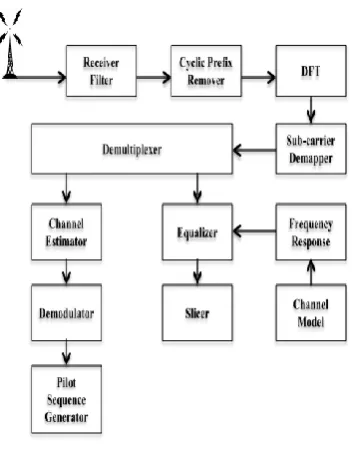
OFDM RECEIVER: An OFDM receiver consists of a receiver filter, CP removal block, DFT, sub-carrier demapper, DE-MUX, channel estimator, modulator, pilot bit generator, equalizer, frequency response, and slicer as shown in Figure 2. The receiver filter is similar to the one at the transmitter end, which is a band pass filter. It filters the incoming signal by convoluting it with alreadyestablished filter coefficients and gives out a cleaner output As shown in Figure 2, to revert the effect of up-sampler used in the transmitter, the receiver has a down-sampler that samples down the incoming signal passed through the filter through the decimation factor of 4. Thus, the original frame dimensions of the frame are cyclic prefixes to strip the signal off of its CP module achieved once the received signal passes through the down-sampler. Similarly, the CP removal block removes.
Figure 3. OFDM Receive
ISSN(Online): 2319-8753 ISSN (Print): 2347-6710
I
nternational
J
ournal of
I
nnovative
R
esearch in
S
cience,
E
ngineering and
T
echnology
(A High Impact Factor, Monthly, Peer Reviewed Journal) Visit: www.ijirset.com
Vol. 8, Issue 8, August 2019
decided in time, as well as lesser frequencies are better decided in frequency. Happening this intellect, the signal remains reproduced through an orthogonal wavelet intention, in growth the transform is calculated alone changed parts of the time domain signal. The wavelet transform can be classified as two categories, continuous ripple transform and discrete ripple transform. The Discrete Ripple Transform could be observed by way of sub-band coding. The signal is analyzed and it accepted over a filter bank succession. A sub-band coding method is defined as full-band source signal is spitted into distorted frequency bands as well as encrypt every band separately established on their spectrum energy. The sub-band coding methodology learning starts from the digital filter bank method; it can be defined as a set of filters with has distorted centre frequencies. Double channel filter bank is mostly used in growth the effective way to tool the discrete ripple transform. Generally, the filter bank plan has double steps which are used in signal transmission scheme. roposed Method Wavelet Transform is an significant mathematical function, because as a tool for multi resolution dissolution of continuous time signal by different times and frequencies.
In wavelet transform, higher frequencies are sophisticated decided in time, as well as lesser frequencies are better decided in frequency. Happening this intellect, the signal remains reproduced through an orthogonal wavelet intention, in growth the transform is calculated alone changed parts of the time domain signal. The wavelet transform can be classified as two categories, continuous ripple transform and discrete ripple transform. The Discrete Ripple Transform could be observed by way of sub-band coding. The signal is analyzed and it accepted over a filter bank succession. A sub-band coding method is defined as full-band source signal is spitted into distorted frequency bands as well as encrypt every band separately established on their spectrum energy. The sub-band coding methodology learning starts from the digital filter bank method; it can be defined as a set of filters with has distorted centre frequencies. Double channel filter bank is mostly used in growth the effective way to tool the discrete ripple transform. Generally, the filter bank plan has double steps which are used in signal transmission scheme.
IV. CONCLUSION
In this paper we analyzed the performance of wavelet based OFDM system and compared it with the performance of DFT based OFDM system. From the performance curve we have observed that the BER curves obtained from wavelet based OFDM are better than that of DFT based OFDM. We used three modulation techniques for implementation that are QPSK, 16 QAM and 64 QAM, which are used in LTE. In wavelet based OFDM different types of filters can be used with the help of different wavelets available The proposed technique can reduce the BER value by increasing the convolution encoder stages which also increase the cost and complexity. The future work for my work will focus on the different encoders than convolution encoder to give high reduction in BER. The effect of other channel type will also studied in this system as a future work scope
REFERENCES
1.Amit Goyani, Riddhi Shah,“A Review Performance comparison of conventional and wavelet based OFDM system”, International Journal of Innovative Science, Engineering & Technology, Vol. 2 Issue 3, March 2015.
2.Prof. Siddeeq Y. Ameen and Wa'il A.H. Hadi,“Investigation of Using Turbo Code to Improve the Performance of DWT-OFDM System over Selective Fading Channel”, IEEE, 2006.
3.Karanpreet Kaur , Ankush Kansal,” Performance Analysis of Convolutional Interleaved DWT based OFDM system”, International Journal of Advanced Research in Computer and Communication Engineering, 2014.
4.Volkan Kumbasar and Oguz Kucur,“ Alamouti Coded Wavelet based OFDM for Multipath Fading Channels”, IEEE,2009.
5.Juhi Khetrapal, Raj Tiwari,“Improving BER Performance of HAAR and Le-Gall Wavelet Based OFDM”, International Journal of Modern Engineering and Research Technology, January 2015.
6. W. Saad, N. El-Fishawy, S. EL-Rabaie, and M. Shokair,“An Efficient Technique for OFDM System Using Discrete Wavelet Transform”,
Springer, 2010.
7.J. Sudha Rani and K. J. Arvind Chary, “Performance comparison of FFT and DWT based OFDM with Alamouti encoding over Rayleigh fading channel”, International Journal of Science and Research (IJSR), 2014.
8.Ratna Kumari and Prof. P.Subba Rao Garu, “ Haar Wavelet based OFDM system with reduced PAPR for different modulation Techniques Bitra”, IJECT and 2014.
ISSN(Online): 2319-8753 ISSN (Print): 2347-6710
I
nternational
J
ournal of
I
nnovative
R
esearch in
S
cience,
E
ngineering and
T
echnology
(A High Impact Factor, Monthly, Peer Reviewed Journal) Visit: www.ijirset.com
Vol. 8, Issue 8, August 2019
10.Sumi K M, ArunShaji, “Performance comparison of HAAR OFDM and Daubechies OFDM in presence of carrier frequency offset (CFO) and Doppler effect ”, International Journal Of Advance Research In Science And Engineering, February 2015.
11.Santhosh Kumar, B.Vidhya,“ Bit error rate reduction of DWT based OFDM system”, International Journal of Emerging Technology in Computer Science & "Electronics (IJETCSE) and 2015.
12.Rakesh, “A Novel approach for efficient bandwidth utilization by employing different multicarrier modulation and MIMO”, International Journal of Engineering Research and General Science Volume 3, Issue 3, May-June, 2015.
13.Gembali Krishna and Adari Satya,“Performance analysis of adaptive MIMO based OFDM using FFT and DWT”, international journal of advanced research in science and technology, 2015.
14.Pratima Manhas,“Performance analysis of DWT based OFDM and FFT based OFDM using various digital modulation techniques and channel coding”, International Journal of Computer Applications, 2015.
15.Rameez Asif, Raed Abd-Alhameed,“A Unique Wavelet-based Multicarrier System with and without MIMO over Multipath Channels with AWGN”, International Journal of Computer Applications, United Kingdom, 2015.
16.Sameer A. Dawood and F. Malek, M. S. Anuar , Suha Q. Hadi, “A Proposed Turbo Coded Discrete Multiwavelet Critical-Sampling Transform Based OFDM S” IJET, 2015.
17.Kavita Trivedi1, Anshu Khare2, Saurabh Dixit3,“BER performance of OFDM with discrete wavelet transform for time dispersive channel”, International Journal of Research in Engineering and Technology, 2014.
18.C. Sreekanth,” Performance Evaluation BER of OFDM Decoder Using Different Wavelets”, International Journal of Recent Trends in VLSI, Embedded Systems and Signal Processing, 2015.