Manifold Learning Towards Masking
Implementations: A First Study
Changhai Ou, Degang Sun, Zhu Wang, Xinping Zhou and Wei Cheng
1 Institute of Information Engineering, Chinese Academy of Sciences 2 School of Cyber Security, University of Chinese Academy of Sciences
Abstract. Linear dimensionality reduction plays a very important role in side chan-nel attacks, but it is helpless when meeting the non-linear leakage of masking im-plementations. Increasing the order of masking makes the attack complexity grow exponentially, which makes the research of nonlinear dimensionality reduction very meaningful. However, the related work is seldom studied. A kernel function was firstly introduced into Kernel Discriminant Analysis (KDA) in CARDIS 2016 to re-alize nonlinear dimensionality reduction. This is a milestone for attacking masked implementations. However, KDA is supervised and noise-sensitive. Moreover, sever-al parameters and a specisever-alized kernel function are needed to be set and customized. Different kernel functions, parameters and the training results, have great influence on the attack efficiency. In this paper, the high dimensional non-linear leakage of masking implementation is considered as high dimensional manifold, and manifold learning is firstly introduced into side channel attacks to realize nonlinear dimen-sionality reduction. Several classical and practical manifold learning solutions such as ISOMAP, Locally Linear Embedding (LLE) and Laplacian Eigenmaps (LE) are given. The experiments are performed on the simulated unprotected, first-order and second-order masking implementations. Compared with supervised KDA, manifold learning schemes introduced here are unsupervised and fewer parameters need to be set. This makes manifold learning based nonlinear dimensionality reduction very simple and efficient for attacking masked implementations.
Keywords:machine learning·manifold learning·dimensionality reduction·ISOMAP
·LLE·Laplacian Eigenmaps·masking·side channel attack
1
Introduction
Cryptographic devices may leak secret information through side channels such as electro-magnetic [1], acoustic [12] and power consumption [15] during the hardware and software implementation of cryptographic algorithms. These leakages are usually unconscious and difficult to be discovered. By taking advantage of statistical correlation between assumed power consumption of intermediate values (e.g. the outputs of Sbox in the first round of AES-128) and these side channel leakages, an attacker can recover the key used in the target devices. Side channel attacks, such as Differential Power Analysis (DPA) [15], Correlation Power Analysis (CPA)[4], Template Attacks (TA) [6] and Collision Attacks
(CA) [25,23], pose serious threats to the security of cryptographic implementation.
Coun-termeasures, such as masking [24,8], must be taken to prevent against them, which make
side channel attacks hard to perform. However, these countermeasures also make it hard to evaluate the security of implementation.
Higher-order attacks against masking implementations are widely researched [7, 19].
the first d ones are random, and the last one is fixed and calculated from the first d
shares and the intermediate values (see Section 2.2). For all shares parallel performed masking implementations, the attacker can simply traverse the time samples and perform his attacks. However, for serial software implementations, different shares are performed at different times. That’s to say, secret information leaks at different time samples. In order to perform higher order attacks, the attacker needs to find at least a time sample
combination of d+ 1 shares. However, most of current papers perform their attacks
under the hypothesis that the locations of alld+ 1 shares are known. This brings
higher-order attacks back to the unprotected first higher-order attacks case and ignores the detection of Points-of-Interest (POI) [18].
As far as we know, there are only several papers talking about POI selection for mask-ing implementation. Oswald et al. used educated guess that performmask-ing an exhaustive
search over all possible (d+ 1)-tuples of time samples in a selected window [17]. Reparaz
et al. proposed an alternative solution based on Mutual Information Analysis (MIA) [13] in [20]. However, both of these two solutions are very time-consuming, since the power traces acquired are usually very long. This makes the higher-order attacks very difficult to perform. Linear dimensionality reduction methods, such as PCA [11], LDA [27], project the high dimensional power traces into a lower dimensional subspace by optimizing ob-jective functions. However, these methods are limited to the dimensionality reduction in linear space. They become powerless when meeting high-dimensional nonlinear leakage for higher-order masking implementations.
Durvaux et al. proposed a new solution to select POIs based on Projection Pursuits (PP) [10]. This solution returns the locations of time samples for shares. It needs to set several parameters. As stated in [5], it works very well when attacking second
or-der masking implementations. However, it becomes powerless and fails when d >2 in
the experimental results of Cagli et al. [5]. In this case, Kernel Discriminant Analysis (KDA) [5] still works in third- and fourth- order attacks. It projects high dimensional traces leaked by higher-order masking implementation to low dimensional space through a nonlinear kernel function (see KDA introduced in Section 3). KDA is currently the only feasible solution for nonlinear dimensionality reduction towards masked implementations. It makes the complex and time-consuming higher-order attacks simple and feasible. This is a milestone for higher order attacks. However, for non-linear dimensionality reduction, there is still a lot of work to do. Since the correlation between the intermediate values and combined power consumption becomes very weak after performing KDA, which makes the attack require a lot of traces (see the experimental results detailed in Section 5). More-over, for higher-order masking implementations, a power trace usually includes hundred thousand or even millions time samples, which makes the storage and computing time very huge, and greatly increases the difficulty of the attacks.
implementations.
The rest of the paper is organized as follows. Notations, non-linear leakage of masking implementation and intrinsic dimensionality estimation in manifold learning are intro-duced in Section 2. KDA is introintro-duced in Section 3. Manifold learning schemes including ISOMAP, LLE and LE are detailed in Section 4. Second- and third-order attacks are per-formed on simulated traces to highlight the superiority of our manifold learning schemes in comparison with KDA in Section 5. Finally, Section 6 draws general conclusions.
2
Backgrounds
2.1
Notations
The principle of dimensionality reduction is to map data samples from high dimensional input space through linear or nonlinear mapping to a low dimensional space, so as to find meaningful low dimensional structures hidden in high dimensional observation data.
Suppose that the attacker encrypts n plaintexts P = (p1, p2, . . . , pn), acquires n power
tracesx1, x2, . . . , xnand saves them in matrixX. Thus,X ={x1, x2, . . . , xn} ⊂RD. Here
Rdenotes the real number space,Ddenotes the number of samples on each acquired power
trace. If the high-dimensional samples inX can be generated from the data setY in the
low dimensional space through an unknown mapping function f:
xi =f(yi) +θi, (1)
thenf :Rd →RD is an embedded mapping. Hereθ
i is noise andd≪D. Iff is a linear
function, then we say it’s a linear mapping. Otherwise, it’s a nonlinear mapping. The
main purpose of manifold learning is to obtain the low dimensional samplesY according
to the given high dimensional observation samplesX, and construct a non-linear mapping
f−1from high-dimension to low dimension.
2.2
Non-linear Leakage of Masking Implementation
The principle of masking is secret sharing. Take a d-th order masking of AES-128 for
example, the sensitive intermediate values of S-box outputs in the first round are divided intoS1, S2, . . . , Sd andSd+1 pieces:
I=S1◦S2◦ · · · ◦Sd◦Sd+1, (2)
◦here denotes a group operation, such as XOR. The sharesS1, S2,· · · , Sdare independent
with each other and random. The last shareSd+1 is fixed and satisfies Equation 1. Thus,
The masking implementations eliminate the correlation between the side channel leakage
X = {x1, x2, . . . , xn} and intermediate values I. To perform a successful attack, the
attacker needs to find at least a time sample combination of these d+ 1 shares. If at
most d shares are found, the combined power consumption is still independent of the
assumed leakage of intermediate values. The introduction of masking into encryption and decryption slows down the implementation, makes the power trace long. If the sampling rate is set very high, this problem is very obvious. This makes it hard for the attacker to find a time sample combination of shares.
Not only the group operation XOR in Equation 2, the intermediate values I can be
generalized as the non-linear function f′ ofd+ 1 shares:
I=f′(S1, S2,· · · , Sd+1), (3)
corresponding power trace set. Intrinsic dimension here is defined as the actual dimen-sion of low-dimendimen-sional manifold structure corresponding to the high-dimendimen-sional leakage samples. In this way, the problem of side channel attacks on masking implementation can
be changed to the problem of non-linear dimensionality reduction. The dimension d of
Y after dimensionality reduction is much smaller than the dimensionD of original power
trace set X. Moreover, the information of shares are mapped into the low dimensional
manifold. We can simply consider that the D-dimension samples are projected onto a
vector for each dimension after mapping.
Manifold learning can map high-dimensional samples to low-dimensional space and preserve the original structure of data. If the first-order CPA performed on a vector have a high correlation coefficient, the classification of samples on this dimension after projection is good. Thus, the attacker can directly perform first order side channel attacks
on the data setY. Therefore, the non-linear dimensionality reductions based on manifold
learning can significantly improve the attack efficiency. If template attack (TA) is used here, the attacker has to take several mapped dimensions into consideration.
2.3
Intrinsic Dimensionality Estimation
As mentioned in Section 2.2, the intrinsic dimension of side channel leakage is always much smaller than the corresponding dimension of power trace set. Dimensionality reduction can not only obtain computational advantages, but also greatly improve the comprehen-sibility of data set. Although the intrinsic dimension of the high-dimensional leakage samples for a certain masking implementation is determined, it is difficult to estimate it from the leakage samples since the presence of other operations and noise. An attacker can usually describe the intrinsic dimension by using the minimum number of independent variables required by model the observed samples.
Schemes such as Geodesic Minimal Spanning Tree (GMST) [9], k-Nearest Neighbor
(k-NN) [26], Maximum Likelihood Estimator (MLE) [16], can be used to estimate the
intrinsic dimension in manifold learning. Actually, it’s enough to keep several projection directions, since the high correlation usually occurs on them.
3
Kernel Discriminant Analysis
Let (xzi
i )i=1,...,n denote the classz=ziincluding all traces corresponding to classzi. For
example, the power traces are divided into 9 classes according to their intermediate values.
Let K = xzj
j , x zi
i
i=1,...,n;j=1,...,n store only columns indexed by the indices i such that
zi=z,Idenote anz×nzidentify matrix, andInz denote anz×nzmatrix with all entries
equal to 1
nz. KDA introduced in [5] uses a kernel function
K(xi, xj) = (xi·xj)d (4)
to turn linear distinguisher LDA [27] into nonlinear distinguisher, where·denotes the dot
product. Then, it uses the labeled set (xzi
i )i=1,...,n and the kernel function to construct a
between-class scatter matrixM:
M=X z∈Z
nz(Mz−MT) (Mz−MT)T, (5)
whereMz andMT are two n-size column vectors whose entries are given as:
Mz[j] = 1
nz nz
X
i:zi=z
K(xzj
j , x zi
and
MT[j] = 1
nz n
X
i=1
K(xzj
j , x zi
i ). (7)
There represents a matrix transpose. Cagli et al. then constructed a within-class scatter
matrixN:
Nz[j] =
X
z∈Z
Kz(I−Inz)K
T
z. (8)
Cagli et al. then regularized the matrixN:
N=N+µI, (9)
and foundQnon-zero eigenvaluesλ1, . . . , λQand the corresponding eigenvectorsν1, . . . , νQ ofN−1
M. This step aims at minimizing the within-class variance and maximizing
between-class variance. (νj)j=1,...,Qhere denotes different projection directions. If a new tracexis
projected onto thel-th nonlineard-th order discriminant component, then the projection
is
εKDAl (x) = n
X
i=1
νι[i]K(xzii, x). (10)
The most time-consuming step in KDA is to find the eigenvalues ofN−1M, of which the
complexity is O(n3). When the number of traces used is very large, KDA works very
slowly. Moreover, KDA is a supervised nonlinear dimensionality reduction, the training result has direct impact on the dimensionality reduction results.
4
Manifold Learning
Since the proposal of ISOMAP [29], Manifold learning schemes such as LLE [21], LE [2], LTSA [32], LPP [14] and MFA [30], have been widely studied. ISOMAP, LLE and LE is three most classical schemes, which are introduced in Sections 4.1, 4.2 and 4.3. It is worth noting that different manifold learning schemes are based on different mathemat-ical principles. So, it is all depend that whether the scheme can be used to reduce the dimension of time samples acquired when performing masking implementation. The rea-son why we use these three methods is that they are able to attack our simulated masking implementations in addition to their classic.
4.1
Isomap
ISOMAP is one representative of isometric mapping methods and maintains the global structure of the original data. Euclidean distance used in MDS [3] can’t be exactly rep-resent the distance relation between points on manifold structure. For example, a worm creeps from a point A to a point B on the curved surface. Since it can only creep on the surface. So, directly using the Euclidean distance between these two points to present the creeping distance of the worm is clearly not appropriate. Here if we use geodesic distance to represent the distance, then it can correctly reflect the shortest distance that the insect has creep. In this sense, ISOMAP improves MDS by using geodesic distance instead of Euclidean distance, the procedures of which are introduced as follows:
Neighbors Selection. The attacker defines the adjacency graph G containing all
points (here each power trace is regarded as a point). If two nodesi andj are adjacent,
then there is a side between them, of which the length is dx(i, j). Euclidean distance is
Finding Shortest Paths. The attacker calculates the approximate geodesic distance matrix J ={dG(i, j)}n×n. If nodes i andj are connected, the shortest pathdG(i, j) =
dx(i, j). Otherwise,dG(i, j) =∞. The attacker performs Floyd or Dijkstra algorithm on
adjacency graphGto find the shortest paths. The geodesic distance is defined as:
dG(i, j) =
(
dG(i, j), if nodes i and j are adjacent
min{dG(i, j), dG(i, k) +dG(k, j)}, otherwise
(11)
The shortest path matrix JG = (dG(i, j)) among sample vectors finally converges after
many iterations. The complexity is O(n2) when using Dijkstra algorithm to find the
shortest path between two power traces. If the shortest paths between any two sample
points are calculated, the complexity is O(kn2logn). k here is the number of nearest
neighbors.
Computing Low Dimensional Embedding. Isomap uses MDS to obtain the low
dimensional embedding, a d-dimensional space that maintains the essential geometry of
power traces. The procedures of MDS are as follows:
Step 1. The attacker computesS = (d2ij).
Step 2. He then setshij=δij−n1. The centralization matrixH = (Hij). δij satisfies that
δij =
(
1, i=j
0, j 6=j (12)
Step 3. The attacker then doubles the centering and computes
τ(J) =−HSH
2 . (13)
Let JY denote the Euclidean distance between samples after dimensionality reduction.
ISOMAP aims at minimizing the objective function:
E =kτ(JG)−τ(JY)kL2, (14)
wherekAkL2 =
q P
ijA2ij. The low dimensional embeddingy1, y2, . . . , yn are thed
eigen-vectors corresponding to the d minimum eigenvalues. ISOMAP uses MDS to perform
eigendecomposition, the complexity is O(n3). Compared to KDA, ISOMAP is
unsuper-vised. The attacker only needs to set two parameterskandd.
4.2
Locally Linear Embedding
Unlike ISOMAP, Locally Linear Embedding (LLE) [21] maintains local properties of data, and it’s a local optimization solution. LLE considers the structure of data as linearity in
local sense. Therefore, a data point xi can be approximated by the linear combination
Pk
j=1wijxj of its neighbor points xj-s. That is, xi ≈ P
k
j=1wijxj. In this way, recon-struction weights are constructed between each data point and its neighboring points. The weight vectors constructed by reconstruction weights keep the local linear structure of high-dimensional data. The local linear structure is also maintained in the low
dimen-sional space. That is,yi≈P
k
j=1wijyj. The procedures of LLE are as follows:
Neighbors Selection. Similar to ISOMAP, the first step of LLE is also to find
k nearest neighbors for each point. k is a predetermined value given by the attacker.
It is a very important parameter and has great impact on the results of side channel
attacks. Another important parameter here is dimensiondafter dimensionality reduction
It must be noted here that both the ISOMAP and LLE have two parameterskandd,
so as to the LE introduced in Section 4.3. k-NN is also used in their first step. However,
the mathematical principles of them are different. So, we can’t simply think that these two parameters are same. Actually, they are tested separately in our experiments.
Computing Reconstruction Weight Matrix. Since we usePk
j=1wijxj to
approx-imatexi, an error of reconstruction
min ε(W) = n X i=1
xi− k
X
j=1
wijxj
2 (15)
is between point xj and its neighbors. wij here denotes the reconstruction weight of
data point xi and its neighborhoodxj. Ifxj is not a neighborhood ofxi, then wij = 0.
Otherwise, wij 6= 0 and P
k
j=1wij = 1. In order to minimize the reconstruction error,
W satisfies symmetry. The complexity of computing reconstruction weight matrix is
O((D+k)k2n).
Computing Low Dimensional Embedding. In this step, the linear relationship in local areas is established by using the weights obtained in Step 2. The low dimensional space Y is obtained by minimizing the cost function:
min ϕ(Y) = n X i=1
yi− k
X
j=1
wijyj
2 =
Y(I−W
T )
2
=tr(Y M YT), (16)
whereyi is the low dimensional mapping vector ofxi, andyj is the mapping vector ofxj
(the neighborhood of xi). Y satisfies n1Y YT =I (I is the unit matrix), and Pni=1yi =
0. The above objective function can be transformed into calculating the eigenvectors of matrix
M = (I−W)T(I−W). (17)
If the eigenvalues of M are sorted in ascending order, the first one is about 0 and
dis-carded. Finally, the eigenvectors corresponding to the minimum d non-zero eigenvalues
of matrixM are chosen as low dimensional coordinate. The complexity of computing low
dimensional embedding is O(dn2). Similar to ISOMAP, LLE is also unsupervised. The
attacker only needs to set two parameterskandd.
4.3
Laplacian Eigenmaps
Laplacian Eigenmaps (LE), like LLE, is also a local feature preserving algorithm. It builds
a graph from neighborhood information of the data set. If two nodesiandj are adjacent
in the original data space X, they are also adjacent in the subspaceY. The procedures
of LE are as follows:
Constructing Adjacency Graph. We put an edge between the nodeiand node j
if two measurementsxi andxj are "close". Two schemes,k-NN andǫ−ballcan be used to
construct of the adjacency graph. Fork-NN, nodesiandj are connected by an edge if i
is amongnnearest neighbors ofj orj is among thennearest neighbors ofi. Forǫ−ball,
nodesiandj are connected by an edge ifkxi−xjk< ǫwherek·kis the usual Euclidean
norm inRD. Finally, the adjacency graphGis constructed.
Computing Reconstruction Weight Matrix. For each point, the attacker com-putes the weight coefficient
wij =e− kxi−xjk2
t (18)
if nodesiandjare connected. Otherwise,wij is set to 0. The parametertis an adjustable
wij to 1 if nodesiandj are connected. Otherwise,wij is set to 0, of which the case also
corresponds tot=∞.
Computing Low Dimensional Embedding. LE keeps the local property of mani-fold structure in the mean sense, which depends on the distances between adjacent points.
The adjacent points in G are close after dimensionality reduction. Therefore, LE
mini-mizes the objective function:
ϕ(y) =X ij
kyi−yjk
2
wij. (19)
LetJ denote a diagonal weight matrix, and its entries are column sums ofw,J = (Jii) =
P
jwij andL=J−W is the Laplacian matrix. If a constraintY J YT =I is added, the
objective function can be transformed into:
ϕ(y) = 2Y LYT. (20)
This is equivalent to solving
LY =λJ Y. (21)
LE then sorts the eigenvalues of Laplacian matrix in ascending order and selects the d
eigenvectors corresponding to thedminimum eigenvalues. The obtained low dimensional
embedding coordinates are:
Y ={y1, y2,· · ·, yn}, yi∈Rd. (22)
The complexity of constructing adjacency graph isO(Dn2), the complexity of
comput-ing low dimensional embeddcomput-ing is O(dn2). Similar to LLE,dhere denotes the number of
eigenvalues or eigenvectors. The complexity of computing reconstruction weight matrix
is less than O(kDn). So, compared to ISOMAP and LLE, LE only has a small amount
of computation, of which the calculation speed is high.
Compared to ISOMAP and LLE, LE not only needs to set k and d, but also needs
to set a parameter t for the weight of hot kernel function (see Equation 18). In our
experiments, this parameter is set to 2. We have not done much research on the impact of this parameter.
5
Experimental Results
In order to facilitate the evaluation, our experiments are performed on simulated traces. Since the locations of shares and the noise are easy to control. Moreover, the lengths of non-leaky areas can also be set shortly, so as to shorten the time for evaluation. Since the
complexity of ISOMAP, LLE and KDA are O(n3). When more than 8000 power traces
(300 points for each) are used, several hours are hard to get the experimental results for
a repetition. Let R denote the Gaussian distributed noise with mean 0.00 and variance
σ2,Z denote the intermediate value (e.g. the output of Sbox in the first round of AES),
and HW denote the Hamming weight function. The leakage model of the S-box output
implementation can be modeled as
L=HW(Z) +R. (23)
Time samples
0 50 100110 150 200210 250 300
power consumption
-4 -2 0 2 4 6
Figure 1: A simulated power traces with first-order mask.
areas that are not related to the operation of shares. The average power consumption is 0.00 and the noise standard deviation is 1.00 in these areas.
In our experiments, we insert a sample area of length 100 in front of and behind time samples of each share. Leakage area of each share includes 10 time samples. A simulated trace with first order mask is shown in Fig.1. The trace includes two leakage areas, of which the time samples range from 100 to 110 and from 200 to 210 respectively. Since Hamming weight model is used for the simulation, power traces are classified into 9 classes according to the Hamming weights of the intermediate values in KDA. Compared to KDA, our manifold learning solutions ISOMAP, LLE and LE are unsupervised, so dimensionality reduction is directly performed on the simulated power traces. Then, first order CPA is performed on the dimensionality reduced traces.
guessing key
0 50 100 150 200 250
ρ
0 0.2 0.4 0.6 0.8
1 (1) CPA after performing ISOMAP
guessing key
0 50 100 150 200 250
ρ
0 0.2 0.4 0.6 0.8
1 (2) CPA after performing LLE
guessing key
0 50 100 150 200 250
ρ
0 0.2 0.4 0.6 0.8
1 (3) CPA after performing LE
guessing key
0 50 100 150 200 250
ρ
0 0.2 0.4 0.6 0.8
1 (4) CPA after performing KDA
Figure 2: CPA after performing ISOMAP, LLE, LE and KDA on unprotected implemen-tation respectively.
that both KDA and manifold learning schemes (ISOMAP, LLE and LE) are very efficien-t when aefficien-tefficien-tacking unproefficien-tecefficien-ted implemenefficien-taefficien-tions. However, efficien-this is noefficien-t efficien-the focus of efficien-this article. The purpose of Fig.2 is to compare correlation coefficients under first-, second-and third-order attacks, second-and highlight the superiority of our manifold learning schemes ISOMAP, LLE and LE in comparison with KDA. We compare the experimental results of second-order attacks and third-order attacks on the simulated traces in Sections 5.1 and 5.2.
5.1
Second Order Attacks
µ is a very important parameter that needs to be optimized (see Equation 9). However,
Eleonora et al. did not give the detailed method to optimize it in their paper [5]. They
just tested µ for several times and chose the best one. In this paper, we also test this
parameter several times and choose the best one, of which the results are shown in Table 1. We perform second-order attacks on 600 power traces and repeat this operation 200
times, the number of traces used to construct matrixMequals to 4000. The success rate
(SR)[28] is the highest and equals to 0.155 when µ = 10. So, in our experiments, the
constant µis always set to 10.
Table 1: Success rate under differentµ-s.
µ 10−9 10−7 10−5 10−3 10−1 100
SR 0.130 0.075 0.115 0.115 0.130 0.090
µ 101 103 105 107 109 1011
SR 0.155 0.055 0.125 0.060 0.130 0.085
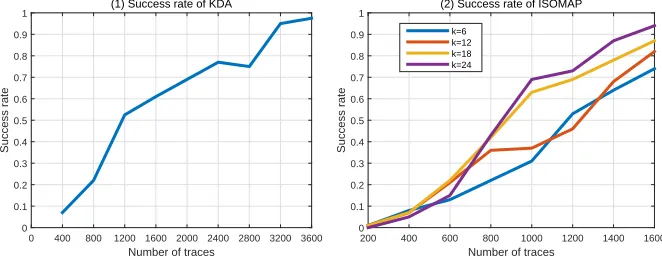
KDA is the first feasible supervised nonlinear dimensionality reduction scheme. It is not very efficient when attacking masking implementations. Take the simulated second-order masking implementation for example, to get a success rate close to 1.00, more than 3000 power traces are needed. If less than 1200 traces are used, the success rate is less than 0.50. Enlarging the noise or lengthening the number of time samples on the power traces reduces the success rate. Thus, the attacks require more traces.
Number of traces
200 400 600 800 1000 1200 1400 1600
Success rate
0 0.1 0.2 0.3 0.4 0.5 0.6 0.7 0.8 0.9
1 (2) Success rate of ISOMAP
k=6 k=12 k=18 k=24
Number of traces
0 400 800 1200 1600 2000 2400 2800 3200 3600
Success rate
0 0.1 0.2 0.3 0.4 0.5 0.6 0.7 0.8 0.9
1 (1) Success rate of KDA
Figure 3: Success rates of KDA and ISOMAP when attacking second-order masking implementation.
200 times. This makes the success rate fluctuate, but this does not affect our analysis. As shown in Fig.3, the success rate of ISOMAP is much higher than that of KDA. The
choice of constantkis crucial. When the number of traces used is small, a smallkmakes
the attacker get a higher success rate. With increase of the number of power traces,kcan
be enlarged properly. When kis set to 6, 12, 18 and 24, and the number of traces is less
than 400, the success rates are almost the sample. When 400< n <600, the success rates
corresponding to k = 24 is lower than these of k= 12 and k = 18. This indicates that
if the threshold setting is too large, the attack efficiency will be affected. However, the
threshold is relative and not fixed. It can be increased appropriately with nto achieve a
higher success rate. Whenn >600, the success rates corresponding tok= 18 andk= 24
are significantly higher than these corresponding to k= 6 andk= 12.
Number of power traces
0 150 200 250 300 350 400 450 500 550 600 650 700
Success rate
0 0.1 0.2 0.3 0.4 0.5 0.6 0.7 0.8 0.9
1 (1) Success rate of LLE
k=6 k=12 k=18 k=24
Number of power traces
0 150 200 250 300 350 400 450 500 550 600 650 700
Success rate
0 0.1 0.2 0.3 0.4 0.5 0.6 0.7 0.8 0.9
1 (2) Success rate of LE
k=6 k=12 k=18 k=24
Figure 4: Success rates of LLE and LE when attacking first-order masking implementa-tion.
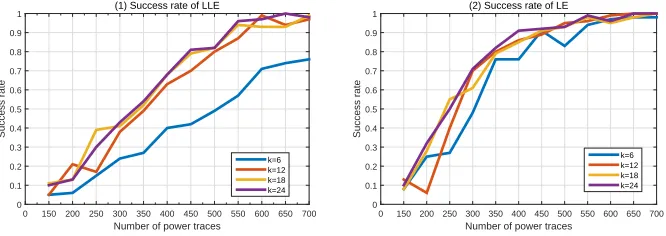
ISOMAP, LLE and LE is significantly more efficient than KDA. Compared to ISOMAP, LLE and LE is faster. The success rates of them is significantly higher than that of
ISOMAP (as shown in Fig.4). When n = 550, the success rate corresponding to LE
approaches 1.00, compared to nearly 700 power traces used in LLE. It is worth noting
that the parameterkalso needs to be set properly. Ifkis very small, the success rates of
LLE and LE are low, especially for LLE, of which the success rate is significantly lower
than these corresponding tok= 12, 18 and 24. However, ifkis more than 12, the success
rate no longer significantly improves.
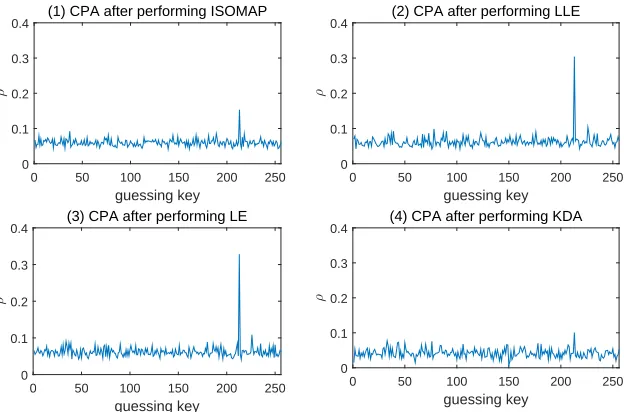
The correlation between the intermediate values and the combined leakages drops very quickly. Similarly, correlation coefficient decrease rapidly in nonlinear dimensionality reduction. We use 4000 power traces to perform KDA, ISOMAP, LLE and LE, the success rates of which are about 1.00. However, the correlation coefficients of LLE and
LE are about 0.30 (as shown in Fig.5). Theρ-s of ISOMAP and KDA are very small, the
former is about 0.15, the latter is about 0.10. This is not a special case, the results are
representative. We find that the ρ-s of LLE and LE in many experiments are about 0.30,
andρ-s of KDA and ISOMAP are close to 0.10. The small correlation coefficients can be
easily drowned out by the ρ-s corresponding to wrong keys. This also means that it is
difficult for the attacker to get success using the same number of traces. That’s to say, in order to get the correct key, the attacker needs more power traces.
5.2
Third Order Attacks
guessing key
0 50 100 150 200 250
ρ
0 0.1 0.2 0.3
0.4 (1) CPA after performing ISOMAP
guessing key
0 50 100 150 200 250
ρ
0 0.1 0.2 0.3
0.4 (2) CPA after performing LLE
guessing key
0 50 100 150 200 250
ρ
0 0.1 0.2 0.3
0.4 (3) CPA after performing LE
guessing key
0 50 100 150 200 250
ρ
0 0.1 0.2 0.3
0.4 (4) CPA after performing KDA
Figure 5: CPA after performing ISOMAP, LLE, LE and KDA on traces of first-order masking implementation respectively.
to KDA, ISOMAP, LLE and LE are all smaller than 0.10 when third-order attacks are performed on 4000 power traces.
guessing key
0 50 100 150 200 250
ρ
0.04 0.06 0.08
0.1 (2) CPA after performing LLE
guessing key
0 50 100 150 200 250
ρ
0.02 0.04 0.06 0.08
0.1 (3) CPA after performing LE
guessing key
0 50 100 150 200 250
ρ
0.02 0.04 0.06 0.08
0.1 (4) CPA after performing KDA
guessing key
0 50 100 150 200 250
ρ
0.04 0.06 0.08
0.1 (1) CPA after performing ISOMAP
X: 213 Y: 0.088
X: 213 Y: 0.07188
X: 213 Y: 0.04495
X: 213 Y: 0.02532
Figure 6: CPA after performing ISOMAP, LLE, LE and KDA on second-order masking implementation respectively.
We get a conclusion similar to the one of second order attack in Fig.5: the attacker will get higher correlation coefficients if he uses LLE or LE to perform dimensionality reduction rather than KDA and ISOMAP. The attack efficiency of LLE and LE is still much higher than that of KDA and ISOMAP in our third-order attack experiments. When
the number of nearest neighborskis set to 24, the success rate of LE can reach 0.90 under
5000 power traces (as shown in Fig.7). Compared to LE, the success rate of LLE is less
than 0.40. khas great impact on the attack efficiency. For example, the success rate of
success rate is higher than 0.30. The similar impact of threshold k on attack efficiency also happens in LE.
Number of traces
1000 2000 3000 4000 5000
Success rate
0 0.1 0.2 0.3 0.4 0.5 0.6 0.7 0.8 0.9
1 (2) Success rate of LE
k=6 k=12 k=18 k=24
Number of traces
1000 2000 3000 4000 5000
Success rate
0 0.1 0.2 0.3 0.4 0.5 0.6 0.7 0.8 0.9
1 (1) Success rate of LLE
k=6 k=12 k=18 k=24
Figure 7: Success rates of LLE and LE when attacking second-order masking implemen-tation.
We perform our experiments on 6000 power traces for each repetition to test the success rate of KDA. However, the success rate is still very close to 0. So as to ISOMAP. ISOMAP is very time-consuming in our experiments since it uses Dijkstra algorithm to find the shortest path between any two power traces. So, we do not give the corresponding graphs for both of them. This paper only considers using the most basic methods. A lot of improvements have been proposed to enhance KDA, ISOMAP, LLE and LE, other manifold learning schemes can also be used to reduce dimension. These work may also be introduced into attacking masking implementations. There also exists other side channel attacks more efficient than CPA. These improvements can be left as open problems here.
6
Conclusions
Informative extraction (e.g. POI detection scheme PP [10] and KDA) for masking imple-mentation is one of the most challenging problems of side channel attacks. It is also crucial for higher-order attacks and leakage assessment. However, it is rarely studied. In this case, we think KDA in [5] is a milestone for informative extraction towards masking implemen-tation, since it makes the dimensionality reduction of high-dimensional nonlinear leakage samples practical for the first time. However, this scheme is supervised, noise-sensitive and inefficient, requires a large number of power traces to perform attacks.
In this paper, we introduce manifold learning into nonlinear dimensionality reduction for masking implementations. We use un-supervised schemes ISOMAP, LLE and LE to realize this target. Compared to KDA, these three methods are much more efficient at second-order attacks. The correlation between intermediate values and the components after dimensionality reduction in these three schemes are higher than that of KDA, too. We also compare ISOMAP, LLE and LE with KDA on third-order attacks. ISOMAP is very time-consuming and the success rate of KDA is very low. In this case, LLE and LE still work very well. Manifold learning schemes introduced in this paper are unsupervised, which makes the attacks easy to perform. The attacker needs to set fewer parameters. These above advantages make manifold learning meaningful when attacking masking implementations.
further study. For example, better kernel functions, more accurate intrinsic dimension es-timation and more efficient dimensionality reduction algorithm implementations. It may be the most efficient way to use non-linear dimensionality reduction methods to attack the high-dimensional non-linear time samples of masked implementations.
References
[1] D. Agrawal, B. Archambeault, J. R. Rao, and P. Rohatgi. The EM side-channel(s). InCryptographic Hardware and Embedded Systems - CHES 2002, 4th International Workshop, Redwood Shores, CA, USA, August 13-15, 2002, Revised Papers, pages
29–45, 2002.
[2] M. Belkin and P. Niyogi. Laplacian eigenmaps for dimensionality reduction and data
representation. Neural Computation, 15(6):1373–1396, 2003.
[3] I. Borg and P. Groenen. Modern multidimensional scaling: theory and applications. Journal of Educational Measurement, 40(3):277–280, 2003.
[4] E. Brier, C. Clavier, and F. Olivier. Correlation power analysis with a leakage model. InCryptographic Hardware and Embedded Systems - CHES 2004: 6th International Workshop Cambridge, MA, USA, August 11-13, 2004. Proceedings, pages 16–29, 2004.
[5] E. Cagli, C. Dumas, and E. Prouff. Kernel discriminant analysis for information
extraction in the presence of masking. InSmart Card Research and Advanced
Appli-cations - 15th International Conference, CARDIS 2016, Cannes, France, November 7-9, 2016, Revised Selected Papers, pages 1–22, 2016.
[6] S. Chari, J. R. Rao, and P. Rohatgi. Template attacks. InCryptographic Hardware
and Embedded Systems - CHES 2002, 4th International Workshop, Redwood Shores, CA, USA, August 13-15, 2002, Revised Papers, pages 13–28, 2002.
[7] J. Coron, E. Prouff, and M. Rivain. Side channel cryptanalysis of a higher order
masking scheme. In Cryptographic Hardware and Embedded Systems - CHES 2007,
9th International Workshop, Vienna, Austria, September 10-13, 2007, Proceedings, pages 28–44, 2007.
[8] J. Coron, E. Prouff, M. Rivain, and T. Roche. Higher-order side channel security and
mask refreshing. In Fast Software Encryption - 20th International Workshop, FSE
2013, Singapore, March 11-13, 2013. Revised Selected Papers, pages 410–424, 2013.
[9] J. A. Costa and A. O. H. III. Geodesic entropic graphs for dimension and entropy
estimation in manifold learning. IEEE Trans. Signal Processing, 52(8):2210–2221,
2004.
[10] F. Durvaux, F. Standaert, N. Veyrat-Charvillon, J. Mairy, and Y. Deville. Effi-cient selection of time samples for higher-order DPA with projection pursuits. In Constructive Side-Channel Analysis and Secure Design - 6th International Workshop, COSADE 2015, Berlin, Germany, April 13-14, 2015. Revised Selected Papers, pages
34–50, 2015.
[11] T. Eisenbarth, C. Paar, and B. Weghenkel. Building a side channel based disassembler. Trans. Computational Science, 10:78–99, 2010.
[12] D. Genkin, A. Shamir, and E. Tromer. RSA key extraction via low-bandwidth
a-coustic cryptanalysis. In Advances in Cryptology - CRYPTO 2014 - 34th Annual
[13] B. Gierlichs, L. Batina, P. Tuyls, and B. Preneel. Mutual information analysis. In Cryptographic Hardware and Embedded Systems - CHES 2008, 10th International Workshop, Washington, D.C., USA, August 10-13, 2008. Proceedings, pages 426–442,
2008.
[14] X. He and P. Niyogi. Locality preserving projections. In Advances in Neural
Infor-mation Processing Systems 16 [Neural InforInfor-mation Processing Systems, NIPS 2003, December 8-13, 2003, Vancouver and Whistler, British Columbia, Canada], pages 153–160, 2003.
[15] P. C. Kocher, J. Jaffe, and B. Jun. Differential power analysis. In Advances in
Cryptology - CRYPTO ’99, 19th Annual International Cryptology Conference, Santa Barbara, California, USA, August 15-19, 1999, Proceedings, pages 388–397, 1999.
[16] E. Levina and P. J. Bickel. Maximum likelihood estimation of intrinsic dimension. InAdvances in Neural Information Processing Systems, NIPS 2004, December 13-18, 2004, Vancouver, British Columbia, Canada, pages 777–784, 2004.
[17] E. Oswald, S. Mangard, C. Herbst, and S. Tillich. Practical second-order DPA attacks
for masked smart card implementations of block ciphers. InTopics in Cryptology
-CT-RSA 2006, The Cryptographers’ Track at the RSA Conference 2006, San Jose, CA, USA, February 13-17, 2006, Proceedings, pages 192–207, 2006.
[18] C. Rechberger and E. Oswald. Practical template attacks. In Information Security
Applications, 5th International Workshop, WISA 2004, Jeju Island, Korea, August 23-25, 2004, Revised Selected Papers, pages 440–456, 2004.
[19] O. Reparaz. Detecting flawed masking schemes with leakage detection tests. InFast
Software Encryption - 23rd International Conference, FSE 2016, Bochum, Germany, March 20-23, 2016, Revised Selected Papers, pages 204–222, 2016.
[20] O. Reparaz, B. Gierlichs, and I. Verbauwhede. Selecting time samples for multivariate
DPA attacks. InCryptographic Hardware and Embedded Systems - CHES 2012 - 14th
International Workshop, Leuven, Belgium, September 9-12, 2012. Proceedings, pages 155–174, 2012.
[21] S. T. Roweis and L. K. Saul. Nonlinear dimensionality reduction by locally linear
embedding. science, 290(5500):2323–2326, 2000.
[22] B. Schölkopf, A. J. Smola, and K. Müller. Nonlinear component analysis as a kernel
eigenvalue problem. Neural Computation, 10(5):1299–1319, 1998.
[23] K. Schramm, G. Leander, P. Felke, and C. Paar. A collision-attack on AES:
combin-ing side channel- and differential-attack. InCryptographic Hardware and Embedded
Systems - CHES 2004: 6th International Workshop Cambridge, MA, USA, August 11-13, 2004. Proceedings, pages 163–175, 2004.
[24] K. Schramm and C. Paar. Higher order masking of the AES. InTopics in Cryptology
- CT-RSA 2006, The Cryptographers’ Track at the RSA Conference 2006, San Jose, CA, USA, February 13-17, 2006, Proceedings, pages 208–225, 2006.
[25] K. Schramm, T. J. Wollinger, and C. Paar. A new class of collision attacks and its
application to DES. InFast Software Encryption, 10th International Workshop, FSE
[26] K. Sricharan, R. Raich, and A. O. H. III. Optimized intrinsic dimension estimator
using nearest neighbor graphs. In Proceedings of the IEEE International
Confer-ence on Acoustics, Speech, and Signal Processing, ICASSP 2010, 14-19 March 2010, Sheraton Dallas Hotel, Dallas, Texas, USA, pages 5418–5421, 2010.
[27] F. Standaert and C. Archambeau. Using subspace-based template attacks to
com-pare and combine power and electromagnetic information leakages. InCryptographic
Hardware and Embedded Systems - CHES 2008, 10th International Workshop, Wash-ington, D.C., USA, August 10-13, 2008. Proceedings, pages 411–425, 2008.
[28] F. Standaert, T. Malkin, and M. Yung. A unified framework for the analysis of
side-channel key recovery attacks. InAdvances in Cryptology - EUROCRYPT 2009, 28th
Annual International Conference on the Theory and Applications of Cryptographic Techniques, Cologne, Germany, April 26-30, 2009. Proceedings, pages 443–461, 2009.
[29] J. B. Tenenbaum, V. De Silva, and J. C. Langford. A global geometric framework
for nonlinear dimensionality reduction. science, 290(5500):2319–2323, 2000.
[30] S. Yan, D. Xu, B. Zhang, H. Zhang, Q. Yang, and S. Lin. Graph embedding and
extensions: A general framework for dimensionality reduction. IEEE Trans. Pattern
Anal. Mach. Intell., 29(1):40–51, 2007.
[31] J. Yang, X. Gao, D. Zhang, and J. Yang. Kernel ICA: an alternative formulation and
its application to face recognition. Pattern Recognition, 38(10):1784–1787, 2005.
[32] Z. Zhang and H. Zha. Principal manifolds and nonlinear dimensionality reduction