Annotating the MASC Corpus with BabelNet
Andrea Moro
†, Roberto Navigli
†, Francesco Maria Tucci
†, Rebecca J. Passonneau
‡ †Dipartimento di Informatica, Sapienza University of Rome, Roma, Italy{moro,navigli}@di.uniroma1.it, [email protected] ‡Center for Computational Learning Systems, Columbia University, New York, NY USA
Abstract
In this paper we tackle the problem of automatically annotating, with both word senses and named entities, the MASC 3.0 corpus, a large English corpus covering a wide range of genres of written and spoken text. We use BabelNet 2.0, a multilingual semantic network which integrates both lexicographic and encyclopedic knowledge, as our sense/entity inventory together with its semantic structure, to perform the aforementioned annotation task. Word sense annotated corpora have been around for more than twenty years, helping the development of Word Sense Disambiguation algorithms by providing both training and testing grounds. More recently Entity Linking has followed the same path, with the creation of huge resources containing annotated named entities. However, to date, there has been no resource that contains both kinds of annotation. In this paper we present an automatic approach for performing this annotation, together with its output on the MASC corpus. We use this corpus because its goal of integrating different types of annotations goes exactly in our same direction. Our overall aim is to stimulate research on the joint exploitation and disambiguation of word senses and named entities. Finally, we estimate the quality of our annotations using both manually-tagged named entities and word senses, obtaining an accuracy of roughly 70% for both named entities and word sense annotations.
Keywords:Semantic Annotation, Named Entities, Word Senses, Lexical Ambiguity, Semantic Network, Disambiguation
1.
Introduction
One of the key tasks of Artificial Intelligence is the auto-matic understanding of the meaning of text, i.e., Machine Reading (Etzioni et al., 2006). To tackle this problem an important aspect to be pursued is obtaining a correct and, as far as possible, complete representation of both general-purpose and domain-specific knowledge. However, encod-ing knowledge is a very onerous task, which cannot be per-formed manually with high accuracy on a large scale. The recent upsurge of interest in the use of semi-structured re-sources to create novel repositories of knowledge (Hovy et al., 2013) has opened up new opportunities for wide-coverage, general-purpose Natural Language Understand-ing techniques. Moreover, some of these knowledge reposi-tories integrate both lexicographic and encyclopedic knowl-edge (Navigli and Ponzetto, 2012a). Given structured re-sources such as these the logical next step from the point of view of Machine Reading is to link natural language text to them. To this end, the research community has exploited already existing datasets for tasks such as Information and Relation Extraction, e.g., the MUC and ACE datasets, and has developed semi-automatic and manual methods for building semantically annotated datasets (N´ev´eol et al., 2011; Basile et al., 2012). However, no dataset to date has addressed both kinds of lexicographic (i.e., word senses) and encyclopedic knowledge (i.e., Named Entities), a task which on a large scale is hampered by the so-called knowl-edge acquisition bottleneck (Pilehvar and Navigli, 2014).
In this paper we fill this gap by performing two Natural Language Processing tasks which link raw text to a struc-tured repository of knowledge: Word Sense Disambigua-tion (WSD) (Navigli, 2009), i.e., the task of determining the sense of a word in a given context, and Entity Linking (EL) (Rao et al., 2013), i.e., the task of discovering which named entities are mentioned in a text. The two main
dif-ferences between WSD and EL consist in the kind of inven-tory used, i.e., dictionary vs. encyclopedia, and the assump-tion that the menassump-tion is complete or potentially partial, re-spectively. Notwithstanding these differences, the tasks are pretty similar in nature, in that they both involve the dis-ambiguation of textual mentions according to a reference inventory. However, the research community has tackled the two tasks separately, often duplicating efforts and solu-tions. Recently, Moro et al. (2013) have shown that word senses can be used to improve entity relation extraction per-formance both in terms of precision and accuracy, showing that these two kinds of annotation can be effectively ex-ploited together.
We present a first attempt at the automatic semantic an-notation of textual resources with both named entities and word senses. We use BabelNet 2.0 as our sense/entity in-ventory, together with its semantic structure, for effectively performing the automatic annotation task as described by Moro et al. (2014). We decided to annotate the MASC 3.0 corpus (Ide et al., 2008), because the rationale underlying the organization of this resource goes in exactly the same direction as our idea of integrating different kinds of se-mantic annotation. Combining these annotations therefore offers the potential for increasing the amount of multilevel information available to a level approaching that which we humans exploit in order to interpret text. Thanks to the ap-plication of our integrated WSD and EL approach, we add a complete word sense and named entity annotation on top of the annotations already available in MASC. Evaluations of the annotation quality are carried out using the existing manual word sense annotations available in the MASC cor-pus and a random sample of items automatically annotated with Named Entities and word senses.
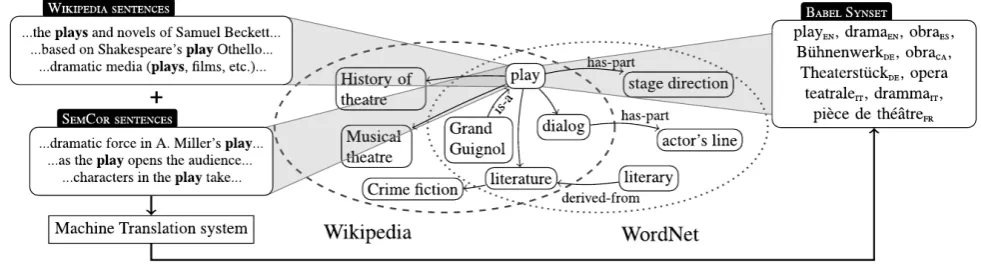
Figure 1: An excerpt of the BabelNet semantic network.
3 and BabelNet in Section 4, we describe our joint approach to WSD and EL in Section 5 and provide statistics and eval-uations of our MASC annotations in Sections 6 and 7.
2.
Related Work
The WSD task, i.e., the task of determining the sense of a word in a given context, has been investigated for more than fifty years (Navigli, 2009; Navigli, 2012) and many different datasets are available. One long-lasting example is the Senseval/SemEval competition series, thanks to which, during the last fifteen years, many datasets for WSD were released. However, being manually created, these datasets contain few annotations (typically around one-two thou-sand), hence limiting the scale of the evaluations. Another well-known resource for WSD is the SemCor dataset cre-ated at Princeton University by Miller et al. (1993). This contains roughly 700k words, of which 240k are manu-ally annotated with WordNet senses. However, because it links to WordNet senses, this resource contains only lexi-cographic annotations without considering named entities. On the other hand, the EL task, i.e., the task of discovering which named entities are mentioned in a text, has become a leading task more recently, see Rao et al. (2013) for a recent survey. During the last two years Google has re-leased two datasets containing semantically annotated web pages with named entities (Singh et al., 2012; Gabrilovich et al., 2013). The first of these is Wikilinks, which is the result of a web crawl on roughly eleven million webpages looking for hyperlinks to Wikipedia pages, i.e., the manual annotations are the hyperlinks found in webpages. The sec-ond is the Freebase Annotations of the ClueWeb Corpora v1 (FACC1), which consists of an automatic annotation of roughly 400 million web documents totaling more than six billion annotated mentions of entities from Freebase (Bol-lacker et al., 2008) with an estimated precision around 80-85% and an estimated recall around 70-80-85%. However, these resources contain only named entities without taking into account word senses.
State-of-the-art approaches for knowledge-based Word Sense Disambiguation (Ponzetto and Navigli, 2010; Nav-igli and Ponzetto, 2012b; Agirre et al., 2014) exploit the semantic relations between word senses, as found for ex-ample in WordNet or enriched versions of it, to run graph-based algorithms and obtain a ranking over the candidate senses. However, semantic networks containing named
en-tities are an order of magnitude larger than lexical repos-itories such as WordNet, causing unavoidable slowdowns. For the task of Entity Linking, instead, the most common approach is to consider the subgraph induced by the named entity candidates in the considered knowledge base and then select the candidates that are more connected to each other by means of semantic relations (Ploch, 2011; Hof-fart et al., 2011; Rao et al., 2013; Cornolti et al., 2013). However, EL falls short when the input text lacks sufficient encyclopedic context. In recent work, Moro et al. (2014) have proposed a unified approach to WSD and EL which overcomes the above limits by taking advantage of the joint structural information provided by a large semantic net-work at both the lexicographic and encyclopedic level. In this paper we apply this algorithm to create a large-scale corpus semantically annotated with both word senses and named entities.
3.
MASC 3.0
We use the Manually Annotated Sub-Corpus (MASC) (Ide et al., 2008) which consists of parts of the American Na-tional Corpus covering a wide range of genres of written and spoken textual data amounting to over 500k words. This project aims at organizing and addressing the prob-lems arising against the creation of a resource with mul-tiple annotations. The corpus is available in different for-mats such as GrAF, in-line XML, token/part of speech se-quences, RDF encoding and CoNLL format. The key fea-ture of this corpus is the availability within a single resource of many different linguistic annotations; to date, it contains 17 different types of linguistic annotation, such as sentence boundary, part of speech and syntactic dependency among others. These annotations are the result of a semi-automatic effort in which automatic systems have been coupled with an iterative process of manual evaluations and annotations for retraining the automatic approaches and finetuning an-notator guidelines to improve inter-anan-notator agreement. Moreover, the fact that it is freely available1 makes it an
invaluable resource for both industry and academic com-munities in order to produce and improve cutting-edge lan-guage technologies. Another reason for our use of this corpus is that it already contains around 3k word sense
1MASC 3.0 and all its previous versions are freely available
instances manually disambiguated for 116 distinct words (Passonneau et al., 2010; Passonneau et al., 2012; Passon-neau and Carpenter, 2013).
4.
BabelNet
To perform the automatic annotation of the MASC 3.0 cor-pus with word senses and named entities, we exploit Ba-belNet2(Navigli and Ponzetto, 2012a), a large-scale
multi-lingual semantic network created from the algorithmic in-tegration of Wikipedia3and WordNet. Its core idea is the
automatic mapping between Wikipedia pages and WordNet synsets that represent the same concept. For instance, the concept hot-air balloonis defined both in Wikipedia and WordNet. The wide coverage of Wikipedia enables Babel-Net to cover novel word senses such as cluster balloon-ing and novel named entities such as Montgolfier broth-erswhich are not available in WordNet, while at the same time having fine-grained sense differences thanks to Word-Net. The nodes of this semantic network are called Ba-bel synsets and can contain Wikipedia page titles, Word-Net synsets and OmegaWiki senses both by themselves or, in the case of the same concept or named entity being covered by more than one resource, within a same Babel synset. For instance, for the conceptplane, we have a Babel synset containing a reference to the Wikipedia page “Fixed-wing aircraft” and one to the WordNet synsetplane#n#1 together with their synonyms, glosses and translations as contained in the respective resources. Moreover, Babel-Net relates these elements with semantic relations auto-matically extracted from WordNet and Wikipedia, such as hypernymy, meronymy and semantic relatedness resulting in a rich structured resource containing both encyclopedic and lexicographic knowledge. The latest release of Babel-Net, i.e., version 2.0, covers 50languages and integrates the Open Multilingual WordNet (Bond and Foster, 2013) and OmegaWiki4 into the network. This multilingual
se-mantic network contains roughly 9M synsets, 50M senses and 250M semantic relation instances. In this latest ver-sion, BabelNet has even been released in RDF format so as to enable its connection within the Linked Open Data cloud (Ehrmann et al., 2014).
5.
Word Sense Disambiguation and
Entity Linking
In this section we describe our approach to Word Sense Disambiguation and Entity Linking. A thorough descrip-tion of the approach is provided by Moro et al. (2014). Our approach is divided into four steps. The first step deals with the discovery of textual mentions within the input text, i.e., substrings of the text for which at least one candidate named entity or word sense can be found in BabelNet. The second step consists of connecting the candidate meanings by means of pre-computed random walks with restart on BabelNet. The third step regards a reduction of the size of the semantic interpretation graph by means of a dense
2
http://babelnet.org
3
http://www.wikipedia.org
4
http://www.omegawiki.org
Algorithm 1Discover mentions and candidates.
1: input:d, the input document;
cand, a map from the lexicalizations in BabelNet to the Babel synsets.
2: output:cand, a map from the mentions to the set of candidates.
3: functionMENTCAND(d, cand)
4: List<WordLemmaTag> t:=POStag(d);
5: foreach substringsof maximum lengthM intdo
6: List<BabelSynset> lb:=cand.get(s);
7: foreach Babel synsetbinlbdo
8: ifb.pos() is equal to s.pos()then
9: cand.get(s).add(b)
10: returncand
subgraph extraction routine. The last step addresses the se-lection of the most appropriate candidate for each textual mention and the computation of a confidence score for each of them.
We use this approach to perform the automatic annotation of the MASC corpus with word senses and named entities as this is a state-of-the-art system in both WSD and EL (Moro et al., 2014).
5.1.
Mentions and Candidates
To perform the first step we first obtain the part-of-speech (POS) tags of the input document5. Next, we discover
men-tions and their respective candidates using the pseudocode in Algorithm 1. We consider each substring of maximum length M in the POS-tagged document and check if it is present as an English lexicalization of some Babel synset in BabelNet (see lines 4–6). As a result of this procedure we obtain, for each substring, a list of candidate Babel synsets. We enforce POS-coherence by requiring that at least one POS tag of the words of the considered substring matches the tags of the candidate synsets (see line 8). We remark that we allow the recognition of overlapping mentions. For instance, for the multi-word expressionbus driver, we ob-tain three nominal mentions, i.e.,bus, bus driver,anddriver and the corresponding candidate synsets.
5.2.
Semantic Relations between Candidates
As a result of the previous step we obtain a list of mentions together with their respective candidate meanings. In this step we focus on the relations between the candidates of different mentions so as to give a better semantic charac-terization of their relevance within the considered context. To obtain a good semantic characterization of the candidate meanings we exploit the semantic relations within Babel-Net by performing random walk with restart (RWR) and obtain sets of semantically relevant concepts and named en-tities for each node of the network.
More formally, for each nodecof the considered semantic network we simulate a RWR, as shown in Algorithm 2, and obtain a weighted distribution over the other nodes of the semantic network, i.e. synDistrc. Starting from a nodec
5We exploit the POS tag annotations of the MASC 3.0 corpus
# Documents 392 # Content Words 305,960
# Non-Content Words 286,512
# Words 592,472
# Adjective Word Senses 30,015 # Adverb Word Senses 23,685 # Noun Word Senses 131,688 # Verb Word Senses 82,489
# Word Senses 267,877
# Named Entities 18,539 Total number of annotations 286,416
Table 1: Statistics of the MASC 3.0 corpus and of our au-tomatic annotation.
inG? I:
ds(s,c):=
|{s0 ∈S:∃c0s.t.((s, c),(s0, c0))
or((s0, c0),(s, c))∈EI}|
|S| −1 ·deg((s, c))
(1) whereS={s:∃(s, c)∈VI}is the set of all the substrings
extracted from the document andEI is the set of edges of
G?
I. The rationale behind this scoring function is to take
into account both the semantic coherence, using a graph centrality measure among the candidate meanings such as the degree, and the lexical coherence, in terms of the num-ber of substrings that a candidate relates to. Given a sub-stringsand a set of candidatesC={c:∃(s, c)∈EI}we
select the most suitable candidate as the one that maximizes thedsscore:
dis(s) = arg max
c∈C
ds(s,c)
In this manner we can disambiguate all the considered sub-strings. To assign a confidence score between0 and1 to the disambiguated entry we compute the number of sub-strings that each disambiguated entry connects to, and we normalize it by the total number of substrings found in the document.
6.
Statistics
We now present the statistics of our automatically-annotated dataset. We automatically-annotated 592K words of running text in 392 documents of the MASC corpus. Overall, we extracted from the corpus 286K mentions (including 30K unique mentions). Among these 286K mentions, we have 41K unambiguous mentions and 18K multiword expres-sions.
In Table 1, we show, together with the number of words and documents in MASC 3.0, the number of annotated named entities and word senses disambiguated by our system. We can see that we disambiguate most of the mentions within the corpus. The average polysemy of the disambiguated mentions is roughly 9 for nouns, 5 for verbs, 5 for adjectives and 4 for adverbs.
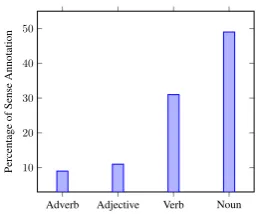
In Figure 2 we show the distribution of the disambiguated word senses by part of speech (excluding named entities which are names by definition); as expected, there is a greater number of nouns and verbs.
Adverb Adjective Verb Noun
10 20 30 40 50
Percentage
of
Sense
Annotation
Figure 2: Distribution of Word Senses by Part of Speech
7.
Evaluations
To evaluate our approach we used the accuracy measure, which is defined as the number of correct senses/entities over the whole number of manually annotated substrings. We performed two evaluations to estimate the quality of the automatically created semantic annotations. As regards, named entities we manually evaluated a random sample of
600entities obtaining an estimated accuracy of70.1%for our annotations. As regards evaluating the quality of word senses, instead, we exploited the MASC word sense sen-tence annotation corpus6 (Passonneau et al., 2010), which
consists of the manual annotations performed by multiple judges of 53words in roughly 3,000 sentences. By us-ing this dataset we calculated a word sense disambiguation accuracy of 54.5%. Note, however, that each of those 53 words is ambiguous, hence the dataset provides a lower-bound estimate for the word sense annotation quality of our approach. To estimate general accuracy on the full set of annotations, we randomly sampled 400 word tokens from the MASC corpus and manually validated the automatic an-notations of these items, obtaining 67.8% accuracy.
8.
Conclusion
In this paper we presented a joint word senses disambigua-tion and entity linking of the MASC corpus. We performed the disambiguation of all the word senses and named en-tities as found in the MASC 3.0 corpus using BabelNet 2.0, a multilingual semantic network that integrates ency-clopedic and lexicographic knowledge automatically ex-tracted from WordNet, Wikipedia and OmegaWiki, as our word sense/named entity inventory. To perform this auto-matic annotation we exploited a novel joint disambigua-tion system for word senses and named entities. More-over, to validate the quality of our annotations we eval-uated both manually annotated named entities and word senses, with an estimated accuracy of 70.1% for named entities and 67.8% for word sense annotations. Finally, following the MASC licensing philosophy, our automat-ically generated semantic annotations are accessible at
http://lcl.uniroma1.it/MASC-NEWS.
Acknowledgments
The Sapienza authors gratefully acknowl-edge the support of the ERC Starting Grant MultiJEDI No. 259234.
6We used the file masc wordsense.zip downloadable from
9.
References
Agirre, E., de Lacalle, O. L., and Soroa, A. (2014). Ran-dom Walks for Knowledge-Based Word Sense Disam-biguation. Computational Linguistics, 40(1).
Basile, V., Bos, J., Evang, K., and Venhuizen, N. (2012). Developing a large semantically annotated corpus. In Proc. of LREC, volume 12, pages 3196–3200.
Bollacker, K., Evans, C., Paritosh, P., Sturge, T., and Tay-lor, J. (2008). Freebase: a collaboratively created graph database for structuring human knowledge. InProc. of SIGMOD, pages 1247–1250.
Bond, F. and Foster, R. (2013). Linking and extending an open multilingual wordnet. InProc. of ACL, pages 1352–1362.
Charikar, M. (2000). Greedy approximation algorithms for finding dense components in a graph. InProc. of AP-PROX, pages 84–95.
Cornolti, M., Ferragina, P., and Ciaramita, M. (2013). A framework for benchmarking entity-annotation systems. InProc. of WWW, pages 249–260.
Ehrmann, M., Cecconi, F., Vannella, D., McCrae, J.,
Cimi-ano, P., and Navigli, R. (2014). Representing Multilin-gual Data as Linked Data: the Case of BabelNet 2.0. In Proc. of LREC.
Etzioni, O., Banko, M., and Cafarella, M. J. (2006). Ma-chine Reading. InProc. of AAAI, pages 1517–1519. Gabrilovich, E., Ringgaard, M., and Subramanya, A.
(2013). FACC1: Freebase annotation of ClueWeb cor-pora, Version 1 (Release date 2013-06-26, Format vers. 1, Correction level 0).
Hoffart, J., Yosef, M. A., Bordino, I., F¨urstenau, H., Pinkal, M., Spaniol, M., Taneva, B., Thater, S., and Weikum, G. (2011). Robust Disambiguation of Named Entities in Text. InProc. of EMNLP, pages 782–792.
Hovy, E. H., Navigli, R., and Ponzetto, S. P. (2013). Col-laboratively built semi-structured content and Artificial Intelligence: The story so far. Artificial Intelligence, 194:2–27.
Ide, N., Baker, C., Fellbaum, C., Fillmore, C., and Passon-neau, R. (2008). MASC: the Manually Annotated Sub-Corpus of American English. InProc. of LREC. Khuller, S. and Saha, B. (2009). On Finding Dense
Sub-graphs. InProc. of ICALP, pages 597–608.
Miller, G. A., Leacock, C., Tengi, R., and Bunker, R. T. (1993). A semantic concordance. InProc. of HLT, pages 303–308.
Moro, A., Li, H., Krause, S., Xu, F., Navigli, R., and Uszko-reit, H. (2013). Semantic Rule Filtering for Web-Scale Relation Extraction. InProc. of ISWC.
Moro, A., Raganato, A., and Navigli, R. (2014). Entity Linking meets Word Sense Disambiguation: A Unified Approach. Transactions of the Association for Compu-tational Linguistics, 2.
Navigli, R. and Ponzetto, S. P. (2012a). BabelNet: The automatic construction, evaluation and application of a wide-coverage multilingual semantic network. Artificial Intelligence, 193:217–250.
Navigli, R. and Ponzetto, S. P. (2012b). Joining Forces
Pays Off: Multilingual Joint Word Sense Disambigua-tion. InProc. of EMNLP, pages 1399–1410, Jeju, Korea. Navigli, R. (2009). Word sense disambiguation: A survey.
ACM Comput. Surv., 41(2):1–69.
Navigli, R. (2012). A quick tour of word sense disam-biguation, induction and related approaches. In Proceed-ings of the 38th Conference on Current Trends in The-ory and Practice of Computer Science (SOFSEM), pages 115–129.
N´ev´eol, A., Do˘gan, R. I., and Lu, Z. (2011). Semi-automatic semantic annotation of PubMed queries: A study on quality, efficiency, satisfaction. Journal of Biomedical Informatics, 44(2):310–318.
Passonneau, R. J. and Carpenter, B. (2013). The benefits of a model of annotation. InProc. of the 7th Linguistic An-notation Workshop and Interoperability with Discourse, pages 187–195.
Passonneau, R. J., Salleb-Aoussi, A., Bhardwaj, V., and Ide, N. (2010). Word Sense Annotation of Polysemous Words by Multiple Annotators. InProc. of LREC. Passonneau, R. J., Baker, C., Fellbaum, C., and Ide, N.
(2012). The MASC word sense sentence corpus. In Proc. of LREC.
Pilehvar, M. T. and Navigli, R. (2014). A Large-scale Pseudoword-based Evaluation Framework for State-of-the-Art Word Sense Disambiguation. Computational Linguistics.
Ploch, D. (2011). Exploring Entity Relations for Named Entity Disambiguation. InProc. of ACL, pages 18–23. Ponzetto, S. P. and Navigli, R. (2010). Knowledge-rich
Word Sense Disambiguation rivaling supervised system. InProceedings of the 48th Annual Meeting of the Asso-ciation for Computational Linguistics, pages 1522–1531, Uppsala, Sweden.
Rao, D., McNamee, P., and Dredze, M. (2013). Entity link-ing: Finding extracted entities in a knowledge base. In Multi-source, Multilingual Information Extraction and Summarization, pages 93–115. Springer.