3D Image Encoding Based on Dual Tree Complex Wavelets for
Plant Phenotyping Precision Agriculture
Bhoomireddy Avinash Reddy1, Dr. D. Srinivasulu Reddy2
1Mtech Student, Department of Ece,Sri Venkateswara College of Engineering, Tirupati, Andhra Pradesh, India
2Principal, Sv Engineering College for Women, Tirupati, Andhra Pradesh, India
ABSTRACT
Plant phenotyping is identification of plant appearance and performance with genotype changes and environmental changes the plant is subjected to. As plant phenotyping is multisensory data, and requires huge data base of images compression is vital and hence knowledge on image compression and loss introduced during compression must be addressed during image based plant phenotyping. The proposed research work addresses the most significant image processing technique which is image compression for plant phenotyping. It involves 3D images that are obtained from 2D image data set, plant also has growth pattern which is time dependent. Use of transformational techniques such as wavelets for compression suffers from time shift loss and directionality. As 3D data with time information are directional sensitive, dual tree wavelets are suitable for 3D image compression. Novel algorithms for dual tree based 3D image compressions are explored in this work for plant phenotyping applications.
Keywords: Plant phenotyping, genotype, images compression, 3D data, dual tree wavelets
I.
INTRODUCTION1.1 The Importance and Evolution of Plant Phenotyping:
Plants have always been a crucial source of food, feed, fiber, and fuel. The domestication of plants and livestock caused a revolution in human evolution: we went from being hunter-gatherers to forming pastoral, rooted Communities. Farmers, since that day, Plant, collect the seed (or fruit) of their farm, and retain seeds of those plants that exhibited a behavior (essentially a trait) that was better than the average plant in their crop (we use loosely the word crop here to refer to any plant of agricultural interest). This is known collectively as selective breeding, and modern-day breeders still follow the same practice to create new varieties. Essentially, those traits are the phenotypes we seek after even to this day. A ‘phenome’ is the set of all phenotypes expressed by an organism (e.g., a plant), resulting from the interaction
between its ‘genome’ (i.e. the genetic material) and the surrounding environment:
Phenome = genome _ environment
In the (not so distant) past, such collection of phenotypes was largely based on direct experience: The farmer would just observe what was ‘different’ with a particular plant in his crop and such visual scoring is still an important skill of breeders. As scientific means entered agriculture, and the pioneering work of Mendel on genetics, breeding took a completely different turn.
accelerate phenotype measurement (‘phenomics’) and genotype association. Uncovering a gene’s exact properties and function (‘functional genomics’) is of great practical interest, because important functions can be matched with agronomically important traits, of interest to breeders. best way and method to answer their question and application. The reason for the hype is that first the ‘sensor-to-plant’ concept is becoming increasingly more and more important. It is less expensive compared to conveyor based solutions and enables field phenotyping with higher throughput. In order to assess plants morphological information of a plant that is fixed, 3D plant phenotyping is the method of choice. Moreover, 3D plant phenotyping also allows researchers to gather plant architecture which is fundamental to improvement of traits such as light interception of plants. Lastly, many optical sensors that use spectral information such as hyper spectral or thermal imaging strongly depend on the inclination and distance of the plant organ, hence 3D information is needed to correct those signals.
1.3 Dual Tree Complex Wavelets:
Plant Phenotyping can be implemented based on Dual tree complex transform as explained below:
Complex wavelets have not been used widely in image processing due to the difficulty in designing complex filters which satisfy a perfect reconstruction property. To overcome this, Kingsbury proposed a dual-tree implementation of the CWT (DT CWT) , which uses two trees of real filters to generate the real and imaginary parts of the wavelet coefficients
separately. The two trees for 1D signal. Even though the outputs of each tree are down sampled by summing the outputs of the two trees during reconstruction, the aliased components of the signal can be suppressed and approximate shift invariance can be achieved. In this paper CDWT, which is an alternative to the basic DWT the outputs of each tree are down sampled by summing the outputs of the Compression and sensing platform for Plant Phenotyping.
2.1 An Affordable Image Sensor:
phenotyping. We propose affordable and flexible sensing methods:
The basics sensor methods are:
A smart sensor based on the Raspberry Pi
Imaging plants using a commercial camera
Camera sensor calibration.
2.2 Application-Aware image Compression for Distributed Plant Phenotyping:
In application-oriented image compression a particularly useful feature is Region-of-Interest (ROI) coding. An ROI is a region in an image that is relevant to the user and, thus, should be preserved in the lossy compression process, by encoding it with better quality than the background. An ROI (possibly composed by multiple objects) in an image I, can be represented as a binary mask M, where M(i, j) = 1 means that the pixel at that location is considered part of the foreground, whereas M(i, j) = 0 means that the corresponding pixel is part of the background. In order to compress the acquired images, our system utilizes the JPEG 2000 standard, based on a Discrete Wavelet Transform (DWT).
In plant phenotyping applications, the regions of interest (ROI) in an image should contain plants, and several different approaches for estimating such ROI can be considered. However, the method should provide smooth ROIs and as accurate as possible (to eliminate bits spent on non-relevant portions of the image), without being computationally intensive.
2.3 Plant Segmentation:
Although our framework is generic, in our experiments we adopt a state-of-the-art approach to plant phenotyping that incorporates incremental learning via appearance models and a level set segmentation. Briefly described, when processing a new incoming image, the analysis system employs several steps including a localization step to separate plants (implemented using a K-means clustering algorithm), a level set segmentation algorithm to
accurately delineate plant objects from the background, a plant labeling algorithm to assign disconnected objects to same plant, and also learns an appearance model, which assists the localization and level set initialization. domain, and then evolves this contour with a level set method, minimizing the following energy functional.
This level set process is executed for each image (compressed and uncompressed) providing the S, Sˆ segmentation masks needed for performance evaluation.
2.4 Baseline ROI Approaches:
With the goal of demonstrating the accuracy of our method, and the complexity of finding a good ROI without computationally intense processes, we implemented two baseline ROI extraction approaches. One that relies on fixed placement of the objects in the scene, and one that estimates automatically a foreground mask based on intensity thresholds.
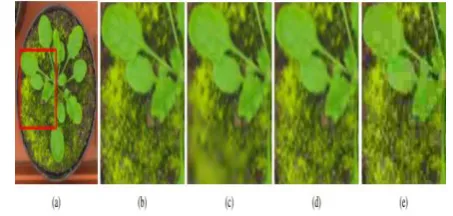
Figure 1. (a) Original image and (b) a detail, reconstructed after compression at 0.2 bpp with different algorithms: (c) proposed method, (d) plain JPEG 2000, and (e) JPEG.
R, G and B are red, green, and blue channels of the RGB color space, respectively. Then, we use Otsu’s method to identify an optimum threshold. Pixel locations having an ExG value higher than the threshold are included in the ROI mask, while the remaining pixels are considered background. Similarly to the proposed method, the obtained binary mask undergoes a post processing: small objects removal (a fixed threshold for the area is set to Amax = 20 pixels), morphological dilation, and hole filling.
DISADVANTAGES:
It is known that the discrete wavelet transform (DWT) lacks of shift invariance and the directional selectivity, which have seriously decayed the effectiveness of wavelet-domain signal processing.
Greater complexity. Greater complexity translates in this case into more resources required to perform the computation - more memory and/or processor cycles and/or time. It is more difficult to interpret the results.
III.
PROPOSED METHODOur method explains about dual tree complex wavelets for plant phenotyping precision agriculture. This method overcomes the drawbacks of photo phenotyping based on DWT.
4.1 Dual-Tree Complex Wavelet Transforms:
Nick Kingsbury proposed that dual tree complex wavelet transform is used to overcome disadvantages of traditional wavelet transform. The complex wavelet transform (CWT) is complex valued extension to standard DWT. CWT use complex value filtering that decomposes the real/complex signal into real and imaginary parts in transform domain. The real and imaginary coefficient is used to compute amplitude and phase information. DTCWT have
separate sub bands for positive and negative orientations. DTCWT calculate complex transform of signal using two separate discrete wavelet transform (DWT) decomposition. DWT decomposition produces two parallel trees.
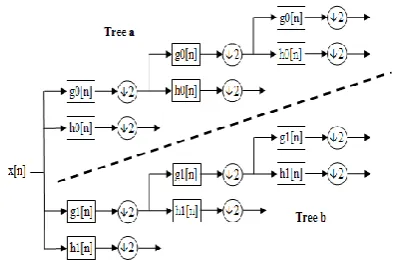
It shows the implementation of 1D dual-tree complex wavelet transform using Finite Impulse Response (FIR) real coefficient filters. ℎ0 (1), ℎ0, 𝑔0 (1), and 𝑔0 are low-pass filters while ℎ1 (1), ℎ1, 𝑔1 (1), and 𝑔1 are high-pass filters. Those filters are designed so that the corresponding wavelets 𝜓ℎ(𝑡) and 𝜓𝑔(𝑡) form approximately a Hilbert pair. Similarly the resulting scaling functions 𝜑ℎ(𝑡) and 𝜑𝑔(𝑡) should be such that 𝜑𝑔(𝑡) is approximately the Hilbert transform of 𝜑ℎ(𝑡). Therefore the complex wavelet (𝑡) and complex scaling function (𝑡) described by the following equation would be approximately analytic:
𝜓 (𝑡) = 𝜓ℎ (𝑡) + 𝑗𝜓𝑔 (𝑡),
𝜑 (𝑡) = 𝜑ℎ (𝑡) + 𝑗𝜑𝑔 (𝑡). (1)
Consequently referring to Figure 3, the output coefficients of the top tree (tree ℎ) and those of the bottom tree (tree 𝑔) can be considered, respectively, as real and imaginary parts of the complex wavelet coefficients. The conditions specified in the previous paragraph can be met if the filters satisfy the following requirements:
(i) They meet the perfect reconstruction conditions.
(ii) One of the two low-pass filters ℎ0 and 𝑔0 should be approximately a half-sample shift of the other.
Figure 2. dual tree transformation
One way to meet those requirements is to design orthogonal Q-shift filters by minimizing energy in the frequency domain as proposed by Kingsbury.
The extension to 2 dimensions is achieved by 2D complex separable wavelets described by (2) and a 2D complex separable scaling function described by (3). They are implemented by separable filters along columns and then rows:
𝜓1 (𝑥, 𝑦) = 𝜑 (𝑥) 𝜓 (𝑦), 𝜓2 (𝑥, 𝑦) = 𝜓 (𝑥) 𝜑 (𝑦), 𝜓3 (𝑥, 𝑦) = 𝜓 (𝑥) 𝜓 (𝑦), (2) 𝜑 (𝑥, 𝑦) = 𝜑 (𝑥) 𝜑 (𝑦), (3)
where 𝜓(⋅) and 𝜑(⋅) are as shown in (1). Therefore, the 2D DTCWT is implemented separable by 2 trees used for the rows of the image and 2 trees for the columns. The resulting wavelet coefficients are then combined by simple sum and difference operations to give real and imaginary wavelet coefficients. This gives 6 wavelets approximately shift invariant and oriented at ±15∘ , ±45∘ , and ±75∘ .
Figure 3. Forward Dual tree Transform
However, the improvement of DT-CWT is at the cost of high coefficients redundancy. For an n-dimensional signal, the redundancy factor of DT-CWT is 2n. In other words, 2D DTDT-CWT will result in 4 times wavelet coefficient as much as DWT does. Therefore, how to remove the redundancy (provide a sparse representation) of the outcomes of DT-CWT but still keep its properties unchanged is a challenging task for DT-CWT based coding. Considering that the real part and imaginary part have the same directional sub-bands and they can be separately reconstructed, Selesnick and Li developed a 2D version of the Dual-Tree Consequently, the redundant factor is halved.
ADVANTAGES:
Following are features of DTCWT:
Approximate shift variant
Good directional selectivity.
Perfect reconstruction using short linear filters.
Limited redundancy.
Efficient order n computations.
APPLICATIONS:
Dual tree wavelet transform has wide applications in:
Tandem mass Spectrometry.
Biomedical signal denoising.
Improved Fabric defect detection.
IV.
RESULTS
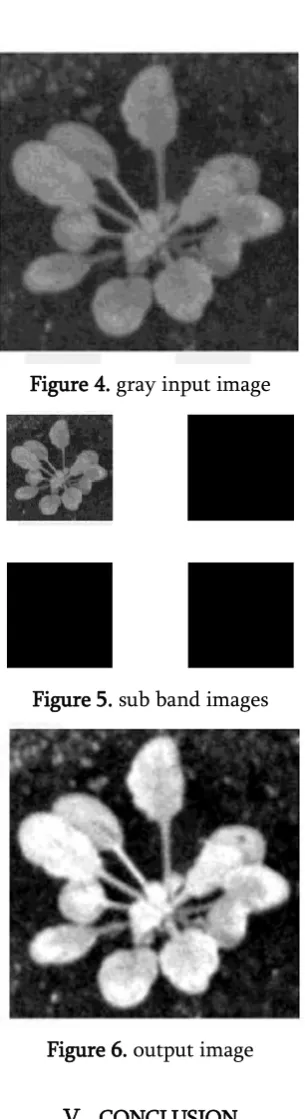
Figure 4. gray input image
Figure 5. sub band images
Figure 6. output image
V.
CONCLUSIONPlant phenotyping is central to the understanding of plant function and is a tool that can enable us to meet agricultural demands of the future. Image based approaches to plant phenotyping are gaining attention among plant researchers as a technology with the promise (and the capability) to increase
throughput by orders of magnitude with respect to traditional approaches based on manual measurements.
In this paper, we proposed a dual-tree discrete wavelet transform based plant phenotyping image coding which has two wavelet trees that are resulted from the original input image by using 3D dual-tree discrete wavelet transform in order to obtain desired results with less complexity.
VI.
REFERENCES
[1].A. Abadpour and S. Kasaei, Color PCA Eigen images and their application to compression and watermarking, Image and Vision Computing, vol. 26, no. 7, pp. 878–890, 2008.
[2].M. M. Abdelsamea and S. A. Tsaftaris, Active contour model driven by globally signed region pressure force, in International Conference on Digital Signal Processing, 2013, pp.1–6.
[3].E. E. Aksoy, A. Abramov, F.Worgotter, H. Scharr, A. Fischbach, and B. Dellen, Modeling leaf growth of rosette plants using infrared stereo image sequences, Computers and Electronics in Agriculture, vol. 110, pp. 78–90, 2015.
[4].G. Alenya, B. Dellen, S. Foix, and C. Torras, "Robotized plant probing: Leaf segmentation utilizing time-of-flight data," IEEE Robotics & Automation Magazine, vol. 20, no. 3, pp. 50–59, 2013.
[5].G. Alenya, B. Dellen, and C. Torras, 3D modeling of leaves from color and ToFdata for robotized plant measuring, inIEEE International Conference on Robotics andAutomation, 2011, pp. 3408–3414.
[6].P. Andrade-Sanchez, M. A. Gore, J. T. Heun, K.