
Design of a research portfolio : Analyzing the SHF projects and formulating research aspects for the future to optimize SHF projects
30
0
0
Full text
(2) Design of a Research portfolio ‘Analyzing the SHF projects and formulating research aspects for the future to optimize SHF projects’. Course/Internship:. Internship 5 years Ir. curriculum Civil Engineering and management and Minor assignment International Management August – November 2006. Supervisors:. Dr.ir. S.J. de Boer (TDG) Dr.ir.arch. I.M.M.J. Reymen (CME) Ing. W.J.H. Stroecken (SHF). Student:. Aart van Ommen. Contact abroad:. Tomas Viguurs c/o Arugam Beach Resort Arugam Bay, Pottuvil Sri Lanka. Code:. FMCH. Version:. 08-03-07. Status:. Final. 2.
(3) Preface This report is part of the course internship for the studies Civil Engineering at the University of Twente, carried out for Solid House Foundation. Mid-July I started to set-up this research. Since that moment I have been working on the research proposition, literature study, case study and finally the writing of this report. This report presents an integral view on the components of the SHF habitat projects. This research has been carried out as part of a masterplan. This masterplan has been set up to provide SHF now and in the future with extensive information on several aspects of the habitat projects undertaken by SHF and their partners. This report will provide an answer to the question on what aspects of the project concept research can be carried out to improve or extend the help and cooperation of the developing communities. The activities of SHF are in a stage in which many improvements and developments can be implied to the projects, for example on the social, economic and physical parts. This report is aiming to be of help in pointing out the project aspects open for future research and development and with that contribute to a sustainable development of developing countries. During the stay in Sri Lanka the conflict between Tamils and the government blazed up once again. This led to complications with regard to activities within and outside the project but has contributed to the visibility of the dynamics of international environment and its impact on the ongoing project in Sri Lanka. Finally I want to thank the following persons for their help and inspiration in writing this report; Ing. W.J.H. Stroecken and Mr. T. Viguurs of SHF and from the University of Twente, Dr.ir.arch. I.M.M.J. Reymen. I hope you will enjoy reading this report and in case you are curious to find out more about the projects developed by SHF, just surf to www.solidhouse.nl where you will also find some up-to-date information on on-going projects all around the world. Aart van Ommen 5 februari 2007. 3.
(4) Summary During the internship the area development project, the habitat organisation SHF is carrying out together with its partners, has been closely monitored. Main objective in this project is to approach this development in a broad sense, socially as well as physically and economically. First, an introduction to SHF is given. Relevant context information with regard to the organisation and the project executed at the moment in Sri Lanka are taken into consideration. Then the objective of this report has been defined. Objective of the research is to design a research portfolio in which several aspects of the project concept of SHF will be specified as suitable research subject, by combining the project case Inspector Eatham, in Sri Lanka, and relevant literature. In order to design the research portfolio, a generic construction process is described; this structure will provide some clarity in the ordering of the aspects. The international environment in which SHF is carrying out the habitat projects is described, again to cover all possible aspects of the dynamic circumstances. By following the day-to-day activities and working close with the project team a clear view of the ins and outs of the project has been build up. A description of the experiences within this case study is written down in the case study chapter, in which the divergent activities in the process of area development have been considered. Finally, the research portfolio is presented in which the different aspects open for research and development are noted down in a table. This table makes a distinction between research already carried out and future and follow-up research on this subject. The future possibility for R&D has been worked out in Annex 1. Most important conclusions of this report, drawn from the literature and case study are listed below. A lot of progress can be achieved on the construction part of the objects. The portfolio SHF can rely on is too small at the moment. Research on several construction-related subjects will bring certain side-effects with it, like financial or durable advantages. The project could not rely on an elaborate construction process model, the lack of hard gates (decision moments) makes it difficult to see structure in the projects process. On the other hand the international environment appears to be very dynamic, what requires a more flexible process. These two basic principles should be united in one model. SHF could develop its own social blueprints and add value to the projects, even if their partner is experienced in livelihood programs. It has been possible to list several aspects for research but it has not been possible to create a distinction in research depth in the matter. This is difficult to enforce, it is better to leave the researcher with relevant freedom. For the direct future and for a clearer view on the setting of the list of aspects a few recommendations can complement this report.. 4.
(5) SHF needs to develop a project process blueprint for its habitat projects. Although SHF wants to be able to carry out a highly flexible process it is necessary to build in hard-gates, moments when the decision go-no go to next stage is made. This is necessary in a dynamic international environment where stakeholders tend to make their own plans for their piece of land which are in general based on short-term motives. They might cross the plans which are more durable, with regard to for example water management or infrastructure, a more predetermined design or project plan is necessary to communicate with all stakeholders and create consensus on the objectives. SHF should make a list of the aspects and mark the aspects which have priority. One of the reasons is that there is a direct need for knowledge on a certain issue, on a specific part of the project or for its overall activities. Another reason can be that SHF or its partners see opportunities to directly improve certain aspects of the project. A third reason might be that SHF wants to create a more divers portfolio in products they can offer. This is might be relevant to optimize the tuning of demand and supply. Another conclusion aims to improve the structure in the research and development activities of SHF. Therefore it is important that the managers on the different projects point out the issues on which research has to be carried out. They have the best feeling with the daily practise of the projects and are able to tell how projects can be optimized.. 5.
(6) Table of Contents. Preface Summary Table of Contents CH1.. Introduction.................................................................................................................. 7. 1.1 1.2 1.3 1.4. CH2.. Introduction and Purpose ......................................................................... 7 Background Project Sri Lanka .................................................................. 7 Characterizing SHF-projects ..................................................................... 8 Research objective ...................................................................................... 9. Generic Construction Process .................................................................................... 10. 2.1 2.2 2.3. Introduction .............................................................................................. 10 Motivation ................................................................................................. 10 Construction process ............................................................................... 11. CH3. International Project environment ............................................................................. 14. CH4.. Case study Sri Lanka ................................................................................................. 16. 4.1 4.2 4.3 4.4 4.5. CH5. Introduction .............................................................................................. 16 Project Inspector Eatham......................................................................... 16 Social Program.......................................................................................... 18 Partnerships .............................................................................................. 18 Construction ............................................................................................. 19. Research portfolio ...................................................................................................... 21. 5.1 5.2. CH6. Introduction .............................................................................................. 21 Table ........................................................................................................... 21. Conclusions and recommendations ........................................................................... 23. References. 25. Appendices. 26. 6.
(7) CH1.. Introduction. 1.1. Introduction and Purpose This report aims to contribute to the masterplan that SHF has set up to develop several aspects of their area development projects they carry out as habitat organisation. A research portfolio is part of that masterplan and provides an overview of aspects open for future research. To be able to design a generic research portfolio a number of steps will be taken which will make up this final report. A first step is to describe SHF as organisation and the characteristics of the projects they carry out. A second step is reflecting on the theory of common construction process, as Cooper et al (2005) presents the state of process management in design and construction. Thirdly the international project environment in which the SHF projects are carried out will described. A fourth step is the reflection on the case-study carried out in Sri Lanka. Following the day-to-day business provided the necessary practical experiences with the SHF habitat projects. Final stage is linking all aspects for research within projects to the different stages in construction process. The research aspects will be supported with a general description and with the formulation of a few research questions in Annex 1, this introduction can be used by related research.. 1.2. Background Project Sri Lanka The habitat organisation Solid House foundation (SHF) aims to contribute to a sustainable development of social housing in developing countries and is, among other things, active in rebuilding Inspector Eatham, a small town in the east of Sri Lanka. Inspector Eatham is located nearby Pottuvil in the Ampara district in the East of Sri Lanka. On this part of the island a tense situation is part of daily life because of the fight between the ‘Tamil Tigers’ and the government. As a result, permanent housing for Tamil-families in this part of the country has hampered. The earthquake and the resulting tsunami in December 2004 caused the destruction of several villages and the death of thousands of people, making living conditions even more miserable. Because of the political conflict the aid to this population seems lag behind compared to other populations (especially Singhalese population) on the island after the tsunami. Inspector Eatham houses approximately 280 Tamil families. The average month income is 27 euro per family.. 7.
(8) 1.3. Characterizing SHF-projects SHF is searching its partners in respected NGO’s, such as the Sewalanka foundation and the CBO (community based organisation) of the Tamil population of Inspector Eatham because of their valuable knowledge of local culture and habits. Another positive aspect which is of importance is their relation with delegates of the province and the government. These parties have a good and trusted network. SHF starts up projects when a ‘future partner’ appeals to do so, but support on local level and the ability of the local community to organize is therefore necessary. Within the projects the future occupants will have a large degree of responsibility. This responsibility is coupled to a number of conditions within the projects; - The mental and physical condition and the ability of the participants to organize must be sufficient to realise the project. - The presence or start of economic activities from which a part of the costs of the project can be earned to repay and to maintain the local environment and buildings. - Future involvement of the occupants for the management of the facilities and to extend the community functions. A list of characteristics of the SHF-projects is summarized in Table 1.1. - Durable housing solutions (among other things) by application of cupola architecture) - Build with aid of the future occupants - Demand-oriented projects - Strengthening of community functions - Increase skills of the target group - Focus on capacity building and own responsibility - Payable for the target group - Cooperation with professional local parties. In short, the projects should rely on a socially justified basis, where a balance between a healthy financial situation, an equitable social policy and the care for the environment has to be achieved. Table 1.1 This will make sure that the key requirements of the SHF approach, affordable personalized habitat solutions, participation, sustainability and responsibility, will be met.. SHF has been set up in 2003 and with that a relatively young organisation. From the start in 2003 much experience has been gained in the field of housing in developing countries. The concept on the basis of these projects, construction of cupola houses in combination with durable advancement of a community, is a combination of aspects like housing, education, economic development, health care, security and community building. More knowledge of and optimising the SHF-concept can be achieved by setting up a research portfolio. This research portfolio will be a guide to give more structure to future research for SHF. Also this plan makes it possible to reach synergy between the different research projects, and provides better anticipation on the existing question within SHF for specific knowledge.. 8.
(9) 1.4. Research objective The research portfolio is a component of a larger plan which is aimed at better and more extensive documentation on the habitat project properties. The study of literature and the practical experiences will contribute to the goal of writing the research portfolio. The research portfolio will on the other hand contribute to the ‘masterplan’ of SHF, in which the organisation aims to gather more information on several aspects of housing projects under sustainable conditions. The objective of this portfolio can be formulated as follows; The design of a research portfolio for SHF in order to structure future research and development. This research portfolio will help SHF acquiring knowledge on and improving different aspects of their habitat projects. Out of the objective the central questions can be derived; -What does the construction process looks like in general for design and construct? Which different stages can be distinguished and what is their content? -Define different aspects for research with the help of theory on international project environment. -What are the main characteristic of the SHF projects -How can the link between the research aspects and the project process be designed and depicted. This research portfolio will help to create a blue print for project start-ups in different circumstances and will give a broad overview on the project’s aspects for improvement or optimizing.. 9.
(10) CH2.. Generic Construction Process. 2.1. Introduction To structure the description of different aspects of the projects Solid House Foundation is carrying out, effort is made to find a suitable model. This chapter will consist of the motivation to use this construction process model. Secondly the current documentation of the projects process within SHF will be presented en discussed. In the end different stages of the construction process model will be described.. 2.2. Motivation The different phases mentioned in this chapter will act as a conceptual frame where several aspects of research (the aim of this report) will be assigned to. It is not aiming at describing and recording the SHF projects process. Nonetheless, it is possible that the frame (the construction process captured in phases) will deliver information on aspects for research. SHF aims specifically to work together with the target group and local organisations on a project. This way of working guarantees the realisation of durable housing projects. This approach of cooperation is applied to the complete process and these partnerships can be accomplished at every stage the project is in. Compared to the traditional construction process this means that from SHF point of view there is need for a more holistic and flexible process to enable the different partners to develop a product (construction, social or economic) for that part of the population of developing countries or for a specific part of the project. This leads to the use of increased front-end involvement and cross-functional teams. This flexible process is one of the key issues in the theory of Cooper et al (2005) where a future vision based on up-to-date research findings and good practice in the construction industry is presented and the, with this issue related, link between different process stages and accompanying activities is described. In the design of the different stages in this model the requirements for better integrated design and construction phases have been kept in mind. After all, the model which will be explained in section 2.3 is used as a help to cover all possible activities and phases in the construction process SHF is carrying out whereas their aim is to involve the target community actively in the projects. In this SHF satisfies both her practical goals (providing shelter) as well as her social goals (stimulating the build-up of skills and establishing and increasing the quality of communal life) SHF already has a model in which a general lay-out is shown. The model is depicted in Annex 2; This model focuses on activities to be carried out in preparation for its projects and on extracting information from different activities in the successive stages. The model which will be used in this report focuses on covering the total process and all aspects involved in the SHF habitat projects, as a guideline.. 10.
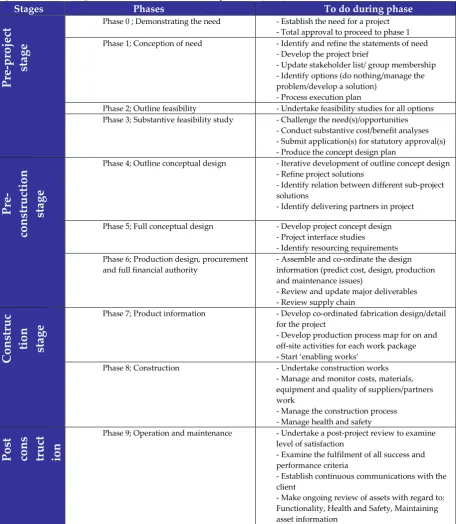
(11) 2.3. Construction process The structure of construction projects which will be described in this paragraph is extracted from Cooper et al. (2005) where four main stages are distinguished and these stages can be broken down into ten distinct phases; Pre-project stage Demonstrating the need (phase 0) Conception of need (phase 1) Outline feasibility (phase 2) Substantive feasibility study and outline financial authority (phase 3) Pre-construction stage Outline conceptual design (phase 4) Full conceptual design (phase 5) Production design, procurement and full financial authority (phase 6) Construction stage Production information (phase 7) Construction (phase 8) Post-construction stage Operation and maintenance (phase 9) For the different phases a short explanation will be given below. Phase 0; Demonstrating the need It is important to demonstrate the ‘client’s’ needs and to be sure that their problems are defined in detail. A first identification of the key stakeholders and their role is part of this stage Phase 1; Conception of need Developing the statement of need and developing this nee into a structured brief. The project stakeholders need to be identified and their role must be clear. The output of this phase will be a clear vision on the different options and how they will be addressed. Phase 2; Outline feasibility The options delivered in phase 1 will be subjected to a feasibility of the project and as a result the solutions are narrowed down. Still the client’s objectives have to be met regarding the different solutions. Phase 3; Substantive feasibility study and outline financial authority In this phase the question whether the proposed solution or solutions can be financed for development is answered. Therefore the requirements of the client have to be met as well as the needs of the stakeholders. Phase 4; Outline conceptual design The solution should have been chosen so this solution can be translated into an outline design solution. It is of course possible that more design solutions will satisfy the project brief. The major components of the design should be identified. Phase 5; Full conceptual design The chosen solution has to be presented in a more detailed form. The parties in the design teams have to be determined. The evaluation criteria have to be set for the conceptual design.. 11.
(12) Phase 6; Production design, procurement and full financial authority The co-ordination of the design information will be ensured in this phase. All detailed information delivered in this phase makes it possible to predict the cost, design, production and maintenance issues among others. Aim of this phase is to prepare all major design elements and to gain full financial approval for the project before it proceeds to the construction stage. Phase 7; Production information The question if the details meet the construction requirements will be answered. The detail of the design has to enable the planning and construction works. If there are different designs/details made by different members of the design team there has to be a co-ordinating model. Phase 8; Construction The careful preparation should ensure a trouble-free construction and realisation of the plan. Any problems occurring within this project can be a guide and lesson for future projects. All construction works are undertaken, the materials, equipment and quality of the supplier’ work should be managed and monitored carefully. In the end of this phase a product is realized and handed over, conditions are set up for the operation and maintenance phase. Phase 9; Operation and maintenance Once the project is handed over the project organisation can identify parts of the project that need to be considered more carefully in projects carried out in the future. Most important is that everybody has the possibility to learn and should have access to an archive to deposit or call in information. A conceptual construction process model is now set up and the different stages are described. To conclude this chapter a matrix will be generated by means of the phase classification mentioned in Cooper et al. (2005). As indicated in the introduction of this chapter, the description of the different phases serves as a generic formwork for describing research aspects. In this matrix the activities to be carried out during the different phases will be included. On one hand to clarify the meaning of the phases and on the other hand because these activities might give some input to the formulations of the ‘aspects for research’.. 12.
(13) Figure 2.2 Construction process and to do list (based on. Stages. Cooper et al. (2005)). Phases. To do during phase. Pre-project stage. Phase 0 ; Demonstrating the need Phase 1; Conception of need. Phase 2; Outline feasibility Phase 3; Substantive feasibility study. Preconstruction stage. Phase 4; Outline conceptual design. Phase 5; Full conceptual design. Post cons truct ion. Construc tion stage. Phase 6; Production design, procurement and full financial authority. Phase 7; Product information. Phase 8; Construction. Phase 9; Operation and maintenance. 13. - Establish the need for a project - Total approval to proceed to phase 1 - Identify and refine the statements of need - Develop the project brief - Update stakeholder list/ group membership - Identify options (do nothing/manage the problem/develop a solution) - Process execution plan - Undertake feasibility studies for all options - Challenge the need(s)/opportunities - Conduct substantive cost/benefit analyses - Submit application(s) for statutory approval(s) - Produce the concept design plan - Iterative development of outline concept design - Refine project solutions - Identify relation between different sub-project solutions - Identify delivering partners in project - Develop project concept design - Project interface studies - Identify resourcing requirements - Assemble and co-ordinate the design information (predict cost, design, production and maintenance issues) - Review and update major deliverables - Review supply chain - Develop co-ordinated fabrication design/detail for the project - Develop production process map for on and off-site activities for each work package - Start ‘enabling works’ - Undertake construction works - Manage and monitor costs, materials, equipment and quality of suppliers/partners work - Manage the construction process - Manage health and safety - Undertake a post-project review to examine level of satisfaction - Examine the fulfilment of all success and performance criteria - Establish continuous communications with the client - Make ongoing review of assets with regard to: Functionality, Health and Safety, Maintaining asset information.
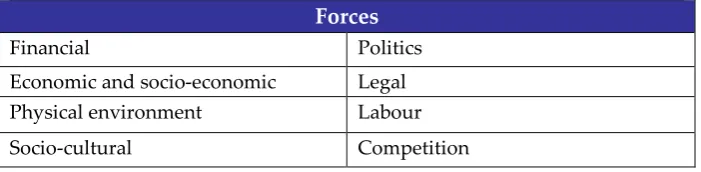
(14) CH3 3.1. International Project environment International project environment The description of 8 forces will be the structure of this paragraph. First aim is to create with the help of this description a theoretical framework for doing business or carrying out projects in a foreign context. Each force has its own specific influence in the projects process. On the other hand the description of the forces might clarify the meaning of these forces and might give input to the formulation of the aspects for research. In the book of Ball et al. (2004), the following grouping is made for the forces which make up the international environment. Table 3.1 Forces international project environment (From Ball et al. (2004)). Forces Financial. Politics. Economic and socio-economic. Legal. Physical environment. Labour. Socio-cultural. Competition. The aspects will be explained in short hereafter.. Financial International operating companies must content with financial forces. Some of these are currency exchange risks, taxation, tariffs, monetary and fiscal policies, inflation, national accounting rules and the way the monetary transaction system is organized.. Economic and socio-economic Management of an international organisation should know how land, labour and capital are allocated to production and distribution. Figures such as Gross National Income/capita, income distribution, private consumption and labour cost are to be investigated. Socioeconomic dimensions playing a role in setting up a project are data concerning for example population by age and sex, population growth and population density.. Physical environment The geographical position of the country, the topography, climate and the natural raw materials the country offers are factors to consider. The nature of the landscape contributes to economic, social, cultural and political differences in several regions. Good accessibility within the project area by, for example, water ways can be useful and creates added value. The different climate circumstances, for example rain, humidity, tropical storms and influences by sea, all have their specific impact on the project. The presence of important natural raw materials can be of influence on price and time within the project.. 14.
(15) Socio-cultural To be successful in project areas, managers must have knowledge of the country’s culture. Culture has to do with socio cultural aspects such as aesthetics, attitudes and beliefs, religion, material culture, education, language, social organization and political structures.. Politics The political forces that affect the success or failure of a project or the activities of an international organisation need to be analyzed. Some of these are nationalism, terrorism, unstable governments, international organizations and government-owned business. Partnerships with local (habitat) organisations and influential international organisations are of strategic importance in the political forces in a country.. Legal Laws and regulations within a country or imposed by international organisations play a substantial role in the international business environment. The contract devices and institutions should be understood. Knowledge of legislation which or when to be used is essential.. Labour Labour quality and labour quantity are forces beyond a company’s, especially when the amount of local employees is maximized, like SHF is used to. The availability of material and equipment, the circumstances where workers have to cope with and education all have their influences on the productivity of the employees. In some countries women in the working population is an excepted phenomenon, in other countries the participation of women has not been accepted.. Competition Competition also plays a role in development projects. Most of the time this competition will not focus on market share (market is very large) but this competition will influence the resource items such as workers and materials. We have described the forces in a conceptual way, the next chapter will relate to the specific situation in Sri Lanka, where a project has been observed.. 15.
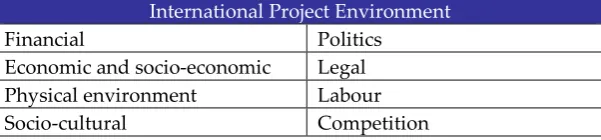
(16) CH4.. Case study Sri Lanka. 4.1. Introduction In this chapter a short description of the ongoing project in Inspector Eatham, Sri Lanka will be outlined. Several aspects of the projects will be described as experienced in Sri Lanka. Most important aim of this chapter is to identify the aspects which later on in this report will recur as research aspects suitable for future research for SHF.. 4.2. Project Inspector Eatham An introduction to this project is already given in paragraph 1.2. A more extensive description of the project will be given in this chapter. Therefore the framework of the previous chapters will be used, like the forces mentioned in table 3.1. Table 4.1 Forces. International Project Environment Financial Politics Economic and socio-economic Legal Physical environment Labour Socio-cultural Competition The different forces related to the project will be described below.. Financial This subject includes taxes and levies on products or services which are imported or develops. Also the payments in and around the project, the cash flows, and how these are organized, are part of this force. In Sri Lanka it meant practically the way obligations are met, with regard to the difference in financial market. The supply of materials and labour payments sometimes suffered because of difficulties in cash flow organisation. Another important issue is the financial feasibility study in the early stage of the project, for example predicting the flows of the project and the financial risk.. Economic and socio-economic An average family consists of 4 family members, adding up to 600 persons for the estimated 150 families. Among these families there are many widows who lost their husband during the war and over two third is under 35 years old. Most families earn their income as day labourers (so called ’coolly’) with some exceptions that do so with farming, fishing and self-employment. Inspector Eatham has its own Community Based Organisation. This CBO is, after the necessary trainings able to function independently and organize programs such as the Credit & Savings system that granted the first loans for small-scale employment projects. Besides that some small shops have been opened and small pieces of land have been cultivated for agriculture.. 16.
(17) Physical environment The area of Inspector Eatham is about 50 acres and the vegetation consists of large bushes and some trees, where especially in the rainy season the vegetation flourishes. Large parts of the land are dry and barren outside the rainy season. Small parts of the land are already being used for cultivation (mainly paddy), cattle farming and brick making. The supply of materials can be managed within the district, the infrastructure around the site is of sufficient quality and in principle the supply of materials is no problem for project progress. There are some existing buildings like a community centre, an unfinished temple and some remains of old buildings on the site.. Socio-cultural The 280 Tamil families have been living and using the land at Inspector Eatham for many years. Starting in 1983 they have been suffering from the war and in 1990 this forced them to leave the area. In 1993 they returned to Inspector Eatham but in 2001 they were forced to move again by the lack of water and security issues. This time they moved to Kotukal, a nearby area close to the sea. The tsunami on December 26th 2004 destroyed the complete community at Kotukal. Since most families were staying in mud and clay brick houses not much remained after the tsunami. The families do not want to return to Kotukal out of fear for the sea and it is their wish to return to their old land at Inspector Eatham. Currently most families are staying with friends and relatives in the area of Inspector Eatham or in improvised shelters nearby. An estimated 150 families are entitled to use land in the project area and some have started building improvised shelters scattered over the area. It is not this number of people who will receive a solid house. Some have chosen to request money from the government fund set up to help Tsunami effected people. The Hindu religion has its influence on the design of the buildings as well as the way they approach and build up relations with their business partners. An example of other specific socio-cultural dimensions; it is difficult to implement improvements to the dome houses, this because of the fact the beneficiaries are promised a house like the Model House and for them it is difficult to accept modifications or improvements compared to the model house. A communication plan in which the advantages of those modifications are clearly explained would take away much fear and obscurity among the people. To develop a durable housing project it is necessary to empathize with the local community, their values and habits and their way of live. This will cost time but in the end the most important aim of the project, to let them develop their own project, will be achieved.. Politics For the last two decades of the twentieth century, Sri Lanka endured war, massive displacement and human rights violations ranging from torture to extrajudicial executions, disappearances and child abductions. A peace agreement has so far never been established and since the presidential elections of November 17, 2005 the numbers of incidents breaking the cease fire agreement have increased. The project is carried out for the benefit and with Tamil families. This puts the project into a sometimes difficult situation.. In the context of this project, it is relevant to mention that the local authorities approved the development of the location of Inspector Eatham for this Tamil community.. 17.
(18) Legal Laws and regulations within a country or imposed by international organisations played a role in the project, for example the land owner system, required papers and/or deeds and the involvement of lawyers and land surveyors in the proposed layout of the area. The contract devices and institutions with for example suppliers are set up in a more primitive way (cash payments etc). Knowledge of legislation which or when to be used is essential.. Labour Most of the project team members are Sewalanka employees. These people are both Tamil and Singhalese. Labour quality and labour quantity are forces beyond the performance of SHF. Especially in this case when the amount of local employees is maximized, like SHF is used to, quality control has to be carried out extensively. The important related goal of course is to deliver a number of skilled labourers when the project is finished. The availability of material and equipment, the circumstances where workers have to cope with and education all have their influences on the productivity of the employees. In some countries women in the working population is an excepted phenomenon, like in the Inspector Eatham project, in other countries the participation of women has not been accepted.. 4.3. Social Program Several meetings with beneficiaries have been convened to present and explain current issues in which the community had to decide. For example issues related to the construction of the wells, location and construction of road and prioritizing of the different houses to be built. The Community Based Organisation is active in convening beneficiary meetings in small groups. After the necessary trainings this organisation is able to function independently and organize matters such as the Credit & Savings programme that granted the first loans for small-scale employment projects. Besides that some small shops have been opened, small pieces of land have been cultivated for agriculture.. 4.4. Partnerships After the partnership between Sewalanka, ‘Livelihood Corporation’ and SHF was established, Inspector Eatham was identified as project. Sewalanka has a lot of experience in starting up (social) programmes and in organising and setting up or strengthen communities. The Ceylon Electricity Board (Board that sets up programs to provide the Sri Lankan population with electricity) has been asked to deliver the electricity. Besides the fact this delivery will be realized in short term, the possibilities for the use of environmentfriendly options such as solar energy are also explored. The use of this kind of energy supports the goals of SHF.. SHF aims to develop a study module to support the participants of SHF-projects with knowledge about setting up and maintaining their own business. Swissconatct, Swiss foundation for Technical Assistance, as a partner of SHF has started with the training of 10 masons (chosen from the 150 families).. 18.
(19) After a general mason course (that meanwhile has taken place) this training will be continued in `training-on-the-job’ at the construction of the Solid Houses. On ICT field, first talks have taken place with the Information and Communication Technology Agency of Sri Lanka (ICTA), which in association with a programme of the World Bank supply telecommunication and computers in rural areas. The water wells will have a depth of 9 meters to ensure the water supply all the year round. Besides this form of water supply, possibilities for irrigation in agriculture with the help and re-use of rain water are more closely studied in association with the Intermediate Technology development Group (IDTG). Furthermore the design of plans and thinking about the construction and modernisation of additional facilities is still in progress. It concerns for example facilities such as an Hindustanic temple, playgrounds, a sports complex, post office, market place and finally the setting up of a `farmer association’ (a shop where farmers can sell their products in a collective).. 4.5. Construction When arriving at the project the Model House was under construction. The foundation and the cupola were constructed; the interior and the outside works were scheduled for the coming weeks. The foundation of the 12 meter dome has been constructed and the rebar net for the dome shell has been installed. The works on the doors and windows formwork were very labour-intensive. The wells have run dry, because of the dry season. These existing wells are located at elevated spots on the Inspector Eatham land. Works on the construction of new wells are carried out; some of these wells are located on lower spots and will therefore give longer access to the groundwater. One road, running straight through the village has been repaired recently by an iNGO (World Vision), the rest of the road network work is in bad state and has to be upgraded and extended to make all lots or houses accessible. Within the located project area the different lots have not been marked yet. Next to the model house a first toilet is built by the French NGO ‘Action Contre la Faim. With this organisation a partnership has been established on the project components water and sanitation. Due to the conflict in Sri Lanka this works can not be completed by ACF. During the stay on the project in physical construction respect 15 foundations have been built, the model house has been delivered and the construction activities for the 12 meter dome continued. This 12 meters dome will be used for office and community activities and is near its completion. Extra masons are hired and as a result of this it is possible to have a work structure in which work is done in teams on different activities. Working on the construction of several houses on different locations within the project area forces the team to seek continuously for inventive solutions on this logistic issue, also due to the lack of heavy equipment.. Building the model house has been a good opportunity to learn and gain experience in the building activities, much information is processed and can be applied in the rest of the project and other, future projects. Since this project is the first project of SHF with this scope many opportunities to learn and improve on different aspects will occur. A manual will be developed in which difficulties and possible solutions on the physical execution are described. Also with the best practices mentioned this manual is meant as a help and support in carrying out the different activities.. 19.
(20) 20.
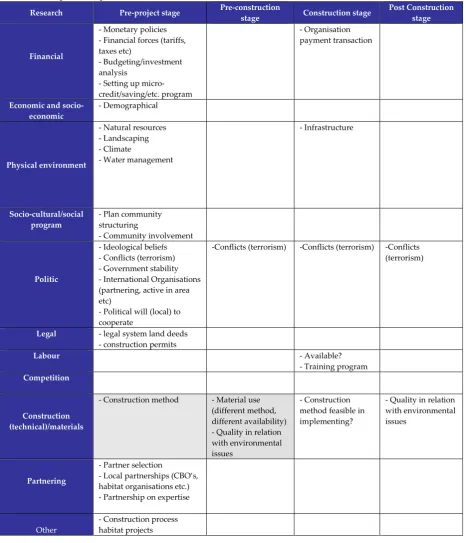
(21) CH5. Research portfolio. 5.1. Introduction The construction process has been described and the different phases have been linked to the major stages in construction projects. For the different phases activities to be carried out have been described. Also a number of forces and aspects have been presented which require attention when an organisation is internationally active. As a result, the matrix is based on the generic construction process phases and on description of forces in SHF project. These two subjects will be combined in a table, and as a result it becomes visible in which phase of the project on which subject information should be available, or which activity must be carried out.. 5.2. Table The table will contain the different research aspects. An explanation on these items is given in Annex 1 where at the same time a start will be given for the further development of the aspects, in the form of a main question and possibly supporting sub-questions. It is difficult to define a certain level of depth with regard to the matter. The amount of time spent on a subject depends on the extend a subject is enclosed in a frame. With respect to the content the same arguments can be applied. This is the reason why this distinction has not been made in table 5.1. Is has been possible to make a distinction between research carried out (grey coloured) so that future research on these aspects can be linked to the results gained. This table is a picture of the moment. The knowledge within SHF is booming, also the amount of questions and differentiation in solutions are growing. Therefore it is important that items will be added in the table, next to the possibilities to colour the aspects research has been carried out.. 21.
(22) Table 5.1 Matrix research aspects suitable for future research. Grey coloured boxes in the table indicate research has been done on this aspect in the past (see for relation Annex 1) Pre-construction Post Construction Research Pre-project stage Construction stage stage stage - Monetary policies - Organisation - Financial forces (tariffs, payment transaction taxes etc) Financial - Budgeting/investment analysis - Setting up microcredit/saving/etc. program Economic and socio- Demographical economic - Natural resources - Infrastructure - Landscaping - Climate - Water management Physical environment. Socio-cultural/social program. Politic. Legal. - Plan community structuring - Community involvement - Ideological beliefs - Conflicts (terrorism) - Government stability - International Organisations (partnering, active in area etc) - Political will (local) to cooperate - legal system land deeds - construction permits. -Conflicts (terrorism). Labour. -Conflicts (terrorism). -Conflicts (terrorism). - Available? - Training program. Competition - Construction method Construction (technical)/materials. Partnering. Other. - Material use (different method, different availability) - Quality in relation with environmental issues. - Construction method feasible in implementing?. - Quality in relation with environmental issues. - Partner selection - Local partnerships (CBO’s, habitat organisations etc.) - Partnership on expertise - Construction process habitat projects. This table is the result of the construction process information, the description of the international environment in several forces and the observation of the habitat project case Inspector Eatham. Of course this table does not stand alone; it must be reviewed in a broader perspective. This lack of completion will be reviewed in the next chapter, in which the conclusions and recommendation will supply a broader perspective.. 22.
(23) CH6. Conclusions and recommendations Introduction The central conclusion of this report is the data provided by table 5.1. This table has the structure that has been explained in the chapters two and three and the research aspects in relation with SHF. Much can be said about these projects and the learning curve at the moment, since SHF is only three years in business. This report aimed at structuring the aspects of the habitat projects, the aspects, which are open for research and development. Since habitat projects in this form of area development have a wide variety in disciplines, many aspects have come up and most of them are interrelated. It is not possible to fully compare the construction process Cooper et al. (2005) described with the construction process of SHF. Firstly this was not the aim and secondly in that theory every stage has a few distinctive activities (see chapter 2) which are taken into account in table 5.1. Conclusions This leaves us with the following conclusions. A lot of progress can be achieved on the construction part of the objects. The portfolio SHF can rely on is too small at the moment. Different construction methods, shapes, forms and materials for example are subjects should be more divers within this portfolio. Research on these subjects will bring certain side-effects with it, like financial or durable advantages. The project could not rely on an elaborate construction process model, the lack of hard gates (decision moments) makes it difficult to see structure in the projects process. On the other hand the international environment appears to be very dynamic, what requires a more flexible process. These two basic principles should be united in one model. SHF relies for its social program on the partners it finds. Own social blueprints and might add value to the projects, even if their partner is experienced in livelihood programs. It has been possible to list several aspects for research but it has not been possible to create a distinction in research depth in the matter. This is difficult to enforce, it is better to leave the researcher with relevant freedom. Recommendations For the direct future and for a clearer view on the setting of the list of aspects a few recommendations can complement this report. SHF needs to develop a project process blueprint for its habitat projects. To do this, it is best to develop two separate process models, a construction process and a social process model. These two models should be interrelated and should have parallel progress. Although SHF wants to be able to carry out a highly flexible process it is necessary to build in hard-gates, moments when the decision go-no go to next stage is made. This is necessary in a dynamic international environment where stakeholders tend to make their own plans for their piece of land which are in general based on short-term motives.. 23.
(24) They might cross the plans which are more durable, with regard to for example water management or infrastructure, a more predetermined design or project plan is necessary to communicate with all stakeholders and create consensus on the objectives. At the moment well defined plans, budgets are not the basis for the different phases, in the project activities will become more and more incoherent. SHF should make a list of the aspects and mark the aspects which have priority. There are a few reasons why such a list should be created. One of the reasons is that there is a direct need for knowledge on a certain issue, on a specific part of the project or for its overall activities. Another reason can be that SHF or its partners see opportunities to directly improve certain aspects of the project, financially, socially, durability or else. This is not as easy as it is formulated, in real life this situation is more complex and connected to several other items. A third reason might be that SHF wants, as soon as possible, to create a more divers portfolio in products they can offer. These products can focus on different parts of their habitat projects, as these are already described in this report. The big advantage in being able to choose between products is that, for every distinctive situation in which SHF has been asked or SHF offers to deliver a product, SHF can match the situation and unique circumstances to the characteristics of the different products to see which product is best to deliver in the given situation. Another conclusion aims to improve the structure in the research and development activities of SHF. Therefore it is important that the managers on the different projects point out the issues on which research has to be carried out. They have the best feeling with the daily practise of the projects and are able to tell how projects can be optimized. Although a document in which best practices in the execution are recorded is being prepared for future projects, a more conceptual way in thinking about setting up projects in different circumstances helps to improve the fitting of the project.. 24.
(25) References. Winch, Graham M. (2004). Managing Construction Projects. Oxford: Blackwell. Cooper, Rachel et al. (2005). Process Management in Design and Construction. Oxford: Blackwell. Ball, Donald A (2004). International Business : the challenge of global competition. New York: McGraw-Hill. Brinks, Daan, Versloot, Thijs Willem (2004). Domes around the World. Developing a general checklist for new projects of the Solid House Foundation in third world countries. Enschede: Universiteit Twente. Hammer, C.E. (2006). Optimization of dome housing in Sri Lanka. Delft: Delft University of Technology.. Internet sites Infolanka • infolanka.com/org/srilanka/cult.html (August 2006) CIA World Factbook • https://www.cia.gov/cia/publications/factbook/geos/ce.html (August 2006) Solid House Foundation • http://www.solidhouse.nl/ United Nations, Human Development Report 2006 • http://hdr.undp.org/hdr2006/statistics/ (August 2006) World Bank, Data and Statistics • http://web.worldbank.org/WBSITE/EXTERNAL/DATASTATISTICS/0,,menuPK :232599~pagePK:64133170~piPK:64133498~theSitePK:239419,00.html (August 2006) Monolithic Dome Institute • http://www.monolithic.com (August 2006). 25.
(26) Annex 1 Specification research aspects on the basis of table 5.1 This specification will consist of at least a research question but will be accompanied with a short explanation.. Financial (Financial, Economic, Accountancy studies) Monetary policies How can financial forces such as balance of payments, tariffs, taxes, inflation, fiscal and monetary policies, and differing accounting practices affect SHF projects? Are there financial risk, if yes, how can these risk be minimized or covered? How should this subject be related to the budgeting structure? Financial forces What do financial forces like tariffs or duties, taxation, inflation and currency exchange controls look like in the country were SHF wants to start up a project and how does it affect its business plan? Budgeting/Investment analysis This issue aims at better predicting different cash flows within a project and framing a reliable budget. The goals within a project are strongly related to this issue, in for example the decision on how to shape the realisation of the house (give away, mortgage structure etc) Micro credit/savings/etc program SHF aims to support a community in its financial structures, like micro-credit or savings programs. What is the nature of these programs, how can these programs connect to the needs and possibilities of, for example, a chosen target group? Structure of Payment Transaction This subject has practical impact, and thus a few possibilities, on how the payments within a project and all the cash flows are organized, could be worked out. This issue can be considered in relation to the here above mentioned more conceptual subjects.. Economic and socio-economic (Urban Planning, Geographical, Social studies) Demographical: The detailed information about the population’s physical attributes measured by the socio-economic dimensions can be helpful by, for example, designing the house and the economic dimensions can, for example, help by setting up a credit or saving system. Above all, the data will help to define the target group and get some understanding in needs and requirements of a target group.. 26.
(27) Physical environment (Engineering studies) Natural resources Which resources needed for the project are available on the different continents or countries SHF is carrying out projects? In combination with a technical objective like the different construction methods or the possible use of different materials; which combination country – construction method is given preference to? Landscaping Urban planning is an important basis for the projects carried out by SHF. The extend of the design of the plan depends on the amount of aspects involved in the project (water management, infrastructure, public spaces etc), anyhow, all aspects of urban planning have to be taken into account in the project preparation. Another important research aspect could be to develop a blueprint for the conceptual design and plan which is developed in the early stages of the project. This should look like the structure which is normally used at urban planning, in which the layers water, ground, green, infrastructure, public spaces and objects are bundled like an urbanistic plan. Climate Specify different climate circumstances and describe the impact on the construction and project process. For example, working in raining season will imply that the risk of not being able to work on concreting activities is increasing or describe the impact of humidity on the curing process of concrete (this again in combination with technical question). Water management What are the latest designs and parts of conceptual planning on water management issues in urban environment in different circumstances (climate, continent, nature of terrain, underground, slope etc)? Infrastructure What are the latest designs and parts of conceptual plan on infrastructure issues in urban environment in different circumstances (availability of materials, continent, nature of terrain, underground, slope, accessibility of different lots or objects etc)?. Socio-cultural (Social studies) Plan for community structuring This research provides a basis for carrying out programs with regard to community structures and community mobilisation. At research aspect ‘financial’ the subject micro credit/saving program has already been mentioned, this is related to this overall social mobilisation plan. A possible objective can be; The design of a blueprint for the social mobilisation and community involvement plan that fits the characteristics, needs and chances of a target community.. Community involvement. 27.
(28) How can we mobilize the whole community and maybe change the present (individual aimed) structures. An organized community can achieve more than an individual in that community. What is the way to motivate, inform and activate people can be an objective for research.. Politics (Political, Social studies) Politics In an international context; what are the consequences of different ideological beliefs of government in relation to SHF projects. Describe the specific government organization and stability, the presence of (other) iNGO’s (for possible partnerships), conflicts and the political will to cooperate (or; the status of public-private partnerships).. Legal (Law schools) Legal system What are the different legal systems all around the world in the field of land deeds, construction permits, zoning plans, well being committees etc. What are the activities in the SHF projects where actions have to be undertaken to act according to that laws.. Labor (Social studies) Labour What is the quality of labour in project countries and what are the quantity and other characteristics of the labour force (age, productivity, income which is also linked to quantity)? Training Program Design a training program for employees, from the target group or eventually outside this group, on several activities and several professions (carpenter, social worker, hygiene specialist, bookkeeper etc). Create some sort of checklist which reflects the status of schooling of a ‘student’.. Construction (Engineering studies) Construction method This research program is in progress. SHF is not dependent on one concept for its habitat projects. For different circumstances different solutions have to be available, with all their own specifications. These variants have to be developed, which means that not only construction variant have to be developed but also social program variants or whatever subject is exposed to research. Research on different construction method and the use of different materials has been carried out, with some conclusions already brought into practice. The current research on different construction methods and concepts elaborates on that research and is also linked to aspect ‘Materials’ (see hereunder).. Feedback from the field is important in this program to measure the feasibility of the concepts in different circumstances.. 28.
(29) Construction method feasible in implementing Different circumstance mean that a plan made on paper can have disastrous consequences for the execution phase. What are the relations between different circumstances in the field and the plans made on the design table.. Materials (Engineering studies) Material use In relation with the construction method and item ‘resources’ this aspect can have a lot of impact on the construction parts of the project. The research and development on this aspect can result in optimizing of different aspects, like financially, sustainable etc. So a question in this aspect could be; which alternative materials can be used in relation to the different housing concepts? What is the relation with for example climate, labour or durability? (As already mentioned these are related issues). Partnering (Social studies) Partner selection The partnering is in this stage of development of the habitat project an issue which can be seen as outsourcing. It is important in an early stage of the project to select the partners and to overview the different disciplines involved in the plan. These disciplines can be matched to local organization or other (i)NGO ‘s working in the area with capacity to do form a partnership with SHF. So one objective can be formulated; what parts of the project are suitable to outsource and what organisation is active in the target country? Another research aspect can focus on restriction SHF applies on partners or criteria. It might be important to formulate policy on the selection of partners or to specify this on the different disciplines of the project. (i)NGO and (inter)national organisation A list of organisations working in a continent or land that SHF is focussing on to carry out habitat projects. Characteristics, objectives and activities of these organisations should be enlisted in this overview.. Other Construction process habitat projects The process of the habitat projects of SHF are complex and have to be very flexible. Is has to include the front-end involvement, the flexible partnerships with partners and a variety of soft gates instead of clear-cut ends of stages. The design of a construction process map for the SHF projects is a suitable object for research.. 29.
(30) Annex 2 Figure 2.1: SHF project layout, Brinks&Versloot, Domes around the world (2004). Stage. Time. Contact points. Stage 1: Initiation. First Contact. SHF is contacted by foreign organisation. Stage 2: Orientation. Before first stay. Stage 3: Preperation. First stay abroad. Features. Primordial organisation Information supply First stay preparation Etc. Meetings with stakeholders Setting up to-do lists Signing contracts Etc. First stay abroad by representative SHF. Making a budget Making preparations for construction Making preparations for definitive stay Etc. Before final stay. Stage 4: Realization. Stage 5: Reflection/ maintanance. Final stay and start construction. Availability of terrains Knowledge of future inhabitants Familiarity with the dome construction Etc. Stay abroad for construction & educational programme (about one year after first contact). …. 30. Constructing the domes Teaching the people Etc.
(31)
Figure
Related documents
If the roll is equal to or higher then the model's shooting skill then it hits and wounds as described in close combat.. If the roll was lower then the model's shooting skill then
Buying membrane filtration solutions from Alfa Laval means you are tapping into the know-how and experience that comes from complete familiarity with every step of the process.
Calvary Chapel Bible College requires written consent from the student to authorize the release of his/her educational and/or financial records to a third party in accordance with
Order intake was CHF 1.7 billion, a slight decrease of 1.2% from the previous year on an adjusted 1) basis. The order intake was impacted by lower demand in the water and the oil
For the poorest farmers in eastern India, then, the benefits of groundwater irrigation have come through three routes: in large part, through purchased pump irrigation and, in a
Conversely, 43.7% of all respondents who misused prescription drugs met criteria for alcohol dependence, problem gambling, and (or) had used illicit drugs in the past year..
Hasil penelitian ini berdasarkan dari jawaban siswa pada kuesioner.Dari kuesioner yang pertama menunjukkan bahwa tipe kecemasan yangpaling dominan adalah kecemasan terhadap
The summary resource report prepared by North Atlantic is based on a 43-101 Compliant Resource Report prepared by M. Holter, Consulting Professional Engineer,
