A Study of Parentheticals in Discourse Corpora — Implications for NLG
Systems
Eva Banik
†and Alan Lee
‡†Department of Computing, The Open University, Milton Keynes, UK
‡Institute for Research in Cognitive Science, University of Pennsylvania, Philadelphia, PA, USA
[email protected], [email protected]
Abstract
This paper presents a corpus study of parenthetical constructions in two different corpora: the Penn Discourse Treebank (PDTB, (PDTB-Group, 2008)) and the RST Discourse Treebank (Carlson et al., 2001). The motivation for the study is to gain a better understanding of the rhetorical properties of parentheticals in order to enable a natural language generation system to produce parentheticals as part of a rhetorically well-formed output. We argue that there is a correlation between syntactic and rhetorical types of parentheticals and
establish two main categories:ELABORATION/EXPANSION-type NP-modifier parentheticals andNON-ELABORATION/EXPANSION-type
VP- or S-modifier parentheticals. We show several strategies for extracting these from the two corpora and discuss how the seemingly contradictory results obtained can be reconciled in light of the rhetorical and syntactic properties of parentheticals as well as the decisions taken in the annotation guidelines.
1.
Definition
Parentheticals are constructions that typically occur embed-ded in the middle of a clause. They are not part of the main predicate-argument structure of the sentence and are marked by special punctuation (e.g. parentheses, dashes, commas) in written texts, or by special intonation in speech. Syntactically, parentheticals can be realized by many dif-ferent constructions. Some examples of difdif-ferent types of parentheticals are given in (1): appositive relative clause (1a), non-restrictive relative clause (1b), participial clause (1c), subordinate clause (1d) . Throughout this paper we will show parenthetical constructions in square brackets.
(1) a The new goal of the Voting Rights Act [– more minorities in political office –] is laudable. (wsj1137)
b GE, [which vehemently denies the government’s allegations,] denounced Mr. Greenfield’s suit. (wsj0617)
c But most businesses in the Bay area, [including Silicon Valley,] weren’t greatly affected. (wsj1930)
d So far, [instead of teaming up,] GE Capital staffers and Kidder investment bankers have bickered. (wsj0604)
A common characteristics of parentheticals is that they ex-press information that is not central to the meaning of the overall message conveyed by a text or spoken utterance and since they are specifically marked by punctuation or intona-tion, they allow the reader to distinguish between more and less important parts of the message. By structuring infor-mation this way, parentheticals make it easier for readers to decode the message conveyed by a text. Consider for example the following message that has been expressed by two different texts: one without parentheticals (2a) and one that contains two parentheticals (2b).
(2) a Eprex is used by dialysis patients who are anaemic. Prepulsid is a gastro-intestinal drug. Eprex and Prepulsid did well overseas.
b Eprex, [used by dialysis patients who are anaemic,] and Prepulsid, [a gastro-intestinal drug,] did well overseas. (wsj1156)
2.
Background and Motivation
Parentheticals have been much studied in linguistics ( see (Dehe and Kavalova, 2007), (Burton-Roberts, 2005) for a recent overview) but so far they have received less atten-tion in computaatten-tional linguistics. Only a few studies have attempted a computational analysis of parentheticals, the most recent ones being (Bonami and Godard, 2007) who give an underspecified semantics account of evaluative ad-verbs in French and (Siddharthan, 2002) who develops a statistical tool for summarisation that separates parentheti-cals from the sentence they are embedded in. Both of these studies are limited in their scope as they focus on a very specific type of parentheticals.
From the perspective of natural language generation (NLG), as far as we know, nobody has attempted to give a principled account of parentheticals, even though these constructions contribute to the easy readability of generated texts, and therefore could significantly enhance the perfor-mance of NLG systems (Scott and Souza, 1990).
Since the input to most NLG systems is a text plan ex-pressed in some variant of Rhetorical Structure Theory (Mann and Thompson, 1987), the first step towards gen-erating parentheticals is to understand which parts of the input text plan can be expressed as parenthetical construc-tions.
relations whose arguments are realized as parentheticals. We argue that the type of rhetorical or discourse relation that holds between parenthetical and its host correlates with the syntactic construction used for the parenthetical. We distinguish between two main types of parentheticals: i) ELABORATION/EXPANSION-type nominal modifiers which express a relation between an object and a proposition and ii) NON-ELABORATION/EXPANSION-type VP- or S-modifiers which express a relation between two proposi-tions. We show how the seemingly contradictory findings from the two corpora can be reconciled in light of these two types and the different perspective on discourse adopted in each corpus.
The next two sections of the paper discuss the strategies we used to extract parentheticals from our chosen corpora. Section 5. discusses our findings and shows how the results of the study can be used to inform a natural language gen-eration system.
3.
Corpus Study on RST Treebank
The RST Discourse Treebank (Carlson et al., 2001) con-sists of 385 Wall Street Journal texts from the Penn Tree-bank, segmented into Elementary Discourse Units (EDUs) and annotated with rhetorical relations (78 different rela-tions in total).
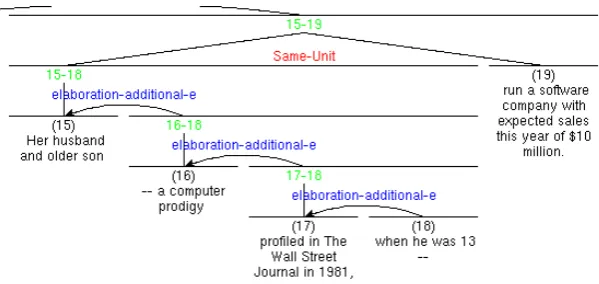
The corpus annotation manual defines embedded units as EDUs which break up another legitimate EDU or modify a portion of an EDU only, not the entire EDU. The corpus de-fines a pseudo-relation called Same Unit, which is used as a device for linking two discontinuous text fragments that are really a single EDU, but are broken up by an embedded unit. Same Unit is a multinuclear relation, where one of the nuclei corresponds to the parenthetical and the part of the host sentence that the parenthetical is related to (e.g. head noun of a relative clause). The other nucleus either simply contains the rest of the sentence or it can be similarly com-plex if there is more than one parenthetical in the sentence. To illustrate, Figure 1. shows an example of a sentence annotated with the Same Unit relation, where Nucleus 1 contains the subject NP broken up into a head noun and a complex relative clause, the latter being the parenthetical. Same Unit annotations identify EDUs that are embedded linearly or syntactically within another EDU, including par-entheticals that are not syntactically related to the sentence but are separated by punctuation.
We have extracted all the examples of Same Unit annota-tions from the corpus, 1117 cases in total and counted the number and type of rhetorical relations that occur within a complex nucleus.1 There were 1401 complex nuclei in total, of which we have excluded 630 cases that contained ELABORATION-OBJECT-ATTRIBUTEannotations.
The reason for this is that by definition, in the cor-pus ELABORATION-OBJECT-ATTRIBUTE relations are as-signed to restrictive relative clauses, which from a natu-ral language generation system’s perspective, are gener-ated as referring expressions. We therefore don’t consider ELABORATION-OBJECT-ATTRIBUTEannotations as paren-theticals.
1For complex cases like the example in Figure 1 we only
counted the top relation.
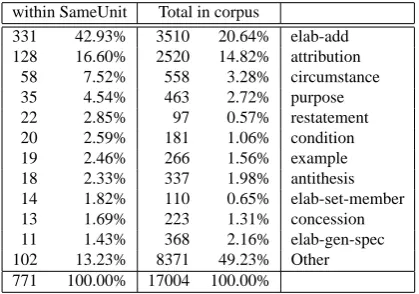
within SameUnit Total in corpus
331 42.93% 3510 20.64% elab-add 128 16.60% 2520 14.82% attribution
58 7.52% 558 3.28% circumstance 35 4.54% 463 2.72% purpose 22 2.85% 97 0.57% restatement 20 2.59% 181 1.06% condition 19 2.46% 266 1.56% example 18 2.33% 337 1.98% antithesis 14 1.82% 110 0.65% elab-set-member 13 1.69% 223 1.31% concession 11 1.43% 368 2.16% elab-gen-spec 102 13.23% 8371 49.23% Other 771 100.00% 17004 100.00%
Table 1: Most frequent relations within Same Unit
Table 1 shows the frequency of relations that occurred more than ten times inside the Same Unit relation. We didn’t find any difference between embedded relations that oc-cur in the first vs. second nucleus of Same Unit, and the table presents the summary of all relations that we found in one of the nuclei.2 The first column shows the
num-ber and frequency of rhetorical relations within Same Unit, and the second column gives the overall number and fre-quency of relations in the whole corpus. As can be seen by comparing the numbers in the two columns, all the re-lations in the table occur more frequently than usual within Same Unit. The most common relations expressed by par-entheticals areELABORATION-TYPErelations, which occur 51.49% of the time, withELABORATION-ADDITIONAL ac-counting for 42.93% of all cases. The rest of the cases are CIRCUMSTANCE,PURPOSE,CONDITION,ANTITHESISor CONCESSIONrelations which altogether occur 35.27% of the time.
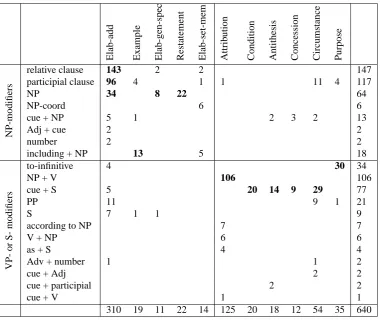
In order to generate parentheticals, a system needs to know not only which rhetorical relations can be realized as paren-theticals, but also which of the available syntactic construc-tions to choose to realize it. To determine which syntac-tic constructions co-occur most frequently with parentheti-cal rhetoriparentheti-cal relations, we have looked at 640 examples of Same Unit annotations and noted the syntactic type of the embedded parenthetical. The summary of our typology is illustrated in Table 2.
As the table shows, although each rhetorical relation can be realized by several different syntactic types, there are one or two types for each relation that are more frequent than others. These are shown in the table in boldface.
Based on which syntactic construction is most fre-quently used, we can distinguish two types of rhetorical relations. ELABORATION-TYPE relations (ELABORATION-ADDITIONAL, ELABORATION-SET -MEMBER, ELABORATION-GENERAL-SPECIFIC, RE -STATEMENTandEXAMPLE) are most frequently expressed by NP-modifiers (non-restrictive relative clauses, NPs and participial clauses) which appear immediately following
2
Figure 1: Embedded discourse unit in Nucleus 1 of a Same Unit relation
the entity which forms the nucleus, most of the time an NP. CIRCUMSTANCE,PURPOSE,ANTITHESISorCONCESSION relations on the other hand are mostly expressed by VP-or S-modifiers (cue + S subVP-ordinate clauses, to-infinitives, and in the case ofATTRIBUTION, NP + V sequences). According to the annotation manual, EDUs that are ex-pressed by certain syntactic constructions such as relative clauses, nominal postmodifiers with a non-finite clause and appositives by definition always play the role of the Satel-lite and enter into “embedded” rhetorical relations, marked by a “-e” following the name of the relation.
To illustrate, (3) shows an example of a regular CONCES -SIONrelation, and (4) an embedded CONCESSION-E rela-tion.
(3) Though couriers work as many as 60 hours a week during the autumn rush, they leave early during slack times while still being assured of a minimum paycheck.(CONCESSION)
(4) All citizens, [regardless of race], must feel represented. (CONCESSION-E)
Overall in the corpus 20% of all discourse relations are annotated as “embedded”. The most frequently occurring of these relations is ELABORATION-OBJECT-ATTRIBUTE, which appears in a ’-e’ form 97.37% of the time. This is a consequence of the definition of ELABORATION-OBJECT -ATTRIBUTE, which is by definition assigned to restrictive relative clauses. Indeed, many of the “non-embedded” examples ofELABORATION-OBJECT-ATTRIBUTEseem to be due to annotation errors. Again, we have excluded ELABORATION-OBJECT-ATTRIBUTE-E relations from the set of ’-e’ relations considered. Table 3. gives the statistics for occurrences of ’-e’ relations in the corpus, showing the frequency of embedding for relations that occur more than ten times in an embedded form in the corpus and excluding ELABORATION-OBJECT-ATTRIBUTE-E.
Table 3 agrees with our study of Same Unit relations in that the most frequently embedded relations are subtypes of elaboration. But these types account for 870 cases, or 73.54% of all ’-e’ relations which is far more than what we found embedded within Same Unit (51.49%). The rest of the relations in Table 3 correspond to the category of
VP-regular ’-e’ Total rhetorical relation 55 56.70% 42 43.30% 97 restatement 69 62.73% 41 37.27% 110 elab-set-member 2820 80.34% 690 19.66% 3510 elab-add
51 80.95% 12 19.05% 63 definition 223 83.83% 43 16.17% 266 example 326 88.59% 42 11.41% 368 elab-gen-spec 422 91.14% 41 8.86% 463 purpose 511 91.58% 47 8.42% 558 circumstance 166 91.71% 15 8.29% 181 condition 212 95.07% 11 4.93% 223 concession 323 95.85% 14 4.15% 337 antithesis 2367 95.87% 102 4.13% 2469 attribution 5998 98.64% 83 1.36% 6081 other 13543 91.97% 1183 8.03% 14726 total in corpus
Table 3: Relations most frequently occurring in a ’-e’ form
or S-modifier relations identified above, accounting for 128 or 10.8% of ’-e’ relations, andATTRIBUTION(8.6%). The numbers in Table 3 give us an idea about which re-lations occur frequently in a syntactically embedded form, and confirms that the set of relations that we found within Same Unit annotations are indeed the most frequently em-bedded ones. However, there is a significant difference in the distribution of the individual relations and it seems that ’-e’ annotations are not a good indicator for parenthetical status since we found both ’-e’ and “regular” rhetorical re-lations within Same Unit. For the purposes of this corpus study we decided therefore to ignore the distinction be-tween ’-e’ and regular occurrences of rhetorical relations and only consider a relation parenthetical when it appears within a Same Unit annotation.
4.
Corpus Study on PDTB
struc-Elab-add Example Elab-gen-spec Restatement Elab-set-mem Attrib
ution
Condition Antithesis Concession Circumstance Purpose
NP-modifiers
relative clause 143 2 2 147
participial clause 96 4 1 1 11 4 117
NP 34 8 22 64
NP-coord 6 6
cue + NP 5 1 2 3 2 13
Adj + cue 2 2
number 2 2
including + NP 13 5 18
VP-or
S-modifiers
to-infinitive 4 30 34
NP + V 106 106
cue + S 5 20 14 9 29 77
PP 11 9 1 21
S 7 1 1 9
according to NP 7 7
V + NP 6 6
as + S 4 4
Adv + number 1 1 2
cue + Adj 2 2
cue + participial 2 2
cue + V 1 1
310 19 11 22 14 125 20 18 12 54 35 640
Table 2: Syntactic types of parentheticals in Same Unit annotations
ture and semantics of some implicit discourse relations and entity relations (similar to entity-based coherence in (Knott et al., 2001)).
The two arguments of a discourse connective are labelled Arg1 and Arg2 in the corpus, where Arg2 is the argument that is syntactically bound to the discourse connective, and Arg1 is the other argument. In the PDTB all connectives have exactly two arguments and there are no constraints on the relative order of these arguments.
One way to identify parenthetical constructions in this cor-pus is to find annotations where one argument of a dis-course connective occurs linearly embedded within the other argument. There are two logical possibilities for this: either Arg1 is embedded within Arg2 or Arg2 is embedded in Arg1. We will call the first type, where Arg1 forms the parenthetical, Arg1-parentheticals. This type is illustrated in (5a). The second type, where Arg2 is parenthetical, is shown in (5b). We’ll call this type Arg2-parentheticals.
(5) a [...] [ARG2late Tuesday the Chinese
government, [ARG1which often buys U.S.
grains in quantity,] turned instead to Britain to buy 500,000 metric tons of wheat] (wsj0155)
b [...] [ARG1pollination, while [ARG2easy in
corn because the carrier is wind,] is more complex and involves insects as carriers in crops such as cotton] (wsj0209)
In Arg1-parentheticals the discourse connective appears in the host sentence, whereas in Arg2-parentheticals it appears
within the parenthetical.
In total there are 219 cases of “embedded-argument” paren-theticals in the corpus, of which 207 are examples of Arg2-parentheticals and only 12 are Arg1-Arg2-parentheticals. The distribution of these two types is illustrated in table 4. The rows of the table show the number of parentheticals found for four different semantic type of connectives: TEMPO -RAL,CONTINGENCY,COMPARISONandEXPANSION, i.e. the number of cases where a discourse relation of a given type holds between the parenthetical and its host. The strik-ing difference between the numbers in the two columns of table 4 shows that when one of the arguments of an explicit discourse relation is expressed as a parenthetical, in most cases the embedded string contains the explicit connective. The connectives that appear within the parenthetical are mostly structural connectives (mainly subordinating con-junctions and their modified forms, e.g., after, although, as, because, before, if, once, since, though, until, when, while), whereas all the connectives that appear in the host sentence are adverbs (e.g., also, instead, later, nevertheless, nonethe-less, previously, still, thereafter).
Relation Arg2-parentheticals Arg1-parentheticals distribution in corpus
TEMPORAL 101 (48.8%) 2 3434 (18.6%)
CONTINGENCY 53 (25.6%) 0 3286 (17.8%)
COMPARISON 38 (18.3%) 5 5490 (29.7%)
EXPANSION 15 (7.2%) 5 6239 (33.8%)
TOTAL: 207 12 18484
Table 4: Relations between “embedded-argument” parentheticals and their hosts
text according to the annotations of the RST treebank were in fact elaboration- (or expansion) type. We will discuss the reason for this discrepancy in more detail in section 5. Nevertheless, it should be noted that a lot of expansion-type relations can be inferred from another expansion-type of anno-tation in the PDTB: supplementary material annoanno-tations. These are extensions to a discourse argument that are rel-evant but not “minimally necessary” for the interpretation of a relation. Supplementary material often appears as a parenthetical embedded within one of the arguments of a discourse relation and therefore we need to consider these cases as well to get the correct distribution of parentheticals over rhetorical relations. The problem with the annotation of supplementary material is that these units have not been annotated for discourse relations so we do not know what relation (if any) holds between a parenthetical of this type and its host (although we suspect in most cases these spans convey a relation similar to expansion). To give an exam-ple, (6) illustrates two cases of parentheticals annotated as supplementary material in Arg1 (6a) and Arg2 (6b) of a connective.
(6) a The trust, which was created as part of
Manville’s bankruptcy-law reorganization to compensate victims of asbestos-related diseases,
ultimately expects to receive $2.5 billion from Manville, but its cash flow from investments has so far lagged behind its payments to victims. (0283)
b Last season, Hartford Stage director Mark Lamos mounted a production at Lincoln Center, and currently two other productions – one just
closed at the Old Globe in San Diego and another now at the Seattle Rep – overlap with
Mr. Boyd’s. (0819)
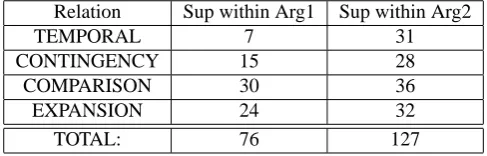
There are 293 examples in the corpus where supplementary material appears embedded within one of the arguments of a connective. Supplementary material appears more fre-quently within arguments that contain a connective: there are 127 examples of Arg2-embedded supplementary mate-rial, compared to 76 Arg1-embedded cases. However, more work will have to be done to evaluate the parenthetical na-ture of supplementary material in the PDTB, and then to distinguish among the various syntactic types that are in-deed parentheticals. Our intuition is that many of these par-enthetical supplements will be quite compatible with the syntactic types noted in the RST.
We end this section by pointing out that the annotation of supplementary material also allows us to investigate the larger discourse context in which the parenthetical and its
host appear (e.g. in (6a) the host of the parenthetical func-tions as Arg1 of the connective ’but’). Table 5 shows the distribution of discourse relations where one of the argu-ments contains supplementary material, broken down ac-cording to the semantic type of the connective. The table shows that there is no significant difference between dis-course relations in terms of allowing parentheticals to occur in their arguments, however parentheticals do occur slightly more frequently in the clause that contains the connective (Arg2).
Relation Sup within Arg1 Sup within Arg2
TEMPORAL 7 31
CONTINGENCY 15 28
COMPARISON 30 36
EXPANSION 24 32
TOTAL: 76 127
Table 5: Distribution of Supplementary material
5.
Discussion
5.1. The Elaboration/Expansion Distribution
The relation types classed as elaboration, as used in the RST, or expansion, as used in the PDTB, are the most common types of relations found in the respective cor-pora. Since their definitions overlap considerably, we therefore consider them jointly under the rubric Elabo-ration/Expansion. In extracting parentheticals from the RST and the PDTB, we might ask therefore whether the set of relations that we obtained also show the same pre-ponderance of elaboration- and expansion-type relations. We classify our data into two primary types - ELABORA -TION/EXPANSION and NON-ELABORATION/EXPANSION type relations. Since the PDTB treats attribution as a sepa-rate phenomenon, we leave out theATTRIBUTIONrelation encountered in the RST to facilitate comparison.3
Table 6 shows the proportions of ELABORA -TION/EXPANSION and NON-ELABORATION/EXPANSION relations in the two corpora, culled from the numbers seen in Tables 1 and 4.
For the RST, we take subtypes of ELABORATION to be-long to the ELABORATION/EXPANSIONgroup, as well as EXAMPLEandRESTATEMENTsince recapitulation and ex-emplification are clearly related to a notion of elaboration.
3A
issues. If a proposition is related only to some nominal object in a higher clause, a reasonable annotation strategy would be to simply link the parenthetical to the relevant nominal phrase. However, the segmentation of discourse units is not done at this level of granularity, so by conven-tion, the host sentence is split up into two halves and nom-inal postmodifiers are linked to the part of the host
con-taining the nominal phrase. Therefore, structurally at the
discourse level, real cases of S- or VP-modifier relations, where two propositions are actually related, become virtu-ally indistinguishable from NP-modifier relations, where an entity and a proposition are related. The only way to make this distinction is to sift through the various labels of rhetor-ical relations in the RST, and then falling back on the syntax to disambiguate them into NP-modifier or S-/VP-modifier types, as we have done.
In sum, from a structural point of view, the RST conflates two discourse-level phenomena - NP-modifier vs S- or VP-modifier types of relations - into one, whereas the PDTB recognizes the distinction but only annotates one of them!
5.2. Location and Distribution of Cue Phrases
Cue phrases are the most salient indicators of discourse re-lations in a piece of text. Therefore, to better understand the behavior of parentheticals in discourse, we also need to understand the characteristic behavior of cue phrases in this context. A corpus like the PDTB is most useful for such an endeavour. Here, cue phrases - known as discourse con-nectives - are taken to be discourse-level predicates which lexically anchor discourse relations. In other words, much of the annotation took place when there was an explicit course connective which signalled the presence of a dis-course relation. The examples extracted for this study, in fact, were all discourse relations anchored by a lexicalized connective. But there is a striking imbalance in the distri-bution of the data. As seen in Table 4, out of 219 parenthet-icals extracted from the corpus, 207 were cases of Arg2-parentheticals, i.e., contained a discourse connective within the parenthetical.
Type of Connective Arg1-Parenth. Arg2-Parenth. Total Subordinating Conj. 0 (0%) 205 (99%) 205 Discourse Adverbial 12 (100%) 2 (1%) 14
TOTAL 12 207 219
Table 7: Nested constructions in PDTB, by connective type
Why should there be so many Arg2-parentheticals relative to Arg1-parentheticals? To answer this question, we note that there are two main grammatical types of discourse con-nectives which appear within parentheticals: i) subordinat-ing conjunctions (e.g. while, because, since); and ii) ad-verbials (instead, however, meanwhile). Interestingly, the overwhelming majority of the pervasive Arg2-Parenthetical type are cases where Arg2 contains a subordinating con-junction (205 tokens out of 207, see Table 7). Subordi-nating conjunctions in fact never co-occur with Arg1 Par-entheticals. In addition, discourse adverbials, even though they may appear in both Arg1- and Arg2-Parentheticals (12 and 2 times respectively), are comparatively rare and their infrequency means that they do not affect the skewered
dis-tribution seen in Table 7.
It appears then that subordinating conjunctions are the most “conducive” to parentheticals. This makes sense when we consider the grammatical nature of these connectives - a subordinating conjunction introduces an S-BAR subordi-nate clause (the parenthetical) which is structurally
grated into the matrix clause (the host). This structural
inte-gration provides for a number of structural transformations, including moving the subordinated clause medially or ini-tially, which would otherwise not be possible. A parenthet-ical construction is “born” essentially when the subordinate clause is moved medially. Since Arg2 is the clause contain-ing the connective (the subordinatcontain-ing conjunction), these would be Arg2-parentheticals. The converse does not hold however: to obtain Arg1 parentheticals when Arg2 contains the subordinating conjunction, the Arg2 subordinate clause would have to be split into two and then be transformed in such a way that it winds up nesting the Arg1 matrix clause, a completely unheard of structural transformation.
The case with discourse adverbials is more complex. Syn-tactically, an adverbial clause is not necessarily structurally integrated into a matrix clause in a subordinated structure but in most cases it introduces an independent new sen-tence. The relation of the discourse adverbial to a preced-ing Arg1 argument is therefore not syntactic, as was the case with subordinating conjunctions. In fact, (Webber et al., 2003) argue that the adverbial is anaphoric instead of structural, the notion being that the adverbial contains some integrated deictic particle which refers back to a preced-ing discourse argument. In other words, the discourse ar-gument containing the adverbial (Arg2) needs to linearly precede the other argument (Arg1). This anaphoric prop-erty of discourse adverbials reduces the space of structural configurations that would be compatible with parenthetical constructions, as illustrated in Table 8. The first configura-tion (row i) shows the canonical non-parenthetical pattern, where Arg2 containing the adverbial simply follows Arg1. Among the parenthetical configurations, there is only one possible configuration of Arg2-Parentheticals (row ii). This configuration is rarely encountered, possibly because the adverbial here only refers to the first portion of its Arg1 an-tecedent (ARG1a) and not the entire Arg1 clause (ARG1a + ARG1b). Among the Arg1-Parentheticals, one of the con-figurations (Table 8, row iii) is impossible , since the adver-bial here does not precede ARG1 at all. This leaves only the option in row iv) where the adverbial points to the nested ARG1 parenthetical.
Configuration Parenthetical Type Observations i) ARG1 ARG2+adv Not Parenthetical Common ii) ARG1a ARG2+adv ARG1b Arg2-Parenthetical Rare iii) ARG2a+adv ARG1 ARG2b Arg1-Parenthetical Impossible iv) ARG2a ARG1 ARG2b+adv Arg1-Parenthetical Possible
Table 8: Configurations involving discourse adverbials.6
observa-tion about the behavior of cue phrases: S- or VP-modifier type parentheticals tend to contain cue phrases, whereas NP-modifier parentheticals do not. From Table 2, we can see that a large majority of VP- or S-modifier parentheticals fall into the following syntactic types: cue+S, to-infinitive (where the “to” might be treated as a shortened form of the purpose cue-phrase “in order to”), cue+N, cue+Adj, cue+participial. NP-modifiers are mostly relative clauses, participial clauses, NPs, PPs or S’s.
In sum, the combined use of the PDTB and the RST tells us quite a bit about the location of cue phrases: they generally occur with the parenthetical and not the host, and they ap-pear with parentheticals which are VP- or S-modifiers. As a side rule, we could also surmise that generally these cue phrases are subordinating conjunctions. Discourse adver-bial cue phrases might be more likely to appear in the host sentence, but the data is sparse and further study would be needed to understand the behavior of adverbials with par-entheticals.
5.3. On the Generation of Parentheticals
Our corpus study provides information to design a gener-ation strategy for several types of parenthetical construc-tions. The overwhelming majority of parentheticals anno-tated in the two corpora are syntactically related to their host sentences. We only found 9 examples of interpola-tions in the RST that consist of full sentences and in the PDTB, the 12 cases of Arg1-parentheticals containing dis-course adverbs are the only ones that can perhaps be in-cluded in this category. A generator should therefore focus more on parentheticals that are syntactically related to their host.
There are two main groups of syntactically re-lated parentheticals. The more popular group, ELABORATION/EXPANSION- type parentheticals should be generated most frequently, using syntactic construc-tions such as relative clauses, nominal postmodifiers with non-finite clauses and NPs. No cue phrases or discourse connectives should be generated in these cases. Conjunctive or paratactic types within the ELABORA -TION/EXPANSIONgroup should also be avoided.
The other group, NON-ELABORATION/EXPANSION-type parentheticals should be generated less frequently and should always involve the use of a cue phrase. The syntac-tic types used for this group should be subordinate clauses, to-infinitives and perhaps PPs.
Assuming that the distribution of rhetorical relations in the input of the generator is similar to the distribution of rhetor-ical relations in our two corpora, the numbers in Table 3 should give an indication as to how often to realize each type of relation as a parenthetical.
There are several types of parentheticals that the present corpus study is missing because of the nature of the an-notation guidelines of the corpora used. For example, in the RST corpus phrasal expressions beginning with prepo-sitions or connectives that have ambiguous discourse cues are not segmented as EDUs (8a), and neither are reduced relative clauses that contain an adjective without a verbal element (8b):
(8) a But the technology, [while reliable,] is far slower than the widely used hard drives. (wsj1971)
b Each $5000 bond carries one warrant, [exercisable from Nov. 28, 1989, through Oct. 26, 1994] to buy shares at an expected premium of 2 1/2 % to the closing share price when terms are fixed Oct. 26. (wsj1161)
We expect that these constructions will behave similarly to subordinating conjunctions and relative clauses respec-tively. This hypothesis could be confirmed by incorporat-ing these non-annotated constructions into the grammar of an NLG system according to the strategy described above, and evaluating the output of the system.
6.
References
N. Asher. 1993. Reference to Abstract Objects in English. Kluwer, Dordrecht.
O. Bonami and D. Godard. 2007. Parentheticals in under-specified semantics: The case of evaluative adverbs.
Re-search on Language and Computation, 5(4):391–413.
N. Burton-Roberts. 2005. Parentheticals. In E. K. Brown, editor, Encyclopaedia of Language and Linguistics. El-sevier Science, 2nd edition edition.
L. Carlson, D. Marcu, and M. E. Okurowski. 2001. Building a discourse-tagged corpus in the framework of Rhetorical Structure Theory. In Proceedings of the
Second SIGdial Workshop on Discourse and Dialogue,
pages 1–10, Morristown, NJ, USA. ACL.
N. Dehe and Y. Kavalova, editors, 2007. Parentheticals, chapter Parentheticals: An introduction, pages 1–22. Linguistik aktuell 106. Amsterdam Philadelphia: John Benjamins.
A. Knott, J. Oberlander, M. O’Donnell, and C. Mellish. 2001. Beyond elaboration: The interaction of relations and focus in coherent text. In T. Sanders, j. Schilperoord, and W. Spooren, editors, Text Representation:
Linguis-tic and PsycholinguisLinguis-tic Aspects, pages 181–196.
Ben-jamins, Amsterdam.
W. C. Mann and S. A. Thompson. 1987. Rhetorical Struc-ture Theory: A theory of text organization. Technical Report ISI/RS-87-190, Information Sciences Institute, June 1987.
PDTB-Group. 2008. The Penn Discourse Treebank 2.0 Annotation Manual. Technical Report IRCS-08-01, In-stitute for Research in Cognitive Science, University of Pennsylvania.
D. Scott and C. S. Souza. 1990. Getting the message across in RST-based text generation. In C. Mellish R. Dale M. Zock, editor, Current Research in Natural
Lan-guage Generation, pages 31–56. Academic Press.
A. Siddharthan. 2002. Resolving attachment and clause boundary ambiguities for simplifying relative clause constructs. In Student Research Workshop, ACL. B. Webber, M. Stone, A. Joshi, and A. Knott. 2003.
Anaphora and discourse structure. Computational