Re-positioning Continuon Netbeheer in
a changing gas market
5
thof January 2007
Examination committee
University of Twentedr. M.J. Arentsen dr. A.M. von Raesfeld meijer
prof. dr. ir. M. Wolters Continuon Netbeheer Ing. B.M.J. Lambregts Ing. J.H.M. van der Vegt
Management Summary
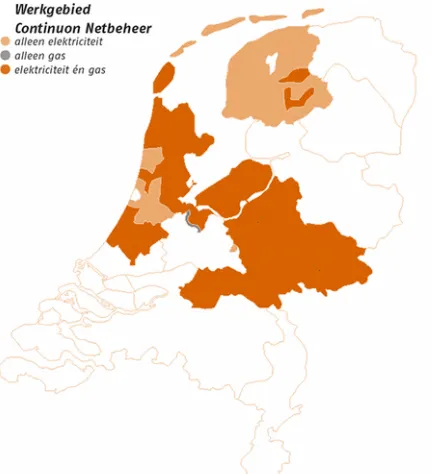
The introduction of competition has changed the structure and functioning of the Dutch gas sector considerably. One of the major impacts for energy companies has been the unbundling of energy distribution and energy supply. The unbundling has led to independent regionally based gas and electricity network companies responsible for gas and electricity distribution in certain regions. Continuon Netbeheer is one of the regionally based distribution companies in the Netherlands with licence to distribute gas and electricity in Gelderland, Noord-Holland, large parts of Flevoland, Friesland and Zuid-Holland.
Next step in the unbundling process is the establishment of Continuon Netbeheer as independent organisation from the holding Nuon. Continuon is facing the challenge of developing a corporate strategy that enables the company to develop a good position in the liberalised energy market and a good profit position now and in the future. This thesis project is meant to provide Continuon with specific suggestions for developing such a position by means of an assessment of the current business strategy and strategic position in the perspective of the changes in the energy market. The project concentrates on the gas distribution activities of Continuon. More specifically the research objective is:
To support Continuon in their business development and offer a specific set of strategic options to improve their position in the current and future liberalized gas market.
The problem definition that has been formulated is:
What will be an effective strategic position for Continuon now and in the future given the changes in the gas market and gas distribution?
Based on current theory on strategic positioning Value Configuration analysis has been used to analyze the current strategic position of Continuon and to make suggestions for improvements. In this study the three “value logic models” from the Value Configuration theory developed by Stabell and Fjeldstad (1998) have been used as reference for the analysis of the current strategic position and the development of alternative strategic positioning options.
The empirical part of my project had three major activities:
1. Assessing the strength and weaknesses of the current position of Continuon Netbeheer in the gas market
2. Developing strategic alternatives for Continuon Netbeheer with the help of the three value models suggested by theory (value chain, value shop and value network type of organisation). 3. Assessment of the effectiveness of the strategic alternatives in the perspective four possible
scenarios for gas market development
For assessing the current position of Continuon Netbeheer an extensive background study to the external environment of Continuon Netbeheer and the company has been performed to be able to draw a conclusion on the current strategic position of Continuon Netbeheer (see Attachments Report). Research Question 1
1. What is the current strategic position of Continuon Netbeheer?
unbundling process1. The lack of a clear vision at Continuon Netbeheer about the position in the gas market now and in the future might threaten the strategic position of the company.
For the next empirical part of this research project different strategic options for Continuon Netbeheer have been identified.
Research Question 2
2. What are the alternative strategic options for Continuon Netbeheer?
First, Value Configuration analysis has been performed on the current configuration of Continuon Netbeheer at the industry and the firm level. The conclusion that has been made from the Value Configuration analysis of the value system of the Dutch gas industry and the Who, What and How dimensions of strategy was Continuon seems to be changing from a value chain logic towards a value network logic.
Next the different strategic options for Continuon Netbeheer, that are based on the three value logic models in the Value Configuration theory developed by Stabell and Fjeldstad (1998), has been introduced. For Continuon Netbeheer as network operator in the regulated domain only the value chain and value network configuration are applicable due to regulative boundaries. These regulations set important boundaries in both configuration models, because they do not allow commercial activities for a network operator. However, we have also seen that a network operator is allowed to be part of a group company (a gas distribution network company), in which commercial activities can take place.
In the last part the suitability of the strategic options in four different future scenarios will be evaluated Research Question 3
1. What is the suitability of the strategic options in the different scenarios for business development in gas distribution services for Continuon Netbeheer? The four different scenarios are: the mass grey, solistic grey, solistic green and mass green scenario. Each of these scenarios differ in the degree of society attention for sustainability and the degree of central or local energy production. They also differ in the customers demands and expectations and the character of gas distribution operations.
Next the suitability of each strategic option in the four different scenarios has been evaluated.
The value chain logic proved to be only suitable in the mass grey scenario. The unsuitability of this option in the other scenarios has been mainly caused by the increased network character of gas distribution services and the need for differentiation in the standard services in those scenarios. The value network has proven to be suitable in almost all scenarios except for the mass grey scenario in this evaluation. The characteristic of the value network configuration of having a focus on both cost drivers as well as value drivers has proven to be effective in meeting the demands and expectations of customers as well as the suitability for describing the nature of gas distribution operations in most s scenarios. The value shop configuration is only suitable in the solistic green and solistic grey scenarios.. The overall conclusion that can be drawn from the assessment of the suitability of the three different strategic options in the future scenarios is that the value network option seems the most suitable option.
On the basis of the analysis of the current position, the value configuration analysis and the suitability assessment of the strategic options in the future scenarios, the conclusion can be made that the value network configuration is the most suitable strategic positioning choice for Continuon Netbeheer given the changes now and in the future in the gas market and gas distribution. We therefore propose that Continuon Netbeheer should be organized according to the value network configuration. Other recommendation is that Continuon Netbeheer should become part of a network company and merge with Nuon Netwerk services to be able to develop commercial activities outside the regulated domain This organization structure fits with the value network configuration and enables exploiting the most business development opportunities in the changing gas market for a regional gas distribution company.
Dutch Abstract
De liberalisering van de Nederlandse gasmarkt heeft de Nederlandse gasvoorziening ingrijpend veranderd. Eén van de belangrijkste gevolgen van de liberalisering is de splitsing van de energiebedrijven in aparte levering- en distributiebedrijven. Deze splitsing heeft geleid tot onafhankelijke regionale netbeheerders voor gas en elektriciteit in de verschillende regio’s.
Continuon Netbeheer is een van deze Regionale netbeheerders in Nederland met een vergunning voor de distributie van gas en elektriciteit in Gelderland, Noord-Holland, grote delen van Flevoland, Friesland en Zuid-Holland.
De splitsing betekent voor Continuon dat het onafhankelijk van het energieconcern zijn functie in de gasmarkt zal moeten vervullen en als onafhankelijk netbedrijf positie zal moeten bepalen in de huidige en toekomstige gasvoorziening. De belangrijkste vraag waar Continuon in die hoedanigheid voor staat is hoe het bedrijf in de komende decennia waarde kan en wil creëren in de geliberaliseerde gasmarkt. Dit afstudeeronderzoek is gericht op de gasdistributie activiteiten van Continuon. Het onderzoeksdoel is om Continuon the helpen om een strategische positie te kiezen in de huidige en toekomstige geliberaliseerde gasmarkt.
Het bepalen van deze effectieve strategische positie voor Continuon is in dit onderzoek op basis van de ‘Value Configuration’ theorie over strategisch positioneren van Stabell en Fjeldstad (1998) gedaan. Het empirische onderzoek bestaat uit drie delen:
1. Het bepalen van de huidige positie van Continuon in de gasmarkt
2. Het ontwikkelen van strategische alternatieven voor Continuon op basis van de drie waardemodellen uit de ‘Value Configuration’theorie
3. Het evalueren van de passendheid van de strategische alternatieven in het perspectief van vier mogelijke toekomst scenario’s voor de ontwikkeling van de gasmarkt.
Het resultaat van het bepalen van de huidige positie van Continuon in de gasmarkt er geconcludeerd kan worden dat Continuon als Nederlandse regionale netbeheerder maar een heel erg kleine speler in de Europese en wereld gas markt is. In Nederland zijn ze echter een vrij grote speler met een marktaandeel van bijna 30% als men naar het aantal gasaansluitingen kijkt. Netbeheer is een gemonopoliseerd deel van de gasmarkt onder strak toezicht van de DTe. Dit betekent dat Continuon een licentie voor de netbeheerderstaken in haar gebied heeft, maar geen commerciële activiteiten mag ontwikkelen. Verder loopt Continuon voorop bij de introductie van innovatieve diensten en producten( zoals bijv. Smart metering en self-services via continuon.nl) en op het gebied van duurzaamheid en duurzaam netbeheer. In vergelijking met de andere Nederlandse netbeheerders is Continuon een van de eerste die heeft gekozen voor een positionering apart van het moederbedrijf en leveringsbedrijf Nuon. Dit betekent dat Continuon beter dan de andere netbeheerders op het splitsingsproces voorbereid is. Belangrijk zwak punt dat de strategische positie van het bedrijf in de toekomst kan verzwakken is dat er momentaal nog geen duidelijke visie is over wat de positie nu en in de toekomst moet zijn van Continuon als netbeheerder.
In het volgende empirische gedeelte is de ‘Value configuration’ theorie gebruikt om the huidige configuratie van Continuon te analyseren en om verschillende strategische alternatieven te ontwikkelen. De belangrijkste conclusie van de analyse van de huidige configuratie van Continuon is dat deze de eigenschappen van zowel de waardeketen als het waardenetwerk model heeft. In feite kan men concluderen dat door de liberalisering en de ontwikkelingen in de gasmarkt Continuon in een transitie zit tussen het waardeketen model naar het waardenetwerk model.
Regulering vormt de belangrijkste belemmering voor de strategische positionering van Continuon in, omdat een netbeheerder geen commerciële activiteiten mag ontplooien. We kunnen echter concluderen dat er een mogelijkheid gevonden kan worden voor het ontplooien van commerciële activiteiten in het feit dat een netbeheerder onderdeel mag zijn van een netwerkbedrijf (groepsbedrijf). Voor een netwerkbedrijf, met als apart bedrijfsonderdeel de netbeheerder, is het waardenetwerk model de meest passende optie. In de structuur van het netwerkbedrijf kan als aparte consultancy divisie ook de waarde shop optie toepasbaar zijn.
Vervolgens zijn de strategische opties beoordeeld op de passenheid in vier verschillende toekomstige scenarios, Mass Grey, Solistic Grey, Solistic Green en Mass green. Uit deze beoordeling kwam naar voren dat de waardeketen optie alleen toepasbaar bleek in het Mass Grey scenario. De waarde shop optie bleek mogelijk te zijn in het Solistic Green en Mass green scenario, minder toepasbaar in de solistic grey en absoluut niet toepasbaar in het Mass Grey scenario.
De value network bleek in alle scenario’s behalve het Mass Grey scenario goed toepasbaar te zijn.
Index
Management Summary...2
Dutch Abstract ...4
Introduction...8
Outline ...8
1 Problem Analysis and methodology...10
1.1 Background ...10
1.2 Research objective...11
1.3 Research model and research questions...11
1.4 Methodology and research methods...14
2 Theoretical Background ...16
2.1 Strategic positioning with the Value Configuration theory ...16
2.1.1 Introduction to Strategic positioning ...16
2.1.2 Value configuration theory...18
2.1.3 Examples of different types of firms in the oil and gas industry...20
2.1.4 Value configuration and industry structure...20
2.1.5 Value configuration and strategic options...20
2.1.6 The value discipline model vs. value configuration ...21
2.2 Other analysis instruments and strategy tools...23
2.3 Summary for the theoretical framework ...23
3 The current strategic position of Continuon Netbeheer ...25
3.1 General overview of Continuon Netbeheer ...25
3.1.1 Historical overview of Continuon Netbeheer...25
3.1.2 Main characteristics ...26
3.2 External analysis for the strategic position ...27
3.3 Internal analysis for the strategic position ...28
3.3.1 The Customers...28
3.3.2 Products and services ...29
3.3.3 Technical & Organizational adaptations ...31
3.4 Summary of the current strategic position of Continuon Netbeheer in the (Dutch) gas sector...34
4 Value configuration Analysis ...35
4.1 Value Configuration analysis ...35
4.1.1 Industry level analysis...35
4.1.2 Firm level analysis ...36
4.1.3 Conclusion on Value configuration analysis of Continuon Netbeheer and the gas industry ...38
4.2 Strategic options ...39
4.2.1 Regulations and strategic options ...39
4.2.2 The Value configuration models ...41
4.2.3 Main consequences of the different strategic options...44
4.2.4 Summary Business development in the three strategic options ...48
4.3 Summary of the Value configuration analysis ...49
5 Assessment of the strategic options in the different scenarios ...50
5.1 Introduction to the scenarios ...50
5.1.2 Customer demands and expectations ...51
5.1.3 The consequences for gas distribution of each future scenario ...52
5.2 The assessment of the strategic options in the scenarios ...53
5.2.1 The Value chain configuration ...54
5.2.2 The Value Network configuration ...55
5.2.3 The Value Shop configuration...57
5.3 Summary of the suitability of the strategic options in the different scenarios...59
6 Conclusion and recommendations on re-positioning Continuon Netbeheer ...60
6.1 Recommendations ...61
Information sources...63
Attachments Report 'Re-positioning Continuon Netbeheer in a changing gas market' Attachment A:Value configuration theory
Attachment B: Other theoretical instruments
Attachment C: Background study on the external environment of Continuon Netbeheer
Introduction
The Dutch gas sector has changed considerably due to liberalization, commercialization, up scaling and concentrations. These developments have made gas network operations more complex and have forced network companies in regional gas distribution to change to a more customer based view.2 Another factor that plays an important role in this process is the society attention for safe and reliable gas distribution and sustainability. In the past there were no parties such as the DTe3 that need to be taken into account in gas network operations. Such governmental supervision has just recently been introduced and has not been an issue before the liberalization.
Customers expect a constant and reliable gas supply whereas significant sections of the Dutch gas infrastructure are reaching the edge of lifetime. Replacement, rehabilitation and innovation of gas infrastructure will demand high investments in the near future. A trade-off of desired reliability and costs will have to be made4.
Liberalization and commercialization have led to a more differentiated gas supply and demand. To adjust to this development gas transport should become more flexible. This puts additional challenges to the operation and management of the gas network. Other issues will affect gas distribution in the coming years, such as the introduction of alternative energy sources like biogas or hydrogen. Integration of new gas infrastructure in densely populated areas is another challenging future issue. Continuon Netbeheer is one of the regionally based distribution companies in the Netherlands with licence to distribute gas and electricity in Gelderland, Noord-Holland, large sections of Flevoland, Friesland and Zuid-Holland. Due to the unbundling process Continuon has to become independent from the holding Nuon. Independence implies that Continuon has to develop its own strategy to continue and improve its position in the liberalized energy market. So Continuon is facing the challenge of reaching a good strategic position in the liberalized energy market and a good profit position now and in the future. This research is meant to provide Continuon with specific suggestions for developing such a strategic position by means of an analysis of the current strategic position. This means an analysis of the current external environment and future developments in the environment, and an assessment of Continuons current business strategy and configuration of activities.
Outline
First we will start with describing the problem and formulating the problem definition of this research project in Chapter 1. We will also describe the methodology and research model. Next the theoretical framework of this research will be introduced and explained in Chapter 2. The main theoretical basis for the empirical section will be described.
In Chapter 3 the empirical section of this research will start with an analysis and description of the current strategic position of Continuon. First Continuon will shortly be introduced with its main characteristics. Next the current strategic position of Continuon in gas distribution services will be analyzed. The conclusion of the descriptive research of the external environment and the position of Continuon in this external environment will be given. Internal analysis will subsequently be performed in the second section of Chapter 3.
The current configuration of Continuon in the gas market will be analyzed and assessed in the first section of Chapter 4. This will be done with Value Configuration models. Next step is the development and introduction of different alternative strategic options based on Value Configuration Theory.
The implications of each different strategic alternative option will be described with their main advantages and disadvantages for Continuon.
2
Arentsen, M., Jager, B., Pater, S., Wolters, M.,’Gastechnologische kennis in de Nederlandse Energiesector: een verdwijnend fenomeen?!’, September 2002
3
DTe (Directie Toezicht Energie) = the governmental supervisor for the Dutch energy market 4
1 Problem Analysis and methodology
In this section the structure of this research project will be defined. Section 1.1 contains the background of this research project. In section 1.2 we will determine the research objective and the problem definition that will guide this research project will be formulated. The next section(1.3) consists of a formulation of the research questions and the construction of the research model. Finally, in the remainder of this chapter (section 1.4) the methodology and research methods will be discussed.
1.1 Background
Liberalization of the gas and electricity market has led to major changes in the market environment of companies in this sector. It used to be a traditional utility sector characterized by natural monopolies, self regulation and public ownership. Due to the liberalization process, gas and electricity supply are now exposed to competitive forces and commercialization. The gas and electricity transport sector is still a capital expensive industry. The unbundling of gas supply and gas transport has led to public owned, strongly regulated5, regionally based network operators responsible for gas and electricity transport-and distribution in certain regions.
Continuon Netbeheer
Continuon originated from the introduction of the Electricity and Gas Law in 1998 and 2000 respectively. To accommodate the liberalization of the energy market, energy companies were forced to split in network controllers, energy suppliers, producers, and metering companies.
Continuon is the network operator of the gas and electricity grids in a large section of the Netherlands. The unbundling of the energy companies has severe consequences for Continuon as network operator. Continuon should separate from the Nuon holding and should independently determine its position in the liberalized gas market as regulated gas network company. At this moment Continuon is not yet separated from Nuon.
Business development for Continuon Netbeheer
Findings from business administration (organization theories) can be useful for repositioning the company in a still rapidly changing market environment like the energy market. In such an environment companies like Continuon can no longer rely on their traditional basic competencies as they did in the past. They have to find new ways to make money and survive. One way to do so, is investigating how to capture value from existing processes and products and to develop new sources of value creation that may result in a strong strategic position in the changed market.
In general, a dynamic market environment requires a constant assessment of the match between the company’s product and the company’s customer. The process of renewing this matching process is called Business development6. Business development is about analysing, creating and delivering value to the customers. For Continuon however, operating in a highly regulated market means that business development opportunities are very limited.
One other important characteristic of the gas sector that has to be taken into account in this process is that in spite of the liberalization process, this sector is still a capital expensive industry with slow reaction times and regulatory supervision. Decisions take a long time to come info effect and once invested, the period of return might be more than 40 years.
5
Being a regional monopoly, the government decided that a strong regulatory regime was to be imposed. 6
Gas distribution
Continuon is active in the energy market in both gas and electricity transport with their related services. This research will focus on the gas distribution services only. This boundary might have consequences for the conclusion about the strategic position of Continuon, since in fact Continuon is acting in the electricity market as well. Because the electricity and gas grids have been developed separately, we will assume that developments towards integrated and interactive electricity and gas grids will not yet play a role in the strategic positioning and business development opportunities for Continuon.
1.2 Research objective
From the previous section we learn that the most important issue for Continuon is to determine how they can and want to create value now and in the future as an independent regulated network operator in a liberalized energy market. This means choosing a strategic position that secures continuity of the company in the longer term. This project aims at providing Continuon with specific suggestions for developing and positioning their business and to anticipate on the continuously changing gas market environment.
Research objective
To support Continuon Netbeheer in their business development and offer strategic options to improve their strategic position in the current and future liberalized gas market.
To create a better position in the current and future liberalized gas market Continuon has to make a choice for a strategic option. In order to obtain the research objective the following problem definition can be formulated. This problem definition will guide the project.
Problem definition
What will be an effective strategic position for Continuon Netbeheer now and in the future given the changes in the gas market and gas distribution?
In more technical terms this problem statement is saying that we will develop and analyze different strategic options for business development available for Continuon Netbeheer in gas distribution services and match these options to different future scenarios
Given the following boundary conditions: • Safe and reliable gas transport • Regulations
1.3 Research model and research questions
This research project will consist of a descriptive background study of the current external environment of Continuon and an empirical section - the main section of this research. The empirical section of this research project can be divided in three different activities:
1. Assessment of the current strategic position of Continuon in the gas market 2. Development of strategic alternatives for Continuon
3. Assessment of the effectiveness of the strategic alternatives in the perspective four possible scenarios for gas market development and given the conditions of a cost effective and reliable gas distribution.
The research project with its three main empirical sections can be represented in a research model (see figure 1). For each of these three main empirical sections a research question has been formulated.
Research Question 1
1. What is the current strategic position of Continuon Netbeheer?
The next step is to look at Continuon herself as a network control operator in gas distribution services by identifying and analyzing their strategy. This means:
• identification of their customers
• what products and services do they offer
• what are the organizational and technical adaptations
The second section consists of an analysis of the current configuration of activities and value creation at Continuon. The theory about value configuration of Stabell and Fjeldstad will be used to classify the value configuration logic model that Continuon has adopted.
The understanding of the strategic position of a Continuon will help assessing whether or not the current strategy and value configuration is capable of dealing with the changes that already have taken place and the changes that will take place in the organizations environment in the future. Alternative strategic options offer opportunities for different strategic positions for Continuon that might better match the current or future external environment and expectations of stakeholders. The identification of these alternative strategic options is one of the main sections in this research and leads to the next research question.
Research Question 2
2. What are the alternative strategic options for Continuon Netbeheer?
In order to determine the consequences of choosing one of the strategic options for Continuon considering future developments, these strategic options will be matched to different future scenarios. This leads to the following next research question.
Research Question 3
1.4 Methodology and research methods
To be able to answer the different research questions and solve the underlying problems, a suitable research strategy will be determined for each specific question. The underlying theoretical framework will be discussed in chapter 2.
If we look at the formulated research questions, we are dealing with descriptive problems (internal and external situation analysis) on one hand and a therapy problem (which strategic options are best for Continuon considering future scenarios) at the other hand.
The main research object is the Continuon company. We will determine the data sources and research methods for each research question. They will be displayed in the tables below (tables 1, 3 and 4).
Research Question 1
1. What is the current strategic position of Continuon Netbeheer?
As we have concluded before this research question consists of two main sections: the first consisting of an external and internal analysis of Continuon in the gas market., and the second a value configuration analysis of Continuon.
Table 1 Research methods and Data sources for research question 1
Research object Data sources Research methods
The external environment of
• Expert interviews (DTe&Energie Clearing house) identified. The next step is to look at Continuon herself as network control operator in gas distribution services. This means identifying and analyzing their strategy, who are the customers, what products and services do they offer and what are the organizational and technical adaptations.
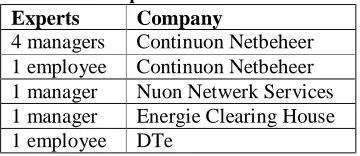
To gain more insight in the current developments and characteristics of the gas market and the company Continuon, experts will be interviewed. The number of experts, their position and company are represented in table 2.
The understanding of the strategic position of Continuon will help assessing whether or not the current strategy and value configuration is capable of dealing with the changes that already have taken place and the changes that will take place in the organizations environment in the future.
Next section consists of an analysis of the current configuration of activities and value creation at Continuon. The theory about value configuration from Stabell and Fjeldstad will be used to classify the value configuration logic model that Continuon has adopted.
identification of these alternative strategic options is one of the main sections in this research and leads to the next research question.
Research Question 2
2. What are the alternative strategic options for Continuon Netbeheer?
Table 3 Research methods and Data sources for research question 2
Research object Data sources Research methods
The value configuration of Continuon
• Literature about the Value configuration theory
• Documents
Case study of Continuon
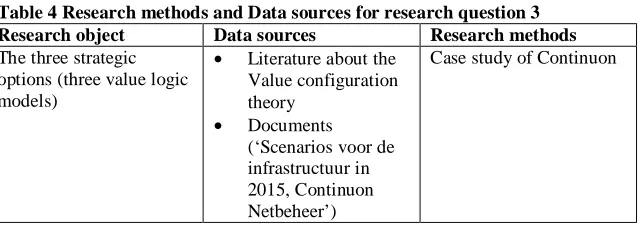
Research Question 3
3. What is the suitability of the strategic options in the different scenarios for business development in gas distribution services for Continuon?
Table 4 Research methods and Data sources for research question 3
Research object Data sources Research methods
The three strategic options (three value logic models)
• Literature about the Value configuration theory
• Documents
(‘Scenarios voor de infrastructuur in 2015, Continuon Netbeheer’)
Case study of Continuon
We observe that the research methods include not only the desktop research of literature and documents, but also an intensive case study of Continuon, as well as a short case study of Gasunie , and a comparative case study of the different regional network operators.
2 Theoretical Background
In this chapter the theoretical framework of this research project for Continuon will be introduced and explained.
The problem definition of the thesis project that has been defined is:
What will be an effective strategic position for Continuon Netbeheer now and in the future given the changes in the gas market and gas distribution?
To answer this question we will need a theoretical basis for analyzing and assessing the strategic position of Continuon. In this research we will use the Value Configuration Theory developed by Stabell and Fjeldstad (1998) for analyzing the current and future strategic position.
This chapter will start with an introduction to the concept of strategic positioning in section 2.1. In this section we will also introduce and describe the three different value configuration models in the “Value Configuration theory”. In section 2.2 we will shortly summarize the analytical instruments that will be used in answering the different research questions. We will conclude with an overview in which way the value configuration theory will be used in the empirical section of this research in section 2.3.
2.1 Strategic positioning with the Value Configuration theory
In this section the concept of strategic positioning will be further explored, leading to the introduction of the Value Configuration theory. The value logic models in this theory will form the basis for analysis of the current strategic position and will also form the basis for developing strategic options for Continuon. The Value Configuration theory will also be compared with the value discipline model of Treacy and Wiersema. This will be done because the current strategy of Continuon is based on this value discipline model. It is important to define the complementarities and differences between these two theories in order to understand the current position of Continuon and the link with the Value Configuration theory.
2.1.1 Introduction to Strategic positioning
Strategic positioning is the positioning of an organization (or business unit) in the future, while taking into account the changing environment, stakeholder expectation and the systematic realization of that positioning (the strategy for reaching that position).
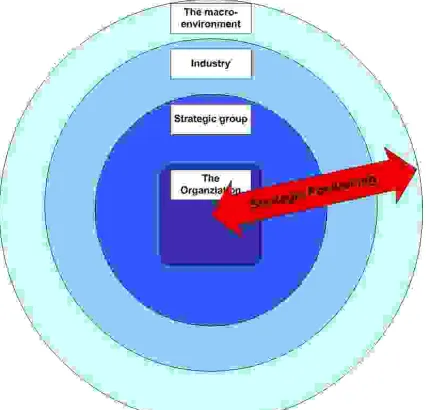
The strategic positioning is focused at reaching a desired future position on the basis of the present external environment and future developments, and the internal configuration of resources and activities to secure the continuity of the organization. The external environment can be divided in different layers (see figure 2):
• the macro-environment (the general environment) • the industry
• the strategic group7 (group of organizations that produce the same sort of products or services and have similar characteristics)
Figure 2 Strategic positioning and the layers of the business environment8
Understanding the current strategic position of Continuon should be concerned with the impact on strategy of the current external environment, internal company resources and competences, and the expectations and influence of stakeholders. The understanding of the strategic position of a company will help assessing whether the current strategy is capable of dealing with the changes that will take place in the organisations environment in the future or not. By matching the current strategic position to the current external environment and different possible future scenarios, the question arises if there is a need for a change in the strategic position.
A strategy for business development can be described by three dimensions9: • Who dimension, defining who are the customers
• What dimension, determining what products and/or services the company offers to customers and with what characteristics
• How dimension, describing how the company delivers its products and/or services through the technical and organization arrangements that it adopts
These three dimensions will be used as a framework for describing the current strategy and strategic position of Continuon in this research. A strategy determines the contents and the character of the organization's activities.
Long-term success of strategies is determined by the extent to which they deliver best value for stakeholders. The underlying basis of strategy is to find a fit between the market opportunities and the organization’s resources with the objective to achieve competitive advantage. The economic consequences of a given strategy will always depend on the features of the surrounding business environment in which the company operates10.
This implies that a strategy must be well-matched to both the firm’s resource strengths and weaknesses as well as the firm’s best market opportunities and external threats to its well-being. There is however not one best strategy that can be linked to economic success for a firm. Various different market strategies can be successful in the business environment in terms of choices in the three dimensions of Who (customer base), What (offering differential) and How (organizational and technical arrangements) of strategy.
8
Johnson, G., Scholes, K., Exploring Corporate Strategy, Prentice Hall, 6th edition 2002 9
These choices together, form in fact a choice for a type of organization, thus a choice for what business to be in and how to create value. There are in fact three basic types of organizations, identified by their different value configurations:
• Value Chains • Value Shops • Value Networks
Each of these types of organizations creates value in different ways11. In the next paragraph a short introduction to the value configuration theory will be given followed by an example for each of the three different value configuration models to explain the differences between these models.
2.1.2 Value configuration theory
Based on Thompson’s (1967) typology of different technologies, Stabell and Fjeldstad (1998) have developed three distinctive value logic models that can be described in terms of primary activity categories, drivers of cost and value and strategic positioning options. They have been examining the competitive advantage of different firms according to their structure and value logic. This theory is an extension to the value chain model developed by Porter (1985) and proposes that the value-chain model is only one of three generic activity configurations12. Each one of these three value configurations is based on significantly different logics and economics, which determine the competitive action and business development opportunities for companies in their industries. The value logic models can be used to analyze activities and to develop means to reposition a firm by identifying ways to create more customer value13. The different value configurations also offer
different options for firms in how they position themselves in an industry.
Each of the three value configurations has a distinct activity template and different drivers of firm performance. The different value logic models indicate different type of firms, their main differences are found in the value elements that are managed and the deliverables created. They also indicate that between the different types of firms there are differences in the focus on cost and value drivers. The value chain is proposed as relevant for manufacturing firms relying on a long-linked technology. The value shop is an activity template for firms that use an intensive technology and create value by resolving unique customer problems, for example hospitals, consulting companies and oil exploration companies. The value network is used to describe the activity template of firms that use a mediating technology for creating value by enabling direct and indirect exchanges across a set of customers. Examples of mediating firms are banks, telecom and airlines.
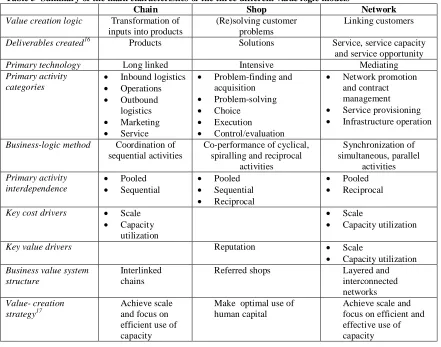
The basic premise of these value logic models is that competitive advantage stems from the unique structural properties of the activity set whereby a particular firm creates value. The main characteristics and differences between these value logic models are summarized in table 514. Next an example for each of the value logic models will be given by looking at the oil and gas industry.
11
http://www.concoursgroup.com/research/completed/project_dbi.asp 12
Fjeldstad, Ø.D., Becerra, M., Narayanan, S., ‘Strategic action in network industries: an empirical analysis of the European mobile phone industry’, Scandinavian journal of Management, nr.20 2004 , page 173-196 13
Table 5 Summary of the main characteristics of the three different value logic models15
Deliverables created16 Products Solutions Service, service capacity
and service opportunity
Primary technology Long linked Intensive Mediating
Primary activity
Key value drivers Reputation • Scale
• Capacity utilization
Stabell, C.B., Fjeldstad, Ø.D.,’Configuring value for competitive advantage: on chains, shops, and networks’, Strategic Management Journal, Vol. 19 1998 pag. 413-437
16
Harris, J.G., Burgman, R.J., ‘Chains, Shops, and Networks: The Logic of Organizational Value’, Research Report Accenture, May 2005
17
2.1.3 Examples of different types of firms in the oil and gas industry
The differences between the different types of firms following different value configuration models will be explored by looking at some examples of firms in the oil and gas industry.
Most firms in downstream activities of oil refining, logistics, sales and marketing are following a value chain configuration. Tosco, which is one of the largest independent oil refiners and marketers of petroleum products in the United States, is one of these firms that follow a value chain configuration. Tosco competes on economies of scale and operational excellence in refining. For the Dutch and European gas market Tosco can be compared with Shell, Exxon Mobile or BP.
This strategy can be compared with feisty newcomers in the US oil industry, such as Union Pacific Resources and Newfield Exploration, which have become major players in new exploration and development of oil and gas fields, primarily by building, acquiring and exploiting specialised technological capabilities. These firms can be classified as following a value shop configuration. This value shop configuration can be seen in the different activities of oil exploration firms (appraising geological data, choosing prospects to drill, drilling and evaluating drilling results) and development firms (appraising a discovery, devising and choosing a development approach, developing a field and evaluating production).
The value network configuration can also be found in this industry in the data companies that have emerged as key players. An example of these firms is QC Data that provides a data-brokering service to oil and gas exploration companies. It stores and maintains drilling and exploration data on its computers and offers access to the data and analytical tools. This saves cost of rediscovering existing data for the exploration companies as well as a richer and more comprehensive base of data for analysis and in return the subscribers to this service receive a fee every time their data is accessed by another QC customer18. For the European market QC Data can be compared with Common Data Access Limited. This is however an non-profit organization owned by its members, but their main activities are the same as QC Data. They reduce the cost of storing and retrieving data for their members by improving efficiency and accessibility to data. They co-ordinate a single source of data from which all parties who have legitimate rights of access can obtain this data either electronically or by conventional means19.
2.1.4 Value configuration and industry structure
The value configuration theory with the three alternative value logic models is important in not only analyzing business logics across firms but also in analysis across industries. Stabell and Fjeldstad argue that industry structure and forces are also different when moving from manufacturing to mediation and problem solving industries. The logic of value creation in an industry can be found in the structure of the industry, meaning that differences in value creation logic are also reflected in differences in industry structure and dynamics. This means that the value configuration logic models can be used for analyzing and describing the structure of relationships between actors in a specific industry and can be used as a tool for determining the position of a company in this industry.
2.1.5 Value configuration and strategic options
Value configuration theory is not only suitable for firm-level and industry analysis of activities, value creation and creating competitive advantage. The theory also suggests that choice of configuration is a major positioning choice for firms20. As stated before choosing for a specific type of value configuration means choosing a specific kind of business model and moving between segments in an industry or even from one industry to another. This also means that one can find firms with different value configurations in a single industry. Choosing a type of value configuration is in fact a generic dimension of strategy beyond choosing between a cost leadership or differentiation strategy. Firms can get stuck in the middle between the different value configurations just as they can get stuck in the
middle if they are not successful when trying to pursue simultaneously cost leadership and differentiation21. The conclusion can be drawn that the three different value configuration models can in fact be seen as alternative strategic positioning options for a firm in an industry.
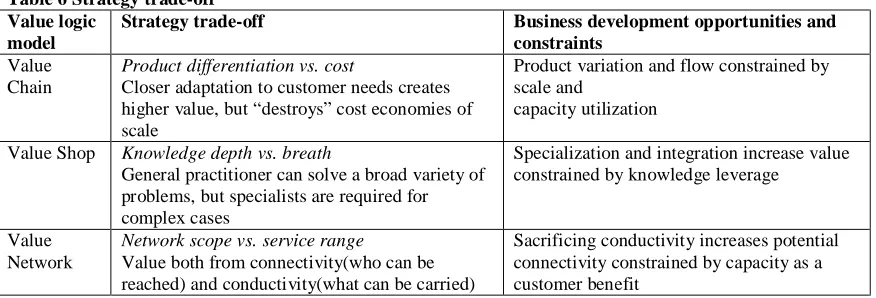
The type of value configuration determines the strategies and business development boundaries and opportunities as will be shown in table 6.
Table 6 Strategy trade-off22 Value logic
model
Strategy trade-off Business development opportunities and
constraints
Value Chain
Product differentiation vs. cost
Closer adaptation to customer needs creates higher value, but “destroys” cost economies of scale
Product variation and flow constrained by scale and
capacity utilization
Value Shop Knowledge depth vs. breath
General practitioner can solve a broad variety of problems, but specialists are required for
2.1.6 The value discipline model vs. value configuration
The Value Discipline model is like the Value configuration analysis a theory about value creation and modelling. They are both models that can be used as frameworks in strategy development23. The difference however is that the value discipline model is about strategic positioning by choosing what kind of value a firm wants to offer their customers, while value configuration is about strategic positioning with an appropriate activity set.
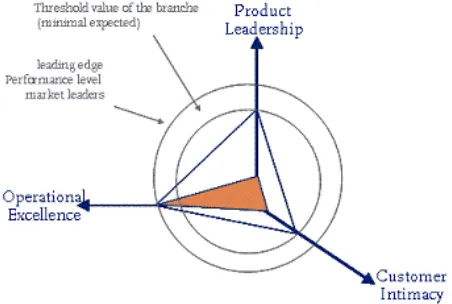
Treacy and Wiersema state in their value discipline model that there can only be one market leader for every customer value type. Companies can build their competitive advantage by focusing on and excelling in only one of three basic values. In addition to having the discipline of maintaining this single focus, a company must at least reach the minimal expected performance in the other two disciplines24.
The idea behind the value discipline is that the choice for one of the three value disciplines determines the structure and type of organization. Every value discipline has its own specific underlying operating model. Operating models are in this theory defined as the whole of operational processes, company and management structures and culture, that all need to be synchronized in order to create superior customer value. This implicates that the hierarchic structures, decision processes, degree of standardization and division of responsibilities differs substantially between the three value disciplines. The operating model can be considered as a guide to an internally successful functional organisation.25
21
Stabell, C., ‘New Models for Value Creation and Competitive Advantage in the Petroleum Industry’, 2001 22
Fjeldstad, Ø., D., ‘Transforming Value Creation: Implications for Business Models and Business Practices’, presentation Norwegian School of Management
23
http://faculty.fuqua.duke.edu/~moorman/GeneralMills/Section2/Section2.htm#MarketBased, May 10th 2006 24
http://www.vea.nl/presentaties/Treacy.doc, May 11th 2006 25
Figure 3 the value disciplines
The three value disciplines are (see figure 3)26: • Operational excellence:
Companies that pursue operational excellence seek to reliably deliver products and services at the lowest possible cost. Their focus is on cutting costs. To be able to operate efficiently a company has to continuously measure performance.
• Product innovation (product leadership):
Companies that pursue product innovation rely on innovation in the pursuit of best-in-class products or services. They focus on the ability to rapidly devise new and enhanced products or services. In order to deliver the best and innovative products or services a company has to be able to operate flexible.
• Customer intimacy:
The primary business model of customer-intimate companies relies on customer insight to address a broad swath of unique customer needs. These companies focus on scope, that is, they tend to deliver complete solutions to any perceived customer need. In order to fulfil customer demands a company should invest in customer relations.
This model looks very similar to Porters three generic market strategies model with cost leadership, differentiation and focus strategies that were developed in line with Porters five forces model for industry analysis. Porters theories however, are developed in coherence with his value chain framework and therefore appropriate for manufacturing firms relying on a long-linked technology. Treacy & Wiersema focus on customer value and how to achieve a value discipline with an underlying operational model, while Porter argues about choosing a market strategy and strategic positioning. However Porter and Treacy & Wiersema both argue that there are in fact two basic choices:
• The first choice is to determine if a company seeks to compete by achieving lower cost than its rivals or with superior products through differentiation.
• The second choice is about in what arena the company seeks competitive advantage, in a broad range of segments or a very narrow range.
The conclusion can be made here that the value configuration theory and the value discipline model are complementary. In the previous paragraph we already noted that choosing a type of value configuration is a generic dimension of strategy beyond choosing between a cost leadership or differentiation strategy.
26
The choice for a cost leadership or differentiation strategy is in fact the same choice as for ‘operational excellence’ or ‘product innovation’ in the value discipline model.
The conclusion is that strategic positioning consists of two steps: • First determining the value configuration model, and
• Next determining what strategy to pursue in this value configuration. The choice for a value discipline is the second step after choosing a value configuration in positioning the company.
2.2 Other analysis instruments and strategy tools
27The value configuration theory with the three value logic models is the main instrument for analysis in this study. But we also use some other theoretical concepts as analytical instruments in answering the different research questions.
Value proposition theory will be used to identify the characteristics of the products and services of Continuon in order to be able to determine the product dimension of the current strategy. Main instruments for identifying the value system at industry level are industry typology and business network pattern analysis.
To be able to anticipate on uncertain future developments, scenarios will be used to deal with this uncertainty. The scenarios will not be developed in this research but scenarios from a scenario study executed by Nuon Asset management for Continuon will be used.
2.3 Summary for the theoretical framework
The value configuration theory provides a systematic basis for analyzing and developing strategy and competitive advantage in all types of firms. A firm can be broken down into value activities where costs and value generated are allocated and estimated, either using the value chain template for manufacturing firms, value network template for mediators, or value shop template for problem solving service firms.
The value configuration theory will be used for the analysis in different sections of this research. As we have seen in the research model, the empirical section of this research project consists of three major sections:
1. Assessing the strength and weaknesses of the current position of Continuon in the gas market 2. Developing strategic alternatives for Continuon with the help of the three value models
suggested by theory (value chain, value shop and value network type of organisation).
3. Assessment of the suitability of the strategic alternatives in the perspective of four possible scenarios for gas market development and given the conditions of a cost effective and reliable gas distribution.
In the first empirical part of this report the results of applying value configuration analysis will be used to identify the current strategic position of Continuon and identify strengths and weaknesses of the company in the gas sector at this moment. To identify the current strategic position and value configuration logic at Continuon the three dimensions of the current strategy (Who, What and How) will be analyzed.
Value configuration analysis will also be used for analysis of the external environment to identify the value system of the gas sector.
In the second section of this research the value logic models in the value configuration theory will be used to identify and develop strategic options for Continuon for positioning the company in the future gas sector.
Strategic options offer opportunities for different strategic positions for Continuon that might better match the future external environment and expectations of stakeholders and provide different options for business development. In the last section of this research project these strategic options will be matched to future scenarios for deciding on the main implications of future developments and each strategic option in the different scenarios.
The resulting theoretical framework for this research project is represented in figure 4.
The macro-environment
Industry
Strategic group
The Organziation
Strategy
analysis Value c
onfigu ration
analysis
Benchmark of the network operators in the Netherlands
Indu stry ty
polo gy
Strat
egic
Posi
tionin
g
Scenario’s Value
propostion
Struc turea
l driv ers of
chan ge
Bu sin
es s n
etw ork p
atte rn an
alysis
3 The current strategic position of Continuon Netbeheer
This Chapter consist of the assessment of the strength and weaknesses of the current position of Continuon Netbeheer in the gas market. The research question for this empirical part was formulated as:
Research Question 1
1. What is the current strategic position of Continuon Netbeheer?
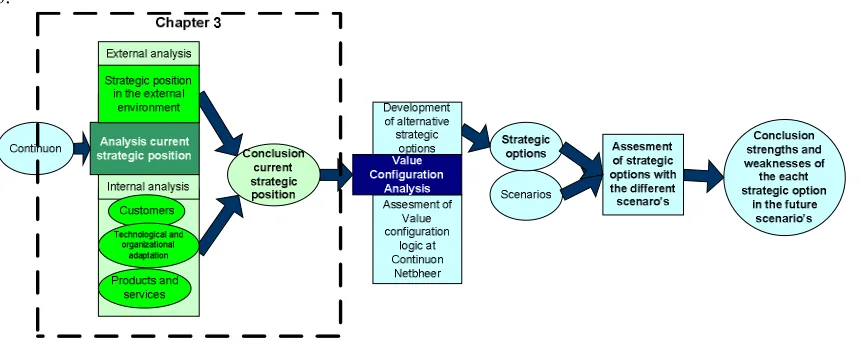
To answer this question the external and internal environment will be analysed to be able to draw a conclusion on the current strategic position of Continuon. This is schematically represented in figure 5.
Figure 5 The research model
In section 3.1 the Continuon company will shortly be introduced with a short history and main characteristics. The next sections and main part of this chapter consists of a description of the current strategic position of Continuon, divided in an external and internal analysis (in sections 3.2 and 3.3 respectively). The external analysis contains a summary of a background study of the external environment28. The relationship and position of Continuon with the main forces will be described. The internal analysis consists of an analysis of the current strategy with the three main dimensions of strategy: customers, products, and the technical and organizational adaptations.
3.1 General overview of Continuon Netbeheer
In this part a general overview and introduction to the company Continuon will be given. 3.1.1. gives an overview of the history of the company, and 3.1.2 contains a description of the main characteristics.
3.1.1 Historical overview of Continuon Netbeheer
Originally Continuon was section of the vertically integrated energy company Nuon. Nuon was founded in 1999, when four different regional integrated energy companies merged together. These four companies were:
• Nuon ( the energy and water company of Gelderland, Friesland and Flevoland • Energie Noord West (the energy company of Noord Holland),
• Energy and water supply Rijnland (energy and water company of Leiden) • GAMOG (the gas company of the east of Gelderland and Flevoland)
Later the GGR (Gasvoorziening Gelders Rivierengebied) also merged into Nuon. The gas distribution activities of this vertically integrated energy company Nuon, could be divided in three main tasks; building assets (contractor), network operations and maintenance and gas supply. The first two tasks
are now main activities for Continuon in the regulated market, while Nuon performs the gas supply activities in a liberalized gas market.
Continuon originated due to the Electricity (1998) and Gas Law (2000). To accommodate the liberalization of the energy market energy companies were forced to split in network controllers, energy suppliers, producers and metering companies. The shares of Continuon are fully owned by Nuon, but Continuon has an independent position as stated in the Energy Law.
3.1.2 Main characteristics
Continuon is the network operator of the gas- and electricity distribution networks in a large part of the Netherlands: Gelderland, Noord-Holland, large parts of Flevoland, Friesland and Zuid-Holland. The main characteristics of the company will be described briefly by looking at the customers, products, organization and technology aspects of the company.
Products and Customers
Continuon provides the connection to the electricity and gas distribution network and the transport of gas and electricity for 2.7 million customers for electricity and 2.1 million customers for gas. Her turnover is over 1 billion Euros per year. The primary function of Continuon is to link customers (gas suppliers, industrial users and households) with each other through the gas distribution infrastructure and to provide the transport of gas from the gas suppliers to the end-users in a safe and reliable way. The same holds for the electricity distribution. To facilitate the transport and connection services, Continuon is also responsible for network operations, construction of new connections and the maintenance of current connections and gas grids.
The customers of Continuon can be divided in the consumer and small business customer market and the business market for gas on the basis of connection capacity.
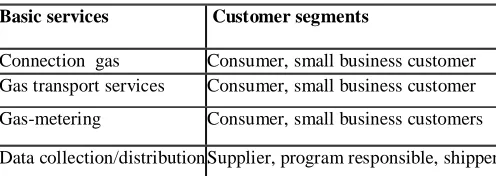
The main gas distribution services that Continuon offers its customers are the connection and transport of gas. However besides these main services Continuon offers more services. These are summarized in the table below.
Table 7 Basic services of Continuon29
Basic services Customer segments
Connection gas Consumer, small business customer
Gas transport services Consumer, small business customer
Gas-metering Consumer, small business customers
Data collection/distribution Supplier, program responsible, shipper
The main focus of Continuon last years has been at the mass market by offering standard services to large customer segments. At this moment Continuon is changing its offerings from not only offering what they are legally obligated to (legal demands) towards adapting their product offering by meeting where possible customer demands.
Organization and Technology
Continuon has been organized as a so-called “small” network controller. This meant that the main tasks of Continuon were selling the transport capacity and managing the distribution network. The operational control and design of the distribution network are outsourced to Nuon Asset Management. The operational tasks (maintenance, inspections etc.) were outsourced to service providers. Due to developments in the external circumstances (the legal separation of the network company and the commercial energy company) Nuon Asset Management has been merged with Continuon.
To facilitate the transport of gas in a large part of the Netherlands Continuon controls over 6,000 km of medium pressure pipes and almost 30,000 km of low pressure pipes in the provinces Noord- en Zuid-Holland, Flevoland, Gelderland en Friesland.
The structure of the gas grids of Continuon is historically determined. In the urban areas the gas grids are ring-shaped and in the more rural areas they are branch-shaped. Because the several regional gas grids of Continuon originated from the former regional gas companies, they differ in their design, pipe materials and operating pressure.
3.2 External analysis for the strategic position
In this section the current strategic position of Continuon will be discussed by looking at the key forces and position in the external environment. This is a short overview of the extensive background study of the analysis of the external environment of Continuon that has been performed for this research30.
Position in the Gas market
Continuon as regional network operator in the Netherlands is only a very small player in the global and European gas markets. This means that they do not have the ability to influence developments in the global gas market and they will have to adapt to these developments. Main threat for the gas distribution services of Continuon is the steadily decreasing demand for gas for domestic heating purposes due to improved insulation and a changing climate. This has not yet had any consequences for network operators, because the number of connections is still steadily rising.
As network operator Continuon is active in gas distribution and this only in a small part of the gas value chain from production to end-use.
At national level however, Continuon is one of the largest gas network operators in the Netherlands with the largest number of gas connections to her gas grids and a market share in number of gas connection of approximately 30%. The market for gas network operations in the Netherlands can be seen as concentrated, because there are only a few very large players that together take up almost 80% of the market. For Continuon this means they have a strong position in market coverage at national level opposed to the other network operators, and the opportunity for economies of scale. They have also been in gas distribution services since the start of the gas industry and therefore their strong position is also based on knowledge, experience and expertise that has been build up over many years.
Regulations
Important for the strategic position of Continuon and their business development opportunities is that the network operators in the Netherlands have to operate in a highly regulated gas market segment. The national and regional gas and electricity network operators are now actors in a monopolized section of the liberalized energy market under governmental supervision by the DTe instead of being section of a vertically integrated energy company in a stable closed national and regional gas market. This means they are restricted in the development of new services and products by what is legally allowed, because a network operator is not allowed to perform commercial activities.
The conclusion can be made that regulations impede on the space for strategic positioning while on the other hand it has led to a stable monopolized position with a low but continuous and secure profit margin.
The introduction of Yardstick regulation means that the profit margin of a network operator is not only determined by their own actions and performance but is also dependent on the performance of the other network operators. For strategic positioning this means that they have to take into account an important main stakeholder, the DTe and the actions and choices of other regional network operators. The regulations that will lead to the unbundling of the energy companies has severe consequences for Continuon. Continuon should separate from the holding Nuon and should independently determine its position in the liberalized gas market as regulated gas network company. At this moment Continuon is not yet separated from Nuon. Compared to the other network operators Continuon is one of the first
that has chosen for a separate positioning from the trading section of the old vertically integrated energy company. Therefore they are better prepared for the legal unbundling process.
Technology
Next reason for the strong market position of Continuon is that they want to have a leading position in innovation and sustainability. This implicates they want to be first mover in the introduction of new technologies in gas distribution operations and gas distribution services. Examples are the introduction of smart metering and self services via the internet. Other important fact is that Continuon is the only network operator in the Netherlands that is exploring ‘intelligent network operations’. It is expected that this combination of gas distribution operations with information exchanges will become important in the future. In gas distribution operations Continuon is striving to become the Dutch and European leader in innovative and sustainable gas grid operations.
3.3 Internal analysis for the strategic position
In this part the current strategic position of Continuon is analyzed by looking at the three dimensions of strategy:
• the customers
• the products and services
• the technological and organization adaptations (The Who, What and How dimensions.)
The mission statement of Continuon is to be a primary supplier of gas and electricity connection- and distribution services and to provide these services for an optimal price/quality ratio considering local circumstances, stakeholder interests and using the opportunities of the Electricity and Gas law. To accomplish this mission they pursue a strategy of ‘Operational excellence’. This strategy originated in the strategic direction of the Nuon holding, that is also directed at ‘Operational excellence’.
3.3.1 The Customers
Due to the geographically determined monopolized position of Continuon, the customers are all the households and businesses with a gas connection in the operational area of Continuon (see figure 6).
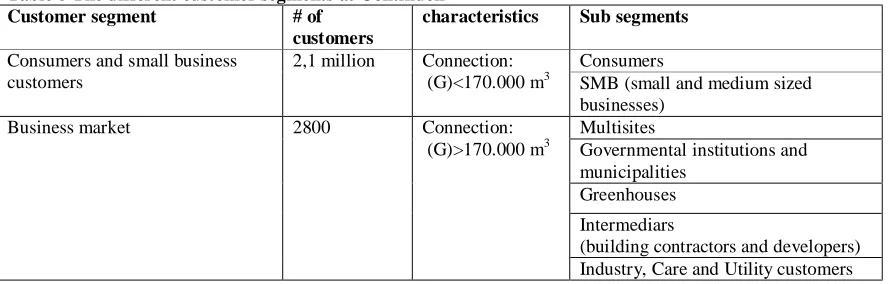
The historically determined customer segmentation of Continuon is based on the capacity of the connection and can be characterized as conventional, thus segmentation in large or small customers. At Continuon a more progressive segmentation has recently been introduced with the development of subgroups for the business market on the basis of homogeneous customer wishes and needs (see table 8).
Business customers and consumers have both growing needs that Continuon wants to meet in the development of new services. The customer demands can better be fulfilled by segmenting the market on the basis of homogeneous customer needs and demands.
Table 8 The different customer segments at Continuon
Customer segment # of
(G)<170.000 m3 SMB (small and medium sized businesses)
The changes in segmentation basis are characteristic for the transition of Continuon from their former position as section of a vertically integrated energy company towards an independent network operator that has its own strategic position in the energy sector. Difficulty in this process however, is that Continuon has not been a customer directed company before and has always been directed at offering standard services to the mass market.
Continuon still focuses on the end-users of the gas as their main customers, while parties like shippers and energy suppliers are not explicitly defined as customers in the market segmentation.
3.3.2 Products and services
The value proposition of the products and services Continuon offers (the offering) is closely linked with the chosen strategy “Operational excellence” This means that the offering should differentiate from other companies offerings on the following product characteristics:
• time • quality • selection • price31
Main promises in the market offering of Continuon are a consistent continuous gas flow with low interruption rates, reliable supply of gas and low costs.
The gas transport and connection services
The current offering of Continuon will be analyzed by identifying the elements of this offering and asses the flexibility of these offering elements (advice, product, service, logistics, adap