168 as well as premature fracture of brace member.
Seismic loads are resisted by the main component of SCBF which is the braces. Brace configuration
includes: diagonal bracing, single story X-bracing.
4. FINITE ELEMENT MODEL
While performing seismic analysis of structures, if inelastic structural behaviour is taken into account then the numerical modeling of structure needs to be done by considering the inelastic behaviour of structural components. Structures can be idealized through line members (beams, columns and braces) which are connected by nodes.
Typical Finite Element analysis on any software requires the below data:
i. Geometry or Spatial locations of Nodal points ii. Elements connecting the nodal points iii. Mass properties of members iv. Material and section properties v. Conditions of boundary or restraints vi. Details of loading or forcing function vii. Analysis options
5. OPENSEES NUMERICAL MODELLING
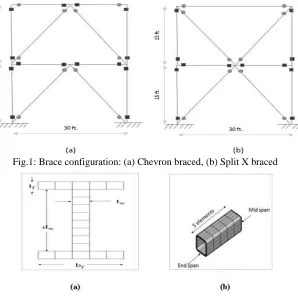
The geometry configuration of the SCBF building used for this study is as shown in Fig.1. Story height for the building is 15 feet and width of bay is 30 feet.
Two approaches in OpenSEES for modeling the elements (Beams, columns and braces) using physical theory model are:
i. Distributed Plasticity - Plasticity spread along the element.
ii. Lumped Plasticity - Plasticity concentrated at the ends over a specified length and interior of element behaves elastic.
In this paper, first method is adopted. Formulation of a fiber model as shown in Fig 2 is done by dividing the structure into discrete number of elements (beams, Columns). Further, these elements are discretized into number of sections. Sections divided into number of Fibers. Based on plane section assumption, fiber strains are then used to determine the section deformations.
Fig.1: Brace configuration: (a) Chevron braced, (b) Split X braced
169 In OpenSEES, distribution of plasticity for fiber
formulation models is done by numerical integrations through the member cross sections and along the member length. Each flange and the web of the W-sections were divided into 8X5 fibers as shown in
Figure.2 (a). More number of fibers were provided in the expected direction of bending in plane of the frame. Brace of the SCBF was divided into 10 elements each. Each region of the square HSS section were divided into 10x10 fibers as shown in Figure.2 (b). Initial imperfection of 0.1% was provided in braces to account for the brace buckling (global buckling). Minimum of 4 Numerical integration points were considered for columns and beams of Split-X and Chevron braced SCBF. Gauss-Lobatto (quadrature integration) is used for the integration along the element. Beams, columns, braces and gusset plates of all types of models were modelled using the command Steel02 Material in OpenSEES. In order to capture the steel behavior in nonlinear region, strain hardening ratio of 3% was assumed. Material
properties for the column, beam and gusset plate members are having minimum yield strength of 55ksi (379 MPa) and HSS braces of 60 ksi (413MPa). Member size used in the models for the first story are beams of W27X84 section, columns of W14X176
section, and HSS brace of HSS10X10X5/8 section. Similarly, for second story beams of W18X46 section, columns of W14X176 section, and HSS brace of HSS8X8X1/2 section.
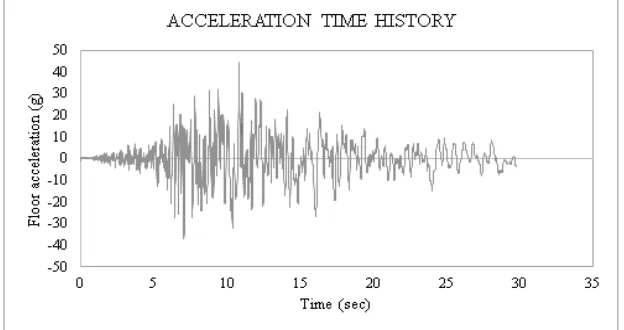
Earthquake ground motion used for this study will be referred as ‘Superstition Hills’ ground motion, which is Imperial Valley Earthquake, occurred in Imperial County, California, USA in 1987 and was recorded at station Wildlife Liquefaction array taken from PEER database. Acceleration-Time history for the Superstition Hills Earthquake was obtained as shown in Fig 3.
Fig. 3. Acceleration Time History for Superstition Hills ground motion
170 Fig. 5. Pushover curve for SCBF bracing configuration
Fig. 6. Time Period comparison for 2 story SCBF