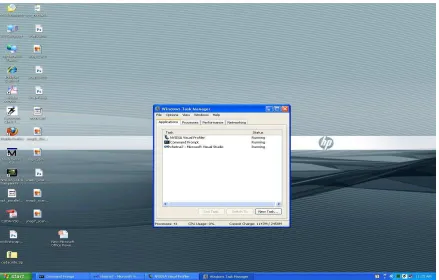
80 Fig. 1. A snapshot of the Project containing the proposed Data Matrix Application
namely Chetna7 running in Visual Studio 2010 with CUDA and NVIDIA Visual Profiler running in the Task Manager
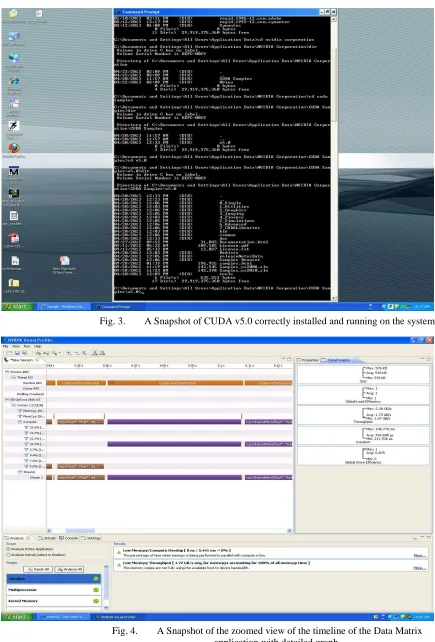
81 Fig. 3. A Snapshot of CUDA v5.0 correctly installed and running on the system
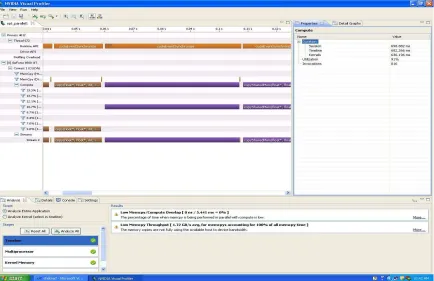
82 Fig. 5.A Snapshot of the Data Matrix application with its associated properties View
4. CONCLUSIONS AND LIMITATIONS
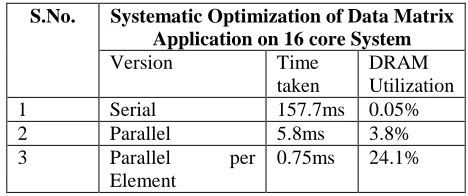
If the optimizing strategies are applied in a systematic manner and analysis and monitoring of bottlenecks is carried out at each stage, the performance of applications on the present multi-core systems may be enhanced by a significant level. It was a small enhancement across various stages for the heterogeneous system under consideration with 16 cores; this enhancement may be quite higher on systems with 32 cores or even higher on many core tiled processors. The limitation of the proposed work is that the results may vary from one computing platform to another and one application to another.
REFERENCES
[1] Guillem, Pratx and Lei Xing, “GPU computing in medical physics: A Review,” Medicine Physics, 38 (5), 2685-2697 (2011).
[2] John D. Owens, Mike Houston, David Luebke, Simon Green, John E. Stone, and James C. Phillips, “GPU Computing,” In Proceedings of the IEEE, Vol.26, no. 5, pp. 879-899,May 2008. [3] Michael D. Mc Cool, “Scalable Programming
Models for Massively Multi-core processor,” In
[4] Proceedings of the IEEE, Vol.96, no. 5, pp. 816-831, May 2008.
[5] Nvidia,"CUDA".http://www.nvidia.
com/objectlcuda_home_new.html, Mar. 24, 2012. [6] Rui Yang, Johnson Thomas,”Processing Dependent Tasks on a Heterogeneous GPU Resource Architecture,” In 2nd IEEE International Conference on Parallel, Distributed and Grid Computing,” pp. 627-632, 2012. [7] Chuntao Hong, Dehao Chen, Wenguang Chen,
Weimin Zheng, Haibo Lin, "MapCG: writing parallel program portable between CPU and GPU", Proceedings of the 19th international conference on Parallel architectures and compilation techniques, September 11-15, 20 I 0, Vienna, Austria.