ReferenceAnnotation
SemanticAnnotation
hieratical enough. For example, many part-of-speech taggers can perform tokenization at the same time. Then a type of token with a part-of-speech field (POSToken) can be the output capability type of a part-of-speech tagger. This POSToken type can also be used to represent the output capability type of simple tokenizers. However, using POSToken as the output capability for both part-of-speech taggers and simple tokenizers makes it impossible to distinguish the differences of these two types of tools. Therefore, we need to define a Token type as a parent type of the POSToken type without the part-of-speech field.
Another usage of the type system is to retain the
uniqueness of the data. If there is already a finite set of well defined tags, including these tags as UIMA types will retain the uniqueness. For example, the Penn Treebank tagset is such a well defined tagset, while there are potential ambiguities when a tag is represented as a string value (e.g. upper/lower cases).
These criterions are not enough to determine which concept should be defined as a type. Ontology based entities are frequently seen in the named entity recognition, but mapping all of the potential ontology entities to the type system is not a realistic solution because the number of the entities is essentially infinite and the ontology itself tends to be updated version to
SemanticClassAnnotation <FSArray:LinkedAnnotationSet>
NamedEntity EventAnnotation
CellType
CellLine DNA GeneOrGeneProduct RNA
Proper
Name
Title
Place Protein Gene
Person
ProteinRegion DNARegion
LinkingAnnotationSet <ExternalReference> <FSArray:SemanticAnnotation>
CoreferenceAnnotation DiscourseEntity
Expression
Negation TOP
NormalizedEntity
Speculation
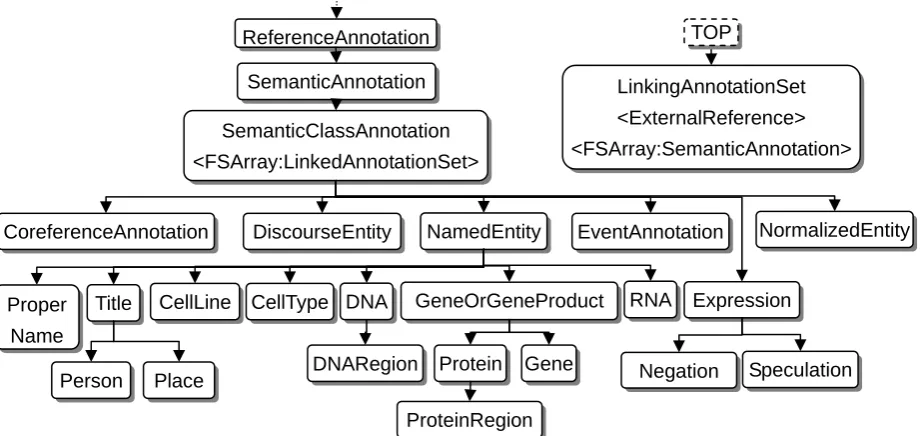
Figure 2. Semantic types in the U-Compare type system.
DocumentClassAnnotation <FSArray:DocumentAttribute>
<FSArray:ReferenceAnnotation>
DocumentAttribute <ExternalReference> DocumentAnnotation
DocumentReferenceAttribute <ReferenceAnnotation>
DocumentValueAttribute
<String>value ReferenceAnnotation
TOP
Structure Text Fragment
Figure 3. Document types in the U-Compare type system.
Abstract Article Appendix Section TextBody Heading Keyword Affiliation Authors
Paragraph AbstractText Title Caption
version. In such cases, our criterion whether to define a concept as a type or not is based on the actual use cases of the resources. For example, Protein, DNA, RNA, CellLine, and CellTypes are defined as types because these types are used in the JNPBA shared task evaluation (Kim, et al., 2004).
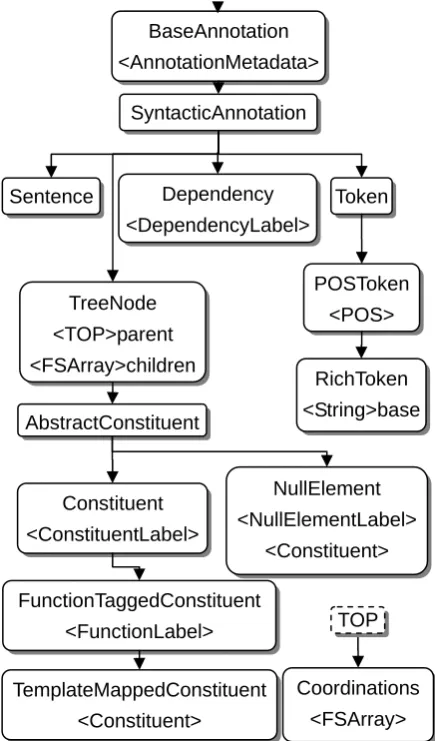
Based on these criterions, we have designed the U-Compare type system which covers syntactic (Figure 1), semantic (Figure 2), and document related concepts (Figure 3).
4.
U-Compare Component Repository
We have been collecting and providing world famous language resources as UIMA components, the U-Compare component repository. U-Compare UIMA components are not just UIMA compliant, but fully compatible with the U-Compare type system. Since some components are originally developed in another type system, we made a type system converter to make it compatible in such a case. Due to this higher level of the interoperability, users only need to be aware of the input and output data types of each component when connecting resources to a workflow.
U-Compare covers broad range of language resources, including annotated corpora, sentence detectors, tokenizers, part-of-speech taggers, dependency parsers, syntactic parsers, named entity taggers, named entity normalizers, relation extractors, etc.
Table 1 shows the current list of the public available language resources. Some of the resources are provided as web services hosted worldwide. Users can mix local and web services transparently when creating their workflows.
5.
U-Compare Integrated Platform
U-Compare provides an integrated natural language processing/text mining platform for any UIMA component, which supports users’ development cycle:
(including evaluation, comparison and visualizations). We provide an easy Graphical User Interface (GUI) based system for such tasks but the command-line based way is also available.
5.1 Launcher Systems
The U-Compare integrated platform, both GUI based and command-line version, can be launched with a single click or a single line of a command, using our UCLoader launcher system. UCLoader only requires Java 6 in the machine, installation and updates (if any) are automatic via Internet. Once launched, offline execution is also available.
5.2 Workflow Creation GUI
The workflow creation GUI consists of two panes, the component library pane and the workflow pane. Users can register any UIMA component into the library while there are many U-Compare components ready to use. With a simple drag and drop motion from the library pane, users can create any workflow easily. Created workflow is a UIMA CPE (Collection Processing Engine) workflow which is still completely compliant to UIMA.
5.3 Combinatorial Comparison
Comparison between components and evaluation with the gold standard data are normally the key process of the NLP/TM development. U-Compare supports these tasks in a very simple manner; when creating a workflow, just to specify which components to compare and which corpus to use for the evaluation. This function is currently available only in U-Compare among many academic UIMA based systems,
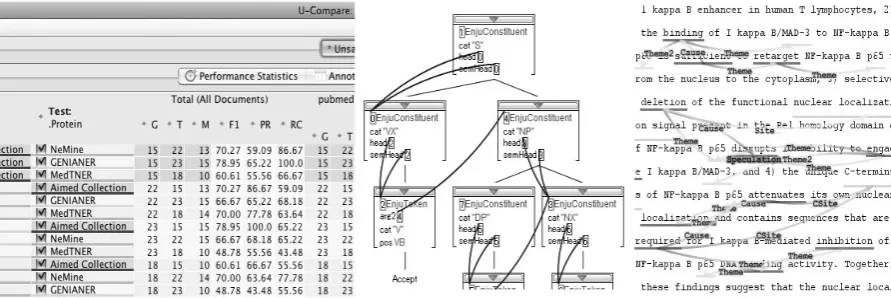
Further, U-Compare has an automatic combinatorial comparison system. An NLP/TM workflow tends to consist of a serial pipeline of components, where some of the components could be replaced with similar other components (e.g. a part-of-speech tagger could be replaced with another part-of-speech tagger). If the user specifies such candidate components in the workflow, Figure 4.Screenshots of a) U-Compare Statistics Viewer showing comparison between AImed corpus and three NERs, b)
U-Compare automatically calculates possible combinations of the components and compares the generated combination workflows.
5.4 Pluggable Evaluation System
Comparison and evaluation need evaluation metrics how to compare the generated annotations. U-Compare provides basic evaluation metrics, but users can plug their own evaluation metrics as a UIMA component (Kano, et al., 2009). Using the evaluation metrics is also very simple without any programming effort.
5.5 Statistics and Evaluation
Based on such comparison and evaluation results, U-Compare shows statistics and instance based visualizations (Figure 1). Most of the TM/NLP researches only show the direct evaluation of the tool. However, it is often discussed how much the scores are improved versus the baseline, then not just the evaluation score between the gold standard data but also the differences between the tool and baseline could be useful. U-Compare shows such statistics as well.
Visualization is another key feature to improve the TM/NLP development process, together with the interoperability and utility features. U-Compare provides a couple of visualization tools specialized on the characteristics of the language resource data structures.
5.6 Command-Line Mode
Although the GUI based system described above is useful and decrease the human works, there are certain requirements from the users to access the resources without GUIs. For example, a user might wish to use their
headless server. U-Compare provides a command-line launcher which launches a specified workflow.
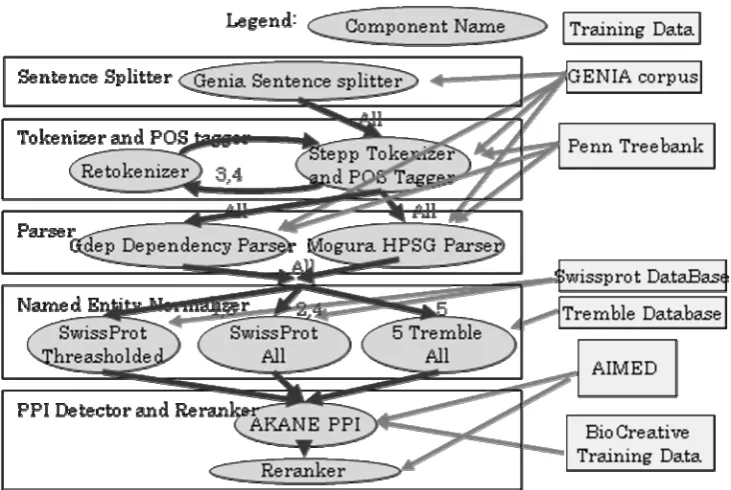
Figure 5. Workflow diagram of the BioCreative II.5 challenge. We provided five workflows sharing some components, ”All”, “3,4”, “5”, etc. means which workflow used which component.
Since U-Compare components are UIMA compliant, it is also very easy to embed these components into existing UIMA workflows or UIMA based systems. The only issue is the type system compatibility.
The UIMA framework is provided both in pure Java and C++, it is straightforward to call a UIMA/U-Compare workflow in a normal Java/C++ applications, using the official UIMA APIs.
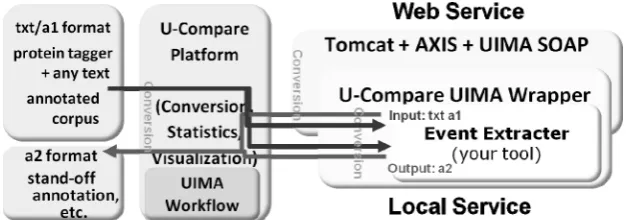
Further, U-Compare provides a simple stand-off format I/O via the standard input/output streams. Developers using scripting languages can easily wrap their tools to be UIM A compliant.
5.7 Remote Deployments
NLP components are sometimes very heavy, consuming large computational resources. Such a heavy component tends to occupy large amount of the process time in a workflow (e.g. a syntactic parser tends to be a heavier process). Due to the independency between documents processed in most of the TM/NLP workflows, we can increase the total performance by making the heaviest component parallelized, processing many documents at the same time. We have developed an automatic cluster deployment system which parallelizes any UIMA component to the cluster system, as a whole pretends like a single very fast component via a load-balancing gateway machine.
Kabiljo, R., Clegg, A.B. and Shepherd, A.J. (2009) A realistic assessment of methods for extracting gene/protein interactions from free text, BMC Bioinformatics, 10, 233.
Kano, Y., Baumgartner, W.A., McCrohon, L., Ananiadou, S., Cohen, K.B., Hunter, L. and Tsujii, J. (2009) U-Compare: share and compare text mining tools with UIMA, Bioinformatics, 25, 1997-1998.
Kano, Y., McCrohon, L., Ananiadou, S. and Tsujii, J. (2009) Integrated NLP Evaluation System for Pluggable Evaluation Metrics with Extensive Interoperable Toolkit, In Proceedings of Software engineering, testing, and quality assurance for natural language processing workshop (SETQA-NLP), NAACL-HLT, 22-30.
Kano, Y., Nguyen, N., Sætre, R., Yoshida, K., Miyao, Y., Tsuruoka, Y., Matsubayashi, Y., Ananiadou, S. and Tsujii, J. (2008a) Filling the gaps between tools and users: a tool comparator, using protein-protein interaction as an example, In Proceedings of Pacific Symposium on Biocomputing (PSB), 13, 616-627. Kim, J.D., Ohta, T., Pyysalo, S., Kano, Y. and Tsujii, J.
(2009) Overview of BioNLP'09 Shared Task on Event Extraction, In Proceedings of BioNLP 2009 Workshop Companion Volume for Shared Task, 1-9.
Kim, J.D., Ohta, T., Tsuruoka, Y., Tateisi, Y. and Collier, N. (2004) Introduction to the Bio-Entity Recognition Task at JNLPBA, In Proceedings of International Workshop on Natural Language Processing in Biomedicine and its Applications (JNLPBA-04), 70--75.