Information Retrieval of Word Form Variants
in Spoken Language Corpora Using Generalized Edit Distance
Siim Orasmaa
1, Reina Käärik
1, Jaak Vilo
1, Tiit Hennoste
2 1Institute of Computer Science, University of Tartu, Estonia
2
Institute of Estonian and General Linguistics, University of Tartu, Estonia J. Liivi Str 2, 50409 Tartu, Estonia
E-mail: {siim.orasmaa; reinak; jaak.vilo; tiit.hennoste}@ut.ee
Abstract
An important feature of spoken language corpora is existence of different spelling variants of words in transcription. So there is an important problem for linguist who works with large spoken corpora: how to find all variants of the word without annotating them manually? Our work describes a search engine that enables finding different spelling variants (true positives) from corpus of spoken language, and reduces efficiently the amount of false positives returned during the search. Our search engine uses a generalized variant of the edit distance algorithm that allows defining text-specific string to string transformations in addition to the default edit operations defined in edit distance. We have extended our algorithm with capability to block transformations in specific substrings of search words. User can mark certain regions (blocked regions) of the search word where edit operations are not allowed. Our material comes from the Corpus of Spoken Estonian of the University of Tartu which consists of about 2000 dialogues and texts, about 1.4 million running text units in total.
1.
Problem
An important feature of spoken language is existence of several different pronunciation variants of words. The variants are transcribed with different spelling variants in the corpus. So there is an important problem for linguist who works with large spoken corpora: how to find all variants of the word from transcribed corpus?
Many search engines will return only exact matches for the input search word. From linguist's point of view, such engine is not feasible, because it would demand from user to predict all the possible spelling variants and enter them one by one.
Alternatively, one could use approximate search algorithms such as Levenshtein distance to allow variations from the given input word. However, when using the Levenshtein distance, one must frequently browse through large amount of false positive results in order to find the few relevant variants.
We have developed a search engine which solves the problem using a generalized variant of the edit distance algorithm that allows defining text-specific string to string transformations in addition to the default edit operations defined in edit distance. We have extended the algorithm with blocking capabilities: user can mark certain regions of the search word where edit operations are not allowed. A technique similar to our generalized edit distance has been used by Lindén (Lindén, 2006) for finding cross-lingual spelling variants of technical terms. A concept of blocking changes in certain regions of the search string has been used for example in Unix tool agrep (Wu & Manber, 1992).
However, to our best knowledge, there has not been made a tool that combines these two techniques, and there is no tool for searching word variants of spoken language where variability is very complicated and frequently unpredictable.
2.
Corpus of Spoken Estonian of the
University of Tartu
Our material comes from the Corpus of Spoken Estonian of the University of Tartu (Hennoste et al, 2008). The corpus includes mainly audio recordings and consists of about 2000 dialogues and texts which makes about 1.4 million running text units (words, fillers, pauses) in total. The corpus is divided by five dimensions that influence the language use:
- social and dialectical background of interactants; - dialogue vs monologue;
- the degree of spontaneity of speech;
- the closeness of contact between participants (face-to-face, telephone, mass-media);
- the degree of institutionality of communicative situation (private/institutional).
The corpus is divided as follows at the moment:
- telephone conversations (63% of texts): private and institutional calls (directory inquiries, travel agency information requests, services etc.), telesales conversations, shopping information, taxi calls etc; - face-to-face conversations (29%): everyday and institutional dialogues or monologues: shop dialogues, service dialogues (post office, library, shoemaker, etc.), conversations between strangers on the streets, doctor-patient encounters, interviews, travel agency dialogues, classroom interactions, meetings, conference presentations, lectures etc;
- media broadcasts (8%).
The transcription system of the conversational analysis (CA) is used which means that the categories crucial from the interactional point of view are important in the transcription (Hennoste, 2000b).
’then’), halloo (hallo ’hello’), onju (on ju ’isn’t it’),
kaeksada (kaheksasada ’eight hundred’) There are special
spelling rules for dialogue particles which are used in written texts only in special cases (e.g. ahah (English ’oh’), ee, õõ (pause fillers).
Estonian has a complicated system of quantity patterns. What is important here is the fact that there are three stresses or ‘quantity degrees’ in Estonian. Short vowels and consonants are transcribed with one vowel or consonant, long and overlong ones with two vowels or consonants here. The exception is transcription of stops. Short stops are written with g, b, d, long ones with k, p, t, and overlong stops with kk, pp, tt.
3.
Spelling Variants in the Corpus of
Spoken Estonian
In the corpus we can find at least 5% of running words which have different types of variants dividable into four groups (Hennoste, 2000a).
1. Missing of some sound or syllable in different positions of the word (mõtlesin > mõtsin ’I thought’). Special case here is missing of laryngeal h at the beginning of the first or second syllable of the word (kaheksa > kaeksa ’eight’,
helistama > elistama ’to call’).
2. Changing diphthong with single vowel (päev > pääv ’day’) or consonant cluster with long or short single consonant (seljast > sellast ’from back’).
3. Changing a vowel with some acoustically higher or lower vowel (üheksa > öheksa ’nine’).
4. Replacing of a (over)long vowel or consonant with short one (kuule > kule ’hear!’) or a shorter consonant with longer one (allkirja > alkkirja ’signature’).
As variation takes place in different vowels and consonants, the number of different variants in corpus is
very high and adding new words to the corpus can bring new variants in.
4.
The Generalized Edit Distance
There are two criteria for the search engine: it must find automatically all variants of an input word (true positives) and it must give as little as possible wrong words (false positives).
The regular edit distance (Levenshtein distance) satisfies the first criterion as all the relevant word variants can be reached with combining the three edit operations (replacing, deleting or adding an arbitrary letter). However, arbitrary transformations often produce a large number of results and time-consuming work is still required to find the few relevant variants amongst them. The generalized edit distance allows addressing problems with the second criterion. It allows user to define, which differences or variations from given search string are important and frequent and hence more permissible in the matching. When defining these variations (string to string transformations), we can use our knowledge about known variation of sounds, which was previously acquired through the analysis of text and conversation corpora. The permissible transformations can be composed manually or even generated automatically in some cases. In manual design we can use our prior knowledge about types and frequency of different spelling variants. The weights of transformations can be assigned by search engine designer, for example using some default values. In the case of transparent and open user interface, users can be allowed to change the predefined transformations or their weights, making some experimental queries on the corpus
Consonants Vowels
t > d (0.02) j > jj (0.04) oo > o (0.02) d > t (0.02) jj > j (0.04) aa > a (0.02) t > tt (0.04) l > ll (0.02) ee > e (0.02) tt > t (0.04) ll > l (0.02) ii > i (0.02) b > p (0.02) m > mm (0.02) uu > u (0.02) p > b (0.02) mm > m (0.04) üü > ü (0.02) p > pp (0.02) h > hh (0.02) õõ > õ (0.02) pp > p (0.04) h > (0.10) öö > ö (0.02) k > g (0.02) nn > n (0.04)
g > k (0.04) n > nn (0.04) k > kk (0.02) rr > r (0.04) kk > k (0.02) r > rr (0.04) s > ss (0.02) v > vv (0.04) ss > s (0.04) vv > v (0.04)
In current implementation we have manually compiled a set of transformations and their weights using the following guidelines.
1. By default, the operation of replacing, deleting or adding an arbitrary letter in the search string has predefined cost of 1.0 (as it is normally defined in the edit distance). If we want that our transformation gets used during the search, its weight must be lower than the sum of weights of the default edit operations, applied to perform the same string to string transformation. If generalized edit distance between the search string and a match is greater than 1.0, it should indicate that at least one of the regular edit operations was used during the search (so, the match contains at least one error).
2. The transformations are applied in parallel, that is to say, when a substring has already been changed by a transformation, it cannot be changed once again. For example, the transformation aa→a cannot be recursively applied as a substitute for the transformation aaaa→a. Our tests on the Corpus of Spoken Estonian have shown that the best results are obtained if we only use transformations of long and overlong sounds to short ones
and shorter consonants to longer ones. The only exception is transformations of h. Overall we have currently defined 37 transformations, which have predefined weights in range 0.02 to 0.1.
5.
Example of Using Generalized Edit
Distance
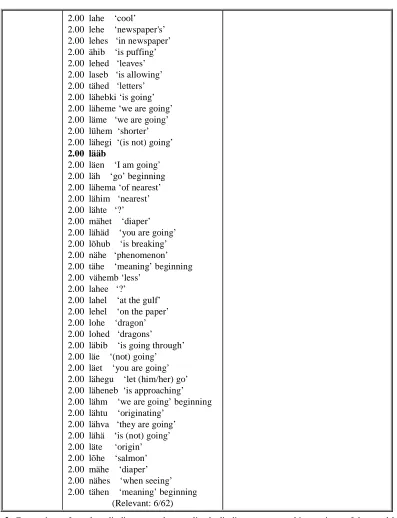
Consider finding all the variants of the word läheb (‘he/she goes’) from the corpus (Table 2). There are 6 variants of the verb currently in corpus: läheb, lähep,
läeb, lähäp, lääb, läb. When we are using the Levenshtein
distance-based search, we must allow at least 2 edit operations to get all 6 variants, which gives us overall 62 words as a result. When using the generalized edit distance with transformations given Table 1, we can lower the maximum distance to 1.5, which gives us 18 words as a result, including all the relevant variants of the verb. Our example shows that using generalized edit distance gives those relevant answers with fewer false positives than if using standard edit distance (12 vs 56 false positives respectively).
Distance limitation
Edit distance Generalized edit distance
d < 1.0 0.00 läheb
(Relevant: 1/1)
0.00 läheb 0.02 lähep 0.10 läeb
(Relevant: 3/3)
d <= 1.0 1.00 lähe ‘(not) going’ 1.00 lähen ‘I am going’ 1.00 lähed ‘you are going’
1.00 läeb 1.00 lähep 1.00 lähäb
1.00 täheb ‘means’ 1.00 Lähe ‘(not) going’ 1.00 lähem ‘nearer’
(Relevant: 4/10)
1.00 lähe ‘(not) going’ 1.00 lähen ‘I am going’ 1.00 lähed ‘you are going’
1.00 lähäb
1.00 täheb ‘means’ 1.00 Lähe ‘(not) going’ 1.00 lähem ‘nearer’
(Relevant: 4/10)
d <= 1.5 1.10 loeb ‘he/she reads’
1.10 läb
1.10 näeb ‘he/she sees’
1.10 lääb
1.10 läen ‘I am going’ 1.10 läe ‘(not) going’ 1.10 läet ‘you are going’ 1.12 läp ‘laptop’
(Relevant: 6/18)
d <= 2.0 2.00 lähme ‘we are going’ 2.00 vähe ‘less’
2.00 lähete ‘you are going’ 2.00 loeb ‘you are reading’ 2.00 vähem ‘lesser’
2.00 läb
2.00 lahe ‘cool’ 2.00 lehe ‘newspaper's’ 2.00 lehes ‘in newspaper’ 2.00 ähib ‘is puffing’ 2.00 lehed ‘leaves’ 2.00 laseb ‘is allowing’ 2.00 tähed ‘letters’ 2.00 lähebki ‘is going’ 2.00 läheme ‘we are going’ 2.00 läme ‘we are going’ 2.00 lühem ‘shorter’ 2.00 lähegi ‘(is not) going’
2.00 lääb
2.00 läen ‘I am going’ 2.00 läh ‘go’ beginning 2.00 lähema ‘of nearest’ 2.00 lähim ‘nearest’ 2.00 lähte ‘?’ 2.00 mähet ‘diaper’ 2.00 lähäd ‘you are going’ 2.00 lõhub ‘is breaking’ 2.00 nähe ‘phenomenon’ 2.00 tähe ‘meaning’ beginning 2.00 vähemb ‘less’
2.00 lahee ‘?’
2.00 lahel ‘at the gulf’ 2.00 lehel ‘on the paper’ 2.00 lohe ‘dragon’ 2.00 lohed ‘dragons’ 2.00 läbib ‘is going through’ 2.00 läe ‘(not) going’ 2.00 läet ‘you are going’ 2.00 lähegu ‘let (him/her) go’ 2.00 läheneb ‘is approaching’ 2.00 lähm ‘we are going’ beginning 2.00 lähtu ‘originating’
2.00 lähva ‘they are going’ 2.00 lähä ‘is (not) going’ 2.00 läte ‘origin’ 2.00 lõhe ‘salmon’ 2.00 mähe ‘diaper’ 2.00 nähes ‘when seeing’ 2.00 tähen ‘meaning’ beginning
(Relevant: 6/62)
Table 2: Comparison of regular edit distance and generalized edit distance on searching variants of the word läheb.
The relevant results are marked with bold. The decimals preceding words in table show the distance between a word and the search string.
6.
Blocked Regions in Search Word
When the maximum edit distance is increased, the number of results that needs to be examined also typically increases. Allowing the regular edit operations to occur at arbitrary locations in search string introduces many transformations that are not probable variations in real language (e.g. in Table 2 only 6 of 62 word variants returned by edit distance were relevant).
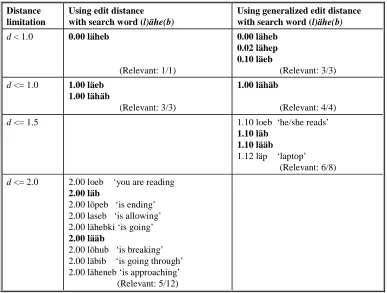
In order to address this problem, we extend our algorithm with capability to block transformations in specific substrings of search string/word (we call these substrings
blocked regions).
Distance limitation
Using edit distance with search word (l)ähe(b)
Using generalized edit distance with search word (l)ähe(b)
d < 1.0 0.00 läheb
(Relevant: 1/1)
0.00 läheb 0.02 lähep 0.10 läeb
(Relevant: 3/3)
d <= 1.0 1.00 läeb 1.00 lähäb
(Relevant: 3/3)
1.00 lähäb
(Relevant: 4/4)
d <= 1.5 1.10 loeb ‘he/she reads’
1.10 läb 1.10 lääb
1.12 läp ‘laptop’ (Relevant: 6/8)
d <= 2.0 2.00 loeb ‘you are reading
2.00 läb
2.00 lõpeb ‘is ending’ 2.00 laseb ‘is allowing’ 2.00 lähebki ‘is going’
2.00 lääb
2.00 lõhub ‘is breaking’ 2.00 läbib ‘is going through’ 2.00 läheneb ‘is approaching’
(Relevant: 5/12)
Table 3: Comparison of edit distance and generalized edit distance when using (l)ähe(b) as search string.
Parentheses in search string mark the blocked regions where edit distance operations are not allowed. The relevant results are marked with bold. The decimals preceding words in table show the distance
between a word and the search string.
10.
Conclusion
In this work, we have introduced a search engine which allows retrieval of word variants from a spoken language corpus, and reduces efficiently the amount of false positives returned during the search. We have developed a generalized variant of the edit distance algorithm that allows defining text-specific string to string transformations in addition to the default edit operations defined in edit distance. The algorithm is also extended with blocking capabilities: user can mark certain regions of the search word where edit operations are not allowed. Our tests on the Corpus of Spoken Estonian of the University of Tartu have shown that the best results are obtained if we only use transformations of long and overlong sounds to short ones and shorter consonants to longer ones. The only exception is transformations of h. Blocking applied at the first and at the last letter of a search word has also shown promising results, however, this approach still requires further research.
11.
Perspective and Future Work
Our future research will focus on extending the set of generalized edit distance transformations, for example, allowing transformations of raising or lowering of vowels. The method of combining the generalized edit distance
with blocked regions also needs further analysis in order to find more general cases when blocking can be safely applied.
Our search engine can be adapted to the other languages and to different varieties of a language (e.g. old standards which have typically different spelling, old rural dialects etc). In addition, it can be used to perform searches from dictionaries by presumed pronunciation rather than exact spelling. In that case the transcription of the pronunciation or pronunciation-spelling information can be used. For other alphabets, e.g. Cyrillic, this can be of great help allowing efficient searches using flexible spellings in Latin alphabets, for example.
We have also experimented with automatic methods for generating text transformations and weights with a rather good success.
Acknowledgements
References
Aho, A., Corasick M.J. (1975). Efficient string matching: An aid to bibliographic search. Communications of the
ACM, 18 (6), pp. 333–340.
doi:10.1145/360825.360855.
Hennoste, T. (2000a). Introduction to Spoken Estonian III.
Akadeemia, 7, pp.1553--1582. (in Estonian)
Hennoste, T. (2000b). Studying Spoken Estonian: transcription, background, and corpus. Keel ja
Kirjandus, 2, pp. 91--106. (in Estonian)
Hennoste, T., Gerassimenko, O., Kasterpalu, R., Koit, M., Rääbis, A., Strandson, K. (2008). From Human Communication to Intelligent User Interfaces: Corpora of Spoken Estonian. Proceedings of the Sixth
International Language Resources and Evaluation (LREC'08), 2008, European Language Resources
Association (ELRA), Marrakech, Morocco, May, 28-30. http://www.lrec-conf.org/proceedings/lrec2008/ Käärik, R. (2006). Generalized edit distance. BSc thesis.
University of Tartu. (in Estonian with English summary)
http://www.egeeninc.com/u/vilo/edu/Students/Reina_K aarik/Bakalaureuset88.pdf
Lindén, K. (2006). Multilingual modeling of cross-lingual spelling variants, Information Retrieval, 9(3), pp. 295--310.