Annotations for Opinion Mining Evaluation
in the Industrial Context of the DOXA project
Patrick Paroubek
1, Alexander Pak
1, Djamel Mostefa
21LIMSI-CNRS, BP 133
91403 Orsay cedex, France
{alexpak,pap}@limsi.fr
2Evaluation and Language resources Distribution Agency (ELDA)
55-57 rue Brillat-Savarin, 75013 Paris, France [email protected]
Abstract
After presenting opinion and sentiment analysis state of the art and the DOXA project, we review the few evaluation campaigns that have dealt in the past with opinion mining. Then we present the two level opinion and sentiment model that we will use for evaluation in the DOXA project and the annotation interface we use for hand annotating a reference corpus. We then present the corpus which will be used on DOXA and report on the hand-annotation task on a corpus of comments on video games and the solution adopted to obtain a sufficient level of inter-annotator agreement.
1.
Introduction
Along with an interest for incorporating emotions in tech-nological devices, the recent years have seen the emer-gence of automatic opinion and sentiment analysis methods (B.Pang and L.Lee, 2008) particularly in the image man-agement and survey business. Opinions are carried over various media, the press, web sites, radio, television etc. They are a spontaneous source of information, which is up-dated daily and provides the means to draw quickly an im-age of the perception that the public entertain with respect to some service, product or major actor of the entertainment or political scene. Survey and analysis of these information sources provide a company with a better knowledge of its customers. They give the means to anticipate new demands, to ensure their fidelity and to reduce attrition risks.
The DOXA1 project aims at specifying and developing
components, resources and services which will allow to :
• Automatically detect topics addressed in large
vol-umes of texts in French and in English,
• Automatically detect feelings and opinions expressed
within large volumes of texts in French and in English,
• Automatically detect relations between feelings and
opinions expressed and the topics concerned by these feelings and opinions,
• Transform extracted information from texts into
struc-tured information to combine this new information with structured information, associated with texts and their authors, to deduct synthetized and exploitable knowledge, by using techniques of data analysis,
1
DOXA is a project (DGE no 08-2-93-0888) supported by the numeric competitiveness center CAP DIGITAL of ˆIle-de-France region which aims among other things at defining and implement-ing an OSA semantic model for opinion minimplement-ing in an industrial context. See http://www.projet-doxa.fr
• Integrate the components of texts and data analysis
into a new version of the INFOM@GIC’s platform (services oriented) to build three applications dedi-cated to ”opinion watch” , ”consumers and citizens in-telligence” , ”customer loyalty and churn” for the end-users of the project : OpinionWay, EDF and Meetic.
The applications developed for end-users will help to sur-vey in dynamic, quantitative and qualitative ways:
• the positioning of consumers, customers and users,
• the relationships they maintain with the universes
about which they express themselves,
• the trends or evolutions of these universes.
They will help to improve both decision-making (On-Line
Analytic Processing, segmentation, scoring, etc.) and
operational processes (profiling), by integrating enriched knowledge into these processes.
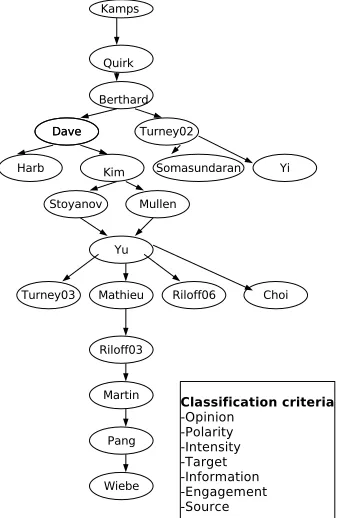
istics of subjectivity. (J.R.Martin and P.R.R.White, 2005)
have introduced the concept ofgraduationwhich is further
declined usingforce andfocus. It expresses the strength
of the opinion expression, so we merged this concept with intensityin our representation. Models of (Y.Choi et al., 2005) and (E.Riloff et al., 2003) are also at the same level as (E.Riloff et al., 2006), (P.Turney and M.Littman, 2003) and (Y.Yannik-Mathieu, 1991). At last, (B.Pang and L.Lee, 2008) and (J.Wiebe et al., 2005) propose the most com-plete models which regroup together all our presentation features.
Figure 1: Hierarchical OSA models sorting from the most generic (top) to the most specific (bottom), based on the
at-tribute ordering shown in the box, withOpinionbeing
con-sidered the most important andSourcethe least. When the
same author has proposed different models, they are distin-guished by publication year.
The characteristics that we retain from this survey as im-portant for an OSA model are the three part representation with: the opinion/sentiment expression, its source and its target, and the distinction between sentiments, related to emotions from opinions which retain more a flavor of ratio-nality. We will now survey the evaluation campaigns that proposed an evaluative framework to compare algorithms for OSA.
3.
Opinion Mining Evaluation Campaigns
From 2006 up to 2008, TREC (Text Retrieval Conference)
has proposed the Blog Track 2 for searching a corpus of
blogs. The task consisted of:
1. distinguishing whether a post was subjective or objec-tive (no opinion expressed in the document),
2http://ir.dcs.gla.ac.uk/wiki/TREC-BLOG/
2. separating positive posts from negative ones,
3. sorting them by decreasing order of positiveness.
Performances observed during the campaign were mea-sured in terms of Mean Average Precision (MAP), and the value measured ranged from 0,17 to 0,45.
Since 2006, the NTCIR-MOAT campaign (Multilingual Opinion Analysis Task) proposes to tag newspaper articles. Each sentence must be tagged depending on its relative
sub-jectivity/objectivity and its relevance with respects to ana
prioritopic. At the clause level, the participants must iden-tify the source and target of opinion, as well as the polarity expressed on a 3 value scale (positive, neuter, negative). In this campaign, identifying subjectivity and relevance have yielded better performance results (F-scores between 0.41 and 0.92) than detecting the source, the target and the polar-ity of an opinion expression (F-scores between 0 and 0.75). In 2007, SemEval campaign (Semantic Evaluations) has
proposed the task Affective Text to explore the
connec-tions between emotion and semantic lexicons. The par-ticipant had to annotate news headlines along two dimen-sions, first, according to the emotion expressed, chosen
among a list of 6 basicemotions: anger, disgust, fear, joy,
sadness, surprise; and second, according to the polarity (positive/negative) of the opinion expressed. The best
rec-ognized emotions were: sadnessandfear with respective
maximum F-scores of 0.30 and 0.20. Anger, joy and
sur-prisehave obtained a maximum F-score of 0.15, while
dis-gustwas the emotion the most badly recognized with a null
F-score.
Finally in 2008, TAC campaign (Text Analysis
Confer-ence) had a Question Answeringtask with opinion
ques-tions. There were two types of questions: a first batch of
questions about the opinion bearer (Who supports what?)
and a second one about the opinion itself (What are the
critics about...Why do people like...) Here the F-scores ob-tained for this two types of questions have ranged from 0.01 to 0.17. In TAC 2008, there was also a task for automatics opinion abstract generation taking as input the answers pro-posed for a set of questions.
In France two evaluation campaigns took place respectively
in 2007 (C.Grouin et al., 2007) and 20093, in the context
of the series of text mining challenges (DEFT). The first
campaign dealt with the assignment of a polarity value to a text bearing an opinion (review of books or of video games for instance), taken from a three value range (bad, average, good)(J.-B.Berthelin et al., 2008). The second campaign asked the participants to determine whether a text was sub-jective or obsub-jective as a whole and locally to identify the subjective portions of a text taken from a newspaper cor-pus made of both factual articles and more opinion ori-ented ones. For both campaigns, the reference data have been built automatically from the metadata present in each corpus. Results from the 2007 campaign were different de-pending on the corpus processed. The best results were ob-tained with the video game reviews (with F-scores values ranging from 0.46 to 0.78) while the corpus of scientific ar-ticle review was more problematic for the participants (F-scores between 0.40 and 0.57).
3
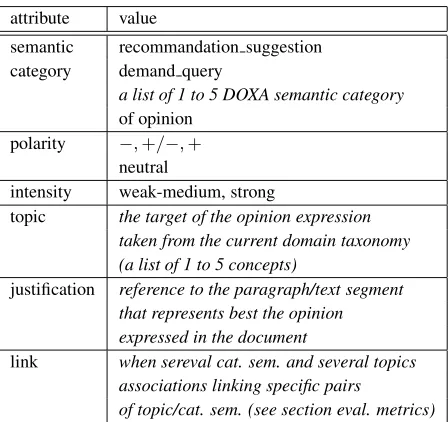
attribute value
semantic recommandation suggestion category demand query
a list of 1 to 5 DOXA semantic category of opinion
polarity −,+/−,+ neutral
intensity weak-medium, strong
topic the target of the opinion expression taken from the current domain taxonomy (a list of 1 to 5 concepts)
justification reference to the paragraph/text segment that represents best the opinion expressed in the document
link when sereval cat. sem. and several topics associations linking specific pairs
of topic/cat. sem. (see section eval. metrics)
Table 2: DOXA macro/meso annotation of opinion.
riching the annotation guidelines by building lists of opin-ion related expressopin-ions.
5.
Evaluation metrics
For evaluation, three metrics will be considered separatly: one for opinion annotations, one for topic annotation and one for the links between topic and opinion. In Table 3
we present the different metrics used. For topic
anno-tation, we will use the conceptual distance proposed by Wu et Palmer (Z.Wu and M.Palmer, 1994). If we call
d(x, y)the topological conceptual similarity between two
concepts of an ontology, i.e. the number of concepts
en-countered along the shortest path linkingxtoy, the
con-ceptual similarity between two conceptsC1andC2, whose
least common superconcept is the conceptCcain a
hierar-chie of rootR, is given by the formula : Sim(C1, C2) =
2×d(Cca,R)
d(C1,Cca)+d(D2,Cca)+2×d(Cca,R)The performance measure
Table 3: Evaluation metrics
annot. evaluation function value range
pol. equal(P1, P2) {0,1}
cat. equal(C1, C2) {0,1}
topic maxk=1,m Pn
i=1 Sim(Ti,Tk)
max(n,m) [0,1]
link maxk=1,mPni=1Sim(Ti,Tk)×equal(Ci,Ck)
max(n,m) [0,1]
of a particular link annotation will be given by the product of the performance measure of the opinion annotation (0 or
Parag id=”d1009.1”
Polarity: positive
Intensity: strong
Text: v´eritablement abouti [truly successful]
Semantic Category: Interest Valorization Appreciation Text: v´eritablement abouti
Topic: VideoGame
Text: Arthur Et Les Minimoys
Justification: Le studio franc¸ais ´Etranges Libellules s’est lanc´e dans l’aventure pour nous proposer, au final, un titre v´eritablement abouti et soign´e. [The French studio Strange Dragonflies embarked on the adventure to propose, in the end, a neat and truly successful title.]
Table 4: Annotation example from the video game corpus with the DOXA evaluation opinion model.
1 value) by the performance measure of the topic (value ob-tained with Wu & Palmer conceptual similarity measure). The problem of how to compute the performance measure for the link information when the hypothesis data or the reference data contain several links will be solved by sim-ple combinatorics, computing all possible performance val-ues and keeping the highest performance value (minimal penalty for the system).
6.
Hand annotation tasks
The corpus is made of video games reviews, news and posts about video games collected from 8 dedicated web sites. There are 8,000 documents of an average size of 4500 words, split into fixed size paragraphs of 200 words (around 1000 characters). Right now there are around 2,000 doc-uments which have been hand annotated with the DOXA OSA evaluation model (see details in Table 6).
As annotation software, we use the Knowtator4(P.Ogren,
2006) plugin for Prot´eg´e since the resulting software com-bination provides an annotation graphic interface coupled to an ontology browser for annotating opinion and senti-ment in corpora (see Figure 3).
The annotation speed measured during this period, mea-sured per day per annotator, ranged from 26 paragraphs (3 documents) to 41 paragraphs (5 documents).
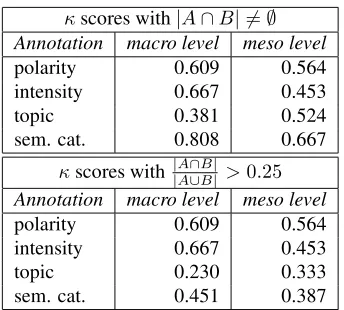
The first return from the hand annotation task that started in october 2009 with two annotators are the low kappa values, in particular for documents which are only slighty positive or negative in nature and for the topic annotation. Table 6. displays the two measurements of kappa computed consid-ering two different equality functions for topics and seman-tic category lists :
1. equal(A, B) ≡ A∩B6=∅
2. equal(A, B) ≡ ||AA∩∪BB||>0.25
This poorκvalues can be partially explained by the fact
that annotation guidelines were being finalized during this
Figure 3: Knowtator annotation interface for DOXA. The left hand side window displays the opinion annotation ontology, the middle contains window the text currently annotated with the selected annotation highlighted and the right hand side window shows the current annotation attribute values.
trial phase of annotation and that the annotators were new to the task. The topic annotation will have to be reconsid-ered, maybe by automatic generalization going up in the conceptual hierarchy of several levels and improving the annotation guidelines. An example of annotation guideline is provide in table 6..
κscores with|A∩B| 6=∅
Annotation macro level meso level
polarity 0.609 0.564
intensity 0.667 0.453
topic 0.381 0.524
sem. cat. 0.808 0.667
κscores with||AA∩∪BB|| >0.25
Annotation macro level meso level
polarity 0.609 0.564
intensity 0.667 0.453
topic 0.230 0.333
sem. cat. 0.451 0.387
Table 5: Two measurements of kappa computed consider-ing two different equality functions for topics and semantic category lists.
Number of documents 1,970
Number of paragraphs 18,415
Number of sentences 88,305
Number of words 202,345
Number of characters 8,918,468
Characters per word 4.4
Table 6: Characteristics of the reference corpus for video games.
Polarity positive Intensity strong
text characteristics opinion expressions are very positive AND negative opinion expressions are missing or present in small number and very moderate in nature. sem. cat. only positive semantic categories
should be present.
.
dom fieldsand extraction patterns. In Proceedings of HLT/EMNLP.
Y.Yannik-Mathieu. 1991. Sciences du langage. In Les
verbes de sentiment – De l’analyse linguistique au traite-ment automatique. CNRS Editions.
Z.Wu and M.Palmer. 1994. Verbs semantics and lexical
se-lection. InIn Proceedings of the 32nd ACL, pages pages