Logic Based Methods for Terminological Assessment
Benoît Robichaud
Observatoire de linguistique Sens-Texte (OLST) Université de Montréal
Abstract
We present a new version of a Graphical User Interface (GUI) called DiCoInfo Visuel, mainly based on a graph visualization device and used for exploring and assessing lexical data found in DiCoInfo, a specialized e-dictionary of computing and the Internet. This new GUI version takes advantage of the fundamental nature of the lexical network encoded in the dictionary: it uses logic based methods from logic programming to explore relations between entries and find pieces of relevant information that may be not accessible by direct searches. The result is a more realistic and useful data coverage shown to end users.
Keywords: electronic dictionary, Graphical User Interface, data visualization, logic programming, assessment tool
1.
Introduction
This paper describes the goals, architecture and usability of a new version of a Graphical User Interface (GUI) used to browse and assess encoded data through a subset of selected lexical relations found in DiCoInfo (Dictionnaire fondamental de l’informatique et de l’Internet), an online multilingual specialized dictionary of computing and the Internet. The GUI allows searches in the dictionary entry fields and presents results as (directed) graphs. Figure 1 bellow exemplifies the kind of data visualization one can expect to obtain with this sort of approach.
This new version is natively written in Prolog (Sterling & Shapiro 1994) and as such allows declarative and generalized search recursion through the lexical descriptions encoded in field entries of the dictionary. In particular, this new version improves the results in two major ways: first, while performing a reification of the data (Polguère 2009), it is able to show relevant lexical
relationships that remained hidden in the preceding version; second, search recursion is used to compute transitive closures on selected (or all) subsets of lexical relations allowing the implementation of other search strategies and layout improvements.
2.
Motivation and related work
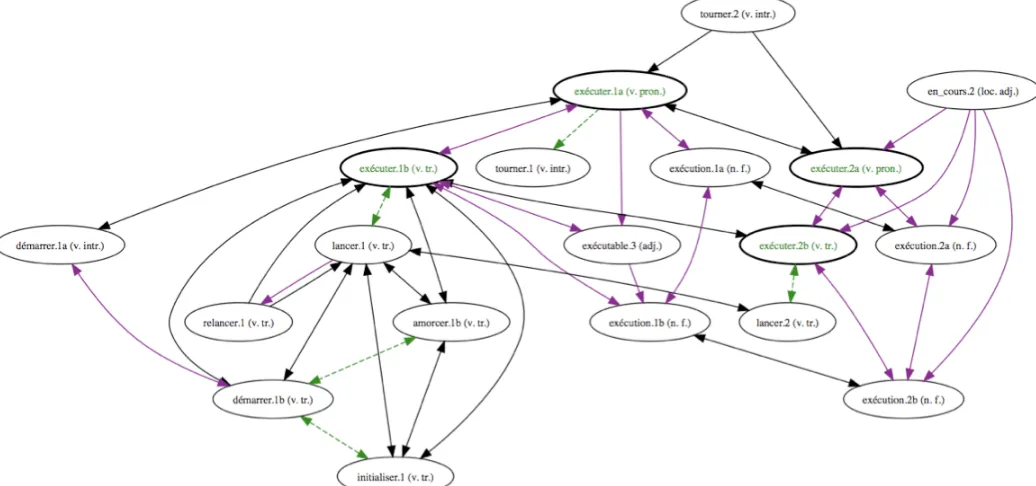
This GUI project started with the idea that it was possible to improve the visual and communicative value of dictionary contents using a graph visualization device that would enhance and capitalize on the fundamental nature of dictionaries since, in essence, they areterm as a derivative, an opposite or a related meaning
(Figure 3).
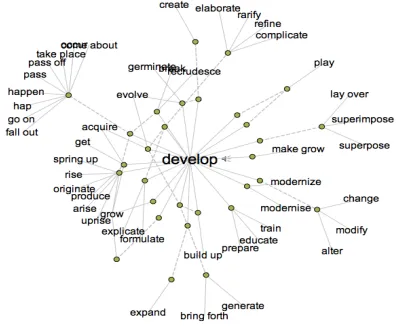
This idea is not new. During the last decades, with the spread of computer use, and the development of more ergonomic GUIs, various innovative means for searching and displaying dictionary contents have been explored and proposed. In particular, a lot of attention has been paid to the network perspective to give end users “a richer experience” (e.g. Jansz et al. 2008; Araúz et al. 2009; Thinkmap’s Visual Thesaurus 2011; logicalOctopus’s Visuwords 2011; Vercruysse’s WordVis
2011) such as Figure 4.
However, it is also well known that this path is fraught with pitfalls: for example, without appropriate display or layout options of some sort, these GUIs may become rapidly complex and confusing and, as a result, users will have trouble to understand a graph with overloaded information.
With a little anticipation on that particular point, this type of interface proves, nonetheless, to be useful for at least two kinds of users: the intended forefront users (such as technical writers and translators) to whom it gives a wider angle on the relations between lexical
units and enabling them to better navigate according to their search; and to the terminologists that encode the dictionary records as it allows them to quickly check the consistency between entries, thereby saving time when they review their work (details are given in section 3).
3.
The
DiCoInfo
and the
DiCoInfo Visuel
DiCoInfo was originally developed as a monolingual tool with the main function of helping end users solve specific knowledge problems associated with this specialized language. From year to year, new languages and functionalities have been added to assist them with tasks such as translation and text production in a second language (see L’Homme et al., 2009). In this section we review specific details related to its technical management and present our interactive graph visualization GUI and its new implementation using logic programming.
3.1 The
DiCoInfo
terminological database
1The records of DiCoInfo are encoded in XML files stored in an eXist database management system (Meier et al. 2011). Apart from the new graph-based interface presented in Section 2.2, end users can access and browse the terminological database through two main standard Web interfaces.
The first one is a compilation of hyperlinked HTML pages that provides the list of all records in the conventional alphabetical fashion. The second one is a searchable version that mimics a search engine and finds records containing strings (that correspond to substrings, words or terms) in specific field entries such as the usual
headword, variants and synonyms, but also in other fields that group different sorts (or families) of paradigmatic and syntagmatic lexical relationships.
1The DiCoInfo can be accessed at:
http://olst.ling.umontreal.ca/dicoinfo/
Figure 4: Lexical relations of the English word
develop from Thinkmap’s Visual Thesaurus
Figure 3: List of records cataloging the French homographs executer
computations of analogies and inferences over these relational data, we thought that it would be simpler to state the problems in a declarative fashion and then take advantage of the fact that Prolog APIs already incorporate logical inference engines, rather than having to call an external module to do them.
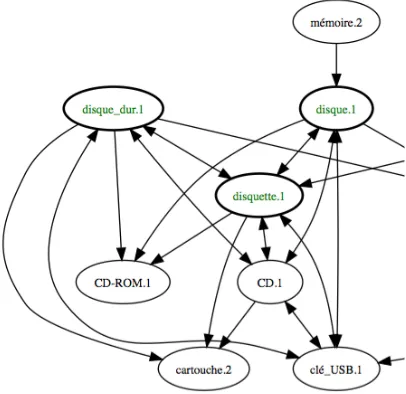
Other than the rewriting of the PHP programs in Prolog, new functionalities were also implemented. Firstly, the GUI now draws lexical relationships that remained hidden in the preceding version. Figure 6 shows that in the current version, the nodes that do not contain the searched expression (here disque, Eng. disc) may also be related to one another (here for example, CD and clé USB, Eng. pen drive) when they have a relationship that was searched for (here, related meanings).
The second improvement concerns the generalization of the transitive closure computation for other relations than that of hypernymy. In the previous version, this computation was relegated to the XQuery interpret of the eXist database server. In the current version, the main Prolog program computes transitive closures for all subtypes of relations using the ordinary recursion mechanism a better view of the lexical coverage. This new capabilities will also be exploited for implementing graph-based methods such as the search for hubs and cliques (Bang-Jensen 2009).
It is worth to mention that the GUI now uses a cache mechanism to reduce the access time to the database (downloading XML file contents on the side).
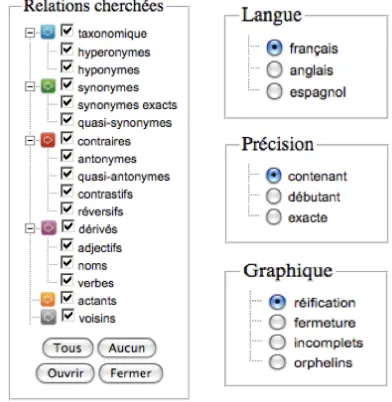
Apart from these new functionalities, two new options have also been implemented to provide support to terminologists. Firstly, as already mentioned, except for taxonomic relationships, all the others are bidirectional
and their corresponding digraphs should be complete
(Bang-Jensen 2009). When users choose the option ‘incomplete’, the GUI draws for these relationships only the subset of links that do not respect this constraint (Figure 7). Secondly, the GUI is also capable to search for orphans, i.e. nodes that match the search expression but do not share any relations with other terms (due for example to a typo or another mistake).
4.
Future work and conclusion
With the new gear describe here, we are ready to challenge the three drawbacks previously noted in Robichaud (2011). First, we will have to find the means to mix ‘tree’ shapes and ‘spring’ shapes when a particular node has too many direct daughters and that these span too widely on the horizontal axis of the tree. A clustering strategy base on constraints solving might be the answer. Second, some queries may simply return too many nodes linked by countless vertices and the entire graph becomes itself extremely difficult to interpret, for example, when searching for transitive closure. In this case, a mechanism could be used to alleviate the graph by identifying nodes that (under the circumstances) seem less important. The last drawback noted in Robichaud (2011) lies in the fact that the first version was simply not ‘intelligent’. By using Prolog as the main program in this version, it will become easier to explore which kind of analogies and inferences (such as the ones presented in the previous section) could lend themselves to search and present data in useful new ways for end users and terminologists.In this paper, we presented a prototypical GUI that allows a new method for organizing and visualizing the lexical relationships of dictionary contents. We also briefly presented a new implementation based on logic programming that simplifies data reification and the computation of transitive closure and searches for specific types of subgraphs over parts of a lexical network. We have high hopes that it will also allow to formalize lexical analogies and inferences.
5.
References
Araúz et al. (2009). Managing inner and outer overinformation in EcoLexicon: an environmental ontology. In 8ème conférence internationale Terminologie et Intelligence Artificielle. Toulouse Figure 6: Relations between the participating nodes
that do not contain the searched expression
CD and clé USB (Eng. pen drive)
Bang-Jensen, J. (2009). Digraphs: theory, algorithms and applications, London: Springer-Verlag.
Clark, J. (ed.) (1999). XSL Transformations(XSLT). W3C Recommendation. Version
1.0http://www.w3.org/TR/xslt
Fellbaum, C. (1998). WordNet: An electronic lexical database. Cambridge MA: MIT Press.
Hawick, KA. (1993). Interactive Graph Algorithm Visualization and the GraViz Prototype. Technical report, AT&T Bell Laboratories
Jansz, K et al. (2008). Kirrkirr: software for the exploration of indigenous language dictionaries. http://nlp.stanford.edu/kirrkirr
Jousse, A.-L.; L’Homme, M.-C.; P. Leroyer & Robichaud B. (2011). Presenting collocates in a dictionary of computing and the Internet according to user needs. In Proceedings of the 5th International Conference on the Meaning Text Theory, Barcelona. Kidd, E. (2009). Visualizing WordNet relationships as
graphs. In Random Hacks
http://www.randomhacks.net/articles/2009/12/29/ visualizing-wordnet-relationships-as-graphs
Cholz, K. (2006). First Whack at JavaScript Visual Wordnet. In kylescholz.com :: blog
L’Homme, M.-C.; Leroyer P. (2009). Combining the semantics of collocations with situation-driven search paths in specialized dictionaries, In Terminology,
15(2), pp. 258-283.
L’Homme, M.-C.; Leroyer, P.; Robichaud B. (2010). Advanced Encoding for Multilingual Access in a Terminological Database – A Matter of Balance, In
Terminology and Knowledge Engineering Conference. Presenting Terminology and Knowledge Engineering Resources Online: Models and Challenges (TKE 2010), 12-13 August, Dublin.
Meier, W. et al. (2011). eXist : an Open Source Native XML Database. http://exist.sourceforge.net
Mel’čuk, I. (1996). Lexical functions: A tool for the description of lexical relations in the lexicon. In Wanner, L. (ed.), Lexical functions in lexicography and natural language processing. Amsterdam / Philadelphia: Benjamins, pp. 37–102.
Polguère, A. (2009). Lexical systems: graph models of natural language lexicons. In Language Resources and Evaluation, 43, pp. 41-55.
Robichaud, B. (2011). A Graph Visualization Tool for Terminology Discovery and Assessment. In
Proceedings of the 5th International Conference on the Meaning Text Theory, Barcelona.
Sterling, L.; Shapiro E. (1994). The Art of Prolog. MIT Press.
Thinkmap, Inc. (2011). The Visual Thesaurus. http://www.visualthesaurus.com