Annotation Process Management Revisited
Dain Kaplan, Ryu Iida, Takenobu Tokunaga
Department of Computer Science, Tokyo Institute of Technology {dain,ryu-i,take}@cl.cs.titech.ac.jp
Abstract
Proper annotation process management is crucial to the construction of corpora, which are indispensable to the data-driven techniques that have come to the forefront in NLP during the last two decades. This paper first raises a list of 10 needs that any general purpose annotation system should address, such as user & role management, delegation & monitoring of work, diffing annotators’ work, versioning of corpora, multilingual support, and so on. A framework to address these needs is then proposed. The explanation of the framework is followed by an introduction of SLATE (Segment and Link-based Annotation ToolEnhanced), the second iteration of a web-based annotation tool, which is being rewritten to implement the proposed framework.
1.
Introduction
Corpus-based approaches have risen in popularity over the last two decades in the field of natural language process-ing (NLP); in many areas corpus-based approaches equal in performance, or rival traditional rule-based methods. With the increase in computational power and the advancement and ease of use of machine-learning (ML) techniques, it is no wonder that corpus-based approaches continue to gain in popularity. In the late 1990s a sizable textbook (Man-ning and Schuetze, 1999) was published attesting to their merits, and even a decade before, research had appeared pursuing such techniques (Charniak, 1993). Corpus-based approaches also allow for more language and domain inde-pendence within a model, important in today’s multilingual world.
The advent of corpus-based approaches also meant that the creation of corpora was required — corpus-based ap-proaches are obviously impossible without them. The in-dividual creation of custom tools for annotation tasks is a tremendous investment of time and labor, which when viewed in a wholistic manner shows how repetitive and wasteful such an investment can be. These custom fitted tools do of course address the demands of the project for which they were born, but also because of this tend towards inflexibility and disposability. Regardless of the problems of interoperability that arise when different tools are used with different data formats (something desirable when try-ing to cross-test methods with different pre-existtry-ing data-sets), a cycle forms of creating new tools for trivial tasks, or perhaps even worse conforming and compromising an-notation criteria to fit within the limits of an existing tool made for a previous project, which impinges on the qual-ity of the resource. Corpus-based methods will only grow in scale and complexity, and so it is crucial the annotation tool does not stand in the way.1
The bottom line is that corpus creation (and also manage-ment) is time consuming enough without having to spend more resources in battling the development of a custom tool. In addition, previous studies have shown that the early phases of a project are the most volatile (Marcus et al.,
1
In addition, as data sets continue to grow in size and methods mature, it will be necessary to compare them, meaning a standard-ized format will also be necessary.
1993), resulting in rapid changes to the annotation schema. This can also cause delays and cost additional resources if the annotation tool is too rigid or otherwise unable to adapt to the changes.
A survey (Dipper et al., 2004) proposed seven categories desirable for any annotation tool: diversity of data, multi-level annotation, diversity of annotation, simplicity, cus-tomizability, quality assurance and convertibility. The goal of these categories is to remove the obstacles outlined as problems above. They are well thought out, but there is one caveat to them: they are document-centric, or rather, they simply do not address the bigger scope of managing the annotation process. Furthermore, though they do raise concerns about areas that need to be addressed, they do not propose how these areas are to be tackled. In simple corpora this may not be much of a concern, but in larger projects – and as corpus-based techniques continue to grow and advance so do the sizes of the corpora (Davies, 2009) – it becomes a serious issue.
In order to create a tool suitable for use in the future, it is important to pinpoint the needs of an annotation project. In Section 3. we outline what we think these needs are, and then in Section 4. propose a framework for addressing them. We next introduce SLATE (Segment and Link-based Annotation ToolEnhanced), the second iteration of a web-based annotation tool under development that utilizes this framework, geared towards being a possible solution. We then conclude the paper and discuss future work.
2.
Related Work
Over the years countless custom annotation tools have been created to meet specific demands of various annotation projects; more recent examples include (St¨uhrenberg et al., 2007; Russell et al., 2005). However, many more never see the public light of day, because they were created behind the scenes hastily and then disposed of. They were mostly created because a tool did not exist that was capable of pro-viding the feature set needed for development of the corpus within a reasonable amount of time.2 A recent example in-cludes Serengeti (St¨uhrenberg et al., 2007), which has been
2
tracked so that an additional version can be released. Without management of versioning, the “current state” of the annotation project is all that is known; for large projects, especially, it is important to identity mile-stones or to “tag” a given state so that one may be able to go back to it later. This way changes made after the “tagging” will not unknowingly be included into a release.
!"#$%&'(&)*++,-."/+0&12$3$3+% 4'#+(+#+2,+&4-"32%
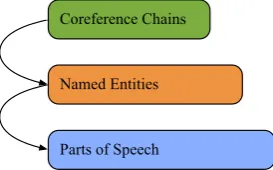
Figure 1: Higher layers access lower layers as a base for more stringent annotation
(7) Extensibility in terms of layering. As corpora are
continuing to grow in size, it is no wonder that they are also fundamentally becoming more complex. We have seen recently the stacking, or layering, of cor-pora upon one another. Attempts at diversifying a sin-gle corpus with various types of annotations are on the rise, such as the Discourse TreeBank on top of the Penn TreeBank (Miltsakaki et al., 2004), or the NAIST Text Corpus atop the Kyoto Text Corpus (Iida et al., 2007). The system must allow for adding new layers upon previous ones, seamlessly. Often the lower lay-ers are directly referenced by the new ones. It must al-low for this as wellwithoutjeopardizing the quality of the lower levels. This idea is shown in Figure 1, where if we consider each level being a separate project, the one above directly references annotations in the pre-ceding layer.
(8) Extensibility in terms of tools. Many annotation
tasks these days involve (semi-)automatic tagging, fol-lowed by an annotator reviewing and correcting any mistakes in the output. The system should ideally al-low the annotator to call plugins to the system to tag a given resource to facilitate this. This step could be done prior to data import, but allowing the user to do so afterwards has several benefits, such as enabling them to quickly view the results of the automatic tag-ging, and to rerun it with different parameters again should it not have provided the expected output. The plugins should be able to be created by anyone (not only the creators of the system).
(9) Extensibility in terms of importing/exporting. The
system should also allow the user to either define rules or call plugins to convert the data from one format to another. This allows the system to be somewhat ag-nostic to the data format. This is important as there are a variety of formats, though the system should provide its own that is capable of handling any supported anno-tation scheme. Including generated comments may fa-cilitate in human verification of the exported resource.
This step could be done after export, but having the ability to have the data processed automatically in-creases productivity for menial tasks that should not require human intervention (and which may also in-troduce error).
(10) Support for multiple languages. Research today is
carried out in a variety of languages, and the system should support them.
4.
Framework Overview
The ten items listed above can be subdivided into those that require a framework for support, and those that rely on an implementation of a given framework. Without a proper framework in place, (1) - (7) are impossible; (8) - (10) re-side entirely with the implementation. We address needs (1) & (2) (User & Project Management, and work delegation) in Section 4.1., (3) & (4) (Adaptability to current and future annotation tasks) in Sections 4.3. and 4.4., and need (7) in Section 4.6.. Needs (5) & (6) require the necessary data within a framework, but also rely heavily on the implemen-tation to supply such features; they appear as the topic is relevant, below. Figure 2 shows a simplified representation in UML of some of the more major entities of the proposed framework. It may be beneficial to refer to it while reading through the explanation.
4.1. User & Project Management
A large part of proper project management involves proper user management (needs (1) & (2)). It is important to en-capsulate user responsibilities in a way that facilitates pro-ductivity, rather than hinders it due to complexity. User roles are nothing new to software systems, but choosing the right granularity can be tough. We think it is best to keep things as simple as possible while maintaining the needed functionality; thus, we propose having minimally two types of users: administrators and annotators. (Note that user roles are not present in Figure 2.)
An administrator oversees projects, configures them, adds/removes annotators, and assigns annotation tasks. The administrator should also be able to check the progress of the annotators to make sure no roadblocks are preventing them from finishing their assigned work, or if they become incapacitated for some reason, allow the administrator to easily reassign outstanding work. As mentioned in Sec-tion 3., the administrator should also be able to create ver-sions of the project (need (6)), import, export, and in all other ways administer the project. They should not, how-ever, be able to annotate resources.
The annotator, therefore, is solely responsible for this task of annotation. They can select a resource that has been as-signed to them and annotate it; they are sandboxed from other users to prevent biases from interfering with their work (meaning they do not see others’ work).
method-!"#$%&'()*+" ,-%.!&'#&(%)#/0(#1)((2%.#
!"#
$%&%'$(
!"#$%&'(#%$
!"#$%&)**+,-. '&())**/,0
&"%$
3
Figure 4: An example showing two segments, and a link between them
attributesare necessary. Say we wish to supplement a seg-ment type definition for “Noun” with information about its plurality; for this we could create an attribute with the pos-sible values of “singular” and “plural”. We can then for-malize the definition of a tagTto be a labellabeland a set of attributesaicomposed of a namenameand a value type
val type, along with a possible default valuedef val, and a flagreqindicating whether or not the attribute is required:
T = (label, {a0, a1, . . . , an−1}),
whereai= (name,val type,def val,req).
The value type could be an enumeration, all possible char-acter strings (i.e. free input), number ranges, etc. We can then group these segment and link type definitions into a
tagset, and assign the tagset to a project. Projects may need to contain multiple tagsets, depending on the task. In the case that the project is extending another previous project (need (7)), it will be important to disable creation of in-stances from that tagset, and instead only allow the annota-tor to view them (reflected in Figure 2).
4.4. Tagset Management
Especially during the early phases of a project, the anno-tation specification is victim to changes in design (need (4)). By creating versions/revisions of tagsets, we can en-able the system to keep track of what resources are anno-tated with which version of each type; allowing an admin-istrator to verify that all documents are annotated with the current spec. Examples include an administrator adding an attribute to verbs, or adding a value to an existing at-tribute, etc. In the framework all instances of annotations are marked with the version/revision of the tagset that was used when they were annotated. It may also be beneficial to denote the difference between changes that complement a current version (e.g. accommodating a new case found dur-ing annotation that does not affect other annotations), i.e. revisions, and changes that require reannotating resources (versions).
4.5. Appearance/Settings
For a visual task like annotation, it is important that as much information as possible is conveyed to the user as quickly as possible. (Dipper et al., 2004) defined the need for cus-tomization, and we address this in our framework here (as it is not so much an annotation process level item, it is not included in our list of needs in Section 3.). We define ap-pearance settings for segments/links that can be defined at
the tagset, project, and annotator level. This allows the user to decide how the information is conveyed should they have an inclination to override the default. In addition, attributes on specific instances of segments/links may carry impor-tance and affect subsequent annotation (e.g. annotating the verbs that relate to nouns with their plurality attribute set to “plural”). For this reason appearance settings can also be set for specific type definitions that have certain attribute values.
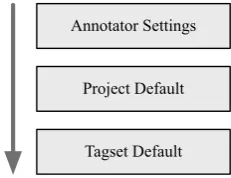
The appearance of the resource and the annotations should be left up to the user. Annotation is a tiring, repetitive pro-cess; creating as stress-free an environment as possible for the annotator is therefore key. Preferences should enable the annotator to change the appearance of the tagsets and of the editor in general. A white background can be tir-ing on the eyes, for example, so the annotator should be able to pick a color that suits him/her. Since segments and links possessing certain attributes can change in color, the user should be allowed to pick the colors that are the most meaning/pleasing to them. Yet, an annotation scheme with-out any colors is next to meaningless; therefore, we define the order of overriding for appearance settings, shown in Figure 5.
!"#$%&'()%*+,-' .//#'+'#"(0%''1/23
4+23%'()%*+,-'
Figure 5: Order of appearance overrides for segments and links; above overrides below
4.6. Annotation
With definitions for the various entities out of the way, we move on to discussing the process of annotation. There is one more feature of the framework that greatly reduces careless annotator errors and at the same time improves pro-ductivity: attribute constraints. In a sense, attribute con-straints work similarly to appearance overrides explained in Section 4.5.; they are defined along with tag type defi-nitions, but they function at the instance level. Instead of affecting appearance, they affect the creation of instances of certain types. Segment and link constraints vary, so we will begin with segments.
Figure 6: SLATE: Document Select Screen with multiple projects and multiple languages
pus” (2006 - 2010), sponsored by MEXT (Ministry of Ed-ucation, Culture, Sports, Science and Technology – Japan).
References
Constantin Or Asan and Constantin Orˇasan. 2003. Palinka: A highly customisable tool for discourse annotation. In
Proc. of the 4 th SIGdial Workshop on Discourse and Dialogue, ACL ’03, pages 39–43.
Steven Bird, David Day, John S. Garofolo, John Hender-son, Christophe Laprun, and Mark Liberman. 2000. At-las: A flexible and extensible architecture for linguistic annotation.CoRR, cs.CL/0007022.
Callisto. 2002. http://callisto.mitre.org. Eugene Charniak. 1993. Statistical Language Learning.
The MIT Press.
H. Cunningham, D. Maynard, K. Bontcheva, and V. Tablan. 2002. Gate: A framework and graphical development environment for robust nlp tools and applications. In
Proc. of the 40th Annual Meeting of the ACL.
Mark Davies. 2009. Contemporary American English (1990-2008+).International Journal of Corpus Linguis-tics, 14(2):159–190.
Glynn Dennis, Brad Sherman, Douglas Hosack, Jun Yang, Wei Gao, H. Clifford Lane, and Richard Lempicki. 2003. David: Database for annotation, visualization, and integrated discovery.Genome Biology, 4(5):P3+. Stefanie Dipper, Michael G¨otze, and Manfred Stede. 2004.
Simple annotation tools for complex annotation tasks: An evaluation. InProc. of the LREC Workshop on XML-based Richly Annotated Corpora.
Ryu Iida, Mamoru Komachi, Kentaro Inui, and Yuji Mat-sumoto. 2007. Annotating a japanese text corpus with predicate-argument and coreference relations. InProc. of the Linguistic Annotation Workshop, pages 132–139, Prague, Czech Republic, June. Association for Compu-tational Linguistics.
Paul Kingsbury and Martha Palmer. 2002. From Treebank to PropBank. In Proc. of the 3rd International Con-ference on Language Resources and Evaluation (LREC 2002), pages 1989–1993.
Christopher D. Manning and Hinrich Schuetze. 1999.
Foundations of Statistical Natural Language Processing. The MIT Press, 1 edition, June.
Mitchell P. Marcus, Beatrice Santorini, and Mary Ann Marcinkiewicz. 1993. Building a large annotated corpus of English: The Penn Treebank. Computational Linguis-tics, 19(2):313–330.
Eleni Miltsakaki, Rashmi Prasad, Aravind Joshi, and Bon-nie Webber. 2004. The penn discourse treebank. In
Proc. of LREC 2004.
Christoph Mueller and Michael Strube. 2001. MMAX: A tool for the annotation of multi-modal corpora. InProc. of the 2nd IJCAI Workshop on Knowledge and Reason-ing in Practical Dialogue Systems, pages 45–50. Masaki Noguchi, Kenta Miyoshi, Takenobu Tokunaga, Ryu
Iida, Mamoru Komachi, and Kentaro Inui. 2008. Multi-ple purpose annotation using SLAT – segment and link-based annotation tool. Proc. of 2nd Linguistic Annota-tion Workshop, pages 61–64.
B. C. Russell, A. Torralba, K. P. Murphy, and W. T. Free-man. 2005. Labelme: A database and web-based tool for image annotation. Technical report, Tech. Rep. MIT-CSAIL-TR-2005-056, Massachusetts Institute of Tech-nology.
Maik St¨uhrenberg, Daniela Goecke, Nils Diewald, Alexan-der Mehler, and Irene Cramer. 2007. Web-based anno-tation of anaphoric relations and lexical chains. InProc. of the Linguistic Annotation Workshop, pages 140–147, Prague, Czech Republic, June. Association for Compu-tational Linguistics.