Iteratively Estimating Pattern Reliability and Seed Quality
With Extraction Consistency
*Yi-Hsun Leea,b, Chung-Yao Chuangb, and Wen-Lian Hsua,b
a
Institue of Information Systems and Applications, National Tsing Hua University, 101, Section 2, Kuang-Fu Road, Hsinchu, Taiwan, R.O.C.
b
Institute of Information Science, Academia Sinica, 128 Academia Road, Sec.2, Nankang, Taipei, Taiwan, ROC
{rog, cychuang, hsu}@iis.sinica.edu.tw
Abstract. In this paper, we focus on the task of distilling relation instances from the Web. Most of the approaches for this task were based on provided seed instances or patterns to initiate the process. Thus, the result of the extraction depends largely on the quality of the instances and patterns. For this matter, we propose an iterative mechanism that estimates the reliability of a pattern by the consistency of its ex-tractions, and reevaluate the usefulness of seed instance based on estimated pattern reliability. The resulting system is a semi-supervised method that can take a large quantity of seed instances with diverse quality. To evaluate the effectiveness of our approach, we experimented on 8 types of relationships. The empirical results show that our system performs quite consistency in different relationships while maintain-ing high precision and recall value.
Keywords: consistency estimation, relation extraction, semi-supervised approach, seed quality
1 Introduction
The rapid growth of the World Wide Web has attracted a lot of research effort on designing methods that automatically extract knowledge or useful information from large, unstructured text. Different from the conventional corpus, the magnitude and noisy natural of the Web has prohibited analytical approaches to be effective. Consequently, most of the systems that took this challenge proceed in a semi-supervised fashion with a human-provided starting point, such as a few instances of the desired extraction(Mann and Yarowsky, 2005; Muslea, 1999; Ravichandran and Hovy, 2002; Pantel and Pennacchiotti, 2006).
In this paper, we focus on the extraction of relation instances. In this scenario, the system needs to be fed with prepared pairs, such as <Barack Obama, Auguest 4th>, or initial extraction patterns to bootstrap. Kozareva and Hovy (2010) mentioned that seed selection plays an important role in this kind of semi-supervised approaches. Therefore, how to select high quality seeds in the initial stage is a critical issue. Most researchers select seeds manually to avoid this problem, but the scalability of such manual selection is not promising. Then, these approaches utilize the given instances, called seeds, and generate extraction patterns that has the potential to locate more instances of the desired type in the text. For example, Ravichandran and Hovy (2002) use surface text patterns like<Person> was born on <Date> to answer questions about birth dates.
* This research was supported in part by the National Science Council under grant NSC 100-2631-S-001 -001, and the research center for Humanities and Social Sciences under grant IIS-50-23.
Copyright 2011 by Yi-Hsun Lee, Chung-Yao Chuang, and Wen-Lian Hsu
to our system. We introduce the proposed CEPRA method in Section 3. In Section 4, we describe the experimental settings; and in Section 5, we discuss the experiments conducted to evaluate the performance of different selection approaches. We summarize the results in Section 6. Then, in Section 7, we provide some concluding remarks and consider avenues for future research.
2 Related Works
Semi-supervised approaches start with manually prepared patterns or seeds, and then generate surface text patterns, which are syntactic patterns that connect two entities in one relationship. Surface text patterns are widely used for information extraction. For example, <Person> was born in <Year> is an intuitive pattern for matching the birth year of someone. This pattern connect the person and the corresponding year as a semantic relation (birth year) and thus can be used to effectively extract the information. For binary relation extraction, such as the above example of <Person, Birth Year>, the first term is often called the hook term(e.g. Person), and the second one the target term(e.g. Birth Year) (Alfonsecaet al., 2006; Mann and Yarowsky, 2005; Ravichandran and Hovy, 2002). Most pattern-based approaches for relation extraction are implemented as follows. First, a set of seed instances are prepared in the form of pairs of hook and target terms serving as examples of the intended relation type. For instance, <Kobe Bryant, 1978> could be one of the seed instances that fed into a relation extraction system for learning how to extract the birth year of someone. The seed instances are then used as queries for retrieving sentences containing both the hook and the target terms, most popularly from the Web. The retrieved sentences are subsequently used for generating extraction patterns. Several approaches for this step have been proposed such as the longest common substring (Agichteinet al., 2001), substrings in suffix trees (Ravichandran and Hovy, 2002; Ruiz-Casado et al., 2007) and edit distance based alignment (Ruiz-Casado et al., 2007). However, a portion of the retrieved sentences can be, to a certain degree, not relevant in describing the intended relation. Thus, the patterns built on top of them can deviate from the original goal. To overcome this problem, most approaches place an evaluation step in which patterns are assessed using certain criteria. Such an evaluation is usually done using a sentence collection different from the one used for producing the extraction patterns. When using the Web as our extraction source, one apparent choice of this testing collection is the sentences retrieved by only submitting the hook terms to the search engine. In this paper, we denote such a sentence collection as SH, and the sentence collection gathered using both hook and target terms asS⟨H,T⟩.
With an additional sentence collection, we can assess the utility of the generated pat-terns. A simple way to estimate the usefulness of an extraction pattern, p, is based on the extraction frequency of that pattern. This frequency-based estimation (FE) method counts how many terms (regardless correct or not) that pattern, with hook-term slot filled, is able to extract from SH,
fF E(p) = ∑
h∈H
|ph(SH)|
where H is the set of all hook terms, ph is the pattern p with hook term h, ph(SH) is the bag of terms that ph extracted fromSH, and|ph(SH)| denotes the size of that bag of terms.
there are several translations other than the above for “Pennsylvania” and “Philadelphia” in Chinese, which all could appear in the retrieval. Besides the translation problem that we encountered frequently in this work, the voluntary nature of Wikipedia renders automatic evaluation vulnerable to specificity mismatches. For instance, the extracted information may be more detailed than the information provided in the infobox, however, there is no general and convenient way to adjust such a mismatch. For these reasons, rather than calling this approach accuracy-based, we refer it as confidence-based estimation (CE), and is formulated as
fCE(p) = ∑
⟨h,t⟩∈⟨H,T⟩|ph(SH) =t| ∑
h∈H|ph(SH)|
where⟨H,T⟩is the set of seed instances in which each ⟨h, t⟩is a pair of hook and target terms, and|ph(SH) =t|is the number of terms inph(SH)that matchest. Both frequency and confidence-based approaches rely heavily on the seed quality. In order to alleviate that, Pantel and Pennacchiotti (2006) proposed a method calledEspressowhich uses point-wise mutual information (PMI) to evaluate the strength of association between a pattern and its extractions,
fES(p) = ∑
⟨h,t⟩∈⟨H,T⟩
pmi(⟨h,t⟩,p)
maxpmi ×gES(⟨h, t⟩)
|⟨H,T⟩|
wherepmi(⟨h, t⟩, p)is the point-wise mutual information between patternpand a relation instance ⟨h, t⟩, maxpmi is the largest PMI observed, and gES(⟨h, t⟩)is an estimate of the quality of instance ⟨h, t⟩,
gES(⟨h, t⟩) = ∑
p∈P pmimax(⟨h,tpmi⟩,p)×fES(p)
|P|
wherePis the set of all patterns. These two formulas are calculated iteratively to adjust the weights of both patterns and seed instances. This approach utilizes the co-occurrence as an indication. However, patterns frequently co-occurred with some instances may still have no relevance to the targeted relation. For example, in (Blohmet al., 2007),Espresso got a low precision result in birth year extraction. Xuet al.(2007) noted that a factor for pattern-based approach to be effective is the ratio of relevant sentences within the text collection for generating the patterns. In this paper, we gather many seeds extracted from Infoboxes in the initial stage. Due to the seed quality is not consistent, we propose a new approach for evaluating both the patterns and seed instances. Different from the above approaches which only evaluate performance based on SH, our proposal further utilizes the statistical similarity between extractions from S⟨H,T⟩and extractions fromSH, which
we believe is a good indicator of pattern reliability.
3 Proposed Approach
In this section, we focus on the main concept about estimating pattern’s reliability with consistency measurement between different sentence collections and measure the seed’s quality by reliable patterns, described in the following sub-sections.
As pattern generation process can potentially produce a large number of extraction patterns, we need a strategy to find the most reliable patterns. To explain the intuition behind our approach, consider an “oracle collection”,SO, which contains all sentences de-scribing the targeted relation that we can find on the Web. Figure 2 shows the relationship between SH, S⟨H,T⟩ andSO. Ideally,SO and S⟨H,T⟩ would be subsets ofSH if we could
is not a subset ofSO because the sentences retrieved by using hook and target terms will contain some noisy results as discussed in Section 1 and demonstrated in Table 1. When generating patterns, S⟨H,T⟩\SO will cause relevance problems, which makes the pattern induction procedure producing deviated patterns. On the other hand, SO\S⟨H,T⟩ will
cause specificity problems, which undermines useful patterns in evaluation.
Manually selecting seed instances could reduce the extent of these two kinds of prob-lems. However, the scalability of such an approach is not promising. Thus, we need an approach to automatically assess the utility of each seed instance in evaluating the ex-traction patterns. Supposedly, high utility seed instances are the ones which distribute high scores into the reliable patterns. In this work, we assume that the reliability of a pattern can be measured by looking into the performance similarities between applying that pattern toSH andS⟨H,T⟩. We consider such a similarity because if a pattern extract
mostly in the intersection of SH, S⟨H,T⟩ and SO, then its performance will be consistent regardless extracting from SH or S⟨H,T⟩. Once those highly reliable patterns are found,
we could in turn assessing the quality of each seed instance.
In this work, we use theextended Jaccard coefficient(Strehl and Ghosh, 2000) (EJAC) to evaluate the consistency in performance when applying to two different sentence collection
J(p) = VSH(p)•VS⟨H,T⟩(p)
∥VSH(p)∥2+∥VS⟨H,T⟩(p)∥2−VSH(p)•VS⟨H,T⟩(p) (1)
whereVX(p)is the performance vector of punder sentence collectionX which comprises the pattern’s weighted precision estimates for each seed instance
VX(p) = (
λ⟨h1,t1⟩(p, X), λ⟨h2,t2⟩(p, X), ..., λ⟨hn,tn⟩(p, X) )
whereλ⟨hi,ti⟩(p, X) =A⟨hi,ti⟩(p, X)×w⟨hi,ti⟩in whichw⟨hi,ti⟩is the weight of seed instance
⟨hi, ti⟩(described below), andA⟨hi,ti⟩(p, X)is the estimated precision ofp,
A⟨hi,ti⟩(p, X) =
|phi(X) =ti|
|phi(X)|
When binding to some hook terms, a pattern may not be able to extract anything from SH orS⟨H,T⟩. In this case, we use theexpected target accuracy(ETA),µX, as the missing value,
µX(p) = ∑
⟨h,t⟩∈⟨H,T⟩A⟨h,t⟩(p, X)×w⟨h,t⟩
∑
⟨h,t⟩∈⟨H,T⟩w⟨h,t⟩
(2)
where X can be SH orS⟨H,T⟩. However, using only Equation 1 is not sufficient because
inferior patterns would have similar low precision distribution in both SH and S⟨H,T⟩.
Therefore, we combine Equation 1 and 2 to form our evaluation metric
fCEP RA(p) =α×µS⟨H,T⟩(p) +β×J(p)
In this paper, we set both αandβ to 0.5.
As mentioned earlier, the quality of the seed instances is an important aspect of this task. Intuitively, the utility of a seed instance can be assessed by the frequency that it is matched by extraction patterns. This assumes that the more inbound links to a seed, the higher quality it gets. However, there may be some overly-general patterns that are characterized by high coverage and low precision. Therefore, we need to prune those possibly unreliable patterns and utilize the remaining ones to evaluate the quality of seed instances. It is conceivable that if the reliable patterns cannot extract correct target term for a specific hook term, then the quality of this seed instance is questionable. In other word, the more reliable the patterns matching the instance, the higher will be the quality of that instance. Hence, we derive our formula for weighing seed instance as
v⟨h,t⟩=
∑
p∈P
{
A⟨h,t⟩(p,S⟨H,T⟩), if fCEP RA(p)> ε
0, otherwise
whereε= 0.7in this work. This value is normalized to obtain the final weight
w⟨h,t⟩=
v⟨h,t⟩−miniv⟨hi,ti⟩ maxiv⟨hi,ti⟩/c
wherec= 20 in this work.
w⟨h,t⟩’s and fCEP RA(p)’s are calculated iteratively. Initially, we compute fCEP RA(p)’s usingw⟨h,t⟩= 1. Then, we collect patterns with highfCEP RA values to determinew⟨h,t⟩’s.
After setting the seed weights, we can re-calculate the fCEP RA’s with reduced influence from inferior seeds. As this process iterates, only patterns whose fCEP RA values higher than a threshold are retained. Note that we also keep patterns with high ETA value if it can extract several seed instances with highw⟨h,t⟩ and theirfCEP RA is set to itsµS⟨H,T⟩.
4 System Architecture and Experimental Environment
In this section, we describe our system, Consistent Estimation Pattern-based Relation Acquirer (CEPRA), which runs briefly as follows. Based on the seed instances gathered from the infoboxes in Chinese portion of Wikipedia, we collect two sentence collections SH andS⟨H,T⟩from the Web. The retrieved sentences are preprocessed with segmentation
and parts-of-speech tagging. Next, extraction patterns are generated with an alignment-based approach (Sung et al., 2009) based on sentences inS⟨H,T⟩. Those patterns are then
evaluated by the approach described in Section 3. Finally, we utilize the retained patterns to extract relation instances.
To assess the performance of our method, we performed experiments on 8 types of relations. The experimental settings are described below:
Experiment Data: We collected our seed instances from the infoboxes in the Chinese portion of Wikipedia. The collected instances are biographical relations and of 8 different types. To compile the trainingS⟨H,T⟩, for each relation type, we used 1000
(a) Birth Date (b) Birth Place
(c) Birth Year (d) Death Date
(e) Death Place (f) Death Year
(g) Nobel Prize (h) Spouse
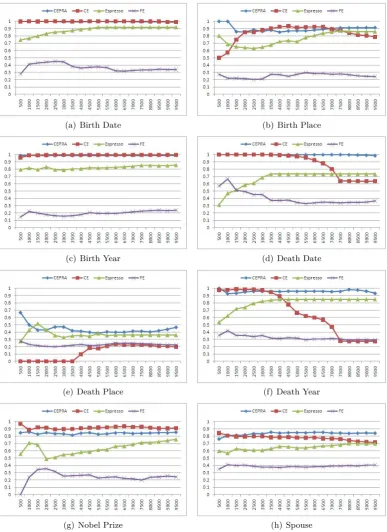
Figure 3: Precision of the TopN ranking patterns of the four compared approaches,CEP RA,
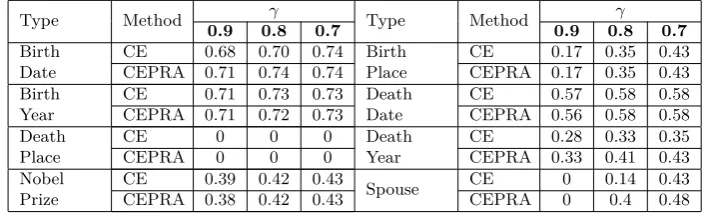
precision values at top N ranked patterns, we do not consider these two approaches in this table. First of all, in theDeath Year relationship, we can find our approach achieves a higher recall value than theCEapproach. As shown in Figure 3, theCEwould encounter a significant drop in this relationship at top 6000 to 7000 ranked patterns. Compared to our approach, we not only retain more reliable patterns but we also get a higher recall value. In theSpouserelationship, although our approach get a bit lower precision value, we get a higher recall value 0.4 compared to 0.14 for theCE approach. Generally speaking, in this empirical experiment, our approach would retain more reliable patterns while maintaining stable and high performance in different relationships.
6 Discussion
As mentioned in Sections 5, the performance of CE approach is not stable on differ-ent relationships. We assume that the problem is caused by 1) insufficidiffer-ent information to judge whether the target is correct, which means that the CE approach yields a bi-ased confidence score because of the influence of low quality seeds; 2) the lack of relevant sentences in the SH. In the F E approach, the precision value of the top N patterns is quite low because a pattern with a high frequency is always a general pattern. In some domains, highly frequent patterns may be useful for finding new instances. However, in relation extraction tasks, we need to find some related or specific patterns instead of highly frequent patterns. Next, we consider the performance of the Espresso approach. In this paper, we utilize collections comprised of sentences retrieved from the Web. This factor may affect the performance of the Espresso approach. However, the patterns highly oc-curred with some targets possible describe different relationships. Besides, how to compile a training set is an important issue when utilizing theEspresso approach. In this paper, we propose an approach to estimate a pattern’s reliability between different sets. We use an iteratively pattern-seed evaluation method to prune irrelevant patterns and low quality seeds. In Sections 5, we noted that the CEP RAachieved a stable performance on differ-ent relationships. However, we still need to resolve the following issues. 1) Because our approach was based on utilizing many seeds extracted from Wikipedia Infoboxes, we need to observe more details about the seed sets like the learning curve with different sizes of seed sets or the performance on different ratio of inferior quality seeds. 2) Currently, we do not consider the issue about pattern generation. Maybe we need to concern about uti-lizing more complex linguistic tools to generate frequent patterns and check our validation performance is consistent or not.
7 Conclusion
References
Agichtein, Eugene, Luis Gravano, Jeff Pavel, Viktoriya Sokolova, and Aleksandr Voskoboynik. 2001. Snowball: a prototype system for extracting relations from large text collections. In Proceedings of the 2001 ACM SIGMOD international conference on Management of data, SIGMOD ’01, p. 612, New York, NY, USA. ACM.
Alfonseca, Enrique, Pablo Castells, Manabu Okumura, and Maria Ruiz-Casado. 2006. A rote extractor with edit distance-based generalisation and multi-corpora precision calculation. InProceedings of the COLING/ACL on Main conference poster sessions, COLING-ACL ’06, pp. 9–16, Stroudsburg, PA, USA. Association for Computational Linguistics.
Blohm, Sebastian, Philipp Cimiano, and Egon Stemle. 2007. Harvesting relations from the web: quantifiying the impact of filtering functions. In Proceedings of the 22nd national conference on Artificial intelligence - Volume 2, pp. 1316–1321. AAAI Press. Kozareva, Zornitsa and Eduard Hovy. 2010. Not all seeds are equal: measuring the quality of text mining seeds. InHuman Language Technologies: The 2010 Annual Conference of the North American Chapter of the Association for Computational Linguistics, HLT ’10, pp. 618–626, Stroudsburg, PA, USA. Association for Computational Linguistics. Mann, Gideon S. and David Yarowsky. 2005. Multi-field information extraction and
cross-document fusion. InProceedings of the 43rd Annual Meeting on Association for Computational Linguistics, ACL ’05, pp. 483–490, Stroudsburg, PA, USA. Association for Computational Linguistics.
Muslea, Ion. 1999. Extraction patterns for information extraction tasks: A survey. In AAAI-99 Workshop on Machine Learning for Information Extraction, pp. 1–6. Pantel, Patrick and Marco Pennacchiotti. 2006. Espresso: leveraging generic patterns for
automatically harvesting semantic relations. InProceedings of the 21st International Conference on Computational Linguistics and the 44th annual meeting of the Asso-ciation for Computational Linguistics, ACL-44, pp. 113–120, Stroudsburg, PA, USA. Association for Computational Linguistics.
Ravichandran, Deepak and Eduard Hovy. 2002. Learning surface text patterns for a question answering system. InProceedings of the 40th Annual Meeting on Association for Computational Linguistics, ACL ’02, pp. 41–47, Stroudsburg, PA, USA. Association for Computational Linguistics.
Ruiz-Casado, Maria, Enrique Alfonseca, and Pablo Castells. 2007. Automatising the learning of lexical patterns: An application to the enrichment of wordnet by extracting semantic relationships from wikipedia. Data Knowl. Eng., 61, 484–499, June.
Strehl, Alexander and Joydeep Ghosh. 2000. Value-based customer grouping from large retail data-sets. InIn Proceedings of the SPIE Conference on Data Mining and Knowl-edge Discovery, pp. 33–42.
Sung, Cheng-Lung, Cheng-Wei Lee, Hsu-Chun Yen, and Wen-Lian Hsu. 2009. Alignment-based surface patterns for factoid question answering systems. Integr. Comput.-Aided Eng., 16, 259–269, August.