Bidirectional Long Short-Term Memory Networks for
Relation Classification
Shu Zhang
1, Dequan Zheng
2, Xinchen Hu
2and Ming Yang
11
Fujitsu Research and Development Center, Beijing, China
{zhangshu, yangming}@cn.fujitsu.com
2
School of Computer Science and Technology, Harbin Institute of Technology,
Harbin, China
{dqzheng, xchu}@mtlab.hit.edu.cn
Abstract
Relation classification is an important se-mantic processing, which has achieved great attention in recent years. The main challenge is the fact that important infor-mation can appear at any position in the sentence. Therefore, we propose bidirec-tional long short-term memory networks (BLSTM) to model the sentence with complete, sequential information about all words. At the same time, we also use fea-tures derived from the lexical resources such as WordNet or NLP systems such as dependency parser and named entity rec-ognizers (NER). The experimental results on SemEval-2010 show that BLSTM-based method only with word embeddings as input features is sufficient to achieve state-of-the-art performance, and import-ing more features could further improve the performance.
1
Introduction
The automatic classification of semantic relations is an important task, which could offer useful in-formation for many applications, such as question answering, information extraction, the construc-tion and compleconstruc-tion of semantic or relaconstruc-tional knowledge base.
In this work, we focus on the classification of semantic relations between pairs of nominals (Hendrickx et al., 2010). Given a sentence S with annotated pairs of nominal e1 and e2, the task is to
classify which of the following nine semantic re-lations holds between the nominals: Cause-Effect,
Instrument-Agency, Product-Producer, Content-Container, Entity-Origin, Entity-Destination,
Component-Whole, Member-Collection, Mes-sage-Topic, or Other if it does not belongs to any of the nine annotated relations.
For example, News and commotion are con-nected in a Cause-Effect relation in the sentence “The news brought about a commotion in the of-fice.” In this instance, the relation between news
and commotion could be inferred by the meaning of the two nominals and the context of “brought about” around them. Therefore, how to grasp and represent the lexical and context information are the key research points for semantic relation clas-sification.
Supervised methods with carefully handcrafted features from lexical and semantic resources have achieved high performance (Hendrickx et al., 2010; Rink and Harabagiu, 2010). However, the selection of features and the effective integration of knowledge sources into relation classification seem to be difficult.
Recently, deep neural networks has been ap-plied with the aim of reducing the number of handcrafted features, and getting effective fea-tures from lexical and sentence level (Socher et al., 2012; Zeng et al., 2014; Yu et al., 2014).
Different from previous work, we propose bi-directional long short-term memory networks (BLSTM) to solve the relation classification. For every word in a given sentence, BLSTM has com-plete, sequential information about all words be-fore and after it. Long distance relationship may be solved in some extent in this networks. At the same time, we also use features derived from the lexical resources such as WordNet or NLP tools such as dependency parser and named entity rec-ognizers (NER). The experimental results show that only using word embedding as input features is enough to achieve state-of-the-art results. Im-porting more features could further improve the performance of the relation classification.
73
2
Related Work
SemEval-2010 task 8 focused on semantic rela-tion classificarela-tion, it provides a standard testbed to evaluate and compare the performance of dif-ferent approaches.
SVM (Rink and Harabagiu, 2010): Using SVM classifier and a number of features derived from NLP tools and many external resources, it achieves the highest performance among the par-ticipating systems (10 teams, 28 runs).
Neural network has got great achievement in many applications, it has also been utilized in re-lation classification as shown in the followings:
MV-RNN (Socher et al., 2012): They propose a recursive neural network model to learn compo-sitional vector representations for phrases and sentences of arbitrary syntactic type and length.
CNN (Zeng et al. (2014): Sentence level fea-tures are learned using a convolutional model, and concatenated with lexical features to form the fi-nal extracted feature vector.
FCM (Yu et al., 2014): They decompose the sentence into substructures, and extract features for each substructure. Finally they combine these features with the embeddings of words in this sub-structure to form a subsub-structure embedding.
CR-CNN (Santos et al., 2015): They propose network to learn a distributed vector representa-tion for each relarepresenta-tion class. A ranking loss func-tion is proposed to reduce the impact of artificial classes.
DepNN (Liu et al., 2015): Using a recursive neural network to model the subtrees, and a con-volutional neural network to capture the most im-portant features on the shortest path.
From the above works, we can see that many different neural network models have been ap-plied to solve relation classification recently. The main target is to learn the effective features in lex-ical and sentence level to represent the latent rela-tion between the given nominals.
Our work has the same target, and we try to ap-ply BLSTM to mine the sentence level features with its advantage of capturing long distance rela-tionship in a sentence. We also study the influence of adding features obtained from NLP tools and resources on the final classification performance.
3
Long Short Term Memory
The Long Short Term Memory architecture was proposed and extended (Hochreiter and Schmid-huber, 1997; Gers et al., 2002) with the motiva-tion on an analysis of Recurrent Neural Nets (Hochreiter et al., 2001), which found that long
time lags were inaccessible to existing architec-tures, because backpropagated error either blows up or decays exponentially.
A LSTM layer consists of a set of recurrently connected blocks, known as memory blocks. Each one contains one or more recurrently connected memory cells and three multiplicative units - the input, output and forget gates - that provide con-tinuous analogues of write, read and reset opera-tions for the cells. LSTM has achieved the best known results in handwriting recognition (Graves et al., 2009) and speech recognition (Graves et al., 2013).
Fig. 1. LSTM memory block with one cell
Figure 1 shows one cell of LSTM memory block. More precisely, the input xt to the cells is
multiplied by the activation of the input gate, the output to the net is multiplied by that of the output gate, and the previous cell values are multiplied by the forget gate. The net can only interact with the cells via the gates.
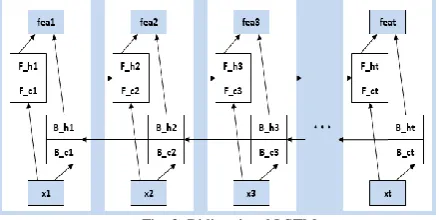
The basic idea of bidirectional LSTM is to pre-sent each training sequence forwards and back-wards to two separate recurrent nets, both of which are connected to the same output layer. This means that for every point in a given se-quence, the network has complete, sequential in-formation about all points before and after it. The structure of BLSTM is shown in Figure 2.
4
Methodology
We propose bidirectional long short-term memory networks (BLSTM) to solve the relation classifi-cation. It includes the following parts:
(1) Initial feature extraction: extract from the input sentence.
(2) Features embedding: transform all initial features into real-valued vector representa-tion.
(3) BLSTM-based sentence level representa-tion: get high level feature representation from step (2).
(4) Constructing feature vector: get lexical level and sentence level features from step (2) and step (3), and concatenate them to form the final feature vector.
(5) Classifying: feed final feature vector into a multilayer perceptron (MLP) and softmax layer to get the probability distribution of relation labels.
4.1 Initial Feature Extraction
Besides word and position features, we utilize NLP tools and resources to get POS, NER, de-pendency parse and hypernyms features. We aim to grasp more features which may indicate the re-lationship of the pair of two nominals. All these features could be classified into two types: lexical features and relative position relationship features.
We extract word, POS, NER and hypernyms as lexical features. The WordNet hypernyms are adopted as MVRNN (Socher et al., 2012).
Three different relative position relationship features are extracted and shown in Figure 3.
In this work we also utilize the relative word position proposed by Zeng et al. (2014). The po-sition feature (PF) is derived from the relative dis-tances of the current word to the target nominals
e1 and e2. For instance, the word sat in the
sen-tence shown in Figure 3, its relative distance to the target nominal cat (e1) and mat (e2) are 1 and -3.
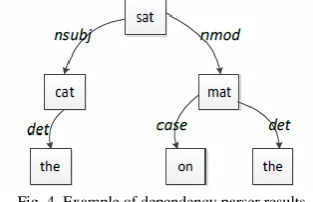
We also chose the Stanford dependency parser to capture long distance relationships between two nominals in a sentence. Our dependency fea-tures are based on paths in the dependency tree. Here, we extract two types of features:
Relative dependency features:
Relative root feature: r_r (root node), r_c
(child node of root), r_o (others)
Relative e1 feature: e1_e1 (e1 node), e1_c
(child node of e1), e1_p (parent node of e1), e1_o (others)
Relative e2 feature: e2_e2 (e2 node), e2_c
(child node of e2), e2_p (parent node of e2), e2_o (others)
Dep features: the tag of the current word to its parent node on the dependency tree
The above features represent the relationship between the current word and the target node, in-cluding the root, e1,e2 and their parent node.
Fig-ure 4 gives an example of dependency parser re-sults.
Fig. 3. Example of relative position relationship features
Fig. 4. Example of dependency parser results
4.2 Feature Embedding
Word Embedding is to map each word into a real-valued vector to represent syntactic and se-mantic information about the words.
Given an embedding matrix
W
wrd
R
dw| |V , where V is the size of word vocabulary. Each wordw has its embedding by using the matrix-vector product:
w wrd w
r W v
where vw is one-hot represenation, to get one column of the matrix Wwrd.
The size of the word embedding dw is a hy-perparameter, which is usually set 50 or 100.
For other kinds of initial features, we also trans-form them into a vector representation rkj, where j
means the jth type of feature, the dimension is dkj.
The initial value of the vector is random generated with the method proposed by Glorot and Bengio (2010).
Given a sentence x={w1,w2,…,wn}, all the initial
feature embeddings are concatenated according to the following format to represent each word:
𝑥𝑖 = [𝑟𝑖𝑤, 𝑟𝑖𝑘1, 𝑟𝑖𝑘2… , 𝑟𝑖𝑘𝑚]
where 𝑟𝑖𝑤 is the word embedding of word xi, 𝑟𝑖𝑘𝑗is
The parameter m is the size of features. Its value is 6 in this paper, because we choose the fol-lowing six kinds of features: POS, NER, hyper-nyms(WNSYN), position feature (PF), depend-ency feature (Dep), relative-dependdepend-ency feature (Relative-Dep).
4.3 BLSTM-based Sentence Level Repre-sentation
It is well known that humans can exploit longer context to mine the relationship of two nominals in a sentence. LSTM has shown its merit on cap-turing long distance relationship in different fields. With this motivation, we adopt BLSTM to get the sentence level representation.
The LSTM equations are given for a single memory block.
Input Gates:
𝑖𝑡 = 𝜎(𝑊𝑥𝑖𝑥𝑡+ 𝑊ℎ𝑖ℎ𝑡−1+ 𝑊𝑐𝑖𝑐𝑡−1+ 𝑏𝑖)
Forget Gates:
𝑓𝑡 = 𝜎(𝑊𝑥𝑓𝑥𝑡+ 𝑊ℎ𝑓ℎ𝑡−1+ 𝑊𝑐𝑓𝑐𝑡−1+ 𝑏𝑓)
Cells:
𝑐𝑡 = 𝑓𝑡𝑐𝑡−1+ 𝑖𝑡tanh(𝑊𝑥𝑐𝑥𝑡+ 𝑊ℎ𝑐ℎ𝑡−1+ 𝑏𝑐)
Output gates:
𝑜𝑡 = 𝜎(𝑊𝑥𝑜𝑥𝑡+ 𝑊ℎ𝑜ℎ𝑡−1+ 𝑊𝑐𝑜𝑐𝑡+ 𝑏𝑜)
Cell Outputs:
ℎ𝑡 = 𝑜𝑡tanh 𝑐𝑡
where σ is the activation function, and i, f, o and c
are respectively the input gate, forget gate, output gate and memory cell.
As shown in Figure 2, the network contained two sub-networks for the left and right sequence context. The outputs of these subnets for the ith
word are integrated in the following way:
𝐹𝑖= [𝐹_ℎ𝑖, 𝐹_𝑐𝑖, 𝐵_ℎ𝑖, 𝐵_ℎ𝑖]
where F and B refer to forward and backward di-rections.
4.4 Constructing Feature Vector
Inspired by the work from Zeng et al. (2014), we extract and concatenate sentence level features and lexical level features to form the finally ex-tracted feature vector.
Lexical level features are focused on the two target nominals e1and e2. We concatenate the
vec-tor got from feature embeddings and BLSTM layer to represent the two nominals as [xe1, Fe1, xe2,
Fe2].
Sentence level features are focused on the con-text information, which are constructed from the
output of BLSTM layer. As shown in Figure 5, the matrix got from BLSTM could be divided into A, B and C parts by e1 and e2. Max pooling operation
is adopted to extract the vector from A and B parts, B and C parts respectively. The vector m1 and m2
is concatenated to form the sentence level repre-sentation.
Fig. 5. Constructing sentence level feature vector
The motivation of constructing sentence level in this way is to strengthen the influence of the context between two entities, which are usually contained more information for indicating the re-lationship.
4.5 Classifying
A multilayer perceptron (MLP) will be used for combining sentence level feature and lexical fea-ture into the final extracted feafea-ture vector. Finally, the final extracted features are fed into a softmax classifier to predict the sematic relation labels.
5
Experiments
5.1 Data and metricsExperiments are conducted on the SemEval-2010 task 8 dataset (Hendrickx et al., 2010). It includes 8,000 training instances and 2,717 test instances. There are 9 relation types, and each type has two directions. If the instance could not refer to any of 9 relation types, there is a type Other.
We adopt the official evaluation metric to eval-uate our systems, which is based on macro-aver-aged F1-score for the nine proper relations and others.
5.2 Experiments setting
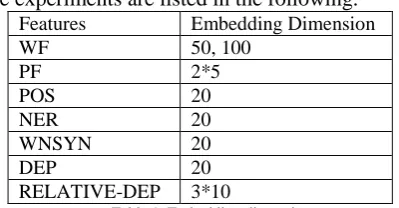
The dimension of feature embeddings used in the experiments are listed in the following.
Features Embedding Dimension WF 50, 100
PF 2*5
POS 20
NER 20
WNSYN 20
DEP 20
RELATIVE-DEP 3*10
Table 1. Embedding dimension
embed-Reference
Bryan Rink and Sanda Harabagiu. 2010. UTD: Classi-fying Semantic Relations by Combining Lexical and Semantic Resources. In Proceedings of 5th Interna-tional Workshop on Semantic Evaluation, pages 256–259.
Daojian Zeng, Kang Liu, Siwei Lai, Guangyou Zhou, and Jun Zhao. 2014. Relation Classification via Convolutional Deep Neural Network. In Proceed-ings of the 25th International Conference on Com-putational Linguistics (COLING), pages 2335–2344.
Iris Hendrickx, Su Nam Kim, Zornitsa Kozareva, Preslav Nakov, Diarmuid Ó Séaghdha, Sebastian Padó, Marco Pennacchiotti, Lorenza Romano, and Stan Szpakowicz. 2010. Semeval-2010 Task 8: Multi-way Classification of Semantic Relations Be-tween Pairs of Nominals. In Proceedings of the 5th International Workshop on Semantic Evaluation, pages 33–38.
Richard Socher, Brody Huval, Christopher D. Manning, and Andrew Y. Ng. 2012. Semantic Compositional-ity through Recursive Matrix-Vector Spaces. In Pro-ceedings of the Joint Conference on Empirical Methods in Natural Language Processing and Com-putational Natural Language Learning, pages 1201– 1211.
Yang Liu, Furu Wei, Sujian Li, Heng Ji, Ming Zhou, and Houfeng Wang. 2015. A Dependency-based Neural Network for Relation Classification. In Pro-ceedings of the 53rd Annual Meeting of the Associ-ation for ComputAssoci-ational Linguistics and the 7th In-ternational Joint Conference on Natural Language Processing (Short Papers), pages 285-290.
Cícero Nogueira dos Santos, Bing Xiang, and Bowen Zhou. 2015. Classifying Relations by Ranking with Convolutional Neural Networks. In Proceedings of the 53rd Annual Meeting of the Association for Computational Linguistics and the 7th International Joint Conference on Natural Language Processing, pages 626–634.
Alex Graves, Marcus Liwicki, Santiago Fernández, Roman Bertolami, Horst Bunke, Jürgen Schmidhu-ber. 2009. A Novel Connectionist System for Im-proved Unconstrained Handwriting Recognition. IEEE Transactions on Pattern Analysis and Machine Intelligence, 31(5): 855-868.
Alex Graves, Abdel-rahman Mohamed, and Geoffrey Hinton. 2013. Speech Recognition with Deep Re-current Neural Networks. IEEE International Con-ference on Acoustics, Speech and Signal Processing (ICASSP), pages 6645–6649.
Joseph Turian, Lev Ratinov, and Yoshua Bengio. 2010. Word Representations: A Simple and General
Method for Semi-Supervised Learning. In Proceed-ings of the 48th annual meeting of the association for computational linguistics, pages 384-394.
Jeffrey Pennington, Richard Socher, and Christopher Manning. 2014. GloVe: Global Vectors for Word Representation. In Proceedings of the Empirical Methods in Natural Language Processing, pages 1532-1543.
Xavier Glorot and Yoshua Bengio. 2010. Understand-ing the Difficulty of TrainUnderstand-ing Deep Feedforward Neural Networks. International conference on artifi-cial intelligence and statistics, pages 249-256.
Mo Yu, Matthew R. Gormley, and Mark Dredze. 2014. Factor-based Compositional Embedding Models. In NIPS Workshop on Learning Semantics.
Sepp Hochreiter and Jürgen Schmidhuber. 1997. Long Short-Term Memory. Neural Computation, 9(8):1735–1780.
Sepp Hochreiter, Yoshua Bengio, Paolo Frasconi, and Jürgen Schmidhuber. 2001. Gradient Flow in Recur-rent Nets: the Difficulty of Learning Long-Term Dependencies. In Kremer, S. C.and Kolen, J. F., ed-itors, A Field Guide to Dynamical Recurrent Neural Networks. IEEE Press.