CSEIT1723272 | Received : 09 June 2017 | Accepted : 25 June 2017 | May-June-2017 [(2)3: 881-886]
International Journal of Scientific Research in Computer Science, Engineering and Information Technology © 2017 IJSRCSEIT | Volume 2 | Issue 3 | ISSN : 2456-3307
881
Arduino Based Automatic Irrigation System Using IoT
Pavankumar Naik, Arun Kumbi, Vishwanath Hiregoudar, Chaitra N K
, Pavitra H K
, Sushma B S,
Sushmita J H , Praveen Kuntanahal
Department of computer Science and Engineering, VTU, Karnataka, India
ABSTRACT
India is mainly an agricultural country. Agriculture is the most important occupation for the most of the Indian families. It plays vital role in the development of agricultural country. In India, agriculture contributes about 16% of total GDP and 10% of total exports. Water is main resource for Agriculture. Irrigation is one method to supply water but in some cases, there will be lot of water wastage. Therefore, in this regard to save water and time we have proposed project titled Arduino based automatic irrigation system using IoT. In this proposed system, we are using various sensors like temperature, humidity, soil moisture sensors that sense the various parameters of the soil. In addition, based on soil moisture value land is automatically irrigated by ON/OFF of the motor. These sensed parameters and motor status will be displayed on user android application.
Keywords: Internet of things(IoT), Arduino, Temperature sensor, Soil moisture sensor, And Humidity sensor.
I.
INTRODUCTION
Agriculture is the backbone of Indian Economy. In today’s world, as we see rapid growth in global population, agriculture becomes more important to meet the needs of the human race. However, agriculture requires irrigation and with every year we have more water consumption than rainfall, it becomes critical for growers to find ways to conserve water while still achieving the highest yield. But in the present era, the farmers have been using irrigation technique through the manual control in which they irrigate the land at the regular interval. According to statistics, agriculture uses 85% of available freshwater resources worldwide, and this percentage will continue to be dominant in water consumption because of population growth and increased food demand. There is an urgent need to create strategies based on science and technology for sustainable use of water, including technical, agronomic, managerial and institutional improvements. Agricultural irrigation based on Internet technology is based on crop water requirement rules. By using Internet technology and sensor network technology we can control water wastage and to maximize the scientific technologies in irrigation methods. Hence it can greatly improve the utilization of water and can increase water productivity.
The Internet of Things (IoT) is a technology where in a mobile device can be used to monitor the function of a device. The Internet of Things (IoT) is concerned with interconnecting communicating objects that are installed at different locations that are possibly distant from each other. Internet of Things (IoT) is a type of network technology, which senses the information from different sensors and make anything to join the Internet to exchange information.
It can also be used to modify the status of the device. The central processing unit will also include communication device to receive data from the sensors and to be relayed to the user’s device. This will be done using a higher communication device such as a Wi-Fi module. The data processed by the central module is converted to meaningful data and relayed to the user. The user can view the data with the help of a handheld device such as a mobile phone or a tablet. Nowadays water scarcity is a big concern for farming. This project helps the farmers to irrigate the farmland in an efficient manner with automated irrigation system based on soil moisture.
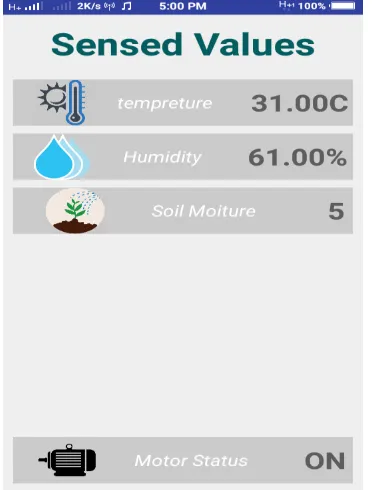
Temperature, moisture and humidity readings are continuously monitored by using temperature, moisture and humidity sensor and send these values to the assigned IP address. Android application continuously collects the data from that assigned IP address. Once the soil moisture values are exceeded the particular limit then the relay, which is connected to the aurdino microcontroller controls the motor. The android application is a simple menu driven application, with 4 options. This includes motor status , moisture , temperature and humidity values. The motor status indicates the current status of the pump.
II.
LITERATURE SURVEY
Primary investigation is carried out under the following stages, such as Understanding the existing approaches, Understanding the requirements, Developing an abstract for the system.
In this paper, soil moisture sensor, temperature and humidity sensors placed in root zone of plant and transmit data to android application. Threshold value of soil moisture sensor that was programmed into a microcontroller to control water quantity. Temperature, humidity and soil moisture values are displayed on the android application.
This paper on "Automatic Irrigation System on Sensing Soil Moisture Content" is intended to create an automated irrigation mechanism which turns the pumping motor ON and OFF on detecting the dampness content of the earth. In this paper only soil moisture value is considered but proposed project provided extension to this existed project by adding temperature and humidity values. [2]
―Remote Monitoring in Agricultural Greenhouse Using Wireless Sensor and Short Message Service (SMS).In this paper they are sending data via sms but proposed system sends the values to mobile application.[5]
This proposed paper is arduino based remote irrigation system developed for the agricultural plantation, which is placed at the remote location and required water provides for plantation when the humidity of the soil goes below the set-point value. But in this we did not aware about the soil moisture level so to overcome this drawback proposed system included with extra feature
soil moisture value and temperature value which displayed on the farmer mobile application.[6]
―Irrigation Control System Using Android and GSM for Efficient Use of Water and Power‖ this system made use of GSM to control the system which may cost more so to overcome that proposed system used arduino yun board which already consist of in build wifi module[13]
―Microcontroller based Controlled Irrigation System for Plantation‖ In this paper old generation with lesser memory microcontroller is used to control the system but proposed system made use of arduino yun board which is user friendly and it helps to dump the programs easily.[15]
―A wireless application of drip irrigation automation supported by soil moisture sensors‖ in this paper irrigation is carried out using soil moisture values but extend to this proposed system displays temperature and humidity values.[18]
By referring all above papers it is found that no such systems are existed with all integrated features but proposed system includes these all features such as displaying temperature, humidity and soil moisture values and also automatic switching on and off of motor by considering soil moisture values.
III.
PROPOSED SYSTEM
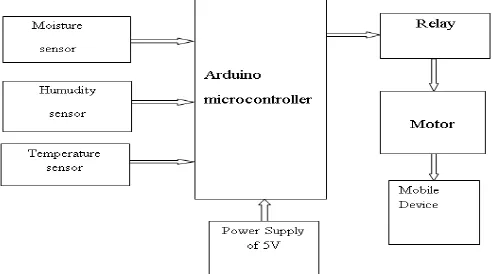
This below figure 3.1 is a overall block diagram of arduino based automatic irrigation system which consist of three sensors which are connected to controller and sensed values from these sensors are send to the mobile application .
Figure 1 shows the block diagram of smart irrigation system with IoT. Farmers start to utilize various monitoring and controlled system in order to increase the yield with help of automation of an agricultural parameters like temperature, humidity and soil moisture are monitored and control the system which can help the farmers to improve the yield.
This proposed work includes an embedded system for automatic control of irrigation. This project has wireless sensor network for real-time sensing of an irrigation system. This system provides uniform and required level of water for the agricultural farm and it avoids water wastage. When the moisture level in the soil reaches below threshold value then system automatically switch ON the motor. When the water level reaches normal level the motor automatically switch OFF. The sensed parameters and current status of the motor will be displayed on user’s android application.
OBJECTIVE OF THE PROJECT
The main objective of this project is to provide an automatic irrigation system thereby saving time, money & power of the farmer. The traditional farm-land irrigation techniques require manual intervention. With the automated technology of irrigation the human intervention can be minimized.
IV.
DESIGN
Design of a system explains temperature, humidity and soil moisture values using flow chart.
A.
Flow Chart
A flowchart is a graphic representation of a logic
sequence,
work
or
manufacturing
process,
organization chart, or similar formalized structure.
The flowchart is a means to visually present the
flow of data through an information processing
systems.
TEMPERATURE AND HUMIDITY SENSOR
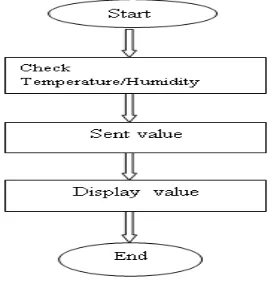
This below figure 2 shows the sensed values of temperature and humidity.
Figure 2: Flowchart of Temperature/Humidity Sensor
The DHT11 is a basic, digital temperature and humidity sensor. It uses a capacitive humidity sensor and a thermistor to measure the surrounding air, and spits out a digital signal on the data pin(no analog pins needed).It is simple to use, but requires careful timing to grab data. Humidity sensors are used for measuring moisture content in the atmosphere. Then current temperature, humidity values are send to the microcontroller, those values will display in the users android app.
SOIL MOISTURE SENSOR
This below figure 3 shows the procedure of displaying soil moisture value.
Soil moisture sensors measure the water content in soil. Moisture in the soil is an important component in the atmospheric water cycle.Sensor module outputs a high level of resistance when the soil moisture is low. It has both digital and analog outputs. Digital output is simple to use, but it is not as accurate as analog output based on moisture level motor gets turn on/off automatically.
V.
IMPLEMENTATION
The proposed agricultural system is designed to solve to find an optimal solution to the water crisis. The design implements IoT technology using an android device, a main controlling unit (MCU), sensors to measure various parameters and a water pump, which will be used to supply water to the farm.
A.PROGRAMMING TECHNIQUES
This programming technique includes explanation about thingspeak web server and it uses JSON format to convert stored data into human readable form.
THINGSPEAK
According to its developers, "ThingSpeak is an open source Internet of Things (IoT) application and API to store and retrieve data from things using the HTTP protocol over the Internet or via a Local Area Network. ThingSpeak enables the creation of sensor logging applications, location tracking applications, and a social network of things with status updates". ThingSpeak was originally launched by ioBridge in 2010 as a service in support of IoT applications. ThingSpeak has integrated support from the numerical
computing software Matlab from Math
works. Allowing ThingSpeak users to analyze and visualize uploaded data using Matlab without requiring the purchase of a Matlab license from Math works. ThingSpeak has a close relationship with Math works. In fact, all of the ThingSpeak documentation is
incorporated into the Math works' Matlab
documentation site and even enabling registered Math
works user accounts as valid login credentials on the ThingSpeak website. The terms of service and privacy policy of ThingSpeak.com are between the agreeing user and Math works.
JSON FORMAT
In computing, JavaScript Object Notation or JSON is
an open standard file format that uses
human-readable text to transmit data objects consisting of attribute–value pairs and array data types (or any other serializable value). It is a very common data
format used for asynchronous browser/server
communication, including as a replacement for XML in some AJAX-style systems. JSON is a
language-independent data format. It was derived
from JavaScript, but as of 2017 many programming languages include code to generate and parse JSON-format data. The official Internet media type for JSON
is application/json. JSON filenames use the
extension .json.
B. PROTOTYPE
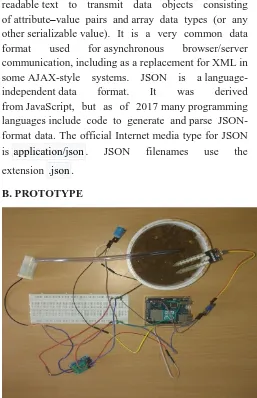
Figure 4: Prototype of Automatic Irrigation System
Figure 4 shows the prototype of automatic irrigation system. The microcontroller arduino is connected to temperature sensor, soil moisture sensor, humidity sensor, relay and motor. These sensors sense the various parameter of the soil, motor is used to provide water to the land. And relay is used control the motor.
Although a conclusion may review the main points of
Figure 5 : Home page
Figure 6: Sensed values displayed on user android application
VII.
CONCLUSION
The application of agriculture networking technology is need of the modern agricultural development, but also an important symbol of the future level of agricultural development; it will be the future direction of agricultural development. After building the agricultural water irrigation system hardware and
analyzing and researching the network hierarchy features, functionality and the corresponding software architecture of precision agriculture water irrigation systems, actually applying the internet of things to the highly effective and safe agricultural production has a significant impact on ensuring the efficient use of water resources as well as ensuring the efficiency and stability of the agricultural production.
With more advancement in the field of IoT expected in the coming years, these systems can be more efficient, much faster and less costlier. In the Future, this system can be made as an intelligent system, where in the system predicts user actions, rainfall pattern, time to harvest and many more features which will make the system independent of human operation.
VIII.
REFERENCES
[1] Anurag D, Siuli Roy and SomprakashBandyopadhyay, ―Agro-Sense: Precision Agriculture using Sensor-based Wireless Mesh Networks‖, ITU-T ―Innovation in NGN‖, Kaleidoscope Conference, Geneva 12-13 May 2008.
[2] C. Arun, K. Lakshmi Sudha ―Agricultural Management using Wireless Sensor Networks – A Survey‖2nd International Conference on Environment Science and Biotechnology IPCBEE vol.48 (2012) © (2012) IACSIT Press, Singapore 2012.
[3] Bogena H R, Huisman J A, OberdÊrster C, etal. Evaluation of a low cost soil water content sensor for wireless network applications [J].Journal of Hydrology, 2007.
[4] R.Hussain, J.Sehgal, A.Gangwar, M.Riyag― Control of irrigation automatically by using wireless sensor network‖ International journal of soft computing and engineering, vol.3, issue 1, march 2013.
[5] Izzatdin Abdul Aziz, MohdHilmiHasan, Mohd Jimmy Ismail, MazlinaMehat, NazleeniSamihaHaron, ―Remote Monitoring in Agricultural Greenhouse Using Wireless Sensor and Short Message Service (SMS)‖, 2008. [6] Jeonghwan Hwang, Changsun Shin, and Hyun
[7] Ning Wang, Naiqian Zhang, Maohua Wang, ―Wireless sensors in agriculture and food industry—Recent development and future perspective‖, published in Computers and Electronics in Agriculture 2006.
[8] Pepper Agro, ―M-Drip Kit‖ Internet: www.pepperagro.i/mdripkitmanual.htmlSiuli Roy, SomprakashBandyopadhyay, ―A Test-bed on Real-time Monitoring of Agricultural Parameters using Wireless Sensor Networks for Precision Agriculture‖ 2007.
[9] Yiming Zhou, Xianglong Yang, Liren Wang, Yibin Ying, A wireless design of low-cost irrigation system using ZigBee technology, International Conference on Networks Security, Wireless Communications and Trusted Computing , IEEE 2009.
[10] Zhang xihai, Zhang changli Fang junlong. Smart Sensor Nodes for Wireless Soil Temperature Monitoring Systems in Precision Agriculture 2009.
[11] R.Suresh, S.Gopinath, K.Govindaraju, T.Devika, N.SuthanthiraVanitha, ―GSM based Automated Irrigation Control using Raingun Irrigation System‖, International Journal of Advanced Research in Computer and Communication Engineering Vol. 3, Issue 2, February 2014. [12] Pavithra D.S, M. S .Srinath, ―GSM based
Automatic Irrigation Control System for Efficient Use of Resources and Crop Planning by Using an Android Mobile‖, IOSR Journal of Mechanical and Civil Engineering (IOSR-JMCE) Vol 11, Issue I, Jul-Aug 2014, pp 49-55.
[13] LaxmiShabadi, NandiniPatil, Nikita. M, Shruti. J, Smitha. P&Swati. C, and Software Engineering, Volume4, Issue 7, July 2014. ―Irrigation Control System Using Android and GSM for Efficient Use of Water and Power‖,International Journal of Advanced Research in Computer Science
[14] Shiraz Pasha B.R., Dr. B Yogesha, ―Microcontroller Based Automated Irrigation System‖, The International Journal Of Engineering And Science (IJES), Volume3, Issue 7, pp 06-09, June2014.
[15] S. R. Kumbhar, Arjun P. Ghatule, ―Microcontroller based Controlled Irrigation System for Plantation‖, Proceedings of the International MultiConference of Engineers and Computer Scientists 2013VolumeII, March 2013.
[16] Yunseop (James) Kim, Member, IEEE, Robert G. Evans, andWilliam M. Iversen, ―Remote Sensing and Control of an Irrigation System Using a Distributed Wireless Sensor Network‖,
IEEE TRANSACTIONS ON
INSTRUMENTATION AND
MEASUREMENT, Volume 57, Number 7, JULY 2008.
[17] Venkata Naga RohitGunturi, ―Micro Controller Based Automatic Plant Irrigation System‖, International Journal of Advancements in Research & Technology, Volume 2, Issue4, April-2013.
[18] MahirDursun and SemihOzden, ―A wireless application of drip irrigation automation supported by soil moisture sensors‖, Scientific Research and Essays, Volume 6(7), pp. 1573-1582, 4 April, 2011.
[19] Joseph Bradley, Joel Barbier, Doug Handler: Available online at : http://www.cisco.com/web/about/ac79/docs/inno v/IoE_Economy.pdf consulted on February 2014.