CSEIT1724151| Received : 08 August 2017 | Accepted : 19 August 2017 | July-August-2017 [(2)4: 608-614]
International Journal of Scientific Research in Computer Science, Engineering and Information Technology © 2017 IJSRCSEIT | Volume 2 | Issue 4 | ISSN : 2456-3307
608
A Significant Big Data Interpretation Using Map Reduce
Algorithm
Bheemisetty Venkata Sivaiah
1, Dr. M. Rudra Kumar
21M.Tech.,(PG Scholar), Department of CSE, Annamacharya Institute of Technology & Sciences, Rajampet, Kadapa,
Andhra Pradesh, India
2Professor, Department of CSE, Annamacharya Institute of Technology & Sciences, Rajampet, Kadapa, Andhra
Pradesh, India
ABSTRACT
Hadoop is an open source file system that can have a framework is processed over the big data. The fast growth of ontologies nowadays that can grow significantly performs normally and also some major issues in the efficiency and scalability reasoning methods. The traditional and centralized reasoning methods do not handle large ontologies. The system proposed a large scale ontologies for healthcare is applied to use map reduce and hadooframework. Semantic inference method attracts much attention of users from all fields. Many inference engines have been developed to support the reasoning over semantic web. The system also proposed a transfer inference forest and effective assertional triples for reduce the storage for reasoning methods and also simplified and accelerate. The Ontology Web Language which provides the semantic web access to all the relationships maintained by the syntaxes, specifications and expressions. With a large volume of Semantic Web data and their fast growth, diverse applications have emerged in a plurality of domains poses new challenges for ontology mapping. Ontology mapping can provide more correct results if the mapping process can deal with uncertainty effectively that is caused by the incomplete and inconsistent information used and produced by the mapping process. As it is evolving into a global knowledge-based framework, supporting knowledge searching over such a big and increasing dataset has become an important issue. A survey was made for different reasoning approaches that focus on semantic inferences. This paper describes about how the reasoning approaches process on users’ queries. This paper proposes an incremental and distributed inference method for large-scale Ontologies by using MapReduce, which realizes high-performance reasoning and runtime searching, especially for incremental knowledge base. By constructing transfer inference forest and effective assertional triples, the storage is largely reduced and the reasoning process is simplified and accelerated.
Keywords : Semantic Web, Transfer Inference Forest, Ontology bases, Effective Assertional Triple, RDF, MapReduce.
I.
INTRODUCTION
An Extension of Web is the Semantic Web [2]. The concept of the Semantic Network Model was formed in the 1960s to represent semantically structured knowledge. When applied in the context of the modern internet, it extends the network of hyperlinked human-readable web pages by inserting machine-human-readable metadata about pages and how they are related to each other. This enables agents to access the web more
incremental and distributedinference method (IDIM) for large-scale RDF datasets via Map Reduce. The choice of Map Reduce is motivated by the fact that it can limit data exchange and alleviate load balancing problems by dynamically scheduling jobs on computing nodes.
Provided that each mapping operation is independent of the others, all maps can be performed in parallel through in practice this is limited by the number of independent data sources and o the number of CPUs near each source Semantic Web is the large volume of the information that contains the information in the description framework and specify vocabularies and set the rules for handling the data. The ontology web language algorithm is implemented in this concept to represent and handle large scale ontologies with the representation of transformation. Healthcare is mainly having the social potential that can be explored in semantic web. The inference model is used to represent the large datasets that can execute a fast process in the online queries. Existing reasoning methods can take too much of time to handle large datasets. Resource description framework is the representation of ontologies that can be describing the knowledge in the semantic web. In the resource description framework two functions are used to reduce the storage and efficient reasoning process that are transfer inference forest (TIF) and effective assertional triple (EAT).The relationship between the new triples is updated by these two methods to describe subject, predicate and object by implementing OWL algorithm.
Since the data objects in a variety of languages are typically trees, tree pattern matching (twig) is the central issue. Naturally queries in the XML query language specify the patterns of selected predicates on multiple elements which have a tree structured relationships. The complex query tree pattern is usually decomposed into set of basic parent-child and ancestor- descendant relationships. But finding all these basic structural relationships occurrences is a complex process in the XML query processing. There are various techniques provides wireless XML
dissemination schemes but none of them supports twig pattern queries since they does not have parent child relationship. Normal index methods divides a query into several sub-queries, thereby join the results together to provide the final answer.
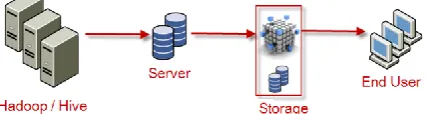
Hadoop Architecture
Figure 1. Hadoop Architecture
Characteristic
VOLUME: Many factors contribute to the increase in data volume. Transaction based data stored through the years. Unstructured data streaming in form social media. Increasing amounts of sensor and machine-to-machine data being collected. In the past, excessive data volume was a storage issue. But with decreasing storage costs, other issues emerge, including how to determine relevance within large data volumes and how to use analytics to create value from relevant data VELOCITY: Data is streaming in at unprecedented speed and must be dealt with in a timely manner. RFID tag, sensors and smart metering are driving the need to deals with torrents of data in near-real time. Reacting quickly enough to deal with data velocity is a challenge for most organizations
VARIETY: Data today comes in all types of formats. Information created from line-of-business applications. Managing, merging and governing different varieties of data are something many organizations
VARIABILITY: In addition to the increasing velocities and varieties of data, data flows can be highly inconsistent with periodic peals. Daily, seasonal and event-triggered peal data loads can be challenging to manage. Even more so with unstructured data involved COMPLEXITY: Today’s data comes from multiple sources and it is still an undertaking to link, match, cleanse and transform data across systems. However, it is necessary to connect and correlate relationships hierarchies and multiple data linkages or your data can quickly spiral out of control
II.
RELATED WORK
Semantic inference has attracted much attention from both Academic and industry nowadays. Many inference engines have been developed to support the reasoning over Semantic For example, Anagnostopoulos and proposed two fuzzy inference engines based on the knowledge- representation model to enhance the context inference and classification for the well-specified information in
Semantic Web introduced a novel Rule XPM approach that consisted of a concept separation strategy and a semantic inference engine on a multiphase forward- chaining algorithm to solve the semantic inference problem in heterogeneous e-marketplace activities. The SD Type method based on statistical distribution of types in RDF datasets to deal with noisy data presented a temporal extension of the web ontology language (OWL) for expressing time-dependent information. To deal with such large base, some researchers turn to distributed reasoning methods. Weaver and Hendler presented a method for materializing the complete finite RDF closure in a scalable manner and evaluated it on hundreds of millions of triples. Urbani et al. proposed a scalable distributed reasoning method for computing the closure of an RDF graph based on MapReduce and implemented it on top of Hadoop. MapReduce-based reasoning and then introduced Map resolve method for more expressive logics. However, these methods considered no influence of increasing data volume, and did not answer how to process users’ queries. The storage of RDF closure is thus not a small amount and the query on it takes nontrivial time.
III.
MODULES
Large Data Collection
In this module, collection of a large datasets is very large that makes a challenging in the traditional applications. These large datasets is collected from various applications in the real time datasets. There are so many large datasets which is collected from the knowledge representation. In the healthcare domain also collect a large datasets with millions of files are running in every countries. These datasets are maintained by security and provides a high transmission range for communicating the system.
Transform the RDF formation
In this module semantic web is provide the resource description framework from the content of all the ontology bases that representing the schemas. RDF is a basic representation of the ontologies that can specify the semantics and syntaxes for the knowledge bases through schemas. The updated triples are expressed with the statements and attributes that define the taxonomies with the specifications of ontologies.
Hbase function provides a real time data that can be access and generates the read and write access to very large tables. It also performs the commodity hardware with cluster nodes and generates six tables. Hbase also store the intermediate results from the real time data and return the results from the queries.
Hadoop Processing
Hadoop is open source software that is integrated of the distributed processing and compatible with large datasets. It also provides a framework for commodity hardware and a cluster nodes access from the large datasets. Hadoop also designed with the scale up of single sever to thousand of machines with a very high degree of fault tolerance. The reliability of software and the process for detection of failure in hardware can be easily found in the hadoop environment. By implementing the hadoop is to run the process in linux and performs a main function is MapReduce concept is performed for efficiency in a real time data.
1) TIF/EAT Construction
Transfer Inference forest and Effective Assertional Triple is the process of constructing an RDF formation of specifying to functions are Domain and range. This subset of domain and range specify the attributes which convert the information available in the medical datasets like patient details disease name, illnesses and drugs which specify its value to the range and domain. Forest is the single or multiple trees which generate the relations that is linked with property of the RDF subsets.
2) Hbase Processing
Hbase is a distributed and a scalable process of integration of the data store in the hadoop
IV.
METHODOLOGY
A. Resource Description Framework (RDF)
Definition 1: Ontological triples are the ones from which significant inferences can be derived, i.e., the triples with predicate rdfs:domain , rdfs:range , rdfs:subClassOf , rdfs:subPropertyOf , and those with predicate rdf:type and object rdfs:Datatype or rdfs:Class or rdfs:ContainerMembershipProperty
Definition 2: Assertional triples are the ones that are not Ontological triples
Table I. Rule Statement
B.MapReduce
In this paper, our inference method is based on MapReduce and Hadoop platform. MapReduce is a programming model for parallel and distributed processing of batch jobs. Each job contains a map and a reduce, in which the map phase assigns a key to each element and then partitions the input data, while the reduce phase processes each partition in parallel and merges all intermediate values with the same key into final results. It provides real-time read/write access to very large tables (billions of rows and millions of columns) on clusters of commodity hardware. Because of its features in linear scalability, automatic failover support
V.
INCREMENTAL AND DISTRIBUTED
INFERENCE OVER LARGE-SCALE RDF
DATASET
This section presents the IDIM over large-scale RDF datasets. Before its detailed explanation,
gives an overview of its modules and main steps. The input of the system is incremental RDF data files. As our knowledge increases, new RDF data continuously arrive as commonly seen in practice. Then the dictionary encoding and triples indexing module encodes the input triples, and for each triple an index is built based on an inverted index method. After that the incremental triples are separated into the incremental ontological triples and incremental assertional ones. At the first time that we run the system, the TIF/EAT Construction Module generates the TIF based on the ontological and assertional triples. For the second time and thereafter, the TIF/EAT Update Module only updates relative TIF and EAT. The created or updated ones are stored in TIF and EAT storages, respectively. The query processing module takes users’ queries as input, and reasons over the TIF and EAT to obtain the query results. Each module is introduced next
A. Dictionary Encoding and Triples Indexing
Since RDF data usually contain many statements made of terms that are either URIs or literals, i.e., long sequences of characters, their processing and storage have low performance. Therefore, we use an effective compression method to reduce the data size and increase the application performance. The dictionary encoding and triples indexing module encodes all the triples into a unique and small identifier to reduce the physical size of input data. Then the ontological and assertional triples are extracted from the original RDF data. To efficiently compress a large amount of RDF data in parallel, we run a MapReduce algorithm on input datasets to scan all the URIs line by line, and for each URI, a unique numeric ID is generated by the hash code method which is implemented in RDF dataset that contain in incremental mapping
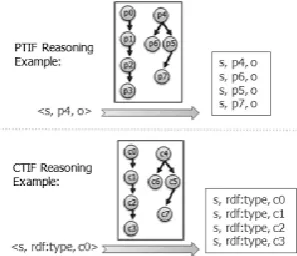
B. Reasoning over TIF
Definition 3: Forward Path of Edge/Node: In each forest, the forward path of node n or edge r is a route starting from
Figure 2. PTIF Construction
Algorithm 1 Reasoning over PTIF
begin
For each node p in PTIF, Q ← forward path of p
For each node q in Q,
Add triple <s, q, o> to R // generate the derived triple
Return R
end
Algorithm 2 Reasoning over DRTF
begin
For each node p in DRTF,
If p has a domain edge linked to node c
Add triple <s, rdf: type , c> to R If p has a range edge linked to node c
Add triple <o, rdf: type , c>
to R Return R end
Algorithm 3 Reasoning over CTIF
begin
For each node o in CTIF, C ← forward path of o
For each node c in C,
Add triple <s, rdf: type, c>
to R Return R End
VI.
SYSTEM IMPLEMENTATION AND
COMPARISON
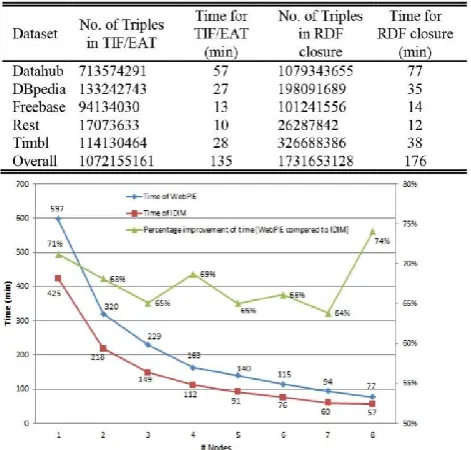
For IDIM, the output triples are the ones in TIF and EAT, and the time for generating TIF/EAT is recorded. For WebPIE, the output triples are the ones in RDF closure, and the time for computing RDF closure is recorded. The result is shown in Table III. From it, we can conclude that the reasoning time for our method is less than WebPIE (76.7% of WebPIE in total time) and the output triples for our method is much fewer than WebPIE (only 61.9% of WebPIE)
Table I - Data Sets used in the experiment
Performance Evaluation
The dataset for our experiment is from the BTC dataset was built to be a realistic representation of the Semantic Web and therefore can be used to infer statistics that are valid for the entire Web of data. BTC consists of five large datasets, Datahub, DBpedia, Freebase, Rest, and Timbl, and each dataset contains several smaller ones. Their overview is shown in Table II. In order to show the performance of our method, we compare IDIM with WebPIE, which is the state-of-the-art for RDF reasoning. As the purpose of this paper is to speed up the query for users, we use WebPIE to generate the RDF closure and then search the related triples as the output for the query. The Hadoop configurations are identical to that in IDIM. We run three times of the two methods on each dataset and then calculate the number of the output triples and the time
Figure 4. Processing time on different nodes (Datahub dataset)
VII.
CONCLUSION
In the big data era, reasoning on a Web scale becomes increasing challenging because of the large volume of data involved and the complexity of the task. Full reasoning over the entire dataset at every update is too time-consuming to be practical. The Hadoop configurations are identical to that in IDIM. This paper for the first time proposes an IDIM to deal with large-scale incremental RDF datasets to our best knowledge. The result is scalable and the output triples are the onces in TIF and EAT. The construction of TIF and EAT significantly reduces the computation time for the incremental inference as well as the storage for RDF triples. Meanwhile, users can execute their query more efficiently without computing and searching over the entire RDF closure used in the prior work. We have evaluated our system on the BTC benchmark and the results show that our method outperforms related ones in nearly all aspects
VIII.
REFERENCES
[1]. G. Antoniou and A. Bikakis DR-Prolog: A system for defensible reasoning with rules and Ontologies on the Semantic Web IEEE Trans Know Data Eng., vol. 19, no. 2, pp. 233-245, Feb. 2007.
[2]. J. Cheng, C. Liu, M. C. Zhou, Q. Zeng, and A. Yla- Automatic Composition of Semantic Web
services based on fuzzy predicate Petrinets, IEEE Trans. Autom Science Eng., Nov. 2013, to be published.
[3]. J. Dean and S. Ghemawat, MapReduce: Simplified data processing on large clusters, Commun. ACM, 2008.
[4]. IEEE TRANSACTIONS ON
CYBERNETICS,VOL 45, NO . 1, JANUARY 2015
[5]. J. Guo, L. Xu, Z. Gong, C.-P. Che, and S. S.Chaudhry, Semantic Inference on heterogeneous e- Marketplace activities, IEEE Trans. Syst., Man, Cybern. A, Syst,Humans, vol. 42, no. 2, pp. 316-Mar. 2012.
[6]. M. J. Iba nez, J. Fabra, P. Álvarez, and J. Ezpeleta, Model checking analysis of semantically annotated business processes, IEEE Trans. Syst.,Man, Cybern. A, Syst., Humans, vol. 42, no. 4, pp. 854-867, Jul. 2012.
[7]. D. Kourtesis, J. M. Alvarez-Rodriguez, and I. Paraskakis, Semantic based QoS management in systems: Current status and future challenges, Future Gener. Comput. Syst., vol. 32, pp. 307-323, Mar.2014.
[8]. M.S. Marshall, Emerging practices for mapping and linking life science data using RDF—A case series, Jul. 2012.
[9]. M. Nagy and M. Vargas-Vera, Multiagent Ontology mapping framework for the Semantic Web, IEEE Trans. Syst., Man, Cybern. A, Syst., Humans, vol. 41, no. 4, pp. 693-704, Jul. 2011. [10]. H. Paulheim and C. Bizer, Type inference on
noisy RDF data, in Proc.ISWC, Sydney, NSW, Australia, 2013, pp. 510-525.
[11]. V. R. L. Shen, Correctness in hierarchical knowledge-based requirements, IEEE Trans. Syst., Man, Cyber. B, Cybern., vol. 30, no. 4,pp. 625-631, Aug. 2000
[12]. J. Urbani, S. Kotoulas, E. Oren, and F. Harmelen Scalable distributed reasoning using MapReduce , in Proc. 8th Int. Semantic Web Conf.,Chantilly, VA, USA, Oct. 2009, pp. 634-649
[13]. J. Urbani, S. Kotoulas, J. Maassen , F. V. Harmelen, and H. Bal,WebPIE : A web-scale parallel inference engine using
[14]. J. Web Semantics, vol. 10, pp. 59-75, Jan. 2012.