Annotating a corpus to develop and evaluate discourse entity realization
algorithms: issues and preliminary results
Massimo Poesio
University of Edinburgh,HCRCand Informatics
Abstract
We are annotating a corpus with information relevant to discourse entity realization, and especially the information needed to decide which type ofNPto use. The corpus is being used to study correlations betweenNPtype and certain semantic or discourse features, to evaluate hand-coded algorithms, and to train statistical models. We report on the development of our annotation scheme, the problems we have encountered, and the results obtained so far.
1.
MOTIVATIONS
The goal of theGNOMEproject is to developNP gen-eration algorithms that can be used by real systems, with different architectures, and operating in realistic domains. As part of the project, we have been annotating a corpus with the syntactic, semantic and discourse information that is needed for different subtasks of NP realization, includ-ing the task of decidinclud-ing on the most appropriateNPtype to be used to realize a certain discourse entity (proper name, definite description, pronoun, etc.), and the task of orga-nizing the additional information to be expressed with that discourse entity. We are using the annotated corpus to ex-tract information useful to the development of hand-coded algorithms for the subtasks ofNPrealization we are focus-ing on, to develop statistical models of these subtasks, and to evaluate both types of algorithms. Conversely, we have been using the results of this evaluation to verify the com-pleteness of our annotation scheme and to identify modifi-cations. The annotation scheme used in our first corpus an-notation exercise was discussed in (Poesio et al., 1999b); in this paper we present the modified annotation scheme that we developed as a result of that preliminary work, and dis-cuss the problems we encountered when trying to annotate semantic and discourse information, and some issues that raise when annotating to evaluate generation algorithms as opposed to analysis ones.
The systems we are working with are theILEXsystem developed at HCRC, University of Edinburgh (Oberlander et al., 1998),1 and the ICONOCLAST system (Scott et al., 1998), developed atITRI, University of Brighton. TheILEX system generates Web pages describing museum objects on the basis of the perceived status of its user’s knowledge and of the objects she previously looked at;ICONOCLAST sup-ports the creation of pharmaceutical leaflets by means of theWYSIWYMtechnique in which text generation and user input are interleaved.
2.
DISCOURSE ENTITY REALIZATION
One of the problems encountered when trying to eval-uate generation algorithms is that it’s often difficult to iso-late subtasks. Producing a sentence constituent syntacti-cally classified as a noun phrase involves a number of tasks
1The latest version of the system can be found at
http://www.cstr.ed.ac.uk/cgi-bin/ilex.cgi.
performed at different points of the generation process, and it’s often not clear at which level certain decisions are best made. In order to be clear about the tasks we are study-ing it is necessary to make quite a few assumptions about generation and about the representations used at each level. In this section we briefly review our assumptions aboutNP generation in general and introduce the subtasks on which we focused inGNOME.
We assume an abstract architecture for NP generation roughly along the lines of that suggested by Dale, 1992) (see also (Cahill et al., 1999; Reiter and Dale, 2000)). Ac-cording to Dale, the task of generation involves, first of all, the production of a tree-likeTEXT PLAN encoding the in-formation to be generated; the structure of the text plan en-codes the rhetorical structure of the text, and its leaves are logical form representations of the propositions to be ex-pressed. This text plan may subsequently be rearranged during an AGGREGATION phase. Next comes the REAL-IZATIONphase, in which the logical forms associated with the leaves of the text plan are turned first into syntactic structures and then into strings. We further assume that the logical forms are Discourse Representation Structures (DRSs) (Kamp and Reyle, 1993; Heim, 1982); concretely, this means that we assume (i) that definites and indefinites are the expressions of terms rather than quantifiers, and (ii) that we assume that definites and indefinites are anaphori-cally accessible, but not all quantifiers necessarily are.
The task(s) we are concerned with inGNOMEare part of the realization phase; i.e., the input to our algorithms includes pointers to elements of the logical form. Noun phrases appear in the generated text as the realization of at least three different types of logical form constituents:
terms, which include referring expressions, as in
Jessie M. King or the hour pieces here , but also
non-referring terms such as jewelry or different types of
creative work. Terms are called DISCOURSE ENTI -TIESin Discourse Representation Theory.
quantifiers, as in quite a lot of different types of
cre-ative work or nearly every day
nominal predicates, such as an illustrator in She was
painted blue underneath).BARE-NPs were the most com-mon type of NP in the first GNOME corpus (700 in total, 22%), followed by definite descriptions (THE-NPs; 596; 18.7%), proper names (PN; 321; 10%), personal pronouns (PERS-PRO; 311; 9.8%) andNPs with the indefinite article
a (A-NPs; 260; 8.19%).
Semantic and Discourse Features That May Affect NP Type Determination
Even if in this first phase we focused on realizing dis-course entities only, we still need to know for eachNPin the corpus its semantic type (quantifier, discourse entity, predicate, or coordination). Coming to the features more strictly needed to determine the NP type chosen to real-ize discourse entities, and given the distribution of the cor-pus, we need first of all to worry about bare-NPs. One of the conditions under which (singular) bareNPs are used is when the object denoted is mass (cfr. *a gold/a jewel vs.
gold/*jewel); the other is when theNP is used to express a generic reference, as in The cabinets de curiosites
con-tained natural specimens such as shells and fossils.
Much work onNPgeneration has been devoted to study-ing the discourse factors that determine the type of NP chosen to realize a given discourse entity, and in partic-ular whether it should be realized by a definite or an in-definite NP (Prince, 1992; Loebner, 1987; Gundel et al., 1993). Among the discourse properties of a discourse en-tity claimed to affect its form are
Whether it is discourse new or old (Prince, 1992): e.g., a new jewel would be introduced by means of the in-definite a jewel, whereas for an already mentioned one the definite description the jewel would be used. This simple notion of familiarity was refined by Prince her-self as well by Gundel et al. (Gundel et al., 1993).
Whether it’s hearer-new or hearer-old (Prince, 1992).
Whether it is referring to an object in the visual situa-tion or not: if so, a demonstrativeNPmay be used, as in this jewel.
Whether it’s currently highly salient or not, which may prompt the use of a pronoun. Properties that have been claimed to affect the salience of a discourse en-tity include: whether it’s the currentCENTER(CB) or not (Grosz et al., 1995), or more generally whether that entity is theTOPICof the current discourse (Rein-hart, 1981; Garrod and Sanford, 1983); its grammati-cal function; whether it’s animated or not; its role; its proximity. (For a discussion of the effect of these and other factors on salience see (Poesio and Stevenson, To appear)).
According to Loebner (Loebner, 1987), the distinguishing property of definites is not familiarity (a discourse notion), but whether or not the predicate denoted by the head noun is functional (a semantic notion).
Evaluating the Agreement on Feature Annotation
Empirical studies ofNP use typically involve a single annotator annotating her corpus according to her own
sub-jective judgment (Prince, 1992; Passonneau, 1998). In or-der for the results of a corpus-based study to be replicable, it is, however, essential to show that more than one person un-derstands the scheme (Passonneau and Litman, 1993; Car-letta, 1996); this is particularly important with potentially subjective properties of discourse such as topic, and even more so if one is to propose the annotation scheme as some-thing that other groups may use to train statistical models for their domain. The first step towards extracting an an-notation scheme from the list of features just discussed in-volves therefore checking which of these can be annotated reliably.
Previous work (Poesio and Vieira, 1998) suggested that some of the information that has been suggested to influ-ence NP type determination is hard to annotate reliably: e.g., whether an entity was hearer-new or hearer-old, or whether it was related to a previous entity by a relation other than identity. We thus came up with the following list of features of NPs that we felt may play a role in NP generation, and on whose reliability we didn’t have previ-ous negative results:
The output feature, i.e., the type of NP (which we calledcat). Our first specification of this attribute in-cluded the following values:
PERS-PRO POSS-PRO REFL-PRO Q-PRO WH-PRO THIS-PRO THAT-PRO ONE-ANA NULL-ANA PN POSS-NP THE-NP THIS-NP THAT-NP A-NP ANOTHER-NP BARE-NP Q-NP WH-NP NUM-NP MEAS-NP GERUND COORD-NP
These labels should all be self-explicatory. NUM-NP is used for numericalNPs such as three years; whereas MEAS-NP is used for NPs such as 4 mg of
Prod-uct X.GERUNDis used for NPs such as swimming in
swimming should be avoided.
Syntactic attributes:num,per,gen(for GENder).
Semantic attributes:
– den to mark the semantic type of an NP - i.e., whether it is a discourse entity, a quantifier, or a predicate, and whether it’s generic or not;
– count, to mark whether an NP is countable or mass;
– loeb, to mark up the functionality of the head predicate ( to verify Loebner’s claims).
Discourse attributes:
– disc: whether the NP is discourse-new or discourse-old;
– deix: whether theNPis deictical or not;
– cb: whether theNPis the currentCB(Grosz et al., 1995);
– top: whether theNPis the current topic or not .
– ani: whether theNPis animate or inanimate;
– fun: grammatical FUNction of theNP;
– role: its thematic ROLE;
– the clause type (ct and mood (mood) of the clause in which it occurs.
We also marked anaphoric relations, and annotated the following properties of these relations:
The proximity of the antecedent to the anaphor (prox);
The relation between the antecedent and the anaphor (rel), similar to theref attribute in theMUC scheme (Chinchor, 1997), with valuesIDENT,SUBSET, etc.
We ran a partial reliability study of these features by having two of the developers of the scheme independently annotate a subset of our corpus including 700NPs and computing their agreement by means of the K statistic discussed by Carletta, 1996). A value of K between .8 and 1 indicates good agreement; a value between .6 and .8 indicates some agreement. The K results for the NPfeatures were as fol-lows:
Attribute K Value
cat .92
ani .88
disc .72
fun .68
loeb .63
cb .6
ct .51
den .456
role .42
top .375
Concerning the agreement on anaphoric relations, we ob-served a fairly good agreement on identifying the an-tecedents of direct anaphoric references, but worse agree-ment on bridging references, as expected on the basis of the results in (Poesio and Vieira, 1998). The agreement on the features of anaphoric relations features in the cases when both annotators marked them, was as follows:
Attribute K Value
prox .61
rel .6
Of the features of noun phrases,ct,den,roleandtopwere the ones that most clearly failed to reach the level of mini-mum agreement. The disagreements among our annotators had three main causes. In some cases the problem was that certain notions are intrinsically difficult to define: this is the case, for example, of trying to annotate for topic, or for the thematic role of an entity. In order to be able to anno-tate this informatin, substantial theoretical work would be needed. In other cases, and in particular with the semantic attributeden, the problem was that different semantic anal-yses of certainNPs have been proposed in the literature–in (4a), for example, long periods can be analyzed either as a quantifier or as a kind–so that two annotators assuming two
different theories could disagree. This forced us to aban-don our attempt of not committing to any specific semantic theory, and to commit toDRTinstead (where, e.g., bare plu-rals are systematically analyzed as terms rather than quanti-fiers). Finally, someNPs were ambiguous–e.g., in (4b), it’s not clear whether tortoise shell and brass or pewter refers to these materials in the abstract or to the specific tokens used in the object being discussed–and the semantic type of otherNPs was difficult to characterize, as in (4c).
(4) a. Infants and children must not be treated con-tinuously with Nerisone for long periods.
b. The interiors of this coffer are lined with tortoise shell and brass or pewter.
c. . . . each decorated using a technique known as premiere
partie marquetry, a pattern of brass and pewter on a tortoiseshell ground ...
As a consequence of these problems, we decided to elim-inate from the scheme used for the preliminary annotation used to train our first statistical models (below) the least re-liable features (topandrole), and to drastically revise the manual, especially the instructions for annotating the two attributes with next lowest reliability, (denandloeb). This left us with the syntactic featurescat,num,per, andgen; the semantic featurescount,den, andloeb; and the dis-course featuresdeix,disc, andcb.
Evaluating the Scheme by Building a Statistical Model
After this preliminary test of reliability, we proceeded to evaluate the complenetess of the remaining set ofNP fea-tures by annotating theNPs in our corpus (not the anaphoric relations) using this smaller set of attributes, and using this annotation to build a statistical model of the process ofNP type determination - i.e., the process by which the value of
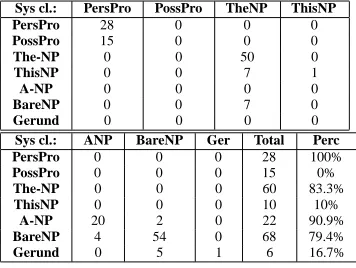
catis chosen on the basis of the values of the other features. We tried both the Maximum Entropy model (Berger et al., 1996) as implemented by Mikheev (Mikheev, 1998) and the CARTmodel of decision tree construction (Breiman et al., 1984); the results below were obtained using CART. The model was evaluated by comparing the label it predicted on the basis of the features of a givenNPwith the actual value of catfor that NP, performing a 10-fold cross-validation. The model achieved a 70% accuracy, against a baseline of 22% (if the most common category,BARE-NP, were cho-sen every time.) The accuracy for the main types ofNPs was as follows:
CAT Accuracy
PN 97.5%
PERS-PRO 94.1% Q-NP 89.43% BARE-NP 82.7%
THE-NP 81.10%
A-NP 68%
POSS-NP 46%
Sys cl.: PersPro PossPro TheNP ThisNP
PersPro 28 0 0 0
PossPro 15 0 0 0
The-NP 0 0 50 0
ThisNP 0 0 7 1
A-NP 0 0 0 0
BareNP 0 0 7 0
Gerund 0 0 0 0
Sys cl.: ANP BareNP Ger Total Perc
PersPro 0 0 0 28 100%
PossPro 0 0 0 15 0%
The-NP 0 0 0 60 83.3%
ThisNP 0 0 0 10 10%
A-NP 20 2 0 22 90.9%
BareNP 4 54 0 68 79.4%
Gerund 0 5 1 6 16.7%
Table 1: Comparison between the class of anNP as spec-ified by the annotation (vertical dimension) and the class assigned to it by the system (horizontal).
other classes there aren’t enough data to get significant re-sults. Table 1 illustrates the most interesting classification errors on one of the test sets of the cross validation.
In the case ofPOSS-NPs, what is missing from the an-notation is simply the information that the object denoted by theNPis ‘owned’ by some other entity; this information will become available once anaphoric relations have been annotated, since this annotation would also include infor-mation that there is a possession relation between theNPas a whole and the possessor.
The problem withGERUNDs is that they tend to be clas-sified by the system as bare-NPs; this is because both types of NPs tend to denote types rather than tokens - types of events in the case of gerunds, types of ‘concrete’ individu-als in the case of other bareNPs - but the current annotation scheme does not specify whether an entity denotes a set of events or a set of concrete individuals. What is missing from the scheme in this case is an indication of whether the object denoted by the discourse entity is an event.
The most complex problem to fix is that ofTHIS-NPs: here the reason for the misclassification is thatTHIS-NPs are used in our texts not only to refer to pictures or parts of them, but also to refer to abstract objects introduced by the text, as in the following examples:
(5) a. A great refinement among armorial signets was to reproduce not only the coat-of-arms but the correct tinctures; they were repeated in colour on the reverse side and the crys-tal would then be set in the gold bezel. Al-though the engraved surface could be used for impressions, the colours would not wear away. The signet-ring of Mary, Queen of Scots (beheaded in 1587) is probably the most interesting example of this type;
b. The upright secr´etaire began to be a fash-ionable form around the mid-1700s, when letter-writing became a popular past-time. The marchands-merciers were quick to re-spond to this demand,
Again, we expect to be able to improve the results for this class once we have completed the annotation of antecedent relations; however, it’s not clear that this type of references can be annotated reliably.
4.
THE NEW SCHEME
We are currently in the process of reannotating the cor-pus from scratch according to a new annotation scheme developed on the basis of the tests just discussed (reli-ability and/or incompleteness of information). We dis-cuss the new scheme in this section. In addition, we are adding information about NP modification; this as-pect of the new annotation won’t be discussed here. For reasons of space, only a brief discussion is possible -in particular, we won’t be able to discuss -in detail the instructions given to annotators; the complete instruc-tions are available athttp://www.hcrc.ed.ac.uk/
~gnome/anno manual.html.
Annotation Methodology
One of the important lessons taught by our first attempts at annotation was that doing all of this annotation at the same time was too much, and that it was essential to or-der the annotation process so that, for example, informa-tion about clauses would be available when annotating for grammatical function. So we split the task as follows:
1. First mark up the layout
2. Then identify and annotate the units (see below)
3. Then identifyNPs and mark their syntactic attributes
4. Then annotate anaphoric information
5. Then annotate the more complex semantic and dis-course information.
Markup Language
Our annotation scheme is XML-based, which allows us to make use of the suite of XML ma-nipulation tools developed by the Language Tech-nology Group of the University of Edinburgh (http://www.ltg.ed.ac.uk/software/).
The basis for our annotation are a rather minimal set of layout tags, identifying the main divisions of texts, their ti-tles, figures, paragraphs, and lists. Also, as a result of the reliability studies discussed below and of our first annota-tion effort, we decided to also mark up units of text that may correspond to rhetorical units in our second annotation, us-ing the taghuniti.
An important feature of the scheme is that the informa-tion aboutNPs is split among twoXMLelements, as in the MATEscheme for coreference (Poesio et al., 1999a). Each NPin the text is tagged with anhneitag, as follows:
(6) <ne ID="ne07" ... >
Scottish-born, Canadian based jew-eller,
Alison Bailey-Smith</ne> ...
<ne ID="ne08"> <ne ID="ne09">Her</ne> materials</ne>
(Passonneau, 1997) and in MUC-7 (Chinchor and Sund-heim, 1995).
Anaphoric relations are annotated by means of a sep-aratehanteielement specifying relations betweenhneis, also as proposed inMATE. Anhanteielement includes one or morehanchorielement, one for each plausible an-tecedent of the current discourse entity (in this way, am-biguous cases can be marked). E.g., the anaphoric relation in (6) between the possessive pronoun withID ="ne09" and the proper name withID ="ne07"is marked as fol-lows:
(7) <ante current="ne09">
<anchor ID="ne07" rel="ident" ... > </ante>
The information relevant to the task of modifier order determination is marked up by associating ahmoditag with eachNPmodifier inside ahneitag:
(8) <ne ID="ne07" ... >
<mod>Scottish-born,</mod> <mod>Canadian based</mod> <mod>jeweller,</mod> Alison Bailey-Smith</ne>
(Discourse) Units
The problems encountered with thecb,fun, andprox
features, especially, suggested the need for marking up sen-tences and potential rhetorical units / centering theory utter-ances before marking up certain types of information about NPs such as grammatical function. The instructions for marking up units were in part derived from (Marcu, 1999); for eachhuniti, the following attributes were marked:
utype: whether the unit is a main clause, a relative clause, appositive, a parenthetical, etc.
verbed: whether the unit contains a verb or not.
finite: for verbed units, whether the verb is finite or not.
subject: for verbed units, whether they have a full subject, an empty subject (expletive, as in there sen-tences), or no subject (e.g., for infinitival clauses).
The agreement on identifying the boundaries of units was K = .9; the agreement on features was follows:
Attribute K Value
utype .76
verbed .9
finite .81 subject .86
This part of the annotation has now been completed. The main difficulties we observed had to do with assigning an utterance type to parenthetical sentences.
NEs
A few attributes were dropped from the scheme for marking up noun phrases used in the previous annotation effort: among these in particulardisc(redundant once an-tecedent information was marked up) andcb(which could
be automatically derived from the information about gram-matical function and units). All attribute definitions and instructions were revised, in particular, the den attribute was drastically revised by separating off information about the logical form type of anNP(quantifier, term, etc) from the information about genericity. New attributes were in-troduced to annotate information about the abstractness or concreteness of an object, and about its semantic plurality or atomicity. The revised list of information annotated for eachNPincludes:
The output feature,cat(slightly revised and with bet-ter instructions)
The other ‘basic’ syntactic features, num, per, and
gen(as in the previous scheme)
A featuregfspecifying its grammatical function;
The following semantic attributes:
– ani: whether the object denoted is animate or inanimate
– count: whether the object denoted is mass or count
– lftype: one ofquant,term,pred,coord
– generic: whether the object denoted is a generic or specific reference
– onto: whether the object denoted is concrete, an event, a temporal reference, or another abstract object
– structure: whether the object denoted is atomic or not
The following discourse attributes:
– deix: whether the object is a deictic reference or not
– unique: whether the description used allows the reader to characterize the object as unique
A number ofNPproperties (e.g., familiarity) can be derived from the annotation of anaphoric information (below); in addition, a few properties ofNPs are automatically derived from other sources of information - e.g., the type of lay-out element in which theNPoccurs (in titles, bare-nps are often used) and whether a particular NPhas uniquely dis-tinguishing syntactic features in a given unit. We haven’t yet completed all the agreement studies forNPfeatures; the results that we do have are as follows:
Attribute K Value
ani .81
cat .9
deix .81
gen .89
gf .85
lftype .74
num .84
per .9
(One interesting point to note here is that agreement on
Antecedent Information
Previous work, particularly in the context of theMUC initiative, suggested that while it’s fairly easy to achieve agreement on identity relations, marking up bridging ref-erences is quite hard; this was confirmed, e.g., by (Poesio and Vieira, 1998). The only way to achieve a reasonable agreement on this type of annotation, and to contain some-how the annotators’ work, is to limit the types of relations annotators are supposed to mark up, and specify priorities. We are currently experimenting with marking up only four types of relations, a subset of those proposed in the ‘ex-tended relations’ version of theMATEscheme (Poesio et al., 1999a) (which, in turn, derived from Passonneau’sDRAMA scheme (Passonneau, 1997): identity (IDENT), set mem-bership (ELEMENT), subset (SUBSET), and ‘generalized possession’, including part-of relations.
In addition, given our interests we had to be quite strict about the choice of antecedent: whereas inMUCit is per-fectly acceptable to mark an ‘antecedent’ which follows a given anaphoric expression, in order, e.g., to compute the CBof an utterance it is necessary to identify the closest
pre-vious antecedent.
As expected, we are achieving a rather good agreement on identity relations. In our most recent analysis (two anno-tators looking at the anaphoric relations between 200 NPs) we observed no real disagreements; 79.4% of these rela-tions were marked up by both annotators; 12.8% by only one of them; and in 7.7% of the cases, one of the annota-tors marked up a closer antecedent than the other. On the other hand, only 22% of bridging references were marked in the same way by both annotators; although our current scheme does limit the disagreements on antecedents and relations (only 4.8% relations are actually marked differ-ently) we still find that 73.17% of relations are marked by only one or the other annotator.
5.
DISCUSSION
There are some pretty obvious omissions in the work done so far. Even if we only consider the task ofNPtype determination, there are a number of features whose impact we haven’t been able to study so far, in some cases because they proved very hard to annotate. We already discussed two such examples, topichood and thematic roles; another potentially important source of information about the deci-sion to pronominalize, rhetorical structure, is even harder to annotate. We would like to be able to annotate some types of scoping relations as well, especially the cases in which anNPis in the scope of negation as this may license the use of polarity-sensitive items such as any. Another important factor is the role of the information which the text planner has decided to realize: e.g., once the text planner has de-cided to generate both the proper name of discourse entity
x, Alphonse Mucha, and the fact thatxis a Czech painter, the decision to use theTHE-NPthe Czech painter Alphonse Mucha is more or less forced on us. And of course,
noth-ing in the scheme discussed above allows us to study the conditions under which a generator may decide to produce a quantifier or a coordinatedNPs.
Among the issues raised by this work, an important one is how much of the information that we annotated by hand
could be automatically extracted. We believe that a lot of the syntactic information we rely on (huniti and hnei identification,hunitiattributes, basic syntactic attributes ofhnei) could be extracted automatically using recent ad-vances in robust parsing; this would already cut down the amount of work considerably. The problem is what to do with semantic information: e.g., whether suitable approxi-mations could be found.
Another important question is whether our characteriza-tion ofNPrealization is plausible. One could imagine two quite distinct objections. On the one hand, some could ar-gue that we conflated intoNPtype determination two very different tasks: determining whether to use a numeral or not, and whether to use a definite article or not. Con-versely, it could be argued thatNPtype determination goes hand-in-hand with content determination, as we saw above, and the two problems can only be attacked simultaneously. We are trying to address the general architectural problem by making sure that our algorithms can be embedded in real systems, being developed independently by other groups. The problem with the second type of objections is that it’s very difficult to study content determination. This is be-cause of a more general problem with the methodology we are using: there is a mismatch between what a system knows and what an annotator may know about an object– i.e., between the features that a generation system may use and the features that can be annotated, and it’s not clear this mismatch can be resolved.
For one thing, the need to choose features that can be annotated reliably imposes serious constraints: features that a generation system can easily set up by itself (e.g., the ILEXsystem keeps track of what it thinks the current topic is) can be difficult for two annotators to annotate in the same way. Second, some information that a generation sys-tem can use when deciding on the type ofNP to generate may simply be impossible to annotate. For example, we already seen that the form of anNPoften depends on how much information the system intends to communicate to the user about a given entity, or how much information the system believes the user has. In order to build a model of this decision process, we would need to specify for eachNP how much information it conveys, and of what type; it’s not at all clear that it will be feasible to do this by hand, except in domains in which the annotator knows everything that there is to know about a given object (see, e.g., Jordan’s work on theCOCONUTdomain (Jordan, 1999)).
Conversely, some information that can be annotated -indeed, that is easy to annotate - may not be available to some systems. E.g., we do not know of any system with a lexicon rich enough to specify whether a given entry is functional or not. A solution in this case may be to develop algorithms to extract this information from an annotated corpus, or perhaps just using the syntactic distribution of the predicate as an indication (e.g., a predicate X occurring in a the X of Y construction may be functional).
Acknowledgments
I wish to thank the other members of the GNOME project, without whom this work would not have been possible– in particular Hua Cheng, Kees van Deemter, Re-nate Henschel, Rodger Kibble, and Rosemary Stevenson. The corpus is being annotated by Debbie De Jongh, Ben Donaldson, Marisa Flecha-Garcia, Camilla Fraser, Michael Green, Shane Montague, Carol Rennie, and Claire Thom-son. I also wish to thank Janet Hitzeman, Alistair Knott, Chris Mellish, Johanna Moore, and Jon Oberlander. The GNOMEproject is supported by the UK Research Council EPSRC, GR/L51126. Massimo Poesio is supported by an EPSRC Advanced Research Fellowship.
6.
References
Abney, S. P., 1987. The English Noun Phrase in its
Senten-tial Aspect. Ph.D. thesis, MIT, Cambridge MA.
Berger, A., S. Della Pietra, and V. Della Pietra, 1996. A maximum entropy approach to natural language process-ing. Computational Linguistics, 22(1):39–72.
Breiman, L., J. H. Friedman, R. A Olshen, and C. J. Stone, 1984. Classification and Regression Trees. Chapman and Hall.
Cahill, L., C. Doran, R. Evans, C. Mellish, D. Paiva, M. Reape, D. Scott, and N. Tipper, 1999. In search of a reference architecture for NLG systems. In Proc.
Eu-ropean Workshop on Natural Language Generation.
Carletta, J., 1996. Assessing agreement on classification tasks: the kappa statistic. Computational Linguistics, 22(2):249–254.
Chinchor, N. A., 1997. Overview of MUC-7/MET-2. In Proc. of the Seventh Message Under-standing Conference (MUC-7). Available at http://www.muc.saic.com/proceedings/ muc_7_proceedings/overview.html.
Chinchor, N. A. and B. Sundheim, 1995. Message Un-derstanding Conference (MUC) tests of discourse pro-cessing. In Proc. AAAI Spring Symposium on Empirical
Methods in Discourse Interpretation and Generation.
Dale, R., 1992. Generating Referring Expressions. Cam-bridge, MA: The MIT Press.
Garrod, S. C. and A. J. Sanford, 1983. Topic dependent effects in language processing. In G. B. Flores D’Arcais and R. Jarvella (eds.), The Process of Language
Compre-hension. Chichester: Wiley, pages 271–295.
Grosz, B. J., A. K. Joshi, and S. Weinstein, 1995. Center-ing: A framework for modeling the local coherence of discourse. Computational Linguistics, 21(2):202–225. Gundel, J. K., N. Hedberg, and R. Zacharski, 1993.
Cog-nitive status and the form of referring expressions in dis-course. Language, 69(2):274–307.
Heim, I., 1982. The Semantics of Definite and Indefinite
Noun Phrases. Ph.D. thesis, University of Massachusetts
at Amherst.
Hitzeman, J., A. Black, P. Taylor, C. Mellish, and J. Ober-lander, 1998. On the use of automatically generated discourse-level information in a concept-to-speech syn-thesis system. In Proc. of the International Conference
on Spoken Language Processing (ICSLP98),. Australia.
Jordan, P., 1999. An empirical study of the communicative goals impacting nominal expressions. In R. Kibble and K. van Deemter (eds.), Proc. of the ESSLLI workshop on
The Generation of Nominal Expressions. Utrecht:
Uni-versity of Utrecht, OTS.
Kamp, H. and U. Reyle, 1993. From Discourse to Logic. Dordrecht: D. Reidel.
Loebner, S., 1987. Definites. Journal of Semantics, 4:279– 326.
Marcu, D., 1999. Instructions for manually annotating the discourse structures of texts. Unpublished manuscript, USC/ISI.
Mikheev, A., 1998. Feature lattices for maximum entropy modeling. In Proc. of ACL-COLING. Montreal, CA. Oberlander, J., M. O’Donnell, A. Knott, and C. Mellish,
1998. Conversation in the museum: Experiments in dy-namic hypermedia with the intelligent labelling explorer.
New Review of Hypermedia and Multimedia, 4:11–32.
Passonneau, R., 1997. Instructions for applying dis-course reference annotation for multiple applications (DRAMA). Unpublished manuscript.
Passonneau, R., 1998. Interaction of discourse structure with explicitness of discourse anaphoric noun phrases. In M. A. Walker, A. K. Joshi, and E. F. Prince (eds.),
Centering Theory in Discourse, chapter 17. Oxford
Uni-versity Press, pages 327–358.
Passonneau, R. and D. Litman, 1993. Feasibility of auto-mated discourse segmentation. In Proceedings of 31st
Annual Meeting of the ACL.
Poesio, M., F. Bruneseaux, and L. Romary, 1999a. The MATE meta-scheme for coreference in dialogues in mul-tiple languages. In M. Walker (ed.), Proc. of the ACL
Workshop on Standards and Tools for Discourse Tag-ging.
Poesio, M., R. Henschel, J. Hitzeman, R. Kibble, S. Mon-tague, and K. van Deemter, 1999b. Towards an anno-tation scheme for Noun Phrase generation. In B. Krenn H. Uszkoreit, T. Brants (ed.), Proc. of the EACL
work-shop on Linguistically Interpreted Corpora (LINC-99).
Poesio, M. and R. Stevenson, To appear. Salience:
Com-putational Models and Psychological Evidence.
Cam-bridge and New York: CamCam-bridge University Press. Poesio, M. and R. Vieira, 1998. A corpus-based
investiga-tion of definite descripinvestiga-tion use. Computainvestiga-tional
Linguis-tics, 24(2):183–216.
Prince, E. F., 1992. The ZPG letter: subjects, definiteness, and information status. In S. Thompson and W. Mann (eds.), Discourse description: diverse analyses of a
fund-raising text. John Benjamins, pages 295–325.
Reinhart, T., 1981. Pragmatics and linguistics: An analysis of sentence topics. Philosophica, 27(1).
Reiter, E. and R. Dale, 2000. Building Natural Language
Generation Systems. Cambridge University Press.
Scott, D., R. Power, and R. Evans, 1998. Generation as a solution to its own problem. In Proc. of the 9th
In-ternational Workshop on Natural Language Generation.