VIQTORYA – A Visual Query Tool for Syntactically Annotated Corpora
Ilona Steiner , Laura Kallmeyer
Seminar f¨ur Sprachwissenschaft, Universit¨at T¨ubingen Wilhelmstr. 113, D–72074 T ¨ubingen, Germany
TALaNa-Lattice, Universit´e Paris 7 2, place Jussieu, F–75251 Paris cedex 05, France
Abstract
This paper presents a query tool for syntactically annotated corpora. The query tool is developed to search the T ¨ubingen Treebanks annotated at the University of T ¨ubingen. However, in principle it also can be adapted to other corpora. The tool uses a query language that allows to search for tokens, syntactic categories, grammatical functions and binary relations of (immediate) dominance and linear precedence between nodes. The overall idea is to extract in an initializing phase the relevant information from the corpus and store it in a compact way in a relational database. An incoming query is then translated into a corresponding SQL query that is evaluated on the database. A graphical user interface allows to specify queries in a user-friendly way.
1.
Introduction
With the increasing availability of large amounts of electronic texts, linguists have access to more and more ma-terial for empirically based linguistic research. Currently many corpora are tagged with morphosyntactic categories (part-of-speech) and there are already several syntactically annotated corpora. Examples are the Penn Treebank (Mar-cus et al., 1994; Bies et al., 1995) annotated at the Univer-sity of Pennsylvania, the Negra corpus (Brants et al., 1999) developed in Saarbr ¨ucken, the French treebank annotated in Paris (Abeill´e and Cl´ement, 1999) and the T ¨ubingen Tree-banks (Hinrichs et al., 2000) annotated in the project
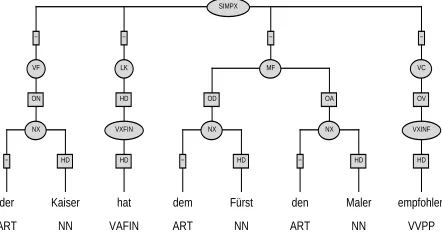
Verb-mobil at the University of T ¨ubingen. A sample entry taken
from the T¨ubingen German Treebank is shown in Fig. 1. However, in order to have access to these rich linguistic an-notations, adequate query tools are needed.
In this paper we present the prototype version of VIQ
-TORYA(A Visual Query Tool for Syntactically Annotated Corpora) with a query language that allows to search for complex syntactic structures in corpora. In contrast to an earlier version of the tool presented in Kallmeyer (2000b), the query component now can process all elements defined by the query language (disjunction in a restricted version) and the architecture is extended by a graphical user inter-face. The tool is developed for the T ¨ubingen Treebanks, but it can be adapted to other corpora as well.
1.1. The T ¨ubingen Treebanks
The T¨ubingen Treebanks, annotated at the University of T¨ubingen, comprise a German, an English and a Japanese treebank consisting of spoken texts restricted to the domain of arrangement of business appointments. In this paper we focus on the German Treebank (T ¨uBa-D) (Stegmann et al., 2000; Hinrichs et al., 2000) that contains approx. 38.000 trees (or rather tree-like annotation structures since the structures are not always trees).
The corpus is part-of-speech tagged using the Stuttgart T¨ubingen tagset (STTS) described in Schiller et al. (1995).
One of the design decisions was that for the purpose of reusability of the treebank, the annotation scheme should not reflect a commitment to a particular syntactic the-ory. Therefore a surface-oriented annotation scheme was adopted to structure German sentences that is inspired by the notion of topological fields in the sense of H ¨ohle (1985) (see Fig. 1, 2): The verbal elements have the categoriesLK
(linke Klammer) andVC(verbal complex), and roughly ev-erything preceding the LKforms the “vorfeld”VF, every-thing betweenLKandVCforms the “mittelfeld”MFand the “nachfeld”NFfollows the verbal complex.
The corpus is annotated with syntactic categories as node labels, with grammatical functions as edge labels and with dependency relations. The syntactic categories are based on traditional phrase structure and on the theory of topological fields.
The data structures used for the T ¨ubingen Treebanks are not always trees in order to cope with the characteristics of spontaneous speech. So, for example, an entry of the treebank can consist of several tree structures (see Fig. 1). Furthermore, an element of the corpus might contain com-pletely disconnected nodes (see, e.g., the repetition of the finite verb macht in Fig. 1 which is not bound to the rest of the sentence). In contrast to Negra or Penn Treebank, there are neither crossing branches nor empty categories.
1.2. An Example
In the following, an example of a linguistically relevant construction is considered that illustrates how useful access to structural information in a corpus might be.
(1) der Kaiser hat dem F ¨urst den Maler empfohlen the emperor has to the prince the painter recommended “the emperor recommended the painter to the prince”
0 1 2 3 4 5 6 7 8 9 10 11
500 501 502 503 504 505 506 507
508 509 510 511
512 513
500 501 502 503 504
505 506 507 508
Fig. 1). The intended query models and the model-theoretic semantics are defined in Kallmeyer (2000b).
Of course, when adapting this language to another cor-pus, depending on the specific annotation scheme, other unary or binary predicates might be added to the query lan-guage. This does not change the complexity of the query language in general. However, it is also possible that at a later point negation needs to be allowed in a general way or that quantification needs to be added to the query language for linguistic reasons. Such modifications would affect the complexity of the language and the performance of the tool. Therefore the decision was taken to keep the language as simple as possible in the beginning.
2.2. Underspecification in VIQTORYA
An important aspect of the query language defined above is the possibility of underspecification. It is possible to specify abstract tree fragments and, furthermore, to leave underspecified particular aspects of these partial structures as, e.g., the relation of dominance and the linear precedence of nodes.
In the following, another example is considered that il-lustrates the usefulness of underspecification. (3) shows a complex prepositional phrase (PP) consisting of two parts: a first PP beginning with the preposition von (“from”) and a second PP beginning with the preposition bis (“to”).
(3) von der Stadt in der ich lebe bis nach Hannover “from the town I live in to Hannover”
In order to find complex PPs as described above in the corpus, one needs to search for a preposition von linearly preceding a preposition bis and, moreover, a prepositional phrase (with syntactic category PX) that dominates both prepositions. Everything else remains underspecified. For this query the relations of general dominance and general linear precedence are needed since it is unknown how com-plex both PPs are and how much material is positioned be-tween the two prepositions. This leads to the query in (4).
(4) token(1)=von & token(2)=bis & 1..2 & cat(3)=PX & 3>>1 & 3>>2
3.
The Architecture of V
IQTORYA The general idea of the tool is to store the informa-tion one wants to search for in a relainforma-tional database and then to translate an expression in the query language pre-sented above into an SQL expression that is evaluated on the database. The tool consists of the following compo-nents:an initializing component that extracts the relevant in-formation (e.g., nodes/node pairs) from the trees in the corpus and stores them in the database (see Sec. 3.2.). This needs to be done only once for each corpus, usu-ally by the corpus administrator.
a graphical user interface for specifying in a user-friendly way the queries that are then passed on to the query component (see Sec. 3.4.),
a query component that translates an incoming query (expressed in the query language described above) into
node pair
tree id node1 node2 class id
pair class
class id node id1 node id2 p1 p2 d1 d2 l1 l2
node class node id cat fct
tokens
tree id node word
Figure 3: The relational database schema of VIQTORYA
an SQL expression and evaluates it on the database (see Sec. 3.3.),
query results (including their annotation) can be viewed
in the Annotate tool (Brants and Skut, 1998).
VIQTORYA is implemented in Java and uses Java Database Connectivity (JDBC) as interface and MySQL as database management system.
3.1. The Relational Database Schema
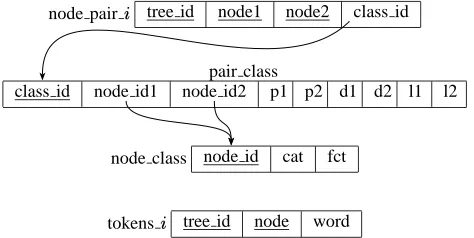
The T¨ubingen German Treebank consists of several subcorpora. In the relational database there are two global tables, node class and pair class. Besides these, for each of the subcorpora identified by there are tables tokens and node pair . The database schema is shown in Fig. 3. The arrows represent foreign keys. The column class id in the table node pair , for example, is a foreign key referring to the column class id in the table pair class. This means that each entry for class id in node pair uniquely refers to one entry for class id in pair class.
The content of the tables is as follows:
node class contains node classes characterized by cate-gory (node label) and grammatical function (edge label between the node and its mother). Each node class has a unique identifier, namely the column node id. pair class contains classes of node pairs characterized by the two node classes and the parent, dominance and linear precedence relation between the two node classes. The columns p1, p2, d1, d2, l1 and l2 stand for binary relations and have values or depending on whether the relation holds or not. p1 signifies immediate dom-inance of the first node over the second, p2 immediate dominance of the second over the first, d1 dominance of the first over the second, etc. Each node pair class has a unique identifier, namely its class id.
tokens contains all leaves from subcorpus with their tokens (words).
node pair contains all node pairs from subcorpus with their pair class. Of course, only pairs of nodes be-longing to one single annotation structure are stored.
be-#BOS 24 25 898511955 1
scheinbar ADV -- HD 500
nicht PTKNEG -- HD 501
beides PIS -- HD 502
zusammen ADV -- HD 503
. $. -- -- 0
#500 ADVX -- - 505
#501 ADVX -- - 505
#502 NX -- HD 504
#503 ADVX -- - 504
#504 NX -- HD 505
#505 NX -- -- 0
#EOS 24
Corresponding structure:
0 1 2 3 4
500 501 502 503
504 505
scheinbar
ADV
nicht
PTKNEG
beides
PIS
zusammen
ADV
.
$.
HD HD HD HD NX ADVX HD −
ADVX ADVX
NX NX
− − HD
Figure 4: Export format of sentence 24 in cd20 and corre-sponding structure
longs to. Each class of pairs is an equivalence class on the sets of node pairs. In order to obtain a compact character-ization of these classes, additional node classes are intro-duced. This double abstraction allows an efficient storage of large amounts of data and facilitates the search in the corpus. The only feature that is not part of the characteris-tics of node classes is the token of a node. The tokens of the corpus are stored in an extra table.
3.2. Initializing the Database
The storage of the corpus in the database is done by an initializing component. This component extracts informa-tion from the structures in export format (the format used for the T¨ubingen German Treebank) and stores them in the database. Details about the initializing process can be found in Kallmeyer (2000b).
As an example, consider the storage of sentence 24, subcorpus cd20 (identifier 20) in the database. This sen-tence was chosen for the simple reason that it is not too long but contains enough nodes to provide a useful exam-ple. Besides this, its construction and its tokens are not of any interest here.
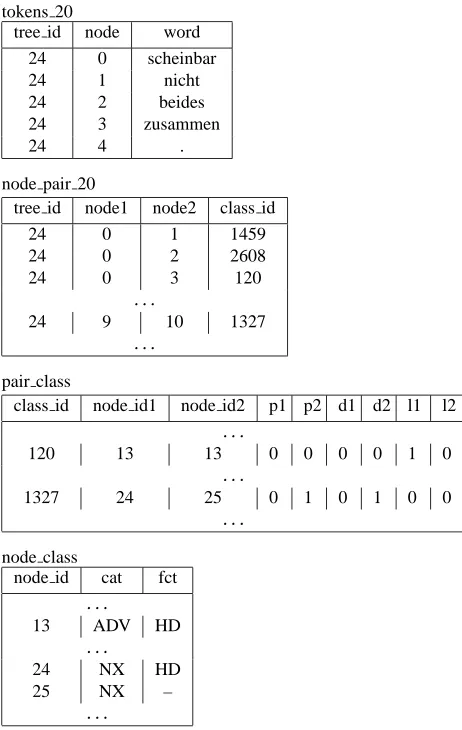
Fig. 4 shows the sentence in its export format, i.e., the way it originally occurs in the corpus, together with a pic-ture of the corresponding strucpic-ture. Parts of the tables in the database concerning sentence 24 are shown in Fig. 5. Each line in the export format corresponds to one node. The nodes are assigned numbers 0, 1, . The nodes with to-kens (i.e., the leaves) are inserted into the table toto-kens 20.
tokens 20
tree id node word 24 0 scheinbar
24 1 nicht
24 2 beides
24 3 zusammen
24 4 .
node pair 20
tree id node1 node2 class id
24 0 1 1459
24 0 2 2608
24 0 3 120
24 9 10 1327
pair class
class id node id1 node id2 p1 p2 d1 d2 l1 l2
120 13 13 0 0 0 0 1 0
1327 24 25 0 1 0 1 0 0
node class
node id cat fct
13 ADV HD
24 NX HD
25 NX –
Figure 5: Sentence 24 in the database
Each pair of nodes is inserted into the table node pair 20 to-gether with its pair class. Both orders of a pair are stored.1
The pair classes and node classes belonging to a pair can be found in the global tables. Consider for example the nodes 9 and 10 in sentence 24 (the node labelled NX that dom-inates beides zusammen and the topmost node with label
NX). The class id of this pair is 1327. The corresponding entry in pair class tells us that the second node is the mother of the first, that the second dominates the first, and that there is no linear precedence relation between the two nodes. Furthermore, the node classes identified by node id1 and node id2 are such that the first node has labelNXand gram-matical functionHDwhereas the second has labelNXand no grammatical function.
After having stored the data in the data base, several indexes are created using the MySQL indexing function-alities, e.g., indexes are put on the column class id in ta-ble node pair and on node id1 and node id2 in pair class. This accelerates the search of the corpus considerably.
In order to test the tool approximately one quarter of the T¨ubingen German Treebank is stored in the database,
1In a previous version just one order was stored but it turned
We implemented the composition of an SQL expression in a modular way. Each conjunct in theWHERE-clause is assigned a particular rank and an additional subrank for each rank. The conjuncts are ordered according to this ranking. For example, the same rank is assigned for all conjuncts that are concerned with the same table (e.g.,
ta-blenode class) and the subrank determines the ordering
of the different variables for this table (e.g.,nc1,nc2, etc.). If it turns out at a later point that a different ordering of the SQL conjuncts is favoured, this can be easily modified with the present implementation.
The performance depends crucially on the size of inter-mediate results. In cases where more than one node pair is searched for (as in the examples above) the order of the pairs is important since the result set of the first pair re-stricts the second pair etc. In (5) for example, two node pairs that involve the search for a node NXwith function
ODare searched for first. Afterwards, the search for node
NXwith functionOAdominated byMFis restricted to those trees that were found when searching for the first two pairs. Obviously, each of the first two pairs is much more restric-tive than the third. If the order is reversed and the third node pair is searched for first, the query takes much more time to process. Currently the ordering of the pairs needs to be done by the user, i.e., depends on the incoming query. However, we plan to implement at least partly an ordering of the binary conjuncts in the query depending on the fre-quency of the syntactic categories and grammatical func-tions involved in the pairs.
In contrast to the examples illustrated above, queries containing disjunctions are not translated directly into an SQL expression. Instead they are transformed first into disjunctive normal form. The different disjuncts are then translated separately into the corresponding SQL state-ments and evaluated iteratively. Following, the union of the search results is built. In most cases this procedure leads to a much better performance than the evaluation of a large and complex SQL statement, especially in those cases where the disjunction contains binary relations. But we also found that even disjunctions of category or function labels can best be treated this way. An additional advantage of transforming queries first into disjunctive normal form is that the query language defined in Sec. 2. and the query component can be extended easily in order to allow nega-tion in a general way with just one more transformanega-tion step prior to the proposed procedure, namely transforming negation in general into atomic negation.
Currently, the query component can process almost all possible expressions in the query language. However, queries involving disjunctions are so far only allowed in disjunctive normal form. The query component will be completed very soon to process the full range of disjunc-tion defined in Sec. 2.
The database and the tool are running at present on a Pentium II PC 400MHz 256MB under Linux. On this machine, example (5) takes 1.26 sec to be answered by MySQL, and example (6) takes 0.28 sec to be answered. This shows that although the queries are quite complex and involve many intermediate results, the performance of the system is quite efficient.
The obvious advantage of using a relational database to store the corpus is that some parts of the work are taken over by the database management system such as the search of the corpus. Furthermore, and this is crucial, the indexing functionalities of the database management system can be used to increase the performance of the tool.
3.4. The Graphical User Interface of VIQTORYA
Since VIQTORYA will be used by linguists a user-friendly handling of the tool is important. Therefore we developed a graphical user interface for the specification of the queries that are then passed on to the query compo-nent. In a comfortable way the user can choose a corpus, can specify nodes with their properties (including, e.g., the topological field a node is situated in) and relations between nodes. The user does not need to know the specific syntax of the query language since the queries can be generated au-tomatically on the basis of the chosen specifications, at least for standard queries without complex disjunction. Disjunc-tion in general will be supported by the user interface very soon. Furthermore, specified queries can be stored for later use and refinement.
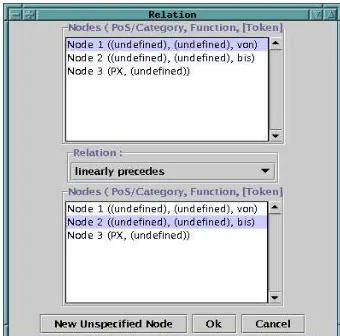
Figure 6 shows the main window of the user interface containing the specification of query (6). Specified nodes together with their properties (PoS-tag or category, function and, in the case of terminals, token) are shown in the left window. For example, in Fig. 6 the first node (“Node 1”) is specified only for token (von) and the third node (“Node 3”) is specified only for category (PX). The right window displays the specified binary relations. On the basis of these specifications the query can be generated automatically and will show up in the query window on top. Then the query together with the chosen corpus (here subcorpus cd20) can be submitted to the query component.
Terminal nodes, nonterminal nodes and binary relations are specified with the bottom part of the main window. In Figure 7 the specification of “Node 3” (in Fig. 6) is shown, i.e., the specification of its syntactic categoryPX. The dif-ferent properties of a node can be chosen with the register on top of the node window, i.e. category, function, topo-logical field in case of nonterminal nodes. In case of ter-minal nodes there is an additional option for “token” and “category” is replaced by “PoS-tag”. For each property the negation of the corresponding predicate can be chosen (see in Fig. 7 “Category of Node is not...”) which leads to a modified surface of the node window in order to have the possibility to choose more than one value for a predicate.
Figure 6: Specification of the query in (6)
Figure 7: Specification of “Node 1” in Fig. 6
property. Since the theory of topological fields is specific for German and, furthermore, not every German corpus is annotated with topological fields, we implemented this op-tion in a modular way, i.e., for corpora that are not anno-tated with topological fields it can be faded out easily.
Having specified and submitted a query, the correspond-ing search results can be viewed in the Annotate tool.
4.
Related Work
Recently, some other query tools for syntactically an-notated corpora have been proposed, e.g., TIGERSearch (Lezius and K ¨onig, 2000), ICECUP III (Wallis and Nelson, 2000), CorpusSearch (Randall, 2000) and tgrep2 (Rohde, 2001). We will briefly compare VIQTORYAto them.
The most interesting tool with respect to a comparison to VIQTORYA is TIGERSearch since it was primarily de-veloped for the data structures used in the Negra corpus (allowing crossing branches) and therefore has to deal with the specific problems of annotations that are not trees.
The query language of TIGERSearch allows the same
Figure 8: Specification of the first binary relation in Fig. 6
logical connections as VIQTORYA (conjunction, disjunc-tion and atomic negadisjunc-tion). TIGERSearch comprises some binary relations that are not present in VIQTORYAbut that either can be defined using the existing relations or can be easily integrated extending the pair class table in a corre-sponding way.
There is a crucial difference between TIGERSearch and VIQTORYAconcerning the way linear precedence between
internal nodes is defined: in TIGERSearch a node lin-early precedes a node if the leftmost leaf dominated by linearly precedes the leftmost leaf dominated by . One problem of this definition is that it does not exclude a dominance relation between and : in Fig. 2, according to this definition, theSIMPXnode linearly precedes theMF
first macht). Therefore, in VIQTORYAwe chose the follow-ing definition: linearly precedes
if all nodes domi-nated by linearly precede all nodes dominated by
. ICECUP, developed for the ICE-GB corpus, uses a query language with predicates that are slightly different from VIQTORYA. ICECUP, however, does not allow nega-tion for binary predicates and, moreover, is restricted to trees and cannot handle the data structures used in the T¨ubingen Treebanks.
Neither tgrep, developed for the Penn Treebank, nor CorpusSearch, developed for the Penn Helsinki Corpus of Middle English, provide a graphical user interface. Both allow sets of unary and binary predicates slightly different from VIQTORYA. CorpusSearch, however, does not allow negation of these predicates and general disjunction.
Concerning the general architecture of the tools, a key feature of VIQTORYAis that, in contrast to the tools men-tioned above, it uses a relational database schema that al-lows an efficient search in large amounts of data.
5.
Conclusion and Future Work
In this paper, we have presented VIQTORYA, a visual query tool for syntactically annotated corpora, that is im-plemented for the T ¨ubingen German Treebank annotated at the University of T ¨ubingen. The key idea is to extract in an initializing phase the information one wants to search for from the corpus and to store it in a compact way in a rela-tional database. The search itself is done by translating an input query, that is an expression in a simple quantifier free first order logic, into an SQL query that is then passed to the database system. A graphical user interface allows to specify queries in a user-friendly way.An obvious advantage of this architecture is that a con-siderable amount of work is taken over by the database management system and therefore needs not to be imple-mented. Furthermore, the MySQL indexing functionalities can be used to directly affect the performance of the search. The query tool is work in progress, and we briefly want to point out some of the things that still need to be done. First, the set of queries the tool can process needs to be ex-tended to the full range of disjunction allowed in the query language. This will be done very soon. Another task for the near future is, as mentioned above, to add an ordering mechanism on binary conjuncts in order to ensure that the more restrictive node pairs are searched for first.
Besides these tasks, a more general issue to persue in the future is to adapt the tool to other corpora. In some cases, this implies a modification of the way binary rela-tions are precompiled in the initialization process, and in some other cases this would even lead to a modification of the query language and the database schema, namely in those cases where other binary relations are needed, e.g., the coindexation relation in the case of the Penn Treebank.
6.
Acknowledgments
The work presented here was done as part of the project A1 in SFB 441 “Linguistic Data Structures” at the Univer-sity of T¨ubingen. We would like to thank our research assis-tant Thomas Schurtz for the implementation of the graphi-cal user interface. For valuable discussions of the work
pre-sented here we would like to thank Detmar Meurers, Oliver Plaehn and, in particular, Stephan Kepser. Furthermore, we are grateful to the project A2 for support in the final phase of this work.
7.
References
A. Abeill´e and L. Cl´ement. 1999. A tagged reference Cor-pus for French. In Proceedings of EACL-LINC, Bergen. A. Bies, M. Ferguson, K. Katz, and R. MacIntyre. 1995.
Bracketing Guidelines for Treebank II Style Penn Tree-bank Project. University of Pennsylvania.
T. Brants and W. Skut. 1998. Automation of treebank an-notation. In Proceedings of NeMLaP-3/CoNLL98,
Syd-ney, Australia, pages 49 – 57.
T. Brants, W. Skut, and H. Uszkoreit. 1999. Syntactic An-notation of a German Newspaper Corpus. In Journ´ees
ATALA, 18–19 juin 1999, Corpus annot´es pour la syn-taxe, pages 69–76, Paris.
S. Featherston. 2002. Coreferential objects in german: Experimental evidence on reflexivity. In Linguistische
Berichte. Buske Verlag. In press.
E. W. Hinrichs, J. Bartels, Y. Kawata, V. Kordoni, and H. Telljohann. 2000. The VERBMOBIL Treebanks. In
Proceedings of KONVENS 2000, October.
T. H¨ohle. 1985. Der Begriff ‘Mittelfeld’. Anmerkungen ¨uber die Theorie der topologischen Felder. In A. Sch ¨one, editor, Kontroversen alte und neue. Akten des 7. Int.
Ger-manistenkongresses G ¨ottingen, pages 329–340.
L. Kallmeyer. 2000a. On the Complexity of Queries for Structurally Annotated Linguistic Data. In Proceedings
of ACIDCA’2000, pages 105–110, March.
L. Kallmeyer. 2000b. A query tool for syntactically anno-tated corpora. In Proceedings of Joint SIGDAT
Confer-ence on Empirical Methods in Natural Language Pro-cessing and Very Large Corpora, Hong Kong, October.
W. Lezius and E. K ¨onig. 2000. Towards a search engine for syntactically annotated corpora. In Proceedings of
the KONVENS Conference.
M. Marcus, G. Kim, M. A. Marcinkiewicz, R. MacIntyre, A. Bies, M. Ferguson, K. Katz, and B. Schasberger. 1994. The Penn Treebank: Annotating Predicate Argu-ment Structure. In ARPA ’94.
D. Meurers. 1999. Von partiellen Konstituenten, er-staunlichen Passiven und verwirrten Franken. Zur Ver-wendung von Korpora f ¨ur die theoretische Linguistik. Handout at the DGfS Jahrestagung, February.
B. Randall, 2000. CORPUSSEARCH USER’S MANUAL. University of Pennsylvania.
D. L. T. Rohde, 2001. Tgrep2 User Manual - version 1.2. Carnegie Mellon University, Pittsburgh.
A. Schiller, S. Teufel, and C. Thielen. 1995. Guide-lines f¨ur das Tagging deutscher Textcorpora mit STTS. Manuscript Universit¨aten Stuttgart und T ¨ubingen. R. Stegmann, H. Telljohann, and E. W. Hinrichs. 2000.
Stylebook for the German Treebank in VERBMOBIL. Technical Report 239, Verbmobil.
S. A. Wallis and G. Nelson. 2000. Exploiting fuzzy tree fragments in the investigation of parsed corpora.