170 Elizabeth Zeitoun and Ching-Hua Yu
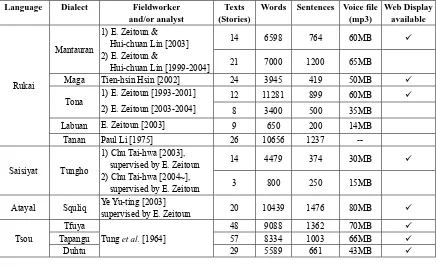
Amis Central Fey et al. [1993] 25 50000 1780 200MB 9
Bunun Isbukun Tseng et al. [1998] 49 35089 1265 -- 9
Kanakanavu -- Tsuchida [2003] 10 5961 781 -- 9
Pazih -- Li & Tsuchida [2001] 31 7590 991 -- 9
Paiwan Southern Hua Jia-jing [2004~2005]
supervised by E. Zeitoun 20 12000 800 55MB The goal of the present paper is to discuss the linguistic analysis approach adopted in the Formosan Language Corpora and the processing programs that have been developed for it. Indeed, the digitization of various Formosan languages and dialects has posed numerous challenges on both the linguistic and computational levels. We have had to develop not only a uniform annotation system to account for language variation and typology but also processing tools for annotating the growing corpus and retrieving and displaying the data from/on the Internet.
This paper is organized as follows. In section 2, we discuss problems related to the transcription of different corpora. In section 3, we deal with annotation rules and standards. In section 4, we turn to the notion of text structure. In section 5, we discuss problems related to analytic and programming consistency. Conclusions are drawn in section 6.
2.
Transcriptions
In this section, we first deal with the orthographic system adopted in the Archive and then discuss IPA conversions from one operating environment (Word) to another (Web).
2.1
Orthographic system adopted in the Archive
We first outline the phonemic inventory of the Formosan languages. We then provide an overview of the diverse writing systems that have been used to transcribe the Formosan languages. Finally, we deal with the problems raised by these writing systems, and explain our preference for using IPA for standardized transcription.
2.1.1 Outline of the phonemic inventory of the Formosan languages
The Formosan languages exhibit fairly simple phonemic inventory systems consisting usually of no more than twenty consonants and four vowels, which typically include a series of voiceless and voiced stops: /p, t, k, q, /, b, d, g/; an affricate: /ts/; fricatives: /s, z/; a series of nasals: /m, n, N/; liquids: /l, r/; and four vowels: /a, i, u, ´/. Of course, there is great variation among these languages which has arisen through phonological changes. They will not be detailed in the present paper. Most noticeably, Paiwan has developed a series of palatals: /c, Ô,
The Formosan Language Archive: Linguistic Analysis and Language Processing 171
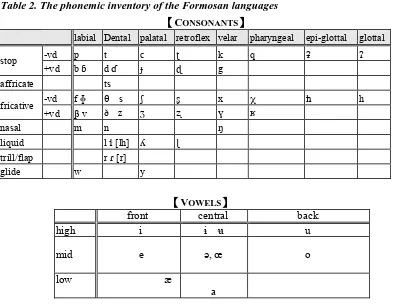
Amis differentiates glottal and epi-glottal sounds [Li 1999]. A few languages such as Squliq Atayal, Tsou, Maga Rukai and Saisiyat have developed more complex vocalic systems. All the consonants and vowels found in the Formosan languages are given in Table 2 below.
Table 2. The phonemic inventory of the Formosan languages
【
CONSONANTS】
labial Dental palatal retroflex velar pharyngeal epi-glottal glottal
-vd p t c ˇ k q ? /
stop
+vd b ∫ d Î Ô Í g
affricate ts
-vd f ∏ T s S ß x X h fricative
+vd B v D z Z Ω ƒ “
nasal m n N
liquid l ¬ [lh] ¥ Ò trill/flap r R [r]
glide w y
【
VOWELS】
front central back
high i i u u
mid e ´, ø o
low Q
a
The basic syllable structure in most languages is CVC, though both Rukai and Tsou now exhibit a CV syllable structure. Consonant clusters occur in only a few languages (e.g., Tsou, Maga Rukai, Thao and Atayal). Stress is usually non-phonemic.
2.1.2 Writing systems adopted to transcribe the Formosan languages during the past four hundred years
172 Elizabeth Zeitoun and Ching-Hua Yu
Dutch colonization (1629-1661):
The Roman alphabet was first used in Taiwan in the 17th century by Dutch missionaries to record Siraya and Favorlang. They devised a Romanization system based on the Dutch spelling, which at the time had not yet been standardized.
Chinese colonization (1661-1895):
With the colonization of Taiwan by the Chinese, many land contracts, songs, place or family names and reports were transcribed with Chinese characters. The phonetic value of these Chinese characters is somewhat complex, sometimes referring to Mandarin Chinese and at other times to the Minnan pronunciation.
Japanese colonization (1895-1945):
From 1895 to 1945, Taiwan was a Japanese colony. Aboriginal children were enrolled in schools (up to the age of 12) and learnt Japanese, so they were able, in later years, to transcribe their own language in katakana.
Post-1945:
With the arrival of the Nationalist Chinese under the leadership of Chiang Kai-shek, the Chinese government imposed Mandarin Chinese as the sole official language. The Zhuyin fuhao system more popularly known as Bopomofo, was introduced and used in textbooks, dictionaries etc. At one time, it was also used to transcribe the Formosan languages (e.g., the Bible, songs and textbooks). Bopomofo consists of 37 symbols derived from Chinese characters, and some of these symbols were slightly altered to convey sounds recorded in the Formosan languages that are not found in Chinese. Different writing systems (all Romanized) were devised by the Catholic and the Protestant Church and used during the same period. The lack of adherence to common principles had the unfortunate consequence of producing different writing systems for different tribes. Diacritics were introduced: in Amis, for instance, ^ is used to represent a glottal stop.
In 1991, Prof. Li Jen-kuei [Li 1992] was asked by the Ministry of Education of Taiwan to devise writing systems for the Formosan languages and proposed different solutions (e.g., replacing IPA symbols such as N with a capital letter N or with two symbols, ng).
The Formosan Language Archive: Linguistic Analysis and Language Processing 175
new versions of these based on our own standardized format.
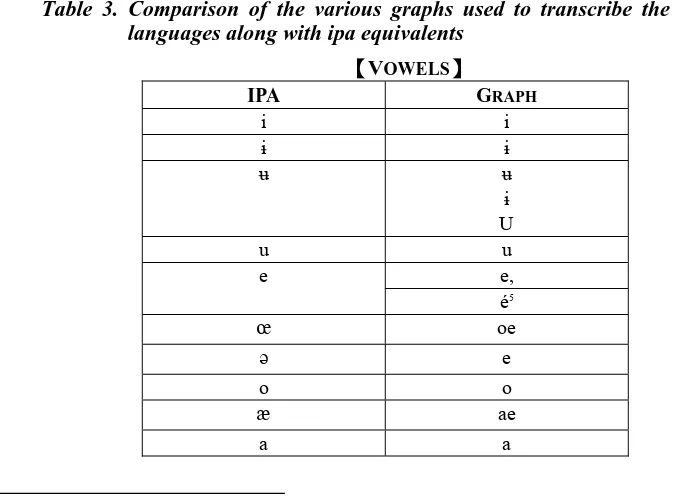
It became necessary for us to make changes in our corpus, as we were including more and more languages. The first languages we started to digitize and to annotate were Rukai, Atayal and Tsou. The commonly accepted use of c in Formosan linguistics as a replacement for [ts] seemed at the time the best choice6, as there are consonant clusters in three of these
languages, cf., Maga Rukai, Squliq Atayal and Tsou. However, the introduction of Paiwan, in which there is a distinction between palatalized and non-palatalized sounds, forced us to change our writing policy though, as c is the standard IPA symbol used to represent a palatal stop. We thus changed the earlier c to ts, to distinguish the affricate [ts] from the palatal [c].
Other changes may be needed in the future as we include more languages, but we plan to keep them to a minimum.
2.2
Using Unicode IPA symbols
To convert IPA symbols from Word documents (in which texts are typed) to the Web, we make use of the Unicode encoding system, which offers the possibility of displaying symbols uniformly across browser platforms. In Unicode, each IPA character is assigned a standardized encoding number so as to avoid using the same code for two different symbols. In theory, Unicode represents the best way to display IPA characters on the Web. In practice, it requires an initial configuration. Displaying IPA symbols on certain platforms is sometimes difficult as will be shown below (Webster [2002]).
This section discusses how we use IPA in our two working environments (Word and the Web) and how we convert IPA symbols into a computer-readable form.
Three things are required to convert IPA symbols from word processing documents into HTML files:
1. An operating system that supports Unicode (e.g., Windows 2000/XP).
2. An installed Unicode font that includes IPA (e.g., SILDoulosIPA for Microsoft Word, and Lucida Sans Unicode for the Web).
3. A Unicode-compliant application (e.g., Microsoft Word or Internet Explorer).
2.2.1 Creating Word processing documents
All the texts included in the Formosan Language Corpora contain different kinds of information: metadata information, utterance identifications, orthographic transcriptions, interlinear word-glosses and free translations. Specific IPA symbols are introduced in the files whenever necessary. We make use of the Unicode-compliant font SILDoulosIPA, made
176 Elizabeth Zeitoun and Ching-Hua Yu
available through SIL. The data is typed as follows:
(1) /ina/i vaha-nai /i /oponoho toramoro ka ma-kotsiNai. 這 話-我們.屬格 * 萬山 很 * 狀態.虛擬式-難
this language-1PE.Gen * Mantauran very * Stat.Subj-difficult 我們萬山話很難(學)。
Our language is very difficult (to learn). (Zeitoun and Lin [2003, ex. 01-002-a])
Strictly speaking, a Word document is not an ASCII text file, as it may contain formatting code (e.g., indenting, italics, etc.) and IPA symbols, which are challenging for computer processing. It is thus necessary to convert these phonetic symbols into computer-readable forms. Thus the interoperability can be achieved on another application or platform. A macro can be used to transliterate IPA symbols as decimal numeric entities. For instance, the D character is rendered by the HTML code ð. Each IPA symbol is automatically converted into its corresponding numeric reference entity throughout a document. When this operation is finished, we import these alphanumeric characters into the textual database. Once the database has been established, the query operation can be performed as desired.
2.2.2 Creating Unicode IPA Web pages
To display IPA symbols in Web pages, some preliminary work must be done by the user, i.e., his/her computer must be configured with a Unicode IPA font and a Unicode-compliant browser for viewing IPA symbols on the Web. Internet Explorer automatically views web pages encoded with UTF-8, an encoding standard, provided that an appropriate font is installed. As for the font, most Windows 2000/XP machines make use of the Lucida Sans Unicode font, which contains the Unicode IPA symbols.
In order to display Unicode IPA Web pages, we declare that the HTML page is using:
(2) <head>
<meta http-equiv="Content-Type" content="text/html; charset=utf-8"> ...
The Formosan Language Archive: Linguistic Analysis and Language Processing 177
Then, we need to either specify the name of the font locally, e.g., Lucida Sans Unicode as:
(3) <font face="Lucida Sans Unicode">ð</font>
or declare it globally in the <head> element of the HTML page, for example:
(4) <head> ...
<style type="text/css">
BODY {font-family: Lucida Sans Unicode; font-size: 10pt;} </style>
...
</head>
Our database keeps track of all the graphs and symbols in each corpus. In other words, not only the Romanization systems but also the numeric reference entities for IPA symbols are stored. This means that when a query is issued from the user’s machine, the request is then sent to the server application, which sends the query command to the back-end database, producing a query result that satisfies the initial criteria. The result is then sent back to the server program, which finally produces the HTML output for the user. Our web application is oriented to both browsing and searching the corpus. Either method displays the HTML output, including the IPA codes (if any), and finally displays it in the client browser. If the client computer has the appropriate font installed, e.g., Lucida Sans Unicode, then the IPA symbols are guaranteed to be displayed correctly; if not, the user’s web browser will display "????" or empty boxes .
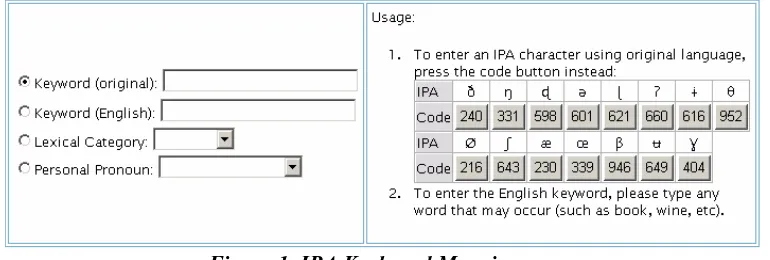
2.2.3 Keyword search with IPA symbols
As briefly outlined above (see section 1), the Formosan Language Archive not only permits the browsing of texts, but also allows for searching based on (i) keywords, (ii) list of affixes and (iii) lexical categories. While the search through affixes and lexical categories is rather simple, as the user browses a separate database7, keyword search is one of the most important
features of the Formosan Language Archive. The search can be made by typing a word in any
The Formosan Language Archive: Linguistic Analysis and Language Processing 179
Figure 1. IPA Keyboard Mapping
3. Annotation rules and standards
3.1
Ontology of different Formosan languages
The use of language codes is necessary when constructing the ontology of different Formosan language families included in the corpora. Our coding system is actually based on the latest version of Ethnologue, which was developed by the Summer Institute of Linguistics and is available on the Internet (e.g., DRU for Rukai and BNN for Bunun). As the SIL website does not provide abbreviated names for dialects. We use a two-letter code based on the dialect name itself (e.g., Mn from Mantauran Rukai). Thus, the language and the dialect codes form distinct entries in our database.
The codes used for the Formosan languages (along with the dialects they include) that are being archived are shown in Table 4.
Table 4. The code system used in the Formosan language archive
Language SIL Code Dialect Code
Rukai DRU
Mantauran Maga Tona Budai Tanan Labuan
Mn Mg To Bu Ta La Saisiyat SAI Taai Tungho Ta Tu Atayal TAY Squliq C’uli’ Cu Sq
Tsou TSY Duhtu Tfuya Tapangu
184 Elizabeth Zeitoun and Ching-Hua Yu
corpus that allow the user to search for a word, to determine its word formation, to check for related words and to understand its meaning. Second, morphemic analysis can be performed only if a language is well understood by the analyst. Though the project leader trained for many years aboriginal assistants in linguistic analysis, and is supervising the development of each corpus to help make the consistency rate higher through the use of the same terminology, it has become clear that to overcome analytical problems, the participation of more language specialists in the development of each different corpus is crucial. Third, while users can cross-reference rather easily both “original” and “linguistically re-annotated/re-edited” data files, our system can not display the phonetic/phonemic transcriptions of languages, as in the case of Maga Rukai for instance, where morphophonemic alternations render systematic morphemic analysis opaque. This inoperability of our system results from the fact that only a few languages exhibit such dense internal variation so that it is hard to generalize a program for the whole corpora. But this limitation has been solved by adding columns pertaining to morphophonemic alternations in the databases for lexical categories.
Other shortcomings (e.g., inconsistencies in glosses or “wrong” analyses) have been either remedied through the development of new programs or can be resolved through follow-up revisions and corrections of earlier corpora.
3.3
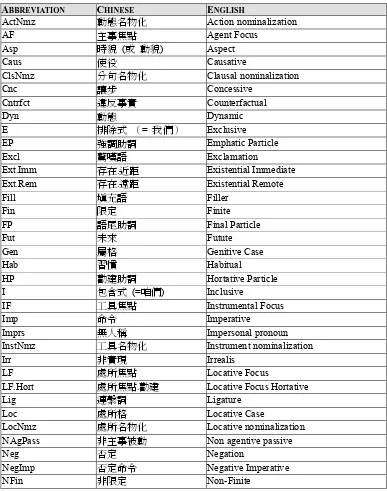
AnnoTool: An Annotation Tool for Formosan Languages
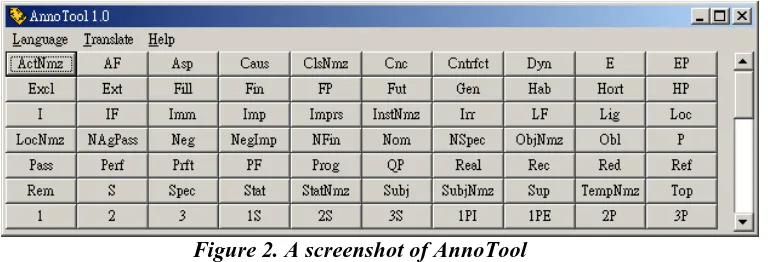
To help with annotation of the corpora, a program called AnnoTool (see Figure 2) has been developed. It has two main functions: it facilitates the tagging of texts and the translation of the linguistic terminology from English to Chinese or vice versa.
Figure 2. A screenshot of AnnoTool
The Formosan Language Archive: Linguistic Analysis and Language Processing 185
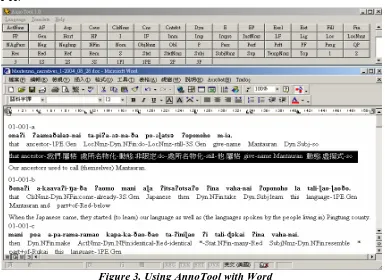
AnnoTool has been designed to work with Microsoft Word. The user can have both programs running concurrently. However, it is necessary to arrange the desktop so that the two windows do not overlap each other. As shown in Figure 3, AnnoTool usually occupies one-third of the screen, and Word two-thirds. When the user clicks on one of the buttons in AnnoTool, a tag is inserted into the Word document automatically. This method makes linguistic analysis more efficient and more accurate. It is more efficient because the linguist can view the on-screen list and stick to pre-defined terminology. It is more accurate because the likehood of introducing typos is kept to a minimum.
Labels can be translated from English into Chinese, or vice versa. To do so, the user must first select a single term or an entire line from a document and then switch to AnnoTool and click on English→Chinese (or Chinese→English) in the Translate menu. Accordingly, the selected sequence in Word can be translated into one of these two languages.
We are conscious that one limitation of AnnoTool is that it has been programmed to handle a specific terminological set. It does not deal with the literal translation of lexical words or phrases. Nevertheless, using this tool makes our linguistic analysis easier than it used to be.
188 Elizabeth Zeitoun and Ching-Hua Yu
(6) Tona Rukai
la wa wam´c´ na b´k´/´ na caNacaNa´ then Dyn.NFin:go Dyn.Subj:take * pig * white and black la paowa po-/aÍiNi si la so
then Caus:Dyn.NFin:go Caus:to-inside and then just doo ki paN´t´Í´ /aboal´ si... Dyn.NFin:can * person name Dyn.Subj:come out and
‘Then they brought a black flecked with white pig, put it inside (the hole) and Pangetede could come out.’ (Zeitoun [2004, ex. 01-004-b])
4.2
Design of programs to recognize words, sentences and paragraphs
In accordance with annotating conventions, the transcription of a text is divided into sentences, which are further segmented into space-delimited words. There are two types of translations: glosses at the word level and free translations at the sentence level. Sentences are numbered for reference purposes. The encoded format of the reference number is xx-xxx-x, where the first part refers to the text id, the second indicates the paragraph id, and the third corresponds to the sentence id11.Each utterance or sentence contributes to the concept of “one block.” A block thus includes: (i) the reference information, (ii) the original utterance or sentence, (iii) word glosses and (iv) free sentential translations.
The annotated data has a three-level hierarchy. It includes the "text,” the "word" and the "sentence." Transcriptions, glosses and translations are associated with one of these three levels. Metadata is associated at the text level. The structure is hierarchical in that a text contains sentences and words. Based on this hierarchical structure, it is easy for a computer to handle a text as an object (see Jacobson et al. [2000]).
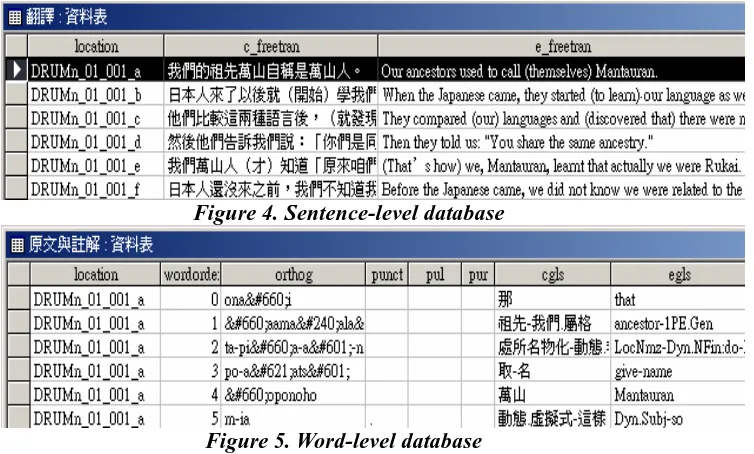
A parse program was written to extract sentence and word objects from each corpus. The location of each sentence, their translations and other related information are stored in the sentence-level database (Figure 4). The locations of words, their transcriptions, their word order, Chinese and English word glosses, and punctuation are stored into the word-level database (Figure 5). The location field, as a primary key, is used to relate one database to another.
The Formosan Language Archive: Linguistic Analysis and Language Processing 189
Figure 4. Sentence-level database
Figure 5. Word-level database
There is no translation at a higher level than the sentence, so there is no need for a paragraph-level table. The free, sentence-level translations can be strung together and arranged in the original order, and they serve as intelligible, if not always smooth or elegant, translations of the whole text.
4.3
Bilingual translation and alignment
Our project consists of multilingual parallel corpora, which in turn consist of Formosan utterances and bilingual translations. At the sentence level, a source segment and two translations of this source are included. At the word level, each lexical unit and their bilingual glosses are included. From the typographic format, two linking correspondences can be inferred from the text: sentence alignment and word alignment. We developed a morphological program to convert the implicit structure of the text into the XML format, which is now the commonly used standard for corpus encoding (Figure 6), as well as a database format (Figures 4 & 5), which can be utilized by the relational method and is accessed by using the structured query language (SQL). When corpus information has been encoded in such formats, it is easier to handle the alignment problems.
<?XML version="1.0" encoding="BIG5" ?>
190 Elizabeth Zeitoun and Ching-Hua Yu
<TITLE>Our language</TITLE> ...
</HEAD> <BODY>
<S id="01-001-a"> <TRANSCR>
<W><FORM WO="0")>onaʔi</FORM><CGLS>那</CGLS><EGLS>that</EGLS> </W>
<W><FORM WO="1">ʔaamaðalaə-nai</FORM><CGLS>祖先-我們.屬格
</CGLS><EGLS>ancestor-1PE.Gen</EGLS></w>
<W><FORM WO="2">ta-piʔa-aə-na-ða</FORM>
<CGLS>處所名物化-動態.非限定:做-處所名物化-還-他.屬格</CGLS> <EGLS>LocNmz-Dyn.NFin:do-LocNmz-still-3S.Gen</EGLS></W> <W><FORM WO="3">po-aɭacə</FORM><CGLS>取-名</CGLS>
<EGLS>give-name</EGLS> </W>
<W><FORM WO="4">ʔoponoho</FORM><CGLS>萬山</CGLS> <EGLS>Mantauran</EGLS></W>
<W><FORM WO="5">m-ia</FORM><CGLS>動態.虛擬式-這樣</CGLS> <EGLS>Dyn.Subj-so</EGLS></W>
<PUNCT>.</PUNCT> </TRANSCR>
<FREETRAN lang="Chinese">我們的祖先自稱萬山人。</FREETRAN> <FREETRAN lang="English">Our ancestors used to call (themselves) Mantauran.
</FREETRAN> </S>
…
</BODY> </TEXT> </XML>
Figure 6. XML markup of a linguistic text
4.3.1 Sentence alignment
The Formosan Language Archive: Linguistic Analysis and Language Processing 191
(7) Mantauran Rukai
o-kaoDo ka aÒa-nai to/onai.
我們沒有任何(東西)
We did not have anything. (Zeitoun and Lin [2003, ex. 013-165-b])
To keep the sentences aligned, our approach maps the linking relationships of the sentence segments and stores or encodes them in a standard format. In other words, the sentential information is stored in the individual fields of a record or in certain XML node elements.
4.3.2 Word alignment
In the Formosan Language Corpora, each uttered word is space-delimited and owns its bilingual glosses appear below it. If no gloss is available, then an asterisk * replaces it:
(8) Mantauran Rukai
o-kaoDo ka aÒa-nai to/onai.
動態.限定-沒有 * 拿-我們.屬格 任何
Dyn.Fin-not+exist * take-1PE.Gen any(thing)
Interlinear morpheme-by-morpheme glosses provide most of the information necessary to build a word alignment database. In the database design, each record is based on a transcribed word. This lexical unit includes important pieces of information, such as a unique identifier (here called a location), a spelled form, a specific word order, and glosses. Word order plays a major role in word arrangement. It allows words (along with their glosses) to be pieced together and to reappear in the same order as in the original format.
Word alignment provides a basis for the extraction of bilingual lexicons. Using the alignment database, we can get the full index of a particular language. However, as each word is deliberately cut into pieces corresponding to morphemes rather than being given a literal meaning, it is impractical to put them together in the order of the source language since the result would be incomprehensible gibberish. That is why we provide a lexical category search, which allows the user to browse the meaning of each word, and a reference to its word formation (see section 3.1).
192 Elizabeth Zeitoun and Ching-Hua Yu
corresponding glosses and attaching bilingual translations in a correct order. It will be possible to enhance this approach in the future so that it can be used for other processing tasks.
5.
Consistency
The consistency of transcribed words and aligned glosses is one of our major concerns in the construction of each corpus. Even though the various types of corpora collected follow standard notations (IPA transcriptions, interlinear glosses and sentence translations), a certain degree of inconsistency can be found in each corpus.
Inconsistencies can be found at different levels: lexical (i.e., inconsistency in transcriptions; word glossing problems), morphological (incorrect identification of morpheme boundaries, hesitation regarding the distribution of certain affixes or roots), and syntactic (differences in syntactic structures between different dialects or languages that may yield incorrect interpretations of the data at hand). We provide examples of these three types of inconsistencies below and show how we are able to deal with them.
5.1
Transcriptions and word glosses
Certain incorrect transcriptions are easily “repaired,” e.g., in Tanan Rukai, Li [1975] recorded ‘very’ as aramor and /aramor, but later fieldwork showed that the second instance is the correct one. Other discrepancies are more difficult to account for. In Mantauran Rukai, the term ivoko ‘male friend’ contrasts with la-/ivoko ‘male friends’. We checked both words many times, and both forms are correct (the first without a glottal, and the second with a glottal).
The Formosan Language Archive: Linguistic Analysis and Language Processing 193
been/are being adopted for other Rukai dialects and other languages whenever necessary.
5.2
Morphology
Morphology plays a crucial role in understanding the Formosan languages, and the morphemic method we have adopted to annotate each corpus has forced us to deal even more carefully with word formation. The analyst is confronted with two major problems, (i) the incorrect identification of morpheme boundaries, and (ii) the restricted distribution of certain affixes or roots that might render their use and functions opaque.
5.2.1 Morpheme boundaries
Blust [Forthcoming] states that “most AN languages can be characterized as agglutinative-synthetic.” Our assumption is based on the fact that morphemes can either be free or bound and can include roots, function words, clitics and affixes and on the fact that morpheme boundaries are usually clear. However, morpheme boundaries might also be difficult to identify, and linguists sometimes propose different approaches to analyzing for the same words. The first problem that has to be settled is whether a word is composed of one or two morphemes. It happens that in some languages/dialects, certain words are no longer divisible, though historically, an affix could be identified. That is the case with the word
/oponoho ‘name of a tribe (Mantauran) or the place they inhabit’, which derives from the prefixation of /o- (<swa- from) to ponoho (<ponogo ‘name place’).
Different analyses from ours are found in the literature, and we must take them into consideration. In Saisiyat (Chu [2003]), for instance, we analyze /i//ik as a ligature, i.e., a grammatical word that carries no lexical meaning. These two morphemes occur in complementary distribution and must be glossed slightly differently, /i as ‘Lig’ and /ik as /i-k ‘Lig-Stat’. The first occurs before dynamic verbs and the second before stative verbs. Li [1999], on the other hand, has analyzed both morphemes as sometimes bound and sometimes free, and translated them as ‘not’.
5.2.2 Distribution of affixes and roots
194 Elizabeth Zeitoun and Ching-Hua Yu
Likewise, some affixes are very non-productive, and it might be difficult to determine their meaning. This is the case with Mantauran Rukai ta/aDa/an´ ‘house warning’ (<Da/an´ ‘house’); the meaning of ta/a is still poorly understood.
5.2.3 Syntactic structures
The major problem that the linguist must be aware of regarding syntactic structures has to do with typological diversity. For instance, in Mantauran and Labuan Rukai, though subordinate temporal clauses are superficially identical, in the former, the subject is marked by the genitive, and in the latter, it is marked by the nominative.
(9) Mantauran Rukai
ona/i /iDa a-paka-kan´-Na-li
that yesterday ClsNmz-Dyn.NFin:finish-eat-already-1S.Gen (/a) o-Davac´-Na-Òao.
Top Dyn.Fin-leave-already1S.Nom ‘Yesterday, after I had eaten, I left.’
(10) Labuan Rukai
sa maka-kan´-N-ako ko aga ka
when Dyn.Fin:finish-eat-already-1S.Nom Acc rice Top w-a-davac-ako.
Dyn.Fin-Real-leave-1S.Nom ‘Yesterday, after I had eaten, I left.’
5.3
Programs developed to remedy analytic inconsistencies
From the processing perspective, a hyphen is used as a morpheme boundary and as such provides morphemic information that can be used to parse word tokens (e.g., om-ia-nai ‘Dyn.Fin-so-1PE.Nom’) without difficulty. To remedy inconsistencies in transcriptions and glosses, all the words can be extracted from the corpus data to create an index. This index list (or finderlist) enables the analyst to compare all the words in order to minimize incorrect spelling or glosses. This program can also output a frequency list of morphemes (Hockey [1998]).
The Formosan Language Archive: Linguistic Analysis and Language Processing 195
space between two words as a punctuation mark, so every word can be said to have an associated punctuation mark. Although this mark indicates a boundary between a group of words, in practice it is connected to the preceding word. Following this approach, we can treat punctuation as a field of the preceding word, as shown in Figure 5 (Leech et al. [1995]).
5.3.1 Word-by-word alignment consistency checker
At a very early stage in the development of the Formosan Language Archive, a program called Chkgloss was designed to verify the rigid structure of the corpus by comparing the number of orthographic words with that of their glosses (see Figure 7). In each corpus, transcribed words are aligned vertically with their interlinear glosses. For example:
(11) o-kaoDo ka aÒa-nai to/onai.
動態.限定-沒有 * 動態.非限定:拿-我們.屬格 任何 Dyn.Fin-not+exist * Dyn.NFin:take-1PE.Gen any(thing)
我們沒有任何(東西)。
We did not have anything.
As mentioned above, to guarantee that transcribed words are the same in number as their glosses, an asterisk is used to represent an empty word (whose meaning or morphosyntactic function remains opaque). It is only after the verification process is completed that a text can undergo whole transformation and be displayed on the Internet.
Figure 7. A Screenshot of Chkgloss
196 Elizabeth Zeitoun and Ching-Hua Yu
cases, a corpus has to undergo back-and-forth processing several times before it can be deemed to be valid (Figure 8).
Figure 8. The workflow of using Chkgloss
6. Conclusion
The Formosan Language Archive is a useful tool for conducting research on the Formosan languages. The multilingual comparable corpora have begun to find their way in linguistic applications and natural language processing. As far as linguistic applications are concerned, each corpus features well-analyzed data that can serve as a basis for more in-depth studies. There are a number of advantages in providing word alignment, sentence alignment, linguistic annotations and bilingual translations. Computer-aided linguistic research is being carried out using tools and techniques that improve the work of the analyst. Applications that were developed for the Formosan Language Archive include Unicode IPA symbols, AnnoTool, Chkgloss and Indexer.
Drawbacks are inevitable, however. If suitable electronic text versions had been available, progress would have been more rapid. Admittedly, a lot of time has been spent on reformatting the legacy data to make it computer readable. In addition, electronic versions of earlier published materials have to be made from scratch, since there were previously no electronic files (e.g., Li [1975], Tung et al. [1964], Fey et al. [1993] etc.).
The Formosan Language Archive: Linguistic Analysis and Language Processing 197
how to develop new tools, make use of existing tools described in the literature (cf., Szakos et al. [2004]) and process the voice files for further research (e.g., phonetic and discursive studies)12. We might also be able at some point to conduct an experiment on natural language
processing (e.g., corpus-based machine translation).
References
Adelaar, K.A., “Retrieving Siraya phonology: a new spelling for a dead language,” In Selected Papers from the Eighth International Conference of Austronesian Linguistics, ed. by E. Zeitoun and P. J.-K. Li, Symposium Series of the Institute of Linguistics (Preparatory Office), No. 1, Institute of Linguistics, (Preparatory Office), Academia Sinica, Taipei, 1999, pp. 313-354.
Bird, S. and G. Simons, “Seven dimensions of portability for language documentation and description,” Language, 79(3), 2003, pp.557-582.
Blust, R., Thao dictionary, Language and Linguistics Monograph Series, No. A5 Institute of Linguistics, ( Preparatory Office), Academia Sinica, Taipei, 2003.
Blust, R., The Austronesian Languages, Ms., Forthcoming.
Bow, C., B. Hughes and S. Bird, “Towards a general model of interlinear text,” In Proceeding of EMELD 2004: the Workshop on Linguistic databases and best practice, Detroit, Michigan, July 15-18, 2004.
Chu, T.-H., Saisiyat texts, ms., 2003.
Early, R. and J. Whitehorn, One hundred Paiwan texts. Pacific Linguistics, 542, Research School of Pacific and Asian Studies, The Australian National University, Canberra, 2003.
Fey, V., et al., O’Orip no’ - Amis Ameizu wenhua - Amis Culture. Taiwan Bible Society, Taipei, 1993.
Hockey, S., “Textual Database,” Using Computers in Linguistics: A Practical Guide, ed. by J. Lawler and H. Aristar-Dry, Routledge, London, 1998, pp.101-133.
Hua J.-J., Southern Paiwan texts, ms., 2005. Hsin, T.-H., Maga (Rukai) texts, ms., 2002.
Jacobson, M., B. Michailovsky and B. Lowe, “Linguistic documents synchronizing sound and text,” Speech Communication, 33, 2000, pp.79-96.
Leech, G., G. Myers and J. Thomas, Spoken English on Computer, Longman Publishing, New York, 1995, pp. 208-219.
Li, P. J.-K., Rukai Texts, Institute of History and Philology, Special Publication No. 64-2, Academia Sinica, Taipei, 1975.
The Formosan Language Archive: Linguistic Analysis and Language Processing 199
Zeitoun, E. and H.-C. Lin, We should not forget the stories of the Mantauran : Memories of the past, Language and Linguistics Monograph Series, No. A4, Institute of Linguistics, Preparatory Office, Taipei, 2003.
Zeitoun, E. and H.-C. Lin, We should not forget the stories of the Mantauran: Traditional folktales, ms., 2004.
Zeitoun, E., The Formosan Language Archive: Linguistic analysis and language processing, Invited talk at Tuesday Seminar of the Institute of Linguistics, University of Hawai’i at Mānoa, January 25, 2005.
Related web pages:
http://www.ailla.org/pc/mainindex.html http://lacito.archivage.vjf.cnrs.fr/
http://www.emeld.org/workshop/2004/paper.html http://www.language-archives.org
http://www.rosettaproject.org:8080/live/ http://www.sinica.edu.tw/SinicaCorpus http://wwwtalana.linguist.jussieu.fr
http://sino-tibetan.cityu.edu.hk/rda/ -- no longer available, later moved to: http://victoria.linguistlist.org/~lapolla/RDA/index.html