Maximum Entropy Classifier Ensembling using Genetic Algorithm for NER in
Bengali
Asif Ekbal
1, Sriparna Saha
21Department of Computational Linguistics
University of Heidelberg Heidelberg-69120, Germany
[email protected], [email protected]
2Interdisciplinary Center for Scientific Computing (IWR)
University of Heidelberg Heidelberg-69120, Germany
[email protected], [email protected]
Abstract
In this paper, we propose classifier ensemble selection for Named Entity Recognition (NER) as a single objective optimization problem. Thereafter, we develop a method based on genetic algorithm (GA) to solve this problem. Our underlying assumption is that rather than searching for the best feature set for a particular classifier, ensembling of several classifiers which are trained using different feature representations could be a more fruitful approach. Maximum Entropy (ME) framework is used to generate a number of classifiers by considering the various combinations of the available features. In the proposed approach, classifiers are encoded in the chromosomes. A single measure of classification quality, namely F-measure is used as the objective function. Evaluation results on a resource constrained language like Bengali yield the recall, precision and F-measure values of 71.14%, 84.07% and 77.11%, respectively. Experiments also show that the classifier ensemble identified by the proposed GA based approach attains higher performance than all the individual classifiers and two different conventionalbaselineensembles.
1.
Introduction
Named Entity Recognition (NER) has immense applica-tions in almost all Natural Language Processing (NLP) ap-plication areas that include Information Retrieval, Informa-tion ExtracInforma-tion, Machine TranslaInforma-tion, QuesInforma-tion Answering and Automatic Summarization etc. The main goal of NER is to identify every word/term in a document and to classify them into some predefined categories like person name, lo-cation name, organization name, miscellaneous name (date, time, percentage and monetary expressions etc) and “none-of-the-above”.
The existing approaches of NER can be grouped into three main categories, namely rule based, machine learning based and hybrid approach. Rule based approaches focus on extracting names using a number of handcrafted rules. Generally, these systems consist of a set of patterns us-ing grammatical (e.g., part of speech), syntactic (e.g., word precedence) and orthographic features (e.g., capitalization) in combination with dictionaries. Some of the typical sys-tems are University Of Sheffield’s LaSIE-II (Humphreys et al., 1998), ISOQuest’s NetOwl (Aone et al., 1998) and University Of Edinburgh’s LTG ((Mikheev et al., 1998), (Mikheev et al., 1999)) for English NER. These kinds of systems yield results for restricted domains and are capa-ble of detecting complex entities that are difficult with ma-chine learning models. However, rule based systems lack the ability of portability and robustness, and furthermore the high cost of the maintenance of rules increases even when the data is slightly changed.
In comparison, machine learning (ML) approaches have gained more attention to the researchers for NER because these are easily trainable, adaptable to different domains and languages as well as their maintenance are also less
handcraft rule based NER surfaces when there is a need to change the domain of data.
Besides these, there are many other existing works in the area of NER. The languages covered include English, most of the European languages and some of the Asian languages like Chinese, Japanese and Korean. India is a multilingual country with great linguistic and cultural diversities. People speak in at least 22 different official languages that are de-rived from almost all the dominant linguistic families in the world. However, the works related to NER in Indian lan-guages have started to emerge only very recently. Named Entity (NE) identification in Bengali as well as in any In-dian language is more difficult and challenging compared to others due to the following facts:
• Lack of capitalization information that acts as a good indicator for NE identification, especially in English.
• Indian names are more diverse and a lot of these ap-pear in the dictionary as common nouns.
• Indian languages are relatively free word order in na-ture.
• Bengali, like any other Indian languages, is also re-source constrained, i.e., corpus, annotated corpus, name dictionaries, morphological analyzers, part of speech (POS) taggers etc are not readily available.
• Indian languages are highly inflected and provide rich and challenging sets of linguistic and statistical fea-tures resulting in long and complex wordforms.
For Bengali, a few works are available that are based on un-supervised lexical pattern learning from the unlabeled data (Ekbal and Bandyopadhyay, 2007), HMM (Ekbal et al., 2007) that considers additional context information during emission probabilities, CRF (Ekbal and Bandyopadhyay, 2009a), SVM (Ekbal and Bandyopadhyay, 2008a) and vot-ing (Ekbal and Bandyopadhyay, 2009b). Various systems on NER in Indian languages using different approaches can be found in the proceedings of the IJCNLP-08 Work-shop on NER for South and South East Asian Languages (NERSSEAL)1.
The performance of any classification technique depends on the features of training and test data sets. Feature se-lection, also known as variable sese-lection, feature reduction, attribute selection or variable subset selection, is the tech-nique, commonly used in machine learning, of selecting a subset of relevant features for building robust learning mod-els. In ME based models, selection of appropriate features is a crucial problem and also a key issue to improve the recognition as well as classification performance. It does not provide a method for automatic feature selection and uses heuristics for this task in general. Rather than select-ing the best-fittselect-ing feature set, ensemblselect-ing several NER sys-tems where each one is based on different feature represen-tation can be considered as an alternative research direction. Ensembling of classifiers is done to increase the generaliza-tion accuracy that greatly depends on the diversity of each
1
http://ltrc.iiit.ac.in/ner-ssea-08
individual classifier as well as on their individual perfor-mance. But, it is a very crucial step to determine the partic-ular subset of classifiers (from a set) that can participate in the process of an ensemble construction. In this paper, we formulate this classifier ensemble selection problem under the single objective optimization framework that uses ge-netic algorithm (GA) (Goldberg, 1989). Gege-netic algorithms (Goldberg, 1989) are randomized search and optimization techniques guided by the principles of evolution and natu-ral genetics, having a large amount of implicit panatu-rallelism. It performs search in complex, large and multimodal land-scapes, and provide near-optimal solutions for objective or fitness function of an optimization problem. In GAs, the parameters of the search space are encoded in the form of strings calledchromosomes. A collection of such strings is called apopulation. Initially, a random population is cre-ated, which represents different points in the search space. Anobjectiveor afitnessfunction are associated with each string that represents the degree ofgoodnessof the string. Based on the principle of survival of the fittest, a few of the strings are selected and each is assigned a number of copies that go into the mating pool. Biologically inspired opera-tors likecrossoverandmutationare applied on these strings to yield a new generation of strings. The processes of se-lection, crossover and mutation continue for a fixed number of generations or till a termination condition is satisfied. Depending on the various available feature combinations, different versions of the ME based classifier are made. One most interesting and important characteristics of these fea-tures is that these are language independent in nature, and can be easily derived for almost all the languages with a very little effort. Here, classifiers are encoded in the chro-mosomes. The average F-measure value of the 3-fold cross validation (on the training data) of the classifier ensemble encoded in a particular chromosome is used as it’s fitness value. We use elitism to keep the best solution intact in a place outside the population. The proposed approach is evaluated for a resource-constrained language, namely Bengali. In terms of native speakers, Bengali ranks fifth in the world and second in India. Bengali is also the na-tional language in Bangladesh. Evaluation results show the effectiveness of the proposed approach with the overall re-call, precision and F-measure values of 71.14%, 84.07% and 77.11%, respectively. We also show that our technique performs superior to the two conventionalbaseline ensem-bles.
The remainder of the paper is organized as follows. Section 2 gives a very brief introduction about the main goal of this work. The ME framework for NER is introduced in Sec-tion 3. In SecSec-tion 4, we describe the various language in-dependent features used for our NER task. We elaborately describe our proposed GA based classifier ensemble tech-nique in Section 5. Detailed evaluation results along with the necessary discussions are reported in Section 6. Finally, Section 7 concludes the paper with some future directions.
2.
Goal of the Paper
Suppose, there are N number of classifiers available and these be denoted by C1, . . . , CN. Let, A = {Ci :
i = 1;N}. The classifier ensemble selection problem is then stated as follows: Find a set of classifiers B which will optimize a function F(B) such that: B ⊆ A. Here, F is a classification quality measure of the combined classifier. The particular kind of problem like NER has three different types of classification quality mea-sures, namely recall, precision and F-measure. Thus,F ∈
{recall,precision,F-measure}. Combination of the classi-fiers can be done by either majority voting or weighted vot-ing. Several optimization techniques exist in the literature. In this paper we use GA (Goldberg, 1989), a very popular search technique, to solve the above mentioned classifier ensemble selection problem.
3.
Maximum Entropy Framework for NER
The ME framework estimates probabilities based on the principle of making as few assumptions as possible, other than the constraints imposed. Such constraints are derived from the training data, expressing some relationships be-tween features and outcome. The probability distribution that satisfies the above property is the one with the highest entropy. It is unique, agrees with the maximum likelihood distribution, and has the exponential form:P(t|h) = 1
Z(h)exp( n ∑
j=1
λjfj(h, t)) (1)
where,tis the NE tag,his the context (or, history),fj(h, t)
are the features with associated weight λj andZ(h)is a
normalization function.
The problem of NER can be formally stated as follows. Given a sequence of words w1, . . . , wn, we want to find
the corresponding sequence of NE tagst1, . . . , tn, drawn
from a set of tagsT, which satisfies:
P(t1, . . . , tn|w1, . . . , wn) = ∏
i=1,2...,n
P(ti|hi) (2)
where,hiis the context for the wordwi.
In general, the features are binary valued functions, which associate a NE tag with various elements of the context. For example:
fj(h, t) = 1if word(h) =sachInandt=I-PER (3)
= 0 otherwise (4)
We use the OpenNLP Java based ME package 2 for the
computation of the values of the parametersλj. This allows
to concentrate on selecting the features, which best charac-terize the problem instead of worrying about assigning the relative weights to the features. In the present work, we use the generalized iterative scaling (Darroch and Ratcliff, 1972) algorithm to estimate the MaxEnt parameters.
4.
Named Entity Features
The main features for the NER task are identified based on the different possible combinations of available word and
2
http://maxent.sourceforge.net/
tag contexts. We use the following features for constructing the various classifiers based on the ME framework. These features are language independent in nature, and can be eas-ily derived for almost all the languages.
1. Context words: These are the preceding and succeed-ing words of the current word. This feature is added with the observation that surrounding words carry ef-fective information for the identification of NEs.
2. Word suffix: Fixed length (say,n) word suffixes are very effective to identify NEs and work well for the highly inflected language like Bengali. Actually, these are the fixed length character strings stripped from the rightmost position of the words. For example, the suffixes of length up to 3 characters of the word ”ObAmA” [Obama] are ”A”, ”mA” and ”AmA”. If the length of the corresponding word is less than or equal ton−1then the feature values are “not defined” (de-noted by ND). The feature value is also not defined (ND) if the token itself is a punctuation symbol or con-tains any special symbol or digit. This feature is in-cluded with the observation that NEs share some com-mon suffixes.
3. Word prefix: Fixed length word prefixes are used as the features. These are the fixed length charac-ter strings stripped from the leftmost positions of the words. For example, the prefixes of length up to 3 characters of the word ”ObAmA” [Obama] are ”O”, ”Ob” and ”ObA”. This is also defined in the similar way as like the word suffixes.
4. Infrequent word: This is a binary valued feature that checks whether the current word appears in training set very frequently or not. We compile a list of most frequently occurring words from the training set by defining an appropriate threshold value. In the present work, we set this threshold value to 10. However, this threshold value does vary depending upon the size of the training set. A binary valued feature ”INFRQ” is set to 1 if the word does not appear in this list, other-wise it is set to 0.
5. Part of Speech (POS) information: POS information of the current and/or the surrounding word(s) are ef-fective for NE identification. We use a SVM based POS tagger (Ekbal and Bandyopadhyay, 2008b) that was originally developed with a tagset of 26 tags, de-fined for the Indian languages. In this particular work, we evaluate the SVM based POS tagger with a coarse-grained tagset that contains only three tags, namely Nominal, PREP (Postpositions) and Other. We con-sider postposition as it often occurs after the NEs. The coarse-grained POS tagger has been found to perform better compared to a fine-grained one in case of ME based NER.
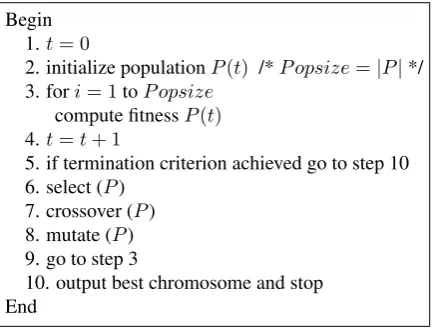
Begin 1.t= 0
2. initialize populationP(t) /*P opsize=|P|*/ 3. fori= 1toP opsize
compute fitnessP(t)
4.t=t+ 1
5. if termination criterion achieved go to step 10 6. select (P)
7. crossover (P) 8. mutate (P) 9. go to step 3
10. output best chromosome and stop End
Figure 1: Basic Steps of GA
7. Digit features: Several digit features are defined de-pending upon the presence and/or the number of its and/or symbols in a token. These features are dig-itComma (token contains digit and comma), digitPer-centage (token contains digit and perdigitPer-centage), digitPe-riod (token contains digit and pedigitPe-riod), digitSlash (to-ken contains digit and slash), digitHyphen (to(to-ken con-tains digit and hyphen) and digitFour (token consists of four digits only). These features are helpful to iden-tify miscellaneous NEs.
5.
Proposed Approach
The proposed GA based classifier ensemble selection method is described below. The basic steps of our approach closely follow those of the conventional GA as shown in Figure 1.
5.1. String Representation and Population Initialization
If the total number of available classifiers is M, then the length of the chromosome isM. As an example, the en-coding of a particular chromosome is represented in Figure 2. Here,M = 19, i.e., total 19 different classifiers are built. The chromosome represents an ensemble of 7 classifiers (i.e., first, third, fourth, seventh, tenth, eleventh and twelfth classifiers). The entries of each chromosome are randomly initialized to either 0 or 1. Here, if theithposition of a
chromosome is 0 then it represents thatithclassifier does
not participate in the classifier ensemble. Else, if it is 1 then the ith classifier participates in the classifier
ensem-ble. If the population size is P then all the P number of chromosomes of this population are initialized in the above way.
5.2. Fitness Computation
Initially, the F-measure values of all the individual ME based classifiers are calculated using 3-fold cross valida-tion on the available training data. Thereafter, we execute the following steps to compute the fitness value.
1. Suppose, there are N number of classifiers present in the ensemble represented in a particular chromo-some (i.e., there are total N number of 1’s in that chro-mosome). Let, the overall average F-measure values
Figure 2: Chromosome Representation
of the 3-fold cross validation on the training data for theseNclassifiers beFi,i= 1. . . N.
2. Here, the training data is again divided into 3 parts. Each classifier is trained using 2/3 of the training data and tested with the remaining 1/3 part. Now for the ensemble classifier, the output NE tag for each word in the 1/3 training data is determined using the weighted voting of theseN classifiers’ outputs. The weight of the NE tag provided by theithclassifier is equal toF
i.
3. The overall F-measure value of this ensemble classi-fier for the 1/3 training data is calculated.
4. Step 2 and 3 are repeated 3 times to perform 3-fold cross validation. The average F-measure value, ob-tained from the cross validation, of the ensemble clas-sifier is used as the fitness value of that particular chro-mosome.
The objective is to maximize this fitness value (i.e., F-measure) using the search capability of GA.
5.3. Selection
During each successive generation, a proportion of the ex-isting population is selected to create a new generation. In-dividual solutions are selected through a fitness-based pro-cess, where fitter solutions (as measured by a fitness func-tion) are typically more likely to be selected. Certain selec-tion methods rate the fitness of each soluselec-tion and preferen-tially select the best solutions.
In this paper, we use Roulett wheel selection. Here, the fit-ness function invoked with each chromosome is used to as-sociate a probability of selection with each individual chro-mosome. Iffiis the fitness of individualiin the population,
its probability of being selected is
pi=
fi
ΣN
j=1fj
,
selection, chromosomes with a higher fitness are less likely to be eliminated but there is still a chance that they may be.
5.4. Crossover
Here, we use the normal single point crossover (Holland, 1975). Suppose, there are 19 classifiers. The two chromo-somes look like:
P1= 0 1 1 0 0 0 1 1
P2= 1 1 1 0 0 0 1 0
Now, if we consider the crossover point is at 4 then after single point crossover the new chromosomes will look like:
O1= 0 1 1 0 0 0 1 0
O2= 1 1 1 0 0 0 1 1.
Crossover probability is selected adaptively as in (Srinivas and Patnaik, 1994). The expressions for crossover probabil-ities are computed as follows. Let,fmaxbe the maximum
fitness value of the current population, f be the average fitness value of the population andf0 be the larger of the fitness values of the solutions to be crossed. Then the prob-ability of crossover,µc, is calculated as:
µc = k1×
(fmax−f
0 )
(fmax−f)
, if f0 > f , (5)
= k3, if f
0
≤f . (6)
Here, as in (Srinivas and Patnaik, 1994), the values ofk1
and k3 are kept equal to 1.0. Note that, when fmax=f,
thenf0 =fmaxandµcwill be equal tok3. The aim behind
this adaptation is to achieve a trade-off between exploration and exploitation in a different manner. The value ofµc is
increased when the better of the two chromosomes to be crossed is itself quite poor. In contrast when it is a good so-lution,µcis low so as to reduce the likelihood of disrupting
a good solution by crossover.
5.5. Mutation
Each chromosome undergoes mutation with a probability µm. The mutation probability is also selected adaptively for
each chromosome as in (Srinivas and Patnaik, 1994). The expression for mutation probability,µm, is given below:
µm = k2×
(fmax−f)
(fmax−f)
if f > f , (7)
= k4 if f ≤f . (8)
Here, values of k2 and k4 are kept equal to 0.5. This
adaptive mutation helps GA to come out of local opti-mum. When GA converges to a local optimum, i.e., when fmax−fdecreases,µcandµmboth will be increased. As a
result GA will come out of local optimum. It will also hap-pen for the global optimum that may result in disruption of the near-optimal solutions. As a result GA will never converge to the global optimum. Theµc andµmwill get
lower values for high fitness solutions and higher values for low fitness solutions. While the high fitness solutions aid in the convergence of GA, the low fitness solutions prevent the GA from getting stuck at a local optimum. The use of elitism will also keep the best solution intact. The val-ues of µc andµm are both set to 0 for the solution with
the maximum fitness value. The best solution in a popu-lation is transferred undisrupted into the next generation. Together with the selection mechanism, this may lead to an exponential growth of the solution in the population and may cause premature convergence. To overcome the above stated problem, a default mutation rate (of 0.02) is kept for every solution in the population. Here, we apply mutation operator to each entry of the chromosome where the entry is randomly replaced by either 0 or 1.
5.6. Termination Condition
In this approach, the processes of fitness computation, se-lection, crossover, and mutation are executed for a maxi-mum number of generations. The best string seen upto the last generation provides the solution to the above classifier ensemble problem. Elitism is implemented at each genera-tion by preserving the best string seen upto that generagenera-tion in a location outside the population. Thus on termination, this location contains the best classifier ensemble.
6.
Experimental Results and Discussions
We set the following parameter values for GA: population size=100, number of generations=50, probabilities of mu-tation and crossover are selected adaptively. The system is evaluated in terms of recall, precision and F-measure as de-fined in CoNLL-2003 shared task (Sang et al., 2003). We define two differentbaselineensemble systems as below:• Baseline 1: In thisbaselinemodel, all the individual classifiers are combined together into a final system based on the majority voting of the output class la-bels. If all the outputs differ then anyone is selected randomly.
• Baseline 2: All the individual classifiers are combined with the help of a weighted voting approach. In each classifier, weight is calculated based on the average F-measure value of the 3-fold cross validation on the training data. The final output label is selected based on the highest weighted vote.
6.1. Datasets for NER
Indian languages are resource-constrained in nature. For NER, we use a Bengali news corpus (Ekbal and Bandy-opadhyay, 2008c), developed from the archive of a lead-ing Bengali newspaper available in the web. A portion of this corpus containing approximately 250K wordforms has been manually annotated with a coarse-grained NE tagset of four tags namely, PER (Person name), LOC (Location name), ORG (Organization name) and MISC (Miscella-neous name). The miscella(Miscella-neous name includes date, time, number, percentages, monetary expressions and measure-ment expressions. We collet the data mostly from the na-tional, states, sports and politics domains of the newspaper. This annotation was carried out by one of the authors and verified by an expert. We also use the IJCNLP-08 NER on South and South East Asian Languages (NERSSEAL)3
shared task data of around 100K wordforms that were orig-inally tagged with a fine-grained tagset of twelve tags. This
3
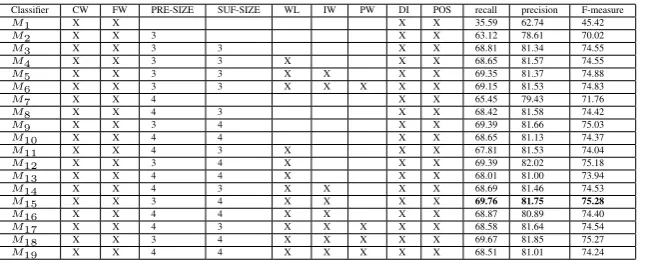
Table 1: Feature types and parameters used for training different ME based classifiers for Bengali. Here, the following abbreviations are used: ’CW’:Context words, ’Pre-size’: Size of the prefix, ’Suf-size’: Size of the suffix, ’WL’: Word length, ’IW’: Infrequent word, ’PW’: Position of the word, ’FW’:First word, DI: ’Digit-Information’, X: Denotes the presence of the corresponding feature
Classifier CW FW PRE-SIZE SUF-SIZE WL IW PW DI POS recall precision F-measure
M1 X X X X 35.59 62.74 45.42
M2 X X 3 X X 63.12 78.61 70.02
M3 X X 3 3 X X 68.81 81.34 74.55
M4 X X 3 3 X X X 68.65 81.57 74.55
M5 X X 3 3 X X X X 69.35 81.37 74.88
M6 X X 3 3 X X X X X 69.15 81.53 74.83
M7 X X 4 X X 65.45 79.43 71.76
M8 X X 4 3 X X 68.42 81.58 74.42
M9 X X 3 4 X X 69.39 81.66 75.03
M10 X X 4 4 X X 68.65 81.13 74.37
M11 X X 4 3 X X X 67.81 81.53 74.04
M12 X X 3 4 X X X 69.39 82.02 75.18
M13 X X 4 4 X X X 68.01 81.00 73.94
M14 X X 4 3 X X X X 68.69 81.46 74.53
M15 X X 3 4 X X X X 69.76 81.75 75.28
M16 X X 4 4 X X X X 68.87 80.89 74.40
M17 X X 4 3 X X X X X 68.58 81.64 74.54
M18 X X 3 4 X X X X X 69.67 81.85 75.27
M19 X X 4 4 X X X X X 68.51 81.01 74.24
data is mostly from the agriculture and scientific domains. An appropriate conversion routine is defined to convert this fine-grained NE annotated data to the desired forms, i.e., tagged with a coarse-grained tagset of four tags. In order to report the evaluation results, we select approximately 37K wordforms from the total 350K wordforms as the test set. The rest is used as the training set. Some statistics of the training and test sets are presented in Table 2. There are 35.1% unseen NEs in the test set.
In order to properly denote the boundaries of NEs, four basic NE tags are further divided into the format I-TYPE (TYPE→PER/LOC/ORG/MISC) which means that the word is inside a NE of type TYPE. Only if two NEs of the same type immediately follow each other, the first word of the second NE will have tag B-TYPE to show that it starts a new NE. For example, the name mahatmA gAndhi[Mahatma Gandhi] is tagged as mahatmA[Mahatma]/I-PER gAndhi[Gandhi]/I-PER. But, the names mahatmA gAndhi[Mahatma Gandhi] ra-bIndrAnAth thAkur[Rabindranath Tagore] are to be tagged as mahatmA[Mahatma]/I-PER gAndhi[Gandhi]/I-PER rabIndrAnAth[Rabindranath]/B-PER thAkur[Tagore]/I-PER if they appear sequentially in the text. This is the standard IOB format that was followed in the CoNLL-2003 shared task (Sang et al., 2003).
6.2. Results and Discussions
We build a number of different ME models from the avail-able NE features. We consider various combinations from the following set of features:
context of size five (previous two and next two words), word suffixes and prefixes of length upto three (3+3 dif-ferent features) or four (4+4 difdif-ferent features) characters, POS information of the current word, first word, length, in-frequent word, position of the word in the sentence, and several digit features.
We construct 19 different classifiers as shown in Table 1 with the various combinations of the available features. The best individual classifier shows the recall, precision and F-measure values of 69.76%, 81.75% and 75.28%, respec-tively. The corresponding features are: previous two and
next two words, first word, prefixes of length upto three characters of only the current word, suffixes of length upto four characters of only the current word, word length, infre-quent word, POS information of the current word and the various digit features. Overall evaluation results are pre-sented in Table 3. It reports the overall performance of the best individual classifier, two differentbaselineensembles and the best ensemble classifier identified by the proposed single objective GA based technique. Results show that the overall performance attained by the classifier ensem-ble determined by the proposed algorithm outperforms all the other models. It shows the improvement in recall, pre-cision and F-measure values by 1.38%, 2.32% and 1.83%, respectively, over the best individual classifier. In compar-ison to the firstbaseline, the proposed algorithm performs superior with more than 1.31%, 1.17% and 1.30% in re-call, precision and F-measure values, respectively. We also observe the improvement of 0.89% recall, 1.10% precision and 1.03% F-measure over the secondbaseline. The best solution of the proposed GA based classifier selection ap-proach selects the following classifiers for ensembling: M2,M3,M4,M5,M7,M9,M10,M11,M12,M14,M16,
M18andM19.
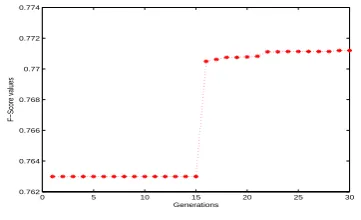
Just for an illustration, we show the boxplot of the F-measure values of the solutions on the final population of the proposed GA based ensemble in Figure 3. The vari-ations of the best F-measure values over genervari-ations are shown in Figure 4. This figure shows that the proposed al-gorithm converges within 21 generations for this particular data set.
Table 2: Statistics of training and test sets
Set PER LOC ORG MISC
Training 6,717 5,591 3,070 8,058
Test 648 670 374 1,008
Table 3: Overall results for Bengali
Classification Scheme recall (in %) precision (in %) F-measure (in %) Best individual classifier 69.76 81.75 75.28
Baseline 1 69.83 82.90 75.81
Baseline 2 70.25 82.97 76.08
GA based ensemble 71.14 84.07 77.11
1 0.754
0.756 0.758 0.76 0.762 0.764 0.766 0.768 0.77 0.772
F−Score values
Population Members
Figure 3: Boxplot of the F-measure values of the solutions on the final population of the proposed GA based technique
0 5 10 15 20 25 30 0.762
0.764 0.766 0.768 0.77 0.772 0.774
Generations
F−Score values
Figure 4: Variations of the best F-measure values over gen-erations
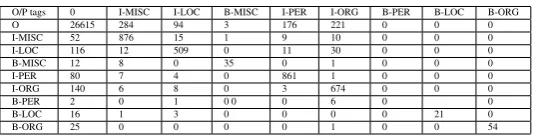
vs. O, I-LOC vs. O etc. This table also shows that the pro-posed algorithm performs best for the MISC class followed by PER, LOC and ORG classes.
7.
Conclusion and Future Works
In this paper, we propose the use of GA to develop a clas-sifier ensemble for NER. We carried out sufficient exper-iments to validate our underlying assumption that instead of searching for the best-fitting feature set heuristically, it could be more effective to find out an appropriate ensemble technique to combine the different classifiers, where each one is based on distinct feature representation. We have used ME framework as the base classifier. One mostinter-Table 4: Results of pairwise comparisons of different tech-niques on F-measure values obtained by ANOVA test
Technique Comparing Mean Significance Name (I) Algo.(J) Difference (I-J) Value GA Best Classifier 1.38±0.23 0.00
Baseline 1 1.31±0.18 0.017
Baseline 2 0.89±0.26 0.023
esting and important characteristic of our system is that it makes use of only language independent features that can be easily derived for almost all the languages without any knowledge of them a priori. We evaluated our proposed technique for a resource poor language like Bengali. Re-sults show the recall, precision and F-measure values of 71.14%, 84.07% and 77.11%, respectively. Experiments also show the superiority of our proposed technique over the two conventionalbaselineensembles.
In future we would like to incorporate some more language independent (dynamic NE information etc.) as well as the language specific features to generate more classifiers. In this work, we have considered only ME as the underlying classification technique. Future works include the develop-ment of vote based classifier ensembles using some other well-known classifiers like CRF and Support Vector Ma-chine. A single objective optimization techniques can only optimize a single quality measure, e.g., recall, precision or F-measure at a time. In reality, sometimes a single mea-sure like these can not capture the quality of a good ensem-bling reliably. Any good ensemble should have it’s recall, precision and F-measure parameters optimized simultane-ously. Inspired by this, we would like to model the classifier ensemble selection problem under the multiobjective opti-mization (MOO) framework (Deb, 2001) that can simulta-neously optimize more than one classification parameters.
8.
Acknowledgement
activ-Table 5: Confusion matrix for Bengali
O/P tags 0 I-MISC I-LOC B-MISC I-PER I-ORG B-PER B-LOC B-ORG
O 26615 284 94 3 176 221 0 0 0
I-MISC 52 876 15 1 9 10 0 0 0
I-LOC 116 12 509 0 11 30 0 0 0
B-MISC 12 8 0 35 0 1 0 0 0
I-PER 80 7 4 0 861 1 0 0 0
I-ORG 140 6 8 0 3 674 0 0 0
B-PER 2 0 1 0 0 0 6 0 0
B-LOC 16 1 3 0 0 0 0 21 0
B-ORG 25 0 0 0 0 1 0 0 54
ities in the University of Heidelberg, Germany.
9.
References
T. W. Anderson and S.L. Scolve. 1978. Introduction to the Statistical Analysis of Data. Houghton Mifflin.
Chinatsu Aone, L. Halverson, T. Hampton, and M. Ramos-Santacruz. 1998. SRA: Description of the IE2 system used for MUC-7. InMUC-7. Fairfax, Virginia.
Daniel M. Bikel, Richard L. Schwartz, and Ralph M. Weischedel. 1999. An Algorithm that Learns What’s in a Name.Machine Learning, 34(1-3):211–231.
A. Borthwick. 1999. Maximum Entropy Approach to Named Entity Recognition. Ph.D. thesis, New York Uni-versity.
J. Darroch and D Ratcliff. 1972. Generalized Iterative Scaling for Log-linear Models. Ann. Math.Statistics, 43:1470–1480.
Kalyanmoy Deb. 2001. Multi-objective Optimization Us-ing Evolutionary Algorithms. John Wiley and Sons, Ltd, England.
A. Ekbal and S. Bandyopadhyay. 2007. Lexical Pattern Learning from Corpus Data for Named Entity Recogni-tion. InProceedings of the 5th International Conference on Natural Language Processing (ICON), pages 123– 128, India.
A. Ekbal and S. Bandyopadhyay. 2008a. Bengali Named Entity Recognition using Support Vector Machine. In Proceedings of Workshop on NER for South and South East Asian Languages, 3rd International Joint Confer-ence on Natural Languge Processing (IJCNLP), pages 51–58, India.
A. Ekbal and S. Bandyopadhyay. 2008b. Web-based Ben-gali News Corpus for Lexicon Development and POS Tagging. POLIBITS, ISSN 1870-9044, 37:20–29. A. Ekbal and S. Bandyopadhyay. 2008c. A
Web-based Bengali News Corpus for Named Entity Recog-nition. Language Resources and Evaluation Journal, 42(2):173–182.
A. Ekbal and S. Bandyopadhyay. 2009a. A Conditional Random Field Approach for Named Entity Recognition in Bengali and Hindi. Linguistic Issues in Language Technology (LiLT), 2(1):1–44.
A. Ekbal and S. Bandyopadhyay. 2009b. Voted NER Sys-tem using Appropriate Unlabeled Data. Proceedings of the 2009 Named Entities Workshop: Shared Task on Transliteration (NEWS 2009), ACL-IJCNLP 2009, pages 202–210.
A. Ekbal, S.K. Naskar, and S. Bandyopadhyay. 2007. Named Entity Recognition and Transliteration in
Ben-gali. Named Entities: Recognition, Classification and Use, Special Issue of Lingvisticae Investigationes Jour-nal, 30(1):95–114.
D. E. Goldberg. 1989. Genetic Algorithms in Search, Opti-mization and Machine Learning. Addison-Wesley, New York.
J. H. Holland. 1975. Adaptation in Natural and Artificial Systems. The University of Michigan Press, AnnArbor. K. Humphreys, R. Gaizauskas, S. Azzam, C. Huyck,
B. Mitchell, H. Cunnigham, and Y. Wilks. 1998. Univ. Of Sheffield: Description of the LaSIE-II System as Used for MUC-7. InMUC-7. Fairfax, Virginia.
John D. Lafferty, Andrew McCallum, and Fernando C. N. Pereira. 2001. Conditional Random Fields: Probabilis-tic Models for Segmenting and Labeling Sequence Data. InICML, pages 282–289.
A. Mikheev, C. Grover, and M. Moens. 1998. Description of the LTG System used for MUC-7. InMUC-7. Fairfax, Virginia.
A. Mikheev, C. Grover, and M. Moens. 1999. Named En-tity Recognition without Gazeteers. In Proceedings of EACL, pages 1–8. Bergen, Norway.
S. Miller, M. Crystal, H. Fox, L. Ramshaw, R. Schawartz, R. Stone, R. Weischedel, and the Annotation Group. 1998. BBN: Description of the SIFT System as Used for MUC-7. InMUC-7, Fairfax, Virginia.
E. Riloff and R. Jones. 1999. Learning Dictionaries for Information Extraction by Multi-level Bootstrapping. In Proceedings AAAI ’99/IAAI ’99: Proceedings of the Six-teenth National Conference on Artificial Intelligence and the Eleventh Conference on Innovative Applications of Artificial Intelligence, pages 474–479.
Tjong Kim Sang, Erik F., and Fien De Meulder. 2003. In-troduction to the CoNLL-2003 Shared Task: Language Independent Named Entity Recognition. InProceedings of the Seventh Conference on Natural Language Learn-ing at HLT-NAACL 2003, pages 142–147.
Satoshi Sekine. 1998. Description of the Japanese NE Sys-tem used for MET-2. InMUC-7, Fairfax, Virginia. R. Srihari, Cheng Niu, and W. Li. 2002. A Hybrid
Ap-proach for Named Entity and Sub-type Tagging. In Pro-ceedings of Sixth Conference on Applied Natural Lan-guage Processing (ANLP), pages 247–254.