On the use of Web resources and natural language processing
techniques to improve automatic speech recognition systems
Gw´enol´e Lecorv´e, Guillaume Gravier, Pascale S´ebillot
IRISACampus de Beaulieu, 35042 RENNES, France
{gwenole.lecorve,guillaume.gravier,pascale.sebillot}@irisa.fr
Abstract
Language models used in current automatic speech recognition systems are trained on general-purpose corpora and are therefore not relevant to transcribe spoken documents dealing with successive precise topics, such as long multimedia streams, frequently tackling reports and debates. To overcome this problem, this paper shows that Web resources and natural language processing techniques can be effective to automatically collect a topic specific corpora from the Internet in order to adapt the baseline language model of an automatic speech recognition system. We detail how to characterize the topic of a segment and how to collect Web pages from which a topic-specific language model can be trained. We finally present experiments where an adapted language model is obtained by combining the topic-specific language model with the general purpose one to obtain new transcriptions. The results show that our topic adaptation technique leads to significant transcription quality gains.
1. Introduction
Using speech transcriptions is an effective way for the in-dexing of long multimedia streams, like 24h of TV or radio broadcast. To generate these transcriptions, current auto-matic speech recognition (ASR) systems are based on lan-guage models (LM) which gather word sequence probabil-ities, typicallyn-gram probabilities, and assist the system
in discriminating utterances with the highest likelihood. In practice, thesen-gram probabilities are estimated globally
once and for all on large multi-topic corpora. However, sincen-gram probabilities change with topics, these
multi-topic LMs are not accurate to transcribe spoken documents successively tackling various topics, like broadcast news or debates.
To circumvent this problem, this paper proposes to use nat-ural language processing techniques to automatically adapt a general purpose LM to any topic, using the Internet as an open resource to dynamically gather an adaptation corpus. The final goal in this paper is to improve the transcription quality of ASR systems on topic specific segments. To this end, experiments are carried out on a large set of various radio broadcast news shows.
The paper is organized as follows: Section 2 presents an overview of the complete LM adaptation technique. Works related with all the steps of the adaptation process are pre-sented in Section 3. Sections 4 to 6 detail each key point of the proposed approach and experimental results are given in Section 7.
2. Overall approach
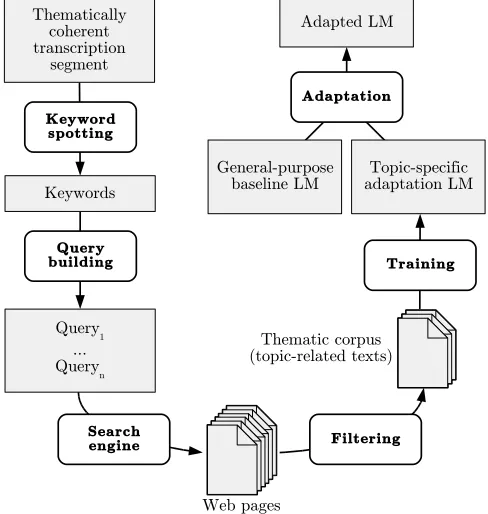
As presented in Fig. 1, the basic idea of our topic adapta-tion technique is to use the Internet as an open linguistic resource from which topic-specific texts can be retrieved to estimate newn-gram probabilities for almost any topic.
The process described below is applied to single topic segments, previously transcribed with a baseline general-purpose LM, where such segments may come either from the thematic segmentation of a long speech stream or from smaller documents like broadcast news shows, as
consid-Figure 1: Overview of our Web-based language model adaptation process.
ered in this paper, or podcasts. For a segment, keywords are extracted based on information retrieval techniques in or-der to characterize the topic. These terms are used to form queries that are submitted to a Web search engine (Yahoo!). Retrieved pages are then browsed and filtered to make a corpus from which topic-specific LM probabilities are es-timated before being combined with the probabilities from the general-purpose LM. Finally, new, and hopefully better, transcriptions are obtained from the ASR system using the adapted LM.
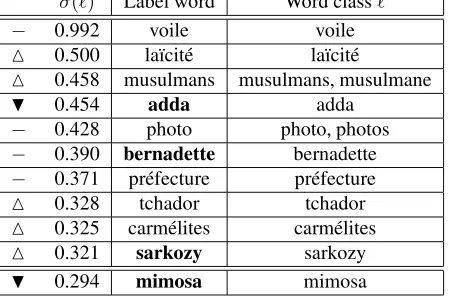
σ(`) Label word Word class`
− 0.992 voile voile
M 0.500 la¨ıcit´e la¨ıcit´e
M 0.458 musulmans musulmans, musulmane
H 0.454 adda adda
− 0.428 photo photo, photos
− 0.390 bernadette bernadette
− 0.371 pr´efecture pr´efecture
M 0.328 tchador tchador
M 0.325 carm´elites carm´elites
M 0.321 sarkozy sarkozy
H 0.294 mimosa mimosa
Table 3: List of the 10 keywords with the highest scores af-ter inclusion of confidence measures within the score com-putation.
The case of transcription errors
Automatic transcriptions inevitably contain errors whose impact on the LM adaptation process has to be carefully considered. Transcription errors may result in biased word class scores and in a keyword list thematically unrelated to the topic of the segment. We rely on word level confidence measures provided by the ASR system to dampen the im-pact of transcription errors. Confidence measures, in[0,1],
are associated with each word at the output of the ASR sys-tem and indicate how confident is the syssys-tem in its output,
1indicating a total confidence in the decision. For each
lemma, the scoreS0(`)is modified based on the confidence measures of the word occurrences for`according to
σ(`) =
α+ (1−α)c`×S0(`)
with c`= P
w∈`
cw
|`|
(4)
wherecw ∈ [0,1]is the average confidence measure over
all the occurrences ofw. The parameterα, empirically set
to0.25, limits the influence of confidence measures since
they are not absolutely reliable (Huet et al., 2007).
In our example, it appears that the two misrecognized words adda and mimosa are effectively pushed down, whereas the other words are less affected by the penalties, as illustrated in Table 3. Nevertheless, we can notice that the list of keywords with the highest scores still contains the misrecognized wordadda. Due to the complexity of the whole adaptation process and to the number of its intrinsic parameters, no optimization has been done to improve the use of confidence measures. Thus, it could be interesting to study the relationship between the limiting factorαand
re-liability measures frequently used for confidence measures, e.g., normalized cross entropy (Huet et al., 2007) or confi-dence error rates (Wessel et al., 2001).
We have observed that the proposed modifiedtf∗idfscores lead, on average, to consider keywords which characterize well most aspects of the topic of a segment, even though this opinion is subjective as no objective criterion can yet be defined. We present in the next section how queries can be formed from the selected keywords.
#1 voile
#2 la¨ıcit´e
#3 voile la¨ıcit´e
#4 voile la¨ıcit´e musulmans
#5 voile la¨ıcit´e adda
#6 voile la¨ıcit´e photo
#7 voile musulmans adda
#8 voile musulmans photo
#9 voile adda photo
#10 la¨ıcit´e musulmans adda
#11 la¨ıcit´e musulmans photo
#12 la¨ıcit´e adda photo
#13 musulmans adda photo
#14 voile la¨ıcit´e musulmans adda
#15 voile la¨ıcit´e musulmans adda photo
Table 4: Example of queries formed based on subsets of the 5 best-scored keywords. Queries in bold include misrecog-nized words.
5. Querying the Internet
Considering a sorted list of keywords, the problem is now to form one or several queries in order to gather Web pages related to the topic of the segment. Two opposite consider-ations must be taken into account: queries must be precise enough to return topic-specific pages while they must also return enough pages to estimate reliablyn-gram
probabili-ties.
As mentioned in Sethy et al. (2005), the number of key-words included in a query is crucial with regard to the num-ber of matching pages found. In preliminary experiments, we have observed that, on average, a query returns 40,000 hits when using 3 keywords, 6,000 hits with 4 keywords, and 600 hits with 5 keywords. Thus, in practice, the set of keywords selected is limited to the five words used to represent the five lemmas with the highest scoresσ(`). As
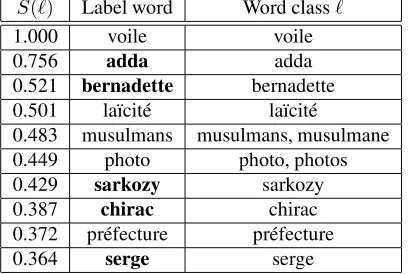
in query-based sampling techniques (Callan et al., 1999; Monroe et al., 2002), various simple queries are formed based on subsets on the selected keywords. For example, one query is composed of the two best keywords while an-other one is composed of the first and third keywords. In our experiments, fifteen simple queries containing one, two or three keywords are formed for each segment. This strat-egy offers the advantage of maximizing the probability of having at least one relevant query, even when transcription errors are present. For example, queries resulting from the top-5 keywords in Table 3 are listed in Table 4. In this example, the retrieval of a topic-specific corpus does not fail even if the misrecognized wordaddais not discarded from the best keywords: out of the 15 proposed queries, 7 queries do not include the wordaddaand are well related to the topic.
Figure 2: Average similarity between segments and each selected Web page as a function of the number of pages retrieved and of the similarity threshold.
replacing the original ASR transcription by the reference one, even though the similarity between the former and the latter is only 0.72.
7. Experiments
Experiments were carried out on about 6 hours of French radio broadcast news data coming from the ESTER evalu-ation campaign (Galliano et al., 2005). A total of 172 seg-ments containing a single story were manually extracted from three different broadcasters, namely France Inter, France Info andRFI. These segments, whose respective size ranges from 30 to 2,000 words, cover various topics, such as the war in Iraq, national politics or sports. Fur-thermore, segments are divided into a development set (91 segments), used to tune the different parameters, and a test set, used for our back-end experiments.
Each segment was transcribed with our ASR system, de-scribed in Huet et al. (2007), which is based on a4-gram
general-purpose LM and a64,000word vocabulary. For
each segment, an adapted LM is computed following the adaptation technique previously exposed, while the vocab-ulary remains untouched.
Two performance measures are used to evaluate the impact of LM adaptation. On the one hand, we compare the per-plexity of the reference transcription with the initial and adapted LMs respectively, in order to appraise the topic modeling quality of each LM. Since perplexity is linked to the n-gram probability distribution entropy, it is expected
to be as low as possible. However, decreasing the perplex-ity of the LM does not necessarily translate into a better automatic transcription. Therefore, on the other hand, we compare word error rates (WER) of automatic transcrip-tions obtained respectively without and with LM adapta-tion. This last measure does not evaluate the quality of the sole LM as the first one but rather that of the entire ASR system.
Experimental results are presented in Table 5 (perplexity) and in Table 6 (WER). Language model adaptation based on text collections retrieved from the Web results in a sig-nificant perplexity improvement of about 14.5% relative
and a WER gain of 0.2absolute. This last result is
sta-tistically significant as it has been measured with p-values of respectively0.0007for the pairedt-test and of 0.0001
for the paired Wilcoxon test. More precisely, the perplexity decreases after adaptation for95%of the segments while
the WER is improved for only37%of the segments.
Fur-thermore, one can notice that the best WER variation is ob-tained on shows coming fromRFIwhile consistently lower variations are measured onFrance Inter andFrance Info. This can probably be explained by the fact thatRFI, an in-ternational French speaking radio station, addresses many topics not included in the training data of the ASR system while the other (national) radio stations does not. In par-ticular, RFI tackles many topics related to Africa, where this radio station is widely broadcasted, while national sta-tions such asFrance InterandFrance Infomostly deal with national and major international matters, these last matters being well represented in the training data of the baseline LM.
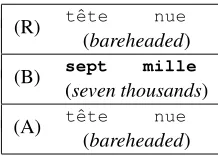
Table 7 presents word error rates measured on lemmatized lexical words (LER),i.e., nouns, adjectives and non-modal verbs reduced to their respective lemmatized forms. Com-pared to the word-level results of Table 6, gains are more than doubled for each broadcaster and on average. A de-tailed analysis of the results highlights that adapted LMs mainly improves the transcription of “thematic” words,i.e., terms which are frequently used in a given domain. This conclusion is illustrated by the example given in Table 8 which compares the transcription of an utterance, taken from the previous example dealing with secularism and wearing a veil, obtained without and with adaptation re-spectively. In this example, the small word sequence “tˆete nue” (bareheaded), misrecognized with the baseline LM, is correct after adaptation even though neithertˆetenornue ap-peared in the keyword list. Nevertheless, we noticed that, in some cases, WER improvements due to adaptation are offset by grammatical errors that do not appear when using the baseline LM. This idea is backed up by the example re-ported in Table 9. In this second example, extracted from a segment dealing with strikes in transport services, the ref-erence wordtramswas originally transcribed by the homo-phonetrames(frames), grammatically correct but far from the topic. With the adapted LM, this mistake is corrected but the transcription remains erroneous:tramsis now tran-scribed by its singular formtram, another homophone. This error is due to the fact that only the singular form tram can be found in the adaptation corpus. We also observed the frequent occurrence of new errors on ordinary words, like modal verbs, prepositions, conjunctions. . . This prob-lem can be explained by the small size of thematic corpora which leads to badly estimate the probability of n-grams
containing ordinary words. Even if using larger corpora may solve the problem, we rather think that a different adaptation method should be used instead of linear inter-polation,e.g., MDI adaptation (Federico, 1999).
8. Discussion
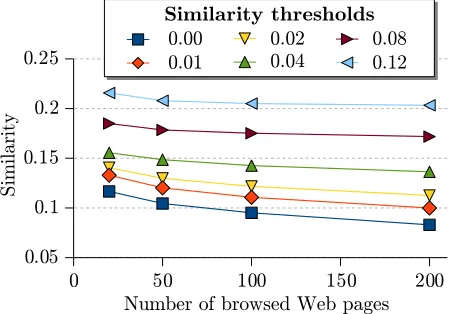
Figure 3: Thematic similarity between segments and their respective topic-specific corpora as a function of the number of pages retrieved and of the similarity threshold.
Broadcaster Baseline LM Adapted LM Variation France Inter 141.4 123.8 −9.9 %
France Info 138.7 106.9 −19.5 %
RFI 116.9 102.1 −11.8 %
Average 132.4 109.5 −14.5 %
Table 5: Perplexities measured on the test set with the base-line LM and with the adapted LM for each broadcaster and on average.
Broadcaster Baseline LM Adapted LM Variation France Inter 19.87 19.74 −0.13
France Info 21.74 21.59 −0.15
RFI 23.47 23.24 −0.23
Average 21.66 21.49 −0.17
Table 6: Word error rates observed on the test set when using the baseline LM and the adapted LM successively for each broadcaster and on average.
Broadcaster Baseline LM Adapted LM Variation France Inter 17.22 16.65 −0.57
France Info 19.91 19.50 −0.42
RFI 21.83 21.33 −0.50
Average 19.61 19.11 −0.50
Table 7: Word error rates measured on lemmatized lexical words when using the baseline LM and the adapted LM successively for each broadcaster and on average.
additional considerations like confidence measures, natural language processing techniques can be adapted to work on transcribed, unreliable, texts and that the innumerable lin-guistic resources present on the Internet can be effectively exploited to build topic-specific LMs by sampling queries based on automatically extracted keywords. Experiments result in a better thematic quality of the adapted LMs with respect to the baseline LM. This improvement is translated by encouraging WER gains, resulting mainly from a better transcription of thematic words. However, besides these
re-tˆete nue
(R) (bareheaded)
sept mille
(B) (seven thousands)
tˆete nue
(A) (bareheaded)
Table 8: Comparison of an utterance transcribed with our baseline LM (B) and our adapted LM (A) according to the reference transcription (R).
le service des trams est affect´e
(R) (the tram service is affected)
le service des trames est affect´ee
(B) (the frame service is affected)
le service des tram est affect´ee
(A) (the tram service is affected)
Table 9: Comparison of a second utterance transcribed with our baseline LM (B) and our adapted LM (A) according to the reference transcription (R).
sults, discussions introduced along each key point highlight the remaining difficulties and outline future works. First, our approach rely on the assumption that segments are thematically coherent. However, for some segments, the adaptation process results in a deteriorated transcription. It therefore seems interesting to be able to diagnose, for any segment, whether topic adaptation is necessary or not. To do this, the link between the impact of LM on the WER and the segment thematic qualities should first and foremost be studied. However, this task is all the more difficult since the notion of theme is still not clear in our case: for example, a report on the war in Iraq, dealing with several aspects of the war (combats, the role of the non-profit organizations, etc.) can be considered as a single theme, or not.
are simple terms and are therefore sometimes not discrim-inative enough. For example, in a segment dealing with the 70’s, the two words flower andpower describe much more the topic when considered together than when consid-ered separately. To do this, complex term extraction tech-niques (Daille, 2003) could be adapted in order to handle automatic transcriptions. On the other hand, despite the fact that words are grouped into word classes, the length and the style of some segments still imply only a few rep-etitions. This problem could be overcome with the help of information about semantic links between words (Grefen-stette, 1994).
Finally, a deeper and better use of the thematic corpora is necessary. Given the sparseness of general-purposen
-grams in the adaptation corpora, it would be interesting to attach different importance levels ton-gram
probabili-ties depending on their thematic specificity. For example, n-gram probabilities for general-purpose word sequences should be left unchanged from the baseline LM while only n-gram probabilities where topic specific words are in-volved should be modified. Topic-specific corpora could also be helpful to determine keywords. For example, in a segment dealing with a given sport, technical terms are frequently used, whereas more general terms, such as the name of the sport, are rarely pronounced, leading therefore to consider too specific keywords. An interesting solution to this problem consists in iterating the adaptation process: a first step consists in gathering a topic specific corpus as described in this paper from which new keywords are ex-tracted to iterate the corpus gathering step.
9. References
A. Berger and R. Miller. 1998. Just-in-time language mod-elling. In Proceedings of International Conference on Acoustics, Speech, and Signal Processing (ICASSP), vol-ume 2, pages 705–708.
I. Bulyko, M. Ostendorf, M. Siu, T. Ng, A. Stolcke, and ¨Ozg¨ur C¸etin. 2007. Web resources for language model-ing in conversational speech recognition.ACM Transac-tions on Speech and Language Processing, 5(1):1–25. J. Callan, M. Connell, and A. Du. 1999. Automatic
dis-covery of language models for text databases. SIGMOD Record, 28(2):479–490.
L. Chen, J.-L. Gauvain, L. Lamel, and G. Adda. 2004. Dynamic language modeling for broadcast news. In Proceedings of International Conference on Speech and Language Processing (ICSLP), pages 1281–1284. B. Daille. 2003. Conceptual structuring through term
vari-ations. In Proceedings of the ACL 2003 workshop on Multiword expressions: analysis, acquisition and treat-ment, pages 9–16.
M. Federico. 1999. Efficient language model adaptation through MDI estimation. InProceedings of Eurospeech, volume 4, pages 1583–1586.
S. Galliano, E. Geoffrois, D. Mostefa, K. Choukri, J.-F. Bonastre, and G. Gravier. 2005. The ESTER phase II evaluation campaign for the rich transcription of French broadcast news. In Proceedings of Eurospeech, pages 1149–1152.
G. Grefenstette. 1994. Corpus-derived first, second and third-order word affinities. InProceedings of EURALEX, pages 279–290.
S. Huet, G. Gravier, and P. S´ebillot. 2007. Morphosyntac-tic processing of N-best lists for improved recognition and confidence measure computation. InProceedings of Interspeech, pages 1741–1744.
D. Klakow. 2000. Selecting articles from the language model training corpus. InProceedings of International Conference on Acoustics, Speech, and Signal Processing (ICASSP), volume 3, pages 1695–1698.
G. Monroe, J. French, and A. Powell. 2002. Obtaining language models of Web collections using query-based sampling techniques. In Proceedings of Hawaii Inter-national Conference on System Sciences (HICSS), vol-ume 3.
R. Nisimura, K. Komatsu, Y. Kuroda, K. Nagatomo, A. Lee, H. Saruwatari, and K. Shikano. 2001. Auto-matic n-gram language model creation from Web re-sources. In Proceedings of Eurospeech, pages 2127– 2130.
G. Salton. 1989. Automatic text processing: the transfor-mation, analysis, and retrieval of information by com-puter. Addison-Wesley Longman Publishing Co., Inc. A. Sethy, P. G. Georgiou, and S. Narayanan. 2005.
Build-ing topic specific language models from Webdata us-ing competitive models. InProceedings of Interspeech, pages 1293–1296.
M. Suzuki, Y. Kajiura, A. Ito, and S. Makino. 2006. Unsu-pervised language model adaptation based on automatic text collection from WWW. In Proceedings of Inter-speech, pages 2202–2205.
D. Vaufreydaz, M. Akbar, and J. Rouillard. 1999. In-ternet documents: A rich source for spoken language modeling. In Proceedings of Workshop on Automatic Speech Recognition and Understanding (ASRU), pages 277–280.