Sources of Individuation in Mandarin Chinese, a Classifier Language
*Pierina Cheunga, Peggy Lib, and David Barnerc
a
Department of Psychology, University of Toronto, 100 St. George Street, Toronto, ON M5S 3G3. b
Department of Psychology, Harvard University, 25 Francis Ave, Cambridge, MA 02138, USA. c
Department of Psychology, University of California, San Diego, 9500 Gilman Drive, La Jolla, CA 92093-0109
[email protected], [email protected], [email protected]
Abstract. When presented with an entity (e.g., a wooden honey-dipper) labeled with a novel noun, how does a listener know that the noun refers to an instance of an object kind (honey-dipper) rather than to a substance kind (wood)? While English speakers draw upon count-mass syntax for clues to the noun’s meaning, linguists have proposed that classifier languages, which lack count-mass syntax, provide other syntactic cues. Three experiments tested Mandarin-speakers’ sensitivity to the diminutive suffix -zi and the general classifier
ge when interpreting novel nouns. Experiment 1 found that -zi occurs more frequently with nouns that denote object kinds. Experiment 2 demonstrated Mandarin-speaking adults’ sensitivity to ge and -zi when inferring novel word meanings. Experiment 3 tested Mandarin three- to six-year-olds’ sensitivity to ge. We discuss differences in the developmental course of these cues relative to cues in English, and the impact of this difference to children’s understanding of individuation.
Keywords: individuation, numeral classifiers, Mandarin –zi morpheme, mass-count syntax.
1.
Introduction
Language allows us to express different perspectives towards things in the world. For example, a single object, like a wooden table, can be described both as a table (i.e., a kind of object), and as some wood (i.e., a kind of material). The ways in which these perspectives are expressed, however, differs from language to language, leading some to claim that speakers of different language may think differently about objects in the world (Lucy, 1992; Imai & Gentner, 1997; Quine 1960). This paper contributes to this debate by probing the representation and development of syntactic cues to individuation in Mandarin Chinese.
In English, a distinction can be made between count nouns and mass nouns. Typically, words like dog, table and idea are used as count nouns, and refer to kinds of things that have “atomic structure”, with “atoms” or “individuals” that come in natural units for counting. When hearing one of these words (e.g., dogs), we know that it refers to a quantity of discrete, naturally bounded individuals, and not some arbitrary portions thereof (e.g., pieces of dog). In contrast, mass syntax does not specify individuation (see Bloom 1994; Gordon 1988; Link 1983). Mass nouns can refer to unindividuated stuff like water, wood, and fun, or to sets of individuals like
* Thank you to Frankie Chen for his help with preparing the word list in Experiment 1. Thank you also to
Becky Huang and Xiaowen Xu for their help with data collection in Taipei, Taiwan. We are grateful to the parents and children who participated, and to the daycares and preschools in Taipei for their support and help with recruitment. This work was supported by a Connaught Grant awarded to D.B.
footware, furniture, and ammunition. Ususally, words used in mass syntax do not refer to individuals. In English count nouns can occur directly with numerals (e.g., one dog), in singular or plural forms (a dog, some dogs), or with quasi-cardinal determiners (these dogs) that signal reference to sets of individuals. Mass nouns, in contrast, usually1 cannot be used directly with numerals, with singular or plural morphology, or with quasi-cardinal determiners. Also, mass and count constructions selectively specify different quantifiers (many/*much table vs. *many wood/much wood).
Not all languages, however, have such transparent syntactic cues to individuation. In classifier languages like Chinese and Japanese, there is no mass-count distinction at the level of the noun, regardless of what the noun refers to. Instead, nouns in classifier languages syntactically resemble mass nouns in English. For example, in Mandarin Chinese, nouns cannot co-occur directly with numerals, but require a discretizing unit (i.e., a “classifier”) for counting, like English mass nouns (e.g. two pieces of toast). Classifiers encode information such as the shape, animacy, functionality, or the unit of measure of the referent noun. For example, to label three pens in Mandarin requires both the numeral san (three) and the classifier zhi (stick) as in san zhi bi (or “three stick pen”). Also, unlike English count nouns, which obligatorily specify number via singular-plural marking (e.g., a cat vs. some cats), classifier languages normally lack obligatory plural marking. As a result, bare nouns in classifier languages are unspecified for number. If a classifier language has a plural marker, its use is often optional, infrequent, and restricted (e.g., to animates). Finally, nouns in classifier languages, irrespective of whether they denote countable individuals or unindividuated stuff, typically permit the same quantifiers.2
If count syntax specifies individuation in English, are there equivalent syntactic structures to encode individuation in languages that lack a mass-count distinction? According to Cheng and Sybesma (1998, 1999) Mandarin Chinese may make an analogous distinction at the level of the classifier. They argue that Mandarin features two types of classifier, which they call “count classifiers” and “mass classifiers”. Count classifiers form a closed-class and mark reference to individuals, whereas mass classifiers form an open-class and function as measure words that are used to denote portions of unindividuated stuff (e.g., a cup of sugar) or portions of objects (e.g., a cup of marbles).
To test the hypothesis that classifiers are semantically analogous to mass-count syntax, Li, Barner and Huang (in press) examined how Mandarin speakers interpret them in a word extension task. Typically, when speakers of English learn new count nouns (e.g., “Look, this is a wug”), they assume that these words refer to kinds of objects that share a common form. When they learn mass nouns (“Look, this is some wug”), in contrast, they are less likely to assume that the word denotes a solid thing. Based on this, Li et al asked if Mandarin speakers would extend count classifiers, like gen (rod) and pian (slice) to solid things with matching shape (e.g., rod shapes or slice shapes), and whether they would do so less for mass classifiers like dui (pile) and
tuan (wad). When asked to find “one CL something” (CL = classifier) among several choices, adults selected solid, shape-matched objects when presented count classifiers, but rejected things that were non-solid or that didn’t match in shape. However, this distinction was less available to young children, who were willing at age four to accept portions of non-solid stuff when the experimenter requested something with a count classifier, so long as the substance matched the shape specified by the classifier (e.g., toothpaste that was shaped like a rod when the experimenter asked for gen). It was not until approximately six years of age that children
1
The mass-count status of some words is fixed by the type of thing that they denote. However, many nouns can also be used flexibly in either mass or count frames (e.g., “some beer”; “three beers”, etc.).
2 The fact that nouns in classifier languages pattern syntactically like mass nouns in English, has led some
began to extend classifiers like adults. Li and colleagues concluded that, before 6 years of age, most Mandarin-speaking children still have not learned that count classifiers are cues to individuation. As a result, syntactic cues to individuation may emerge much later in Mandarin than in English
One problem in comparing classifiers to count syntax is that whereas count syntax specifies only individuation, classifiers also encode item-specific conceptual information, such as the shape, animacy, etc. Classifiers may emerge later in Mandarin acquisition in part because they pose a more difficult learning problem. In the present studies, we explored this question by testing children and adults with the generic or default classifier ge rather than on shape-based classifiers tested in Li et al’s study. Ge is by far the most frequent count classifier in the language. As it provides no shape information, it may function mainly to encode individuation. Therefore, we might expect children to learn the role of this classifier in individuation earlier.
In addition to ge, we also tested Mandarin speakers’ sensitivity to another potential source to individuation – the diminutive suffix -zi (Doetjes, 1997; Sybesma, 2007). Linguists have noted that in several languages diminutive markers function much like unitizers in making mass nouns into count nouns (Wiltschko, 2006). Historically, -zi, (meaning “son” or “child”) functioned as a diminutive marker in Chinese. However, simplification of the phonological system in the language during the Han Dynasty, and a movement away from monosyllabic nouns led to the adaptation of -zi as an ending for many nouns (Li & Thompson, 1981). In contemporary Mandarin it is debateable whether the suffix is still productive (Nishimoto, 2003). When asked about the function of -zi, native speakers are often unable to state its contribution to the meaning of the noun. Nonetheless, linguists have observed that many nouns used with -zi often refer to “concrete, non-abstract things, that can be counted individually” (Dragunov, 1960, p. 81; Sybesma, 2007). It is possible that speakers of Mandarin are implicitly sensitive to this property of -zi and that -zi could function as a cue to individuation. However, no experiments have ever examined -zi and its relation to object individuation. We, therefore, included -zi in our study and compared it to the general classifier ge, in the domain of word learning.
The present study investigated whether the general classifier ge and the diminutive suffix -zi
are cues to individuation in Mandarin-speaking children and adults. Experiment 1 tested the hypothesis that -zi tends to occur with nouns that denote discrete individuals by asking whether this relation held true for the 256 most frequent nouns in Mandarin child-directed speech. Experiment 2 then examined how adult speakers interpret both -zi and ge by contrasting them with bare nouns in two word learning tasks. Experiment 3 extended Experiment 2 by testing Mandarin-speaking children's developing comprehension of the classifier ge, in order to establish the role of classifiers in children’s emerging understanding of individuation.
2.
Experiment 1
The first experiment tested whether the diminutive suffix -zi is more likely to be used with nouns that refer to object kinds than with nouns that refer to substance kinds. One group of native Mandarin speakers judged whether nouns referred to a kind of object, a kind of substance, both, or neither. A second group rated whether these same nouns could be used with the -zi suffix. We asked whether words that were categorized as object nouns were more likely to be acceptable with -zi than substance nouns.
2.1.Methods
2.1.1.
Participants
2.1.2.
Stimuli and Procedure
The 256 most frequent nouns were taken from a list provided by Sandhofer, Smith, and Luo (2000), who culled 50 transcripts in CHILDES of Mandarin child-directed speech. The following nouns were excluded: proper nouns, pronouns, and compound nouns. Reduplicated forms of nouns (e.g., go3-go3 or ’dog-dog’) were changed to non-reduplicated (e.g., go3 or ’dog’) forms. Nouns that had -zi endings (66 of them) were stripped of the ending.
The list of 256 words was randomly divided into two lists of 128 words each (List A and List B), which were assigned to participants between subjects. To verify that no sytematic difference existed between groups, ten words from each list were randomly selected and added to the other list so that each list had 138 words, with 20 words overlapping between the two lists.
Object-Substance Categorization. Fourteen participants were assigned to List A and 13 participants to List B. For each list, they were randomly assigned to one of two randomized orders. Participants were asked to rate whether each of 138 words referred to an object (wu4ti3), substance (wu4zhi3), both, or neither. If they selected neither, they were asked to describe in writing what kind of entity the noun could denote.
-Zi Rating. Thirteen participants were assigned to List A and 12 participants to List B. They were asked to rate how likely -zi could be affixed to each word, using a scale of 1 to 7 (1 being highly acceptable and 7 being highly unacceptable).
2.2.Results
2.2.1.
Object-Substance Categorization.
Words were assigned to a category (object, substance, both, or neither) if at least 66.7% of participants provided the same judgment. Words that received less than 66.7% agreement were categorized as “unclassified”.
Comparing the 20 overlapping words of the two lists, participants showed remarkable agreement in their object-substance categorization: 19 of the 20 overlapping words received the same classification. The only exception was bei4 (which means quilt/blanket in English): participants of List B categorized it as “object”, whereas those of List A did not reach a 2/3 agreement and it was thus “unclassified” (50% of the participants rated it as “object”).
Of the 256 words, 130 words (50.8%) were categorized object words, 20 were categorized as substance words (7.8%), 0 as both, and 21 nouns as neither (8.2%). A remaining 85 nouns were unclassified (33.2%).
2.2.2.
-Zi Rating.
The average -zi rating, out of a total score of 7, was calculated for each word. First we verified whether participants were providing sensible ratings. Of the 66 nouns that originally had a -zi
ending, the average rating was 1.5, suggesting participants highly agreed that the words should be affixed with -zi and that their performance was consistent with how -zi is used in everyday speech. The average ratings for the 20 overlapping words of the two lists were also highly correlated (Pearson’s r = .90, p < .001).
To examine the relation between object ratings and -zi ratings, we compared the two rating tasks. Words that were rated as object kinds received the lowest average -zi rating (2.87), meaning that participants found it highly acceptable to suffix -zi to the given noun. Likewise, words that were rated as substance kinds received the highest average -zi rating (6.03), meaning that participants found substance nouns highly unacceptable with the -zi suffix. The -zi ratings of the object noun category differed significantly from the ratings of the substance nouns (t(148) = -6.43, p < 0.0001) and the neither object nor substance nouns (t(149) = -5.32, p < 0.0001).
kind of substance? Indeed, as indicated in Table 1, words that are compatible with -zi tend to be nouns that have object kind meanings (N = 75) but not substance kind meanings (N = 0). Interestingly, it should also be noted that having the -zi suffix does not provide a necessary condition for a word to refer to object kinds. Out of all nouns that are categorized as words that refer to object (N = 130), participants rated 42.3% of them as less likely to accept -zi as a suffix. As compared to singular-plural morphology in English, which is obligatory for all count nouns, -zi is a linguistic device that only applies to a subset of count nouns.
Table 1: Number of words in each category based on –zi ratings (> or <= 2)
Object substance both neither unclassified
zi highly acceptable (rating <= 2) 75 0 0 2 24
zi less acceptable (rating > 2) 55 20 0 19 61
2.3.Discussion
Experiment 2 revealed two main findings. First, the object-substance categorization task found that many Mandarin nouns denote object kinds, consistent with what is typically found for mass-count languages such as English (Samuelson and Smith, 1999).
Second, the two rating tasks showed that when a word refers to an object, it is more likely to take -zi as a suffix, and substance words never take a -zi ending. These results support the contention that -zi specifies individuation in Mandarin Chinese.
3.
Experiment 2
As shown in Experiment 1, words that take the diminutive suffix -zi are more likely to refer to object kinds. Experiment 2 examined Mandarin-speaking adults’ sensitivity to such linguistic devices as a source of individuation by using two tasks: the word extension task (Imai and Gentner, 1997; Soja, Carey and Spelke, 1991) and the quantity judgment task (Barner and Snedeker, 2005; Gathercole, 1985).
In a standard word extension task, participants are first shown a standard item (e.g., a cork pyramid) labeled with a novel word (blicket) and then two alternatives: a shape matched object (e.g., metal pyramid), and a material matched object (e.g., cork square). Participants are then asked to extend the word to one of the two choices, indicating whether they think the noun refers to a kind of object (shape choice) or a kind of material (material choice).
In a quantity judgment task, two characters are shown: one of them with the standard item and the other with a larger number of identical objects that are smaller, and thus have a lesser combined mass or volume than the standard. Participants are asked to decide which of two characters has more (e.g., three tiny cork pyramids vs. one large cork pyramid), indicating whether the noun refers to a kind of individual (choice by number) or a kind of material (choice by mass or volume).
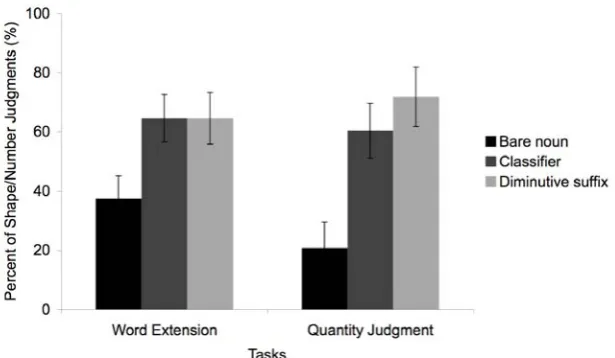
We asked whether novel words that are used with a general classifier ge or with -zi are more likely to be extended by shape in the word extension task and more likely to be quantified by number in the quantity judgment task, when compared to bare nouns.
3.1.Methods
3.1.1.
Participants
3.1.2.
Stimuli and Procedure
Six sets of stimuli were hand-crafted, one for each trial. They were simple-shape solid objects that were designed to be unrecognizable as known artifacts or substance. At the beginning of each trial set in each condition, there was a familiarization phase in which the participant was introduced to a standard object that was named four times with a novel term (e.g., fen2yan2 in the bare noun condition, yi2 ge4 fen2yan2 in the classifier condition, fen2yan2 zi in the diminutive condition). They were then presented with either a block of word extension trials or a block of quantity judgment trials, with block order counterbalanced across participants .
For word extension, participants were shown a shape alternative (that matched in shape but not in substance) and a substance alternative (that matched in substance but not in shape). In the bare noun condition, participants were asked to “Point to blicket” (Mandarin: qing2 ni3 zhi3 zhe fen2yan2.). In the classifier condition, the ‘numeral + general classifier’ combination was used to describe the novel object: “Point to one-CL blicket” (Mandarin: qing2 ni3 zhi3 zhe yi2 ge4 fen2yan2), whereas in the diminutive condition, -zi was suffixed at the end of each novel word: “Point to blicket-zi” (Mandarin: qing2 ni3 zhi3 zhe fen2yan2 zi). The side of the shape alternative was counterbalanced across trials.
For quantity judgment, two characters (Farmer Tom and Captain Peter) were shown. One character had two standard items, and the other had four miniature versions of the item. Participants were asked to judge which character has more of the object named by the novel term. In the bare noun condition, they were given the following instructions: “Farmer Tom has blicket. Captain Peter has blicket. Who has more blicket?” (Mandarin: nong2 fu1 tang1 mu3 you3 fen2yan2, jiang1 jun1 bi3 de2 ye3 you3 fen2yan2, shei2 you3 bi3 jiao4 duo1 fen2yan2?). In the classifier condition, the general classifier ge was included only in the test question: “Who has more CL-blicket?” (Mandarin: shei2 you3 bi2 jiao3 duo2 ge fen2yan2). In the diminutive condition, -zi was suffixed at the end of each novel word (Mandarin: nong2 fu1 tang1mu3 you3 fen2yan2 zi, jiang1jun1 bi3 de2 ye3 you3 fen2yan2 zi, shei2 you3 bi3 jiao4 duo1 fen2yan2 zi?).
3.2.Results
For word extension, the dependent variable was the percentage of trials in which participants extended a novel word on the basis of shape. Data were submitted to an ANOVA for word extension with three between-subject variables: condition (bare noun vs. classifier vs. diminutive), block order (word extension first vs. quantity judgment first), and item order (order 1 vs. order 2). A parallel ANOVA was conducted for quantity judgment with the percentage of trials in which participants chose the array with the greater number of objects as the dependent variable.
Figure 1 presented data for both word extension and quantity judgment. For word extension, there was a significant main effect of condition (F(1,36) = 135.69, p < 0.038). No other significant main effects or interaction was found. There was no significant difference in percentage of shape judgments between the classifier condition and the diminutive suffix condition (64.6% vs. 64.6%; t(30) = 0, p = 1.000). Mandarin-speaking adults extended words on the basis of shape significantly more in both the classifier condition (64.6%; t(30) = 2.46, p < 0.020) and the diminutive suffix condition (64.6%; t(30) = 2.35, p < 0.026) than in the bare noun condition (37.5%).
Figure 1: Mandarin speaking adults’ performance on word extension and quantity judgment in bare noun, classifier, and diminutive suffix conditions.
3.3.Discussion
Two results emerged from this experiment. First, as predicted, we found that adults were more likely to extend novel words based on shape and quantified them by number when the words were accompanied by the general classifier ge. This supports the view proposed by Cheng and Sybesma (1998, 1999) that mass/count distinction in English appears in Mandarin Chinese on the classifier level. Second, we showed that not only does classifier mark individuation, results from word extension and quantity judgment demostrated that adults were also sensitive to the diminutive suffix -zi as a cue for novel word learning, suggesting that different languages have their own systems of individuation: Mandarin Chinese provides other syntactic cues (e.g., ge
and -zi) to substitute for mass-count syntax.
4.
Experiment 3
The second experiment indicated that adults were aware of the role of the general classifier ge
as a means to encode shape and to individuate objects. In this last experiment, we explored the developmental trajectory of such sensitivity in Mandarin-speaking children. Studies have generally found that children starting as young as age of 2 1/2 begin to produce classifiers and reach adult understanding at the age of 6 of 7 (e.g., Chien, Lust and Chiang, 2003; Erbaugh, 1986). Thus, using the word extension task, we tested four groups of children between the ages of three and six, and compared their performance to the results obtained from adults in Experiment 2. We only conducted word extension with children, since pilot work with eight five-year-old Mandarin-speaking children indicated a strong bias to base quantification on number (100% of the time) in the bare noun condition in quantity judgment; this suggests the task may not be an appropriate measure of sensitivity to syntactic cues with children.
4.1.Methods
4.1.1.
Participants
4.1.2.
Stimuli and Procedure
Children were randomly assigned to one of two conditions (bare noun and classifier), and were tested on the word extension task only. The stimuli and procedure were identical to Experiment 2.
4.2. Results
For children’s performance on word extension, an ANOVA was submitted with three between-subject variables: condition (bare noun vs. classifier), item order (order 1 vs. order 2) and age group (3-year-olds vs. 4-year-olds vs. 5-year-olds vs. 6-year-olds).
There was a significant main effect of condition on word extension (F(1,110) = 638.7, p < 0.058) for children as a group, and a marginally significant effect of age group (p < 0.062) and item order (p < 0.058). No significant difference was found between the two conditions for each of the four age groups, suggesting that children may not be sensitive to the use of the general classifier to individuate entities. However, the difference in percentage of shape judgments between the bare noun and classifier conditions became gradually bigger from 3-year-olds (3.19%) to 6-year-olds (20.0%; see Figure 2). Compared to a difference of 27.1% found in adults, our current data clearly show a developmental progression and suggest that when children become older, they are more likely to show sensitivity to the classifier ge as a cue for individuation.
Figure 2: Percentage of judgments based on shape for the bare noun and classifier conditions in
Mandarin-speaking 3-, 4-, 5-, 6-year olds and adults.
4.3.Discussion
The current study tests the parallels between Mandarin and English systems of individuation and examines whether morphosyntactic devices such as ge and -zi in Mandarin Chinese provide cues to individuation as count syntax in English. Experiment 1 aimed at verifying claims raised by previous researchers regarding the function of the diminiutive suffix -zi, and how it was related to object individuation. We found that adults were more likely to suffix -zi to a noun if it was categorized as an ”object”. We also found, in Experiment 2, that adults were sensitive to using both syntactic cues, ge and -zi to encode individuation in learning novel words. Results from word extension and quantity judgment provided strong support for this claim. Our next question is: when does this knowledge that classifiers encode individuation develop in children? Experiment 3 examined this question by testing 3-year-olds to 6-year-olds using word extension and found that even 6-year-olds did not posses adults’ sensitivity to ge. However, our results also showed that as children grew older, the gap of their perfomance between bare noun and classifier conditions became bigger, suggesting that the development of sensitivity is relatively gradual.
On one hand, results from all three experiments strongly supported the claim that Mandarin speakers have a distinct linguistic system in acquiring individuation. Classifiers and the diminutive suffix in Mandarin Chinese function in much the same way as count syntax in English, and as suggested in Li et al (in press), count classifiers (e.g., ge, tiao, tou) alone may provide such support. On the other hand, results obtained from Mandarin-speaking children suggested that the distinct syntactic system of individuation may be qualitatively different from mass-count syntax in English. Barner and Snedeker (2005) found that English-speaking 4 year olds based their quantity judgments on number when words were presented in count syntax. Our finding that even Mandarin-speaking children 6 year olds did not possess adults’ sensitivity suggested that classifier is a relatively complex linguistic structure. It entails more specific information about the referents than what mass count syntax provides in English. Thus, it seems likely that although classifiers provide cues to individuation, Mandarin-speaking children may take a longer time to understand individuation than their English peers acquiring mass-count syntax.
Future studies could examine why the acquisition of the role of classifiers in encoding individuation is more protracted than that of mass-count syntax. A comparison of -zi, which is present in many nouns and required even when not enumerating, to ge may yield some insights into the rate of acquisition of the various linguistic structures. Additionally, it is worth examining whether the presence of these syntactic devices could shift meanings of known nouns (e.g., whether the addition of -zi to a substance denoting noun could create object-denoting nouns – a recent one in Mandarin is dian4 = electricity, and dian4zi = electron). Finally, these methodologies could be adapted to (1) examine how lexical items interact with syntax to generate meaning across several languages, (2) characterize whether the various languages could express the same conceptual content despite structural differences, and (3) conduct cross-linguistic studies to compare the developmental course of how children acquire these language-specific syntactic structures.
6. References
Barner, D., S. Inagaki and P. Li. Under review. Language, thought, and real nouns.
Barner, D. and J. Snedeker. 2005. Quantity judgments and individuation: Evidence that mass nouns count. Cognition, 97, 41–46.
Barner, D. and J. Snedeker . 2006. Children’s early understanding of mass–count syntax: Individuation, lexical content, and the number asymmetry hypothesis. Language Learning and Development, 2, 163–194.
Bloom, P. 1994. Semantic competence as an explanation for some transitions in language development. In Y. Levy ed., Other children, other languages: Theoretical issues in language development. Hillsdale, NJ: Erlbaum.
Cheng, L. L.-S. and R. Sybesma. 1999. Bare and not-so-bare nouns and the structure of NP. Linguistic Inquiry, 30, 509-542.
Chien, Y-C., B. Lust and C-P. Chiang. 2003. Chinese children’s comprehension of countclassifiers and mass-classifiers. Journal of East Asian Linguistics, 12, 91–120.
Colunga, E and L. B. Smith. 2003. The emergence of abstract ideas: Evidence from networks and babies. In L. Saitta ed., Philosophical Transactions by the Royal Society B. Theme Issue: ‘The abstraction paths: fro experience to concept’, pp. 1205- 1214.
Doetjes, J. 1997. Quantifiers and selection: On the distribution of quantifying expressions in French, Dutch and English. Ph. D. thesis, Leiden University, HAG, The Hague.
Dragunov, A. A. 1960. Untersuchungen zur Grammatik der modernen Chinesischen Sprarache [orig. 1952, in Russian; tr. Wolfgang Lippert]. Berlin: Akademie-Verlag.
Erbaugh, M. 1986. Taking stock: The development of Chinese noun classifiers historically and in young children. In C. Craig ed., Noun Classes and Categorization, pp. 399-436. Amsterdam/ Philadelphia: John Benjamins.
Gathercole, V. C. 1985. ‘He has too much hard questions’: The acquisition of the linguistic mass-count distinction in much and many. Journal of child Language, 12, 395-415.
Gordon, P. 1988. Count/mass category acquisition: Distributional distinctions in children's speech. Journal of Child Language, 15(1), 109-128.
Imai, M. and D. Gentner. 1997. A cross-linguistic study on early word meaning. Universal ontology and linguistic influence. Cognition, 62, 169–200.
Inagaki, S. and D. Barner. In press. Countability in absence of count syntax: Evidence from Japanese quantity judgments. In M. Hirakawa, S. Inagaki,Y. Hirakawa,H. Sirai,S. Arita,H. Morikawa,M. Nakayama and J.Tsubakita eds., Studies in Language Sciences (8): Papers from the Eighth Annual Conference of the Japanese Society for Language Sciences. Tokyo: Kurosio.
Li, P., D. Barner and B. Huang. In press. Classifiers as count syntax: Individuation and measurement in the acquisition of Mandarin Chinese. Language Learning and Development.
Li, C. and S. A. Thompson 1981. Mandarin Chinese: A Functional Reference Grammar. Berkeley, CA: University of California Press.
Li, P., Y. Dunham and S. Carey. In press. Of substance: The nature of language effects on entity construal. Cognitive Psychology.
Link, G. 1983. The logical analysis of plurals and mass terms: A lattice-theoretical approach. In R. Bauerle, C. Schwarze, A. Stechow eds., Meaning, use, and interpretation of language. Berlin: de Gruyter.
Lucy, J. 1992. Grammatical Categories and Cognition. Glasgow, Scotland: Cambridge University Press. Nishimoto, E. 2003. Measuring and comparing the productivity of Mandarin Chinese suffixes. Journal of
Computational Linguistics and Chinese Language Processing, 8 (1), 49–76. Quine, W. V. O. 1960. Word and object. Cambridge, MA: MIT Press.
Samuelson, L and L. Smith. 1999. Early noun vocabularies: Do ontology, category structure and syntax correspond? Cognition, 73, 1-33.
Sandhofer, C., L. Smith and J. Luo. 2000. Counting nouns and verbs in the input: Differential frequencies, different kinds of learning? Journal of Child Language, 27, 561-585.
Soja, N. N., S. Carey and E. Spelke. 1991. Ontological categories guide young children’s inductions of word meaning: Object terms and substance terms. Cognition, 38, 179–211
Sybesma, R.P.E. 2007. Bifng fngyán hé Yuèy zh ng míngcí de kshbiojì (Markers of countability on the noun in Mandarin and Cantonese). Yyánxué lùncng, 35, 234-245.
Wiltschko, M. 2006. Why should diminutives count? Organizing Grammar. Linguistic Studies in Honor of Henk van Riemsdijk. Berlin: Walter de Gryter.