Chinese Organization Name Recognition Using Chunk Analysis
Jihao YinP
1
P
, Xiaozhong FanP
1
P
, Kaixuan ZhangP
2
P
, Jiangde YuP
1,3
P
P
1
P
Department of Computer Science and Engineering, Beijing Institute of Technology, Beijing, 100081, China;
P
2
P
Liaoning Technical University, Fuxin, Liaoning, 123000, China;
P
3
P
Department of Computer Science, Anyang Teachers’ College, Anyang, Henan, 455000, China [email protected]
Abstract. A simplified N-best cascade model is put forward about Chinese organization names automatic recogni-tion. This model can do words segmentation, part-of-speech tag, chunks analysis and Chinese organization names recognition. The N-best cascade method can limit not only the errors propagation but also the search space. In the experiments, we integrate heuristic information and Organization name abbreviations processing into the model to achieve the better experiment results. The last precision and recall of Chinese organization names recognition are 92.31% and 81.01% in IEER99 newswire test set.
Keywords: Chunk analysis; Chinese organization names recognition; N-best cascade model; Heuristic information
1 Introduction
Named entity recognition is a foundational job in natural language processing, is an important pretreat-ment module too. Generally, the assignpretreat-ment of named entity recognition is identifying person names, location names, organization names, digital and time expressionP
[1]
P
from a text. Person names, location names and organization names are not only difficult but also important.
Many researches about person names and location names have been done, and their precision and re-call have meet practical need. But organization names recognition cannot satisfy need whether in theory or in practiceP
[2]
P
.
Many scholars have done some researches about Chinese chunk analysis. GuoDong Zhou et al identi-fied English named entities using an HMM-based chunk taggerP
[3]
P
. But the study of Chinese organization names recognition using chunk analysis technology is a little. Noun-chunk is almost like the structure of Chinese organization names, so it is feasible to identify Chinese organization names using Noun-chunk analysis technology.
Based on Chinese chunk analysis technology and name entity recognition, we put forward a simpli-fied N-best cascade model by mining the characters of Chinese organization names. In the experiments, we added heuristic information and organization name abbreviations processing, which improved the precision and recall of Chinese organization names recognition obviously.
2 Noun-chunk Automatic recognition
2.1 Noun-chunk DefinitionNoun-chunk usually includes noun and its former modifier. The former modifier includes number, ad-jective and noun, but excludes “的” structure. The modifier and center word of “的” structure fall into
the different chunks separately[4].
the simplified N-best cascade model. Chinese organization name keywords list includes 1,355 wordsP [7]
P
(e.g. 大学(university), 公司(corporation)). A keyword and its front two to six words can be considered
to construct a Chinese organization name. The heuristic information can limit redundant entities genera-tion. If one organization name doesn’t include the words in keyword list, this organization name will be eliminated directly.
3.2.2 Dealing with Abbreviation
We found many errors when identifying organization name abbreviations. Therefore, some strategies are adopted to deal with abbreviations. We use the simple rule-based method to identify organization name abbreviations.
4 Experiments and Analysis
4.1 Evaluation Metric and Data SetsThis model was evaluated in terms of precision (P), recall (R) and F-measure (F1).
responses of
number
responses correct
of number
P= (14)
names on organizati all
of number
responses correct
of number
R= (15)
R P) (
R P 1) (
2 2
+ ×
× × + =
β β
F (
β
=
1
) (16)The training set is chunk corpus of Microsoft Research Asia, including 502,141 words, 259,843 chunks. In the corpus, Chinese organization name chunks were marked especially.
The test sets select IEER99 newswire test set and “Xinhuanet---Chinese simplified webpages” (http://www.xinhuanet.com) tagged texts, as is shown in Table 1.
Table1. Chinese simplified edition of xinhuanet
ID Domain Number of ORG Size 1
2 3 4 5
Sports Economy
Politics Entertainment
Education Total
643 356 227 152 97 1475
117K 103K 126K 108K 145K 599 K
4.2 Experiments
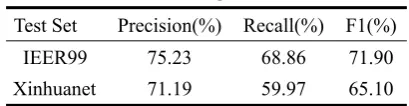
We conduct incrementally the following three experiments:
(1) Simplified N-best cascade model, we view the results as the baseline performance; (2) Integrating heuristic information into (1);
(3) Integrating Cache-based model with (2).
4.3 Experiment Results
4.3.1 Simplified N-best Cascade Model
in-cludes 1475 organization names, but IEER99 test set inin-cludes 497 organization names).
Table 2. Test 1 experiment results
Test Set Precision(%) Recall(%) F1(%) IEER99
Xinhuanet
75.23 71.19
68.86 59.97
71.90 65.10
4.3.2 Integrating Heuristic Information
After heuristic information is added to the experiment, we found that decoding became simple and the precision of organization names recognition was improved, as is shown in Table 3. For example, the precision of organization names recognition in IEER99 test set increases from 75.23% to 87.31%. The reason is that integrating heuristic information reduces the noise influence.
Table 3. Test 2 experiment results
Test Set Precision(%) Recall(%) F1(%) IEER99
Xinhuanet
87.31 89.52
64.22 60.37
74.01 72.11
However, we noticed that the recall of organization names recognition decreased. The reason is or-ganization names without oror-ganization ending keywords were not identified. For example, “中国保险
(China assurance)” is the abbreviation of “中国保险公司 (China assurance corp.)”, so it cannot be
identified.
4.3.3 Dealing with Organization Names Abbreviation
In this experiment, we integrate the organization name abbreviations processing, the results are shown in Table 4. Comparing Table 3 and Table 4, we found the recall of organization names recognition in IEER99 test set increases from 64.22% to 81.01%.
Table 4. Test 3 experiment results
Test Set Precision(%) Recall(%) F1(%) IEER99
Xinhuanet
92.31 90.75
81.01 76.92
86.29 83.26
4.3.4 Experiment Results and Analysis
From above experiments, we can make some conclusions: (1) The simplified N-best cascade model can select the front N-best results as the candidates of the next phase, so the errors propagation will be lim-ited. Moreover, N-best results were searched in each phrase, which can reduce the search space greatly. (2) Integrating heuristic information, i.e. using keywords list and some simply rules, can restrict redun-dant organization names generation. So the precision of organization names recognition increased obvi-ously. (3) The organization name abbreviations processing can improve the recall of organization names recognition.
5 Conclusions and Future Work
in-creases the recall of organization names recognition. In the IEER99 newswire test set, the last precision and recall of Chinese organization names recognition are 92.31% and 81.01%, each of values is higher about 9% than precision and recall of reference [8].
In the process of organization names recognition, one organization name usually appears in the dif-ferent style. This problem is named entity coreference. So we will focus more on name entity corefer-ence. Furthermore, we intend to extend our model to the specific domain for proper names recognition.
Acknowledgment. This paper is supported by the Doctor Foundation project 20050007023 of China Ministry of Education.
References
1. Sun Bin. A summarization of information extraction[J]. Language Information Processing, 2003, 2(1): 34-35. 2. Yu Hongkui, Zhang Huaping. Recognition of chinese organization name based on role tagging[A]. Proceedings
of 20th International Conference on Computer Processing of Oriental Languages[C]. Beijing, China, 2003, 79-87.
3. GuoDong Zhou, Jian Su. Named entity recognition using an HMM-based chunk tagger[A]. Proceedings of the 40th Annual Meeting of ACL[C]. Philadelphia, America, 2002, 473-480.
4. Li Hongqiao. Chinese chunking and its applications[D]. Beijing: Beijing Institute of Technology, 2004.
5. L. R. Rabiner, B. H. Juang. An introduction to Hidden Markov Models[J]. IEEE ASSP Magazine, 1986, 3(1): 4-16.
6. Sabine Buchholz, Jorn Veenstra, Walter Daelemans. Cascaded grammatical relation assignment[A]. Proceed-ings of EMNLP/VLC-99[C]. University of Maryland, USA, 1999, 239-246.
7. Jian Sun, Jianfeng Gao. Chinese named entity iIdentification using class-based language model[A]. Proceedings of the 19th International Conference on Computational Linguistics[C]. Taipei, China, 2002, 24-25.