Using Tree Kernels for Classifying
Temporal Relations between Events
∗∗∗∗Seyed Abolghasem Mirroshandel, Gholamreza Ghassem-Sani, and Mahdy Khayyamian
Department of Computer Engineering, Sharif University of Technology Azadi Ave., 11155-9517 Tehran, Iran
[email protected], [email protected], [email protected]
Abstract. The ability to accurately classify temporal relations between events is an important task in a large number of natural language processing and text mining applications such as question answering, summarization, and language specific information retrieval. In this paper, we propose an improved way of classifying temporal relations, using support vector machines (SVM). Along with gold-standard corpus features, the proposed method aims at exploiting useful syntactic features, which are automatically generated, to improve accuracy of the SVM classification method. Accordingly, a number of novel kernel functions are introduced and evaluated for temporal relation classification. Our evaluations clearly demonstrate that adding syntactic features results in a considerable performance improvement over the state of the art method, which merely employs gold-standard features.
Keywords: Temporal Relations between Events, Classification, Information Retrieval, Text Mining
Copyright 2009 by Seyed Abolghasem Mirroshandel, Gholamreza Ghassem-Sani, and Mahdy Khayyamian
1
Introduction
In recent years, many progresses have been made in natural language processing (NLP). Combining statistical and symbolic methods plays a significant role in these advances. Tasks such as part-of-speech tagging, morphological analysis, parsing, and named entity recognition have been addressed with satisfactory results (Mani et al., 2006). Problems such as temporal information processing that requires a deep semantic analysis are yet to be addressed.
Lately, the increasing attention in practical NLP applications such as question answering, information extraction, and summarization have resulted in an increasing demand for temporal information processing (Tatu and Srikanth, 2008). In question answering, one would expect the system to answer questions such as "when an event occurred", or "what is the chronological order between some desired events". In text summarization, especially in multi-document type, knowing the order of events is a useful source for merging related information correctly. It is also the case that in some information extraction applications, the temporal information between events can be very useful and effective (Alonso, 2009).
Temporal information is usually encoded in the textual description of some events. For a given ordered pair of components
(
x1,x2)
, where x1 and x2 are times or events, a temporal information processing system tries to identify the type of relation ri that temporally links x1 to2
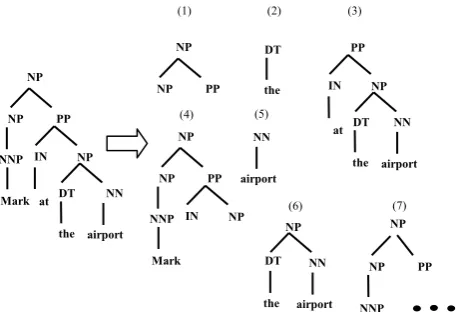
With recent construction of the Timebank corpus (Pustejovsky et al, 2003), the efficiency of different machine learning methods can now be compared. The recent work with Timebank has disclosed that six-class classification of temporal relations is a very complicated task, even for human annotators. In this paper, we propose an improved way of classifying temporal relations, using a machine learning approach. Support vector classification using effective kernel functions are specifically applied to two types of features: corpus gold-standard event features and underlying syntactic features of the contextual sentence. To capture either type of features, we apply an event-kernel to the gold-standard event features, and a convolution tree-kernel to syntactic features. The event kernel has been implemented according to (Mani et al., 2006) and some novel tree kernels have been employed as our syntactic tree kernel. Experimental results on Timebank validate the proposed method by showing 6% improvement over the state of the art method that merely uses gold-standard features.
The remainder of the paper is organized as follows: section 2 is about previous approaches to temporal relation classification. Section 3 explains our proposed method. Section 4 briefly presents characteristic of the corpus that we have used. Section 5 demonstrates evaluation of the proposed algorithm. Finally, paper is concluded in section 6.
2
Previous Works
There are numerous ongoing researches focused on temporal relation classification. These efforts can be divided into three categories: 1) Pattern based; 2) Rule based, and 3) Anchor based. These categories are discussed in the next three sub-sections.
2.1
Pattern Based Methods
This group of methods tries to extract some generic lexisyntactic patterns for events co-occurrence. Extracting these patterns can be done manually or automatically.
Manual Extraction of Patterns
Perhaps the simplest pattern based method is the one that was developed using a knowledge resource called VerbOcean (Chklovski and Pantel, 2005). VerbOcean has a small number of manually selected generic patterns. The style of patterns is in the form of <Verb-X> and then <Verb-Y>. After manually creating these patterns, this method can obtain some of existing semantic relations between events. Similar to other manual methods, a major drawback of this method is its tendency to have a high recall but a low precision. One way to overcome this weakness is to create more specific patterns; however it is clear that this would be very hard and time consuming.
Another way of resolving the low precision problem is using an additional component for pruning extracted relations. Many researches have tried to address this issue by a variety of approaches. In some studies, several heuristics have been employed to resolve the low precision problem (Chklovski and Pantel, 2005; Torisawa, 2006). Another solution is incorporating a classifier that is trained on a related corpus (Inui et al., 2003) and is used to refine the results.
Automatic Extraction of Patterns
These methods use machine learning techniques for pattern extraction. They try to learn a classifier from an annotated corpus, and attempt to improve classification accuracy by feature engineering.
There is another approach in this group that trains an event classifier for intra-sentential events, and builds a corpus that contains sentences with at least two events, one of which is triggered by a key time word (e.g., after, before, etc.). The classifier is based on syntax and clausal ordering features (Lapata and Lascarides, 2006).
The state of the art in this group is very similar to the MaxEnt classifier. It relies on features extracted automatically from some raw text, and works 3% better than MaxEnt. This classifier tries to learn event attributes and event-event features in two consecutive stages. Event attributes are the same as that of MaxEnt, but event-event features are new and include part of speeches, event-event syntactic properties, prepositional phrase, and temporal discourses (Chambers et al, 2007). This method also uses some extra resources like WordNet to find words' synsets.
There are also other methods that have used some machine learning techniques for acquisition of semantic relations between events (Abe et al., 2008). Such techniques can be applied to temporal relation classification as well. In addition to these methods, there is an SVM-based method which has been shown satisfactory results in event-time relation classification (Mirroshandel et al., 2009).
2.2
Rule Based Methods
The common idea behind rule based methods is to find some rules for classifying temporal relations. In most existing works, these rules are determined manually and are based on Allen's interval algebra (Allen, 1984).
In a study, rules of temporal transitivity were applied to increase the training set by a factor of 10. Next, the MaxEnt classifier was trained on this enlarged corpus. The test accuracy on this enlarged corpus was very encouraging. There was nearly 32% progress in accuracy (Mani et al., 2006).
Reasoning with determined rules is another usage of rules. In (Tatu and Srikanth, 2008), a rich set of rules (axioms) was created. Then by using a first order logic based theorem prover, they tried to find a proof of each temporal relation by refutation.
2.3
Anchor Based Methods
Anchor based methods use information of argument fillers (i.e., anchors) of every event expression as a valuable clue for recognizing temporal relations between events. They are based on the distributional hypothesis (Harris, 1968) and by looking at a set of event expressions whose argument fillers have a similar distribution, they try to recognize synonymous event expressions. Algorithms such as DIRT (Lin and Pantel, 2001), TE/ASE (Szpektor et al., 2004), and that of Pekar's system (Pekar, 2006) are some examples of anchor based methods.
It has been shown that one can gain more accuracy by combining some of these three different methods. For example, pattern and rule based methods were merged (Mani et al., 2006), and the new system showed to be more efficient than each of the base methods. In the other study, pattern and anchor based methods were combined (Chklovski and Pantel, 2005; Abe et al., 2008). However, there has been an exception: merging pattern and anchor based methods did not gain any improvement (Torisawa, 2006).
3
Tree Kernel Based Temporal Relation Classification
• Argument Distance Kernel (AD)
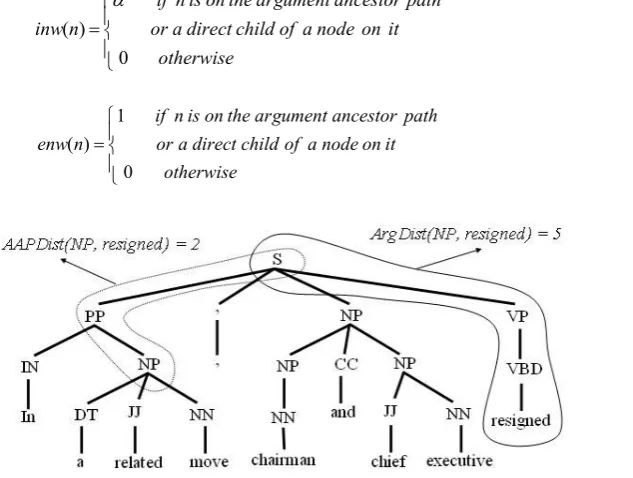
Weighting functions of this kernel, which have identical definitions, are shown as follows. Their definitions are similar to the previous kernel functions, though they use a different distance function which measures the distance of a node from an event argument rather than its ancestor path (see Figure 2).
( )
( )
( ( MAXDIST) ( ))n ArgDist n
ArgDist
n enw n inw
2
1, ,arg
arg , min
α
=
= (9)
• Threshold Sensitive Argument Ancestor Path Distance Kernel (TSAAPD)
This kernel is intuitively similar to AAPD kernel; except that instead of using a smooth decaying method, it employs a threshold based technique. Weighting functions are as follows:
( )
( )
( )
( )
> ≤ =
=
Threshold n
AAPDist
Threshold n
AAPDist n
enw n inw
α
1 (10)
3.3
Composite Kernels for Temporal Relation Extraction
In this section, two types of composition are proposed: linear composition and polynomial composition (Zhang et al., 2006).
Linear Composite Kernel
(
TR1,TR2)
Kˆ1(
TR1,TR2) (
1) (
Kˆ2 TR1,TR2)
Kl =α + −α (11)
where Kˆ1can be a normalized form of one of the mentioned convolution tree kernels. A kernel
K(X, Y) can be normalized by dividing it by K
(
X,X) (
.K Y,Y)
. Kˆ2 is the normalized form ofsimple event kernel. α is the composition coefficient. Based on five tree kernels that have been introduced, five linear composite kernels can be accordingly produced.
Polynomial Composite Kernel
(
TR1,TR2)
Kˆ1(
TR1,TR2) (
1)
Kˆ2(
TR1,TR2)
KP =α + −α P (12)
where Kˆ1 , 2 ˆ
K and α have similar definition as in linear composite kernel. P
Kˆ2 is the polynomial expansion of Kˆ2 with degree d (in this work, we have assumed d=2) and is defined as follows:
(
)
dP
K
Kˆ2 = 1+ ˆ2 (13)
Five different polynomial composite kernels can also be constructed in this case.
4
Corpus Description
Event-Time relations) class of Event-TimeML. Similar to (Mani et al., 2006; Tatu and Srikanth, 2008; Mani et al., 2007), we used a normalized version of these 14 temporal relations that contains 6 temporal relations RelTypes = {SIMULTANEOUS, IBEFORE, BEFORE, BEGINS, ENDS, INCLUDES}. For converting 14 relations to 6, the inverse relations were omitted, and SIMULTAENOUS and IDENTITY, as well as DURING and IS_INCLUDED, were collapsed.
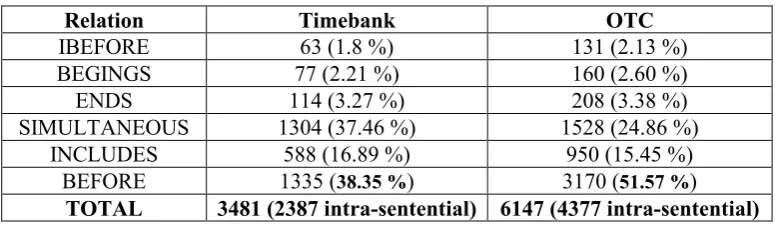
In our experiments, we merged two Timebank and Opinion datasets to generate a single corpus called OTC. Table 1 shows the normalized TLink class distribution over OTC.
Table 1: The normalized Event-Event TLink distribution in the Timebank and OTC.
Relation Timebank OTC
IBEFORE 63 (1.8 %) 131 (2.13 %)
BEGINGS 77 (2.21 %) 160 (2.60 %)
ENDS 114 (3.27 %) 208 (3.38 %)
SIMULTANEOUS 1304 (37.46 %) 1528 (24.86 %)
INCLUDES 588 (16.89 %) 950 (15.45 %)
BEFORE 1335 (38.35 %) 3170 (51.57 %)
TOTAL 3481 (2387 intra-sentential) 6147 (4377 intra-sentential)
As it is shown in table 1, relation "BEFORE" is the most frequent relation; thus it forms the majority class, and has been used as the baseline of experiments.
5
Experiments
We have used LIBSVM (Chang and Lin, 2001) java source for the SVM classification
(one-versus-one multi class strategy), Stanford NLP package (available at
http://nlp.stanford.edu/software/index.shtml) for tokenization, sentence segmentation, and parsing.
Since tree kernels can be more appropriately applied to the event pairs that reside on the same sentence, the corpus data have been accordingly split into two intra-sentential and inter-sentential parts. The proposed kernels have been evaluated on the intra-inter-sentential instances, while the simple event kernel has been exclusively used for the inter-sentential instances. The results reported for the whole corpus has been produced by combining those results. All the results are the outcome of a 5-fold cross validation. In order to find the appropriate value for parameters, 1000 event pairs have been randomly chosen as development set.
Table 2 shows the accuracy results of employing different tree kernels. In our evaluation, baseline was the majority class (BEFORE relation) of the evaluated corpus. Mani is the state of the art method, which exclusively uses gold-standard features (Mani et al., 2006). The other methods were described in the subsection 3.2.
The results show that using syntactic structure of sentences can be very effective. Comparing with other methods, AAPD kernel has achieved the best results. It showed 3% improvement over Mani's method on Timebank and 1% over OTC. The other tree kernels showed satisfactory results, too.
Table 2: The accuracy of tree kernels on Timebank and OTC.
Method Timebank Corpus OTC Corpus
Baseline 38.35 51.57
Mani 50.97 62.5
CollinsDuffy 51.71 62.04
AAP 53.41 62.52
AAPD 54 63.44
AD 53.3 62.38
As it is demonstrated in table 3, the effective exploitation of syntactic and simple event features in the linear composite kernels (subsection 3.3) resulted in a noticeable improvement of accuracy. Here, AAPD linear composite kernel was the most successful kernel, which gained over 6% improvement on Timebank, and 3% progress in accuracy on OTC.
Table 3: The accuracy of linear composite kernels on Timebank and OTC.
Method Timebank Corpus OTC Corpus
CollinsDuffy Linear 56.67 65.27 AAP Linear 56.12 64.88 AAPD Linear 56.73 65.62
AD Linear 56.6 65.34 TSAAPD Linear 56.4 65.24
Table 4 shows the accuracy results of applying five polynomial composite kernels (subsection 3.3) to Timebank and OTC.
Table 4: The accuracy of polynomial composite kernels on Timebank and OTC.
Method Timebank Corpus OTC Corpus
CollinsDuffy Polynomial 56.81 65.67 AAP Polynomial 56.94 65.76 AAPD Polynomial 57.02 65.95
AD Polynomial 57.25 65.92 TSAAPD Polynomial 56.43 65.32
The results of applying polynomial composite kernels reveal that these methods work better than their linear counterparts. On Timebank, AD polynomial composite kernel achieved the best result (i.e., over 6.2% improvement). On the other hand, on OTC, AAPD gained the best results with 3.45% improvement.
Unfortunately there are not a lot of researches on pattern based event-event relation classification, and we have to compare our work only with Mani algorithm. Regarding the hardness of the problem, it can be said, that the improvement is considerable.
6
Conclusion
In this paper, we have addressed the problem of extracting temporal relations between events, which has been a topic of interest since early days of natural language processing. Although syntactic features seem to be potentially useful in various text classification tasks, they have not yet been effectively exploited in temporal relation classification. We have tried to take advantage of such features to enhance classification performance. Support Vector Machines (SVM) has been chosen as our classification algorithm, due to its promising results in related works. Using SVM, two types of composite kernels have been proposed by combining convolution tree kernels and a simple event kernel.
The results of applying the new method, without using any extra annotated data, show a noticeable improvement over related works in the area of pattern based methods (including the state of the art method) in terms of accuracy.
It seems that using dependency structure of sentences or creating better kernels for SVM might be even further improve the accuracy of system.
References
Abe, S., K. Inui, and Y. Matsumoto. 2008. Two-phased event relation acquisition coupling the relation-oriented and argument-oriented approaches. In Proceedings of the 22nd International
Allen, J. F. 1984. Towards a general theory of action and time. Artificial Intelligence, 23(2):123-154. Alonso, R. 2009. The value of time in unstructured data for IR. In CIDR.
Boser, B. E., I. M. Guyon, and V. N. Vapnik. 1992. A training algorithm for optimal margin classifiers. In Proceedings of 5th workshop on Computational learning theory, pp.144-152. Chambers, N., S. Wang, and D. Jurafsky. 2007. Classifying temporal relations between events. In
Proceedings of ACL-45, pp.173-176.
Chang, C. C. and C. J. Lin. 2001. Libsvm: a library for support vector machines. Software available at http://www.csie.ntu.edu.tw/ cjlin/libsvm.
Chklovski, T. and P. Pantel. 2005. Global path-based refinement of noisy graphs applied to verb semantics. In Proceeding of Joint Conference on Natural Language Processing, pp.792-803. Collins, M. and N. Duffy. 2001. Convolution kernels for natural language. In Advances in Neural
Information Processing Systems 14, pp.625-632. MIT Press.
Cortes, C. and V. Vapnik. 1995. Support-vector networks. Machine Learning, pp.273-297. Harris, Z. 1968. Mathematical structure of language. John Wiley Sons, New York.
Inui, T., K. Inui, and Y. Matsumoto. 2003. What kinds and amounts of causal knowledge can be acquired from text by using connective markers as clues? In Proceedings of 6th International
Conference on Discovery Science, pp.180-193.
Khayyamian, M., S. A. Mirroshandel, and H. Abolhassani. 2009. Syntactic tree-based relation extraction using a generalization of Collins and Duffy convolution tree kernel. In Proceedings of
Human Language Technologies, pp.66-71.
Lapata, M. and A. Lascarides. 2006. Learning sentence-internal temporal relations. Journal of
Artificial Intelligence Research, 27:85-117.
Lin, D. and P. Pantel. 2001. Dirt-discovery of inference rules from text. In Proceedings of the 7th
ACM SIGKDD Conference on Knowledge Discovery and Data Mining, pp.323-328.
Mani, I., B. Wellner, M. Verhagen, and J. Pustejovsky. 2007. Three approaches to learning tlinks in
timeml. Technical Report CS-07-268. Computer Science Department, Brandeis University,
Waltham, USA.
Mani, I., V. Marc, B. Wellner, C. M. Lee, and J. Pustejovsky. 2006. Machine learning of temporal relations. In Proceedings of ACL-44, pp.753-760.
Mirroshandel, S. A., M. Khayyamian, and G. R. Ghassem-Sani. 2009. Event-Time Temporal Relation Classification Using Syntactic Tree Kernels. In Proceedings of the LTC’09, Poznan, Poland (To appear).
Pekar, V. 2006. Acquisition of verb entailment from text. In Proceedings of the Human Language
Technology Conference of the NAACL, Main Conference, pp.49-56.
Pustejovsky, J., P. Hanks, R. Sauri, A. See, R. Gaizauskas, A. Setzer, D. Radev, B. Sundheim, D. Day, L. Ferro, and M. Lazo. 2003. The TIMEBANK corpus. In Proceedings of Corpus
Linguistics 2003, pp.647-656.
Szpektor, I., H. Tanev, and I. Dagan. 2004. Scaling web-based acquisition of entailment relations. In
Proceedings of EMNLP, pp.41-48.
Tatu, M. and M. Srikanth. 2008. Experiments with reasoning for temporal relations between events.
In Proceedings of the 22nd International Conference on Computational Linguistics, pp.857-864.
Torisawa, K. 2006. Acquiring inference rules with temporal constraints by using Japanese coordinated sentences and noun-verb co-occurrences. In Proceedings of the Human Language
Technology Conference of the NAACL, Main Conference, pp.57-64.
Zhang, M., J. Zhang, J. Su, and G. D. Zhou. 2006. A composite kernel to extract relations between entities with both flat and structured features. In Proceedings of the 21st International