DOI : https://doi.org/10.32628/CSEIT195664
Game Theory and Queue Learning Based Sleep/Wakeup Approach Scheduling
in Wireless Sensor Network for Energy Efficiency
Mrs. S. Aswini Rose1, Mrs. N. Sharmila Banu2
1Research Scholar, Assistant Professor, Department of Computer Science, Providence College for Women,
Coonoor, Yedapalli, Tamil Nadu, India
2Assistant Professor, Department of Computer Science, Providence College for Women, Coonoor, Yedapalli,
Tamil Nadu, India ABSTRACT
Wireless Sensor Network (WSN) is a network with numerous sensor nodes for examining physical situations, communication and data collection. Sensor nodes communicate with a base station to distribute their data for the purpose of remote process and storage. While transmitting the data energy problem were occurred. This paper goal is to enables senders to predict receivers’ wake-up times by using a reinforcement learning technique. If senders have packets to transmit, senders can wake up shortly before the predicted wake-up time of receivers, so the energy, which senders use for idle listening, can be saved. In this case, senders do not have to make the trade-off, because their wake-up times are totally based on receivers’ wake-up times. Receivers still face the trade-off, however, since a receiver’s wake-up time relies on our technique to scheduling function and different selections of parameters in this function will result in different wake-up intervals. In addition, before a sender can make a prediction about a receiver’s wake-up time, the sender must request the parameters in the receiver’s wake-up scheduling function.
Keywords : Wireless Sensor Network, Energy Efficiency, Sleep / Wakeup scheduling
I. INTRODUCTION
A wireless sensor network (WSN) is a wireless network consisting of spatially distributed autonomous devices using sensors to cooperatively monitor physical or environmental conditions such as temperature, sound, vibration, pressure, motion pollutants at different locations. Wireless Sensor Networks have several unique characteristics such as small-scale sensor nodes, dynamic network topology, limited power supply, harsh environmental conditions, node failures, mobility of nodes, energy harvesting, mobility of detected events, large scale deployments, and unattended operation etc. In WSNs, most sensor nodes must rely on rechargeable power sources, e.g.,
batteries, to provide the necessary power. In most cases, it is difficult to charge or replace the batteries, especially in outdoor monitoring. Thus, their power management has become crucial. Energy shortage is always the bottleneck restricting the development of WSNs applications. As an engineering practice, sleep scheduling or duty cycling approaches have long been used in a wide variety of devices to save energy and prolong the lifetime of equipment’s, such as air -conditioning compressors, pumps and electric motor.
energy consumption in a sensor node could be due to either “useful” or “wasteful” sources. Due to transmitting or receiving data, useful energy consumption can occur. The process scheduling is the activity of the process manager that handles the removal of the running process from the CPU and the selection of another process based on a strategy. Process scheduling is an essential part of a Multiprogramming operating system. Sleep/Wake scheduling is every effective process where the network’s energy is saved to a maximum extent. In the network once the cluster formation is done then every cluster starts applying the process of sleep/wake scheduling. In order to save energy, only one or two nodes with highest residual energy in each cluster are required to keep active, while others will be kept on in the sleep mode. At the beginning of this scheduling all the nodes in the cluster will be active in order to analyse the residual energies. This analysis is done to select an active node with the highest residual energy in a cluster. And this active node will undertake the sensing task in a cluster. The node which will undertake the sensing task will be decided by the cluster head. The cluster head sends a WORK message to order the selected node to perform its duty as an active node, moreover, one of which is told to be the head node in the next period. And also the cluster head sends a SLEEP message to all of the rest nodes.Our main goal is to enables senders to predict receivers’ wake-up times by using a reinforcement learning technique. If senders have packets to transmit, senders can wake up shortly before the predicted wake-up time of receivers, so the energy, which senders use for idle listening, can be saved. In this case, senders do not have to make the trade-off, because their wake-up times are totally based on receivers’ wake-up times.
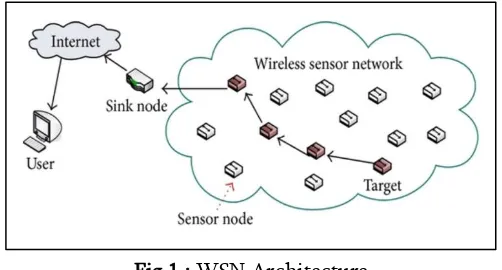
Fig 1 : WSN Architecture
II. LITERATURE REVIEW
Zhang, Zeyu, Lei Shu, et al [23] Sleep scheduling, also known as duty cycling, which turns sensor nodes on and off in the necessary time, is a common train of thought to save energy. Sleep scheduling has become a significant mechanism to prolong the lifetime of WSNs and many related methods have been proposed in recent years, which have diverse emphases and application areas. This paper classifies those methods in different taxonomies and provides a deep insight into them. To satisfy this requirement, the sensor nodes may have to wake up more frequently than in synchronous wake-up approaches.
introduce the architecture and elaborate some of the required extensions to the 3GPP presence service. The proof of concept prototype is also described.
Ye
Dayong
et al [25] Sleep/wake-up scheduling is one of the fundamental problems in wireless sensor networks, since the energy of sensor nodes is limited and they are usually rechargeable. The purpose of sleep/wake-up scheduling is to save the energy of each node by keeping nodes in sleep mode if possible (without sacrificing packet delivery efficiency) and thereby maximizing their lifetime. In this paper, a self-adaptive sleep/wake-up scheduling approach is proposed. Unlike most existing studies that use the duty cycling technique, which incurs a trade-off between packet delivery delay and energy saving, the proposed approach, which does not us duty cycling, avoids such a trade-off. The proposed approach, based on the reinforcement learning technique, enables each node to autonomously decide its own operation mode (sleep, listen, or transmission) in each time slot in a decentralized manner. Simulation results demonstrate the good performance of the proposed approach in various circumstances.ChengFang Zhen
et al [26] analyse Both energy-saving and synchronization issues are the paramount concern in wireless sensor networks (WSNs). In this paper we propose a simple and efficient WSN node design based on acoustic positioning applications and present an on-demand sleep/wake scheduling synchronization protocol. Three aspects are already considered in the design: (a) power controllable; (b) energy efficient; (c) high synchronization accuracy. Our primary goal is to maximize energy saving and to control power supplying according to environments and demands. We establish a model of energy consumption and improve it by the ways of power control and demand synchronization. The on-demand synchronization protocols are implemented in sensor nodes and evaluated in a testbed. Analysis and simulation were performed that the proposedprotocol has significantly reduced the energy consumption. It is also demonstrated by experiments that the platform is accurate and effective.
Runze Wan and Naixue Xiong [27] analyse an energy-efficient sleep scheduling mechanism with similarity measure for wireless sensor networks (ESSM) is proposed, which will schedule the sensors into the active or sleep mode to reduce energy consumption effectively. Firstly, the optimal competition radius is estimated to organize the all sensor nodes into several clusters to balance energy consumption. Secondly, according to the data collected by member nodes, a fuzzy matrix can be obtained to measure the similarity degree, and the correlation function based on fuzzy theory can be defined to divide the sensor nodes into different categories. Next, the redundant nodes will be selected to put into sleep state in the next round under the premise of ensuring the data integrity of the whole network. Simulations and results show that our method can achieve better performances both in proper distribution of clusters and improving the energy efficiency of the networks with prerequisite of guaranteeing the data accuracy.
III.PROBLEM STATEMENT
theoretically, nodes in this approach are smarter than nodes in most existing approaches.
IV.PROPOSED SYSTEM
A self-adaptive sleep/wake-up scheduling approach. This approach does not use the technique of duty cycling. Instead, it divides the time axis into a number of times slots and lets each node autonomously decide to sleep, listen or transmit a timeslot. Each node decides based on its current situation and an approximation of its neighbour’s situations, where such approximation does not need communication with neighbour’s. Through these techniques, the performance of the proposed approach outperforms other related approaches. Most existing approaches are based on the duty cycling technique and the sere searchers have taken much effort to improve the performance of their approaches. Thus, duty cycling is amature and efficient technique for sleep/wakeup scheduling. This paper is the first one which does not use the duty cycling technique. Instead, it proposes an alternative approach which is based on game theory and there in forcement learning technique. The performance improvement of the proposed approach, compared with existing approaches, may not be big, but the proposed approach provides a new way to study sleep/wake-up scheduling in WSNs. This paper primarily focuses on theoretical study, so there are so many assumptions. These assumptions are set to simplify the discussion of our approach. Without these assumptions, the discussion of our approach will become extremely complex, which is harmful for the readability of this paper. The problem itself addressed in this paper, however, is not simplified by these assumptions. Thus, the problem is stillgeneral under these assumptions. To achieving an energy-efficient medium access solution is to use wake-up radios. The wake-up radio approach enables the on-demand activity of the sensor node, so that the node can sleep until it is needed. At the same time, this ondemand capability saves energy at low sampling rates and
enables more efficient utilization for event-based and on-demand applications where continuous communications are not needed. The wake-up system consists of both a wake-up transmitter and receiver.
The proposed approach is not designed incorporating a specific packet routing protocol. This is because if the sleep/wakeup scheduling approach is designed incorporation with a specific packet routing protocol, the scheduling approach may work well only with that routing protocol but may work less efficiently with other routing protocols. In sleep/wake-up scheduling approach is designed incorporation with a packet routing protocol. Their scheduling approach uses staggered wake-up schedules to create unidirectional delivery paths for data propagation to significantly reduce the latency of data collection process. Their approach works very well if packets are delivered in the designated direction, but it is not efficient when packets are delivered in other directions. The contributions of this thesis are summarized as follows.
1) To the best of our knowledge, this approach is the first one which does not use the technique of duty cycling. Thus, the trade-off between energy saving and packet delivery delay, which is incurred by duty cycling, can be avoided. This approach can reduce both energy consumption and packet delivery delay.
2) This approach can also achieve higher packet delivery ratios in various circumstances compared to the benchmark approaches.
3) Unlike recent prediction-based approaches, where nodes must exchange information between each other, this approach enables nodes to approximate their neighbour’s situation without requesting information from these neighbour’s. Thus, the large amount of energy used for information exchange can be saved.
in WSNs. The game is defined by a pair of payoff matrices
where R and C specify the payoffs for the row player and the column player, respectively. Each of the two players selects an action from the three available actions. The joint action of the players determines their payoffs according to their payoff matrices. If the row player and the column player select actions i and j, respectively, the row player receives payoff rij and the column player obtains payoff cij. The players can select actions stochastically based on a probability distribution over their available actions. Let α1–α3 denote the probability for the row player to choose actions 1–3, respectively, where α1+ α2 + α3 =1. Let β1–β3 denote the probability for the column player to choose actions 1–3, respectively, where β1 +β2 + β3 =1. The row player’s expected payoff is
and the column player’s expected payoff is
Let above equation denote transmit, listen, and sleep, respectively. The values of those payoffs in the payoff matrices can be defined by the energy used by a node (which is a negative payoff). In addition, if a packet is successfully transmitted, the payoff of the transmitter/receiver is the energy, used to transmit/receive the packet, plus a positive constant, U, say U =98. Constant U is added on the energy consumption, if and only if a packet is successfully transmitted. The payoff for action sleep is−0.003 (the
energy consumed during sleeping period) irrespective of the opponent’s action, where the negative sign means that the energy is consumed. The value of the constant U is larger than the energy used for transmitting or receiving a packet. For example, if the row player has a packet to transmit and it selects transmit and the column player selects listen, the packet can be successfully transmitted. The payoffs for both players are positive, which can be calculated using the energy they use to transmit/receive the packet plus the constant U. Then, the row player gets payoff −81+98=17 and the column player obtains payoff −30+98 = 68, where 81 and 30 are energy consumption for transmitting and receiving a packet, respectively, and the negative sign means that the energy is consumed. However, if the column player selects sleep, the packet cannot be successfully transmitted. Then, the row player gets payoff−81 (the energy used for transmitting a packet) and the column player gets payoff−0.003 (the energy used for sleeping). It should be noted that if a node does not have a packet to transmit, it will not select transmit. In a time slot, each node is in one of several states which indicate the status of its buffer. For example, if a node’s buffer can store three packets, there are four possible states for the node: s0–s3, which imply that the node has 0–3 packets in its buffer, respectively. The aim of each node is to find a policy π, mapping states to actions, that can maximize the node’s long-run payoff. Specifically, for a node, π(s,a) is a probability, based on which the node selects action a in current state s, and π(s) is a vector which is a probability distribution over the available actions in current state s. Thus, policy π is a matrix. For example, a node’s buffer can store three packets, so the node have four states: s0–s3, as described above.
Initially, as the node does not have any knowledge, each action is considered to be equally important in each state. Because for each state, s, ∑1≤i≤3 π(s,i) has
to be 1, each element in π is set to be (1/3). Then, through learning, the node will adjust the value of each element in π. The detail will be give in the following sections. Here, the terms π(s,a) and α, β denote the probability of selecting an action. π(s,a) takes states into consideration while α and β do not do so. α and β are used only for description convenience of the model and the algorithms.
If the selected action is transmit, the node needs to decide when to transmit the packet in the time slot. The node then receives a payoff and reaches a new state. It updates the Q-value of the selected action in its current state based on the received payoff and the maximum value in the new state (line 7). Here, Q-value, Q(s,a), is a reinforcement of taking action an in states. This information is used to reinforce the learning process. The formula in line 7 is a value iteration update. Initially, Q-value is given arbitrarily by the designer. Then, the Q-value is updated using the current Q-value, (1−ξ) Q(s,a), plus the learned knowledge, ξ(p+γmaxaQ(s,a)). The learned knowledge
consists of the payoff obtained by the node after taking an action plus the estimate of optimal future value: p+γmaxaQ(s,a). In lines 8–10, if the selected action is
not sleep, the node will approximate the probability distribution over the neighbour’s available actions. This neighbour is the one that has interacted with the node, i.e., transmitted a packet to the node or received a packet from the node, in the current time slot.
V. EXPERIMENTAL RESULT
The Network Simulator-NS2 is used as simulation platform to test the proposed algorithms. The results are tabulated in the below table. The results are declared based on effectiveness and performance of the proposed algorithms namely: SA-MECH algorithm. The proposed work is compared with EM-MAC and the comparison is represented in the form of graphs.
Table 1.1 : Simulation Parameters
PARAMETER VALUE
Simulator NS-2.34
Topology grid
Number of nodes 49,81,121,169
Sink nodes 5
Grid distance 200m
Simulation time 100s
Traffic type CBR, UDP
Transmission range 200m
EM-MAC: In EM-MAC, each node uses a pseudorandom number generator: Xn+1 = (aXn + c) mod m to compute its wake-up times, where m > 0 is the modulus, a is the multiplier, c is the increment, Xn is the current seed and the generated Xn+1 becomes the next seed. In this simulation, m = 65536, each node’s a, c and Xn are independently chosen following the principles suggested by Knuth [50]. By requesting the parameters, m, a, c, and Xn, from a receiver, a sender can predict the receivers future wake-up times and prepare to send data at those times. EM-MAC does not need synchronization but it requires nodes to exchange information before nodes can make predictions
Performance is measured by three quantitative metrics: 1) average packet delivery latency;
The minimum time needed by nodes to transmit or receive a packet is about 2 ms [14], e.g., using the radio chip Chipcon CC2420. The three metrics are described as follows.
1) Packet delivery latency is measured by the average time taken by each delivered packet to be transmitted from the source to the destination. Note that those packets, which do not reach the destination successfully, have also been taken into account. Their delivery latency is the time interval, during which they exist in the network.
2) Packet delivery ratio is measured by using the percentage of packets that are successfully delivered from the source to the destination. Each packet comes with a parameter, time-to-live (TTL), which is a positive integer. Once a packet is transmitted from a sender to a receiver (no matter whether successfully or unsuccessfully), the TTL of this packet subtracts 1. If the TTL of this packet becomes 0 and it has not reached the destination, the delivery of this packet is a failure.
3) Average energy consumption is calculated by using the total energy consumption to divide the number of nodes n the network during a simulation run.
Simulation Results in Grid Networks:
The topology of a grid network is like a chessboard as described in the previous section. Grid networks have three rules.
1) Each of the four nodes that are located at the four corners has two neighbors.
2) Each node on the edge has three neighbors. 3) All the other nodes have four neighbors.
Moreover, in this simulation, five sinks are located at the four corners and the center of the network, respectively. Therefore, the grid networks are highly
regular. In this situation, the proposed approach, SA-Mech., can work well, because SA-Mech. is based on reinforcement learning, and something with high regularity can be easily learned. In the grid networks, all the packets are transmitted to the four corners and the center, where sinks are located. This regularity can be easily learned by nodes under SA-Mech. as time progresses, and based on the learned knowledge, nodes can precisely approximate their neighbors’ situations. The detailed analysis of the simulation results is given in the following sections
1) Performance of the Approaches in Different Scales of Grid Networks:
Chart 1: Average delivery latency (ms)
Chart 3: Average energy consumption (mW) Above charts demonstrates the performance of these approaches in different scales of grid networks. The packet generation probability is fixed at 0.2. In Fig. 4(a), with the increase of network scale, the average delivery latency in all of these approaches rises. This is because when the network scale increases, based on the routing approach used in this simulation, on average, each packet has to be transmitted with more steps to its destination. Thus, the average delivery latency will undoubtedly increase EM-MAC is slightly, about 5%, Although in EM-MAC, nodes have to request their neighbors’ information for future wake-up prediction, that request is ondemand and only once.
Performance of the Approaches Under Different Packet Generation Probabilities in Grid Networks:
Chart 4: Average delivery latency (ms).
Chart 5: Packet delivery ratio (%).
Chart 6 Average energy consumption (mW).
VI.CONCLUSION
To improve a sensor network’s reliability and extend its longevity, sensor networks are deployed with high densities (up to 20 nodes/m3). However, if all sensor nodes in such a dense deployment scenario operate at the same time, energy will be consumed excessively. Also, packet collisions will increase as a result of the large number of packets being forwarded in the network. In addition, most of the data forwarded in the network will be redundant since when node density is high, sensing regions of the nodes will overlap and the data of adjacent sensor nodes will be highly correlated. In summary, sleep scheduling reduces both energy consumption and network traffic by avoiding the transmission of redundant data. This thesis introduced a self-adaptive sleep/wake-up scheduling approach. This approach does not use the technique of duty cycling. Instead, it divides the time axis into a number of times slots and lets each node autonomously decide to sleep, listen or transmit in a time slot. Each node decides based on its current situation and an approximation of its neighbors’ situations, where such approximation does not need communication with neighbors.
VII. REFERENCES
[1]. Karthik, S., and A. Ashok Kumar. "Challenges of Wireless Sensor Networks and Issues associated with Time Synchronization." In Proceedings of the UGC Sponsored National Conference on Advanced Networking and Applications. 2015. [2]. Zhang, Zeyu, Lei Shu, Chunsheng Zhu, and
Mithun Mukherjee. "A short review on sleep scheduling mechanism in wireless sensor networks." In International Conference on Heterogeneous Networking for Quality, Reliability, Security and Robustness, pp. 66-70. Springer, Cham, 2017.
[3]. El Barachi, May, ArifKadiwal, RochGlitho, FerhatKhendek, and RachidaDssouli. "A
presence-based architecture for the integration of the sensing capabilities of wireless sensor networks in the IP multimedia subsystem." In 2008 IEEE Wireless Communications and Networking Conference, pp. 3116-3121. IEEE, 2008.
[4]. Ye, Dayong, and Minjie Zhang. "A self-adaptive sleep/wake-up scheduling approach for wireless sensor networks." IEEE transactions on cybernetics 48, no. 3 (2017): 979-992.
[5]. ChengFang Zhen et al, “Energy-Efficient Sleep/Wake Scheduling for Acoustic Localization Wireless Sensor Network Node”, IJDSN, 2014
[6]. Runze Wan and Naixue Xiong, “An energy -efficient sleep scheduling mechanism with similarity measure for wireless sensor networks”, springer 2018
[7]. Yan Wu, Sonia Fahmy, “Optimal Sleep/Wake Scheduling for Time-Synchronized Sensor Networks with QoS Guarantees”, IJRTE, Volume-8 Issue-2, 2019
[8]. Zeyu Zhang, Lei Shu, “A Short Review on Sleep Scheduling Mechanism in Wireless Sensor Networks”, 2018.
[9]. P RachelinSujae, S Arulselvi, “Receiver-Initiated Medium Access Control (RI-MAC) Protocols”, (IJITEE) ISSN: 2278-3075, Volume-8 Issue-8, June 2019
[10]. Sakshi Aggarwal, Vikas Gupta, “Localization in Wireless Sensor Networks”, (IJARECE) Volume 5, Issue 5, May 2016
[11]. EwaNiewiadomska-Szynkiewicz, “Localization in Wireless Sensor Networks: Classification and Evaluation of Techniques”, Int. J. Appl. Math. Comput. Sci., 2012, Vol. 22, No. 2, 281–297 DOI: 10.2478/v10006-012-0021-x
[13]. C. C. Hsu, M. S. Kuo, S. C. Wang and C. F. Chou, “Joint design of Asynchronous Sleep-Wake Scheduling and Opportunistic Routing in Wireless Sensor Networks,” IEEE Transactions on Computers, Vol. 63, No. 7, pp. 1840–1846, July 2014.
[14]. Lei Tang, Yanjun Sun, Omer Gurewitz and David B. Johnson, “PW-MAC: An Energy-Efficient Predictive-Wakeup MAC Protocol for Wireless Sensor Networks,” in Proc. of IEEE INFOCOM, Vol. 6, No. 9, pp. 1305–1313, March 2011.
Cite this article as :
S. Aswini Rose, N. Sharmila Banu, "Game Theory and Queue Learning Based Sleep/Wakeup Approach Scheduling in Wireless Sensor Network for Energy Efficiency", International Journal of Scientific Research in Computer Science, Engineering and Information Technology (IJSRCSEIT), ISSN : 2456-3307, Volume 5 Issue 6, pp. 331-340, November-December 2019. Available at doi : https://doi.org/10.32628/CSEIT195664