Rationale, Concepts, and Current Outcome
of the Unit Graphs Framework
Maxime Lefranc¸ois and Fabien Gandon
Wimmics, Inria, I3S, CNRS, UNSA
2004 rte des Lucioles, BP. 93, 06902 Sophia Antipolis, France
{maxime.lefrancois,fabien.gandon}@inria.fr
Abstract
The Unit Graphs (UGs) framework is a graph-based knowledge representation (KR) formalism that is designed to al-low for the representation, manipula-tion, query, and reasoning over linguis-tic knowledge of the Explanatory Com-binatorial Dictionary of the Meaning-Text Theory (MTT). This paper introduces the UGs framework, and overviews current published outcomes. It first introduces rationale of this new formalism: nei-ther semantic web formalisms nor Con-ceptual Graphs can represent linguistic predicates. It then overviews the foun-dational concepts of this framework: the UGs are defined over a UG-support that contains: i) a hierarchy of unit types which is strongly driven by the actantial struc-ture of unit types, ii) a hierarchy of cir-cumstantial symbols, and iii) a set of unit identifiers. On these foundational con-cepts and on the definition of UGs, this paper finally overviews current outcomes of the UGs framework: the definition of a deep-semantic representation level for the MTT, representation of lexicographic def-initions of lexical units in the form of se-mantic graphs, and two formal sese-mantics: one based on UGs closure and homomor-phism, and one based on model semantics.
1 Introduction
The Meaning-Text Theory (MTT) is a theoreti-cal dependency linguistics framework for the con-struction of models of natural language. As such, its goal is to write systems of explicit rules that ex-press the correspondence between meanings and texts (or sounds) in various languages (Kahane, 2003). From semantic representations to surface
phonologic representations, seven different levels of linguistic representation are supposed for each set of synonymous utterances. Thus, two times six modules containing transformation rules are used to transcribe representations of a level into representations of an adjacent level. The main constituent of the MTT is the dictionary model where lexical units are described, which is called the Explanatory Combinatorial Dictionary (ECD) (Mel’ˇcuk, 2006).
As for any community of interest, linguists and lexicographers of the MTT framework produce knowledge. Knowledge Representation (KR) is an area of artificial intelligence that deals with recur-rent needs that emerge with such knowledge pro-duction.
The aim of this paper is to introduce the Unit Graphs KR formalism that is designed to allow for the representation, manipulation, query, and rea-soning over dependency structures, rules and lexi-cographic knowledge of the ECD.
The rest of this paper is organized as follows. We will first introduce rationale of this new KR formalism (§2), then the fundamental concepts of the UGs framework (§3), implications for the MTT, lexicographic definitions and application to a specific MTT lexicographic edition project (§4), and finally two approaches to assign UGs with log-ical semantics, so as to enable reasoning in the UGs framework (§5).
2 Rationale: Representation of Valency-based Predicates
Most past or current projects that aimed at im-plementing the ECD did so in a lexicographic perspective. One important example is the RE-LIEF project (Lux-Pogodalla and Polgu`ere, 2011), which aims at representing a lexical system graph named RLF (Polgu`ere, 2009), where lexical units are interlinked by paradigmatic and syntagmatic links of lexical functions (Mel’ˇcuk, 1996). In
the RELIEF project, the description of Lexical Functions is based on a formalization proposed by Kahane and Polgu`ere (2001). Moreover, lexico-graphic definitions start to be partially formalized in the RELIEF project using the markup type that has been developed in the Definiens project (Bar-que and Polgu`ere, 2008; Bar(Bar-que et al., 2010).
One exception is the proprietary linguistic pro-cessor ETAP-3 that implements a variety of ECD for Natural Language Processing (Apresian et al., 2003; Boguslavsky et al., 2004). Linguistic knowledge are asserted, and transformation rules are directly formalized in first order logic.
Adding to these formalization works, our goal is to propose a formalization from a knowledge engi-neering perspective, compatible with standard KR formalisms. The term formalization here means not onlymake non-ambiguous, but alsomake op-erational, i.e.,such that it supports logical oper-ations(e.g., knowledge manipulation, query, rea-soning). We thus adopt a knowledge engineering approach applied to the domain of the MTT.
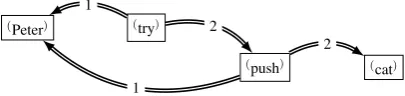
At first sight, two existing KR formalisms seem interesting for this job: semantic web for-malisms (e.g., RDF1, RDFS2, OWL3, SPARQL4), and Conceptual Graphs (CGs) (Sowa, 1984; Chein and Mugnier, 2008). Both of them are based on directed labelled graph structures, and some research has been done towards using them to represent dependency structures and knowledge of the ECD (OWL in (Lefranc¸ois and Gandon, 2011; Boguslavsky, 2011), CGs at the concep-tual level in (Bohnet and Wanner, 2010)). Yet Lefranc¸ois (2013) showed that neither of these KR formalisms can represent valency-based pred-icates, therefore lexicographic definitions. One crucial issue is the following: in RDFS, OWL and the CGs, there is a strong distinction between con-cept types and relations. Yet, a linguistic predi-cate may be considered both as a concept type as it is instantiated in dependency structures, and as a relation as its instances may link other instances. The simple semantic representation illustrated on figure 1 thus cannot be represented with these for-malisms unless we use reification of n-ary
rela-1
RDF - Resource Description Framework, c.f.,http:// w3.org/RDF/
2
RDFS - RDF Schema, c.f., http://www.w3.org/ TR/rdf-schema/
3
OWL - Web Ontology Language, c.f.,http://www. w3.org/TR/owl2-overview/
4SPARQL, c.f., http://www.w3.org/TR/ sparql11-overview/
tions. But then these formalisms lack logical se-mantics to reason with such relations.
(Peter) (try)
(push) (cat)
1
2
1
2
Figure 1: Semantic representation of sentence Pe-ter tries to push the cat.
As the CGs formalism is the closest to the se-mantic networks, the following choice has been made to overcome these issues: Modify the CGs formalism basis, and define transformations to syntaxes of Semantic Web formalisms for sharing and querying knowledge. As we are to represent linguistic units of different nature (e.g., seman-tic units, lexical units, grammaseman-tical units, words), termunithas been chosen to be used in a generic manner, and the result of this adaptation is thusthe Unit Graphs (UGs) framework.
3 Fundamental Concepts of the UGs Framework
First, for a specific Lexical Unit L, Mel’ˇcuk (2004, p.5) distinguishes considering L in language (i.e., in the lexicon), or in speech (i.e., in an utterance). KR formalisms and the UGs formalism also do this distinction using types. In this paper and in the UGs formalism, there is thus a clear dis-tinction between units (e.g., semantic unit, lexi-cal unit), which will be represented in the UGs, and their types (e.g., semantic unit type, lexical unit type), which are roughly classes of units that share specific features. It is those types that will specify through their so-called actancial structure (Mel’ˇcuk, 2004) how their instances (i.e., units) are to be linked to other units in a UG.
3.1 Hierarchy of Unit Types
The core of the UGs framework is a structure calledhierarchy of unit typesand notedT, where unit types and their actantial structure are de-scribed. This structure is thoroughly described in (Lefranc¸ois, 2013; Lefranc¸ois and Gandon, 2013b) and studied in (Lefranc¸ois and Gandon, 2013d).
Symbol (ASymbol) which is chosen in a set de-notedST. ST contains numbers for the semantic unit types, and other ”classical” symbols for the other levels under consideration (e.g, roman nu-meralsItoVIfor the Deep Syntactic actants). The set of ASlots of a unit typetis represented by the setααα(t) of ASymbols these ASlots have. More-over,
• some ASlots are obligatory, they form the set
α
αα1(t)ofObligatory Actant Slots (OblASlots); • other are prohibited, they form the setααα0(t)
ofProhibited Actant Slots (ProASlots); • the ASlots that are neither obligatory nor
pro-hibited are said to be optional, they form the set ααα?(t) of Optional Actant Slots
(Op-tASlots).
Finally, every unit typethas a signature function
ςςςt that assigns to every ASlot of t a unit type,
which characterises units that fill such a slot. The set of unit types is then pre-ordered5 by a specialization relation ., and for mathematical reasons as one goes down the hierarchy of unit types the actantial structure of unit types may only become more and more specific: (i) some ASlot may appear, be optional a moment, and at some points become obligatory or prohibited; (ii) the signatures may only become more specific.
3.2 Hierarchy of Circumstantial Symbols
UGs include actantial relations, which are consid-ered of type predicate-argument and are described in the hierarchy of unit types. Now UGs also in-clude circumstantial relations which are consid-ered of type instance-instance. Example of such relations are the deep syntactic representation re-lationsATTR,COORD,APPENDof the MTT, but we may also use such relations to represent the link between a lexical unit and its associated sur-face semantic unit for instance. Circumstantial re-lations are labelled by symbols chosen in a set of so-calledCircumstantial Symbols (CSymbols), de-noted SC, and their categories and usage are de-scribed in a hierarchy denotedC, that has been for-mally defined in (Lefranc¸ois and Gandon, 2013a).
3.3 Unit Graphs
UGs are defined over a so-called support, S def= (T,C,M)whereT is a hierarchy of unit types,C
5A pre-order is a reflexive and transitive binary relation.
is a hierarchy of CSymbols, andMis a set ofunit identifiers.
A UGGdefined over a supportS is a tuple de-notedG= (def U,l, A, C, Eq), whereU is the set of unit nodes,lis a labelling mapping overU that as-sociate every unit node with a unit type and one or more unit identifiers,AandCare respectively actantial and circumstantial triples, andEqis a set of asserted unit node equivalences. Unit nodes are illustrated by rectangles with their label written in-side, actantial triples are illustrated by double ar-rows, circumstantial triples are illustrated by sim-ple arrows, and asserted unit node equivalences are illustrated by dashed arrows.
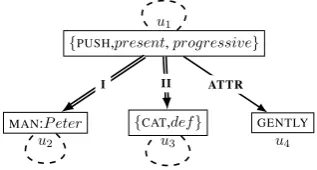
For instance, figure 1 is a semantic represen-tation of sentence Peter tries to push the cat. in which units are typed by singletons and ASym-bols are numbers, in accordance with the MTT. Figure 2 is a simplified deep syntactic represen-tation of Peter is gently pushing the cat. In this figure unit nodes u2 and u4 are typed by
single-tons, and only unit nodeu2is not generic and has
a marker: {P eter}. P is composed of(u1,I, u2)
and(u1,II, u3), whereI andII are ASymbols. C
is composed of (u1,ATTR, u4) where ATTR is a
CSymbol. In the relation Eq there is (u1, u1), (u2, u2), and(u3, u3).
{PUSH,present,progressive}
MAN:P eter {CAT,def} GENTLY u1
u2 u3 u4
I II ATTR
Figure 2: Deep syntactic representation of sen-tencePeter is gently pushing the cat.
UGs so defined are the core dependency struc-tures of the UGs mathematical framework.
4 Unit Graphs and the Meaning-Text Theory
4.1 A Deep-Semantic Representation Level
(en: instrument) has a Semantic ASlot1that cor-responds to the activity for which the instrument is designed. NowPEIGNE(en: comb) has a stricter meaning thanINSTRUMENT, and also two Seman-tic ASlots:1correspond to the person that uses the comb, and 2 is a split variable6 that corresponds either to the hair or to the person that is to be combed. Then semantic unit type(peigne)cannot be more specific than(instrument)in the hierarchy of unit types because the signature of its ASlot1
is not more specific than the signature of the ASlot
1 of(instrument), i.e., ςςς(peigne)(1) = (person) 6. (activity) = ςςς
(instrument)(1). In fact, the meaning
of ASlot 1 is not the same for (instrument) and
(peigne).
Lefranc¸ois and Gandon (2013b) therefore intro-duced a deeper level of representation to describe meanings: thedeep semantic level, and defined the deep and surface semantic unit types and their ac-tantial structure. The Deep Semantic Unit Type (DSemUT) associated with a Lexical Unit Type (LexUT) L is denoted/L\. So that the ASlots of deep semantic unit types convey meanings, the set of ASsymbols that is used to symbolize ASlots at this level is a set of lexicalized semantic roles (e.g.,
agent, combedhair, combedperson). For in-stance the DSemUT/instrument\associated with the LexUTINSTRUMENT may have an ASlot ar-bitrarily symbolizedactivity, which would be in-herited by the DSemUT/peigne\. Then/peigne\ also introduces three new ASlots: one arbitrar-ily symbolizedpossessorthat corresponds to the ASlot 1 of(peigne), and two arbitrarily symbol-izedcombedhair, andcombedpersonthat corre-spond to the ASlot2of(peigne).
Actually, one may need to introduce a new ASymbol every time a Semantic ASlot that con-veys a new meaning is introduced. The set of se-mantic roles thus cannot be bound to a small set of universal semantic roles.
4.2 Lexicographic Definitions
It is at the deep semantic representation level that one may represent the actual meaning of a LexUT L. The lexicographic definition of L cor-responds to the definition of its associated DSe-mUT /L\, which is roughly an equivalence be-tween two deep semantic UGs. Unit type defi-nitions have been formally defined in (Lefranc¸ois
6For details about split Semantic ASlots, see (Mel’ˇcuk,
2004, p.43)
and Gandon, 2013a), and the definition of/L\is a tripleD/L\
def
= (D−/L\, D
+
/L\, κ), where (roughly):
• D/−
L\ represents only a central unit node
typed with /L\, and some other unit nodes that fill some of the ASlots of/L\;
• D/+
L\is a UG called theexpansionof /L\,
• there is no circumstantial triple in these two UGs because circumstantials must not be part of the lexicographic definition of a LexUT. • κis a mapping from the unit nodes of D/−L\
to some unit nodes ofD/+ L\.
Figure 3 is an example of lexicographic defini-tion ofPEIGNE: an instrument that a person X uses to untangle the hair Y1of a person Y2.
/ peigne\
/ person\ /hair\
/ person\
possessor combedperson
combedhair
/instrument\
/ person\
/ untangle\
/person\ /hair\ activity
agent object
partof
Figure 3: Lexicographic definition ofPEIGNE.
Intuitively, a definition corresponds to two re-ciprocal rules. If there is the defined PUT in a UG then one may infer its definition, and vice versa. A set of unit type definitionsDmay thus be added to the unit types hierarchy.
Lefranc¸ois et al. (2013) illustrated how the UGs framework may be used to edit lexicographic definitions in the RELIEF lexicographic edition project (Lux-Pogodalla and Polgu`ere, 2011). Lex-ical Units are assigned a semantic label that may be considered as a deep semantic unit type and to which one may assign an actantial structure. A lexicographer may then manipulate nodes in a graphical user interface so as to little by little con-struct a deep semantic UG that represents the de-composition of the DSemUT associated with the defined LexUT. A prototype web application has been developed, and a demonstration is available online: http://wimmics.inria.fr/doc/
video/UnitGraphs/editor1.html. We
with actors of the RELIEF project in order to en-hance the workflow of this prototype.
5 Reasoning in the Unit Graphs Framework
The prime decision problem of the UGs frame-work is the following: Considering two UGs G andH defined over the same supportS, does the knowledge ofGentails the knowledge ofH?
5.1 Reasoning with UGs-Homomorphisms
Lefranc¸ois and Gandon (2013a) proposed to use the notion of UGs homomorphism to define this entailment problem. There is a homomorphism from a UGH to a UG Gif and only if there is a homomorphism from the underlying oriented la-belled graphs ofHto that ofG.
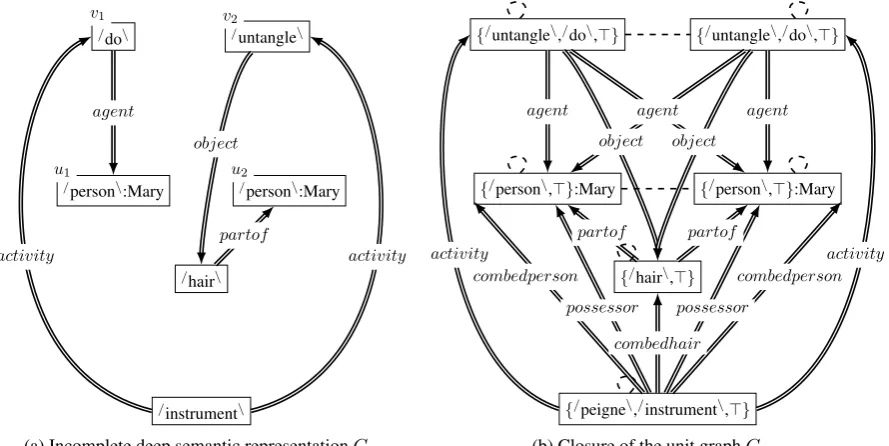
Now one need to define the notion of knowl-edge of a UG. In fact, the UGs framework makes the open-world assumption, which means that a UG along with the support on which it is defined represents explicit knowledge, and that additional knowledge may be inferred. Consider the UG
G = (U,l, A, C, Eq) defined over the support S illustrated in figure 4a. Some knowledge inGis implicit:
1. two unit nodes u1 and u2 share a common
unit marker M ary, so one may infer that they represent the same unit. (u1, u2) may
be added toEq.
2. every unit type is a subtype of the prime uni-versal unit type>, so one could add>to all the types of unit nodes inG.
3. there are two unit nodesv1andv2that fill the
same ASlot activity of the unit node typed
/instrument\. So one may infer thatv 1 and v2 represent the same unit. Said otherwise, (v1, v2)may be added toEq.
4. one may recognize the expansion of/peigne\ as defined in figure 3, so this type may be made explicit in the unit node typed
/instrument\.
Each of the rules behind these cases explicit knowledge inG. More generally, Lefranc¸ois and Gandon (2013a) listed a set of rules which defines the axiomatization of the UGs semantics. The pro-cess of applying this set of rules on a UGGuntil none of them has any effect is called closingG. Figure 4b illustrates the closure ofG, where all of the inferable knowledge has been made explicit.
The notion ofentailmentmay hence be defined as follows:GentailsH, notedGhH, if and only if there is a homomorphism fromHto the closure ofG. Lefranc¸ois and Gandon (2013a) illustrated problematic cases where the closure is infinite for finite UGs. If that occurs it makes the closure un-decidable, along with the entailment problem. We are currently working of the definition of restric-tions of the unit types hierarchy and the set of def-initions in order to ensure that any UG has a finite closure.
5.2 Model Semantics for the UGs framework
Another approach to defining the entailment prob-lem has been presented in (Lefranc¸ois and Gan-don, 2013c), using model semantics based on re-lational algebra. The model of a support S = (T,C,M) is a couple M = (D, δ), where D is a set called the domain of M, and δ is denoted theinterpretation function. In order to deal with the problem of prohibited and optional ASlots,D
contains a special element denoted • that repre-sentsnothing, plus at least one other element, and must be such that:
• Mis a model ofT; • Mis a model ofC;
• for all unit identifier m ∈ M, the interpreta-tion ofmis an object of the domainDexcept for the specialnothingelement;
Lefranc¸ois and Gandon (2013c) listed the dif-ferent equations that the interpretation function must satisfy so that a model is a model of a unit types hierarchy and of a CSymbols hierarchy.
A model of a UGGis a model of the support on which it is defined, augmented with an assignment functionβ, which is a mapping from the set of unit nodes ofGto the domainD. Such a model needs to satisfy a list of equations so that it may be said to satisfy the unit graphG.
Then the notion of entailment is defined as clas-sically done with model semantics: LetH andG
be two UGs defined over a supportS. G entails H, or H is a semantic consequenceof G, noted
GmH, if and only if for any model (D, δ) of Sand for any assignmentβGsuch that(D, δ, βG)
satisfiesG, then there exists an assignmentβH of
the unit nodes inH such that(D, δ, βH)satisfies H.
/instrument\ /person\:Mary
/do\ /untangle\
/person\:Mary
/hair\
activity activity
agent
object
partof
u1 u2
v2 v1
(a) Incomplete deep semantic representationG
{/peigne\,/instrument\,>}
{/person\,>}:Mary
{/untangle\,/do\,>} {/untangle\,/do\,>}
{/person\,>}:Mary
{/hair\,>}
activity activity
combedperson combedperson
possessor possessor
combedhair
agent agentagent agent
partof partof
object object
(b) Closure of the unit graphG
Figure 4: Closure of a UG.
• the definition of the model semantics of the UGs shall be completed so as to take lexico-graphic definitions into account.
• one need to define algorithms to construct a model that satisfy a UG, and to check the en-tailment of a UG by another.
• such algorithms may lead to an infinite do-main. A condition over the unit types hierar-chy and the lexicographic definitions must be found so as to ensure that the model is decid-able for a finite UG.
• are the two entailment relations h and m
equivalent ?
6 Conclusion
We thus introduced rationale of the new Unit Graphs Knowledge Representation formalism that is designed to formalize, in a knowledge engineer-ing perspective, the dependency structures, the valency-based predicates, and lexicographic def-initions in the ECD.
The strong coherence in the unit types hierar-chy justifies the introduction of a deep semantic representation level that is deeper than the MTT semantic level, and in which one may represent the lexicographic definitions.
Finally, two different logical semantics have been provided for UGs and the prime entailment decision problem has been defined in two ways. More research is needed to determine if these two decision problems are equivalent, and what their
complexity is.
There are other longer-term directions of re-search for the Unit Graphs framework:
We are working on a syntax based on seman-tic web standards for the different objects of the framework. Like WordNet today, the linguis-tic knowledge written with that syntax could be shared and queried on the web of linked data7. This would support their use as a highly structured lexical resource by consumers of the linked data cloud.
Rules have already been defined in the UGs framework. LetGDSem be a deep semantic UG,
we need algorithms to select and apply correspon-dence rules to transcribeGDSem to a surface se-mantic UGGSSemfor instance.
We are working on defining generic rules to for-mally represent semantic derivations. This is a first step towards representing Lexical Functions that play a very important role in the MTT.
Finally, the design of the Unit Graphs frame-work is a first step towards Natural Language Pro-cessing applications. Future work include (semi-automatically) populating this model with linguis-tic data, and formulating classical NLP tasks in terms of UGs, such as machine translation, ques-tion answering, text summarizaques-tion, and so on.
References
Juri Apresian, Igor Boguslavsky, Leonid Iomdin, Alexander Lazursky, Vladimir Sannikov, Victor Sizov, and Leonid Tsinman. 2003. ETAP-3 linguis-tic processor: A full-fledged NLP implementation of the MTT. In First International Conference on Meaning–Text Theory (MTT’2003), pages 279–288.
Lucie Barque and Alain Polgu`ere. 2008. Enrichisse-ment formel des d´efinitions du Tr´esor de la Langue Franc¸aise informatis´e (TLFi) dans une perspective lexicographique. Lexique, 22.
Lucie Barque, Alexis Nasr, and Alain Polgu`ere. 2010. From the Definitions of the ’Tr´esor de la Langue Franc¸aise’ To a Semantic Database of the French Language. In Fryske Akademy, editor,Proceedings of the XIV Euralex International Congress, Fryske Akademy, pages 245–252, Leeuwarden, Pays-Bas. Anne Dykstra et Tanneke Schoonheim, dir.
Igor Boguslavsky, Leonid Iomdin, and Viktor Sizov. 2004. Multilinguality in ETAP-3: reuse of lexical resources. In Gilles S´erasset, editor,Proc. COLING 2004 Multilingual Linguistic Ressources, pages 1–8, Geneva, Switzerland. COLING.
Igor Boguslavsky. 2011. Semantic Analysis Based on Linguistic and Ontological Resources. In Igor Boguslavsky and Leo Wanner, editors,Proceedings of the 5th International Conference on Meaning-Text Theory (MTT’2011), pages 25–36, Barcelona, Spain. INALCO.
Bernd Bohnet and Leo Wanner. 2010. Open source graph transducer interpreter and grammar develop-ment environdevelop-ment. In Proceedings of the Seventh International Conference on Language Resources and Evaluation (LREC’10), pages 19–21, Valletta, Malta. European Language Resources Association (ELRA).
Michel Chein and Marie-Laure Mugnier. 2008. Graph-based Knowledge Representation: Computa-tional Foundations of Conceptual Graphs. Springer-Verlag New York Incorporated.
Sylvain Kahane and Alain Polgu`ere. 2001. Formal foundation of lexical functions. InProceedings of ACL/EACL 2001 Workshop on Collocation, pages 8–15.
Sylvain Kahane. 2003. The Meaning-Text Theory. Dependency and Valency, An International Hand-books of Contemporary Research, 25(1):546–569.
Maxime Lefranc¸ois and Fabien Gandon. 2011. ILexi-cOn: Toward an ECD-Compliant Interlingual Lex-ical Ontology Described with Semantic Web For-malisms. In Igor Boguslavsky and Leo Wanner, ed-itors, Proceedings of the 5th International Confer-ence on Meaning-Text Theory (MTT’2011), pages 155–164, Barcelona, Spain. INALCO.
Maxime Lefranc¸ois and Fabien Gandon. 2013a. Rea-soning with Dependency Structures and Lexico-graphic Definitions using Unit Graphs. In Proc. of the 2nd International Conference on Dependency Linguistics (Depling’2013), Prague, Czech Repub-lic. ACL Anthology.
Maxime Lefranc¸ois and Fabien Gandon. 2013b. The Unit Graphs Framework: A graph-based Knowl-edge Representation Formalism designed for the Meaning-Text Theory. In Proceedings of the 6th International Conference on Meaning-Text Theory (MTT’2013), Prague, Czech Republic.
Maxime Lefranc¸ois and Fabien Gandon. 2013c. The Unit Graphs Framework: Foundational Concepts and Semantic Consequence. InProceedings of the 9th International Conference on Recent Advances in Natural Language Processing (RANLP’2013), Hissar, Bulgaria. ACL Anthology.
Maxime Lefranc¸ois and Fabien Gandon. 2013d. The Unit Graphs Mathematical Framework. Research Report RR-8212, Inria.
Maxime Lefranc¸ois, Romain Gugert, Fabien Gandon, and Alain Giboin. 2013. Application of the Unit Graphs Framework to Lexicographic Definitions in the RELIEF project. In Proceedings of the 6th International Conference on Meaning-Text Theory (MTT’2013), Prague, Czech Republic.
Maxime Lefranc¸ois. 2013. Repr´esentation des connaissances du DEC: Concepts fondamentaux du formalisme des Graphes d’Unit´es. In Actes de la 15`eme Rencontre des ´Etudiants Chercheurs en Informatique pour le Traitement Automatique des Langues (RECITAL’2013), pages 164–177, Les Sables d’Olonne, France.
Veronika Lux-Pogodalla and Alain Polgu`ere. 2011. Construction of a French Lexical Network: Method-ological Issues. InProceedings of the International Workshop on Lexical Resources, Ljubljana.
Igor Mel’ˇcuk. 1996. Lexical Functions: A Tool for the Description of Lexical Relations in a Lexicon. In Leo Wanner, editor, Lexical Functions in Lexi-cography and Natural Language Processing, pages 37–102. Benjamins Academic Publishers, Amster-dam/Philadelphia.
Igor Mel’ˇcuk. 2004. Actants in Semantics and Syntax I: Actants in Semantics.Linguistics, 42(1):247–291.
Igor Mel’ˇcuk. 2006. Explanatory combinatorial dic-tionary. Open Problems in Linguistics and Lexicog-raphy, pages 225–355.
Alain Polgu`ere. 2009. Lexical systems: graph models of natural language lexicons. Language resources and evaluation, 43(1):41–55.