Cross-Domain Dutch Coreference Resolution
Orph´ee De Clercq, V´eronique Hoste
LT3, Language and Translation Technology Team University College Ghent
Groot-Brittannielaan 45 B - 9000 Gent, Belgium [email protected] [email protected]
Iris Hendrickx
Centre of Linguistics University of Lisbon Av. Prof. Gama Pinto, 2 1649-003 Lisbon, Portugal
Abstract
This article explores the portability of a coreference resolver across a variety of eight text genres. Besides newspaper text, we also include administrative texts, au-tocues, texts used for external communi-cation, instructive texts, wikipedia texts, medical texts and unedited new media texts. Three sets of experiments were conducted. First, we investigated each text genre individually, and studied the ef-fect of larger training set sizes and in-cluding genre-specific training material. Then, we explored the predictive power of each genre for the other genres conducting cross-domain experiments. In a final step, we investigated whether excluding gen-res with less predictive power increases overall performance. For all experiments we use an existing Dutch mention-pair solver and report on our experimental re-sults using four metrics: MUC, B-cubed, CEAF and BLANC. We show that resolv-ing out-of-domain genres works best when enough training data is included. This ef-fect is further intensified by including a small amount of genre-specific text. As far as the cross-domain performance is con-cerned we see that especially genres of a very specific nature tend to have less gen-eralization power.
1 Introduction
Coreference resolution is the task of automatically recognizing which words or expressions refer to the same discourse entity in a particular text or di-alogue.1 In the last decade considerable efforts
1In this article we only discuss nominal coreference, i.e.
which coreferential relations exist between noun phrases (common and proper nouns, pronouns).
have been put in annotating corpora with coref-erential relations. Not only a widespread lan-guage such as English (e.g. ACE-2 (Doddington et al., 2004),ARRAU(Poesio and Artstein, 2008),
OntoNotes 3.0(Weischedel et al., 2009)), but also Czech (PDT 2.0 (Kuˇcov´a and Hajiˇcov´a, 2004)), Catalan (AnCora-Ca(Recasens and Mart´ı, 2010)) and Italian (I-CAB (Magnini et al., 2006))2 can now rely on substantial resources for coreference research.
One of the challenges in many current NLP tasks is to test their portability across different do-mains and languages. This portability to other languages was the main objective of the SemEval 2010 Task on Coreference Resolution in Multi-ple Languages (Recasens et al., 2010). The is-sue of domain portability was the focus of the ACL 2010 Workshop on Domain Adaptation for NLP (Daum´e III et al., 2010).
In this paper we investigate the performance of an existing mention-pair coreference resolver for Dutch (Hoste, 2005; Hendrickx et al., 2008b) across various text genres. More specifically we want to know whether training on out-of-domain data can be done without performance loss. The above-mentioned corpora designed for corefer-ence resolution consist almost exclusively of text from the same genre, i.e. newspaper texts, and as a consequence resulting coreference resolvers are mostly trained on this particular genre. More-over, when other genres are included, the acquired data are rather scarce: 25K of dialogues in AR-RAU (Poesio and Artstein, 2008), 23K manuals inAnATar(Hammami et al., 2009) or 50K of an-notated blogs inLiveMemories(Rodr´ıguez et al., 2010). Another related study is the work of Longo and Todirascu (2010). They analyzed a French corpus (50K) consisting of 5 different text genres to develop genre-specific features; in their study
2For a more complete overview we refer to (Recasens,
2010) and (Poesio et al., forthcoming)
they use genre-specific features such as average length of the coreferential chain and average dis-tance separating several mentions of the same ref-erent. An exception to this observation of small datasets is the new OntoNotes 4.0 corpus that is used for the CoNLL 2011 Shared Task on unre-stricted coreference resolution, as the corpus con-tains approximately 1 million words from 5 differ-ent text genres.3 We do see a growing interest in one specific different text genre, namely biomedi-cal text in many NLP tasks, including coreference resolution (e.g Yang et al. (2004), Gasperin and Briscoe (2008), Ngan Nguyen and Tsujii (2008)).
The data for the experiments come from three Dutch corpus projects in which coreference was annotated: COREA (Hendrickx et al., 2008a), DuOMAn (Hendrickx and Hoste, 2009) and SoNaR (Schuurman et al., 2010)4. Combining these three resources allows us to work with di-verse data spread over different text genres. An-other advantage is that all data was annotated fol-lowing the same approach: first all NPs were pre-tagged based on syntactic dependency struc-tures (Bouma and Kloostermans, 2007) and sec-ondly the COREA guidelines (Bouma et al., 2007) were reused in each project. Though the empha-sis in this study is on edited text, we also include unedited text, viz. blogs and news comments (Hendrickx and Hoste, 2009). With this cross-domain portability study, we aim to see which gen-res perform better or worse and whether it is pos-sible to determine a priori which training data to add to our resolver so as to obtain better results. The results are presented using four of the more frequently used evaluation metrics for coreference research, namely MUC (Vilain et al., 1995), B-cubed (Bagga and Baldwin, 1998), CEAF (Luo and Zitouni, 2005) and BLANC (Recasens and Hovy, 2011).
We show that adding more data to training proves mostly beneficial, especially when genre-specific information is included. Moreover, train-ing a resolver on each genre separately allows us to classify each genre as having good or bad general-ization power when applied to other genres. This led us to conduct experiments in which we train on all genres while progressively leaving out the worst-performing cross-domain genres as an at-tempt to boost overall performance. Although the
3
Website from CoNLL 2011: http://conll.bbn.com
4SoNaR is currently still under development.
results are sometimes better, performance does not rise nor drop dramatically. We show that inclusion of some genre-specific training material is neces-sary, especially when less generalizable genres are to be labeled. However, most effect is perceived by adding more data to training.
The remainder of this paper is organized as fol-lows. In Section 2, we present the datasets and experimental setup of our system and briefly dis-cuss the different evaluation metrics. In Section 3 the results are presented and analyzed, and we report on our experience with the different evalu-ation metrics. Section 4 concludes this paper by formulating some conclusions and prospects for future work.
2 Datasets and Experimental Setup
In the present study, we aim to investigate the cross-genre portability of an existing mention-pair coreference resolver for Dutch. In order to do so, our system’s performance was compared on eight datasets: administrative texts (ADM), au-tocues (AUTO), texts used for external communi-cation (EXT), instructive texts (INST), journalis-tic texts (JOUR), medical texts (MED), wikipedia (WIKI), and unedited text (DUO). All data were manually annotated using the COREA guidelines (Bouma et al., 2007). These guidelines allow for the annotation of four relations and special cases are flagged. The four annotated relations are identity (NPs referring to the same discourse en-tity), bound (expressing properties of general cat-egories), bridge (as in part-whole, superset-subset relations) and predicative. The following special cases were flagged: negations and expressions of modality, time-dependency and identity of sense (as in the so-called paycheck pronouns (Karttunen, 1976)). As annotation environment, the MMAX2 annotation software5was used.
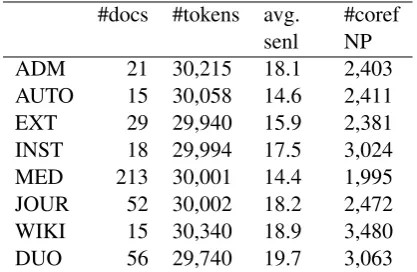
To rule out data size as a possible explana-tion for performance shifts, datasets of equal size (about 30K) were randomly selected. The fo-cus of the current experiments was on resolving identity and predicative relations. Table 1 gives some statistics about each dataset, such as the av-erage sentence length and the number of corefer-ring NPs.
For all experiments we used an existing coref-erence resolver for Dutch, developed by Hoste (2005) and Hendrickx et al. (2008b). The system
follows a machine learning approach6based on the seminal work of Soon et al. (2001) and represents a mention-pair model. First, a classifier is trained to decide whether a pair of NPs is coreferential or not, after which coreference chains are built for the pairs of NPs that were classified as coreferential.
#docs #tokens avg. senl
#coref NP
ADM 21 30,215 18.1 2,403
AUTO 15 30,058 14.6 2,411
EXT 29 29,940 15.9 2,381
INST 18 29,994 17.5 3,024 MED 213 30,001 14.4 1,995 JOUR 52 30,002 18.2 2,472 WIKI 15 30,340 18.9 3,480
DUO 56 29,740 19.7 3,063
Table 1: Size and number of coreferring NPs per dataset
All datasets were preprocessed in the same way. Tokenisation, lemmatisation, Part-of-Speech tag-ging and grammatical relations were based on the manually verified output of the Alpino parser (Bouma et al., 2001), i.e. gold standard depen-dency structures. For the DuOMAn data, how-ever, no gold standard dependency trees were available. Named entity recognition was per-formed using MBT (Daelemans et al., 2003), trained on the 2002 CoNNL shared task Dutch dataset (Tjong Kim Sang, 2002) and an addi-tional gazetteer lookup. As features we em-ploy string matching, distance between sentences and NPs, grammatical role and named entity overlap, synonym/hypernym lookup using Cor-netto (a Dutch database combining Dutch Wordnet (Vossen, 1998) and the Referentie Bestand Neder-lands (Martin and Ploeger, 1999)) and local con-text. All instances were built between NP pairs going 20 sentences back in context. NPs that are not part of a coreferential chain (singletons) are included as negative examples. For more informa-tion we refer to Hoste (2005) and Hendrickx et al. (2008a).
Since the focus of this study is on genre, we decided not to train on different NP types (pro-nouns, common nouns and proper names) individ-ually.7 For all experiments we used Timbl version
6For an extensive overview of the different machine
learn-ing approaches for coreference resolution, we refer to the sur-veys of Ng (2010) and Poesio et al. (forthcoming)
7Hoste (2005) built a separate learning module for each
6.3 (Daelemans et al., 2010) with default parame-ter settings.
Our experimental results are evaluated using the four scoring metrics as implemented in the scoring script from the coreference resolution task from the SemEval-2010 competition (Recasens et al., 2010):
• The MUC scoring software (Vilain et al., 1995) counts the number of links between the coreferential elements in the text, and looks how many links are shared or not between the gold standard coreferential chains and the system predictions. As MUC concentrates on links, elements that are not part of a corefer-ential chain, entities that are only mentioned once (singletons), are not taken into account in this scoring method.
• The B-cubed measure (Bagga and Baldwin, 1998) does not consider mere links between elements, but takes into account the coref-erential clusters of elements referring to the same entity. B-cubed computes for every in-dividual element in the text the precision and recall by counting how many elements are in the true coreferential cluster and how many in the predicted coreferential cluster.
• The CEAF measure (Luo and Zitouni, 2005) focuses on a one-to-one mapping of elements in the true and predicted coreferential clus-ters. Both B-cubed and CEAF measures are sensitive to the presence of many singletons, the larger the percentage of singletons, the higher these scores become (Recasens and Hovy, 2011).
• Recently, the BLANC measure (Recasens and Hovy, 2011) was developed to overcome problems with the other scoring methods. This measure is a variant of the Rand Index (Rand, 1971) adapted for coreference resolu-tion and it averages over a score for correctly detecting singletons, and a score for detecting the correct cluster for coreferential elements.
An important remark to make here is that our system does not take into account chains of only one element. As a consequence, contrary to the SemEval-2010 competition, when we compute
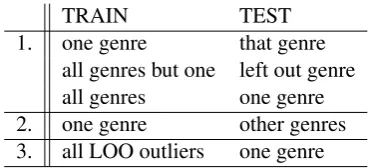
TRAIN TEST 1. one genre that genre
all genres but one left out genre all genres one genre 2. one genre other genres 3. all LOO outliers one genre
Table 2: Three sets of experiments
our scoring metrics, a singleton that is erroneously classified as part of a coreference chain is counted as an error. When it is correctly classified as a singleton, however, this is not represented in the scores.
In order to test cross-genre portability, we ran three sets of experiments (Table 2):
1. In the first set of experiments, we wanted to investigate whether adding more data is ben-eficial for the classifier. We trained the classi-fier on each genre individually and compared performance with different training set sizes. Three experiments were conducted: we first trained on each individual genre and tested on the relevant genre using ten-fold cross vali-dation (each fold 27K vs. 3K). In a second experiment, the classifier was trained on all genres except one and tested on the one that was left out (210K vs. 30K). In a third ex-periment, we used all data, including genre-specific training material for training the clas-sifier, in a ten-fold cross validation set-up (each fold 237K vs. 3K).
2. In a second set of experiments, we focused on the actual cross-domain portability. In order to test this, we each time trained on one genre and tested the performance of the classifier for each of the other genres.
3. Based on the results obtained in the sec-ond batch of experiments, we investigated whether some particular genres actually de-crease performance when training on all data. In other words, does excluding outlier gen-res from training data increase performance? This was done by each time leaving out the worst-performing cross-domain genres and performing ten-fold cross validation.
3 Results
The results of the first round of experiments are presented in Figure 1. The dots marked as individ-ualpresent the experiments in which each classi-fier was trained and tested on the same material. The scores forAll-individualpresent experiments in which the classifiers are trained on a large and diverse training set of all different genres except the genre that is held out as a test set. The last ex-periments in the graphAll+individualshow the re-sult when training on all genres including the held-out genre. Though the B-cubed and CEAF scores are lower than MUC, they present the same ten-dency: adding more and diverse training material improves performance, especially when genre-specific information is also included.8 BLANC, however, seems to contradict the other metrics. Though the scores are higher, they reveal that larger training data proves only beneficial for three genres: INST, JOUR and MED. BLANC thus sug-gests that training only on in-domain material of some genre is the best approach.
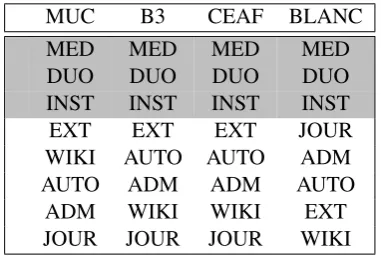
This brings us to the cross-genre experiments, where we each time train on one genre and test on all the other genres individually until all genres have been once used as training data.9 In order to represent the results, we ranked the classifier per-formance on each genre, ranging from the genre-classifier which on average performs worst when being applied to the other genres to the one per-forming best. We performed this ranking for each of the four evaluation metrics. The final ranking is visualized in Table 3. Although there are some differences between the metrics -we again observe that BLANC tends to differ more from the oth-ers - they all seem to agree that MED (medical text), DUO (unedited text) and INST (instructive text) constitute poor cross-genre training material. JOUR has been selected by MUC, B3 and CEAF as the best material for training on other genres. As we mentioned in Section 1 that most of the cur-rently available datasets annotated with coreferen-tial information consist of newspaper text, this re-sult shows that this might indeed be a good choice. The four metrics confirmed that three genres had less generalization power, viz. MED, DUO and INST. In the third experiment, we aim to
op-8
Because of space constraints we only incorporated two graphs in this paper.
9Train on ADM = test on AUTO; train on ADM test on
(a) MUC F-measure (b) BLANC F-measure
Figure 1: Performance comparison for each genre when training only on the genre, all the other genres, or both, respectively
MUC B3 CEAF BLANC
MED MED MED MED
DUO DUO DUO DUO
INST INST INST INST
EXT EXT EXT JOUR
WIKI AUTO AUTO ADM
AUTO ADM ADM AUTO
ADM WIKI WIKI EXT
JOUR JOUR JOUR WIKI
Table 3: Comparison of the worst (top) to best-performing (bottom) cross-domain genres per metric.
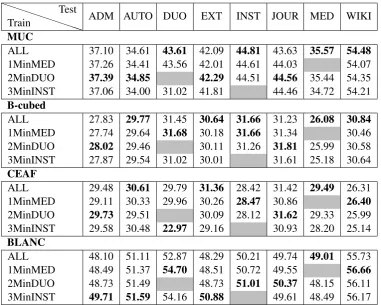
timize our selection of training data to get the best possible general performance. We hypothesize that leaving out those genres with less predictive power for other genres from the training material will increase overall performance. In this set of experiments we train on all data, including genre-specific information, and test on one genre while progressively leaving out those three genres. The results of thisreversed learning curvefor all met-rics can be found in Table 4. Whenever a score is printed in bold, it is the best score obtained for a particular genre.
It is difficult to compare the different metrics with each other. We observe that only the BLANC metric confirms our expectation that the results are almost always better when poor training ma-terial is excluded from training. The results as measured with the other 3 metrics, however, show that leaving out data is only beneficial for half of the datasets. Overall, these results do not strongly confirm our hypothesis. An important observation
to make is that, for all metrics, the performance gains which are obtained by leaving out data are modest, the effect of removing data is very small. Based on these observations we conclude that to get good generalization performance it is more im-portant to have a large training set than to put time and effort in the composition of this training set.
3.1 Error Analysis
Three genres, viz. MED, DUO and INST, did not score high in the cross-domain experiments and were the first genres to be left out in the final ex-periments. An error analysis on this data imposed itself. Looking at the data itself we see that MED includes data of a scientific nature consisting of various entries in a medical encyclopedia. DUO contains mostly user-generated text as it consists of texts from blogs and newspaper articles together with a large set of reader comments. This type of data is rather different from the other genres as it is unedited, subjective, informal and more similar to spoken language than the other genres. INST con-tains various patient information leaflets and man-uals in which exactly the same sentences are often repeated with only one word – mostly the name of the product – different. The above observations al-ready hint at the low generalizability of these three genres.
P P
P P
P P
P PP
Train
Test
ADM AUTO DUO EXT INST JOUR MED WIKI
MUC
ALL 37.10 34.61 43.61 42.09 44.81 43.63 35.57 54.48
1MinMED 37.26 34.41 43.56 42.01 44.61 44.03 54.07 2MinDUO 37.39 34.85 42.29 44.51 44.56 35.44 54.35 3MinINST 37.06 34.00 31.02 41.81 44.46 34.72 54.21
B-cubed
ALL 27.83 29.77 31.45 30.64 31.66 31.23 26.08 30.84
1MinMED 27.74 29.64 31.68 30.18 31.66 31.34 30.46 2MinDUO 28.02 29.46 30.11 31.26 31.81 25.99 30.58 3MinINST 27.87 29.54 31.02 30.01 31.61 25.18 30.64
CEAF
ALL 29.48 30.61 29.79 31.36 28.42 31.42 29.49 26.31 1MinMED 29.11 30.33 29.96 30.26 28.47 30.86 26.40
2MinDUO 29.73 29.51 30.09 28.12 31.62 29.33 25.99 3MinINST 29.58 30.48 22.97 29.16 30.93 28.20 25.14
BLANC
ALL 48.10 51.11 52.87 48.29 50.21 49.74 49.01 55.73 1MinMED 48.49 51.37 54.70 48.51 50.72 49.55 56.66
2MinDUO 48.73 51.49 48.73 51.01 50.37 48.15 56.11 3MinINST 49.71 51.59 54.16 50.88 49.61 48.49 56.17
Table 4: Results of the third set of experiments for all metrics and in comparison with training on all data.
of 213 smaller documents and the average sen-tence length is shorter, viz. 14.4 words. More-over, looking at the subdivision of NPs we see that MED contains a large number of common nouns (89%) and only few pronouns (5%) and proper nouns (6%). In the other five datasets, this divi-sion ranges between 70-75% common nouns and 10-15% pronouns and proper nouns. When using MED as training data this results in a higher num-ber of introduced errors between common nouns. Especially when no string matching features are found between two common nouns the resolver has a lot of difficulty into correctly classifying them. Of all genres we see that with MED pro-nouns and proper pro-nouns are harder to recognize, which can be explained by their low coverage in the training data. Having a closer look at the DUO dataset, we see that the division between common, proper and pronouns is 64% - 14% - 22% – which is a high number of pronouns. Counterintuitively, this does not mean that resolving pronouns goes better when training on DUO. On the contrary,we see that although the resolution of pronouns rises slightly, more errors are introduced. Dutch pro-nouns also turned out to be difficult to resolve
ac-cording to Hoste (2005) because of the inability to distinguish between anaphoric and pleonastic pro-nouns. The NP subdivision in INST is compara-ble to the five other genres, with a small prefer-ence for proper nouns. The high amount of reoc-curring sentences in the data is also reflected in the features, the INST dataset scored best when performing in-domain experiments because of the many exact matches. Furthermore, as many tech-nical NPs are not covered by WordNet (and these semantic features are crucial for most genres), im-portant links between two NPs are missed.
In sum, these three genres have very specific features that seem to make them less predictive for other genres.
4 Conclusion
set size improves performance, especially when genre-specific training material (10%) is included. We saw that excluding poor cross-genre training material does not always results in better scores neither can a drop in performance be perceived. This might imply that training on more data with higher predictive power is more important than training on various text genres. This is something we definitely wish to look into in closer detail in future work. Moreover, we would like to find out how much genre-specific training data is ex-actly needed to optimize performance. We discov-ered that especially genres containing very spe-cific (e.g. scientific or unedited) data and having a different subdivision between pronouns, com-mon and proper nous are less equipped for cross-genre experiments and thus have less generaliza-tion power.
We also observe that the different evaluation metrics for coreference research in use today, (MUC, B-cubed, CEAF and BLANC) tend to con-tradict each other and as a consequence hamper in-terpretation. This is a well-known problem within the community for which no solution has been found yet. In order to allow for a better compari-son with the SemEval-2010 competition we intend to have a closer look at the effect of also scoring
singletons.
Acknowledgments
The work presented in this paper was made possi-ble by the STEVIN programme of the Dutch Lan-guage Union within the framework of the SoNaR project under grant number STE07014 and the Portuguese Science Foundation, FCT (Fundac¸˜ao para a Ciˆencia e a Tecnologia). We would like to thank the anonymous reviewers for their helpful comments and valuable suggestions.
References
Amit Bagga and Breck Baldwin. 1998. Algorithms for scoring coreference chains. In Proceedings of the First International Conference on Language Resources and Evaluation Workshop on Linguistic Coreference, pages 563–566.
Gosse Bouma and Geert Kloostermans. 2007. Mining Syntactically Annotated Corpora using XQuery. In Proceedings of the Linguistic Annotation Workshop (held in conjunction with ACL 2007), pages 17–24, Prague, Czech Republic.
Gosse Bouma, Gertjan van Noord, and Robert Malouf.
2001. Alpino: Wide coverage computational anal-ysis of dutch. In Computational Linguistics in the Netherlands 2000: selected papers from the twenti-eth CLIN meeting.
Gosse Bouma, Walter Daelemans, Iris Hendrickx, V´eronique Hoste, and Anne-Marie Mineur. 2007. The COREA-project, manual for the annotation of coreference in Dutch texts. Technical report, Uni-versity Groningen.
Walter Daelemans, Jakub Zavrel, Antal van den Bosch, and Ko van der Sloot. 2003. MBT: Memory Based Tagger, version 2.0, Reference Guide. Technical Re-port ILK Research Group Technical ReRe-port Series no. 03-13, Tilburg University.
Walter Daelemans, Jakub Zavrel, Ko Van der Sloot, and Antal van den Bosch. 2010. TiMBL: Tilburg Mem-ory Based Learner, version 6.3, Reference Guide. Technical Report ILK Research Group Technical Report Series no. 10-01, Tilburg University.
Hal Daum´e III, Tejaswini Deoskar, David McClosky, Barbara Plank, and J¨org Tiedemann, editors. 2010. Proceedings of the 2010 Workshop on Domain Adaptation for Natural Language Processing. As-sociation for Computational Linguistics, Uppsala, Sweden, July.
George Doddington, Alexis Mitchell, Mark Przybocki, Lance Ramshaw, Stephanie Strassel, and Ralph Weischedel. 2004. The Automatic Content Extrac-tion (ACE) Program Tasks, Data, and EvaluaExtrac-tion. In Proceedings of LREC 2004, pages 837–840, Lisbon, Portugal.
Caroline Gasperin and Ted Briscoe. 2008. Statis-tical anaphora resolution in biomedical texts. In Proceedings of the 22nd International Conference on Computational Linguistics (Coling 2008), pages 257–264, Manchester, UK, August. Coling 2008 Or-ganizing Committee.
Souha Hammami, Lamia Belguith, and Abdelma-jid Ben Hamadou. 2009. Arabic anaphora reso-lution: Corpora annotation with coreferential links. The International Arab Journal of Information Tech-nology, 6(5):481–489.
Iris Hendrickx and V´eronique Hoste. 2009. Coref-erence Resolution on Blogs and Commented News. In Anaphora Processing and Applications, Lecture Notes in Artificial Intelligence, volume 5847, pages 43–53, Heidelberg.
Iris Hendrickx, Gosse Bouma, Frederik Coppens, Wal-ter Daelemans, V´eronique Hoste, Geert KloosWal-ter- Klooster-man, Anne-Marie. Mineur, Joeri Van Der Vloet, and Jean-Luc Verschelde. 2008a. A coreference corpus and resolution system for Dutch. InProceedings of LREC 2008, pages 144–149, Marrakech, Morocco.
the 9th International Conference on Intelligent Text Processing and Computational Linguistics, Lecture Notes in Computer Science, volume 4919, pages 351–361, Haifa, Israel.
V´eronique Hoste. 2005. Optimization Issues in Ma-chine Learning of Coreference Resolution. Ph.D. thesis, Antwerp University.
Lauri Karttunen. 1976. Discourse referents. Syntax and Semantics, 7.
Lucie Kuˇcov´a and Eva Hajiˇcov´a. 2004. Coreferen-tial relations in the Prague Dependency Treebank. In Proceedings of DAARC 2004, pages 97–102, Azores, Portugal.
Laurence Longo and Amalia Todirascu. 2010. Genre-based reference chains identification for french. In-vestigationes Linguisticae, 21:57–75.
Xiaoqiang Luo and Imed Zitouni. 2005. Multi-lingual coreference resolution with syntactic features. In Proceedings of Human Language Technology Con-ference and ConCon-ference on Empirical Methods in Natural Language Processing, pages 660–667.
Bernardo Magnini, Emanuele Pianta, Christian Girardi, Matteo Negri, Lorenza Romano, Manuela Sper-anza, Valentina Bartalesi-Lenzi, and Rachele Sprug-noli. 2006. I-CAB: the Italian Content Annotation Bank. In Proceedings of LREC 2006, pages 963– 968, Genoa, Italy.
Willy Martin and Jeannette Ploeger. 1999. Tweetalige woordenboeken voor het Nederlands: het beleid van de Commissie Lexicografische Vertaalvoorzienin-gen. Neerlandica Extra Muros, 37:22–32.
Vincent Ng. 2010. Supervised Noun Phrase Corefer-ence Research: The First Fifteen Years. In Proceed-ings of the 48th Annual Meeting of the Association for Computational Linguistics, pages 1396–1411.
Jin-Dong Kim Ngan Nguyen and Junichi Tsujii. 2008. Challenges in pronoun resolution system for biomedical text. In Proceedings of the Sixth International Language Resources and Evaluation (LREC’08), Marrakech, Morocco, may. European Language Resources Association (ELRA).
Massimo Poesio and Ron Artstein. 2008. Anaphoric annotation in the ARRAU corpus. InProceedings of LREC 2008, pages 1170–1174, Marrakech, Mo-rocco.
Massimo Poesio, Simone Paolo Ponzetto, and Yannick Versley. forthcoming. Computational models of anaphora resolution: A survey. Linguistic Issues in Language Technology.
William M. Rand. 1971. Objective criteria for the eval-uation of clustering methods. Journal of the Ameri-can Statistical Association, 66(336):846–850.
Marta Recasens and Eduard Hovy. 2011. Blanc: Im-plementing the rand index for coreference evalua-tion. Natural Language Engineering,.
Marta Recasens and M. Ant`onia Mart´ı. 2010. AnCora-CO: Coreferentially annotated corpora for Spanish and Catalan. Language Resources and Evaluation, 44(4):315–345.
Marta Recasens, Llu´ız M´arquez, Emili Sapena, M. Ant`onia Mart´ı, Mariona Taule´e, V´eronique Hoste, Massimo Poesio, and Yannick Versley. 2010. SemEval-2010 Task 1: Coreference resolution in multiple languages. In Proceedings of the 5th International Workshop on Semantic Evaluations (SemEval-2010), pages 1–8, Uppsala, Sweden.
Marta Recasens. 2010. Coreference: Theory, An-notation, Resolution and Evaluation. Ph.D. thesis, Department of Linguistics, University of Barcelona, Barcelona, Spain, September.
Kepa Joseba Rodr´ıguez, Franceska Delogu, Yannick Versley, Egon Stemle, and Massimo Poesio. 2010. Anaphoric annotation of Wikipedia and blogs in the Live Memories Corpus. In Proceedings of LREC 2010, pages 157–163, Valletta, Malta.
Ineke Schuurman, V´eronique Hoste, and Paola Monachesi. 2010. Interacting Semantic Layers of Annotation in SoNaR, a Reference Corpus of Con-temporary Written Dutch. InProceedings of LREC 2010, pages 2471–2477, Valletta, Malta.
Wee Meng Soon, Hwee Tou Ng, and Daniel Chung Yong Lim. 2001. A Machine Learning Ap-proach to Coreference Resolution of Noun Phrases. Computational Linguistics, 27(4):521–544.
Erik F. Tjong Kim Sang. 2002. Introduction to the CoNLL-2002 Shared Task: Language-Independent Named Entity Recognition. In Proceedings of the 6th Conference on Natural Language Learning, pages 155–158, Taipei, Taiwan.
Marc Vilain, John Burger, John Aberdeen, Dennis Con-nolly, and Lynette Hirschman. 1995. A Model-Theoretic Coreference Scoring Scheme. In Pro-ceedings of the Sixth Message Understanding Con-ference (MUC-6), pages 45–52.
Piek Vossen, editor. 1998. EuroWordNet: a mul-tilingual database with lexical semantic networks. Kluwer Academic Publishers, Norwell, MA, USA.
Ralph Weischedel, Sameer Pradhan, Lance Ramshaw, Martha Palmer, Nianwen Xue, Mitchell Marcus, Ann Taylor, Craig Greenberg, Eduard Hovy, Robert Belvin, and Ann Houston, 2009. OntoNotes Release 3.0. LDC2009T24. Linguistic Data Consortium.