720
Semantic Language Model for Tunisian Dialect
Abir Masmoudi
MIRACL Laboratory University of Sfax [email protected]
Rim Laatar
MIRACL Laboratory University of Sfax
Mariem Ellouze
MIRACL Laboratory University of Sfax [email protected]
Lamia Belguith
MIRACL Laboratory University of Sfax
Abstract
In this paper, we describe the process of creating a statistical Language Model (LM) for the Tunisian Dialect. Indeed, this work is part of the realization of Au-tomatic Speech Recognition (ASR) sys-tem for the Tunisian Railway Transport Network. Since our field of work has been limited, there are several words with similar behaviors (semantic for example) but they do not have the same appear-ance probability; their class groupings will therefore be possible. For these reasons, we propose to build an n-class LM that is based mainly on the integration of purely semantic data. Indeed, each class repre-sents an abstraction of similar labels. In order to improve the sequence labeling task, we proposed to use a discriminative algorithm based on the Conditional Ran-dom Field (CRF) model. To better judge our choice of creating an n-class word model, we compared the created model with the 3-gram type model on the same test corpus of evaluation. Additionally, to assess the impact of using the CRF model to perform the semantic labelling task in order to construct semantic classes, we compared the n-class created model with using the CRF in the semantic labelling task and the n-class model without using the CRF in the semantic labelling task. The drawn comparison of the predictive power of the n-class model obtained by ap-plying the CRF model in the semantic la-belling is that it is better than the other two models presenting the highest value of its perplexity.
1 Introduction
Generally, the development of such ASR system for a specific language requires first and foremost the construction of a large speech corpus. This corpus must be based on both an orthographic and a phonetic transcription. In addition, tex-tual data for learning the LM of the system are also required. Nevertheless, these re-sources are not available directly for Ara-bic dialects. As a result, the ASR sys-tem development for Arabic dialects is fraught with many different kinds of dif-ficulties that it faces. In this perspective, this work is integrated in the field of de-veloping the Tunisian Dialect ASR system for the Tunisian Railway Transport Net-work. More precisely, we are interested in this paper in presenting our method for constructing a LM; one among the essen-tial components of the ASR system. This model proposes to define the probability distribution on sets of word sequences. Due to the lack of learning data of the Tunisian dialect, it is necessary to find a method that maximizes the amount of in-formation. This corresponds to the appear-ance of the n-class LM. The main idea of this model is to classify vocabulary words into lexical classes and to calculate the probability of a sequence of words, such as the probability of a sequence of lexical classes (5).
The primary contributions of this paper are as follows:
the Tunisian Railway Transport Net-work. This corpus is based on speech transcriptions. In order to obtain a standardized and normalized cor-pus, we employed our Tunisian Di-alect CODA (Conventional Orthogra-phy for Dialectal Arabic) (30).
• We present our proposed method of creating the n-class LM. To achieve this, we show the different stages of our method.
• We evaluate the performance of the discriminative algorithm based on the CRF model in order to perform the semantic labeling task for sponta-neous speech in the Tunisian Dialect in the n-class LM construction con-text.
• Testing the impact of using CRF model in the semantic labelling field. It is also important to assess its effect on creating semantic classes on the one hand, on developing an n-class LM and on its perplexity level on the other hand.
• We eventually disclosed the elabo-rated experiments we went through and the obtained results.
The remainder of this paper is organized as follows: Section 2 tries to show the main role of ASR system and its compo-nents. We also shed light on the main types LM. Section 3 discusses the related work in this field summarizing the main aspects of every work. Section 4 de-scribes the TARIC corpus in Tunisian Di-alect used for experiments. In section 5, we present the CRF discriminative model used to perform semantic labeling then, we explain our method to construct n-class LM for Tunisian Dialect. Then Conclu-sion is drawing in the last section.
2 ASR system and language model
An Automatic Speech Recognition (ASR) system aims to transcribe textual data of a speech signal. Indeed, in the context of statistical modeling of speech, an ASR system is composed of acoustic model,
language model (LM) and phonetic dictio-nary. As our works aim at suggesting a method in order to construct a LM, we pro-vided further explanations of this compo-nent by concentrating on its different types that have been proposed in the literature. As we mentioned earlier, the LM seeks to represent the language behavior in or-der to confirm or refute the propositions made by the acoustic module. In litera-ture, several statistical LM types are rec-ognized as being the most efficient models in ASR. Among these models, we can cite n-gram, sequences of n-words and facto-rial LM. We will present some examples of the aforementioned approaches in the fol-lowing sub-sections.
2.1 N-gram model
Thanks to their simplicity and efficiency, n-gram models are the most widely used LM in the speech recognition field. They are based on the assumption that the ap-pearance of a single word depends only on its history. In practice, estimating this probability is very difficult. In fact, no learning corpus can make it possible to ob-serve all the sequences of possible words. As a result, the basic idea of n-gram mod-els consists in considering only the se-quences of words of length n, i. e the cal-culation is approached by a limited history consisting of the n-1 preceding words. The major drawback of this modeling type is that it can lead to assigning a zero prob-ability to any n-gram that has never been encountered in the training corpus. This problem is serious especially when this n-gram could be perfectly valid in linguis-tics.
2.2 N-class model
to the appearance of n-class LM. The chief idea of this model is to group vocabulary words into lexical classes and to estimate the probability of the word sequence, such as the probability of a sequence of lexical classes (5). One of the clearest concep-tion of motivaconcep-tions for n-class models is that a word of a given class, not necessar-ily found in the learning corpus, inherits the probability of all the other representa-tives of its class. In addition, it is possible to add words to classes without having to re-estimate the model probabilities. How-ever, the problems faced by n-class models are numerous. The first major difficulty is that this type of model requires the need for a prelabeled learning corpus (24). Nev-ertheless, manual labeling is particularly heavy despite its exact results.
2.3 Factorial LM
The factored LM is based on the princi-ple that a word is no longer seen as a sim-ple graphic chain but rather as a vector of characteristics (3). These characteristics can include the lemma and the grammat-ical class of a word, morphs, its kinds, its numbers, or Booleans indicating the word belonging to given semantic classes. On the theoretical side, factorial models have already shown good results for some tasks, such as machine translation (14). At the practical level, few works have relied on this model, especially in the speech recog-nition task.
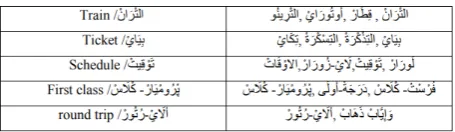
To conclude, due to the limitation of our field of work ”Tunisian Railway Trans-port Network”, several words with simi-lar behaviors exist, (semantic for exam-ple) but they do not have the same prob-ability of appearance; their class group-ings will therefore be possible. Moreover, the amount of learning data is reduced. In this context, the use of the n-class model is beneficial at several levels. For these reasons, we propose to build an n-class LM that is based mainly on the integra-tion of purely semantic data. Indeed, our method will be used to create a LM based on semantic information for the creation
of word classes. The figure 1 shows some words with the same semantic behavior.
Figure 1: some words with the same semantic be-havior.
3 Related Work
syn-tactic information, is formalized by cate-gories or grammars. In the approach pro-posed by (8), the used information a pri-ori is extracted from a learning corpus la-beled in grammatical categories. The ap-proach proposed by (29) is based on con-textual information (left context and right context), so words that appear frequently in similar contexts should be assigned to the same class. According to (29), differ-ent vocabulary words are classified using the k-means algorithm. The particularity of this approach is based on the fact that the number of words in a class is set to k and if there is a class whose number of words is less than k then that class will be merged with another. The main advantage of this algorithm is its simplicity to find centroids and suddenly, the cost of merg-ing words or classes becomes less expen-sive. The approach developed by (2) pro-poses to integrate semantic information for the formation of word classes in the statis-tical LM of ASR system. This approach is based on a pivot language (called IF for Interchange Format), which represents the meaning of the sentence regardless of the language (2). Thus, the criterion of choice of classes is guided by the definition of the pivot language and the most used concepts in the IF.
4 Tunisian dialect corpus collection
We create our own corpus of real spo-ken dialogues corresponding to the infor-mation request task in railway stations in collaboration with the Tunisian National Railway Company (SNCFT). This cor-pus is called TARIC, for Tunisian Ara-bic Railway Interaction Corpus [16]. The main task of the TARIC corpus is in-formation request in the Tunisian dialect about the railway services in a railway sta-tion. These requests are about consulta-tion, train type, train schedule, train des-tination, train path, ticket price and ticket booking. The creation of the corpus was done based on two steps: the production of audio recordings and the manual tran-scription of these recordings.This corpus
consists of 21,102 statements and 66,082 words.
The Tunisian dialect the Tunisians’ mother tongue, which is used in their daily oral communication. It is becoming more and more useful not only in interviews, talk shows and public services but also in blogs, chat rooms, SMS, e-mails, etc. However until now the Tunisian dialect has no standardized spelling. Indeed, this dialect differs from MSA and it does not have a standard spelling because there are no academies of Arabic dialect. Thus, to obtain coherent learning data and to have a robust and powerful language model, it is necessary to utilize a standard spelling. Indeed, there are words with many forms. For example, the word
àñJ ¯P PP
/reserva-tion/ can be written in four different ways:àñJ ¯P P@P
,àñJ ¯P@ P@P
andàñJ ¯P QKP
. As a result, each word has a unique form. Spelling transcription guidelines CODA (Tunisian Dialect writing conven-tion), (30), were adopted.The normalization step is essential be-cause it presents a key point for the other steps of our method. Among the normal-isation Tunisian Dialect words we have:
(i)Number ”sixteen” is written as
A ¢J
.(ii)To define the future, we must follow the following form:
AK.
+ verb, for example:ú
æÖ
ß
AK.
. (iii)To define the negation, wemust follow the following form:
A
Ó
+ verb.The Tunisian Dialect is characterized by the presence of foreign words, such as for instance: French, English, Spanish, Ital-ian, etc.To transcribe these words, Arabic alphabets have been used. These foreign words have a unique form, for example:
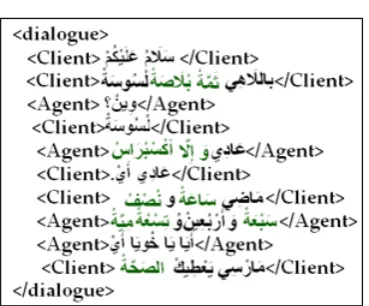
Figure 2: Corpus extract before the normalisation step
The figure 3 represents a corpus extract af-ter the normalization step.
Figure 3: Corpus extract after the normalisation step
5 N-class LM construction
In this section, we are going to describe our method to create n-class LM based on semantic information for establishing word classes. This method is made up of five distinct stages.
5.1 Pre-processing stage
When we studied our corpus, we noticed that there are words that have no seman-tic value when they are figured all alone. Only the grouping of these words with other words can give a better semantic value to words that may be insignificant and subsequently useless for our field of
work. As a result, we have decided to cre-ate semantic blocks that consist of group-ing one or more words into a sgroup-ingle word. Semantic block is defined as a group of two or more words. Indeed, this pre-treatment consists of adding a (-) between two or more words to build a single word. Among the words that can be grouped to-gether to form a semantic block, we find
ú
æ
A
Ó
followed by another word to indi-cate the time for exampleé
«A
ú
æ
A
Ó
[1 PM]. Cities whose names are composed such asYK PñK. øYJ
[name of Tunisiancity]
A
Ó
[negation] followed by a verb with a negative form to express negation. Thisstep is necessary because it will be used for semantic labeling and later for the for-mation of word classes. Indeed, the main objective of this step is to give a better semantic value to words that may be in-significant and subsequently useless for our work. Following this step, we obtain a corpus that contains all the possible se-mantic blocks. Below (figure 4) is an ex-cerpt from this corpus.
Figure 4: Extract of our corpus after semantic blocks formation
5.2 Statistical Semantic labeling
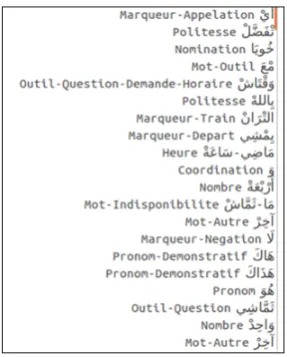
task of words or semantic blocks extracted from a sentence and their corresponding concepts in the field of railway request in-formation. In this task, each word or se-mantic block is labeled with a concept in-dicating its appropriate semantic nature. Thus, semantic labeling is not done word by word because we can find words that can have several meanings depending on the context in which they are used. Sub-sequently, the labeling of a word or a se-mantic block is done while taking into ac-count its left and right neighborhood in a sentence. The figure 5 shows examples of semantic labeling.
Figure 5: Extract of semantically labelled corpus
In order to improve the sequence labeling task, we proposed to use a discriminative algorithm based on the Conditional Ran-dom Field (CRF) model. Thanks to their ability in learning the sequence tagging tasks efficiently, CRF have been applied to a wide range of NLP applications, such as morpho-syntactic tagging (POS), chunk-ing and language modelchunk-ing. CRF are prob-abilistic models for computing the condi-tional probability of a possible output giv-ing an input sequence also called the ob-servation sequence. To train semantic la-beling associations and some predefined feature sets, CRF learns a set of weights
w. Learning the parameter set w is usu-ally done by a maximum likelihood learn-ing forp(¯x|y;¯ w):
p(¯x|y;¯ w) = 1 z(¯x|w)exp
X
j
wjFj(¯x,y)¯
(1)
According to these equations, x¯ repre-sents the sequence of words or seman-tic blocks (observation), y¯represents the sequence of labels, and w stands for the weights.Fj corresponds to a feature func-tion. The latter depends on the sequence of words, the current label, the previous label and the current position in an utter-ance. We utilized the CRF++ toolkit (16) in our experiments. It is a customizable and open source, which implement the CRF for segmenting and labeling sequen-tial data. It is written in C++, employs fast training based on gradient descent and generates n-best candidates. In order to measure the performance of the labelling task, three evaluation metrics were gen-erally adopted. The latter allow express-ing Recall and Precision. These measures could be calculated as follows:
P recision= #word correctly Labelling #word Labelling
(2)
Recall= #word correctly Labelling #total of word
(3) Our purpose is to create training and test-ing sets decently. We outlined the avail-able datasets for the languages under in-vestigation. We randomly selected 15826 sentences and 49562 words for training, 5276 sentences and 1652 words for test-ing. The outcomes of the CRF system show a Recall of 88% and a Precision of 87%. Based on the manual examination of the automatic labeling result using CRF, we found that the CRF have the ability to detect composed token specific to the task and label them correctly.
5.3 Construction of semantic classes
classes. Each class represents an abstrac-tion of similar labels. In fact, a seman-tic class may correspond to a label or a group of labels, whereas a label cannot belong to only one class. Thus, if we consider the two statements: Sentence 1:
C
¿ ÐAK Pð
X
ñ
K
[Tunis second class]. Sentence 2:C
¿ PAJÓðQK
é
ñ
[Sousa first class]. They become similar from this point of view because the words
ñ
K
[name of city] and
é
ñ
[name of city] belong to the same semantic class group-ing ”city” and the wordsÐAK Pð
X
andPAJÓðQK
belong to the same semantic class group-ing ”Class”. Indeed, the number of classes must be limited while the number of oc-currences of words belonging to same class must be large enough to come up with correct learned probabilities. We therefore choose to limit ourselves to the selection of classes most frequently en-countered in our corpus, corresponding to our Field of study ”Tunisian Railway Transport Network”. In this step, we iden-tify the most common label and group them into classes. A class then corre-sponds to a set of words leading to the same semantic labelling representation.Table 1: Examples of Semantic Classes
Semantic classes Variants semantic tags
City Destination-Station..
Schedule Trip-time, Arrival-hour ..
Response Confirmation, Negation..
In our case, this classification provides about 20 semantic classes such as [City], [Response], [Request-Concept], [Compar-ison], [Schedule]. After obtaining the list of semantic classes, as shown in Table 1, we can then directly associate each word of our corpus with the class to which it be-longs.
5.4 N-class calculation
We have already done the first experience for n-class LM calculation for Tunisian Dialect. After obtaining the list of
seman-tic classes, we use it in combination with the data of LM to build our new ”seman-tic” model. In the LM learning corpus all words (or semantic blocks) are replaced by class names. The result is a ”prepared” corpus that contains both words ( or se-mantic blocks) and Sese-mantic classes. Fi-nally, we use the SRILM1toolbox to learn LM including semantic classes. SRILM is a toolkit for building and applying statisti-cal LM, primarily for use in speech recog-nition, statistical tagging and segmenta-tion, and machine translation.
5.5 Evaluation of a LM
Several measures are used to evaluate the quality of LM. We present perplexity as the most used method. Perplexity (PPL) is a quick method to evaluate LM. It is com-monly used for several years to judge the quality of LM (15). This evaluation met-ric is used to measure the prediction abil-ity of LM on a test corpus not seen during learning. The principle of perplexity is to check how much LM can predict the word sequences of the language it is supposed to model. Perplexity is defined by:
P P L= 2−1n n
X
t=1
logP(wt|h) (4)
WhereP(wt|h)represents the probability proposed by the LM for the word knowing the history h. Indeed, the perplexity of LM is between 1 and V, V is the size of vocabu-lary, that is to say the number of words that compose it. A reduced value of perplexity leads to better LM prediction capability.
As we have already mentioned, a low value of perplexity reflects a strong pre-dictive power of LM. Thus, to better judge our choice of creating an n-class word model, we compared the created model with the 3-gram type model on the same test corpus of evaluation. Additionally, to assess the impact of using the CRF model to perform the semantic labelling task in order to construct semantic classes,
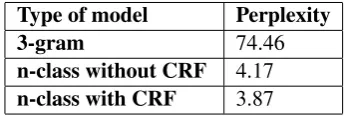
we compared the n-class created model with using the CRF in the semantic la-belling task and the n-class model without using the CRF in the semantic labelling task. The table below shows a compari-son between the n-class model based on the CRF model in the Semantic labeling task and the n-class model without apply-ing the CRF model in the Semantic label-ing task together with the n-gram model in terms of perplexity.
Table 2: Value of perplexity calculated on the same test corpus
Type of model Perplexity
3-gram 74.46
n-class without CRF 4.17
n-class with CRF 3.87
Table 2 shows the very significant rela-tive reduction in perplexity by applying the CRF model in the semantic labelling compared to the other models. These re-sults are consistent with what could be ex-pected: (1) it is the classification based on semantic data that has minimized the per-plexity of the obtained LM. The value of the n-class model perplexity remains well below that of the 3-gram model on the test corpus. Interestingly, the same mod-els as for the learning corpus have the low-est perplexity value on the tlow-est corpus. (2) the application of CRF model to perform the semantic labelling task affects the im-provement in creating semantic classes, by taking into account the n-class LM, and calculating the perplexity rates.
6 Conclusion
In this work, we have interested in con-structing a statistical LM as one of the components of ASR system. The main role of this model is to give the probability of distribution on sets of word sequences. In particular, we are interested in n-class LM by using semantic information for the creation of word classes. Our choice is jus-tified by the fact that some words are
References
[1] Bahl L.R., Brown P.F., Souza P.V., Mercer R.L.: A tree-based Statistical Language Model for Natural Language Speech Recognition, IEEE Transactions on Acoustics, Speech and Signal Process-ing (1989).
[2] Bigi B : Modle de langage smantique pour la reconnaissance automatique de parole dans un contexte de traduction, Labora-toire Parole et Langage - Aix-en-Provence (2012).
[3] Bilmes J. A., Kirchhoff K.: Factored Lan-guage Models and Generalized Parallel Backo, Proc. of Human Language Tech-nologies, North American (2003).
[4] Bouagres F. : Attelage de systmes de tran-scription automatique de la parole, thse de doctorat, universit du Maine-Le Mans-France (2012).
[5] Brown P. F., DellaPietra V. J., Souza P. V., Lai J. C., Mercer R. L.: Class-Based N-Gram Models of Natural Language, Com-putational Linguistics (1992).
[6] Chelba C., Engle D., Jelinek F., Jimenez V., Khudanpur S., Mangu L., Printz H., Ristad E., Rosenfeld R., Stolcke A., Wu D.: Structure and Performance of a De-pendency Language Model, Dans Proc. of the European Conf. on Speech Com-munication and Technology (Eu-rospeech) (1997).
[7] Chelba C., Jelinek F.: Structured Lan-guage Modeling , Computer Speech and Language (2000).
[8] Damnati G. : Modles de langage et clas-sification automatique pour la reconnais-sance de la parole continue dans un con-texte de dialogue oral homme-machine, thse de doctorat, uni-versit dAvignon et des pays du vaucluse (2000).
[9] Graja M., Jaoua M. and Belguith L.: Discriminative Framework for Spo-ken Tunisian Dialect Understanding. SLSP(2013)
[10] Farhat A., Isabelle J.F., O’Shaughnessy D.: Clustering Words for Statistical Lan-guage Mod-els based on Contextual Word Similarity, Dans Proc. IEEE International Conference on Acoustics, Speech and Sig-nal Processing, Atlanta, USA (1996).
[11] Jelinek F.: Continuous Speech Recogni-tion by Statistical Methods, Proc. Of the IEEE (1976).
[12] Ji G., Bilmes J.: Dialog Act Tagging Us-ing Graphical Models, Proc. Of the IEEE Intl Conf. on Acoustics, Speech, and Sig-nal ProcessingICASSP (2005).
[13] Habash, N., Diab, M. and Rambow, O.: Conventional Orthography for dialectal Ara-bic,Proceedings of the Eighth Interna-tional Conference on Language Resources and Evalua-tion, LREC-2012, (2012).
[14] Kirchhoff K., Yang M.: Improved Lan-guage Modeling for Statistical Machine Translation, Proc. of the ACL Work-shop on Building and Using Parallel Texts (ParaTex), Morristown, NJ, USA. As-sociation for Computational Linguistics (2005).
[15] Kneser R., Ney H.: Improved Cluster-ing Techniques for Class-Based Statisti-cal Language Modeling. Proc. Euro-pean Conference on Speech Communica-tion and Technology, Berlin, Allemagne (1993).
[16] Kudo, T.: crf++,
http://chasen.org/ taku/software/CRF++/
[17] Lecorv G. : Adaptation thmatique non su-pervise d’un systme de reconnaissance au-tomatique de la parole, thse de doctorat, Universit europenne de Bretagne (2010).
[18] Masmoudi A., Ellouze M., Estve Y., Hadrich Belguith L., Habash N.: A Cor-pus and Pho-netic Dictionary for Tunisian Arabic Speech Recognition, LREC’2014, Reykjavik, Iceland (2014).
[20] Masmoudi, A., Habash, N., Khmekhem, M., Esteve, Y. and Belguith, L.: Ara-bic Transliteration of Romanized Tunisian Dialect Text: A Preliminary Investiga-tion, Computational Linguistics and Intel-ligent Text Processing - 16th International Conference, CICLing 2015, Cairo, Egypt, p.608-619, (2015).
[21] Masmoudi, A., Bougares,F., Ellouze, M., Estve, Y., Belguith, L.: Automatic speech recognition system for Tunisian di-alect. Language Resources and Evaluation 52(1): 249-267 (2018).
[22] Abir Masmoudi, Rim Laatar, Mariem Ellouze, Lamia Hadrich Belguith: N-Class Language Model for Tunisian Di-alect Automatic Speech Recognition Sys-tem. LPKM (2018)
[23] Rosenfeld R.: Adaptive Statistical Lan-guage Modeling: A Maximum Entropy Approach, PhD Thesis, (1994).
[24] Smali K., Conception et ralisation dune machine dicter entre vocale destine aux grands vocabulaires : Le systme MAUD, Thse de doctorat, Universit de Nancy 1, 1991.
[25] Smaili K., Jamoussi S., Langlois D., Haton J.-P.: Statistical feature language model, Proc. of the 8th Intl Conf. on Spo-ken Language ProcessingICSLP, (2004).
[26] Vergyri D., Kirchhoff K., Duh K., Stolcke A.: Morphology-Based Language Model-ing for Arabic Speech Recognition, Proc. of the 8th Intl Conf. on Spoken Language Processing (ICSLP), Jeju Island, South Korea, (2004).
[27] Wang, Y., Acero, A., Mahajan, M., Lee, J.: Combining statistical and knowledge-based spoken language understanding in conditional models. In: Proceeding COL-ING/ACL, Sydney, Australia (2006)
[28] Xu P., Chelba C., Jelinek F.: A study on richer syntactic dependencies for struc-tured lan-guage modeling, Proc. of the 40th Annual Meeting on Association for
Computational Linguistics (ACL), Mor-ristown, NJ, USA. Association for Com-putational Linguistics, (2002).
[29] Zitouni I.: Linearly Interpolated Hier-archical N-gram Language Models for Speech Recogni-tion Engines, IBM T.J. Watson Research Center, NY, Bell Labs Alcatel-Lucent, NJ,USA, (2008).