University of South Carolina
Scholar Commons
Theses and Dissertations
2016
Revealing Malicious Contents Hidden In The
Internet
Muhammad Nazmus Sakib
University of South Carolina
Follow this and additional works at:https://scholarcommons.sc.edu/etd
Part of theComputer Engineering Commons, and theComputer Sciences Commons
This Open Access Dissertation is brought to you by Scholar Commons. It has been accepted for inclusion in Theses and Dissertations by an authorized administrator of Scholar Commons. For more information, please [email protected].
Recommended Citation
R
EVEALINGM
ALICIOUSC
ONTENTSH
IDDEN IN THEI
NTERNETby
Muhammad Nazmus Sakib
Bachelor of Science
Bangladesh University of Engineering and Technology, 2008
Submitted in Partial Fulfillment of the Requirements
For the Degree of Doctor of Philosophy in
Computer Science and Engineering
College of Engineering and Computing
University of South Carolina
2016
Accepted by:
Chin-Tser Huang, Major Professor
Srihari Nelakuditi, Committee Member
Csilla Farkas, Committee Member
Wenyuan Xu, Committee Member
Ying-Dar Lin, Committee Member
D
EDICATIONTo my parents, Muhammad Abdur Razzaque and Nazma Begum, who made it
A
CKNOWLEDGEMENTSI want to thank my advisor Dr. Chin-Tser Huang for being my mentor and for
his invaluable guidance and constant support. I would also like to thank Dr.
Srihari Nelakuditi, Dr. Csilla Farkas, Dr. Wenyuan Xu and Dr. Ying-Dar Lin for
sparing their valuable time to serve on my dissertation committee and for
extending their invaluable knowledge and advice to help me improve my
dissertation. Finally, I want to thank my wife, Rahnuma Akhter, who was always
there by my side for this journey.
A
BSTRACTIn this age of ubiquitous communication in which we can stay constantly
connected with the rest of the world, for most of the part, we have to be grateful
for one particular invention - the Internet. But as the popularity of Internet
connectivity grows, it has become a very dangerous place where objects of
malicious content and intent can be hidden in plain sight. In this dissertation, we
investigate different ways to detect and capture these malicious contents hidden
in the Internet. First, we propose an automated system that mimics high-risk
browsing activities such as clicking on suspicious online ads, and as a result
collects malicious executable files for further analysis and diagnosis. Using our
system we crawled over the Internet and collected a considerable amount of
malicious executables with very limited resources. Malvertising has been one of
the major recent threats against cyber security. Malvertisers apply a variety of
evasion techniques to evade detection, whereas the ad networks apply inspection
techniques to reveal the malicious ads. However, both the malvertiser and the ad
network are under the constraints of resource and time. In the second part of this
dissertation, we propose a game theoretic approach to formulate the problem of
advertising system. During malware collection, we used the online multi-AV
scanning service VirusTotal to scan and analyze the samples, which can only
generate an aggregation of antivirus scan reports. We need a multi-scanner
solution that can accurately determine the maliciousness of a given sample. In
the third part of this dissertation, we introduce three theoretical models, which
enable us to predict the accuracy levels of different combination of scanners and
determine the optimum configuration of a multi-scanner detection system to
achieve maximum accuracy. Malicious communication generated by malware
also can reveal the presence of it. In the case of botnets, their command and
control (C&C) communication is good candidate for it. Among the widely used
C&C protocols, HTTP is becoming the most preferred one. However, detecting
HTTP-based C&C packets that constitute a minuscule portion of everyday HTTP
traffic is a formidable task. In the final part of this dissertation, we present an
anomaly detection based approach to detect HTTP-based C&C traffic using
statistical features based on client generated HTTP request packets and DNS
T
ABLE OFC
ONTENTSDEDICATION ... iii
ACKNOWLEDGEMENTS ... iv
ABSTRACT ... v
LIST OF TABLES ... x
LIST OF FIGURES ... xi
CHAPTER 1INTRODUCTION ...1
1.1MOTIVATION ...1
1.2PROBLEM OVERVIEW ...2
1.3OVERVIEW OF DISSERTATION ...8
CHAPTER 2COLLECTION OF MALWARE DISSEMINATED VIA MALVERTISING... 13
2.1BACKGROUND ... 13
2.2SYSTEM DESIGN ... 17
2.3SYSTEM IMPLEMENTATION ... 22
2.4RESULTS AND ANALYSIS ... 25
2.5RELATED WORK ... 28
2.6SUMMARY ... 29
3.1BACKGROUND ... 31
3.2THE MALVERTISING GAME MODEL ... 38
3.3FINDING NASH EQUILIBRIUM OF THE GAME ... 41
3.4EVALUATION AND ANALYSIS ... 45
3.5RELATED WORK ... 54
3.6SUMMARY ... 56
CHAPTER 4MAXIMIZING ACCURACY IN MULTI-SCANNER MALWARE DETECTION SYSTEMS ... 57
4.1PROBLEM FORMULATION ... 57
4.2COMBINED PROBABILITY MODEL (CPM) ... 59
4.3GREEDY HEURISTIC BASED MODELS ... 67
4.4ACCURACY METRICS ... 69
4.5RANKING OF SCANNERS ... 70
4.6NUMERICAL SIMULATION ... 71
4.7EXPERIMENTAL EVALUATION USING REAL DATA ... 79
4.8RELATED WORK ... 87
4.9SUMMARY ... 91
CHAPTER 5DETECTION OF HTTP-BASED BOTNET C&CTRAFFIC ... 93
5.1INTRODUCTION ... 93
5.2DETAILS OF METHODOLOGY... 94
5.4RESULTS AND ANALYSIS ... 108
5.5RELATED WORK ... 110
5.6SUMMARY ... 113
CHAPTER 6CONCLUDING REMARKS ... 114
L
IST OFT
ABLESTable 2.1 Search Keywords ...22
Table 2.2 Types of Malware Detected ...26
Table 4.1 Notations ...58
Table 4.2 Average Deviation from Maximum Accuracy ...75
Table 4.3 Malware and Goodware Dataset ...79
Table 4.4 Training and Test Sets ...80
Table 4.5 List of Anti-Virus Scanners ...81
Table 4.6 Distribution of Test Sets of Combined Accuracy Test ...85
Table 4.7 Comparison of the Models ...87
Table 5.1 RapidMiner Implementation Configurations ...105
Table 5.2 Collected HTTP Botnet Families ...107
Table 5.3 Detection Results (False Negative) ...109
L
IST OFF
IGURESFigure 2.1 Advertisement delivery system ...14
Figure 2.2 Infection process of malicious advertisements ...16
Figure 2.3 (a) Sample malicious ad frame, (b) JavaScript code for the same malicious ad frame ...17
Figure 2.4 System architecture ...18
Figure 2.5 Flowchart of Crawler ...19
Figure 2.6 Flowchart of Detector...20
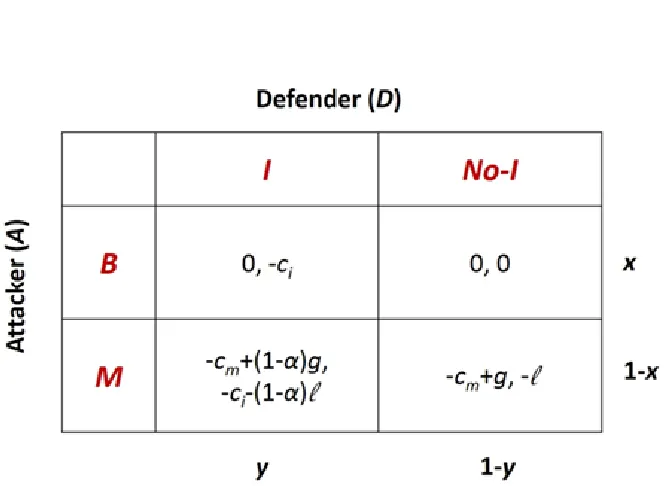
Figure 3.1 Payoff functions of the game ...40
Figure 3.2 Attacker and Defender randomize their choice of strategies ...44
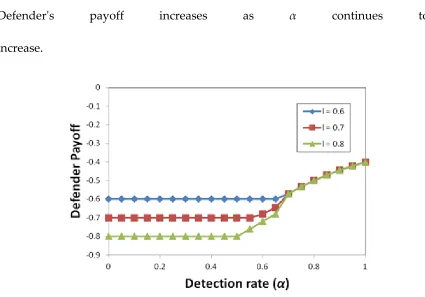
Figure 3.3 Variation in Defender's payoff with α ...46
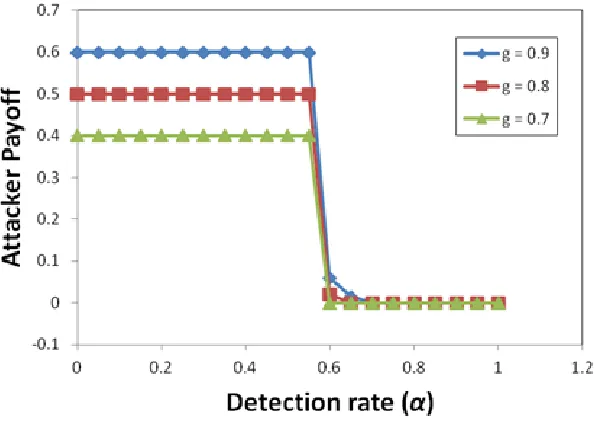
Figure 3.4 Variation in Attacker's payoff with α ...47
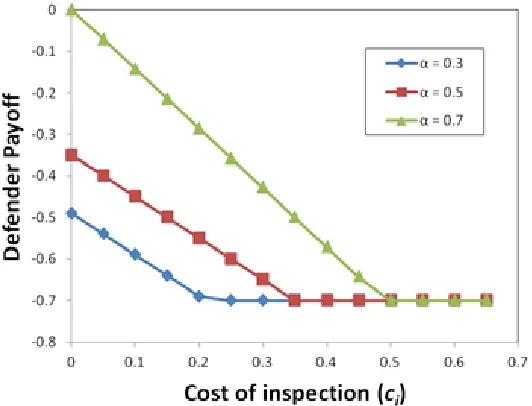
Figure 3.5 Variation in Defender's payoff with ci ...48
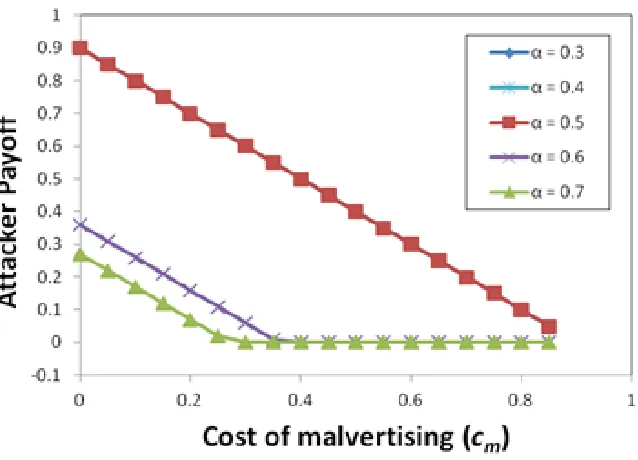
Figure 3.6 Variation in Attacker's payoff with cm ...49
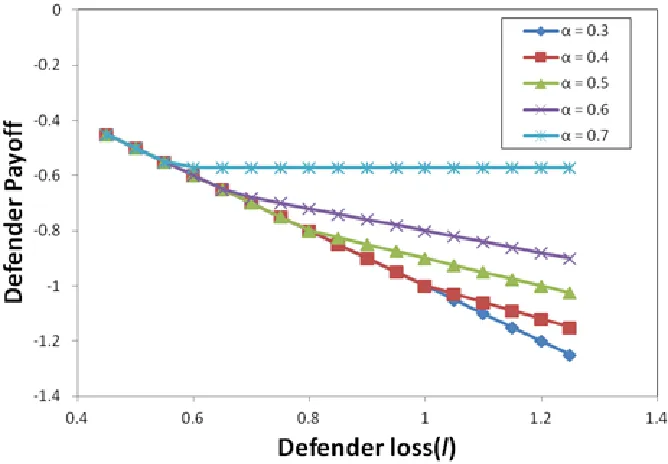
Figure 3.7 Variation in Defender's payoff with l ...50
Figure 3.8 Variation in Attacker's payoff with g...51
Figure 4.1 A 3-scanner parallel system ...59
Figure 4.3 An N-scanner parallel system...63
Figure 4.4 An N-scanner serial system ...65
Figure 4.5 Two variations of a 3-scanner mixed system ...66
Figure 4.6 The Greedy Approximation algorithm ...68
Figure 4.7 The Complementary Greedy Approximation algorithm ...69
Figure 4.8 Graphs of combined detection probabilities against different threshold values...73
Figure 4.9 Comparison of accuracy values using three evaluation metrics based on simulation results ...74
Figure 4.10 Trends of changes in Q vs. average false positive rate ...76
Figure 4.11 Comparison of maximum accuracy by best, worst and ranked best combinations based on simulation results ...78
Figure 4.12 Comparison of graphs of combined detection probabilities against threshold values generated from actual test cases and our models ...83
Figure 4.13 Comparison of accuracy values using three evaluation metrics based on real world (a) test set 1, (b) test set 2, and (c) test set 3 ...84
Figure 4.14 Comparison of maximum accuracy by best, worst and ranked best combinations based on real world dataset ...86
C
HAPTER1
I
NTRODUCTION1.1 Motivation
Most cyber crimes can be attributed to hacking or cracking, and computer virus
or worm. Hacking or cracking falls into the category of malicious activity, in
which the cyber criminal is online to perform malicious actions. On the other
hand, computer virus or worm can be categorized as malicious content, in which
the cyber criminal first injects the malicious contents into the victim system, and
lets the malicious contents perform the malicious actions. In practice, there are
many forms of malicious contents. A majority of them is classified as malicious
software, or in short, malware. Malware is the primary and in many cases the
only weapon of attack used by the cyber criminals. They usually use it in an
intelligent way so that the victim remains unaware of the attack until very late.
This is possible for the autonomous and active nature of software objects. Other
forms of malicious contents involve some kind of malicious activity or
communication and are passive on their own. Examples of such malicious
emails, etc. These passive malicious objects are created with stealthy
characteristics as well. Therefore, detection of malicious contents is imperative
for ensuring the security of most modern cyber systems.
1.2 Problem Overview
1.2.1 Collection and Inspection of Malware Hidden in Online Advertising
To develop effective detection and mitigation techniques against malware, the
first step is to develop a repository of existing malware samples for analysis and
testing. For this purpose, we need an effecting malware collection system, which
can provide us with the latest versions of active malware executable binary and
other related files from various Internet sources. In the recent past, the online
advertising system has become one of major sources of Internet malware. Over
the years, this system has evolved to become very effective in reaching and
delivering content to targeted audiences consisting of all kinds of Internet users.
Recently, cyber-criminals have started exploiting this system as an effective and
risk-free channel to disseminate malware. Many popular websites became
victims to such exploitation and have had malicious advertisements placed on
their webpages or widgets unknowingly, including Horoscope.com, The New
York Times [1], the London Stock Exchange, Spotify [2], and The Onion. The
served malicious ads via AOL ad-network [3]. Since the cyber criminal are
already delivering their goods via malvertising, this should be a good source to
find and capture active malware samples. But we have not seen any prior work
where malvertising was considered a source of malware for collection. We want
to address this issue in this dissertation.
Most malvertisements operate with the help of a tool called exploit kit [4],
which can probe the vulnerabilities on the victim machine's web browser or
plug-in in order to exploit and install the malware. There is an expensive price
tag attached to the acquisition of these exploit kits. Moreover, in order to protect
their "investments" on malicious ads and malware from detection by the ad
network, malvertisers often apply to their campaigns a variety of evasion
techniques such as fingerprinting the execution environment, redirecting to
compromised IP addresses, and malware polymorphism (introduced in more
detail in the next section). These evasion techniques also incur considerable
overhead cost on the malvertiser. On the other hand, in order to control and limit
the huge reputation damage and financial losses caused by malvertising
campaigns [5], the ad network also spends a lot of money and efforts to apply
inspection techniques on submitted ads, including live monitoring and code
analysis. These inspection efforts also incur substantial overhead coming from
needed to conduct analysis, and cost for establishing partnership with other
companies for sharing of expertise and data [6]. However, we note that both the
malvertiser and the ad network are under the constraints of resource and time,
which makes it impossible and impractical for the malvertiser to always submit
malicious ads and for the ad network to inspect every submitted ad. Therefore,
the ad network needs proper guidelines to effectively manage its resources for
inspection to maximize its chance to thwart possible malvertising campaigns. We
intend to address this problem in this dissertation.
1.2.2. Maximizing Accuracy in Multi-scanner Malware Detection System
Malicious software or malware is one of the major tools of cyber attack. Every
cyber attack involves some kind of malware. Therefore, detection of malware is
one of the cornerstones of modern cyber security. For a long time, we have been
relying on the anti-malware or anti-virus scanners to detect malware and to
protect ourselves from it. Variety of anti-malware scanners have been developed
over the years with different levels of performances. In the early days, a single
scanner could detect most of the malware out there. But over time, the malware
writers and their repository of malware has evolved and proliferated so much
that no single anti-malware engine can protect us from all of them. Moreover,
researchers proved that combining the power of multiple anti-malware engines
have a lot of online multi-AV scanning services and tools (VirusTotal [8], Jotti,
VirScan, etc.) at our disposal.
Although we have many multi-AV scanning services and tools available,
most of them are used only for informational purposes or as a source of second
opinion. None of them directly provide an exact decision of whether a particular
sample is malicious or benign. Instead, they work as an information aggregator
and only list the individual results returned from each anti-virus scanning
engine. The responsibility of making a decision based on these individual scan
results is up to the human user. This may be convenient for personal use where
an end-user is looking for a second opinion for an unknown sample downloaded
from the Internet. But if we want to use these multi-scanner detection systems
effectively for a large scale detection and collection operation, we need the
system to automatically come up with the best decision. Now, the question
remains - how the system can do that? Obviously, it has to use the available
information at hand. Let's look at the available information we can have for the
unknown sample set. Firstly, we have the individual scan results from various
scanners, which can be considered merely as their opinions. We are labeling
them as "opinions" since we don't know for sure whether they are right or
wrong. Secondly, we have the statistics for each scanner indicating their
scanning results which can be proven as right or wrong over the course of time.
These statistical accuracy values can be used to measure how right or wrong
these scanners can be. In other words, these are the ratings that indicate how
good these scanners are. Now, the original problem becomes determining how to
combine these detection accuracy ratings and the actual scan results for a given
unknown sample to classify the sample as benign or malicious with the best
possible accuracy. We further investigate this problem in this dissertation.
1.2.3 Detection of HTTP Botnet Command and Control Traffic
A botnet is a network of compromised computers, each of which harbors a piece
of malicious software called bot. The bot software is remotely controlled by a
botmaster, who exploits the botnet for malicious purposes like launching a
distributed denial-of-service (DDoS) attack, spamming, performing click-fraud
scams, stealing personal user information, etc. At the heart of any botnet is its
communication architecture, i.e. how the botmaster communicates with
hundreds and thousands of bot members. Since the size of a botnet is particularly
crucial for its business, the botnet needs to be formed over common and popular
network infrastructure, especially the Internet. Therefore, the botmaster chooses
legitimate communication channels to interact with the bots. The server that the
botmaster uses for its communication is called Command and Control (C&C)
channel among the earliest botnets. Over time, it has been proved that the
botnets formed over IRC network was not stealthy and the entire botnet could be
shut down by simply taking down the IRC server. Moreover, network traffic
monitoring on IRC based botnets was easier and effective in identifying C&C
communication among botnet hosts. Consequently, botnets have evolved to
adopt more common and generalized networking protocols and thus developed
a stealth mechanism. Of the newer protocols used by botnets, peer-to-peer (P2P)
protocols and hypertext transfer protocol (HTTP) are the most notable. The main
advantage of using P2P networks is that it removes the centralized architecture
from the botnet and makes it harder to shut down. However, P2P botnets suffer
from higher latency in C&C communication and increased complexity in
controlling the botnet as a whole. By contrast, HTTP, still being a centralized
client-server protocol, provides the botmasters with desirable trade-off between
stealth and performance. The protocol that runs the World Wide Web (WWW) is
one of the most widely used network protocols, which helps the botmasters in
bypassing most firewalls. In addition, HTTP allows using encryption to avoid
detection based on deep packet inspection.
Security researchers have been working for many years on botnet
detection and mitigation. Over the recent years, we have seen a significant
straightforward approach is to apply C&C traffic signatures which can be very
effective for a specific botnet. The problem with this approach is that new botnets
emerge very fast with newer communication patterns, which require new
signatures to detect. To address this issue, most of the network traffic based
methods apply some kind of machine learning algorithm to train and identify
communication patterns and thus adapt to newer threats. However, these
methods still focus on identifying botnet communication itself based on certain
features, rather than isolating legitimate communication from the malicious ones.
It is far easier for the botmasters to avoid certain patterns and come up with new
techniques when they already know what patterns the defenders are looking for.
Consequently, the detection methods begin to suffer from deteriorating
performances against newer botnets. The detection of botnet C&C traffic
becomes much more difficult when it comes to HTTP based C&C, since the
percentage of C&C packets among the overall everyday Web traffic is in
microscopic range. We investigate this problem further in this dissertation.
1.3 Overview of Dissertation
In this dissertation, we address four problems in the area of detection of
malicious contents hidden in the internet. The organization of this dissertation is
In Chapter 2, we provide a background on online advertising and
malicious display ads and propose automated simulation of the user clicks and
automatic downloads to collect and analyze malicious executable files generated
in the process. We implemented an automated system to mimic harmful and
risky browsing activities such as clicking on suspicious online ads, and thereby
to collect malicious executable files for further analysis and diagnosis. Using our
system we crawled over the Internet for a period of 3 months to collect a
significant amount of ad frame or placeholder URLs, which has been monitored
for another period of 3 months to collect more than 13 thousand malicious
executables. The experimental results showed that our system is quite effective in
collecting online malware samples within a short period of time using very
limited resources compared to other honeypot systems.
In Chapter 3, we provide a brief background on game theory and model
the malvertising inspection problem as a game between an attacker (the
malvertiser) and a defender (the ad network). We define the strategies and
payoff functions of each player. We assume both players are aware of each
other's strategies, cost and payoff functions, and the rate of malvertising
detection by the ad network. We then calculate pure strategy and mixed strategy
Nash equilibria for the game. Through the game model, we intend to better
extract insights that can guide the ad network in its choice of inspection
strategies.
In Chapter 4, we address the problem of finding an optimum
configuration in multi-scanner malware detection systems by first deriving a
mathematical model named Combined Probability Model (CPM) to capture the
combined outcome of a specific combination of scanners, given their individual
detection rates. The mathematical model consists of a set of formulas involving
individual detection probabilities of the scanners. The model gives us a good
approximation of the combined true and false detection probabilities of the
combined system of scanners, which can be used to calculate the overall accuracy
of the multi-scanner system for a specific configuration. Therefore, if we can
calculate the accuracy of all configurations of the system, we can compare them
to determine the optimum configuration that provides us with the maximum
accuracy. We also present two other greedy heuristic based approximation
models called Greedy Approximation Model (GAM) and Complementary
Greedy Approximation Model (CGAM). These models apply greedy
approximation over CPM formulas to improve runtime and at the same time try
to maintain the accuracy as much as possible. In addition to the original problem,
we also try to answer the following two questions - (1) Is it always beneficial to
can we select a subset from all available scanners, which will provide us with a
maximum accuracy for a size of the given subset? To address the second
question, we come up with a ranking system for the scanners which allows us
select a best subset from the full set of scanners. To verify the accuracy of our
models and to answer these additional questions, we first numerically simulate
our models over randomly generated hypothetical datasets and test case
scenarios. From the simulation results, we found that if the average false positive
rate of the scanners is high enough, the accuracy value of multi-scanner system
can decrease at some point with the increase in the number of scanners. At the
end, we provide experimental evaluation based on real-world malware and
goodware datasets and corresponding anti-virus scanning results using a
popular online multi-AV scanning service, VirusTotal. From the evaluations, we
can verify the accuracy of our simulation results and establish that our models
along with the ranking system perform reasonably well in predicting the
optimum configuration to achieve maximum accuracy based on available
information.
In Chapter 5, we introduce an anomaly detection based approach to detect
HTTP-based botnet C&C communication which focuses on how to prevent the
botnet from upgrading itself to avoid detection. That means, we want to make it
hide C&C activities. Our approach is based on identifying anomaly in client
generated HTTP request packets as well as DNS server generated response
packets for the same HTTP communication. Based on some initial analysis of
both legitimate and botnet C&C HTTP traffic, we have selected some statistical
features that are suitable for detecting anomaly in a large set of captured HTTP
traffic. These features are based on patterns emerging from HTTP request
packets, more specifically, the URL string that is used to fetch data from an
HTTP server. Using these features we primarily run an unsupervised anomaly
detection algorithm to distinguish between HTTP request packets generated by
human actions and HTTP request packets generated by a software bot, both
legitimate and malicious. Then, to further narrow down the isolated packets, we
extract the primary domain names involved in those packets and run a
semi-supervised anomaly detection algorithm using a selected set of features based on
the DNS server response packets that particularly contain resolved IP address list
(A or AAAA record). Eventually, we are left with a list of domain names that are
highly probable to be involved in malicious C&C communication. Results
indicate that our method can achieve more than 90% detection rate while
maintaining a reasonably low false positive rate.
Finally, we conclude the dissertation with a brief summary of the research
C
HAPTER2
C
OLLECTION OFM
ALWARED
ISSEMINATED VIAM
ALVERTISING2.1 Background
2.1.1 Online Advertising
Online advertising is a form of advertising that uses the Internet as the delivery
channel for promotional marketing messages to consumers. It includes all sorts
of online marketing such as email marketing, search engine marketing (SEM) [7],
social media marketing, display advertising, mobile advertising, etc. In this
chapter, our focus is only on display advertising, the type of advertising that is
located on websites in a wide range of different formats and contains items such
as texts, images, flash, video, and audio. Besides the consumer, there are three
major participants in online advertising described as follows. The Ad Publishers
are the owners of the websites or online contents, who integrate or place
advertisements into their contents. The Ad Networks are the companies that
work as the middlemen who connect the Advertisers to interested Ad Publishers
central ad server which delivers advertisements to consumers, and also facilitates
ad related activities such as targeting, tracking, reporting and billing. Lastly, the
Advertisers are the business entities or individuals who are interested in
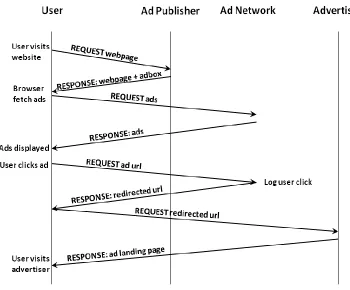
promoting their products through online advertising. Figure 2.1 illustrates a
typical scenario of how the ad delivery system works. From Figure 2.1 we can
see four request-response style communications. The first such interaction is
when the user opens a webpage hosted by the ad publisher who displays the ad
frame or placeholder (referred to as adbox in the figure). This action triggers a
ads. This is shown as the second pair of request-response communication. The
third interaction happens when the user actually clicks on the ad. The ad
network sends the redirected URL as response which triggers the browser to
request it to generate the final request-response communication. As a result, the
browser gets the ad landing page.
2.1.2 Infection Process of Malicious Ads
The infection process of malicious ads can be largely divided into two categories:
silent infection and user triggered infection. Silent infection can occur when an
Internet user only visits a legitimate website that contains malicious ads. In this
case, the malicious ad itself contains malicious code (written in JavaScript, Action
Script, etc.) which can find Web browser vulnerabilities and exploit them to
infect the user system. This is the most dangerous form of infection, since it does
not require any interaction or trigger from the user. The mere action of visiting a
legitimate and otherwise safe website triggers the infection. On the other hand,
user triggered infections require some form of user interaction such as click or
key press events. By refraining from risky interactions, the user can prevent
infection in most cases. After the first interaction with the malicious ad, the user
usually ends up visiting a malicious ad landing page hosted by the malicious
advertiser. From this page, the user may also be infected in two ways: either
one the following three results: user system being infected, a malicious browser
add-on being installed, or a malicious executable file being downloaded. Figure
2.2 depicts various paths and outcomes generated when an ad publisher
webpage is visited. The bold-faced sections of the figure highlight the path we
focus on in this chapter.
Figure 2.3(a) shows a sample malicious ad frame. This is a typical
malicious ad falsely claiming that the user needs to update his or her media
player. If the user clicks on anywhere inside the ad frame (not just the buttons), it
will open a new page where the user will be prompted to download a malicious
binary executable file with names like "mediaplayer.exe" or
"mediaplayerupdate.exe". Figure 2.3(b) shows the underlying JavaScript code for
Figure 2.3 (a) Sample malicious ad frame, (b) JavaScript code for the same malicious ad frame.
(a) (b)
cannot be identified straightforwardly. Only after this JavaScript code is
executed in the Web browser, we can see the target URL. This is the primary
reason why we need to simulate user clicks on the ads to find the target URL.
2.2 System Design
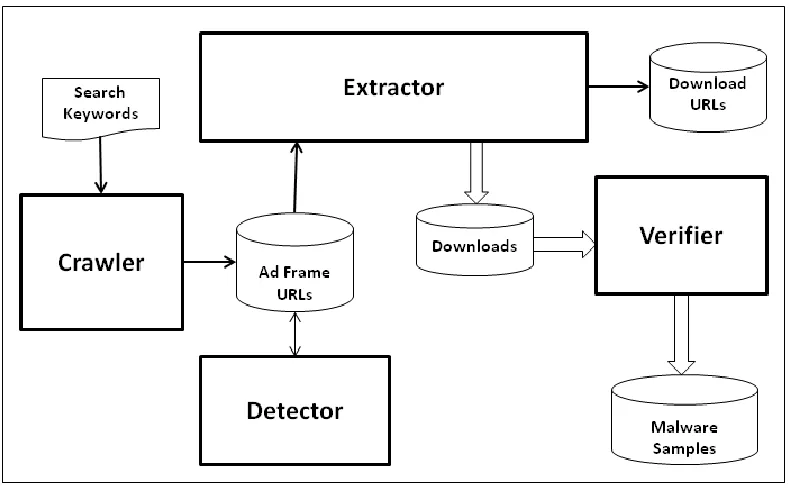
Our system can be divided into four major components, including (i) Crawler,
(ii) Detector, (iii) Extractor, and (iv) Verifier, as depicted in Figure 2.4. It also
shows the input and output of each component. Each component implements a
major stage in the overall process of collection and analysis of malicious
executable files. Description of each of the components is given in the following
2.2.1 Crawler
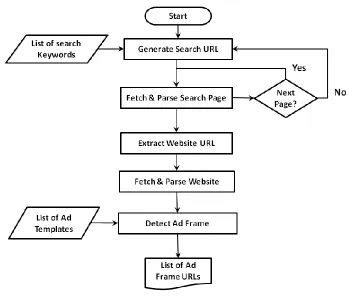
The main task of this component is to crawl over the Internet and find ad frames
or placeholders in various websites. To increase the effectiveness in finding
websites with more ads and potential malicious ads, it makes use of the popular
Internet search engines like Google, Bing, Yahoo, etc. A pre-defined list of search
keywords is used to search websites via different search engines and extract a list
of URLs. Then, the web pages of these URLs are fetched and parsed to detect ad
frames or placeholders that display textual or graphical ads. If detected, the ad
frame or placeholder URL is recorded into a list of ad frame URLs for further
2.2.2 Detector
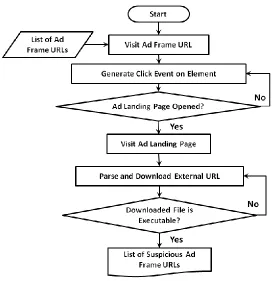
This component uses the list of ad frame URLs generated by the Crawler and
detects whether the ad eventually results in a malicious download or not. To
achieve this, we need to know what the target URLs are for the ads and test
whether any one of them lead to an executable file download event. A simple
HTML ad will contain the target URL as part of a plain HTML element.
However, with the widespread use of Web 2.0 technologies, most of the ads now
contain complex JavaScript or Action Script code (as shown in Figure 2.3), where
simulate user interaction such as mouse click on the ad itself which will trigger
the target ad landing page URL for us. Once we can fetch the ad landing page,
we can further parse and inspect to determine whether it contains any download
URL which lead to a download of an executable binary file. If the Detector
detects at least one such download URL, it records the download URL along
with the ad frame URL. Figure 2.6 shows a flowchart of the overall process of the
Detector.
2.2.3 Extractor
We make use of the ad frame URLs that is generated by the Detector to
download more executable files. The design of the Extractor is similar to the
Detector except that it is used to periodically monitor (and download from) only
the already detected ad frame URLs. Using this approach we can maximize the
number of downloaded files from a minimum number of ad frame URLs, since
the contents of the ad placeholder changes dynamically over time with a
probability of generating a new ad every time. Thus, by monitoring a single
malicious ad placeholder we can extract many different malicious files. In
addition, we can investigate the behavior of a single malicious ad frame URL and
find out answers to questions like how frequently ads change, how many distinct
download URLs are generated from the same ad frame, etc. Examples of such
analysis results are further discussed in section 2.4.
2.2.4 Verifier
This is the part where we automatically submit the collected executable files to
anti-malware scanning engines to verify the maliciousness of them. Instead of
using a single scanner, we used the online service provided by VirusTotal [8]
where at most 56 anti-virus scanning engines are used to generate the scanning
2.3 System Implementation
We have implemented our system using Python 3.4. Details of the
implementation for each component are given in the following sub-sections.
2.3.1 Crawler
We used a list of search keywords generated from Table 2.1. Each keyword is
generated by combining one or more qualifier keywords and one content
keyword. To create this list of potential keywords, we tried to answer the
following question: what types of websites are most likely to host high number
of advertisements? To find the answer, we manually analyzed 20 ad-filled
websites collected from various Internet discussion forums. We found that most
of the websites offer free services or contain free contents, for which they try to
compensate by placing as many ads as possible.
Table 2.1 Search Keywords
Qualifier Keywords Content Keywords
Therefore, a good qualifier keyword is "free". Similarly, we found that one
of the most desired services is downloading some content or data from the
Internet. Hence, "download" should be a good qualifier keyword.
The fetching and parsing of websites has been done using Python libraries
"Requests" [9] and "lxml" [10] respectively. The detection of ad frames or
placeholders has been done using the Python library "adblockparser" [11] and a
list of filters from EasyList [12], an ad filter provider service designed for the
most popular ad blocking Web browser extension Adblock Plus [13].
2.3.2 Detector
To implement the Detector, we needed some way to simulate the user click
events on the ads. Selenium WebDriver API [14] provided us with such features.
This Python API can be easily used to simulate the behaviors exactly like what a
normal human Web user will do, such as opening a URL in the browser, clicking
on an ad, switching to new pages as a result of the clicking, responding to any
JavaScript alert generated in the process, etc. A difficult task was to determine
where to click, since ads are dynamically generated with varying sizes.
Fortunately, Selenium provides a way to click on a specific HTML element.
Therefore, we iterated over all the HTML elements of the ad and generated click
event for them. The assumption we make is that at least one of the elements
of the click event. This is a valid assumption since usually the ads are generated
such that the entire ad frame is clickable and the user can click anywhere inside
the frame to produce the ad landing page.
After the ad landing page is opened, we parse the HTML source and find
all target URLs leading to external resources. Here, the Selenium WebDriver
executes most of the internal JavaScript code and we can use the innerHTML
property (the property that sets or returns the HTML content of an element) for
each element to get the generated HTML code from JavaScript code. In this way,
we can make sure that we don't miss any target URL generated by internal
JavaScript codes.
2.3.3 Extractor
The implementation of the Extractor is similar to Detector. The only difference
lies in the input and output. The input for the Extractor only contains those ad
frame URLs that have been detected already, and the output contains
downloaded executable files with corresponding download URLs for a specific
ad frame URL. We map the downloaded files and URLs to a specific ad frame
2.3.4 Verifier
The VirusTotal API [15] provided by VirusTotal is used to implement the
Verifier. For each of the downloaded files, we generated a scanning report from
VirusTotal which contains how many anti-virus scanners have detected the file
as malicious and what classes of malware the file belongs to.
2.4
Results and Analysis
We tested our system for a total period of 6 months and divided it into two
stages of 3 months each. In the first stage, we deployed the Crawler and the
Detector for 3 months. The Crawler used the search keywords generated from
Table 2.1 and crawled 51,467 websites, where 10,950 of them contained at least
one advertisement. The number of detected ad frame URLs were 73,240, which
were passed to the Detector. We detected ad frames containing at least one target
URL which lead to the download of executable binary files. In total, we found
895 such ad frame URLs. This is our input to the second stage of experiment.
In the second stage, we ran the Extractor for 3 months to monitor and
extract downloads from 895 suspicious ad frame URLs. It ran a single iteration
over all 895 of them 3 times a day. We recorded the download URLs along with
the downloaded files for each individual ad frame URL. In total, we found 13,648
the Verifier to identify false positives checking against 56 anti-virus scanners
provided by VirusTotal. Only 115 files out of 13,648 pass all the anti-virus
scanners as benign and 13,353 files were identified by at least one scanner as
malicious. This means that 99% of the files collected by our system were
identified as malicious by VirusTotal. Table 2.2 lists the number of different types
of malware detected. A single malware sample can belong to two or more
different categories, since modern malware is packaged with multiple features
and functionalities. Here, we have considered all the labels for a single sample
labeled by different scanners. From the VirusTotal reports, we found that on an
average each sample was detected as malicious by at least 9 out of 56 scanners.
Table 2.2 Types of Malware Detected
Malware Type Total Number Percentage
Adware 12,952 97%
Trojan 10,816 81%
Virus 4,406 33%
Backdoors 3,872 29%
Potentially Unwanted Program 12,151 91%
Some interesting results were observed when we grouped the malware
samples and their download URLs by corresponding ad frame URL. We
observed that every time we extracted the download target, a new distinct URL
can be found. Even though the downloaded binary files looked exactly same
with respect to name and size, the files were found to be different when MD5
approximately 49 malware samples on an average from a single ad frame URL,
with a maximum of 255 samples. After the 3 month period ended, we replayed
all download URLs to check their validity. 21% of them were still working while
the rest of them were redirecting to a different webpage. In addition, malware
samples collected from a single ad source usually fell into the same malware
family or class. From these observations, we conclude that (1) a single malicious
ad frame URL can be monitored for a long period of time to consistently collect
malware samples, (2) URL that hosts the malware is changed frequently to
provide a constant availability of malware as well as to thwart takedown efforts,
(3) even though the malware samples disseminated by a single ad source belong
to the same class or family, they could be distinct in binary content, which means
every now and then a new malware payload is generated with a relatively short
lifetime.
Additionally, we tested the captured download URLs via VirusTotal URL
scanner service. We found that only 34% of the URLs were flagged as malicious
by at least one URL scanner. Therefore, the list of malicious download URLs
generated from our system can be a good addition to online URL blacklist
2.5
Related Work
In the scientific literature, malicious online advertising is better known as
"malvertising" by taking the portmanteau of the words "malicious" and
"advertising". Although numerous news articles have been published on
malvertising, not many research articles can be found on this topic.
Sood et al. [16] provided one of the earliest accounts of how malvertising
works. They explained several malvertising modes and offered a few guidelines
to prevent them. S. Manfield-Devine presented the recent state of malvertising in
[17], describing the use of Flash and mobile websites. Zhang et al. [18] proposed
a detection scheme to detect malvertising cases using depth of the URL
strategies. In addition, Google has opened a website [19] dedicated to prevent
malvertising compromises in all of Google's and partners' ad properties in an
effort to build community awareness against it.
There has been a considerable amount of research done regarding
Web-based malware collection. In the year 2006, researchers from Microsoft [20] came
up with an automated Web patrolling system to automatically identify and
monitor malicious websites that install malware programs by exploiting browser
vulnerabilities. Since then, we have seen many other research efforts to automate
malware collection from the Web. Worth mentioning among these are
and PMCCS [26]. HoneyBow toolkit is an automated malware collection system
based on high-interaction honeypots, which are able to collect autonomous
spreading malware in an automated manner. PhoneyC is a virtual honeyclient
that mimics the behavior of the user-driven network client applications such as
Web browsers and is exploited by an attacker's content to reveal the attack in the
process. Rozzle is a JavaScript multi-execution environment that can reveal
environment specific Internet malware. WebPatrol automatically collects
Web-based malware scenarios including complete Web infection trails to enable
further detailed analysis. HoneyInspector is another active honeypot system that
collects malware from malicious websites as well as from shared P2P files.
Proactive Malware Collection and Classification System (PMCCS) uses P2P
software to actively search suspicious malware samples such as software crack
tools. Although each of these research works presents a way to collect Web-based
malware samples, none of these have explored malvertising and considered it as
a source of malware collection and analysis.
2.6
Summary
Our main contribution in this work is, we have designed and implemented an
automated system to collect malware samples from online advertising sources.
information collection for malvertising research, which can reveal many new
paths of investigation and analysis in this area. Moreover, the collected samples
are instances of live and active malware that are infecting Internet users at this
very moment, which are extremely useful for research purposes.
As of now our system can only collect information related to
downloadable executable binary files via malvertising sources. If we refer back to
Figure 2.2, we can see that we have only implemented one path in the malicious
ad infection process. There are still two more paths yet to be explored. One is
where the system is infected in the background, that is, a malicious code is
executed in the browser through browser vulnerabilities and plug-in exploits.
The other one is where a malicious add-on is installed into the browser. We can
further extend our work to incorporate both of these infection paths.
Along with the malicious executable files, we can collect the HTML,
JavaScript and Action Script sources of the malicious ads and further investigate
to find patterns so that they can be used in the future to detect malicious ads
before they are executed. Moreover, the defenders can use the information about
these patterns to develop mitigation strategies. This can be a very important
C
HAPTER3
A
G
AMET
HEORETICM
ODEL OFM
ALVERTISING3.1 Background
3.1.1 Overview of Game Theory
Game theory identifies multi-person decision scenarios as games where each
player selects actions which result in the best possible self rewards, while
anticipating and considering the rational actions from other players. A player is
the basic entity of a game who makes choices of what actions to perform. A game
is a formal description of the strategic interaction that includes the constraints of,
and payoffs for, a set of actions that the players can choose from, without
specifying what actions they actually take. A solution concept is a formal
description of how the game will be played by applying the best possible
strategies and what the results might be. A strategy for a player is a complete set
of actions in all possible scenarios throughout the game. If the strategy specifies
to take a unique action in a scenario then it is called a pure strategy. If the
strategy specifies a probability distribution for all possible actions in a scenario
Nash equilibrium is a solution concept that describes an equilibrium state
of the game where no player would prefer to change his strategy as that would
lower his payoffs given that all the other players are adhering to their respective
strategies. This solution concept only specifies the equilibrium state but does not
specify how that state is reached in the game. The Nash equilibrium is the most
famous equilibrium and one of the most used solution concepts in game theory.
3.1.2 Game Theory Definitions
Game
A game is a formal description of the strategic interaction between opposing or
co-operating entities where constraints and payoff for actions are taken into
consideration.
Player
A player is a basic entity in a game that is required to make choices for actions.
Action
An action is a player's move in the given game.
Payoff
The payoff is the positive or negative reward to a player associated with a given
Strategy
A strategy is a set of actions that a given player can choose during game play.
3.1.3 The Malvertising Game
The major motivation behind malvertising is the potential lucrative profit. Many
malvertising campaigns install on vulnerable machines a variety of ransomware,
which encrypts user data and files and forces users to pay a ransom of several
hundred dollars to obtain the decryption key. According to the 2016 Annual
Security Report published by Cisco [27], the estimated yearly income from
ransomware per successful malvertising campaign could reach as high as $34M.
However, this potentially huge profit does not come for free; there is a cost
associated with launching a campaign. Most malvertisements operate with the
help of a tool called exploit kit [4], which can probe the vulnerabilities on the
victim machine's web browser or plug-in in order to exploit and install the
malware. Malvertisers need to either develop the exploit kit from scratch (need a
lot of investment), hire someone to do it (there is a list of task prices in the Deep
Web black market [28]), purchase it (about $20-30K [28]), or rent it (about
$500/month [28]). There is an expensive price tag attached to any option.
Moreover, in order to protect their "investments" on malicious ads and malware
from detection by the ad network, malvertisers often apply to their campaigns a
redirecting to compromised IP addresses, and malware polymorphism
(introduced in more detail in the next section). These evasion techniques also
incur considerable overhead cost on the malvertiser.
On the other hand, in order to control and limit the huge reputation
damage and financial losses caused by malvertising campaigns [5], the ad
network also spends a lot of money and efforts to apply inspection techniques on
submitted ads, including live monitoring and code analysis. Similar to the case of
launching malvertising campaigns, these inspection efforts also incur substantial
overhead coming from labor, infrastructure, intellectual property fee for
licensing diagnosis tools (sometimes including purchasing exploit kits for
analysis purpose), time needed to conduct analysis (ranging from a few minutes
to tens of hours, on average around 10 hours per case), and cost for establishing
partnership with other companies for sharing of expertise and data [6].
However, we note that both the malvertiser and the ad network are under
the constraints of resource and time, which makes it impossible and impractical
for the malvertiser to always submit malicious ads and for the ad network to
inspect every submitted ad. Therefore, the malvertising inspection problem can
be modeled as a game between an attacker (the malvertiser) and a defender (the
3.1.4 Attacker and Defender Strategies in Malvertising Game
Malicious advertisers employ many strategies to evade detection including
fingerprinting, redirection, just-in-time assembling and compilation, obfuscation,
timing based evasion, etc. Researchers at Malwarebytes and GeoEdge [29]
investigated malvertising campaigns for several months and found out about an
effective evasion technique used by the threat actors called fingerprinting. This
technique is actually not new, rather has been used by the exploit kits for some
times now. Now it is being used earlier rather than late in the malvertising chain,
helping the malicious advertisers to decide whether to display a malicious ad or
a benign ad. Basically, the fingerprinting technique employs sophisticated
obfuscated code inside the ad to detect indications that can identify a machine
belonging to a security researcher or a honeypot. Researchers at Invincia [30]
identified a new technique called "just-in-time" (JIT) or on-host assembly of
malware. This novel approach can evade detection from network sandbox and
traditional endpoint security solutions while compromising vulnerable systems.
JIT malware uses late-binding techniques to assemble a malware executable on
the target endpoint itself in order to evade network sandbox analysis. In
addition, native Windows components from the target machine are used to
assemble the payload. This helps in evading endpoint white-listing approaches
AdGholas [31] malvertising campaign have been found to have used
steganography and file whitelisting approach to evade detection.
Most of the malvertising campaigns involve an exploit kit to carry out the
infection or delivery of malicious payload. Prominent examples of exploit kits [4]
include SweetOrange, Angler, Magnitude, Rig, Nuclear, etc. Exploit kits are also
equipped with evasion techniques [4] such as fingerprinting, obfuscation, etc.
Researchers have found that through a vulnerability in Internet Explorer, an
attacker can check the presence of files or folders in an affected system, thereby
detecting whether the system is a virtual machine or has an antivirus software
installed. For obfuscation purposes, the use of Pack200 archive format has been
seen in use by Angler exploit kit. Other evasion techniques include encrypted
payload, IP and domain fluxing, domain shadowing, and file-less infections [32].
There has been some work done by both industry and academic
researchers on the strategies that can be employed by the defender, i.e. the ad
network or the ad publisher. GeoEdge [6] is a commercial provider for ad
verification and protection services. Their services include automated ad
verification solution that monitors live advertisements using a globally
distributed network of monitors. Similar techniques involving crawling and
34, 35, 36]. Another focus of research was to detect malicious exploit kits. Taylor
et al. [37] proposed a network-centric technique to detect malicious exploit kits
by capturing tree-like web request structures and finding similarities among
them. Their approach is based on the insight that to infect a client browser, a
web-based exploit kit must guide the client browser to visit its landing page
through multiple redirections generating a pattern of multiple web requests. This
pattern can be identified as a tree-like structure and used for the purpose of
detection of malicious exploit kits. Stock et al. [38] presented Kizzle, an antivirus
signature generator for detecting exploit kits. Wang et al. [39] presented an
approach for identifying new undetected landing pages that lead to drive-by
downloads by using malicious content patterns identified in previously known
collection of Malware Distribution Networks. Malicious obfuscated JavaScript
code has been an integrated part of malvertising campaigns. Lu and Dubray [40]
presented an approach for automatic de-obfuscation of JavaScript code using
dynamic analysis and slicing that preserves code semantics. The resulting code
becomes observationally equivalent to the original program with obfuscation
removed which exposes the core logic of the computation it performs. Xu et al.
[41] presented JStill, a mostly static approach to malicious obfuscated JavaScript
detection that uses static analysis of function invocation and lightweight runtime
advertisements that enables flexible controlling on ad script behaviors by
completely mediating its access to the web page (including its DOM) without
restricting the JavaScript functionality exposed to the ads. Dewald et al. [43]
presented ADSandbox, an analytical sandbox system for malicious websites that
executes any embedded JavaScript within an isolated environment and log every
critical action. Analyzing these logs using heuristic rules, ADSandbox can decide
whether the site is malicious or not. Another useful evasion technique employed
by the attackers is URL redirection. Mekky et al. [44] presented a method to
identify malicious chains of HTTP redirections using supervised decision tree
classifiers.
3.2 The Malvertising Game Model
Our solution aims to apply game theory to formulate the problem of inspecting
the malware inserted by the malvertisers into the Web-based advertising system.
We define a normal form game of two players, the Attacker and the Defender.
The Attacker represents the malvertiser, whose goal is to distribute as many
copies of its malware to vulnerable machines as possible when unwitting users
visit legitimate websites (i.e. ad publishers). The Defender represents the ad
network, whose goal is to detect and remove malicious online ads before they are
that is, they both aim to maximize their payoffs, and will choose the strategy
which is the best response to the strategy chosen by the other player. The
Attacker has two strategies, namely "to post a benign ad" (denoted as B) and "to
post a malicious ad for distributing malware" (denoted as M). The Defender also
has two strategies, namely "to inspect the submitted ad" (denoted as I) and "not
to inspect the submitted ad" (denoted as No-I).
Next, we define the payoff functions for each possible combination of the
two players' chosen strategies. The notations used in the payoff functions are
defined as follows:
cm: Attacker's cost of launching malvertising.
ci: Defender's cost of inspecting online ads.
g: Attacker's gain of successful malware distribution through
malvertising. We can assume that g > cm holds because otherwise the
Attacker will not have sufficient motivation to post malicious ads.
l: Defender's loss due to undetected malvertising. We can assume that l > ci
holds because otherwise the Defender will not have sufficient motivation
to inspect submitted ads.
Figure 3.1 shows the matrix of the payoff functions under each possible
combination of the two players' chosen strategies. In each square, the first value
represents the Attacker's payoff, while the second value represents the
Defender's payoff. Several payoff functions are straightforward, so we will only
explain the payoff functions in the bottom left square. When the Attacker plays
strategy M and the Defender plays strategy I, the Attacker incurs cost cm for
launching malvertising but can get the gain g of successful malware distribution
with probability 1-α; the Defender incurs inspection cost ci but can reduce the
loss due to undetected malvertising by αl.
3.3 Finding Nash Equilibrium of the Game
In this section, we discuss the Nash equilibria computed from the game theoretic
model. We explain how to find the pure-strategy and mixed-strategy Nash
equilibria respectively.
3.3.1 Pure-Strategy Nash Equilibria
According to the payoff functions of each possible combination of strategy
chosen by the Attacker and Defender as defined in Figure 3.1, we can compute
the Nash equilibria of this game. To this end, we need to first determine the best
response of each player toward each strategy chosen by the other player.
For the Attacker, we need to determine his best response to each of the
Defender's two possible strategies, namely I and No-I, respectively. When the
Defender plays I, we compare the Attacker's payoff for playing B, which is 0, and
playing M, which is -cm+(1-α)g. If -cm+(1-α)g ≤ 0, which is equivalent to α ≥ ,
then B is Attacker's best response to Defender's strategy I. If -cm+(1-α)g ≥ 0, which
is α ≤ , then M is Attacker's best response to Defender's strategy I. Note that
when α = , both B and M can be Attacker's best response to Defender's
strategy I according to the definition of best response. When the Defender plays
which is -cm+g. We can get -cm+g > 0 since g > cm. Thus, M is Attacker's dominant
strategy to Defender's strategy No-I.
For the Defender, we need to determine his best response to each of the
Attacker's two possible strategies, namely B and M, respectively. When the
Attacker plays B, we compare Defender's payoff for playing I, which is -ci, and
playing No-I, which is 0. Since cost ci must be positive, hence -ci < 0, we can get
that No-I is Defender's dominant strategy to Attacker's strategy B. When the
Attacker plays M, we compare the Defender's payoff for playing I, which is -ci
-(1-α)l, and playing No-I, which is -l. If -ci-(1-α)l-(-l) = -ci+αl ≥ 0, which is equivalent
to α ≥ , then I is Defender's best response to Attacker's strategy M. If -ci+αl 0,
which is α , then No-I is Defender's best response to Attacker's strategy M.
Note that when α = , both I and No-I can be Defender's best response to
Attacker's strategy M according to the definition of best response.
From the best responses of both players discussed above we can
determine the Nash equilibria of this game. If α , then the strategy
profile (M, I) is a pure-strategy Nash equilibrium, because when this condition
holds, strategy M is Attacker's best response to the Defender's strategy I, and
strategy I is also the Defender's best response to the Attacker's strategy M. In the
pure-strategy Nash equilibrium. However, if α > and α > , then no pure-strategy
Nash equilibrium exists. This is because when one player chooses the best
response strategy corresponding to the other player's chosen strategy, the latter
player will shift to another strategy for it is the best response to the former
player's chosen strategy, and then the former player will also shift to another
strategy, which forms a loop as demonstrated in the example of the well-known
Rock-Paper-Scissors game. However, a mixed-strategy may exist when α > and
α > , in which the Attacker and the Defender randomize their strategies
instead of sticking to the same strategy at all times.
3.3.2 Mixed-Strategy Nash Equilibrium
Next, we show how to derive the mixed-strategy Nash equilibrium of this game.
As shown in Figure 3.2, we assume that the Attacker plays strategy B with
probability x and plays strategy M with probability 1-x, and assume that the
Defender plays strategy I with probability y and plays strategy No-I with
probability 1-y.
To compute x, consider that the Attacker will randomize his choice of
strategy to make Defender indifferent between I and No-I; that is, the expected
payoff is the same for the Defender no matter he plays I or No-I. From Figure
x(-ci)+(1-x)(-ci-(1-α)l) = 0x-(1-x)l
x = (3.1)
On the other hand, y can be computed with the consideration that the
Defender will randomize his choice of strategy to make Attacker indifferent
between B and M; that is, the expected payoff is the same for the Attacker no
matter he plays B or M. From Figure 3.2, we get
y(-cm+(1-α)g)+(1-y)(-cm+g) = 0y-(1-y)0 = 0
y = (3.2)