Translational invariant shell model for
Λ
hypernuclei
R.V. Jolos1, L. Majling1,2,a, and O. Majlingova3
1Bogoliubov Laboratory of Theoretical Physics, JINR, Dubna, Russia 2Nuclear Physics Institute, ˇRez near Prague, Czech Republic 3Czech Technical University, Prague, Czech Republic
Abstract. We extend shell model forΛhypernuclei suggested by Gal and Millener by including 2ω exci-tations in the translation invariant version to estimate yields of different hyperfragments from primaryp-shell hypernuclei. We are inspired by the first successful experiment done at MAMI which opens way to study baryon decay of hypernuclei. We use quantum numbers of group SU(4), [f], and SU(3), (λμ), to classify basis wave functions and calculate coefficients of fractional parentage.
1 Introduction: Hypernuclei
TheΛhypernucleusAΛZ is a bound system ofZ protons, A−Z−1 neutrons and oneΛhyperon. The lifetime of the hypernucleus is about 2·10−10 s. This is one of the best examples of a nucleus with a new flavor (strangeness).
Investigation of the production and properties of hy-pernuclei is of growing importance for contemporary nu-clear and particle physics. The subject of hypernunu-clear physics involves various aspects of modern theoretical and experimental physics. The peculiar behavior of matter containing strange quark raised many interesting prob-lems. The existence of hypernuclei gives a third dimen-sion to the traditional world of nuclei [1]. Hypernuclei not only bring a strangeness to nuclear physics, they provide a convenient laboratory for obtaining information about the hyperon-nucleon (YN) interaction and explore the full SU(3) (flavor) symmetry breaking baryon-baryon interac-tion both strong and weak.
The empirical information on YN scattering consists almost exclusively on the spin averaged characteristics, the spin structure of the YN interaction is mainly unknown. The only way to obtain the necessary information is hy-pernuclear spectroscopy, since the results of hyhy-pernuclear structure calculations are sensitive to the spin dependence of the YN interaction.
There are several hypernuclear research centers and groups with complementary investigative programs: KEK, J-PARC, JLab, KAOS@MAMI, HypHI@GSI, STAR@RHIC, Alice@LHC; planned are BM@N in Dubna and PANDA@FAIR.
Developments and highlights are reported at triennial International Conferences on Hypernuclear and Strange Particle Physics [2].
ae-mail: [email protected]
2 Hypernuclear spectroscopy
The spectroscopy of hypernuclei started to develop very quickly in 70’s. It was M. I. Podgoretsky [3] who first pointed out that there is a magic kaon momentumqK, at which the strangeness exchange reaction
(K−, π−) qK ≈530 MeV/c, θπ≈0o, (1)
transforms a target neutron at rest into a stationaryΛ par-ticle. In this reactionΛsimply replaces a neutron in the nucleus, without otherwise changing its wave function. This fact inspired H. Lipkin to introduce the notion of “Strangeness Analogue State” (SAS) inΛhypernuclei [4]. The term “analogue state” is used to refer to the state ob-tained by substituting ap-shellΛfor a p-shell neutron in the same space-spin state.
Much important Λ-hypernuclear experimental work based on the idea of Podgoretsky was done by Bog-dan Povh (Heidelberg Saclay Collaboration at CERN) [5] and by R. Chrien at BNL [6].
Extensive studies of hypernucleus production have been made using the missing-mass spectroscopy in meson or electron induced reactions
A+1Z (a,b)A+1
ΛZ, (2)
where (a,b)=(K, π), or (π,K), or (e,eK+) [7].
The elementary processes for three typical reactions in terms of today’s (quark) nomenclature are as follows:
A: (K−, π−)
K− + n → Λ + π−
(s¯u) + (udd) → (uds) + (¯ud)
An s in aK−isexchanged with a d in a n
B: (π+,K+)
π+ + n → Λ + K+
(ud)¯ + (udd) → (uds) + ( ¯su)
C: (e,eK+)
p → Λ + K+
(uud) → (uds) + ( ¯su) An ss¯ pair is created associatively
The accepted interpretation is that hypernucleus is pro-duced in a nucleon-holeΛ-particle excited state when a nucleon in the target nucleus in a state jnis converted to theΛhyperon in a state:
|(j−1
n Λ)ΔJ⊗ΨA> =0s, 1p, 2d,2s, · · · , (3)
where ΨA stands for the wave function of the ground state of the core nucleus. For one particle states we use "harmonic oscillator" notation. TheΔJdepends on reac-tion (and kinematics) used. This descripreac-tion obvious in closed-shell nuclei can be also used for all p-shell hyper-nuclei [8, 9]. The broad peaks observed will generally have detailed structure.
The systematic study of excitation energy spectra were conducted for all p-shell hypernuclei, for some medium-heavy as well as for208
Λ Pb. TheΛ-nucleus spectrum pro-vides a “textbook example" ofsingle particlestructure in nuclear physics, see Fig. 1.
Figure 1.The single particle spectrum in89
ΛY, from [7].
Fifteen years ago, H. Tamura started a successful project of hypernucleargamma spectroscopy with ded-icated a germanium detector array [10]. A series of ex-periments on p-shell targets has been carried out using (π+,K+γ) and (K−, π−γ) reactions, [7]. A comprehensive shell model analysis of theseγ-spectra was performed by Millener [11].
3 Baryonic decay
The full chain of events: formation of excited primary hy-pernucleus→baryon decay→weak decay of hyperfrag-ment has been traced only in a single case [12], e.g.
12
ΛC∗(E∼11 MeV)→p+11ΛB. (4)
Recently, new projects were announced: two experi-ments at JLab [13] and at Mainz [14] intend to use high precision monochromaticπ−’s from the unique two-body weak decay to investigate lightΛhypernuclei with variety of (Z,A) combinations through identification of hyperfrag-ments from strongly produced hypernuclear continuum in (e,eK+) electro production. For example, with a7Li
tar-get the binding energies of3
ΛH,4ΛH,5ΛH,6ΛH,6ΛHe and7ΛHe can be measured simultaneously.
The pioneering experiment was performed at MAMI, where a hypernuclear decay-pion study was realized us-ing the A1 spectrometer facility with a9Be target and
suc-ceeded in the identification of the4
ΛH hyperfragment pro-viding the feasibility of the method [15]:
production
9Be(e,eK+)9
ΛLi∗ → X+4ΛH
4
ΛH → 4He+π− signature
The pion momentum distribution shows a monochro-matic peak at qπ ≈ 133 MeV/c, so, hyperfragment 4
ΛH (BΛ=2.12 MeV) is identified uniquelly.
The experiment opens new chapter, namely systemat-ical study of baryonic decays [16]. While missing mass experiments are limited to nuclei close to the initial target, the QF kaon production of an excited primary hypernu-cleus and its subsequent decay gives access to a variety of light and exotic hypernuclei, some of which cannot be produced or measured precisely by other means.
The experiment completes also hypernuclear spec-troscopy in the p-shell. The comprehensive shell model approach was developed in [9]. At that time (80’s) the at-tention was focused onpn→pΛtransitions seen in (K−, π−) and (π+,K+) reactions. In line with nuclear structure ter-minology the states, in which sΛ(pΛ) is coupled to a nu-clear p-shell core, were called 0ω(1ω) excitations, re-spectively. There are also 1ωconfigurations of the form s3pk+1s
Λ which can also be formed in reaction. These sn→sΛtransitions show up very clearly for the Li targets, see Fig. 2.
We have noted similarity of hypernuclear spectra with Giant Dipole Resonance [17], namely its "configurational splitting" [18], when nominally 1ωstates are splitted into three groups, because single-particle energies differ signif-icantly, as can be seen in Table 1.
Table 1.Three groups of 1ωconfigurations
1ωΛ(εpΛ) : p−1pΛ
GDR ⊗ sΛ 1ωN (εd) : p−1d sΛ
1ωN(εs−1) : s−1p sΛ
The concept of configurational splitting comprises two effects [18, 20]:
Figure 2.Thes−1s
Λstates inp−shell nuclei, from [19].
(ii) the predominance of clustering phenomena in the light-est nuclei (related to Wigner supermultiplet symmetry).
The distinctive structure of the s−1s
Λ hypernuclear state influences strongly its decay properties. Calculations for s−1s
Λ states require careful treatment of center-of-mass, e.g. Translation Invariant Shell Model (TISM) [21] with its quantum numbers [f] (Young tableaux) and (λ, μ) (Elliott’s SU(3)). The emission of the 3N cluster:3He,4ΛH is the most probable.
For the first time, a benefit of the classification of highly-excited hypernuclear states in terms of [f] and (λ, μ) was exemplified by decays of6
ΛLi [22], see Fig. 3. The same considerations may be applied [16] when we search for origin of the secondaryγquanta (7ΛLi) observed in the experiment10B(K−, π−γ) [7].
The consequences of the shell model structure of7
ΛHe∗ on its decay modes, i.e. the forbidden decay of thesΛs−1
state to He isotopes is illustrated in Fig. 4.
We welcome the new project and already have dis-cussed its potential in terms of SAS [23]. However, the excitation spectra of primary hypernucleus9
ΛLi in this pro-duction reaction is without any structure due to a small selectivity: spin-flip and large momentum, see Fig. 5.
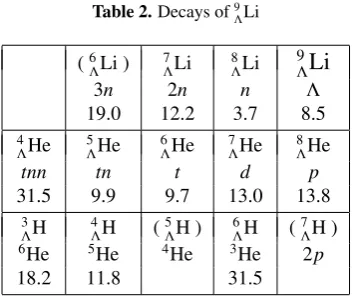
There exist many open channels in9
ΛLi (see Table 2). Simulated decay-pion momentum spectrum (the relative yields) were calculated by astatistical decay model[24]. This model explicitly assumes the formation of an excited
9
ΛLi∗ which creates hypernuclei by fragmentation or de-excitation. It predicted three strong peaks, namely for
7
ΛHe, 8ΛLi and 4ΛH but the only last one was approved in experiment [15, 25].
In [27], we extended the TISM by including the next harmonic oscillator excitations (Nmin+2). Here, we
dis-cuss some steps in more detail.
Figure 3.Spectrum of6
ΛLi, from [22].
Figure 4. Schematic spectrum of7
ΛHe: •,◦and∗marked
neu-tron, proton andΛ, respectively; the [fA] stay for Young scheme.
Figure 5. Excitation spectrum of9
ΛLi: the whole energy range
(a) and the region of interest (b). From [26].
4 TISM
Table 2.Decays of9 ΛLi
(6
ΛLi ) 7ΛLi 8ΛLi 9Λ
Li
3n 2n n Λ
19.0 12.2 3.7 8.5
4
ΛHe 5ΛHe 6ΛHe 7ΛHe 8ΛHe
tnn tn t d p
31.5 9.9 9.7 13.0 13.8
3
ΛH 4ΛH (5ΛH ) 6ΛH (7ΛH )
6He 5He 4He 3He 2p
18.2 11.8 31.5
consists in the wave function antisymmetric with respect to the particle permutations. As a consequence a permu-tation group should be used to construct the basis wave functions. The shell model technique is very effective if the Harmonic Oscillator single particle wave functions are used for the construction of the total wave function. As a consequence the low-dimensional unitary groups SU(2), SU(3) and SU(4) come into the game. The tens of years of application of the shell model have shown that the sim-plest shell model configurations play a very important role as being in many cases the main components of the nu-clear wave function [28]. The wave functions constructed using the quantum numbers of the permutation and unitary groups are very suitable for analysis of the possible cluster decomposition of the state of hyperfragment formed in the reaction and they give a possibility to calculate preforma-tion factors for various decay channels.
To analyze the emission of hyperfragment 4
ΛH from s−1s
Λstates of p-shell hypernuclei we start with the shell model in LS-coupling base [27]. We use harmonic os-cillator wave functions characterized by Young diagram [fA]=[f1f2f3· · ·] (it labels representation of permutation
group SA with f1 ≥ f2 ≥ f3· · · (fi = A)). The or-bital part we characterize by (λμ) of SU(3) representation [29], the spin-isospin part by ˜[fA] of SU(4) representation. So, we can explore simple SU(3) and SU(4) recoupling technique, e.g. Clebsch Gordan coefficients (CGC). More details can be found in [30].
The main driving features of nuclear structure can be represented algebraically. We recognize the limita-tions of the symmetry approach. It can only account for gross properties, any detailed description required more involved numerical calculations. Symmetry techniques can be used as an appropriate starting point for detailed calculations.
4.1 Center of mass
For the states with several open shells, first of all we have to fix the wave function of center-of-mass motion,ΨN(RA). The unitary transformation from the standard shell model to TISM is performed using the Talmi-Moshinsky coef-ficients [31]. The anatomy of kinematic correlations in-duced by fixing center-of-mass motion is demonstrated
clearly for hypernuclear wave function:
ΨN(RA)ψn(rΛ)=
N,ν
TN,νN,n ΦN(RAΛ)ϕν() (5)
(RAΛ≡RA+rΛ, ≡RA−rΛ; N+n=N+ν). For 1ωexcitations we have very simple relations
(10) Φ0ϕ1 Φ1ϕ0
Ψ0ψ1= α β
Ψ1ψ0= β −α
withα=
A
A+μ, β=
μ
A+μ (μ= mΛ
m )
For 2ωexcitations, there are two possible (λμ): (20), (01) and transformation reads
(20) Φ0ϕ2 Φ1ϕ1 Φ2ϕ0 Ψ0ψ2= α2
√
2αβ β2 Ψ1ψ1=
√
2αβ −α2+β2 −√2αβ
Ψ2ψ0= β2 −
√
2αβ α2
(01) Φ1ϕ1
Ψ1ψ1= −1
4.2 Fractional parentage
The key ingredient in the shell model calculations are co-efficients of fractional parentage (cfp), coefficients of de-composition of antisymmetric wave function forA parti-cles
|A: [f
A](λμ)ALS T :J>=
|0sks[f
s]; 1pkp[fp](λμ)p;lkl[fl](λμ)l: [fA](λμ)ALS T :J> =A−4
n=0Φ (A)
N [fA](λμ)N·Ψn(RA),
(6)
where=0s; 1p; 2d,2s; 3f,3p; . . . with obvious constraintsks+kp+kl=A, [fs]⊗[fp]⊗[fl]=[fA], and (λμ)N ⊗(n0) =(λμ)A on product of antisymmetric wave functions forA1andA2particles (A1+A2=A) and wave
function of their relative motionϕν(r) (r=RA1−RA2). For
TISM (harmonic oscillator) wave function we have
Φ(A)
N [f](λμ)=
nf1nf2 nf ·
GL·GS T×
Φ(A1)
N1 [f1](λμ)1·Φ
(A2)
N2 [f2](λμ)2·ϕν(r), (7)
with constraints N=N1+N2+ν. Here, spin-isospin cfp,
GS T≡< τA1[ ˜f1]S1T1; τA2[ ˜f2]S2T2|τA[ ˜f]S T >=
[ ˜f1] [ ˜f2] || [ ˜f]
S1T1 S2T2 | S T
, (8)
is CGC for group SU(4). Orbital cfp,
is Racah coefficient for group SU(3) which describes re-coupling of three representations
(λμ)1⊗(λμ)2⊗(ν0)=(λμ). (10)
For nucleon clusters, |sk[k](00)>, theG
Lis simple CGC:
(λμ)1 (ν0) || (λμ)
L1 l | L
.
The weight factor nf1nf2 nf
is the ratio of dimensions
of representations of the symmetry groups SA1, SA2, SA.
5 Overlook and suggestions
Dalitz and Levi Setti, [32], fifty years ago, discussed the possibility that Λ hyperons could stabilize particle-unstable nuclear cores of Λ hypernuclei and thus allow studies of neutron rich baryonic systems beyond the nu-clear drip line. TheΛ’s effectiveness to enhance binding is primarily connected with the Pauli principle from which it is exempt allowing it to occupy the lowest 0sΛorbital. Several unbound-coreΛhypernuclei have been identified in emulsion work, [33], see Table 3.
Table 3.Hypernuclei in emulsion
core 5He 5Li 6Be 7He 8Be 9B
decay n p 2p n αα p
Eres 0.8 1.7 1.4 0.4 0.1 0.2
BΛ 4.2 4.5 5.2 7.2 6.7 8.9 A
ΛZ 6ΛHe 6ΛLi 7ΛBe 8ΛHe 9ΛBe 10ΛB
It was R. H. Dalitz [34] who highlighted peculiarity of heavy Hydrogen isotopes, see Table 4 (from [35]).
Table 4.Hydrogen isotopes
4H 5H 6H 7H
decay n 2n 3n 4n
Eres 3.0 1.8 2.7 0.8 5
ΛH 6ΛH 7ΛH 8ΛH
Recent experiment by FINUDA Collaboration [36] stirred renewed interest in charting domains of particle-stable neutron-richΛhypernuclei particularly for unbound nuclear cores [37]. Gal and Millener have studied within a Shell Model approach several neutron-richΛ hypernu-clei in the nuclearpshell that could be formed in (K−, π+) ([36]) or in (π−,K+) [38] reactions on stable nuclear tar-gets.
The HYPERNIS (HYPERNeutron-rich hydrogen ISo-topes) experiment @ NUCLOTRON (Dubna) also planed investigation of 6
ΛH [39]. The6
ΛH is produced as one of hyperfragments in
7Li(e,eK+)7
ΛHe∗→p+6ΛH
In this experiment three hyper Hydrogen isotopes,3
ΛH,
4
ΛH and6ΛH are identified simultaneously,4ΛH serves as a benchmark. (A natural6,7Li target is available for installa-tion [25]).
The values ofqπare given in Table 5.
Table 5.The values ofqπfor AΛH
3
ΛH 4ΛH 6ΛH qπ 114.3 132.9 134.8
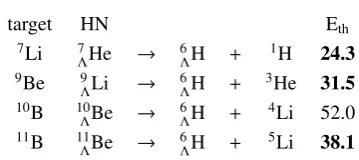
In MAMI set up it is possible to use various targets to studying6ΛH. In Table 6, we collect threshold energies for possible targets (we take BΛ(6ΛH)≈4 MeV):
Table 6.Threshold energies
target HN Eth
7Li 7
ΛHe → 6ΛH + 1H 24.3
9Be 9
ΛLi → 6ΛH + 3He 31.5
10B 10
ΛBe → 6ΛH + 4Li 52.0
11B 11
ΛBe → 6ΛH + 5Li 38.1
The experiments at MAMI and at NUCLOTRON are
complementary: both identify three hyper Hydrogen
isotopes simultaneously. MAMI determines BΛ while NUCLOTRON lifetime (and existence of isomer).
Acknowledgements
This work was supported from Votruba Blokhintsev program. Work of L.M. was supported by the Grant Agency of the Czech Republic under the grant No P2013/15/4301. Work of O.M. was supported by the grant LG 14001(INGO II). L.M. would like to express his sincere thanks to P. Bydžovsky and Liguang Tang inviting him to this challenging project, to S.N. Nakamura and J. Pochodzalla for their interest in even preliminary results. Spe-cial thanks are due to John Millener and Patrick Achenbach for their expertise.
References
[1] W. Greiner, Inter. J. Mod. Phys. E5, 1 (1996) [2] Hyp-XI (HYP2012), XI Intern. Conference on
Hy-pernuclear and Strange Partical Physics, Barcelona, Spain, Nucl. Phys. A914(2013)
[3] M.I. Podgoretsky, Zh. Exp. Teor. Fiz.44, 695 (1963); Sov. Phys. -JETP17, 470 (1963)
[4] H.J. Lipkin, Phys. Rev. Lett.14, 18 (1965)
[5] W.Bruckneret al.,Phys. Lett. B62, 481 (1976); B. Povh, Ann. Rev. Nucl. Part. Sci.28, 1 (1978) [6] R. Chrienet al., Phys. Lett. B89, 31 (1979); R.E.
Chrien, C.B. Dover, Ann. Rev. Nucl. Part. Sci.39, 113 (1981)
[7] O. Hashimoto, H. Tamura, Progr. Part. Nucl. Phys.
[8] A. Gal, J.M. Soper, R.H. Dalitz, Ann. Phys. (NY)63, 53 (1971)
[9] E.H. Auerbach et al., Ann. Phys. (NY) 148, 381 (1983)
[10] H. Tamura, Nucl. Phys. A691, 86c (2001)
[11] D.J. Millener, Topics in Strangeness Nuclear Physics, Lecture Notes in Phys. 724, eds. P. By-džovský, A. Gal, and J. Mareš, (Springer, New York, 2007) p. 31.
[12] R.H. Dalitz, D.H. Davis, D.N. Tovee, Nucl. Phys. A
450, 311c (1986)
[13] L. Tanget al.,Study of light hypernuclei by pionic decay, Proposal E-10-001, Jefferson Lab.
[14] J. Pochodzalla, Acta Phys. Polon. B42, 833 (2011) (arXiv:1101.2790, 2011)
[15] A. Esseret al., Phys. Rev. Lett.114, 232501 (2015) [16] L. Majling, Nucl. Phys. A639, 125c (1998)
[17] J. Žofkaet al., Sov. J. Part. Nucl.22, 628 (1991);28, 101 (1997)
[18] R. Eramzhyanet al., Phys. Rep.136, 229 (1986) [19] R. Bertiniet al., Nucl. Phys. A368, 365 (1981) [20] H. Kissener, I. Rotter, N. Goncharova, Fortschritte
der Physik35, 277 (1987)
[21] I. Kurdyumovet al., Nucl. Phys. A145, 593 (1970) [22] L. Majlinget al., Phys. Lett. B92, 256 (1980) [23] O. Majlingova, L. Majling, PoS (Baldin ISHEEP
XXI) 101 (2012)
[24] A. Sanchez Lorente, A.S. Botvina, J. Pochodzalla, Phys. Lett. B697, 222 (2011); A.S. Botvinaet al., Nucl. Phys. A881, 228 (2012)
[25] P. Achenbachet al., Nucl. Phys. A881, 187 (2012) [26] G.M. Urcioli et al. (JLab Hall A Collaboration),
Phys. Rev. C91, 034308 (2015)
[27] O. Majlingovaet al., PoS (Baldin ISHEEP XXII) 129 (2015)
[28] C. W. Johnson, Phys. Rev. C91, 034313 (2015) [29] J.P. Elliott, Proc. Roy. Soc. A245, 128 (1958);245,
562 (1958)
[30] R.V. Jolos, L. Majling, and O. Majlingova,in prepa-ration.
[31] I. Talmi, Helvetica Phys. Acta 25, 185 (1952); M. Moshinsky, Nucl. Phys.13, 104 (1959); A. Gal, Ann. Phys. (NY)49, 341 (1968)
[32] R.H. Dalitz, R. Levi Seti, Nuovo Cimento 30, 489 (1963)
[33] D.H. Davis, Nucl. Phys. A754, 3c (2005) [34] R.H. Dalitz, Nucl. Phys. A754, 14c (2005) [35] G. Audiet al., Nucl. Phys. A729, 3 (2003) [36] M. Agnelloet al., Nucl. Phys. A881, 269 (2012) [37] A. Gal, D.J. Millener, Phys. Lett. B725, 445 (2013) [38] H. Sugimuraet al., Phys. Lett. B729, 39 (2014) [39] A. V. Averyanov et al., Phys. At. Nucl. 71, 2101
![Figure 1. The single particle spectrum in 89Λ Y, from [7].](https://thumb-us.123doks.com/thumbv2/123dok_us/8169933.1363691/2.595.93.248.415.563/figure-single-particle-spectrum-l-y.webp)
![Figure 4. Schematic spectrum oftron, proton and 7ΛHe: •, ◦ and ∗ marked neu- Λ, respectively; the [ fA] stay for Young scheme.](https://thumb-us.123doks.com/thumbv2/123dok_us/8169933.1363691/3.595.307.539.84.311/figure-schematic-spectrum-oftron-proton-marked-respectively-young.webp)