Explore the Parametric Variations on Different Doping Profiles
of MOSFET for Analog and Digital Applications
Xhino M. Domi
1, Emadelden Fouad
2, and Muhammad S. Ullah
3*
1Dept. of Electrical and Computer Engineering, Florida Polytechnic University, Lakeland, Florida, 33805, USA, [email protected]
2
Dept. of Natural Science, Florida Polytechnic University, Lakeland, Florida, 33805, USA, [email protected]
3
Dept. of Electrical and Computer Engineering, Florida Polytechnic University, Lakeland, Florida, 33805, USA, [email protected]
* Corresponding author: Muhammad S. Ullah
Address:
Florida Polytechnic University
Department of Electrical and Computer Engineering 4700 Research Way
Lakeland, FL 33805, USA
Office : (863) 874-8663 Fax :
Email : [email protected]
2
Abstract — The VLSI industry is facing parasitic effects that trouble development in the nanoscale
domain. However, instead of replacing the traditional MOSFET design, it would be more advantageous
to apply different doping profiles and discerning which deal with specific parasitic effects the best.
With a review of Gaussian doping, Uniform doping, and Delta doping profiles and analysis of the FET
technology characteristics that use these doping profiles, a comparison can be made among them for
integrated circuit design engineers. These doping profiles are compared based on how well they
perform against non-ideal and ideal environments. Also, both digital and analog performance are
measured to ensure the uniqueness of each doping profile that is present. After getting a list of benefits
from each doping profile, it is derived to determine which doping profile works best against a host of
parasitic effects and what type of application do these doping profiles have.
Keywords — Subthreshold Swing, Uniform Doping, Gaussian Doping, Delta doping, and Ultra Low
3
1
I
NTRODUCTIONIn today’s VLSI industry, there are dozens of doping profiles with different application, different
chemical compositions, and different physical characteristics. This is mainly because of smaller
transistors sizes which has the more non-ideal characteristics. These characteristics appear the results
in terms of performance issues, power consumption problems, and temperature dependencies which
hindering the transistor efficiency. With the current technology in place, engineers must use what they can and minimize major changes to ensure that these problems are tackled but won’t drastically change
the market and keep up with the standards in place for optimization of transistor performance.
In the circuit and logic level, most of the problems can only be optimized, but not eliminated.
Therefore, the issues must be addressed in the transistor level where chemical makeup and transistor
design can be modified to fix or at least minimize parasitic effects as much as possible. There is still
an issue with working in the transistor level. A complete remodeling of the transistor can be costly as
it will affect all levels above the transistor level and there are many physical limitations that are difficult
to overcome. The potential possible modifications could be transistor doping profile, doping technique,
gate modification, and drain to source channeling effects and so on. Out of all of those, doping profile
is one of the more easily modifiable as it changes the chemical makeup of the transistor. In the different
chemical makeups, there are significant changes in non-ideal effects. Concentrating on doping profiles
is also relatively cheap and does not overhaul the idea of FET technology.
Therefore, it’s important to help distinguish which type of doping profiles can be used when
designing a transistor down to its physical properties; especially because new designs and
manufacturing techniques help with non-ideal effects for smaller transistor sizes. Separating doping
profiles by which parasitic effect they can minimize the best can help establish what application they
4
The objective is to identify when doping profiles can be applied to best maximize its efficiency at a
task or to help minimize non-ideal parasitic effects in a transistor. The chosen doping profiles are
Uniform doping, Gaussian doping, and Delta doping. Uniform doping is being the conventional doping
profile that can been seen in many bulk transistors today. On the other hand, Gaussian is doing a
complex mathematical model of how to dope source and drain on a FET technology. Besides, delta
doping is being like uniform in design, but includes a lightly dope delta layer underneath the source
and drain of the transistor. A representation of each doping profile can be found in Error! Reference
source not found.. The transistor characteristics of each doping profile will be analyzed to best
determine what aspects the doping profile best performs at; those aspects being: I-V Characteristics in
respect to VGS and VDS, and temperature dependence. This should reduce decision making from a
design perspective as it eliminates the need to evaluate when a doping profile can be used or when it
could be effective to use a doping profile in a circuit. Furthermore, there will be analysis on how those
doping profiles perform for analog and digital applications to ensure that each doping profile has at
least one unique application or performs more efficiently than the rest in one area. Most of the data
involving analog applications will derive from the characteristics and known mathematical models.
The type of analog data presented will be based on what can be most easily derived from each of the
5
Figure 1. Representation of each individual doping profiles. (a) Uniform doping profile, (b) delta doping profile, and (c) Gaussian doping profile.
2
P
REVIOUSR
ESEARCHW
ORK OND
OPINGP
ROFILESIn 1989, a paper “Ideal FET Doping Profile” was published by V. A. K. Temple who describing how
each MOSFET voltage and geometric topology which has an ideal drain region that yields the optimum
resistance and breakdown voltage [1]. This was a time where doping profiles were still in
experimentation stages and there were debates on to measure doping profiles and how to find the most
effective in terms of resistance. Shortly after in 1982, short-circuit dissipation of static CMOS circuitry
and its impact on the design of buffer circuits were elaborated on a short circuit formula for simple
calculations [2]. The summary of mathematical model is shown Table 1. Following that in 1991, David
W. Feldbaumer and Dieter K. Schroder happened upon a discovery in which instead of using C-V
measurements for determine doping profile effective, they instead opted for threshold voltage and
substrate calculations [3]. During their discovery, they notice that small channel devices had a
non-ideal effect that was not yet known at the time and concluded with small channels that had unpredictable
and skewed results.
Not to long after that, P. G. Young, R. A. Mena, S. A. Alterovitz, S. E. Schacham and E. J. Haugland
in 1992, all had an interesting of how delta doping a quantum well actually makes the well temperature
independent [4]. Then in 1996, a paper on different MOSFET doping profiles were compared based of
their threshold voltage, delay time, and device parameters called “A Comparative Study of Advanced
MOSFET Concepts” was published [5]. Equation 4 and Equation 6 are derived in [5]. This paper admit
the value of non-ideal delta doping threshold that would be in between the ideal uniform doping and
the ideal delta doping. There was only one constant that needed to be changed and that was averaged
into 4.5 for non-ideal representation as seen in Eq. 6. Fast forward to 2011, Wolpert, David, and Paul
6
mainly as a reference point to ensure that there is a good correlation between the simulation and theory.
Then, in 2013, an Analytical Modeling of a Double Gate MOSFET Considering Source/Drain Lateral
Gaussian Doping Profile had defined a Gaussian threshold equation for the process [7]. This paper
provides Eq. 6 and is not modified due to its complex nature. Following that on 2013 and 2014, two
similar papers, “Optical Effects on the Characteristics of GaAs Nanoscale FinFET with Vertical
Gaussian Doping Profile” [8] and “Optical Effects on the Characteristics of a Nanoscale SOI MOSFET
with Uniform Doping Profile” [9], were published to display the capabilities of uniform doping and
Gaussian doping when it comes to optics. These papers show that uniform doping does perform
admirably, but Gaussian proves to be much more effective.
The 2015 marked a time where delta doping was used in Mohanty, S.S.’s paper and four different
variations of delta doped transistors [10]. All of them showing promising high frequency cut-offs. On
year later, both Conductivity Enhancement in Organic Electronics by Delta Doping [11] and Improved
Cut-off Frequency for Cylindrical Gate TFET Using Source Delta Doping [12] further emphasizes on
how delta doping is a great conductor and a high cutoff frequency. One focused on how in an organic
electronic the doping profile improves performance, while the other emphasizes on how delta doping
profiled transistors have high cutoff frequencies. Following that, Sood, Himangi created a paper [13]
where uniform and Gaussian doping profiles were used to see how viable this new cylindrical MOSFET
model. It was observed that Gaussian did outperform uniform in low power consumption application.
Soon afterwards, Subthreshold Current and Swing Modeling of Gate Underlap DG MOSFETs with a
Source/Drain Lateral Gaussian Doping Profile [14] created a mathematical model to optimize Gaussian
profile subthreshold current and swing. Finally, Comprehensive doping scheme for MOSFETs in
7
subthreshold results and was a point of comparison for the paper.
3
M
ETHODOLOGYMATLAB will serve as a major component to analyze the data from the previous works and obtain
data points for drain voltage (VDS), gate voltage (VGS), drain current (ID), and temperature (T). First
a set of data will be an I-V characteristics graph with ID and VDS, the second will be an I-V
characteristics graph with a logarithmic ID and VGS, third T vs ID graph, fourth a look at threshold
voltage (Vth) vs oxide thickness (tox), fifth a Vth vs doping density (NA) graph, and finally a Vth vs
intrinsic doping (ni) graph to conclude. All of this can be observed from Fig. 2 to Fig. 7.
After, transconductance and output resistance will be calculated based of the results of each doping
profile and the individual reports on the doping profiles seen in the referenced research papers. Then,
they will be compared to one another similarly to before. Once all that is done, a table will list out and
highlight which doping profile performed the best at dealing with a certain non-ideal effect or what
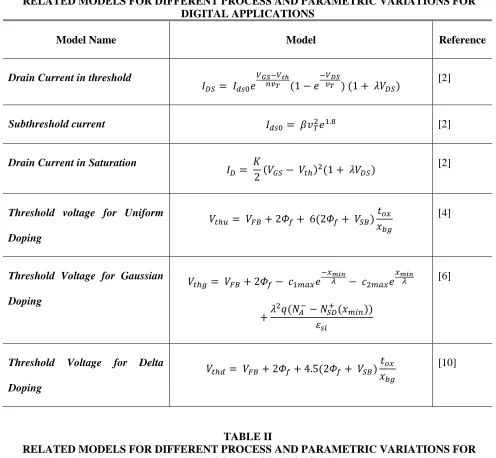
type of application they most fit in. Related models to calculate drain current, threshold voltage with
different process and parametric variations for digital applications are shown in Table 1 while
8
TABLE I
RELATED MODELS FOR DIFFERENT PROCESS AND PARAMETRIC VARIATIONS FOR DIGITAL APPLICATIONS
Model Name Model Reference
Drain Current in threshold
𝐼𝐷𝑆 = 𝐼𝑑𝑠0𝑒
𝑉𝐺𝑆−𝑉𝑡ℎ
𝑛𝑣𝑇 (1 − 𝑒
−𝑉𝐷𝑆
𝑣𝑇 ) (1 + 𝜆𝑉𝐷𝑆) [2]
Subthreshold current 𝐼𝑑𝑠0 = 𝛽𝑣𝑇2𝑒1.8 [2]
Drain Current in Saturation
𝐼𝐷 = 𝐾
2(𝑉𝐺𝑆− 𝑉𝑡ℎ)
2(1 + 𝜆𝑉 𝐷𝑆)
[2]
Threshold voltage for Uniform
Doping
𝑉𝑡ℎ𝑢= 𝑉𝐹𝐵+ 2𝛷𝑓+ 6(2𝛷𝑓+ 𝑉𝑆𝐵)𝑡𝑜𝑥 𝑥𝑏𝑔
[4]
Threshold Voltage for Gaussian
Doping
𝑉𝑡ℎ𝑔 = 𝑉𝐹𝐵+ 2𝛷𝑓− 𝑐1𝑚𝑎𝑥𝑒−𝑥𝜆𝑚𝑖𝑛− 𝑐2𝑚𝑎𝑥𝑒 𝑥𝑚𝑖𝑛 𝜆 +𝜆 2𝑞(𝑁 𝐴−− 𝑁𝑆𝐷+(𝑥𝑚𝑖𝑛)) 𝜀𝑠𝑖 [6]
Threshold Voltage for Delta
Doping
𝑉𝑡ℎ𝑑 = 𝑉𝐹𝐵+ 2𝛷𝑓+ 4.5(2𝛷𝑓+ 𝑉𝑆𝐵)𝑡𝑜𝑥 𝑥𝑏𝑔
[10]
TABLE II
RELATED MODELS FOR DIFFERENT PROCESS AND PARAMETRIC VARIATIONS FOR ANALOG APPLICATIONS
Model Name Model Reference
Transconductance 𝑔𝑚= 𝐾(𝑉𝐺𝑆− 𝑉𝑡ℎ) [11], [16]
Output Resistance
𝑅0= 1 𝑔𝑚
9
4
S
IMULATIONR
ESULTS ANDA
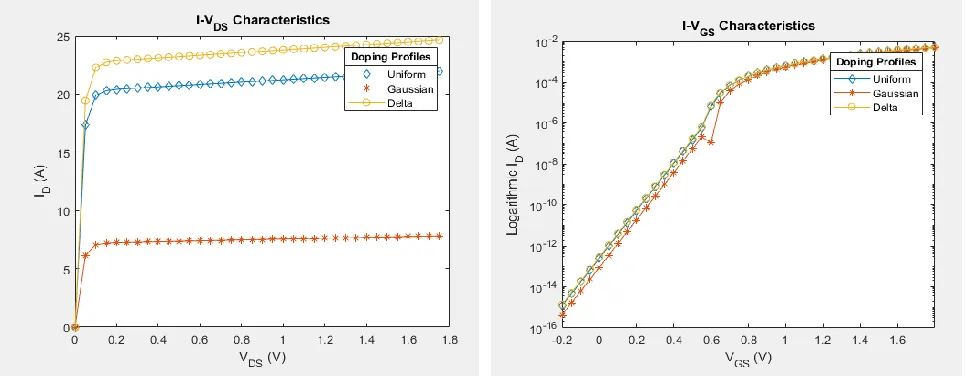
NALYSISWith the simulation in hand, as seen from Fig. 2-Fig. 4, subthreshold swing and temperature have a
similar pattern because of the dependency of the chemical makeup of the doping profiles consisting of
only silicon and silicon dioxide. Therefore, the analysis on those categories means very little for doping
profiles. Note that Gaussian doping has a mismatch after reaching past threshold, this is not indicative
of any oddities, only a mathematical mismatch.
As for how Vth is affected by intrinsic concentration, carrier density, and oxide thickness, then we see
a clear divide. Gaussian in all 3 respects follows a trend in which a small change in any of the three
does not affect the threshold value, instead large ratio differences will. While, uniform and delta being
so similar because of their Vth calculations, but delta doping having a lower threshold voltage every
time because of the small sheet layer resulting it to be less effected by all the other variables.
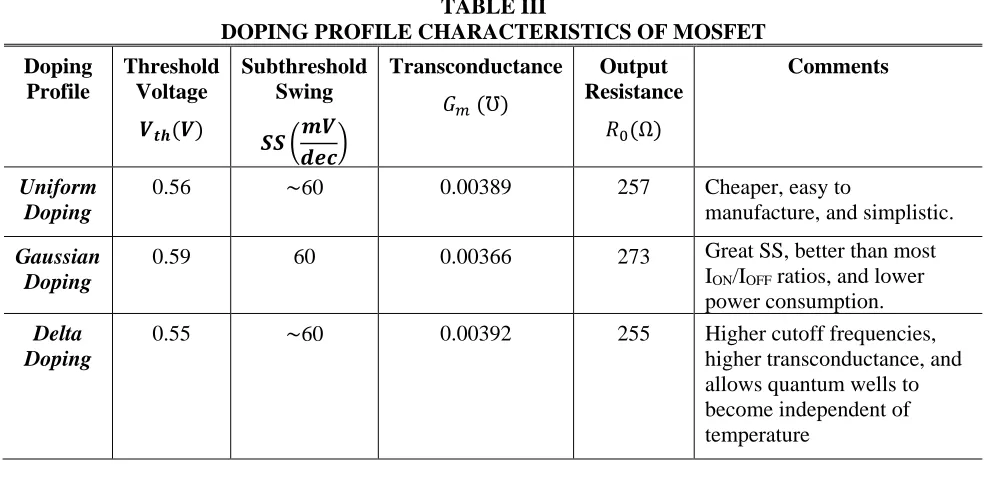
Transconductance and output resistance shows a similar pattern to temperature dependency and
subthreshold swing, in which the dependency is based on the chemical makeup of the device and not
how the transistor is doped.
Yet, there is a clear application difference between them all. The first, being uniform performing the
worst in every category, but has the advantage of being the cheapest method available and the most
simplistic. Then follows delta doping, which does what uniform aims to accomplish but better in many
regards thanks to extra doping layer underneath. Delta doping also plays a big role for RF integration
because of its of how it allows for higher cut-off frequencies. Finally, Gaussian has been shown to be
much more effective at dealing with subthreshold swing, ION/IOFF, and power consumption compared
to delta and uniform because of its complex mathematics that maximizes the efficiency of the source
10
Figure 1. I-V characteristics of each doping profile with channel modulation applied using Eq. 1 and 2. Results show case that uniform and delta deal with channel modulation worse than Gaussian, but it may tie closer to the Vth values both profiles had.
Figure 2. Logarithmic I-V characteristics, showcasing subthreshold swing and subthreshold current using Eq. 1 - Eq. 3. All 3 doping profiles show similar results for subthreshold swing of around 60 mV/dec.
Figure 3. The effects of temperature on each doping profile. All 3 (uniform doping, Gaussian doping and delta doping) have a consistent trend of decreasing linearly.
11
Figure 5. The effects of charge carrier density on the threshold voltage of each doping profile. Gaussian is less effected by the change.
Figure 6. The effects of intrinsic carrier concentration on the threshold voltage of each doping profile. Gaussian does not care about intrinsic carrier concentration in small orders of magnitude.
TABLE III
DOPING PROFILE CHARACTERISTICS OF MOSFET
Doping Profile Threshold Voltage 𝑽𝒕𝒉(𝑽) Subthreshold Swing 𝑺𝑺 (𝒎𝑽 𝒅𝒆𝒄) Transconductance 𝐺𝑚 (℧) Output Resistance
𝑅0(Ω)
Comments
Uniform Doping
0.56 ~60 0.00389 257 Cheaper, easy to
manufacture, and simplistic.
Gaussian Doping
0.59 60 0.00366 273 Great SS, better than most
ION/IOFF ratios, and lower power consumption.
Delta Doping
0.55 ~60 0.00392 255 Higher cutoff frequencies,
higher transconductance, and allows quantum wells to become independent of temperature
5
C
ONCLUSIONThe investigation of this paper acts as a beginner’s guide to help identify ideal and non-ideal effects
of uniform, delta, and Gaussian doping profiles. Then a discussion on what applications these doping
12
that although doping profiles can influence non-ideal characteristics, the chemical makeup of the device
plays a much more important role in that regard. Therefore, a further study on the physical
characteristics of each doping method needs to be made to further understand the differences between
13
R
EFERENCES[1] V. A. K. Temple, "Ideal FET doping profile," in IEEE Transactions on Electron Devices, vol.
30, no. 6, pp. 619-626, June 1983. doi: 10.1109/T-ED.1983.21180.
[2] H. J. M. Veendrick, "Short-circuit dissipation of static CMOS circuitry and its impact on the
design of buffer circuits," in IEEE Journal of Solid-State Circuits, vol. 19, no. 4, pp. 468-473,
Aug 1984. doi: 10.1109/JSSC.1984.1052168.
[3] D. W. Feldbaumer and D. K. Schroder, "MOSFET doping profiling," in IEEE Transactions on
Electron Devices, vol. 38, no. 1, pp. 135-140, Jan 1991. doi: 10.1109/16.65747.
[4] P. G. Young, R. A. Mena, S. A. Alterovitz, S. E. Schacham and E. J. Haugland, "Temperature
independent quantum well FET with delta channel doping," in Electronics Letters, vol. 28, no.
14, pp. 1352-1354, 2 July 1992. doi: 10.1049/el:19920858.
[5] C. H. Wann, K. Noda, T. Tanaka, M. Yoshida and Chenming Hu, "A comparative study of
advanced MOSFET concepts," in IEEE Transactions on Electron Devices, vol. 43, no. 10, pp.
1742-1753, Oct 1996. doi: 10.1109/16.536820
[6] Wolpert, David, and Paul Ampadu. “Temperature Effects in Semiconductors.” Managing
Temperature Effects in Nanoscale Adaptive Systems, 2011, pp. 15–33.,
doi:10.1007/978-1-4614-0748-5_2.
[7] A. Nandi, A. K. Saxena and S. Dasgupta, "Analytical Modeling of a Double Gate MOSFET
Considering Source/Drain Lateral Gaussian Doping Profile," in IEEE Transactions on Electron
Devices, vol. 60, no. 11, pp. 3705-3709, Nov. 2013.
14
[8] Ramesh, R., et al. “Optical Effects on the Characteristics of GaAs Nanoscale FinFET with Vertical Gaussian Doping Profile.” Optik - International Journal for Light and Electron Optics,
vol. 124, no. 19, 2013, pp. 4019–4025., doi: 10.1016/j.ijleo.2013.02.007.
[9] Gowri, K., and V. Rajamani. “Optical Effects on the Characteristics of a Nanoscale SOI MOSFET with Uniform Doping Profile.” Optik - International Journal for Light and Electron
Optics, vol. 125, no. 13, 2014, pp. 3195–3200., doi: 10.1016/j.ijleo.2014.01.025.
[10] Mohanty, S.s., et al. “Effect of Delta Doping on the RF Performance of Nano-Scale Dual Material MOSFET.” Procedia Computer Science, vol. 57, 2015, pp. 282–287., doi:
10.1016/j.procs.2015.07.485
[11] X. A. Cao, X. M. Li, S. Li and L. Y. Liu, "Conductivity Enhancement in Organic Electronics by
Delta Doping," in IEEE Electron Device Letters, vol. 37, no. 12, pp. 1628-1631, Dec. 2016. doi:
10.1109/LED.2016.2620184
[12] Dash, Sidhartha, et al. “Improved Cut-off Frequency for Cylindrical Gate TFET Using Source Delta Doping.” Procedia Technology, vol. 25, 2016, pp. 450–455., doi:
10.1016/j.protcy.2016.08.131
[13] Sood, Himangi, et al. “Performance Analysis of Undoped and Gaussian Doped Cylindrical
Surrounding-Gate MOSFET with Its Small Signal Modeling.” Microelectronics Journal, vol.
57, 2016, pp. 66–75., doi: 10.1016/j.mejo.2016.10.001
[14] Singh, Kunal, et al. “Subthreshold Current and Swing Modeling of Gate Underlap DG MOSFETs with a Source/Drain Lateral Gaussian Doping Profile.” Journal of Electronic
15
[15] Hossain, Munem, and Masud H. Chowdhury. “Comprehensive doping scheme for MOSFETs in
ultra-Low-Power subthreshold circuits design.” Microelectronics Journal, vol. 52, 2016, pp. 73–
16
B
IOGRAPHIESXhino M. Domi received B.S. degree in in Computer Engineering from Florida Polytechnic
University, Lakeland, FL, USA in 2018.He became a Student Member of IEEE in 2017. He was born
in North Miami Beach, FL, USA, in 1996.From 2017-2018, he helped develop an educational tool for
Florida Polytechnic University known as Experimental Education: design and Implementation of Nikola Tesla’s Egg of Columbus as an Instruction Aid; the paper was later submitted to IEEE
SoutheastCon 2018. Mr. Domi was a co-lead for the IEEE SoutheastCon 2018 mobile app and helped
establish a precedence of volunteers working to create a mobile application for future IEEE Southeast
section conferences. Currently, he is working as an associate engineer at Intel. His research interest
include power aware design, VLSI design and digital signal processing.
Emadelden Fouad received his B. Sc and M. Sc degree with Theoretical Physics from Cairo
University, Egypt in 1996 and 2001 respectively. Emadelden also finished his PhD with theoretical
Nano device from Cairo University, Egypt in 2005. Previously he worked as a teaching assistant, and
instructor with the department of Physics at Cairo University. Currently he is working as an assistant
professor of physics with the department of natural science at Florida Polytechnic University. His
research interest include but not limited to quantum transport characteristics of energy efficient devices,
Electromagnetic properties of type II superconductors and emerging nanomaterials like graphene
Muhammad S. Ullah received his M.S. and Ph.D. degrees in Electrical and Computer Engineering
from Purdue University Northwest, IN, USA and University of Missouri-Kansas City, Kansas City,
MO, USA in 2013 and 2016 respectively. Before that he received his B. S. degree in Electrical and
Electronics Engineering from Chittagong University of Engineering and Technology, Bangladesh in
20018 and worked as Lecturer for 3 years. Currently, he is working as an assistant professor of electrical
and computer engineering at Florida Polytechnic University. His research includes on modeling of
17
nano-materials for digital logic and ultra-low-power applications, high speed VLSI interconnect and
modeling and higher order statistics and spectra in signal processing.