ISSN (Print) : 2320 – 3765 ISSN (Online): 2278 – 8875
I
nternational
J
ournal of
A
dvanced
R
esearch in
E
lectrical,
E
lectronics and
I
nstrumentation
E
ngineering
(A High Impact Factor, Monthly, Peer Reviewed Journal)
Website: www.ijareeie.com Vol. 7, Issue 6, June 2018
Genetic Algorithm Approach for Controlling
Nonlinear System
Sucheta Sampatrao Yadav, V.M. Panchade
Student, Department of Electrical Engineering, G. H. Raisoni Institute of Engineering and Technology, Pune, Savitribai Phule Pune University, Pune, India
Professor, Department of Electrical Engineering, G. H. Raisoni Institute of Engineering and Technology, Pune, Savitribai Phule Pune University, Pune, India
ABSTRACT: This paper mainly consist two parts, first part consist a method to solve problem of control of nonlinear time delay system using T-S Fuzzy technique. T-S Fuzzy Technique gives the benefits of to obtain nonlinear control systems, especially in the presence of incomplete knowledge of the plant or even of the precise control action appropriate to a given situation. In second part optimization technique is introduced. In optimization technique genetic algorithm approach is used to optimize the membership functions. With this optimization it is very easy to get membership function by using phase portrait and that is steady states. In this thesis the basic idea to control highly nonlinear CSTR model by using a nonlocal approach, which is conceptually simple and straightforward, is proposed for nonlinear systems design via fuzzy control. TS fuzzy models with time delay are extended to describe the nonlinear Time-delay system. First the nonlinear plant is represented by a dynamic fuzzy model. In this type of fuzzy model, local dynamics in different state-space regions are represented by linear models. The overall model of the system is achieved by fuzzy “blending” of these fuzzy models. The idea is that for each local linear model, a linear feedback control is designed. The resulting overall controller, which is nonlinear in general, is again a fuzzy blending of each individual linear controller. The design methodology is illustrated by application to the control of a CSTR example-a classical nonlinear Time-Delay system.
KEYWORDS: Adaptive control, exponentially stable, Genetic Algorithm Approach, Time Delay Systems, T-S Fuzzy technique.
I. INTRODUCTION
1.1Motivation
What defines a time-delay system is the feature that the system’s future evolution depends not only on its present state, but also on a period of its history. This particular cause-effect relationship can be most succinctly captured, and indeed has been traditionally so modeled by differential-difference equations, or more generally, by functional differential equations. It is thus unsurprising, due to their omnipresence, and for their intrinsic scientific interest and practical implication, that time-delay systems have been studied long and well. It has for decades been an active area of scientific research in mathematics, biology, ecology, economics, and in engineering, under such terms as hereditary systems, systems with after effect, or systems with time-lag. In both delayed control and delayed measurement, the delay is usually considered undesirable, which has the tendency to deteriorate the system performance or even destabilize the system. So controller is to be designed to control the system to achieve desired response.
1.2 Overview
1.2.1 Nonlinear System:
ISSN (Print) : 2320 – 3765 ISSN (Online): 2278 – 8875
I
nternational
J
ournal of
A
dvanced
R
esearch in
E
lectrical,
E
lectronics and
I
nstrumentation
E
ngineering
(A High Impact Factor, Monthly, Peer Reviewed Journal)
Website: www.ijareeie.com Vol. 7, Issue 6, June 2018
of interest to engineers, physicists and mathematicians because most physical systems are inherently nonlinear in nature. Nonlinear equations are difficult to solve and give rise to interesting phenomena such as chaos. It shows some characteristics like chaos, by which we mean that the system output is extremely sensitive to initial conditions, where simple changes in one part of the system produce complex effects throughout. Nonlinearities can be classified as inherent (natural) and intentional (artificial). Inherent nonlinearities are those which naturally come with the system's hardware and motion. Usually, such nonlinearities have undesirable effects, and control systems have to properly compensate for them. We are given a nonlinear plant to be controlled and some specifications of closed-loop system behavior, and our task is to construct a controller so that the closed loop system meets the desired characteristics [5].
1.2.2 Non-linear Time-delay System:
Ordinary differential equations in the form of
( ) = (tx(t)) (1.1)
Have been a prevalent model description for dynamical systems. In this description, the variables ( )€ are known as the state variables, and the differential equations characterize the evolution of the state variables with respect to time. A fundamental presumption on a system modeled as such is that the future evolution of the system is completely determined by the current value of the state variables. In other words, the value of the state variables ( ), < t < ∞,for any t, can be found once the initial condition
( ) = (1.2)
is known. Needless to say, ordinary differential equations in general, and stability and control of dynamical systems so modeled in particular, have been an extensively developed subject of scientific learning.
In practice, however, many dynamical systems cannot be satisfactorily modeled by an ordinary differential equation. For a particular class of many systems, the future evolution of the state variablesnot only depends on their current value, but also on their past values, say ,
(€), − < € < Such a system is called a time-delay system. Time-delay systems may arise in practice for a variety of reasons. Dynamical systems with time delay are common in chemical processes, microwave oscillators, nuclear reactors, long transmission lines in pneumatic, hydraulic, or rolling mill systems [1],[2].
1.3 Problem formulation
In view of this discussion, we should design a controller for nonlinear time-delay systems so that the performance of the dynamical system can be improved. We aim to use a set of fuzzy rules to describe a global nonlinear system into a set of local time-delay systems with uncertain nonlinear functions. We introduce genetic algorithm optimization technique. So designed controller should be robust to time varying parameters and added uncertainty.
1.3.1 Objective
The objectives of this research are outlined as follows: We aim at designing a Controller for Nonlinear Time-Delay System equation such as general equation of Continuously Stirred Tank Reactor. It consists of following steps:
1. Study of nonlinear system and develop mathematical model of nonlinear system. 2. To develop Fuzzy controller for Nonlinear System and Study of responses. 3. Study of genetic algorithm approach in controller design.
4. Simulation of fuzzy-genetic algorithm control.
5. Comparative study of fuzzy and fuzzy-genetic algorithm controller
II. LITERATURE REVIEW
ISSN (Print) : 2320 – 3765 ISSN (Online): 2278 – 8875
I
nternational
J
ournal of
A
dvanced
R
esearch in
E
lectrical,
E
lectronics and
I
nstrumentation
E
ngineering
(A High Impact Factor, Monthly, Peer Reviewed Journal)
Website: www.ijareeie.com Vol. 7, Issue 6, June 2018
delay systems. A typical approach for the analysis and synthesis of nonlinear system with time delay is the local linearization approach. First a linearization model on the nominal operating point is gotten and then a linear feedback control is designed for this linear model. In particular, some delay-independent stability conditions and stabilization approaches have been proposed for these linear delay differential equations. Results are readily available in the literature ([7] and the references cited therein). It is known that each local model is valid only for a certain range of operating conditions and so these results can only guarantee the local stability of nonlinear systems with time delay. Fuzzy logic control is another approach to obtain nonlinear control systems, especially in the presence of incomplete knowledge of the plant or even of the precise control action appropriate to a given situation. It has found successful applications not only in consumer products but also in industrial processes. [8]
A nonlocal approach, which is conceptually simple and straightforward, is proposed for nonlinear systems design via fuzzy control [9], [10]. First the nonlinear plant is represented by a dynamic fuzzy model. In this type of fuzzy model, local dynamics in different state-space regions are represented by linear models. The overall model of the system is achieved by fuzzy “blending” of these fuzzy models. The idea is that for each local linear model, a linear feedback control is designed. The resulting overall controller, which is nonlinear in general, is again a fuzzy blending of each individual linear controller. With the nonlinear time-delay sections bounded by polynomial functions, the adaptive feedback controller was presented [13]. The control problems of strict feedback nonlinear time-delay systems were considered, and corresponding state feedback controllers and output feedback controllers were constructed via backstepping method [14]. During the last two decades, fuzzy logic technique has been widely used for nonlinear system modeling, especially for systems with incomplete plant information. The T–S-model-based fuzzy control method appears to be an effective tool for controller design of complex nonlinear systems [8]. Fuzzy logic systems serve well as universal approximators [10]. T–S fuzzy time-delay system was used to approximate nonlinear time-delay system [11], [14]. Guaranteed cost control problem were considered [14]. However, the local mode under fuzzification may contain nonlinear functions. The reasons are as follows. 1) The uncertainties are difficult for us to obtain for practical industrial plants, which often appear as nonlinear functions. 2) Using few fuzzy rules for practical nonlinear systems often induces the existence of nonlinear functions in the local model. 3) To render the approximation error smaller between the fuzzy model and practical system model, we should employ some nonlinear functions in the local model. The control problem of this class of systems is more difficult than that of the linear form. The T–S fuzzy time-delay systems were investigated, and the memorial switching controllers were successfully constructed [15], [16]. Since the discontinuous control schemes not only induce the problems of the existence and uniqueness of solutions but may also cause the chattering phenomena and excite the high frequency phenomena; therefore, we should try to employ the smooth controller in practical systems if possible. On the other hand, memorial the controller needs a large controller memory to store a large amount of past information, and the precise delay information must be available for controller implementation. In practical systems, a controller equipped with a large memory is costly, and the precise delay time is difficult to obtain, especially when it is time varying. In view of these observations, we aim to design the continuous and memory less state feedback controllers for nonlinear time-delay systems. We use a set of fuzzy rules to describe a global nonlinear system into a set of local time-delay systems with uncertain nonlinear functions.
III. PHASE PLANE ANALYSIS OF CSTR MODEL
3.1 Introduction
Phase plane analysis is a graphical method for studying second-order systems. Phase plane analysis has a number of useful properties. First, as a graphical method, it allows us to visualize what goes on in a nonlinear system starting from various initial conditions, without having to solve the nonlinear equations analytically. Second, it is not restricted to small or smooth nonlinearities, but applies equally well to strong nonlinearities and to hard nonlinearities. Some practical control systems can indeed be adequately approximated as second-order systems, and the phase plane method can be used easily for their analysis.
The phase plane method is concerned with the graphical study of second-order autonomous systems described by
= ( )
ISSN (Print) : 2320 – 3765 ISSN (Online): 2278 – 8875
I
nternational
J
ournal of
A
dvanced
R
esearch in
E
lectrical,
E
lectronics and
I
nstrumentation
E
ngineering
(A High Impact Factor, Monthly, Peer Reviewed Journal)
Website: www.ijareeie.com Vol. 7, Issue 6, June 2018
Where and are the states of the system, and and are nonlinear functions of the states. Geometrically, the state
space of this system is a plane having, and as coordinates. We will call this plane the phase plane. Given a set of initial conditions, Equation (3.1) defines a solution With time varied from zero to infinity, the solution can be represented geometrically as a curve in the phase plane. Such a curve is called a phase plane trajectory. A family of phase plane trajectories corresponding to various initial conditions is called a phase portrait of a system. An important concept in phase plane analysis is that of a singular point. A singular point is an equilibrium point in the phase plane. An equilibrium point is defined as a point where the system states can stay forever. For a linear system, there is usually only one singular point (although in some cases there can be a continuous set of singular points). However, a nonlinear system often has more than one isolated singular point. [4] The power of the phase portrait lies in the fact that once the phase portrait of a system is obtained, the nature of the system response corresponding to various initial conditions is directly displayed on the phase plane
3.2 Singular points
An important concept in phase plane analysis is that of a singular point. A singular point is an equilibrium point in the phase plane. Since an equilibrium point is defined as a point where the system states can stay forever, this implies that
( ) =0
( ) =0
The values of the equilibrium states can be solved from (3.2). For a linear system, there is usually only one singular point (although in some cases there can be a continuous set of singular points, as in the system for which all points on the real axis are singular points). However, a nonlinear system often has more than one isolated singular point.
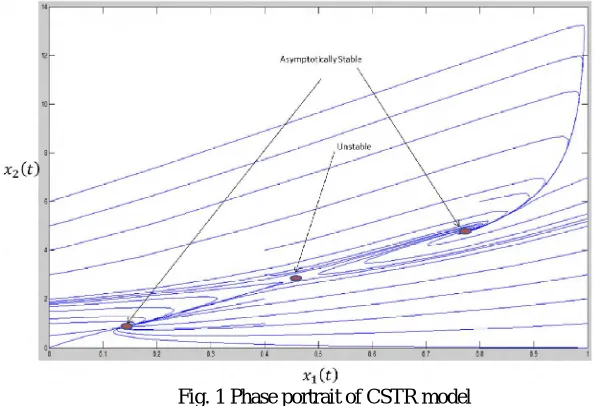
3.3 phase plane analysis of cstr model
When steady input , the system described by (3) and (4) has three steady states. The upper and lower steady state values of ( ) correspond to the steady states at upper and
Fig. 1 Phase portrait of CSTR model
ISSN (Print) : 2320 – 3765 ISSN (Online): 2278 – 8875
I
nternational
J
ournal of
A
dvanced
R
esearch in
E
lectrical,
E
lectronics and
I
nstrumentation
E
ngineering
(A High Impact Factor, Monthly, Peer Reviewed Journal)
Website: www.ijareeie.com Vol. 7, Issue 6, June 2018
IV. T-S FUZZY TECHNIQUE AND CONTROLLER DESIGN
4.1 Introductions
Almost all of the physical dynamical systems in real life cannot be represented by linear differential equations and have a nonlinear nature. At the same time, linear control methods rely on the key assumption of small range of operation for the linear model, acquired from linearizing the nonlinear system, to be valid. When the required operation range is large, a linear controller is prone to be unstable, because the nonlinearities in the plant cannot be properly dealt with. Another assumption of linear control is that the system model is indeed linearizable and the linear model is accurate enough for building up the controller. However, the highly nonlinear and discontinuous nature of many, for instance, mechanical and electrical systems does not allow linear approximation. In the design process of controllers, it is also necessary that the system model is well achievable through a mathematical model and the parameters of the system model are reasonably well-known. For many nonlinear plants i.e. chemical processes, building a mathematical model is very difficult and only the input-output data yielded from running the process is accessible for the estimation. Many control problems involve uncertainties in the model parameters. A controller based on inaccurate or obsolete values of the model parameters may show significant performance degradation or even instability. There are some complicated approaches like auto-regressive model based on the input-output data to compensate model uncertainties, which usually use to design a process control. However due to the high nonlinearity of the process, the order of the model often becomes very high so that past effects are taken into account, even if that is physically unrealistic. One way to cope with such difficulty is to develop a nonlinear model composing of a number of sub-models which are simple, understandable, and responsible for respective sub-domains. The idea of multi-model approach [1] is not new, but the idea of fuzzy modeling [2] using the concept of the fuzzy sets theory [3] offers a new technique to build multi-models of the process based on the input-output data or the original mathematical model of the system. Facing complex and nonlinear systems, we have to recognize that modeling is an art and it is important to realize system modeling is generally an act to understand things directly rather than by computer. At most a linear combination like a fuzzy model is clearly understandable. The fuzzy model proposed by Takagi and Sugeno [2] is described by fuzzy IF-THEN rules which represent local input-output relations of a nonlinear system. The main feature of a Takagi-Sugeno fuzzy model is to express the local dynamics of each fuzzy implication (rule) by a linear system model. The overall fuzzy model of the system is achieved by fuzzy "blending" of the linear system models. Almost all nonlinear dynamical systems can be represented by Takagi-Sugeno fuzzy models to high degree of precision. In fact, it is proved that Takagi-Sugeno fuzzy models are universal approximates of any smooth nonlinear system [4, 5].
Fig.2 Basic structure of Fuzzy systems
4.2 Takagi-sugeno fuzzy modeling
ISSN (Print) : 2320 – 3765 ISSN (Online): 2278 – 8875
I
nternational
J
ournal of
A
dvanced
R
esearch in
E
lectrical,
E
lectronics and
I
nstrumentation
E
ngineering
(A High Impact Factor, Monthly, Peer Reviewed Journal)
Website: www.ijareeie.com Vol. 7, Issue 6, June 2018
familiar Mamdani fuzzy systems. A simple but representative Mamdani fuzzy rule describing the movement of a car is: IF Speed is High AND Acceleration is Small THEN Braking is (should be) Modest, Where Speed and Acceleration are input variables and Braking is an output variable."High," "Small," and "Modest" are fuzzy sets, and the first two are called input fuzzy sets while the last one is named the output fuzzy set. The variables as well as linguistic terms, such as "High", can be represented by mathematical symbols. Thus, a Mamdani fuzzy rule for a fuzzy controller involving three input variables and two output variables can be described as follows:
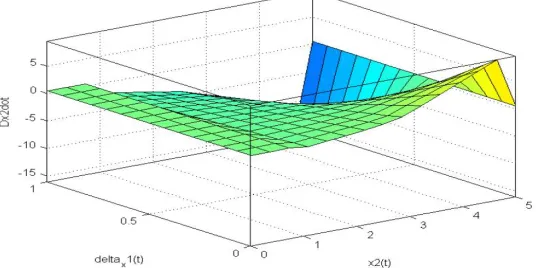
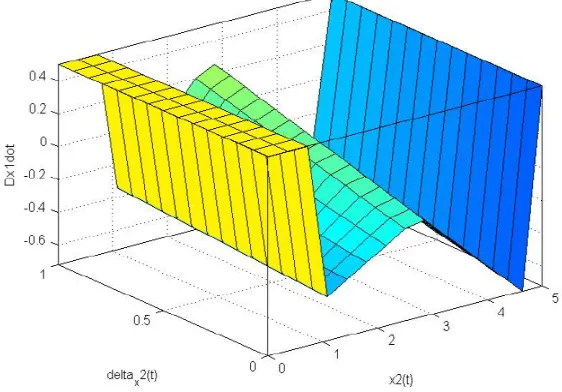
4.3 Fuzzy Rules surfaces.
The fuzzy rules mentioned in above section can be represented in three dimensional surfaces as follows which shows the change in output with various values of input
Fig 3Fuzzy Rules surfaces for output
ISSN (Print) : 2320 – 3765 ISSN (Online): 2278 – 8875
I
nternational
J
ournal of
A
dvanced
R
esearch in
E
lectrical,
E
lectronics and
I
nstrumentation
E
ngineering
(A High Impact Factor, Monthly, Peer Reviewed Journal)
Website: www.ijareeie.com Vol. 7, Issue 6, June 2018
Fig 5 Fuzzy Rules surfaces for output
ISSN (Print) : 2320 – 3765 ISSN (Online): 2278 – 8875
I
nternational
J
ournal of
A
dvanced
R
esearch in
E
lectrical,
E
lectronics and
I
nstrumentation
E
ngineering
(A High Impact Factor, Monthly, Peer Reviewed Journal)
Website: www.ijareeie.com Vol. 7, Issue 6, June 2018
V. SIMULATION BLOCK DIAGRAMS AND RESULTS
1. Simulation block diagram and result
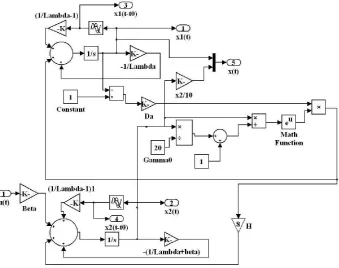
Fig. 7 Closed loop Simulink diagram of CSTR model with constant time delay
ISSN (Print) : 2320 – 3765 ISSN (Online): 2278 – 8875
I
nternational
J
ournal of
A
dvanced
R
esearch in
E
lectrical,
E
lectronics and
I
nstrumentation
E
ngineering
(A High Impact Factor, Monthly, Peer Reviewed Journal)
Website: www.ijareeie.com Vol. 7, Issue 6, June 2018
These equations are implemented in MATLAB/Simulink environment to get simulated model of CSTR system. So Fig. 8 shows the Simulink model of CSTR created as subsystem. Fig. 9 represents closed loop simulation diagram wherein controller is implemented using Fuzzy Logic and is applied to the CSTR model.
2. CSTR model
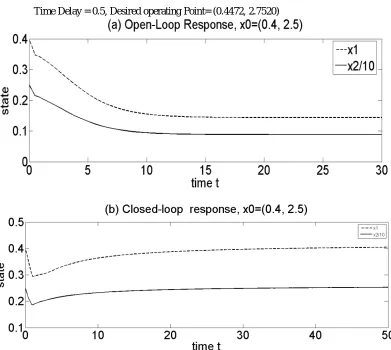
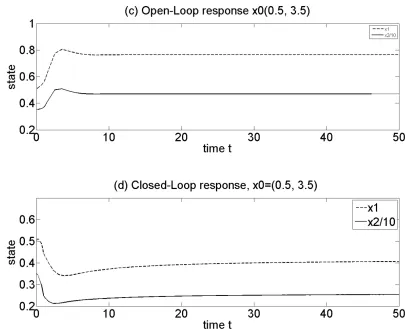
The SIMULINK model of the Continuously Stirred Tank Reactor (CSTR) is simulated n MATLAB/SIMULINK environment. The simulation results for different cases using SIMULINK block diagram are given below.
Case-1: When time delay is constant with x0= (0.4, 2.5)
Time Delay = 0.5, Desired operating Point= (0.4472, 2.7520)
ISSN (Print) : 2320 – 3765 ISSN (Online): 2278 – 8875
I
nternational
J
ournal of
A
dvanced
R
esearch in
E
lectrical,
E
lectronics and
I
nstrumentation
E
ngineering
(A High Impact Factor, Monthly, Peer Reviewed Journal)
Website: www.ijareeie.com Vol. 7, Issue 6, June 2018
Case-2: When time delay is constant with x0= (0.5, 3.5)
Fig. 10 Simulation results CSTR when Time Delay is constant.
VI. GENETIC ALGORITHM APPROACH
1. Need of genetic algorithm
ISSN (Print) : 2320 – 3765 ISSN (Online): 2278 – 8875
I
nternational
J
ournal of
A
dvanced
R
esearch in
E
lectrical,
E
lectronics and
I
nstrumentation
E
ngineering
(A High Impact Factor, Monthly, Peer Reviewed Journal)
Website: www.ijareeie.com Vol. 7, Issue 6, June 2018
Fig. 11Randomly chosen membership function With this membership function we get the results as follow in
Fig. 12 Output response of randomly chosen membership function
2. Genetic algorithm basics Genetic algorithm introduced by Holland in 1975.Genetic algorithms (GAs) are search algorithms based on the mechanics of natural genetics. This has following stages:
1. SELECTION /REPRODUCTION 2. CROSSING OVER
3. MUTATION
Advantages of GA’s are given below: Simple to understand and to implement It solves problems with multiple solutions
Provides a list of optimum variables, not just a single solution
Works with numerically generated data, experimental data, or analytical functions. Therefore, works on a wide range of problems Because of such reasons we are concentrating on fuzzy controller and genetic algorithm approach in our work and then we will compare the result of both. Genetic algorithm is a method for solving both constrained and unconstrained optimization problem.
3. Optimization for triangular membership functions
ISSN (Print) : 2320 – 3765 ISSN (Online): 2278 – 8875
I
nternational
J
ournal of
A
dvanced
R
esearch in
E
lectrical,
E
lectronics and
I
nstrumentation
E
ngineering
(A High Impact Factor, Monthly, Peer Reviewed Journal)
Website: www.ijareeie.com Vol. 7, Issue 6, June 2018
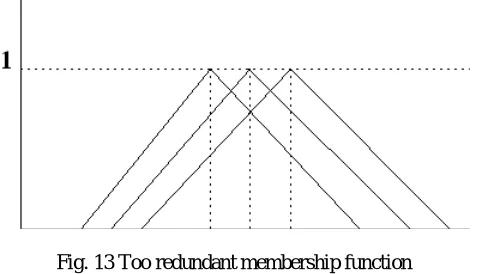
This step is important because there are two types of bad membership function. First one is too redundant and second one is too separated. Due to such membership function we cannot get the desired response or output. Too redundant and too separated membership functions are shown below
Fig. 13 Too redundant membership function
For reducing the probability of getting such membership functions the bounds of base are chosen very correctly for each function.
Fig. 14Too separated membership function
Selection of membership function and respective bounds can be done as follow. Triangular membership function can be defined as
ISSN (Print) : 2320 – 3765 ISSN (Online): 2278 – 8875
I
nternational
J
ournal of
A
dvanced
R
esearch in
E
lectrical,
E
lectronics and
I
nstrumentation
E
ngineering
(A High Impact Factor, Monthly, Peer Reviewed Journal)
Website: www.ijareeie.com Vol. 7, Issue 6, June 2018
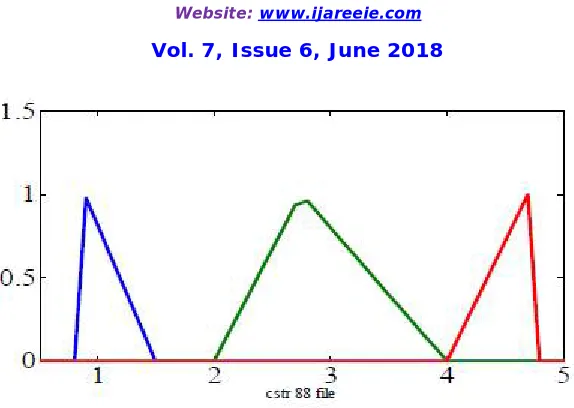
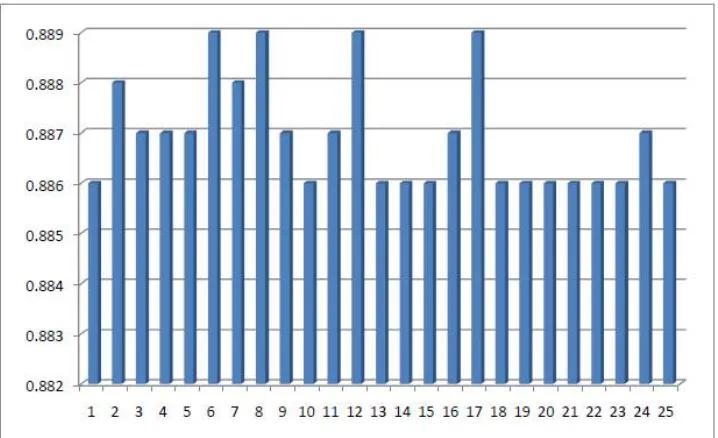
Fig. 15 Base values of first membership function with consecutive 25 run
Below we show bar plot of 25 consecutive runs in which we get 0.886 repeating more time or maximum hits occurs at 0.866 so we consider that point as our base value.
ISSN (Print) : 2320 – 3765 ISSN (Online): 2278 – 8875
I
nternational
J
ournal of
A
dvanced
R
esearch in
E
lectrical,
E
lectronics and
I
nstrumentation
E
ngineering
(A High Impact Factor, Monthly, Peer Reviewed Journal)
Website: www.ijareeie.com Vol. 7, Issue 6, June 2018
For first membership function we get base values as follow
VII. CONCLUSION
The paper mainly consist two parts, first part consist a method to solve problem of control of nonlinear time delay system using T-S Fuzzy technique. T-S Fuzzy Technique gives the benefits of to obtain nonlinear control systems, especially in the presence of incomplete knowledge of the plant or even of the precise control action appropriate to a given situation. In second part optimization technique is introduced. In optimization technique genetic algorithm approach is used to optimize the membership functions. With this optimization it is very easy to get membership function by using phase portrait and that is steady states. In this thesis the basic idea to control highly nonlinear CSTR model by using a nonlocal approach, which is conceptually simple and straightforward, is proposed for nonlinear systems design via fuzzy control. TS fuzzy models with time delay are extended to describe the nonlinear Time-delay system. First the nonlinear plant is represented by a dynamic fuzzy model. In this type of fuzzy model, local dynamics in different state-space regions are represented by linear models. The overall model of the system is achieved by fuzzy “blending” of these fuzzy models. The idea is that for each local linear model, a linear feedback control is designed. The resulting overall controller, which is nonlinear in general, is again a fuzzy blending of each individual linear controller. The design methodology is illustrated by application to the control of a CSTR example-a classical nonlinear Time-Delay system.
i. The response of the CSTR model is improved.
ii. CSTR can be operated at desired state under nonlinearities, uncertainties and time varying delays present in CSTR system because of Recycle.
iii. Controller is designed considering constant time delay, time varying delay and added uncertainty. iv. Membership functions are optimized with genetic algorithm approach.
v. Thus T-S Fuzzy technique is more useful in the control of highly nonlinear system, because the local nonlinearities present in the system can be easily handled and genetic algorithm is beneficial because it optimizes the fuzzy
REFERENCES
[1] PrabhuRamanathan, Sukany A. K. C, Sidhanta Mishra, SudhaRamasamy Study on Fuzzy Logic and PID Controller for Temperature Regulation of a System with Time Delay: 978-1-4673-6150-7/2013 IEEE
[2] W. Assawinchaichote, S. K. Nguang, and P. Shi, Fuzzy Control and Filter Design for Uncertain Fuzzy Systems. Berlin, Germany: Springer-Verlag, 2006.
[3] G. Feng survey on analysis and, “A design of model-based fuzzy control systems,” IEEE Trans. Fuzzy Syst., vol. 14, no. 5, pp. 676–697, Oct. 2006.
[4] B. Kosko, “Fuzzy systems as universal approximators,” IEEE Trans. Comput., vol. 43, no. 11, pp. 1329–1333, Nov. 1994.
[5] FarzadFadaei, Mehdi Shahbazian, MassoudAghajani and HooshangJazayeri-Rad “A Novel Hybrid Fuzzy PID Controller Based on Cooperative Co-evolutionary Genetic Algorithm” J. Basic. Appl. Sci. Res., 3(3)337-344, 2013, TextRoad Publication
ISSN (Print) : 2320 – 3765 ISSN (Online): 2278 – 8875
I
nternational
J
ournal of
A
dvanced
R
esearch in
E
lectrical,
E
lectronics and
I
nstrumentation
E
ngineering
(A High Impact Factor, Monthly, Peer Reviewed Journal)
Website: www.ijareeie.com Vol. 7, Issue 6, June 2018
[8] Huai-Xiang Zhang, Feng Wang, Bo Zhang “Genetic Optimization Of Fuzzy Membership Functions”, Proceedings of the 2009 International Conference on Wavelet Analysis and Pattern Recognition, Baoding, 12-15 July 2009
[9] T. Takagi and M. Sugeno, “Fuzzy identification of systems and its applications to modeling and control,” IEEE Trans. Syst., Man, Cybern., vol. SMC-15, no. 1, pp. 116–132, Jan. 1985.
[10] Y. Cao and P. Frank, “Analysis and synthesis of nonlinear time-delay systems via fuzzy control approach,” IEEE Trans. Fuzzy Syst., vol. 8, no. 2, pp. 200–211, Apr. 2000.
[11] C. Lin, Q. Wang, and T. Lee, “Stabilization of uncertain fuzzy time-delay systems via variable structure control approach,” IEEE Trans. Fuzzy Syst., vol. 13, no. 6, pp. 787– 798, Dec. 2005.
[12] F. Gouaibaut, Y. Blanco, and J. P. Richard, “Robust sliding mode control of non-linear systems with delay: A design via polytopic formulation,” Int. J. Control, vol. 77, no. 2, pp. 206–215, 2004.
[13] K. Gu, V. L. Kharitonov, and J. Chen, Stability of Time-Delay Systems. Berlin, Germany: Birkhauser, 2003.
[14] Huai-Xiang Zhang, Feng Wang, Bo Zhang, Genetic Optimization Of Fuzzy Membership Functions. Proceedings of the 2009 International Conference on Wavelet Analysis and Pattern Recognition, Baoding, 12-15 July 2009