Students’ Performance in Chemistry in relation to their
Logical Thinking Ability
Ali Haider
Ph.D. Scholar, Department of Educational Studies Jamia Millia Islamia, New Delhi-110025, India [email protected]
Abstract
Chemistry seems to be one of the difficult subject to study for many students. One of the probable reasons for their difficulties inherited in the nature of chemistry (Johnstone, 2000). Because some
aspects of chemical phenomenon are observable while others are invisible to the learners.For example,
a chemical reaction which takes place in a test-tube can be identified, by observing for evolution of gas, change in colour, change in energy etc., but description and prediction for such changes seemingly more difficult. This might be due to their inability for establishing relation between visible experiences and invisible changes that taking place at atomic or molecular level. Learning of abstract concepts requires abstract thinking and high level reasoning ability, probably best suited for formal operational thinker.
Logical thinking of formal-operational child involves deductive and inductive reasoning which they operate on operations. Hence, the investigator was intended to explore Grade 11 students’ profile of logical thinking ability and to analyse a pattern of their performance in general chemistry, if any. The sample of the study comprised thirty students of science stream of Grade 11. Since, the sample is small it has little scope for generalisation. In spite of many limitations of the study, the findings have scope for further studies. Teachers, student-teachers and others in the field of education come under the ambit of this paper.
Keywords: Chemistry; Logical thinking ability; TOLT
1. Introduction
The word „thinking‟ is contextual, connotes various notions viz. remembering, solving problem, day dreaming and so on. Although thinking varies in nature yet no one can deny that it largely covers many aspects of the workings of one‟s intellect. All thinking can‟t be treated as logical thinking. The concept of logical thinking can be grasped from the work of Piaget, „Logic of meaning‟. In the words of Miller (2009)
“Piaget emphasized that logic comes from the
meanings of objects, developed from infants‟ actions. Specifically, infants learn that one action
on an object is related to other actions; the meaning of actions comes from „what they lead to.‟ That is, one action can be inferred from another, in a sort of „logic of meaning in actions,‟
a „psycho-logic‟ on objects. This action-based
logic later leads to logic of operations….” (p.
namely concrete operational stage and formal operational stage are special attention for teachers as well as curriculum developers, on account of the fact that these stages are directly linked with elementary and further higher school education.
The concrete operation child usually operates on reality and his or her thoughts are semi-logical. The object of logical thought remains concrete things. This logical thought of a child shifts from concrete world to ideal world when he or she reaches formal stage. A child of this stage is characterised by his/her well reasoned thought, i.e., the child can think logically about abstract propositions, he or she becomes concerned with the hypothetical and ideological problems, and can use both deductive reasoning and inductive reasoning. In other words, reaching at formal operational stage a child gets mature in terms of logical thinking. A formal operational child usually „operates on operations‟. Logical thinking is therefore, an ability that grows over period of time and influenced by maturation, learning and other experiences.
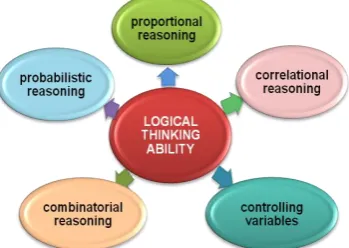
Figure 1: Components of logical thinking ability This ability constitutes of five kinds of reasoning namely, proportional reasoning, correlational reasoning, controlling variables, combinatorial reasoning and probabilistic reasoning.
1.1 Relevance of Logical Thinking Ability in Learning Chemistry
For many students chemistry seems to be a difficult subject (Johnstone, 2000). One of the possible reasons for difficulty lie abstract nature of many concepts in chemistry (BouJaoude, 1991). Some aspects of chemical phenomenon are observable while others are invisible to the learners. For example, a chemical reaction which takes place in a test-tube can identified by observing for evolution of gas, change in colour, change in energy etc., but description and prediction of the cause for such changes and formation product seems to be difficult for them. This might be due to their inability for establishing relation between visible experiences and invisible changes that taking place at atomic or molecular level. The changes which occur in the arrangement of atom, molecules or other subatomic particles are invisible and these changes are beyond students‟ direct sensory experience. In essence, learning of abstract concepts in chemistry demands abstract and formal thinking.
McLaughlin (2003) found that student success in secondary science is highly dependent on proportional reasoning ability. Proportional reasoning seems to be essential in dealing with algorithmic or quantitative nature of problem in chemistry. This reasoning is used in solving
algorithmic problems of mole concepts,
stoichiometry, solid states, solution, Kinetic gas
equations, chemical kinetics, chemical
equilibrium and thermodynamics etc. Similarly, correlational reasoning explains an ability to relate two variables which is a very common task frequently required in chemistry. For doing experiment students should have ability to
determine, discriminate and manipulate
dependent and independent variables. Similarly, probabilistic reasoning allows students to understand the need for repeated trials in investigations as well as the use of averages of collected data from duplicated experiments. The role of individual differences, for instance, logical thinking ability seems to be important factor which can influence performance of students in chemistry. Keeping in view the present investigation was conducted to explore the logical thinking ability profile of Grade 11 students of science stream. The investigator also intended to analyse a pattern of students‟ performance in general chemistry, if any, in relation to different levels of logical thinking ability.
1.2 Objectives of the Study
1 To study Grade 11 students‟ profile of
logical thinking ability.
2 To categorise and study the students in terms
of their logical thinking ability.
3 To study the performance of students on
some basic-concepts in general chemistry.
4 To study the relationship between students‟
logical thinking ability and their
performance on some basic-concepts in general chemistry.
1.3 Hypotheses of the Study
There is no significant relationship
between the students‟ logical thinking ability and their performance on some basic-concepts in general chemistry. 1.4 Delimitations
The study was confined to eleventh-class students of science stream following CBSE syllabus. The Test in Basic-concepts in Chemistry (TBC) was confined to cognitive aspect.
2. Methodology
2.1 Sample
The sample of the study comprised thirty students of Grade 11 enrolled in science stream. All students were taken from same class of one co-education school located in south Delhi.
2.2 Material and Procedure The tools used in the study were:
(i) The Test of Logical Thinking (TOLT): To measure logical thinking ability of students standardized tool the TOLT was used. It was originally developed by Tobin & Capie (1981). The ten items of the TOLT measured five logical reasoning and the maximum possible score for each sub-scale is two.
2.3 Procedure
Before administering the tests, the necessary permission was sought from the Principal of sampled school. The TOLT was administered at in the beginning of the lessons taught and test
was conducted after completion of the required content.
2.4 Analysis of Data
Data was analyzed qualitatively and
quantitatively keeping in view the objectives formulated for the study.
3. Results and Discussion
The forthcoming sections present interpretation of data, results and discussions. 3.1 Logical Thinking Ability of Students
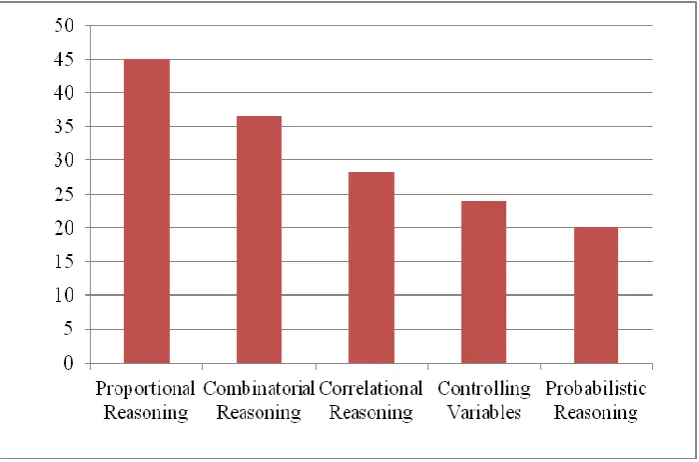
Students‟ logical thinking ability was gauged through the Test of Logical Thinking (TOLT). Performance of students on the five components of logical thinking ability is summarized in the Table 1. As it is revealed from the Table 1, students‟ score was highest (45%) in proportional reasoning and lowest (20%) in probabilistic reasoning. Students‟ highest difficulty in probabilistic reasoning was also supported by findings of earlier researches (Fah, 2010; Bitner & Betty, 1991).
Table 1:Students’ Performance on Five Components of TOLT(N=30)
S. No. Components of logical thinking
ability
Scores Obtained
Max. possible score (N × 2)
Percentage
1 Proportional Reasoning 27 60 45.00
2 Controlling Variables 15 60 24.00
3 Probabilistic Reasoning 12 60 20.00
4 Correlational Reasoning 17 60 28.33
5 Combinatorial Reasoning 22 60 36.66
Overall 30.79
Their performance on the five components of logical thinking ability in decreasing order is depicted in
Figure 2: Student’s performance of components of logical thinking ability
3.2. Categorisation of Students in terms of Logical Thinking Ability
Students‟ scores on the TOLT were used both as a measure of logical thinking ability and also as a means to categorise them into different levels. Valanides (1997) in his study cited Tobin & Capie as “Test scores from 0 1, 2 3 and 4 10 were used as a basis for classifying subjects as concrete, transitional, and formal reasoners, respectively” (p. 174). Piaget did not mention a transitional stage in between concrete and formal operational stage. The concept of transition stage: a sub-stage within concrete and formal operational stage was used by number of researchers (Fah, 2010; Bird, 2010; Valanides, 1997). Following the trend categorisation was done (Table 2).
Table 2: Categorisation of Students Based on TOLT Score (N=30)
Levels of Logical thinking ability TOLT Score Number of Students Percentage
Concrete thinking 0-1 6 20
Transitional thinking 2-3 8 27
Formal thinking 4-10 16 53
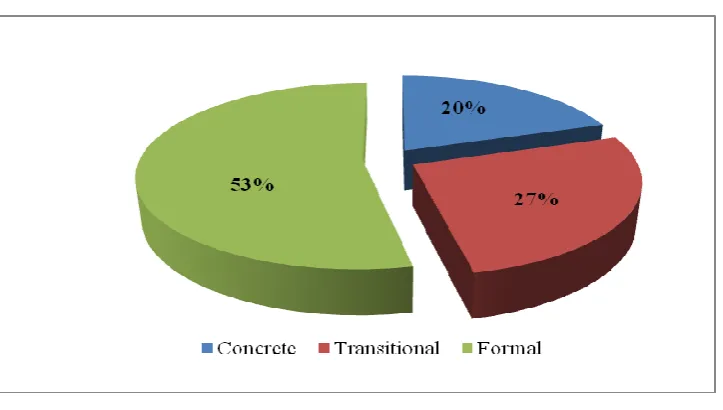
The above Table 2 shows that 20% students were concrete thinker, 27% students were at transitional
level and remaining 53% students reached formal thinking level. A pie diagram Figure 1 shows the
Figure 2: Distribution of students by operational level
The analysis revealed that about 53% students reaches formal level. These findings are somehow comparable to those obatiend by Bird (2010) for students enrolled in general chemistry showed that 19% concrete, 40% transitional and 41% formal level although he used another instrument to measure logical thinking ability. Grade 11 student‟s profile of logical thinking ability highlights the inclusion of students with all three levels of logical thinking ability.
3.3 Performance of Students on the Test of Basic-concepts in Chemistry (TBC)
The mean and standard deviation of students were 13.53 (68%) and 3.75 respectively on the test of basic-concepts in general chemistry as shown in Table 3. Since the obtained mean was about seventy percent of maximum possible score of the test, it can be inferred that on an average, the students had a satisfactory performance on the Test in chemistry.
Table 3: Students’ Performance on TBC (Number of students N=30)
Maximum possible score for each student
= Total number of items
Minimum Maximum Sum Mean Mean
percentage SD
20 5.00 20.00 406.00 13.53 67.65 3.75
3.4 Performance of Students on Some Basic-Concepts in General Chemistry in terms of their Logical Thinking Ability
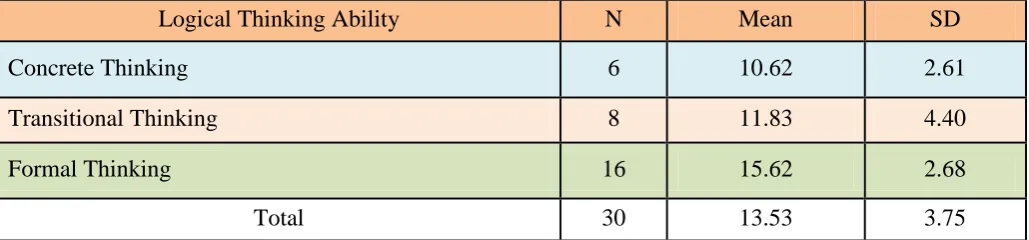
Table 4:Mean and SD of TBC Scores with different levels of Logical Thinking Ability
Logical Thinking Ability N Mean SD
Concrete Thinking 6 10.62 2.61
Transitional Thinking 8 11.83 4.40
Formal Thinking 16 15.62 2.68
Total 30 13.53 3.75
Analysis revealed expected trend in performance of students. Concrete thinker scored low (M = 10.62,
SD = 2.61) compared to those of transitional (M = 11.83, SD = 4.40) and formal thinker (M = 15.62, SD
= 2.68). It means that performance of formal thinker was better than transitional and concrete thinker.
The finding shows that same instructional strategy for teaching basic-concepts in general chemistry cannot be equally effective for these all three groups.
3.5 Relationship between Students’ Logical Thinking Ability and their Performance on TBC
The correlation between students‟ TBC scores and logical thinking ability was shown in Table 5.
Table 5: Correlation between TBC and Logical thinking ability
Variables Correlation coefficient
r p
Students‟ understanding in basic concepts & logical thinking
ability .627
**
.000
* Correlation is significant at the 0.05 level ** Correlation is significant at the 0.01 level
The correlation between logical thinking ability (the TOLT score) and students‟ performance on
basic-concepts in general chemistry (the TBC score) was found to be significant and moderate (r = .627, p ≤
0.01). Thus, the null hypothesis stating that that there is no significant relationship between logical
thinking ability and students‟ performance on TBC was rejected. This finding was in line with many previous researches (Bird, 2010; Lewis & Lewis 2007) which showed a positive correlation between logical thinking ability and students‟ achievement in chemistry or sciences.
4. Major Findings of the Study
Grade 11 students are of three levels of
logical thinking ability.
20% students were concrete thinker, 27%
students were at transitional level and remaining 53% students reached formal thinking level.
Formal thinker performed better than
transitional and concrete thinker.
Students performance in probabilistic
reasoning was low.
Students‟ performance on basic-concepts
in general chemistry and their logical thinking ability shows significant and
moderate correlation (r = .627, 0.01).
5. Conclusion and Suggestions
educators. It is obvious because these two stages exercise logical operations. The findings of this study is in queue with earlier research findings (Bird, 2010; Adey and Shayer, 1990) showing that for a large proportion of secondary and higher secondary students are concrete and transitional thinker. Many of concepts in
chemistry are related with microscopic
phenomenon, such as structure of atom, organic reaction mechanism etc., which seem to require abstract and higher order logical thinking ability. The teacher should emphasise on the logical thinking ability of students. Striking a balance between operational level of students and instructional strategies followed can make teaching-learning of chemistry effective. The development of logical thinking ability in general can assist students in grasping many abstract concepts in chemistry. Effort of teachers in this direction will help students in learning advance concepts in chemistry. Use of computer assisted instruction or ICT in teaching-learning process can assist students in visualising abstract concepts. Similarly, providing more hands-on experiences and concrete problems to school-student can enhance their learning outcome. This study was conducted on very small sample and hence it has little scope for generalization. Still, it can provide some direction for further studies to investigate many questions as, Does logical thinking ability true predictor for learning outcome in chemistry? Does logical thinking ability interact with computer-assisted instruction or any other instructional strategies used for teaching chemistry?
Acknowledgement
The present study was a pilot study of my Doctoral Research, Jamia Millia Islamia (A
teachers and supervisors Prof. Najma Amin, Prof. Harjeet Kaur Bhatia and Prof. Talat Aziz. Sincere thanks goes to my teacher Dr. Arshad Ikram Ahmad, and all my colleagues, school‟s authority, and students who give their valuable contribution in the study. I express my deep gratitude and affection to my brother Mr. Ali Akbar and my sister Ms. Saeeda Khatoon and cousin Fatima Khatoon. Last but not least, I would like to avail this opportunity in acknowledging the contribution and moral support given by my angel parents Mrs. Shamima Khatoon and Mr. Mohammad Shamim Akhtar.
References
[1] Adey, P. S., & Shayer, M. (1990).
Accelerating the development of formal thinking
in middle and high school students. Journal of
Research and Development in Education, 27,
267 285.
[2] Betty, L., & Bitner (1991). Formal
operational reasoning modes: Predictors of critical thinking abilities and grades assigned by teachers in science and mathematics for students
in grades nine through twelve. Journal of
Research in Science Teaching, 28(3), 265–274.
[3] Bird, L. (2010). Logical reasoning ability
and student performance in general chemistry.
Journal of Chemical Education,87(5), 541 546.
[4] BouJaoude, S., Salloum, S., & Fouad
Abd-El-Khalick. (2004). Research report,
International Journal of Science Education,
[5] Fah, L.Y. (2010). The acquisition of logical thinking abilities among rural secondary
students of Sabah. Pertanika J. Soc. Sci & Hum,
18(S), 37 51.
[6] Inhelder, B., & Piaget, J. (1958). The
growth of logical thinking from childhood to
adolescence. New York, Basic Books Inc.
[7] Inhelder, B., & Piaget, J. (1958). The
early growth of logic in the child: Classification
and seriation. New York, Basic Books Inc.
[8] Johnstone, A. H. (2000). Teaching of
chemistry-logical or psychological?. Chemistry
Education Research and Practice, 1(1), 9 15.
[9] Johnstone, A. H. (2005). Chemical
education research in Glasgow in perspective. Chemistry Education Research and Practice,
7(2), 49 63.
[10] Lawson, A. E. (1983). Predicting science
achievement: the role of Piagetian developmental level, disembedding ability, mental capacity,
prior knowledge, and beliefs. Journal of
Research in Science Teaching, 20, 117–129.
[11] Lawson, A. E. (1985). A review of
research on formal reasoning and science
teaching. Journal of Research in Science
Teaching, 22(7), 569 617.
[12] Lewis, S. E., & Lewis, J. E. (2007).
Predicting at-risk students in general chemistry: comparing formal thought to a general
achievement measure. Journal of Chemical
Education, 8(1), 32 51.
[13] McLaughlin, S. (2003). Effect of
modeling instruction on development of
proportional reasoning II: Theoretical
background. Retrieved September 22, 2011, from http://modeling.asu.edu/modeling-HS.html
[14] Miller, P. H. (2009). Theories of
developmental psychology (5th ed.). New York:
Worth Publishers.
[15] Mwamwenda, T. S. (2005). Formal
operations as predictor of university academic
achievement. Africa Education Review, 2(2),
299 306.
[16] Sezen, N., & Bulbul, A. (2011). A scale
on logical thinking abilities. Procedia Social and
Behavioral Sciences, 15, 2476
[17] Tobin, K. G., & Capie, W. (1981). The
development and validation of a group test of
logical thinking. Educational and Psychological
Measurement, 41(2), 413 423.
[18] Valanides, N. (1997). Formal reasoning
abilities and school achievement. Studies in