Scholarship@Western
Scholarship@Western
Electronic Thesis and Dissertation Repository
5-29-2012 12:00 AM
Heterogeneity issues in the meta-analysis of cluster
Heterogeneity issues in the meta-analysis of cluster
randomization trials.
randomization trials.
Shun Fu Chen
The University of Western Ontario
Supervisor Drs Allan Donner
The University of Western Ontario Joint Supervisor Neil Klar
The University of Western Ontario
Graduate Program in Epidemiology and Biostatistics
A thesis submitted in partial fulfillment of the requirements for the degree in Doctor of Philosophy
© Shun Fu Chen 2012
Follow this and additional works at: https://ir.lib.uwo.ca/etd
Part of the Biostatistics Commons, and the Clinical Trials Commons
Recommended Citation Recommended Citation
Chen, Shun Fu, "Heterogeneity issues in the meta-analysis of cluster randomization trials." (2012). Electronic Thesis and Dissertation Repository. 572.
https://ir.lib.uwo.ca/etd/572
This Dissertation/Thesis is brought to you for free and open access by Scholarship@Western. It has been accepted for inclusion in Electronic Thesis and Dissertation Repository by an authorized administrator of
Thesis format: Monograph
by
Shun Fu Chen
Graduate Program in Epidemiology & Biostatistics
A thesis submitted in partial fulfillment of the requirements for the degree of
Doctor of Philosophy
The School of Graduate and Postdoctoral Studies The University of Western Ontario
London, Ontario, Canada
c
THE UNIVERSITY OF WESTERN ONTARIO
THE SCHOOL OF GRADUATE AND POSTDOCTORAL STUDIES
Joint-Supervisor
Dr. Allan Donner
Joint-Supervisor
Dr. Neil Klar
Examiners
Dr. Shelley Bull
Dr. Yun-Hee Choi
Dr. John Koval
Dr. Serge Provost
The thesis by
Shun Fu Chen
entitled
HETEROGENEITY ISSUES IN THE META-ANALYSIS OF CLUSTER RANDOMIZATION TRIALS
is accepted in partial fulfillment of the requirements for the degree of
Doctor of Philosophy
Date
Chair of the Examination Board
An increasing number of systematic reviews summarize results from cluster randomization
trials. Applying existing meta-analysis methods to such trials is problematic because
responses of subjects within clusters are likely correlated. The aim of this thesis is to
eval-uate heterogeneity in the context of fixed effects models providing guidance for conducting
a meta-analysis of such trials. The approaches include the adjusted Q statistic, adjusted
heterogeneity variance (τ2
c) estimators and their corresponding confidence intervals and
adjusted measures of heterogeneity (H2
a, R2a, Ia2) and their corresponding confidence
intervals. Attention is limited to meta-analyses of completely randomized trials having
a binary outcome. An analytic expression for power of Q test is derived, which may be
useful in planning a meta-analysis. The Type I error and power for the Q statistic, bias
and mean square errors for the estimators and the coverage, tail errors and interval width
for the confidence interval methods are investigated using Monte Carlo simulation.
Simulation results show that the adjusted Q statistic has a Type I error close to the
nominal level of 0.05 as compared to the unadjusted Q statistic which has a highly inflated
Type I error. Power estimated using the algebraic formula had similar results to empirical
power. For τc2 estimators, the iterative REML estimator consistently had little bias.
However, the noniterative MVVC and DLVC estimators with relatively low bias may also
be recommended for small and large heterogeneity, respectively. The Q profile confidence
interval approach for τ2
c had generally nominal coverage for large heterogeneity. The
measures of heterogeneity had generally low bias for large number of trials. For confidence
interval approaches, the MOVER consistently maintained nominal coverage for ‘low’ to
‘moderate’ heterogeneity. For the absence of heterogeneity, the approach based on the Q
statistic is preferred. Data from four cluster randomization trials are used to illustrate
methods of analysis.
Keywords: cluster randomization; meta-analysis; heterogeneity; binary outcome; Q statistic; power; confidence intervals
First, I would like to express my deepest appreciation to my supervisors, Drs Allan Donner
and Neil Klar, for offering the opportunity to pursue my PH.D studies in Biostatistics
at the Department of Biostatistics and Epidemiology of Univerisity of Western Ontario.
I would also like to thank them for their persistent patience, warm encouragement and
effective guidance while working on the thesis. This thesis would not have been completed
without their continuous help.
I would thank the authors of the four papers (Moher et al., 2001; Woodcock et al., 1999;
Montgomery et al., 2000; Jolly et al., 1999) for use of their data and Dr. Martin Gulliford
for facilitating their use.
With all my affection, I thank my parents, my husband and my son, for their love and
support.
Finally, I thank God to provide all those people in my life who have helped me and prayed
for me to complete this thesis which seems to be impossible years ago.
CERTIFICATE OF EXAMINATION ii
ABSTRACT iii
ACKNOWLEDGEMENTS iv
CONTENTS v
LIST OF TABLES viii
LIST OF FIGURES xii
1 Introduction 1
1.1 Cluster randomization trials . . . 1
1.2 Meta-analysis of individually randomized trials . . . 2
1.2.1 Fixed versus random effects modeling of heterogeneity . . . 3
1.2.2 Tests of heterogeneity: Q statistic . . . 3
1.2.3 Heterogeneity variance estimatorsτ2 . . . 4
1.2.4 Measures of heterogeneity . . . 7
1.3 Meta-analysis of cluster randomization trials . . . 10
1.4 Scope of thesis . . . 12
1.5 Thesis objectives . . . 14
1.6 Organization of the thesis . . . 15
2 Approximate power of the adjusted Q statistic 16 2.1 Introduction . . . 16
2.2 Notation . . . 17
2.3 Fixed effects model . . . 19
2.3.1 Adjusted Q statistic . . . 19
2.3.2 Approximate power . . . 22
2.4 Summary . . . 27
3.1 Introduction . . . 29
3.2 Random effects model . . . 30
3.3 Adjusted heterogeneity variance estimators τ2 c . . . 31
3.3.1 Variance component estimator (VC) . . . 31
3.3.2 DerSimonian and Laird estimator (DL) . . . 32
3.3.3 Model error variance estimator (MV) . . . 34
3.3.4 Maximum likelihood estimator (ML) . . . 35
3.3.5 Restricted maximum likelihood estimator (REML) . . . 36
3.4 Confidence intervals for τ2 c . . . 37
3.4.1 Q profile confidence intervals . . . 37
3.4.2 Biggerstaff-Tweedie confidence intervals . . . 37
3.4.3 Profile likelihood confidence intervals . . . 39
3.4.4 Wald-type confidence intervals . . . 39
3.4.5 Sidik-Jonkman confidence intervals . . . 40
3.4.6 Nonparametric bootstraps confidence intervals . . . 41
3.5 Summary . . . 41
4 Measures of heterogeneity 44 4.1 Introduction . . . 44
4.2 Measures of Heterogeneity . . . 45
4.2.1 Quantifying Heterogeneity . . . 45
4.2.2 Adjusted H statistic . . . 47
4.2.3 Adjusted R statistic . . . 48
4.2.4 Adjusted I2 statistic . . . . 50
4.3 Confidence intervals . . . 51
4.3.1 Intervals based on MOVER . . . 51
4.3.2 Intervals based on the distribution of Qa . . . 53
4.3.3 Intervals based on the statistical significance of Qa . . . 53
4.3.4 Intervals based on the estimation of τ2 c . . . 54
4.3.5 Bootstraps confidence intervals . . . 54
4.4 Summary . . . 55
5 Simulation study design 56 5.1 Introduction . . . 56
5.2 Objectives . . . 57
5.3 Selection of parameters . . . 57
5.4 Generation of data . . . 61
5.5 Evaluation criteria . . . 62
6.2 Adjusted Q statistic . . . 66
6.2.1 Type I error . . . 66
6.2.2 Power . . . 67
6.3 Heterogeneity variance estimators . . . 69
6.3.1 Convergence issues . . . 70
6.3.2 Comparing bias and mean square error . . . 70
6.3.3 Confidence interval approaches . . . 72
6.4 Measures of heterogeneity . . . 74
6.4.1 Bias and mean square error . . . 74
6.4.2 Confidence interval approaches . . . 75
6.5 Discussion . . . 77
7 Meta-analysis of practice-based secondary prevention programs for pa-tients with heart disease risk factors 126 7.1 Introduction . . . 126
7.2 Aspects of Study Data . . . 127
7.3 Method of analysis . . . 129
7.4 Results . . . 131
7.5 Summary . . . 132
8 Conclusions 136 8.1 Introduction . . . 136
8.2 Summary . . . 137
8.2.1 Key findings . . . 137
8.2.2 Recommendations . . . 139
8.2.3 Practical issues . . . 140
8.3 Limitations and future research . . . 141
A Derivation of Q statistic 145
B Intracluster correlation coefficient (ANOVA estimator) 148
C Variance component approach 150
D ML approach 151
E REML approach 154
BIBLIOGRAPHY 156
VITA 162
List of Tables
1.1 Summary of the heterogeneity variance estimators . . . 6
2.1 Data layout for a meta-analysis of k cluster randomized trials. . . 18
2.2 Notation used in Table 2.1 . . . 18
2.3 Responses for the jth trial . . . 20
3.1 Summary of the adjusted heterogeneity variance estimators with the meth-ods of constructing confidence intervals . . . 43
4.1 Degree of Heterogeneity . . . 55
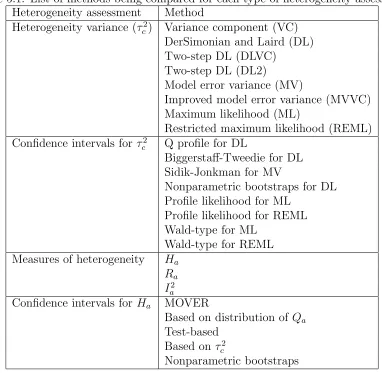
5.1 List of methods being compared for each type of heterogeneity assessment. 58 5.2 Simulation parameters for cluster randomization simulation study . . . . 60
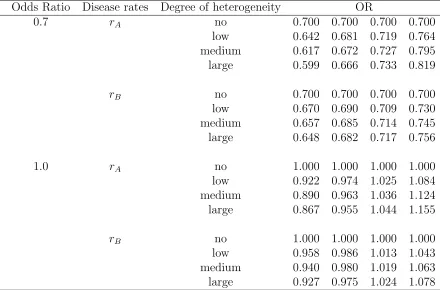
5.3 List of odds ratio values to generate clustered binary datasets. . . 61
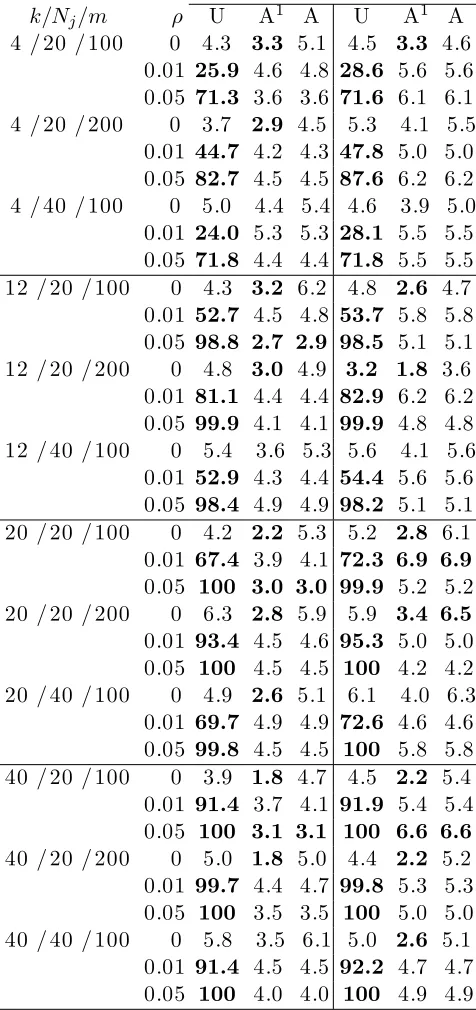
6.1 Type I error (%) of Q statistic for odds ratio ψ = 0.7 based on 1000 simulations. . . 80
6.2 Type I error (%) of Q statistic for odds ratio ψ = 1.0 based on 1000 simulations. . . 81
6.3 Power (%) of adjusted Q statistic for odds ratioψ = 0.7 with truncated ρ based on 1000 simulations. . . 82
6.4 Power (%) of adjusted Q statistic for odds ratioψ = 1.0 with truncated ρ based on 1000 simulations. . . 83
6.5 Power (%) of adjusted Q statistic for odds ratioψ = 0.7 omitting truncation based on 1000 simulations. . . 84
6.6 Power (%) of adjusted Q statistic for odds ratioψ = 0.7 omitting truncation based on 1000 simulations. . . 85
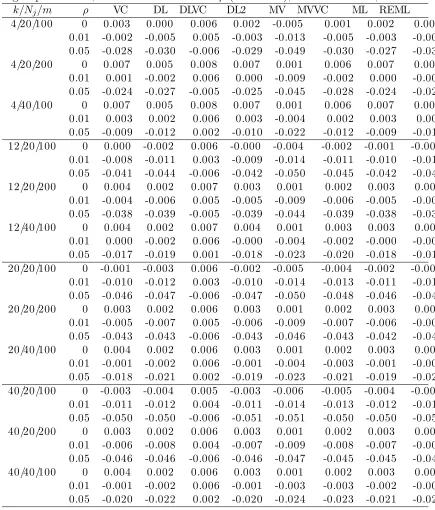
6.7 Bias forτ2 c with ‘no’ heterogeneity and control group disease ratesrAbased on 1000 simulations. . . 86
6.8 Bias for τ2 c with ‘low’ heterogeneity and control group disease rates rA based on 1000 simulations. . . 87
6.9 Bias for τ2 c with ‘moderate’ heterogeneity and control group disease rates rA based on 1000 simulations. . . 88
6.11 Bias for τ2
c with ‘no’ heterogeneity and control group disease ratesrB based
on 1000 simulations. . . 90
6.12 Bias for τ2
c with ‘low’ heterogeneity and control group disease rates rB
based on 1000 simulations. . . 91
6.13 Bias for τc2 with ‘moderate’ heterogeneity and control group disease rates
rB based on 1000 simulations. . . 92
6.14 Bias for τc2 with ‘high’ heterogeneity and control group disease rates rB
based on 1000 simulations. . . 93
6.15 Confidence intervals for τ2
c with ‘no’ heterogeneity, control group disease
ratesrA for Q profile(PQ), Biggerstaff-Tweedie(BT), Sidik-Jonkman(SJ)
and nonparametric bootstraps(NB) based on 1000 simulations . . . 94
6.16 Confidence intervals for τc2 with ‘no’ heterogeneity, control group disease
rates rA for profile likelihood and Wald-Type based on 1000 simulations . 95
6.17 Confidence intervals for τc2 with ‘low’ heterogeneity, control group disease
ratesrA for Q profile(PQ), Biggerstaff-Tweedie(BT), Sidik-Jonkman(SJ)
and nonparametric bootstraps(NB) based on 1000 simulations . . . 96
6.18 Confidence intervals for τ2
c with ‘low’ heterogeneity, control group disease
rates rA for profile likelihood and Wald-Type based on 1000 simulations . 97
6.19 Confidence intervals for τc2 with ‘moderate’ heterogeneity, control group
dis-ease ratesrAfor Q profile(PQ), Biggerstaff-Tweedie(BT), Sidik-Jonkman(SJ)
and nonparametric bootstraps(NB) based on 1000 simulations . . . 98
6.20 Confidence intervals for τ2
c with ‘moderate’ heterogeneity, control group
disease ratesrAfor profile likelihood and Wald-Type based on 1000 simulations 99
6.21 Confidence intervals for τ2
c with ‘high’ heterogeneity, control group disease
ratesrA for Q profile(PQ), Biggerstaff-Tweedie(BT), Sidik-Jonkman(SJ)
and nonparametric bootstraps(NB) based on 1000 simulations . . . 100
6.22 Confidence intervals for τ2
c with ‘high’ heterogeneity, control group disease
rates rA for profile likelihood and Wald-Type based on 1000 simulations . 101
6.23 Confidence intervals for τ2
c with ‘no’ heterogeneity, control group disease
ratesrB for Q profile(PQ), Biggerstaff-Tweedie(BT), Sidik-Jonkman(SJ)
and nonparametric bootstraps(NB) based on 1000 simulations . . . 102
6.24 Confidence intervals for τc2 with ‘no’ heterogeneity, control group disease
rates rB for profile likelihood, and Wald-Type based on 1000 simulations 103
6.25 Confidence intervals for τ2
c with ‘low’ heterogeneity, control group disease
ratesrB for Q profile(PQ), Biggerstaff-Tweedie(BT), Sidik-Jonkman(SJ)
and nonparametric bootstraps(NB) based on 1000 simulations . . . 104
6.26 Confidence intervals for τ2
c with ‘low’ heterogeneity, control group disease
rates rB for profile likelihood, and Wald-Type based on 1000 simulations 105
ease ratesrBfor Q profile(PQ), Biggerstaff-Tweedie(BT), Sidik-Jonkman(SJ)
and nonparametric bootstraps(NB) based on 1000 simulations . . . 106
6.28 Confidence intervals for τ2
c with ‘moderate’ heterogeneity, control group
disease rates rB for profile likelihood, and Wald-Type based on 1000
simulations . . . 107
6.29 Confidence intervals for τ2
c with ‘high’ heterogeneity, control group disease
ratesrB for Q profile(PQ), Biggerstaff-Tweedie(BT), Sidik-Jonkman(SJ)
and nonparametric bootstraps(NB) based on 1000 simulations . . . 108
6.30 Confidence intervals for τc2 with ‘high’ heterogeneity, control group disease
rates rB for profile likelihood, and Wald-Type based on 1000 simulations 109
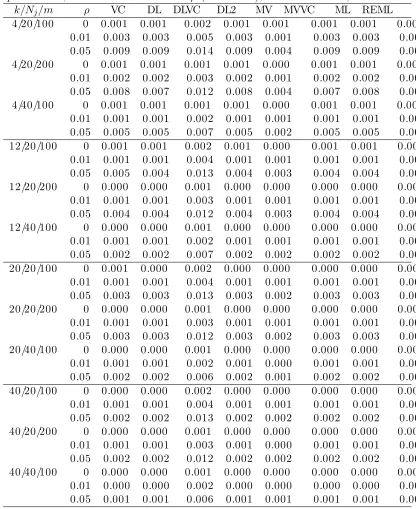
6.31 Bias and MSE for the measures of heterogeneity with ‘no’ heterogeneity
and control group disease ratesrA based on 1000 simulations . . . 110
6.32 Bias and MSE for the measures of heterogeneity with ‘low’ heterogeneity
and control group disease ratesrA based on 1000 simulations . . . 111
6.33 Bias and MSE for the measures of heterogeneity with ‘moderate’
hetero-geneity and control group disease rates rA based on 1000 simulations . . 112
6.34 Bias and MSE for the measures of heterogeneity with ‘high’ heterogeneity
and control group disease ratesrA based on 1000 simulations . . . 113
6.35 Bias and MSE for the measures of heterogeneity with ‘no’ heterogeneity
and control group disease ratesrB based on 1000 simulations . . . 114
6.36 Bias and MSE for the measures of heterogeneity with ‘low’ heterogeneity
and control group disease ratesrB based on 1000 simulations . . . 115
6.37 Bias and MSE for the measures of heterogeneity with ‘moderate’
hetero-geneity and control group disease rates rB based on 1000 simulations . . 116
6.38 Bias and MSE for the measures of heterogeneity with ‘high’ heterogeneity
and control group disease ratesrB based on 1000 simulations . . . 117
6.39 Confidence interval for Ha with ‘no’ heterogeneity, control group disease
rates rA for MOVER, Q distribution, test-based, based onτc2,
nonparamet-ric bootstrap based on 1000 simulations . . . 118
6.40 Confidence interval for Ha with ‘low’ heterogeneity, control group disease
rates rA for MOVER, Q distribution, test-based, based onτc2,
nonparamet-ric bootstrap based on 1000 simulations . . . 119
6.41 Confidence interval for Ha with ‘moderate’ heterogeneity, control group
disease rates rA for MOVER, Q distribution, test-based, based on τc2,
nonparametric bootstrap based on 1000 simulations . . . 120
6.42 Confidence interval for Ha with ‘high’ heterogeneity, control group disease
rates rA for MOVER, Q distribution, test-based, based onτc2,
nonparamet-ric bootstrap based on 1000 simulations . . . 121
6.43 Confidence interval for Ha with ‘no’ heterogeneity, control group disease
rates rB for MOVER, Q distribution, test-based, based onτc2,
nonparamet-ric bootstrap based on 1000 simulations . . . 122
ric bootstrap based on 1000 simulations . . . 123
6.45 Confidence interval for Ha with ‘moderate’ heterogeneity, control group
disease rates rB for MOVER, Q distribution, test-based, based on τc2,
nonparametric bootstrap based on 1000 simulations . . . 124
6.46 Confidence interval for Ha with ‘high’ heterogeneity, control group disease
rates rB for MOVER, Q distribution, test-based, based onτc2,
nonparamet-ric bootstrap based on 1000 simulations . . . 125
7.1 Description of studies. . . 127
7.2 Baseline characteristics of patients in intervention groups for each trial
included in the meta-analysis. . . 130
7.3 Heterogeneity variance estimators and random effects summary odds ratios .133
7.4 Point estimates and confidence intervals forτ2
c. . . 133
7.5 Confidence intervals for Ha. . . 134
List of Figures
2.1 Approximate power of Qa plotted against τc2 (first column) and ρ (second
column). . . 28
4.1 Estimated Ha plotted against degree of heterogeneity. . . 49
5.1 Flowchart of the simulation study. Number of parameter combination is
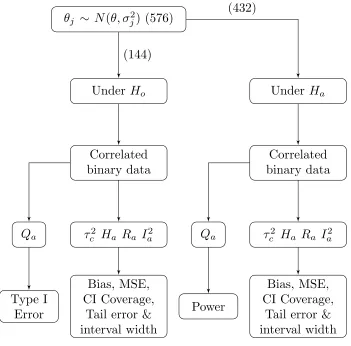
noted in parentheses. . . 65
7.1 Forest plot for the meta-analysis of practice-based secondary prevention
programs for patients with coronary heart disease risk factors. . . 131
Chapter 1
Introduction
1.1
Cluster randomization trials
Randomized controlled trials are often deemed the gold standard to assess the effectiveness
of an intervention in health research (Wade, 1999). A key benefit of randomization is
the potential for elimination of bias due to confounding. The units of randomization in
randomized trials are usually the individual.
Over the past two decades, randomized trials in which the unit of randomization is at the
cluster level have been more frequently adopted in the evaluation of health care
interven-tions, screening and educational programs (Bland, 2004). Such trials are characterized
by random assignment of intact social units (e.g., worksites, clinical practices, schools or
entire communities) instead of individual study subjects (Donner and Klar, 2000).
For example, a study evaluating the effect of vitamin A supplementation on childhood
mortality (Sommer et al., 1986) adopted cluster randomization because it was not
po-litically feasible to randomize individuals. Hence, the units of randomization for this
study were villages instead of individuals within a village. Contamination could have
individuals from the same village who were assigned to different interventions shared their
vitamin A supplement. Cluster randomization trials are preferred in situations where
the ethical issues, the desire to control costs or the attempt to minimize experimental
contamination are major concerns.
However, the cluster randomization design is statistically less efficient compared to
in-dividual randomization because responses of inin-dividuals in a cluster tend to be more
similar to each other than to responses of individuals in different clusters. The degree of
similarity is measured using the intracluster correlation coefficient denoted by ρ (Donner
and Klar, 2000, p2) which takes a value between 0 and 1. In order to adjust for clustering,
the variance of the estimated intervention effect is multiplied by a variance inflation factor
(or design effect), IF = 1 + ( ¯m+ 1)ρ where ¯m is the average cluster size. Intracluster
correlation coefficients may be quite small particularly for community intervention trials
where they rarely take on values above 0.1 (Murray et al., 2000). However even then
design effects may be quite large since such trials typically recruit hundreds of subjects
per cluster. Subsequently, ignoring clustering effects could result in spurious statistical
significance where the variance estimators will tend to be underestimated.
1.2
Meta-analysis of individually randomized trials
Since the 1980s there have been a growing number of published systematic reviews
sum-marizing results from clinical trials (Whitehead, 2002, page xiii). At the same time, there
has also been increasing methodological research dealing with meta-analytic methods.
A key challenge in combining study results is possible heterogeneity in the estimated
intervention effect. Heterogeneity may reflect systematic differences in study design or
in characteristics of participating subjects or may be a consequence of random variation
1.2.1
Fixed versus random effects modeling of heterogeneity
Fixed effects and random effects models depend on different assumptions about
hetero-geneity of the intervention effect. The fixed effects model assumes that there is a common
fixed effect (at least for interval estimation) and a random component (sampling error)
that is responsible for differences among trial results. Often, however, there may be some
heterogeneity of intervention effects across trials. A test of heterogeneity is frequently
used to evaluate the assumption of a common fixed effect. On the other hand, the random
effects model assumes that the observed trials are a random sample from a hypothetical
population of trials. To account for the variation among trial results, an additional
random term is added to the model. This added term, recognized as the heterogeneity
variance parameter, is denoted byτ2. Consequently, the random effects model generally
yields more conservative inferences about the intervention effect as compared to the fixed
effects model (Schulze, 2007; Villar et al., 2001).
1.2.2
Tests of heterogeneity: Q statistic
The Q statistic (Cochran, 1954) tests the null hypothesis: Ho :θ1 = θ2 = . . .=θk =θ
versus the alternativeHA: at least one trial had a truly different intervention effect as
com-pared to the other trials, where θj denotes the intervention effect for trial j, j = 1, . . . , k.
Mathematically, the Q statistic is defined as a weighted sum of squares of the deviations
of individual study estimates ˆθj, from the overall estimate ˆθ. The Q statistic when Ho is
true, is approximately a chi-square random variable with k−1 degrees of freedom. If
the null hypothesisHo is rejected, one concludes that there is at least one study which
truly differs from other studies in terms of the intervention effect. Further analyses are
then usually recommended to identify covariates that stratify studies into homogeneous
Several other test statistics are available to test for heterogeneity (e.g. likelihood ratio
test, score test). In a simulation study generating continuous outcome data, Viechtbauer
(2007b) showed that the Q statistic as compared to other test statistics kept the tightest
control of the Type I error rate for meta-analyses based on studies having at least
moder-ately large sample size, such that the number of trials is from 5 to 80 and the average
sample size per trial is 20 to 640. He also suggested that if the amount of heterogeneity
was small, sample sizes exceeding 100 observations within each study would be required
to detect it. As for binary outcome data in large sample sizes, the Q statistic based on
the Woolf estimator is conservative in general and least powerful for severely unbalanced
and within-strata unbalanced designs (Paul and Donner, 1989). However, for balanced
and mildly unbalanced designs, the Q statistic, which is easy to calculate, is recommended.
According to Hardy and Thompson (1998), the Q statistic may detect clinically
unim-portant heterogeneity when there are many studies but is unable to detect clinically
significant heterogeneity when there are few studies. Therefore, power calculations for the
Q statistic prior to conducting a meta-analysis may prove helpful in assessing statistical
power (Hedges and Pigott, 2001; Valentine et al., 2010). Power for the Q statistic is a
function of the selected effect measure, the specified Type I error, number of trials and
sample size per trial.
1.2.3
Heterogeneity variance estimators
τ
2Point estimation
Heterogeneity variance estimators are also useful in assessing heterogeneity in
meta-analysis. Their advantage is that they do not depend on the number, or size of trials
in a meta-analysis like the Q statistic. A disadvantage they share with the Q statistic
measures (e.g. odds ratio, risk ratio and hazard ratio) (R¨ucker et al., 2008). Seven
methods of estimating the parameter τ2 were compared in terms of bias and mean square
error under a random effects model for a binary outcome in a simulation study Sidik and
Jonkman (2007). Four of these estimators are simple to compute while the remaining
three approaches require relatively extensive computation.
Hedges (1983) originally developed a method of moments estimator obtained by setting
the usual sample variance equal to its expected value and solving for τ2, known as the
variance component type estimator. Another method of moments estimator proposed by
DerSimonian and Laird (1986) using the expectation of the Q statistic (Cochran, 1954) is
commonly used in random effects meta-analysis (Brockwell and Gordon, 2001; Thompson
and Sharp, 1999). Furthermore, given that the DerSimonian and Laird estimator often
underestimates the true value (e.g., Bohning et al., 2002; DerSimonian and Kacker, 2007;
DerSimonian and Laird, 1986; Sidik and Jonkman, 2007), DerSimonian and Kacker (2007)
proposed a two-step method to avoid using iterative methods (e.g. likelihood approaches).
Besides the method of moments estimators, Sidik and Jonkman (2005) proposed an
estimator based on the unbiased estimation of the error variance in a linear model, called
a model error variance type estimator. The model error variance type of estimator requires
an initial estimate of τ2. The simplest is to use the empirical variance estimate as an
initial estimator for τ2. Later, Sidik and Jonkman (2007) suggested an improved version
of this approach by using the variance component type estimate as an initial estimate of
τ2. The common iterative approaches to estimatingτ2 are maximum likelihood estimation
and restricted maximum likelihood estimation (Hardy and Thompson, 1996; Harville,
1977; Raudenbush and Bryk, 1985). Another iterative approach is obtaining by using the
empirical Bayes estimator (Morris, 1983).
F
com-Table 1.1: Summary of the heterogeneity variance estimators
Method Description Non-Iterative
Variance Component (VC) Method of moments
DerSimonian and Laird (DL) Method of moments
Two-step DL (DLVC) Empirical variance as an initial estimator
Two-step DL (DL2) Variance component as an initial estimator
Model Error Variance (MV) Empirical variance as an initial estimator
Improved (MVVC) Variance component as an initial estimator
Iterative
Maximum Likelihood (ML) Likelihood
Restricted (REML) Likelihood
Bayes Bayesian
ponent type estimator and the empirical Bayes estimator provide the most accurate
estimation when the heterogeneity is moderate to large (i.e. τ2 ≥ 0.5). The variance
component estimator and the model error variance both tend to overestimate the true
heterogeneity variance except for meta-analyses with large number of trials and unless
the heterogeneity variance is large, respectively. However, the likelihood estimators and
DerSimonian and Laird’s estimator tend in general to underestimate the true heterogeneity
variance. Schlattmann (2009, Chapter 7) found similar results. Table 1.1 provides a
summary of the heterogeneity variance estimators mentioned above.
Interval estimation
It is often useful to report a confidence interval in addition to a point estimator of
τ2. Viechtbauer (2007a) proposed a new method called the Q profile to construct such
intervals and evaluated its performance in terms of nominal coverage as compared with
other existing approaches, including Biggerstaff-Tweedie (Biggerstaff and Tweedie, 1997),
profile likelihood, Wald-type, Sidik-Jonkman (Sidik and Jonkman, 2005), parametric
bootstrap and non-parametric bootstrap using Monte-Carlo simulation.
free-dom under the null hypothesis. Alternatively, the 95 percent confidence interval obtained
from the Q profile method is constructed based on the 2.5th and 97.5th percentile of this
distribution. Based on a similar idea, the Biggerstaff-Tweedie confidence interval can be
obtained by approximating the distribution of Q with a gamma distribution (Biggerstaff
and Tweedie, 1997). For the profile likelihood method, the confidence intervals can
be obtained by profiling the likelihood ratio statistic with the maximum likelihood or
restricted maximum likelihood estimates. Then, the inverse of the Fisher information
matrix is used to calculate the asymptotic sampling variances of the maximum likelihood
and restricted maximum likelihood estimates of the heterogeneity estimator in order to
construct Wald-type confidence intervals. The confidence interval for the model error
variance is based on the assumption that its estimator approximately follows a chi-square
distribution withk−1 degrees of freedom (Sidik and Jonkman, 2005). Last is the
boot-strap confidence interval constructed by taking the 2.5th and 97.5th empirical percentiles
of the heterogeneity estimate based on the bootstrap sample after repeating the same
process up to 1000 times.
According to simulation results (Viechtbauer, 2007a), the profile likelihood method with
the Q statistic yields the most accurate coverage, closely followed by Biggerstaff and
Tweedie’s method. The performance of other methods was poor in general with a coverage
probability either too low or too high.
1.2.4
Measures of heterogeneity
Higgins and Thompson (2002) proposed three statistics which measure the impact of
heterogeneity on a meta-analysis: H, R, and I2. The advantage of these measures as
compared to the heterogeneity variance is that they allow heterogeneity of the intervention
effect to be compared across meta-analyses including different numbers of studies and
The H statistic is given by the square root of the Q statistic divided by its degrees of
freedom. Since the expectation of Q is equal to k−1 under Ho,H = 1 indicates that the
intervention effects are homogeneous across trials. Values of H exceeding 1.5 may suggest
heterogeneity complicating interpretation of the summary estimates of the intervention
effect. The R statistic is the ratio of the standard error of a random effects meta-analytic
summary estimate to the standard error of a fixed effects meta-analytic summary estimate.
It describes the inflation in the confidence interval for a summary intervention effect
estimate under a random effects model compared with a fixed effects model. When the
value is 1, it indicates that the two models yield identical inferences and the fixed effects
model is sufficient. The I2 statistic is interpreted as the proportion of total variation
in the estimate of an intervention effect that is due to heterogeneity between studies.
When the I2 statistic is 0 percent, the variation is considered only due to sampling error
and not due to heterogeneity. Similarly, an I2 statistic of 20 percent indicates that 20
percent of variability in the trials may be attributed to between-study variation. Several
investigators (e.g. Higgins and Green, 2008; Higgins and Thompson, 2002; Higgins et al.,
2002a) recommend including the H or I2 statistics when reporting meta-analyses.
Several simulation studies (Huedo-Medina et al., 2006; Mittlb¨ock and Heinzl, 2006)
exam-ined the properties of H andI2 as a function of the ratio of between and within study
variances. They concluded that I2 but not H may depend on the number of trials when
that number is small (i.e. k ≤10). In addition, the values of I2 may be affected by the
ratio of between and within study variances rather than the between study variance alone.
Possible approaches for constructing confidence intervals for each measure were also
summarized in the appendix of the Higgins and Thompson’s article (2002): i) based on
the distribution of Q, ii) based on the statistical significance of Q (test-based method),
bootstrap procedure. In addition, the confidence interval approach known as the method
of variance estimates recovery (MOVER) originally proposed by Zou (2008) may be used
to construct a confidence interval for H by treating it as a ratio of within study and
between study variances (Donner and Zou, 2010).
According to the simulation results presented in Table A1 for the H statistic (Higgins
and Thompson, 2002), it appears that a confidence interval constructed based on the
distribution of Q has coverage close to 100 per cent even with large number of trials k (i.e.
k = 30) except for large heterogeneity. The maximum likelihood, restricted likelihood
and bootstrap confidence intervals have inadequate coverage above nominal for small
heterogeneity and below nominal for large heterogeneity. The coverage of the test-based
confidence interval appears to be conservative in most of the situations except when
significant heterogeneity is present or the number of studies is large. The Pearson type
III confidence interval constructed for the heterogeneity estimator provides good coverage
in all situations, but is complicated to calculate. Finally, the accuracy of MOVER will
depend heavily on the performance of confidence intervals for numerator and denominator
of the given ratio (Schuster and Metzger, 2010, Chapter 11).
In summary, despite the different assumptions and methods regarding the assessment
of heterogeneity among studies, the fixed and random effects approaches in principle
both use weighted averages with only a change in the weights to calculate the overall
mean effect size. When the two modeling approaches yield similar results, the conclusions
based on these results gain credibility. When the intervention effects are considered
homogeneous, the results from both models are identical with the heterogeneity variance
1.3
Meta-analysis of cluster randomization trials
In response to the frequent use of cluster randomization designs in the health research
field, the need to conduct meta-analyses for such trials becomes increasingly evident and
necessary. The challenge in planning and conducting such a meta-analysis involves the
need for accounting for clustering effects. Not recognizing that the unit of randomization
for cluster randomization trials is at the cluster level with outcome measures collected
and analyzed at the individual level will generally lead to underestimating the variance
due to lack of independence between individuals.
Heterogeneity is recognized as another important analytic issue in performing a
meta-analysis by investigators who have performed separate meta-analyses on trials that involve
very different randomization units. For example, a study was conducted by Fawzi et al.
(1993) to investigate the effect of vitamin A supplementation on child mortality. The
participants of this study were taken from studies of hospitalized children with measles,
as well as other studies involving healthy children participating in community-based
trials. Individual children were assigned to intervention in the four hospital-based trials,
while allocation was by village, district or household in the eight community-based trials.
Therefore, the meta-analysis was performed separately for the hospital-based trials and
the community studies. When the results agree, an important advantage is the confidence
gained that the intervention tested is effective (or ineffective) in more than one setting.
Otherwise, the investigator can further study the impact of different choices of
random-ization unit as part of a sensitivity analysis.
One approach to testing heterogeneity in the meta-analysis of cluster randomized trials is
to use the Q statistic adjusted for clustering discussed in Donner et al. (2001). In principle,
the idea is similar to the Q statistic used to test for heterogeneity in meta-analysis of
individually randomized trials, except its weights are modified to account for clustering to
described independently by Song (2004), suggesting that the adjusted tests maintained
the nominal significance level in a stimulation study.
Methodological researches on meta-analytic methods involving cluster randomized trials
have mainly focused on fixed effects models. By assuming there is no variation between
studies, there are several statistical approaches that can be applied to a meta-analysis
of cluster randomization trials with a binary endpoint. Statistical methods include the
adjusted Mantel-Haenszel procedures, the ratio estimator approach, the general inverse
variance approach, Woolf procedures and generalized estimating equations (GEE) using
robust variance estimation (Donner et al., 2001).
The adjusted Mantel-Haenszel test statistic (Donner and Klar, 2000) is slightly modified
from the standard Mantel-Haenszel test statistic to account for clustering effects. The null
hypothesis is that the overall odds ratio of all 2x2 tables is equal to one and the test
statis-tic follows approximately a chi-squared distribution with one degree of freedom. The ratio
estimator approach is based on an adjustment of the Mantel-Haenszel chi-square statistic
in which the event rate is regarded as a ratio rather than as a proportion. It was developed
by Rao and Scott (1992) and involves dividing the observed sample frequencies (counts) in
a given study by the estimated design effect. The general inverse variance approach (GIV)
is obtained by combining study estimates in a meta-analysis using a weighted average
of estimated effect measures that are calculated separately for each trial. This approach
is recommended in the guidance provided by the Cochrane Collaboration. The Woolf
procedure, which is best applied with a small number of clusters each of fairly large size,
transforms the intervention odds ratio of each trial to the logarithmic scale in order to
obtain a distribution which is more likely to be normally distributed. Then, the average of
the transformed odds ratios is computed using a weighting scheme originally described by
Furthermore, a simulation study (Darlington and Donner, 2007) was performed to compare
the unadjusted Mantel-Haenszel method, the adjusted Mantel-Haenszel methods, the
ratio procedure, the general inverse variance, and the Woolf procedure. This simulation
study had two important results. First, the simulation results clearly showed that it is
inappropriate to use the unadjusted Mantel-Haenszel method due to elevated Type I error
rate. Second, the adjusted Mantel-Haenszel method had the greatest power and slightly
outperformed the general inverse variance method since it uses information on the cluster
sizes and intracluster coefficient ρ for each trial, while the general inverse method is a
generic procedure.
1.4
Scope of thesis
Most meta-analytic methods focus on combining study results of individually randomized
trials where observations are independent. Meta-analytic methods for cluster
randomiza-tion trials are largely extensions of meta-analytic methods for individually randomized
trials. However, applying existing meta-analytic methods to handle heterogeneity of
cluster randomized trials is problematic with correlated observations. The rationale for
limiting attention to heterogeneity among studies is that this is a substantial issue for
meta-analysis, since when present it complicates discussion of an overall intervention effect.
This research focuses mainly on binary outcomes because such outcomes have been most
frequently used in cluster randomization trials (Laopaiboon, 2003). There are three
fre-quently used designs in cluster randomization trials: completely randomized, matched-pair
and stratified. The completely randomized design is best suited to trials that have a fairly
large numbers of clusters, whereas matching or stratification is more effective in small
studies (Donner and Klar, 2000). The challenge of extending all methods to stratified and
simplicity, the discussion will thus be focused on designs where there is a single binary,
cluster-level covariate, i.e., trials where there is one experimental group and one control
group.
In summary, my thesis will focus on exploring and evaluating heterogeneity in the context
of fixed effects models with the aim of providing general guidance in conducting a
meta-analysis of cluster randomization trials. Attention will also be limited to meta-analyses
of community intervention trials which typically enroll a small number of large clusters.
This focus reflects the relatively greater methodological challenge of statistical inferences
when estimates of variance inflation are less precisely estimated. Intervention effects for
binary outcomes will be measured using odds ratio estimators comparing an experimental
1.5
Thesis objectives
The primary objectives of this research are:
1. Analytics
(a) To extend the Q statistic, as commonly applied to test for heterogeneity in
meta-analyses of individually randomized trials, to the meta-analysis of cluster
randomization trials by specifying a weight accounting for clustering.
(b) To obtain an analytic expression for the power curve of the adjusted Q statistic.
(c) To derive heterogeneity variance estimators and their confidence intervals
accounting for clustering.
(d) To derive measures of heterogeneity and their confidence intervals accounting
for clustering.
2. Simulation
(a) To evaluate the performance of the adjusted Q statistic in terms of Type I error
and statistical power and to compare its power with the proposed formula.
(b) To assess the bias and mean square error for the adjusted heterogeneity variance
estimators and to evaluate the coverage, tail errors and interval width of the
proposed confidence interval methods.
(c) To assess the bias and mean square error for the adjusted measures of
het-erogeneity and to evaluate the coverage, tail errors and interval width of the
proposed confidence interval methods.
3. Example
(a) To illustrate the application of results, both in fixed and random effects models,
1.6
Organization of the thesis
This thesis includes eight chapters. Chapter 2 extends the Q statistic, as commonly
applied to test for heterogeneity in meta-analyses of individually randomized trials, to the
meta-analysis of cluster randomization trials. An analytic expression for the power of the
Q statistic is derived. The effect on the power of cluster size, number of clusters, degree of
heterogeneity, and magnitude of intracluster correlation is explored. Chapter 3 presents
analytic expressions for the heterogeneity variance estimators adjusted for clustering and
describes approaches for constructing confidence intervals. Chapter 4 presents analytic
expressions for the measures of heterogeneity adjusted for clustering and approaches for
constructing confidence intervals.
Chapter 5 describes the design of a simulation study used to assess the procedures and
to validate analytical findings. Performance is evaluated in terms of Type I error and
statistical power for the Q statistic, bias and mean square error for both heterogeneity
variance estimators and measures of heterogeneity, and coverage for the confidence
inter-vals approaches. Results of the simulation study are described in Chapter 6. Chapter 7
presents a meta-analysis of 4 cluster randomization trials to illustrate the application of the
proposed methods. Finally, Chapter 8 summarizes the main results, the recommendations
Chapter 2
Approximate power of the adjusted
Q statistic
2.1
Introduction
The Q statistic was introduced in Chapter 1 for meta-analysis of individually randomized
trials. An extension of this statistic was also described for cluster randomization trials.
Applying the Q statistic to a meta-analysis of cluster randomized trials without adjusting
for clustering is problematic because the unadjusted Q statistic tends to have inflated
Type I error rates. Therefore, we will derive the adjusted Q statistic to account for
clustering as well as derive a formula for its power that may be useful in planning a
meta-analysis of such trials. It can be quite time consuming to review randomized trials
and combine their results for meta-analyses. Thus, performing power calculations prior to
conducting a meta-analysis may prevent wasting time, money and energy in the searching
and collection of representative trials when there is scant likelihood of detecting clinically
relevant amounts of heterogeneity (Donner et al., 2003).
Approaches to computing the power of the Q statistic as applied to the meta-analyses
Jackson (2008); Hardy and Thompson (1998); Hedges and Pigott (2001); Jackson (2006);
Valentine et al. (2010)). However, relatively little attention has been given to considering
the power of the Q statistic in planning a meta-analysis of cluster randomized trials.
Therefore, the aim of this chapter is to extend existing approaches to approximating power
of the adjusted Q statistic (i.e. adjusted for clustering). Specifically, interest focuses
on investigating the power of the adjusted Q statistic as a function of number of trials,
number of clusters, cluster size, disease risk rates, intracluster correlation coefficient and
degree of odds ratio heterogeneity across trials.
Section 2.2 provides the notation used throughout this thesis. An analytic expression
for the adjusted Q statistic is derived in Section 2.3.1, followed by a power formula
approximating the power of the adjusted Q statistic in Section 2.3.2. Summary comments
are provided in Section 2.4.
2.2
Notation
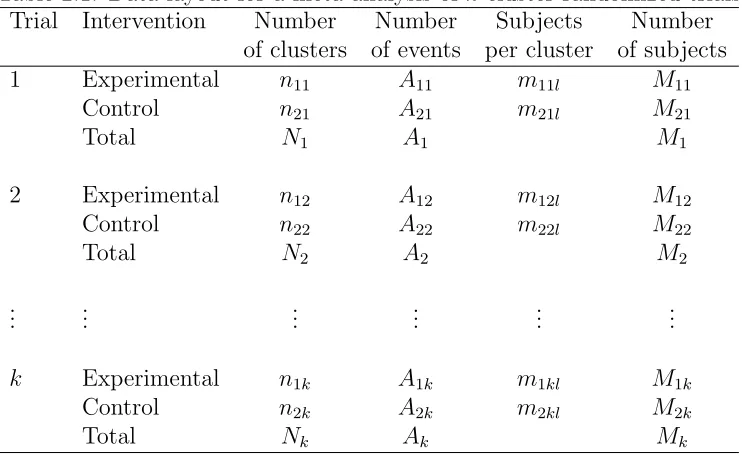
The data layout for a meta-analysis of k cluster randomized trials is provided in Table
2.1, where the notation used is defined in Table 2.2.
Suppose θ1, . . . , θk are the intervention effects of k trials, each measured as a log odds
ratio. Then the estimated intervention effect of θj of trial j is denoted
ˆ
θj =ln " ˆ
P1j(1−Pˆ2j)
ˆ
P2j(1−Pˆ1j) #
Table 2.1: Data layout for a meta-analysis of k cluster randomized trials.
Trial Intervention Number Number Subjects Number
of clusters of events per cluster of subjects
1 Experimental n11 A11 m11l M11
Control n21 A21 m21l M21
Total N1 A1 M1
2 Experimental n12 A12 m12l M12
Control n22 A22 m22l M22
Total N2 A2 M2
..
. ... ... ... ... ...
k Experimental n1k A1k m1kl M1k
Control n2k A2k m2kl M2k
Total Nk Ak Mk
Table 2.2: Notation used in Table 2.1 given that intervention groups i = 1,2, cluster
l = 1, . . . , nij and trial j = 1, . . . , k.
Symbol Description
mijl size of the ith group in cluster l of trial j
nij total number of clusters in group i of trial j
Nj =P2i=1nij total number of clusters in trial j
Mij =P
nij
l=1mijl total number of subjects in group i of trial j
Mj =P2i=1Mij total number of subjects in trial j
Aijl number of events of the ith group in cluster l of trial j
Aij =P
nij
l=1Aijl number of events in group i of trial j
Aj =P2i=1Aij total number of events in trial j
ˆ
Pijl =Aijl/mijl proportion of events of the ith group in cluster l of trial j
ˆ
2.3
Fixed effects model
A fixed effects model assumes that there is a common effect measure and a random
component (within study sampling error), which is responsible for observed between study
heterogeneity in a meta-analysis. The fixed effects model for the observed study-specific
intervention effect ˆθj is given (Whitehead, 2002) by
ˆ
θj =θ+j, (2.1)
where the sampling error j is assumed to be approximately independently and normally
distributed with mean 0 and within study variance σj2 and with overall mean effect sizeθ,
respectively, for trial j, j = 1, . . . , k.
2.3.1
Adjusted Q statistic
Individually randomized trials
The null hypothesis Ho for the Q statistic is given by θ1 = θ2 = . . . = θk = θ and the
alternative hypothesis HA is θi 6=θj for some i6=j. The mathematical expression for the
Q statistic is defined as a weighted sum of squares of the deviations of individual study
estimates from the overall mean effect size, given by
Q =
k X
j=1
ˆ
wj(ˆθj −θˆ)2 (2.2)
where the estimated overall mean effect size is given by
ˆ
θ =
Pk
j=1wˆjθˆj Pk
j=1wˆj
The estimated weights are the reciprocals of the estimated within study variances, given
by ˆwj = 1/σˆ2j. These particular weights are chosen to provide the most precise estimate
of θ by minimizing the variance of θ (Hardy and Thompson, 1996). Under Ho, the Q
statistic is distributed as a chi square random variable with k−1 degrees of freedom.
The derivation of the Q statistic is provided in Appendix A.
In practice, the within study varianceσ2
j is estimated using data fromjth trial,j = 1, . . . , k.
Given the responses for the jth trial in Table 2.3,
Table 2.3: Responses for thejth trial
Positive Negative Total P(positive)
Experimental A1j M1j−A1j M1j P1j =A1j/M1j
Control A2j M2j−A2j M2j P2j =A2j/M2j
and applying Woolf (1955)’s approach to estimate the within study variance for the
estimated log odds ratio, denoted as ˆθj:
ˆ
wj = (ˆσj2)
−1 = "
1
A1j
+ 1
M1j−A1j
+ 1
A2j
+ 1
M2j −A2j
#−1
=
"
1
M1jPˆ1j(1−Pˆ1j)
+ 1
M2jPˆ2j(1−Pˆ2j) #−1
.
Cluster randomized trials
In the case of cluster randomization trials where individuals of the same cluster are
correlated with a positive intracluster correlation coefficientρ, Donner and Donald (1987b)
suggested an adjustment using the variance inflation factor for each intervention group
i= 1,2 defined as
Cij =
nij
X
l=1
The intracluster correlation coefficient ρj may be obtained by using the ‘analysis of
variance’ (ANOVA) estimator proposed by Snedecor and Cochran (1980) (see Appendix
B for details). Consequently, the weights adjusting for clustering wjc become
ˆ
wjc = (ˆσjc2)
−1
=
"
C1j
M1jPˆ1j(1−Pˆ1j)
+ C2j
M2jPˆ2j(1−Pˆ2j) #−1
. (2.4)
Accordingly, replacing ˆwj in (2.2) by ˆwjc, the adjusted Q statistic is obtained by
Qa =
k X
j=1
ˆ
wjc(ˆθj −θˆc)2, (2.5)
where the estimated adjusted overall mean effect size is given by
ˆ
θc= Pk
j=1wˆjcθˆj Pk
j=1wˆjc
. (2.6)
The adjusted Q statistic asymptotically follows a chi square distribution with k −1
degrees of freedom under Ho (Song, 2004). Note that if ˆρj = 0 or Cij = 1 for i= 1,2 and
j = 1, . . . , k, indicating there is no clustering, ˆwjc reduces to ˆwj and Qa equals Q.
Now, the adjusted Q statistic from equation (2.5) may be rewritten as
Qa =
k X
j=1
ˆ
wjc(ˆθj −θ)2− k X
j=1
ˆ
wjc(ˆθc−θ)2 (2.7)
var(ˆθc) = Pk
j=1wˆjc2var(ˆθj)
Pk j=1wˆjc
2 = Pk
j=1wˆ2jcwˆ
−1 jc
Pk j=1wˆjc
2 =
1
Pk j=1wˆjc
. (2.8)
Assuming within study variances are known, the expectation of the adjusted Q statistic
under the null hypothesis based on equations (2.7) and (2.8) is given by
E[Qa|Ho] = k X
j=1
wjcE(ˆθj −θ)2− k X
j=1
wjcE(ˆθc−θ)2
=
k X
j=1
wjcvar(ˆθj)− k X
j=1
wjcvar(ˆθc)
=
k X
j=1
wjcw−jc1− k X j=1 wjc k X j=1 wjc −1
=k−1.
2.3.2
Approximate power
Let δj denote the deviation of the intervention effectθj from the overall mean effect size
θ for trial j, j = 1, . . . , k, under the alternative hypothesis such that θi 6=θj for at least
one pair (i, j) or equivalently δj 6= 0 for at least one j (Montgomery, 2000, p.64). This
implies that the model in equation (2.1) for the observed intervention effect ˆθj becomes
ˆ
θj = θ+δj+j (2.9)
= θj+j,
since δj = θj −θ, where θ is the overall mean effect size. The sampling error j is
approximately normally distributed with mean 0 and within study varianceσ2
jc for trialj,
j = 1, . . . , k. The fixed effects δj has a constraint such that the sum of weighted δj equals
zero to satisfy the condition that ˆθc remains an unbiased estimator of θ with variance
of 1/Pk
because the expectation of j is equal to zero (i.e. E(j) = 0).
Next, replacing ˆθj defined in (2.7) by (2.9), the expectation of the adjusted Q under the
alternative hypothesis assuming the within study variance being known is given by
E[Qa|HA] = k X
j=1
wjcE(θ+δj+j −θ)2− k X
j=1
wjcvar(ˆθc)
=
k X
j=1
wjcE(δj2) + k X
j=1
wjcE(2j)−1
=
k X
j=1
wjc(θj−θ)2+k−1,
where the adjusted Q statistic is distributed as a noncentral chi square distribution with
k−1 degrees of freedom and noncentrality parameter NC defined as
N C =
k X
j=1
wjc(θj−θ)2. (2.10)
The overall mean effect size θ may be estimated using ˆθc in equation (2.6). It follows that
the power of the adjusted Qstatistic at significance level α is defined as
power = 1−P(Accept Ho|HA)
= 1−P(Qa≤χ2k−1|HA)
= 1−F(cα|k−1, N C), (2.11)
whereF(cα|k−1;N C) is the cumulative distribution function of the noncentral chi-square
with k−1 degrees of freedom and noncentrality parameter NC given in equation (2.10)
2001).
In practice, parameters used for calculating statistical power are rarely available; therefore,
it is common to make some a priori assumptions. Based on these assumptions, we
investigate the approximate power of the adjusted Q statistic as a function of the number
of clusters, cluster size, disease risk rates, intracluster correlation coefficient and degree of
heterogeneity.
First, we focus on the case of an equal number of clusters n per intervention group,
where each cluster has a constant cluster size of m. Equal allocation is considered to be
statistically efficient as compared to unequal allocation, which requires more clusters to
obtain the same statistical power. In the case of unequal cluster sizes, we may replace m
by average cluster size ¯m. The slight underestimation of the actual sample size can be
negligible, providing that the variation in cluster size is not substantial. If m is replaced
by mmax, the statistical power calculated will be more conservative (Donner and Klar,
2000, p.57).
Second, for simplicity, we assume a constant within study variance across trials (i.e.
σ2
jc =σc2 for j = 1, . . . , k). However, in the case where the within study variance varies,
the noncentrality parameter assuming a constant within study variance tends to be
overestimated. Thus, the statistical power of the test obtained based on a constant within
study variance will be overestimated.
Third, Donner and Klar (2000, p.56) noted that the study design has an impact on the
es-timates of intracluster correlation coefficient. Since each of the trials in the meta-analysis
is assumed to be completely randomized, we will assume the intracluster correlation
Following these assumptions, the variance inflation factors defined in equation (2.3) are
reduced to 1 + (m−1)ρ and the within study variance in (2.4) is simplified to a common
variance denoted byσ2
c, given by
σc2 = 1 + (m−1)ρ
nmP1(1−P1)
+ 1 + (m−1)ρ
nmP2(1−P2)
. (2.12)
Furthermore, the between study variance denoted byτ2
c (also referred to as the
heterogene-ity variance) can be estimated using the sample variance, given by Pk
j=1(θj−θ¯)2/(k−1),
where ¯θ =Pk
j=1θj/k. When the weights are assumed constant across trials, ¯θ is equivalent
to the overall mean effect size θc. Subsequently, Pkj=1(θj−θc)2 may be approximated by
(k−1)τ2
c (Hedges and Pigott, 2001). Therefore, the noncentrality parameter in equation
(2.10) is approximated by
N C = (k−1)τc2/σ2c. (2.13)
Note that the ratio τ2
c/σ2c is a measure of the degree of heterogeneity (see section
5.3). However, for plotting purposes, τc2 and σc2 are considered as two separate
quan-tities. Therefore, without loss of generality, let the effect size (ES) be defined as
d= 2|arcsin(P1)(1/2)−arcsin(P2)(1/2)|(Cohen, 1992), the values of disease rates (P1, P2)
corresponding to d= 0.20 (small effect size) and 0.50 (medium effect size) are (0.1,0.168)
and (0.1,0.293), respectively. The effect sizes are defined in term of the disease rates
in order to plot the power of the adjusted Q statistic in function of the between study
variance τc2 or the intracluster correlation coefficient ρ. Given the number of trials k,
number of clustersn, cluster sizem, disease rates (P1, P2), between study varianceτc2, and
intracluster correlation coefficient ρ, the power of the adjusted Q statistic was calculated
(P1, P2) = (0.1, 0.168), (0.1, 0.293)
(n, m) = (5, 50), (5, 100), (10, 50)
k = 5, 10, 20
τc2 = 0 to 0.5 in steps of 0.1
ρ = 0 to 0.05 in steps of 0.01
The values for the number of trialsk and between study variance τ2
c, are taken from Hardy
and Thompson (1998). Also, the values of the effect sizes and intracluster coefficients
in community intervention trials are frequently small (Donner and Klar, 1996). For
example, the intracluster correlation coefficients for four cluster randomization trials
(Jolly et al., 1999; Moher et al., 2001; Montgomery et al., 2000; Woodcock et al., 1999)
performed to compare two or more interventions in primary care for cardiovascular heart
disease (CHD), which will be used as an example for this research, were in the range
of 0 to 0.0125. Also, when the approximate power of the adjusted Q statistic plotted
against the between study variance τ2
c, the intracluster correlation coefficient ρ was set
to 0.01. But when the approximate power of the adjusted Q statistic plotted against
the intracluster correlation coefficientρ, the between study varianceτ2
c was then set to 0.1.
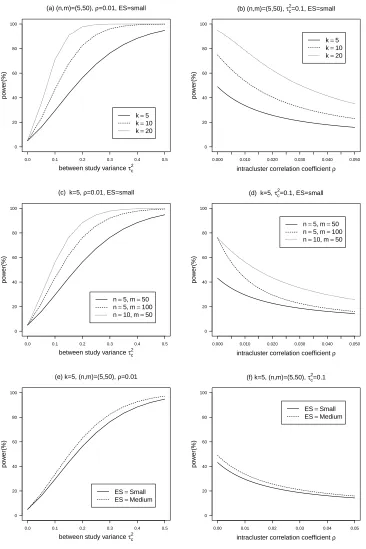
Figure 2.1(a)-(b) shows that the approximate power of the adjusted Q statistic increases
as the number of trials increases, while holding other variables constant. Similarly, in
Figure 2.1(c)-(d), the approximate power of the adjusted Q statistic increases as the total
sample size increases while holding other variables constant. In addition, for a given
total sample size (nm= 500), the adjusted Q statistic with n = 10 has greater power
than with n = 5. In Figure 2.1(e)-(f), the approximate power increases as the effect
size becomes larger while holding other variables constant because larger effect size with
largerP2(1−P2) in equation (2.12) givenP1 fixed results in smaller constant within study
variance. From the plots of power againstτ2
c (first column), it is seen that the approximate
power increases as τc2 increases. For instance, in Figure 2.1(a), the approximate power of
the adjusted Q statistic is approximately 60% for τ2
c = 0.2 and 80% for τc2 = 0.4 while
of power against ρ (second column), it is seen that the approximate power decreases
as ρ increases. For instance, in Figure 2.1(b), the approximate power of the adjusted
Q statistic is approximately 80% for ρ = 0 and 40% for ρ = 0.02 while fixing k = 10,
(n, m) = (5,50), τ2
c = 0.1, andES =small.
2.4
Summary
In summary, since the validity of the unadjusted Q statistic in the presence of clustering
becomes questionable with inflated Type I error rates, the adjusted Q statistic has been
introduced. In addition, the approximate power of the adjusted Q statistic was derived
from a noncentral chi square distribution with k−1 degrees of freedom and a specified
noncentrality parameter.
We have also investigated the power in terms of parameters including the number of
trials, number of clusters, cluster size, disease rates between intervention groups (i.e.
effect size), between study variance and intracluster correlation coefficient. It appears
that the power of the adjusted Q statistic increases by increasing any of the following
parameters: number of trials, overall sample size per trial (i.e. n×m), effect size (disease
rates between intervention groups) and between study variance. In contrast, the power
decreases as the intracluster correlation coefficient increases. Moreover, for a fixed sample
size, it is seen that the power of the adjusted Q statistic is greater for a large number of
(a) (n,m)=(5,50), ρ=0.01, ES=small
between study variance τc 2
po
w
er(%)
k=5 k=10 k=20 0 20 40 60 80 100
0.0 0.1 0.2 0.3 0.4 0.5
(b) (n,m)=(5,50), τc 2
=0.1, ES=small
intracluster correlation coefficient ρ
po
w
er(%)
k=5 k=10 k=20
0 20 40 60 80 100
0.000 0.010 0.020 0.030 0.040 0.050
(c) k=5, ρ=0.01, ES=small
between study variance τc 2
po
w
er(%)
n=5, m=50 n=5, m=100 n=10, m=50 0 20 40 60 80 100
0.0 0.1 0.2 0.3 0.4 0.5
(d) k=5, τc 2
=0.1, ES=small
intracluster correlation coefficient ρ
po
w
er(%)
n=5, m=50 n=5, m=100 n=10, m=50
0 20 40 60 80 100
0.000 0.010 0.020 0.030 0.040 0.050
(e) k=5, (n,m)=(5,50), ρ=0.01
between study variance τc 2
po
w
er(%)
ES=Small ES=Medium 0 20 40 60 80 100
0.0 0.1 0.2 0.3 0.4 0.5
(f) k=5, (n,m)=(5,50), τc 2
=0.1
intracluster correlation coefficient ρ
po
w
er(%)
ES=Small ES=Medium
0 20 40 60 80 100
0.00 0.01 0.02 0.03 0.04 0.05
Figure 2.1: Approximate power of Qa plotted against τc2 (first column) and ρ (second
column). (a)-(b) varying numbers of trials k (k = 5,10,20); (c)-(d) varying number of
clusters per trial n and cluster size m ((n, m) = (5,50),(5,100),(10,50)); (e)-(f) varying
Chapter 3
Heterogeneity variance estimation
3.1
Introduction
The fixed effects model described in Chapter 2 assumes homogeneity of intervention effects
across the k trials. In contrast, the random effects model assumes that the observed
trials are a random sample from a hypothetical population of trials. In order to account
for the variation among trials, a random term known as heterogeneity variance is added
to compute the weights in the random effects model; this tends to equalize the weights
assigned to small and large trials. Subsequently, the random effects model may lead to
wider confidence intervals for the overall intervention effect.
Heterogeneity variance is also used as a measure of heterogeneity in meta-analysis.
Al-though heterogeneity variance may be solely limited to trials with the same effect measures
(e.g. odds ratio, risk ratio and hazard ratio), its value does not depend on the number, or
size of trials in a meta-analysis unlike the other measures such as the Q statistic (R¨ucker
et al., 2008).
The aim of this chapter is to extend existing approaches for estimating the heterogeneity
randomization trials. We begin by considering eight methods for estimating the
hetero-geneity variance. In addition to a point estimate, confidence intervals for the heterohetero-geneity
variance estimate may be useful, as they indicate its precision while also conveying all the
information contained in the corresponding test of heterogeneity (Hardy and Thompson,
1996; Viechtbauer, 2007a). Moreover, such confidence intervals may be also used to
construct confidence intervals for measures of heterogeneity (Higgins and Thompson,
2002), which will be discussed in Chapter 4.
The random effects model for cluster randomization trials is briefly described in Section
3.2. The eight approaches for estimating the heterogeneity variance adjusted for clustering
and the six methods for constructing confidence intervals, which are introduced in Section
1.2.3, are discussed with corresponding mathematical expressions presented in Section 3.3
and 3.4, respectively. Furthermore, a simulation study conducted in order to assess the
bias and mean square error of the adjusted heterogeneity estimators and the coverage
probabilities of the confidence intervals appears in Chapter 5.
3.2
Random effects model
Let ˆθj denote the estimated intervention effect (experimental vs. control) on the log
odds ratio of the study outcome for the jth trial, j = 1, . . . , k. The random effects
meta-analysis model (Whitehead, 2002, p.88) is given by
ˆ
θj =θ+νj+j,
where θ is the true overall mean effect size. Also, two independent random effects
in-cluded in the model are the random study effects and the error terms, denoted by νj and
j, respectively. Random study effects are assumed to be independently and normally
are assumed to be independently and normally distributed with mean 0 and variance σ2 jc,
(i.e. j ∼N(0, σ2jc)), whereτc2 is the between study component of variance also known as
the heterogeneity variance andσ2
jc is the within study component.
In practice, the within study variance is estimated using equation (2.4) for cluster
ran-domization trials ignoring the sampling errors within the trial. This practice is often used
because the within study variance tends to be relatively small as compared to the between
study variance. Therefore, the errors can be negligible. However, caution must be taken
using the estimated within study variance as the true variance for trials with small overall
sizes, where the large sample approximation may be questionable (Bohning et al., 2002;
Brockwell and Gordon, 2001; Sidik and Jonkman, 2006). In this chapter, the focus will
be restricted to estimating heterogeneity varianceτ2
c, with σjc2 being assumed known.
3.3
Adjusted heterogeneity variance estimators
τ
c23.3.1
Variance component estimator (VC)
Hedges and Olkin (1985) proposed a simple approach to estimate the heterogeneity
variance using a method similar to that for estimating the variance components in a
random effects analysis of variance. Given the unweighted mean ¯θ= Pk
j=1θˆj/k, the usual
sample variance of ˆθj may be expressed as
Sθ2 = 1
k−1
k X
j=1
(ˆθj−θ¯)2.
Then the expected value of S2
θ in terms of variance components is
E[Sθ2] =τc2+ 1
k
k X
j=1
ˆ