www.euacademic.org DRJI Value: 5.9 (B+)
Effect of Higher Order Question Types on Students’
Creativity in Chemistry
ORLUWENE, GOODNESS WOBIHIELE (Ph.D.) Department of Educational Psychology, Guidance and Counselling Faculty of Education, University of Port Harcourt, Port Harcourt Rivers State, Nigeria OKORIE, ESTHER NNENNA Department of Guidance and Counselling, Faculty of Education Ignaitus Ajuru University of Education, Port Harcourt Rivers State, Nigeria
Abstract
dependent sample t-test and Analysis of Covariance were employed where appropriate. The result revealed that application, analysis, synthesis, evaluation and the combination of application, analysis, synthesis, and evaluation question types were significantly effective in the improvement of students' creativity in chemistry. However, the combination of the application, analysis, synthesis, and evaluation question types was the most effective question type followed by synthesis question type, application, analysis, evaluation and then factual knowledge type. Based on the findings, it was recommended that teachers should endeavor to consider the two-question rule when assessing their students. Also, it was recommended that teachers refrain from using items which only aid arrival at the right answer, but also add items that stimulate imaginative thinking for a deeper understanding of both facts and concepts which can lead to better problem-solving in the school and the world beyond.
Key words:Application, analysis, synthesis, evaluation, creativity.
INTRODUCTION
The importance of chemistry cannot be over-emphasized because everything in existence is a product of matter, indicating that chemistry is part of everything in our lives and it helps us to describe the world around us. So better understanding of chemistry is of great importance to every profession. That means, achievement in chemistry is needed in our society mostly because we are living in a world that everything has gone digital, which anchored mostly in chemistry.
Secondly, our society has placed much emphasis on science and technology due to their roles in the rapid development of the society. The science and technological innovation depend so much on chemistry as the central science subject which provides the necessary gateway and technological literacy.
achievements in chemistry. High achievement in chemistry is not achieved by the acquisition of retrieval skills (mere recalling of facts) or the lower order thinking skills but by the acquisition of higher order thinking skills which creativity is one. Tankersley (2005) is of the view that the best goal of literacy is achieved when students are able to demonstrate learning at the higher level which is learning at evaluation, synthesis, analysis and application levels. In other words, high achievement in chemistry requires the acquisition of the higher order thinking skills like creativity.
Creativity is the act of changing new and imaginative ideas into reality. It is derived from the Latin word "creo" meaning to create, produce and make new things. Thus creativity is the ability to generate novel ideas, produce new things. Creativity is not an inherited factor that is present in few individuals but is present in everyone. However, it can be learned, nurtured, practice and awakened as a result of interaction with the environment. Shalini (2010) reported that engagement in external communication or interaction had a strong relationship with creativity. Tanner (2011) stated that creativity is not among some of the thinking abilities that are solely inherited, but creativity is influenced by the students’ level of practice and experience Torrance in Ramirez and Ganaden (2008) viewed creativity as the process of sensing gaps or disturbing missing elements, forming ideas or hypotheses concerning them, testing these hypotheses and communicating the results, possibly modifying and retesting the hypothesis. To this end, creativity is the acquired ability that enables individuals to develop new ideas and invent new ways of solving problems and producing things. Schlange and Juttner in Sefertz (2000) stated that the main objectives of creativity include:
- Thinking beyond existing boundaries
- Promoting curiosity
- Considering many alternative ways of solving problems.
- To be imaginative
- To deviate from the known ideas or ways of doing things.
is an essential ingredient for building the culture of innovation and productivity among individuals. Creativity enhances the development of new ideas, fosters cognitive flexibility and the production of problem-solvers and not just knowledge absorbers. Consequently, in the 21st century, more emphasis is placed on how to help students learn how to think well or use their minds well to create and analyze skillfully and not just on mastery recalling of facts (Tankersley, 2005). Recalling of facts encourages production of knowledge absorbers. Production of knowledge absorbers will not only challenge the survival of the society in the 21st century but will also hinder the attainment of one of the main national goals, which is “to build a united, strong and self-reliance nation”. Meanwhile, it is stipulated in the Nigeria philosophy of education that through education acquisition of competencies necessary for the achievement of self-reliance will be obtained. So to achieve this goal, it is very imperative to note that creative ability mostly in chemistry is indispensable.
Despite the importance of creative skills to the self and societal development, it is observed that some individuals mostly students are yet to achieve their full creative potentials. To support this Ishag (2009) stated that human beings have not achieved their full creative potentials primarily due to poor nurturing. Students’ poor creative abilities are evident in the way they respond to questions that demands application of knowledge or open-ended questions. Mourtous (2010) reported that students had failed to apply the knowledge they acquired in a new context. That is students only respond to questions that portray recalling of known facts and rarely respond to questions that require diverse ideas and expansion of their imaginations. Thus, there is an urgent need for students to be nurtured to be imaginative and creative.
diversified responses should be asked to help students improve their thinking skills (Elliot, Kratochwill, Cook & Travers, 2000).
To support this Woolkfolk, Hughes, and Wallkup (2008) suggested that irrespective of age and ability all individuals should experience thought-provoking questions because they involve mental manipulation of tasks or learning targets. That means questions play several functions depending on the type and how they are asked. Woolfolk et al (2008) stated that questions can be used to rehearse information, recall information, identify the extent of learning, provoke curiosity and to provoke learners to determine different ways of solving problems.
To Ben-Peretz (2002) questions can initiate cognitive conflict and promote the disequilibrium among learners. However, to Elliot et al (2000) the role of questions is determined by the type of questions asked and how they are asked or framed. In other words, the way questions are framed can stifle learning or promote learning to a higher level. Chin (2007) asserted that poor questions confused, intimidate and limit students creative thinking, while Gose (2007) asserted that effective questions asked in psychologically safe learning environment probe students understanding, encourage their creativity, stimulate their critical thinking and then instill a high level of self-confidence in them.
deepen students' thinking and penetrate to the core of the matter so that they can create connections to the material presented.
All these boil down to the importance of questioning to the development of creative skills. They also boil down to the consequences or after-effects of the types of questions teachers used while teaching and assessing their students' skillfulness Mcmillian (1997) asserted that one surest way of helping students to acquire the appropriate skills to their fullest potential is the use of questions that reflect the learning targets needed to be acquired. The type of questions asked determine the type of responses to be elicited as well as the thinking skills that will be developed.
In another dimension, Mcmillan (1997) stated that questions that begin with "what", "who" "where" and "when" requires factual and recall responses and will only help to developed remembering level of thinking while questions that begin with "explain" require more than recalling and developed the understanding level of thinking.
Questions that begin with compare, solve, describe, demonstrate, examine, judge and so on demand responses on the ability of learners to use acquired knowledge in different new ways, ability of the students to distinguish the functions of various parts, ability of students to diversify ideas, invent a product, develop new ideas, judge and critic standard. So they can help to develop the applying, analyzing synthesizing and evaluating thinking skills.
Despite, the impacts of higher-order questions in the development of creative skill and other higher thinking skills, it is observed that most teachers are still using more of the questions that stringer recalling and memorization of facts. Mas-Rosli and Maarof (2010) reported that teachers are found to use more of the lower order questions in the classroom than the higher-order questions. Higher order thinking skills prepare people for good living in the 21st century but the extent to which teachers use higher-order questions in the classroom is questionable (Collins, 2014). This implies that students are taught how to remember and recall facts and not how to acquire knowledge that can be transferred. With lower order questions teachers inform students what to do with no room for them to imagine and create their own ideas. Creativity is a skill that is developed, learned and managed, it starts with a good foundation of knowledge, learning, discipline and then mastery ways of thinking.
To be creative requires much practice that will help to trigger the right skills needed for its proper development. It is also known that excellence is determined by opportunity, encouragement training, motivation, and practice. Questions that demand to recall of facts do not create room for much encouragement, practice, training neither will they be the motivating factor of creativity among students. It is to this end that Edwards, McGoldrick, and Oliver (2006) asserted that education system often discourages the development of creative skills. To support this, Daud, Omar, Turiman and Osman (2012) reported that one of the things that limit students' creativity is teachers teaching and questioning strategy since most teachers' questions triggers students to solely focus on how well they can cram and memorize facts. Information crammed can be forgotten easily hence it can not be retained to enable its’ application to other real-life situations. Again Tofade, Elsner & Haines (2013) reported that teachers most often used lower-order questions (closed-ended questions) than the higher-order question (open-ended).
Furthermore, a personal experience and observation of classroom-based instruction during teaching practice supervision revealed that most learning activities in the classroom cover more of the lower order cognitive domain. This is evident in the specific objectives stipulated in the teachers' lesson plans. For instance, most of their specific objectives are;
- State the two forms of matter
- Give 2 examples of matter etc.
These levels of thinking are very easy to understand, teach, test but on the other hand do not encourage diversities in thinking, problem solving and innovations. Lower order questions consider prior knowledge and learning within the classroom context and not how acquired knowledge can be applied beyond classroom context.
So considering the limitations of the lower order questions it is obvious that they cannot lead us to the Promised Land which is essential for the survival in the 21st century. It is against this hunch that the present study effect of higher order questions types on students’ creativity in chemistry was considered necessary. Questions, used to assess students learning are classified basically as convergent and divergent questions. Convergent question is a closed-end question that demands one best response while a divergent question is an open-ended question that demands a wide range of appropriate responses. Questions classified based on knowledge dimensions are factual, conceptual, procedural and meta-cognition questions (Anderson & Krathwohl, 2001).These knowledge dimensions range from abstract to concrete.
Another way questions are classified was on the complexity of the cognitive level based on Bloom's taxonomy of objectives in the cognitive domain. On this basis we have questions, covering the knowledge, comprehension, application, analysis, synthesis, and evaluation. These six question types are in a progressive climb from the lowest (knowledge) to the highest level (evaluation) of cognitive skills. Although in the revised model of the Bloom’s taxonomy of cognitive domain modified by Anderson and Krathwohl (2001) “evaluation” stage was move down a level so the highest level becomes “creating” that replaced the synthesis in the old version of the taxonomy. In the new version, Anderson and Krathwohl (2001) ranked evaluation the fifth instead of the sixth level indicating that creative thinking level is more complex than critical thinking (evaluation).
questions or constructing problems. However, due to more familiarity with the old version of the taxonomy of the cognitive domain, among teachers, the present study hinges on the old version of Bloom’s taxonomy and the theory of Depth of Knowledge (DOK) developed by Norman Webb in 1997
The Bloom's taxonomy is further divided into two levels based on the learning targets which are knowledge and reasoning target. The questions that matched with the knowledge learning targets are called the lower-order questions while the ones that matched with the reasoning learning targets are called the higher order questioning. In grouping the six levels of the cognitive domain into lower and higher-order questions, there are different consensus. For instance, Ramirez and Ganaden (2008), Ramos, Dolipas, and Villamor (2013) are of the view that the combination of knowledge, comprehension and application questions make up the lower-order questions while the combination of analysis, synthesis, and evaluation make up the higher order questions. Then, on the other hand, Mcmillian (1997) stated that in Bloom's taxonomy the major components of higher-order thinking skills are application, analysis, synthesis, and evaluation. To support this, Elliot et al (2000) asserted that to improve students thinking skills, questions that require application, analysis, synthesis and evaluations are indispensable. To Panicker (2015), Hassan, Rosli and Zakaria (2016) skills involving applying, analyzing evaluation and creating are collectively termed higher-order skills.
such as application, analysis, synthesis, and evaluation in order to survive in their career and other potential life activities.
Putting the above various consensuses together the present researchers concluded that questions that dwell on application, analysis, synthesis and evaluation will collectively be termed higher-order questions. Then, the fact that Bloom taxonomy becomes more complex and challenging as one moves up the domain the researchers suspect that their effect on creative abilities may differ, so the higher order questions are treated independently starting from application to evaluation Application was changed to apply in the revised taxonomy and it is the ability of identifying patterns that can transfer acquired knowledge to new or unfamiliar situations. It involves the use of abstract ideas, knowledge, rules in a concrete way (Elliot et al, 2000).
Classification of question-based on Bloom's taxonomy of higher order of cognition and students’ actions required for achieving specific learning outcomes.
Higher cognitive dimension
Action required Sample question content area:
chlorine and its compounds
Application Modify, demonstrates, produces, constructs applies, relates shows, uses, illustrates
With the aid a diagram, demonstrates how chlorine is prepared in the laboratory
Analysis Distinguish, compare, differentiate, relates classifies, deduces.
Compare and contrast a solution of hydrogen chloride in water and a solution of hydrogen chloride in toluene Synthesis Generates, proposes, assembles,
constructs, combines, discuss
Discuss on the procedure used in obtaining a gas-jar of dry chlorine starting with sodium cloride
Evaluation Justifies, criticize, defends, verifies, confirm appraises
Justify the uses of chlorine in industries
Furthermore, the study also anchors on the Theory of Depth of Knowledge (DOK). The DOK is another framework that is used to identify the level of rigor for an assessment. It helps to group learning activities according to the level of complexity in thinking in order to align standards to assessment. To accomplish this, Webb (2005) grouped learning activities into four hierarchical levels from the simplest to the most complex. These levels are
Level 1 – Knowledge acquisition through recalling and reproduction of facts;
Level 2 – Knowledge application tagged skills/concept level; Level 3 – Strategic thinking level where complex reasoning are used to solve problems
Level 4 – Extended thinking level where learners go beyond standard learning and approach diversified method of applying knowledge into reality.
Nevertheless, several pieces of research related to creativity and/or higher-order questions had been conducted in the past. For instance, Ramirez and Gandaden (2008) investigated the effect of creative activities on higher order thinking skills and found that no significant mean difference existed between group exposed to creative activities and the ones exposed to no creative activities.
power of the thinking styles for creative achievement in chemistry found that thinking styles of legislative, executive and judicial jointly predicted creative achievement in chemistry among students. In addition, those legislative thinking styles had the highest predictive power followed by the executive and lastly judicial which even had an insignificant predictive power.
Ramos, Dolipos and Villamor (2013) in another dimension reported that the higher order thinking skills such as analysis, comparison, and evaluation significantly influence the male students' performance in physics while the higher order thinking skill as analysis, inference, and evaluation significantly influence the female students' performance in physics. Mas Rosli and Marrof (2016) reported a significant effect of higher order questions on the improvement of students writing performance.
Considering all the past researches, none was on the specific higher order question types such as application, analysis, synthesis, and evaluation but on the level of higher order or lower order, and convergent or divergent. Sequel to these, the present study is urgently needed. This is because findings from it may promote the use of higher order questioning in the classroom. It will also lead to the high production of graduates who will be capable of facing the challenges of life beyond school.
The study, therefore, sought to determine the effects of higher order question types independently on students’ creativity in chemistry. On that basis, the following research questions were answered.
1. How effective are application, analysis, synthesis, evaluation, a combination of application, analysis, synthesis and evaluation questions and factual questions types on students' creativity in chemistry?
2. To what extent do the effects of application, analysis, synthesis, evaluation, a combination of application, analysis, synthesis and evaluation questions and factual question types on students’ creativity in chemistry differ.
Consequently, the following two null hypotheses were tested at 0.05 alpha level.
factual questions do not have any significant effect on students’ creativity in chemistry independently.
2. Effects of application, analysis, synthesis, evaluation, a combination of application, analysis, synthesis and evaluation question and factual questions independently on students’ creativity in chemistry do not differ significantly.
METHOD
The study adopted the pre-test and post-test non-equivalent quasi-experimental design. It was conducted in Port Harcourt City local government area of Rivers State, Nigeria using a sample of 201 senior secondary two chemistry students. It was constituted using a two-stage sampling technique where simple random sampling technique by balloting method was employed to select six senior secondary schools in Port Harcourt city local government area of Rivers State, Nigeria. Then purposive sampling was used to select only the senior secondary two chemistry students from each of the six selected secondary schools. In all six senior secondary II (SS II) chemistry classes were selected because in each school there was only one chemistry class.
teaching and formative assessment where all the groups were taught the same topics such as hydrogen, chlorine and its compound but they were assessed on the same topic using different question types based on the Bloom taxonomy of higher order cognitive level that is the groups 1-6 were taught the same topics using the same teaching methods of explanation and discussion but different question types were used during assessment. The question types are application, analysis, synthesis, evaluation, a combination of application, analysis synthesis, and evaluation for the five experimental groups. Then the control group was assessed using factual (recalling) questions. The teaching took a period of 8 weeks while the pre-and post-tests took one week each making a total of 10 weeks. At the end of the post-test, the students' responses on the CSCS were scored and collated for analysis using mean, standard deviation, paired t-test, one-way analysis of covariate (ANCOVA) and post hoc multiple comparisons, test by Bonferroni test appropriately.
RESULTS
The results of the research questions 1 and 2 and that of null hypothesis 1 were presented in the same table 1, while the results of hypothesis 2 were presented in table 2, respectively.
Table 1: Mean, standard deviation and paired t-test on the effect of higher order and factual question types on students’ creativity in chemistry.
Question types (Group)
N Post-test Pretest Gained
mean
df t
-value p-value
N Mean SD Mean SD
Application 38 44.45 10.46 30.74 9.22 13.71 37 10.49 0.0005
Analysis 26 42.77 9.50 30.54 7.21 12.23 25 6.11 0.0005
Synthesis 30 55.57 11.61 29.97 5.71 25.60 29 11.28 0.0005
Evaluation 35 41.20 7.03 33.37 7.32 7.83 34 7.03 0.0005
AASE combined 30 63.60 14.18 29.73 7.77 33.87 29 15.66 0.0005
Factual 42 33.37 7.60 32.10 8.86 1.57 41 1.36 0.181
AASE = Combination of application, analysis, synthesis, and evaluation question types.
score-pretest mean score) of 13.71 from their pre-to post-test. When the mean difference was subjected to a paired t-test, a calculated t-value of 10.49 was obtained at df of 37 at 0.0005 level of significance (P<0.05). Thus application question is significantly effective on the improvement of creativity in chemistry among students.
For the 26 students exposed to only analysis question types, table 1 also shows that they had the mean scores of 30.54 (SD = 7.21) and 42.77 (SD = 9.50) respectively in their pre and post-tests. These mean scores yielded a gained mean score of 12.23. When this mean difference between the pre and post test was subjected to a paired t-test statistics, a calculated t-value of 6.11 was obtained at df of 25 at 0.0005 level of significance (P<0.05). Thus analysis question was also significantly effective in improving creativity in chemistry among students.
Considering the 30 students exposed to synthesis questions table 1 shows that they had the mean scores of 29.97 (SD = 5.71) and 55.57 (SD = 11.61) respectively for their pre and post-tests. It is obvious that from their pretest to post-test they gained a mean score of 25.60. It was also shown in the same table 1 that when the mean difference was subjected to a paired test a significant calculated t-value of 11.28 was obtained at df of 29 and at 0.0005 level of significance. Hence synthesis question type significantly improved creativity in chemistry among students.
Furthermore, table 1, revealed that the 35 students exposed to only evaluation type of questions had the mean scores of 33.37 (SD = 7.32) and 41.20 (SD = 7.03) respectively in their pre and post-tests. A critical observation of the mean scores indicated that students exposed to only evaluation type of questions gained a mean score of 7.83 from their pretest to their post-test. When the observed mean difference between the pretest and posttest was subjected to paired t-test, a calculated t-value of 7.03 was obtained at df of 34 and 0.0005 level of significance (P<0.05). Thus evaluation type of question is significantly effective on the improvement of students’ creativity in chemistry.
subjecting the mean difference between the pre and posttest to a paired t-test, a significant calculated t-value of 15.66 was obtained at df of 29 and 0.0005 level of significance (P<0.05). Thus the combination of application, analysis, synthesis and evaluation types of question significantly improved students’ creativity in chemistry.
In table 1, 42 students exposed to factual questions had the mean score of 32.10 (SD = 8.86) at pre-test and 33.67 (SD = 7.60) at post-test. So they gained a mean score of 1.57 from their pretest to post-test. However, when the mean difference was subjected to paired t-test an insignificant calculated t-value of 1.36 was obtained at df of 41 and at 0.181 level of significance (P> 0.05). Thus factual question type is not significantly effective in promoting creativity in chemistry among students.
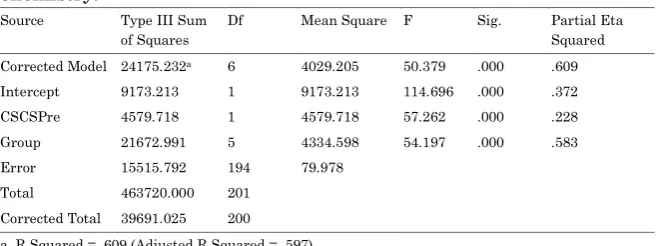
A critical observation of table 1 on the gained mean column, revealed that the group exposed to AASE group gained the highest mean score, followed by synthesis, application, analysis and then evaluation group. A further investigation to determine if a significant difference in the levels of creativity in chemistry among students exposed to different higher order question types exist was conducted. Using one-way analysis of covariate (ANCOVA).The results obtained are summarized and presented in table 2.
Table 2: Summary of analysis of covariate on the differential effects of higher order and factual question types on students’ creativity in chemistry.
Source Type III Sum
of Squares
Df Mean Square F Sig. Partial Eta
Squared
Corrected Model 24175.232a 6 4029.205 50.379 .000 .609
Intercept 9173.213 1 9173.213 114.696 .000 .372
CSCSPre 4579.718 1 4579.718 57.262 .000 .228
Group 21672.991 5 4334.598 54.197 .000 .583
Error 15515.792 194 79.978
Total 463720.000 201
Corrected Total 39691.025 200 a. R Squared = .609 (Adjusted R Squared = .597)
application, analysis, synthesis, and evaluation question types impacted the highest level of improvement in students creativity in chemistry followed by synthesis only, application, analysis, evaluation and then factual question type.
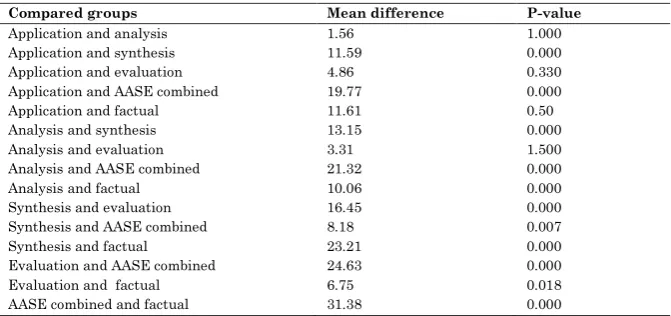
The significant difference that was observed in the effect of the higher order question types demands that the direction of the significant difference be determined. This was done by employing post hoc multiple comparison tests via Bonferroni test. The results obtained are displayed in table 3.
Compared groups Mean difference P-value
Application and analysis 1.56 1.000
Application and synthesis 11.59 0.000
Application and evaluation 4.86 0.330
Application and AASE combined 19.77 0.000
Application and factual 11.61 0.50
Analysis and synthesis 13.15 0.000
Analysis and evaluation 3.31 1.500
Analysis and AASE combined 21.32 0.000
Analysis and factual 10.06 0.000
Synthesis and evaluation 16.45 0.000
Synthesis and AASE combined 8.18 0.007
Synthesis and factual 23.21 0.000
Evaluation and AASE combined 24.63 0.000
Evaluation and factual 6.75 0.018
AASE combined and factual 31.38 0.000
Table 3 revealed that based on estimated marginal mean scores, the mean difference obtained from all the compared groups means were significant (P< 0.05) except for the comparison between application and analysis groups, application and evaluation groups and then analysis and evaluation question types groups.
DISCUSSION OF FINDINGS
The finding that application question type had a significant effect on creativity in chemistry is traceable to the fact that application question requires students to use their acquired knowledge in a new form. That is changing abstract ideas to concrete ones which entail creative ability. It was also found that analysis question type had significant positive effect on students’ creativity in chemistry. This is possible because analysis question demand student to have an in-depth learning by breaking down a given material into several smaller components in order to determine how the structure is organized. It takes one who knows the components of a given material to produce that material in similar or related form.
For the effectiveness of synthesis question type on creativity, it was found to be very effective. This result is traceable to the nature of the question which allows the students to activate their minds to reason critically and deeply into the core of the problem, thereby enabling them to discover new meaning related to a given task. The discovery of new meaning lead to new ways of producing ideas, skills, and things, it was also found that synthesis question type was more effective than evaluation questions. This may suggest why it was placed above evaluation level in the revised Bloom's taxonomy.
The positive effects of evaluation question type on creativity in chemistry are not surprising because with evaluation questions the students are required to judge the value of a given task using certain criteria. It is very obvious that when the quality of a given material is established it will serve as a source of guidance for the students to produce other familiar or unfamiliar things subsequently. That is it takes the understanding of the key themes to authenticate the validity of the obtained information.
types had developed in the students the ability to explore and expand knowledge from what is already known to what is novel form of it. This finding may also stem from the fact, the combination of the higher order questions make up the divergent question which does not require any specific response but a diversity of responses that are appropriate. This finding is in line with that of Orluwene and Essien (2010) who found that divergent questioning was more effective in creative achievement in chemistry than the convergent questions. The finding is not also similar to that of Orluwene and Amadi (2011), Ramas, Dolipas and Villamor (2013). However, this finding supports the notion that the type of question asked determines the thinking level that will be developed. So since a mixture of all the higher order question types was used, all the thinking skills associated with the different question types were developed leading to creativity in chemistry.
RECOMMENDATIONS
On the basis of the findings from the study, the following recommendations were made.
1. Teachers should apply the two-question rule when assessing their students.
2. Teachers should try to ask questions that address all levels of the cognitive domain, mostly the higher order.
3. Teachers should match their questions with the intended learning targets.
4. Teachers should refrain from using items which only aid arrival at the right answer, but also add items that stimulate imaginative thinking for a deeper understanding of both facts and concepts which can lead to better problem-solving in the school and the world beyond.
REFERENCES
1. Anderson, L. W., & Krathwohl, D. R. (2001). A Taxonomy for learning, teaching and assessing: A revision of Bloom’s taxonomy of educational objectives: Complete Edition. New York: Longman 2. Asadullah, S. (2016). Effects of Teacher Training on Secondary
Teachers Mathematical Content Knowledge in Dhaka, Bangladesh.
International Journal of Innovation and Economic Development, 2(5),40-55.
3. Ben-Peretz, M. (2002).Retired teachers reflect on learning from experience Teachers and Teaching: Theory and Practice. 8: 313-323. 4. Chin, C. (2007). Teacher questioning in science classrooms:
Approaches stimulate productive thinking? Journal of Research in Science Teaching (6) 815-843.
5. Collins, R. (2014). Skills for the 21st-century teaching higher-order
thinking, Curriculum and Leadership Journal 12(14) Retrieved http://www.curriculum.edu.au/leader/teaching_higher_order_thinkin g,37431.html?issueID=12910
6. Daud, A. M. & Osman, O. (2012). Creativity in science education.
Procedia -Social and Behavioural Sciences 59(17), 467-474.
7. Edward, M., McGoldrick, C. & Oliver, M. (2006). Creativity and curricula in higher education academics perspectives in N. Jackson, M. Oliver, M. Shaw, & J. Wisdom (Eds.), Developing creativity in higher education an imaginative curriculum (pp. 59-73). London: Routledge.
8. Elliot, S. N., Kratochwill, T. R., Cook J. L. & Travers, J. F. (2000).
Educational psychology: Effective teaching, effective learning (3rd Ed.)
Boston: McGraw Hill.
9. Gose, M. (2009). When Socratic dialogues is flagging questions and strategies for engaging students. College Teaching 57(1) 45-49. 10. Hassan, B. R., Rosli, R. & Zakria, E. (2016). The use of 1-thin map
and questioning to promote higher order thinking skills in mathematics. Creative Education,7(7),1069-1078
11. Ishag, A. (2009). On the importance of creativity, Retrieved from www.aitriz.org/articles/Trizfectures on 23/9/2011.
12. Mas Rosli, F. M., Maarof, N. (2016). The effects of higher order thinking skills (HOTS) questions in improving ESL pupils writing
performance. Retrieved
fromhttps://www.academia.edu/32421863/THE_EFFECTS_OF_HIGH ER_ORDER_THINKING_SKILLS_HOTS_QUESTIONS_IN_IMPRO VING_ESL_PUPILS_WRITING_PERFORMANCE?auto=download 13. McDade, S. A. (1995). Case study pedagogy to advance critical
14. McMillan, J. H. (1997). Classroom Assessment: Principles and practice for effective instruction Boston: Ally and Bacon.
15. Mourtos, N. J. (2010). Challenges students face in solving open-ended problems. International Journal for Engineering Education, 26(4), 846-859
16. Orluwene, G.W. & Amadi, G. N. (2012). The prediction power of thinking styles for creative achievement in chemistry. The Educational Psychologist 6(1), 150-158.
17. Orluwene, G. W. & Essien I. T. (2010). Efficacy of questioning techniques on creative achievement in chemistry. Nigerian Journal
of Educational Research and Evaluation, 9(1), 165-176.
18. Panicker, C. M. V. (2015). Identifying elements of higher-order thinking skills in student teachers’ lesson plans: A preliminary study.
Retrieved from
https://www.academia.edu/25039738/Identifying_Elements_of_Highe
r-Order_Thinking_Skills_in_Student_Teachers_Lesson_Plans_A_Preli minary_Study
19. Ramirez, R. P. B. & Gandaden, M. S. (2008). Creative activities and students higher order thinking skills. Education Quarterly 66(1), 22-23.
20. Ramos, J. L. S., Dolipas, B. B. & Villamore, B. B. (2013). Higher order thinking skills and academic performance Iin physics of college students: A regression Analysis. International Journal of Innovative Interdisciplinary Research, 4, 48-60.
21. Randles, J. (2017, March 10). Three types of question to boost
higher-order thinking. Retrieved from
https://www.iste.org/explore/articleDetail?articleid=912&category=In -the-classroom&article=
22. Sefertzi, E. (2000). Creativity. INNOREGIO: Dissemination of
innovation and knowledge management techniques. London:
Longman
23. Shalini, S. (2016, May 9). Factors that influence creativity. Retrieved from http://passionconnect.in/articleview/articleid/Factors-That-Influence-Creativity.
24. Shen, P. & Yodkhumlue B. (2011). Teachers questioning and students
critical thinking in college EFL reading classroom. The 8th
International Postgraduate Research Colloquium interdisciplinary approach for enhancing quality of life IPRC proceedings (pp. 44-53). Retrieved from http://bsris.swu.ac.th/iprc/8th/044_53_9_Pingshen.pdf 25. Tankersley, K. (2005). The threads of reading: Strategies for literacy
26. Tanner, C. (2011, July 27). Three factors of creativity (genetics are not one) retrieved from http://creativesomething:net/../threefactors-of-creativity.genetics-are-not-one.
27. Tofade, T., Elsner, J. & Aaines, S.T. (2013). Best practice strategies for effective use of questions as a teaching tool. American Journal of
Pharmaceutical Education 77(7), 1-9
28. Webb, N. (2005). Depth of Knowledge levels for four content areas. Presentations to the Florida Education Research Association 50th
Annual Meeting, Miami Florida
29. Woolfolk, A., Malcolm, H. & Wolkup, V. (2008). Psychology in