Vol. 4, Issue 8, August 2015
Gait Recognition Using Background
Subtraction
Azade Fathipour Dehkordi1, Mehran Emadi2
Computer Master Student, Department of Computer Engineering, Najafabad Branch, Islamic Azad University,
Najafabad, Iran 1
Assistant Professor, Department of Electrical Engineering, Mobarakeh Branch, Islamic Azad University, Mobarakeh,
Iran2
ABSTRACT: Biometric is the science of verifying the identity based on subject’s physical and behavioural characteristics. Identity verification specially in applications related to major crime is challenging. Hidden faces and covered ears by hairs are some possible issues. In addition biometrics solutions need direct collaboration with the goal. Gait analysis is a proper solution as long as people need to walk and it almost cannot be hidden. The proposed solution in this paper uses simple background subtraction to extract subject’s silhouette and eliminate background. PCA is used to model height and stride’s length. In this paper was used a dataset of CASIA containing one hundred persons and analyze them by 5 angel views in normal walking and walking by coats. Recognition rate for angel view, 90 degrees, was obtained 89%.This rate is hight rate in gait recognition.
KEYWORDS: Human Identification, Gait Recognition, Background Subtraction,Height,Stride Length ,PCA.
I.INTRODUCTION
Walking is one of the human physiological characteristics [1]. By tracking a sequence of low resolution images, it is possible to recognize the walking style of a person. The walking style is pretty unique, complex biometric characteristic. It contains moving different part of the body and their interactions, so it can be used to identity recognition. Gate is the walking style with the concentrate on moving legs.
In [2] the authors use low quality monochrome videos and a parametric method to achieve automatic recognition. By analysing height and pitch’s parameters the performance of 47% is achieved. It also is resistant to light, dressing style and unsystematic errors.
The legs height from the ground and angels between them has been considered in [3] by Fourier descriptor to extract the frame shapes. Identity recognition is done by considering vector characteristics of the subjects for each video frame statically. They achieved performance of 92% but it is worth to notice that the videos should be high quality with the proper angel views which the angels between the legs and other characteristics can be extracted. Considering these issues may be difficult especially if there were several people on the frame.
Noise cancelation is applied to authorized subjects silhouette by simple background subtraction in [4]. After reducing size by cropping the image, centre of gravity (body), pitch’s size and triangular area between the control points have been extracted. Finally matrix characteristics are used for evaluation.
Vol. 4, Issue 8, August 2015
II.METHOD
In this paper simple background subtraction and HSV techniques are used to eliminate image backgrounds and shadow respectively. After that Proper characteristics have been extracted.
II. I. Simple background subtraction
This method uses the absolute subtraction value between current image I (x, y) and background reference B (x, y) to recognize movement mask D(x, y). Generally, background reference is the first frame of the video without objects on the background.
( , ) = , | ( , ) − ( , ) | ≥ ,
τ is a threshold to make decisions, a pixel corresponding to background or foreground. If the absolute subtraction value is less than τ it is a background pixel, otherwise it is a foreground one [5]. This method is sensitive to modifications but it is effective for stable backgrounds. In addition it is a simple method with simple equations.
II. II. Shadow elimination
Although background subtraction is a very common and popular method, it falls to remove shadows. Shadows must be eliminated by background subtraction. In this work, according to the experimental results in [6], shadow removal is achieved by HSV. Herodotou and his colleagues proved that HSV color environment has a strong correlation with human comprehension of colors [7]. The author in [8] proved HSV color space is more effective in order to remove shadows with experimental results.
Sonia Das in [6], after trying three different data bases and by using HSV, RGB and YCbCr methods, concluded that HSV method is more efficient compared to the two others.
II.III. Walking cycle
In order to extract required characteristics, walking cycle must be calculated. In walking cycle when both feet are closely place on the ground, the height is at its maximum. During walking when the height is at its maximum the pitch is at minimum and vice versa. There are two distinct phases in walking cycle; swing phase and stance phase. Swing phase represents the state where one foot in on the ground and the other foot is right before being lifted from the ground. This state has the maximum height. On the other hand the state phase with minimum height represents the situation where both feet are on the ground placed at the farthest location from each other.
II.IV. Calculation of person’s height
One of the characteristic derived in this work is the height of people which is one of the important features not affected by the camera's performance, distance or appearance of the subject. At first, the head and foot points should be determined to enable calculation of the height. The corner points will be determined after extraction of the person's shape. A local imaginary window is assumed in the image and the average of the changes resulted from moving this window in various directions with short travel paths at a time will be calculated. This procedure is done for each pixel and a value equal to the minimum of the changes resulted by these movements is defined. When the corner points are determined, the highest and lowest point of the shape will be determined which are named head and foot point respectively.
Direct Linear Transformation is used to calculate person height. (u , v ) is the foot and (u , v ) is the head point.
+ + + − ( + + ) = (2)
+ + + − ( + + ) = (3)
Vol. 4, Issue 8, August 2015
+ + + − ( + + ) = (4)
+ + + − ( + + ) = (5)
By computing these four equations, Z is achieved. With the assumptions that is equal to zero for foot points and (x,y) coordination of foot and head points are equivalent. The coordination of Z is different only for height. The subtractions of , is equal to person height.
II.V. Calculation of person’s stride length
Among different characteristics of stride, its size is used in this research and calculated by boundary-box technique. Box’s width is the border of step length and twice box width is stride’s size. The changes in box’s length and width in one period of walking, demonstrate the modifications in height and stride length, respectively.
II.VI. Feature reduction
Feature reduction techniques are necessary for an effective and more efficient analysis. All features are used in feature extraction by linear or non-linear methods in order to reduce the number of features. This causes the fewer amounts of data to process. [9]
II. VII . PCA1 method
PCA is the best non-linear method to reduce dimensions in data modelling which has negligible missing information. It is a statistical procedure that uses an orthogonal transformation to convert a set of observations of possibly correlated variables into a set of values of linearly uncorrelated variables called principal components. The number of principal components is less than or equal to the number of original variables. This transformation is defined in such a way that the first principal component has the largest possible variance (that is, accounts for as much of the variability in the data as possible), and each succeeding component in turn has the highest variance possible under the constraint that it is orthogonal to the preceding components [10]. The resulting vectors are an uncorrelated orthogonal basis set. PCA analysing has been conducted by Pierson work [9].
Principal Component Analysis was used for feature extraction and for similitude estimation Euclidean distance was
Used. Like purpose method in[11].
III.EVALUATION
Video images should be converted to video frames for background detection and elimination goals. Background elimination helps tracking the moving subject. The walking characteristics of the subject can be recognized by analysing received shapes. In this paper the CASIA dataset with 100 persons has been analysed in various angel views in normal walking and walking with coat. Train and test datasets contain 25 and 75 records.
IV. RESULT AND DISCUSSION
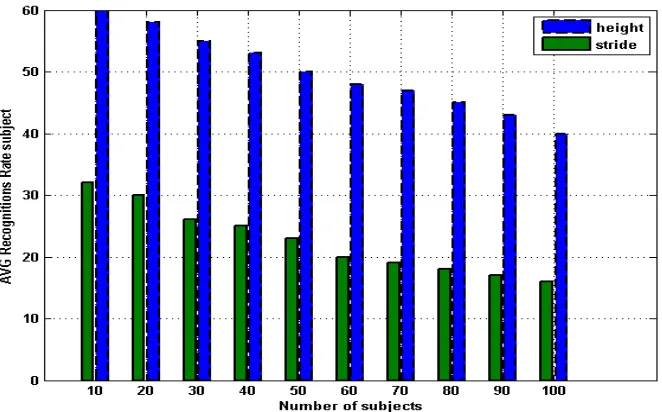
Obtained results by recommended algorithms and the comparison with other works are demonstrated in figure 1. The bar chart is shown in figure 2. As figure 3 reveals, height has better recognition rate than pitch’s size and is less insensitive to various parameters. The bar chart comparing height and pitch’s size is available in figure 4.
1
Vol. 4, Issue 8, August 2015
Fig.1 the average recognition rate in recommended algorithm
Fig.2 the average recognition rate bar chart
Vol. 4, Issue 8, August 2015
Fig.4 height and stride’s length recognition rate bar chart
In table (1) the comparison of recognition rates of different algorithms with various angle views is available. These results have been obtained by analysing normal walking frames. The performance of recommended algorithm is at maximum in 140 and 90 degrees. We assume that height is not affect by various angle views but this assumption is false in some situations. The effect of some angel views and some clothing types cause errors in pitch’s size calculation and low performance consequently. Considering other pitch’s characteristics may improve the performance.
Table (2) contains recognition rates of various algorithms by considering walking style in different angel views. The subjects wearing coats are considered here. Results for recommended algorithm are not favourable and other methods should be applied.
Table (1): performance comparison of different algorithms in normal walking
50
70
90
140
160
Angle view (degree)
0.20 0.29 0.47 0.62 0.40
DCT
2 0.30 0.43 0.72 0.89 0.48DFT
3 0.70 0.50 0.60 0.70 0.50DHT
4 0.30 0.6 0.89 0.89 0.62recommended algorithm
Table (2): recognition rates of different algorithm for wearing coats subjects
50 70 90 140 160 Angle view (degree)
0.12 0.06 0.03 0.13 0.06 DCT 0.14 0.08 0.07 0.11 0.02 DFT 0.14 0.09 0.05 0.18 0.04 DHT 0.25 0.26 0.53 0.87 0.32 recommended algorithm
2
Discrete Cosine Transformation
3
Discrete Fourier Transform
4
Vol. 4, Issue 8, August 2015
V.CONCLUSION AND FUTURE WORK
This study is related on simple background subtraction which is one of the simplest methods in background elimination. Although this method decreases the computational load, it has acceptable results. analysing gate is simpler than other methods by using linear techniques which has lower computational load.
The obtained results demonstrate that subject heights are not affected by various angel views and dressing style but stride length is affected by these parameters. We recommend researchers to consider this issue in future works by adding other stride’s parameter like speed or cadence. We also recommend this method to be tested in other datasets which contain outside frames with no stable backgrounds. The suggested algorithm for background removal in this situation is Gaussian mixture.
REFERENCES
[1] A. Ross and A. Jain, “Human recognition using biometrics: an overview,” Annales Des Tlcommunications, vol. 62, no. 1-2, pp. 11–35, 2007. [2] Chiraz BenAbdelkader, Ross Cutler, and Larry Davis,” View-invariant Estimation of Height and Stride for Gait Recognition”, Biometric Authentication, LNCS 2359, pp. 155–167, 2002, c Springer-Verlag Berlin Heidelberg 2002.
[3] Mridul Ghosh, Debotosh Bhattacharjee,”Gait Recognition For Human Identification Using Fourier Descriptor and Anatomical Landmarks”, I.J. Image, Graphics and Signal Processing, vol 2, pp 30-38, Published Online January 2015.
[4] Sonia Naik, Dr. H. G. Virani,” Human Gait Recognition using BPN and MLP”, IJIRST International Journal for Innovative Research in Science & Technology, Volume 1, Issue 11, April 2015.
[5] Lucky Kodwani,” Automatic Vehicle Detection, Tracking and Recognition of License Plate in Real Time Videos”, Master thesis, 2013.
[6] Sonia Das, Sukadev Meher,” Automatic Extraction of Human Gait Feature for Recognition”, Engineering and Systems (SCES), Students Conference on, 2013.
[7] N. Herodotou, K.N. Plataniotis, and A.N. Venetsanopoulos, “A color segmentation scheme for object-based video coding”, Browse Conference Publications in Proceedings of the IEEE Symposium on Advances in Digital Filtering and Signal Processing, pp:25-29, 1998.
[8] R. Cucchiara, C. Grana, M. Piccardia, A. Prati, and S. Sirotti,” Improving Shadow Suppression in Moving Object Detection with HSV Color Information," IEEE Intelligent Transportation Systems, Conf. Proc. pp. 334-339, 2001.
[9] M.Mohamadi,” methods of data processing and pattern recognition”, Thesis Tusi University, Department of Electrical Engineering, 2005. [10] M.S.Sheykhaee,” Dimensionality reduction "research project studying machine learning, Amirkabir University of Technology, Department of Computer Engineering, 2006.
[11] Suvarna Shirke,Soudamini Pawar,”Human Gait Recognition for Different Viewing Angles using PCA”, International Journal of Computer Science and Information Technologies, Vol. 5 (4),4958-4961, 2014.
BIOGRAPHY
Mehran Emadi received the B.S. degree in Electrical Engineering (Electronics) in 1995, the M.S. degree in Electrical Engineering (Electronics) in 1999 from Azad University, NajafAbad branch, Iran, and the Ph.D. degree in Electrical Engineering (Image processing) from University Technology Malaysia (UTM), Malaysia in 2013. His researches include semiconductors in his M.S. degree and image processing, computer vision, biometric applications in his Ph.D. degree period. There have been more than 30 technical papers, published by him and he is an assistant professor in Azad University in Iran and now he is the head of Master students in Azad University Mobarakeh branch. He has been working as the program chair, and a committee member for some international conferences, and has been training several students in Universities by webinar.
Azade Fathipour Dehkordi received the B.S. degree in Computer Engineering (Hardware) in 2007 from Azad University, Taft Branch, Islamic Azad University, Yazd, Iran, and studying Computer