The Right to Work and Mgnrega: Theory and Fact
Rudra Prasad Roy
Asst. Professor & Hod, Dept. Of Political Science, Egra S.S.B College, Purba Medinipur, West Bengal, India.
Abstract:
The right to work is a relatively modern concept. It was in the French Constitution of 1793 that the right to work, by being able to chose a job freely without losing dignity, is recognized as a right. This culminated in the Constitution of 1848 from which time the right to work slowly starts gaining acceptability. Some claim it was one of the clear social characteristics of the „bourgeois revolution‟ and nascent capitalism signifying the end of the feudal era. It was in 1948, that the newly born United Nations universalized the concept by recognizing the right to work as a human right1.
T
he „right to work‟ is a „directive principle‟ in Indian Constitution which was formalized through the enactment of NREGA (2005)2. It is seen as a mechanism of income transfer, infrastructure development and promoting rural production and consumption markets -a multifarious strategy indeed. NREGA has found priority policy attention in India‟s 11th five year plan (2007-12) under a broader objective of „Bharat Nirman‟3 was aiming for resurgence in rural areas. Some consider NREGA a natural response to non-inclusive growth that occurred during reforms process of last about two decades. The format of NREGA and its nationwide implementation was a result of persistence by civil society and activists which is a common mechanism to influence policy in India. NREGS is unique, being large in size, intended to cover long periods, disburse huge funds and be dynamically responsive to climatic and rainfall conditions and above all opento any adult intending to work for wages often lower than local causal wages. Since self-targeting is inherent to scheme, besides chronic poverty manifest for example in food inadequacy, it also intends to mitigate idiosyncratic risks and shocks faced by households due to being differently-abled or death of earning member. NREGS can attract the unemployed or underemployed rural youth; because of immediate cash availability and 100 days of assured work which functions as a short-term relief objective. Indian policy appears confident that NREGS can be important normally, even in the absence of price or income shocks and that it can smoothen seasonal fluctuations in labour demand and, therefore, wage rates in rural areas where rainfall patterns and insufficient irrigation preclude year round crop cultivation (Barrett, et. al, 2004).Other objectives include, generation of productive assets, empowering rural women, reducing rural-urban migration, fostering social equity and environmental protection.
MGNREGA and the Right to Work:
mid 70 led to the Employment Guarantee Scheme in 1979. However the Maharashtra model was a scheme not a legal right and did not have any limit to the number of days that employment could be provided. It was much later in 2004-05 that the right to work, as it now is, came to be formulated and was the basis for a campaign which demanded its immediate enactment once the UPA came to power in 2004. The MGNREGA in its present form came about mostly as a result of electoral populism outlined in the Common Minimum Program of the first UPA government, but its subsequent vitality would depend not on the pious pronouncements of that in Government but on the strength of people‟s movements. People‟s movement identifies and corrects faultiness, in design and implementation.
At the level of theoretical design, the MGNREGA is a rights based approach where work is provided on demand. This aspect relies on the „principle of self-selection‟ – people who want to do hard manual labour at minimum wages will demand and be given work by the state. This route of the NREGA is fundamentally different from the top-down approaches to rural development which has been there in the past. This opens up a distinct possibility of democratization or decentralisation at the grassroots especially among the rural poor who can now demand the right to do unskilled manual labour at legally stipulated minimum wages.
Further they can now have a say in the decision making process of selection of works – a break from the past where the developmental administration or the vote seeking politicians decided what kind of asset was to be built. This is aimed at achieving a model of sustainable community development keeping in mind local needs for planning and at the same time providing some succour to unemployed rural workers in lean seasons.
Yet the law differed from the theoretical design. The National Rural Employment Guarantee Bill was tabled in parliament and passed in the last week of August, 2005, with some of the amendments that mass organizations, academics, activists and journalists who formed an integral part of the nationwide peoples campaign for Employment Guarantee. The National Rural Employment Guarantee Act, 2005 promises “to provide for the enhancement of livelihood security of the households in rural areas of the country by providing at least one hundred days of guaranteed wage employment in every financial year to every household whose adult members volunteer to do unskilled manual work and for matters connected therewith or incidental thereto.” NREGA became operational on 2nd February, 2006 and first covered 200 of the most backward districts, then 330 and now all 620 districts of the country.
Mahatma Gandhi NREGA belongs to a long history of wage employment programmes. The most significant features of the Mahatma Gandhi NREGA are that it creates a rights-based framework and that it is a law. Its main instruments for articulating a rights-based approach are: (i) documents like job cards that are the workers‟ documents for asserting his/her rights; (ii) exercise of choice by workers; (iii) time-limits on the government for fulfilling guarantees; (iv) social audits; and (v) compensation/penalties.
published biannually through official website suggests that in the year 2007-08, overall 33.7 million households were provided with 1.43 billion man days of NREGA employment and distributed close to Rs. 86 billion. These absolute numbers which account for about 45% of all rural households, suggest a vibrant and highly efficient program implementation and matches with the stated policy and the targets.
WORKERS’ RIGHTS under MGNREGA
• Self-selection: There are no eligibility criteria or prerequisite skills.
• Demand-based: Any rural households willing to do unskilled manual work may apply for registration in their local gram panchayats (local governments at the village or small-town level) if they want to be eligible for employment under the Act. Following registration, the employment to the gram panchayat or to the Programme Officer at the block level, specifying the period for which employment is being sought.
• Time-bound guarantee: The worker‟s application for employment is acknowledged through a dated receipt issued by the village local body or the gram panchayat or the Programme Officer. This initiates the guarantee process in response to the demand. The right to employment is guaranteed through timelines: 15 days to allocate employment, 15 days to make payments. An unemployment allowance is paid by the respective State government to the applicant in case of a delay in employment allocation.
• Local employment must be provided within five kilometres of residence or else transport and extra wages of 10 per cent must be paid.
• Flexibility is given to workers to participate according to need.
• Wage payment must be as per notified wages within a week and not beyond a fortnight.
• No contractors or machinery is permitted.
• The labour-intensive works have ratios of wage costs to material costs (inclusive of skilled and semi-skilled labour) that are 60:40.
The process of application for work is the basic premise for the assertion of rights. Wage seekers have the right to apply for registration in their local body or Gram Panchayat (GP) if they want to be eligible for employment under the Act. Following registration, the applicants are entitled to receive job cards. The job card is the basic physical instrument that enables an applicant to demand work and also the worker‟s record of rights. For availing employment under Mahatma Gandhi NREGA, the job card holder has to submit a written application for employment to the GP or to the Programme Officer (PO) at the block level, specifying the period for which employment is being sought. This right to demand employment as and when needed is acknowledged through a dated receipt issued by the GP or the PO. This initiates the guarantee process in response to the demand. The right to receive employment is guaranteed through timelines: 15 days to allocate employment, 15 days to make payments. Correlated guarantees relate to violation of these rights: an unemployment allowance to the job card holder who has demanded employment, in case of delay in employment allocation, to be paid by the respective state government, and INR 1,000 (US$ 22) as fine on those who violate the Act.
programmes. Mahatma Gandhi NREGA harked back to a much earlier Employment Assurance Scheme (EAS)4.
Implemented in all the rural blocks of the country the EAS shared primary features with Mahatma Gandhi NREGA including demand for work, the provision of 100 days employment, and the nature of works. The implementation of EAS put forth certain challenges as reported by the Programme Evaluation Organisation of the Planning Commission. These related to planning, record maintenance, monitoring, fund release, and utilisation. The physical and financial performance of EAS indicated inconsistent fund utilisation from one financial year to the next. The factors responsible for this inconsistency, according to the Planning Commission, included no availability of timely funds from the state non-disbursal of funds according to entitlement from the districts to blocks, and non-receipt of utilisation certificates. Some of these limitations were addressed in the Mahatma Gandhi NREGA, for instance, by involving potential wage seekers and users of assets in the planning of projects. Gram Sabhas (GS)5 were vested with the task of preparing a shelf of projects. Social audits and proactive disclosures were introduced as legal provisions.
Mahatma Gandhi NREGA made the demand factor a conscious strategy as a right to obtain employment. Financial obligations of both the central and the state governments are part of the legal framework. The Mahatma Gandhi NREGA guidelines also detail operational and administrative modalities of implementation seeking to address the limitations of the earlier wage employment programmes, placing great emphasis, for example, on planning processes, and Management Information System (MIS) for improving data management. The earlier Maharashtra Employment Guarantee Scheme (MEGS)6 is also a forerunner of Mahatma Gandhi NREGA.
Beginning as a programme in 1965, MEGS became a state law in 1979. The MEGS guaranteed that every adult who wanted a job in rural areas would be given one, provided that the person was willing to do unskilled manual work on a piece-rate basis. The piece-piece-rates were fixed so that an average person working diligently for seven hours a day would earn a wage equal to the minimum wage prescribed for agricultural labour for the concerned zone, under the Minimum Wages Act. To obtain employment under the scheme, individuals had to register with the local village authority, and submit a „demand for work‟.
The local MEGS officer, tahsildar, (a local revenue officer) was then obliged to provide work within 15 days of receiving the demand. Failure to provide employment within this period entitled the person to an unemployment allowance. Participants were provided with certain on-site amenities. MEGS has now given way to Mahatma Gandhi NREGA in Maharashtra. Almost all the rights-related features of Mahatma Gandhi NREGA were inherited from previous wage employment programmes. The impetus to recreate a WEP as law under Mahatma Gandhi NREGA came from the political manifesto of the Congress party. There should, therefore not be any ambiguity regarding the „architect‟ of the Mahatma Gandhi NREGA. So Mahatma Gandhi NREGA inherited a number of elements from previous programmes.
employment generation. It was a programme for works related to natural resource management. This was an opportunity lost. Had the Mahatma Gandhi NREGA design, especially its rights-based instruments, been tried out in the NFFWP, several problems and dilemmas that have emerged now would have been anticipated and modified where needed. Alternatively, some of the complex challenges inherent in the rights-based design and decentralised planning of the Mahatma Gandhi NREGA may have been acknowledged and prioritised. This would have paved the way for intensive and preparatory capacity -building on those processes perhaps leading to the condition that the Act would be notified only where suitable capacity building was evidenced as a commitment of the State to legal rights and obligations. The incentive to the state then would be the transition from a finite budget to an open-ended, demand-based budget – an opportunity, in fact, of strengthening the natural resource base of rural livelihood and offering a guaranteed social safety net to the rural poor.
Thus, the design constituents of Mahatma Gandhi NREGA were inherited from earlier wage employment programmes. However, since the conditions for implementing the rights-based processes of the Act were not necessarily universally or equally present, the implementation of the schemes under the Act, immediately after its notification, became the testing and training ground. Inevitably, violations of the legal provisions of the Act attracted considerable commentary. This is not an attempt to add to that commentary. The discussion here focuses on potential positive trends and constraints at this particular stage of implementation. Since there is considerable dynamism in the policy environment of the Act and in its programme implementation, the issues discussed here will need to be re-visited.
Implementation of the Right-based Act:
households issued job cards is 17 percent and share in the total employment generated under MGNREGA is 25.4 percent. This means the allotment of work for Scheduled Tribes (STs) is more than there proportion in the job cards issued. The shares of ST households have
witnessed an improvement in employment under this employment programmes. This may be due to initial targeting of the programmes in districts, where ST households form a sizeable share of the total households.
Table-1
Job Cards Issued, Employment Demanded and Provided (million households)
Year Job cards issued Employment demanded Employment provided
2007-08 48.8 11.2 10.6
2008-09 94.3 28.4 28.1
2009-10*
* Till February
94.3 32.1 31.7
Source: NREGA Official Website (www.nrega.nic.in)
Table-2
Share of SCs, STs and Women (per cent)
Job Cards Issued Employment Person Days Generated
SC ST SC ST Women
2007-08 19 23 17 27 47
2008-09 20 17 19 23 48
2009-10*
*Till February
20 15 20 18 49
Table- 3
Distribution of Households provided Job Cards under MGNREGA according to their Social Status (Percent)
Sl.
No. State Name SCs 2009-10 STs Others SCs 2008-09 STs Others
1 ANDHRA PRADESH 25.3 11.7 63 25.3 11.7 63.0 2 ARUNACHAL PRADESH 0.2 89.5 10.3 0.1 93.7 6.1 3 ASSAM 12.5 20.7 66.8 11.0 22.1 66.9 4 BIHAR 42.2 2.2 44.1 55.6 2.1 53.8 5 GUJARAT 14.7 34.2 51.1 14.1 36.1 49.8 6 HARYANA 52.2 0.0 47.8 55.9 0.0 44.1 7 HIMACHAL PRADESH 34.3 7.3 58.5 35.5 7.4 57.2 8 JAMMU AND KASHMIR 10.0 24.2 65.8 8.8 28.2 63.0
9 KARNATAKA 19.3 9.5 71.2 25.8 12.0 62.2 10 KERALA 13.9 3.8 82.3 14.8 4.4 80.8 11 MADHYA
PRADESH 18.4 27.6 54.0 19.4 27.3 53.3 12 MAHARASHTRA 20.4 19.9 59.8 20.7 20.5 58.8 13 PUNJAB 77.7 0.0 22.3 73.0 0.0 27.0 14 RAJASTHAN 24.7 19.9 55.3 25.6 20.5 53.9 15 SIKKIM 6.7 41.4 51.9 6.5 37.3 56.3 16 TAMIL NADU 40.1 1.6 58.2 42.7 1.7 55.6 17 TRIPURA 18.5 38.3 43.2 19.6 37.7 42.7 18 UTTAR PRADESH 51.0 0.8 48.2 50.7 0.9 48.4 19 WEST BENGAL 35.1 10.3 54.6 35.3 10.6 54.0
20 CHHATTISGARH 13.9 37.9 48.2 14.8 39.8 45.5
21 JHARKHAND 15.3 37.9 46.8 16.2 37.7 46.0 22 UTTARAKHAND 28.3 4.2 67.5 28.8 3.9 67.3 23 MANIPUR 2.9 53.8 43.3 1.4 54.8 43.7 24 MEGHALAYA 0.3 94.3 5.4 0.4 93.6 6.1
25 MIZORAM 0.0 99.9 0.1 0.0 99.9 0.1
26 NAGALAND 0.0 100.0 0.0 0.0 100.0 0.0 27 ORISSA 19.9 29.4 50.7 20.0 29.9 50.1
All India - - - 29.2 16.5 54.4
Source: NREGA website GOI (www.nrega.nic.in)
This is a good indication how the economic benefits of MGNREGA trickling down to the marginalised sections
The data on participation of beneficiaries of land reforms and Indira Awas Yojna, the two household groups which belongs to poor class, indicate that participation of such households increased from 26 lakh in 2006-07, 57 lakh in 2007-08 and 65 lakh in 2008-09. This is a significant increase in the number of poor households‟ participation in MGNREGA. However, it is only 8.5 percent of the total household provided employment (2008-09). Still efforts are required to raise this proportion. As far as participation of women is concerned, the MGNREGA outshines earlier programmes by significantly higher margins. The participation of women beneficiaries is much higher in the programmes as compare to their participation, for example, in Employment Assurance Scheme (EAS), which was merged with the Swaran Jayanti Gramin Rojgar Yojna in 2001-028.
For women the scheme is especially attractive because there is no gender differentiation in wage rates, in marked contrast to the prevailing system for agriculture labour. Interestingly, males in some poor peasant households send the women to work on MGNREGA projects where the rate of return is certainly higher than in alternative employment on the farm, at least in most months of the year. In terms of number of person days employment generated per households there was an increase of 5.38 percent from 2008-09 to 2009-10 (till February). But the
number of households who are provided employment has also gone up, hence the average person days of employment per household which is 38 person days in 2008-09, it has not increased at least till February 2010. Still one month of this financial year is remaining therefore these figures are not comparable to the previous year. However if we compare the figures for the period 2007-08 (43 days) and 2008-09 there is a clear decline in the average person days of employment generated per household. One reason may be the inclusion of those remaining districts under this scheme which are relatively better of in terms of economic development. Hence there was less demand for jobs in those districts as compare to the poorer districts which were already under MGNREGA in previous year i.e. 2007-08. But this aspect needs to be further investigated.
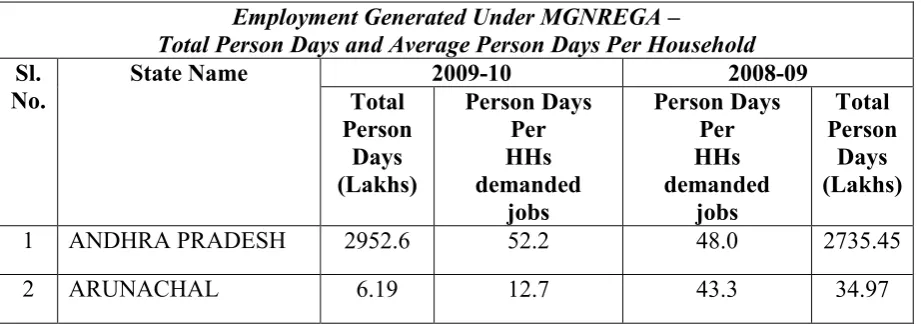
Table 4 shows that states like Rajasthan, Madhya Pradesh, Uttar Pradesh, Tripura, Manipur, Tamil Nadu and Andhra Pradesh are again the better performing states as far as the average employment per household is concerned. The states like Kerela, Bihar, West Bengal are again lagging behind in providing employment to unskilled in these provinces under MGNREGA. Among the various states, many states such as Karnataka, West Bengal, Gujarat and Andhra Pradesh have witnessed improvement in the person days of employment per household in 2009-10.
Table- 4
Employment Generated Under MGNREGA –
Total Person Days and Average Person Days Per Household Sl.
No.
State Name 2009-10 2008-09
Total Person
Days (Lakhs)
Person Days Per HHs demanded
jobs
Person Days Per HHs demanded
jobs
Total Person
Days (Lakhs)
1 ANDHRA PRADESH 2952.6 52.2 48.0 2735.45
PRADESH
3 ASSAM 569.42 33.1 40.0 751.08
4 BIHAR 902.3 25.9 25.9 991.75
5 GUJARAT 436.86 30.9 25.0 213.07
6 HARYANA 39.61 33.1 42.4 69.1
7 HIMACHAL
PRADESH 205.04 48.8 46.1 205.28 8 JAMMU AND
KASHMIR 65.42 35.5 39.6 78.8
9 KARNATAKA 1482.69 53.2 32.1 287.63
10 KERALA 216.57 27.7 22.2 153.76
11 MADHYA PRADESH 2600.8 53.4 56.6 2946.96
12 MAHARASHTRA 239.37 42.1 46.3 419.85
13 PUNJAB 53.09 26.5 26.9 40.28
14 RAJASTHAN 4200.84 67.6 75.8 4829.55
15 SIKKIM 29.17 53.7 50.6 26.33
16 TAMIL NADU 1966.57 54.8 36.0 1203.61
17 TRIPURA 304.04 54.2 64.0 351.12
18 UTTAR PRADESH 2663.58 57.9 52.4 2272.21
19 WEST BENGAL 619.53 34.4 26.0 786.62
20 CHHATTISGARH 812.04 46.9 54.8 1243.19
21 JHARKHAND 682.72 48.9 47.6 749.97
22 UTTARAKHAND 136.61 33.0 34.9 104.33
23 MANIPUR 239.71 61.7 74.9 285.63
24 MEGHALAYA 104.89 36.9 38.5 86.31
25 MIZORAM 133.7 74.4 72.8 125.83
26 NAGALAND 232.44 75.0 68.3 202.71
27 ORISSA 363.67 34.9 36.1 432.6
All India - 35.4 38.0
Conclusion:
But what still remains a most disappointing fact is that this employment guarantee is to be provided to rural households, and not individuals. What this means in other words is that our policy-makers have (implicitly or explicitly) assumed a unitary household model and have tended to direct resources principally at male household heads in the rural economy. The household approach instead of the individual-entitlement approach has been one of the serious drawbacks of the current act, excluding a large majority of the labour force from their legitimate rights. Further a full fledged employment guarantee would imply that it would be applicable to both rural and urban areas. At the same time, MGNREGA has no urban employment guarantee. Also financial decentralisation9, i.e. panchayat level decision making with regards to financial allocation is currently absent in this act. Further, the natures of works that can be undertaken under NREGA are such that disabled and old people cannot avail of this opportunity. These limitations restrict the scope of the Act compared to its original intention visualized by the campaign.
However, the flaws in the MGNREGA can be distinguished as belonging to two types - those that arise during the process of implementation and those which arise from the very way MGNREGA was designed. Design faults are in the formulation of the program which takes place at the top (first movement). Faults in implementation come to the fore when people‟s ‟rights are asserted from below (second movement). The two are however interwoven in a historical process and often reinforce one another. This often makes the two different nature of faults appear as part of the same historical process and often are not distinguishable by observation. It also gives rise to the suspicion that the design faults are at times deliberate, so that the process of
implementation can be easily corrupted. The conceptual separation that we have outlined is often such that upon observation it seems to contain both. This is precisely the feature of a double movement, because, only when the law is implemented do rights take actual shape. The other feature is that often we observe what surface level phenomenon, e.g. corruption, but fail to look below the surface for structural reasons causing it. Most observers of NREGA point to the level of corruption and hence the policy prescription that follows is one of proper implementation. What we want to explore instead is that whether these are faults of designs or of implementation? In the working of a double movement, these two features often are observed together but the conceptual separation is often not affected.
Notes:
1. Sen, Amartya- „Collective Choice and Social Welfare‟; Oxford University Press, New Delhi, 1970. 2. This act replaced the National
Food for Work Program, introduced in 140 districts in November 2004, the Jawahar Gram Samridhi Yojana (JGSY) and the Employment Assurance Scheme (EAS). NREGA documents and operational guidelines are available from the Ministry of Rural Development‟s website 3. Roughly translates to „rural India
reconstruction‟.
4. EAS was launched on 2 October 1993 in 1,778 backward blocks of different states. The blocks selected were in drought-prone, desert, tribal and hilly areas. Later, the scheme was extended to the remaining blocks of the country in a phased manner. At present, the scheme is being implemented in all the rural blocks of the country. The programme was restructured later. The primary objective of the EAS is to provide gainful employment during the lean agricultural season in manual work to all able-bodied adults in rural areas who are in need and desirous of work, but cannot find it.
5. The GS is the foundation of decentralised governance in India where elected representatives are directly and regularly accountable to the people. Meetings of the GS are convened to ensure the development of the people through their participation and mutual cooperation. The annual budget and the development schemes for the village are placed before the GS for consideration and approval. 6. For further details, Programme Evaluation Organisation: Joint Evaluation Report on Employment
Guarantee Scheme of Maharashtra, 1980, PEO Study No.113.
7. SGRY was launched to provide a greater thrust to additional wage employment, infrastructural development and food security in rural areas. The Employment Assurance Scheme (EAS), (the then only additional wage employment scheme for rural areas), the Jawahar Gram Samridhi Yojana (JGSY) (a rural infrastructure development scheme) were merged into one, launching the SGRY on 25 September 2001.
8. NCAER-PIF- „A Study on Evaluating Performance of National Rural Employment Guarantee Act‟; National Council of Applied Economic Research, New Delhi, 2009.
9. Bhaduri, Amit- „Development with Dignity: A Case for Full Employment‟; National Book Trust, New Delhi, 2005.
References:
1. Beg, Mansoor Ahmad (2012). „MGNREGA: Empowering Rural Poor through Wage Employment‟; Neha Publishers & Distributors, Jaipur.
2. Bhaduri, Amit (2005). „Development with Dignity: A Case for Full Employment‟; National Book Trust, New Delhi. 3. Dreze, J., Sen, A. (2013). „An
Uncertain Glory‟; Penguin Books India, New Delhi.
4. Dreze, J., Sen, A. (2009). „Development and Participation‟; Oxford University Press, Delhi. 5. Dreze, J., Sen, A. (2005). „India:
Economic Development and Social Opportunity‟; Oxford University Press, Delhi.
perspectives‟; Oxford University Press, Delhi.
7. Dreze, J., Reetika Khera (2009). „The Battle for Employment Guarantee‟; Frontline, Vol. 26 No. 1.
8. Gaiha, Raghav (2013). „Battling Corruption: Has NREGA Reached India's Rural Poor'; Oxford University Press, Delhi.
9. Government of India (2008). „The National Rural Employment Act‟, Ministry of Rural Development, New Delhi.
10.Govt. of India, Ministry of RD, RD Dept. (2008). „National Rural Employment Guarantee Act - Some Reports from the Field‟, 2006-07. 11.Jana, Anil Kr. (2005).
„Development at the Grassroots- The Policy Syndrome‟; Politics and Society.
12.Ministry of Rural Development (2014.). „Rural Development Schemes issue‟; Kurukkshetra Vol 62 No.4, February.
13.Ministry of Rural Development, Government of India (2014). „India Rural Development Report 2012-13‟; Orient Blackswan, New Delhi. 14.Ministry of Rural Development,
Government of India (2012). „MGNREGA Sameeksha‟; Orient Blackswan, New Delhi.
15.NCAER-PIF- „A Study on Evaluating Performance of National Rural Employment Guarantee Act‟; National Council of Applied Economic Research, New Delhi, 2009.
16.Pankaj, Ashok K. (2012). „Right to Work and Rural India - Working of the Mahatma Gandhi National
Rural Employment Guarantee Scheme (MGNREGS)‟ Sage, New Delhi.
17.Puthenkalam, John Joseph., George, M. K. (2012). „Human Development Strategy of MGNREGA‟; Rawat Publications, Jaipur.
18.Sen Roy, Dipjoy., Saamanta, Debabrata (2009). „Good Governance and Employment Generation through MGNREGA: A case study of Gram Panchayats in West Bengal‟; Conference on “Infarstructure, finance & governance: Push for growth”, Nov, New Delhi.
19.Sharma, Ajay Kr. (2009). „Effectiveness of the NREGS: A Case Study of the Rajgarh District, India‟; ICPE, January.
20.Siddhartha & Vanik, Anish (2008). „CAG Report on: Fact and Fiction‟; EPW, June 21.
21.Singh, S. R. (2011). „National Rural Employment Guarantee Act (NREGA): Issues and Challenges'; Aph Pulishing Corporation.
22.Sudarshan, Ratna M. (2009). „Examining India‟s National Regional Employment Guarantee Act: Its Impact and Women Participation‟; Working paper issue- 05, May.
23.Trivedi, B. R. (2011). „Encyclopaedia of nrega and panchayati raj‟; Neha Publishers & Distributors.