A Two-Pass Incremental Sheet Forming Method to Perform the
Thickness Repartition on A Pyramidal Shape
Radouane BENMESSAOUD, Youssef AOURA, Mohammed RADOUANI and Benaissa El FAHIME
Moulay Ismail University, ENSAM, National Higher School of Engineering, Meknès, Morocco
Abstract
Multi-pass single point incremental forming is a sheet metal forming process characterized by height flexibility and a capacity to control the spatial distribution of thickness in the final formed shape. In this paper, the finite element method (FEM) is used to study the incremental sheet forming process of pyramidal shapes. The comparison between single-pass and two-pass incremental sheet forming method is carried out. Moreover, the effect of the first pyramid depth, in a two-pass forming method, on the final thickness distribution, is investigated. The results indicate that the final shape walls become thicker and the minimal thickness areas are avoided by using the two-pass forming method. In the fillets, where the tool changes direction, two-pass method shifts the minimal thickness zones to areas near the corners and the shape becomes thinner there. As the depth of the first pyramid in a two pass SPIF method increases, the thickness of the pyramid walls increases and the minimal thickness values in the fillets decreases.
Keywords: Multi-pass single point incremental forming (MSPIF); Tool path; FE method; Pyramidal shape.
1. Introduction
Sheet metal forming is widely used by industrials. Most of time, it requires a specialized die and a high capacity press machine to operate. Consequently, the lead time and cost of tooling are very high for small quantities production and for rapid prototyping application.
Single point incremental forming (SPIF) is a promising technology of sheet metal forming processes developed originally in the early 1990 in Japan [1], characterized by high formability ,product independent tooling and greater process flexibility which allows a relatively fast and cheap production of small series of sheet metal parts [2].
In this process, a hemispherical shaped tool controlled by a general purpose CNC machine moves and produces local plastic deformations in a sheet, clamped by a blocking system, around its periphery. The tool path is controlled in three directions to achieve the formed part. Yamashita et al. [3] investigate numerically the deformation behavior of
sheet metal on a pyramidal shape using SPIF process. Wu et al. [4] apply numerically SPIF strategy to form a pyramidal shape. Jun-chao et al. [5] study the thickness distribution and the mechanical properties in a pyramidal shape using the SPIF process. Nevertheless, the process presents some drawbacks; the thickness distribution in the final product is not uniform. This creates some minimal thickness areas where the part is much solicited. To deal with this, multi-pass incremental forming (MSPIF) is proposed. Indeed, multiple intermediate shapes are formed to control the spatial distribution of thickness before producing the final shape, by using the same principle of SPIF for each pass. This makes it possible to form a part with thinner sheet while satisfying the required structural integrity in key location [6].
KIM and Yang [7] use two-pass forming sequences with purpose of achieving a more uniform distribution of thickness in a cylindrical part. Skejoedt et al. [8] report the production of a cylindrical cup using the multi-pass method. Duflou et al. [9] use five passes to produce a cylindrical part.
Hirt et al. [10] develop a modified multi-pass forming strategy for pyramidal shape with a die to overcome the incremental sheet forming (ISF) process limits; the limitation on the maximum achievable wall angle, and the occurrence of geometric deviations.
In this paper, the finite element method (FEM) is used to study the incremental sheet forming process of pyramidal shape. The two-pass SPIF method is developed to study the effect of the first pyramidal depth on thickness repartition in the final part. The tool path for each forming method is obtained using a java application and then implemented in the numerical model.
method to ascertain the depth influence of the first pyramid on the final shape thickness variation.
2. Forming strategy
The studied part is a quadrangular pyramid. Its height is 30mm and its slope angle is 45°. The bases dimensions are respectively 60mm x 60mm and 30mm x 30mm. The initial sheet dimension is 150mm x 150mm.
The first step in this work is to form the final part using the single-pass and the two-pass forming methods. Then, a comparison in term of thickness distribution, between the formed parts, is established. The second step is to investigate the influence of the first pyramid depth on the final part thickness distribution using two-pass forming method.
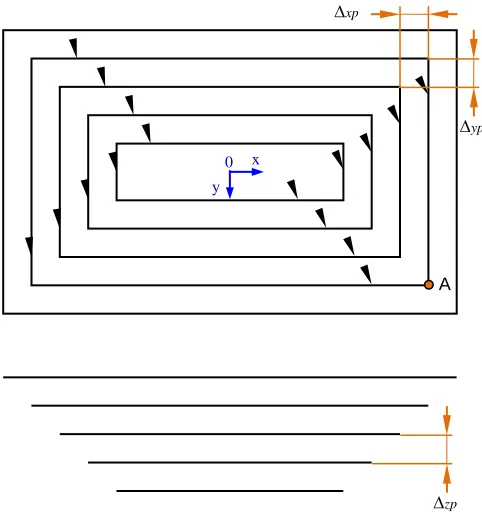
For the single-pass forming method, the starting tool position is the corner of the first quadrangular loop of 60 x 60mm (point A, Fig. 1). Traveling tool is indented vertically to the sheet face and it moves in the horizontal direction inducing plastic deformation locally around the contact area. It returns to the starting position after one cycle. Then it shifts to the next quadrangular loop whose size is smaller than the previous one, and travels along this loop, and so on.
Fig. 1 Tool path strategy adopted for the SPIF process.
For the two-pass forming method, the tool performs the final part in two passes. In the first one, a pyramidal shape with height hp (Fig. 2) is created using the SPIF principle, and then the goal shape is achieved using the same path implemented in the single-pass method. After each pass, the tool returns to the starting position.
Fig. 2 Schematic illustration of the Two-pass SPIF process of a quadrangular pyramid.
A Java application is developed to generate the three displacements coordinates of the tool in space. The path parameters used to perform the single-pass method are given in table 1 where ∆dp is the step size according the direction d at the pass number p, Cp is the cycle’s number of the pass p, and hp is the pyramid depth. For the single-pass method, the first pyramid depth is assumed null. Whereas, the two-pass one is achieved with a first pyramid depth of 30 mm, by using the parameters given in table 2, and a second pyramid with parameters similar to those implemented for the single-pass method. The reason behind this is to ensure similar geometric profile between the two formed parts at the contact zone between tool and sheet.
Table 1: Tool path parameters values for the single-pass SPIF method. hp
(p = 2)
∆xp (mm)
∆yp (mm)
∆zp
(mm) Cp
30 1 1 1 30
For the study of the first pyramid depth influence, on the final part thickness distribution, the final shape is performed using three depths values: hp = 0mm, hp =
25mm and hp = 30 mm. With the same tool path
generation method described previously, the tool becomes able to perform the final shape using the parameters described in tables 1 and 2.
Table 2: Tool path parameters values for the first pyramid (Two-pass SPIF method).
0 x y
A
∆xp
∆yp
hp (p = 1)
∆xp (mm)
∆yp (mm)
∆zp
(mm) Cp
25 2.4 2.4 1 25
30 2 2 1 30
3. Finite Element Model
A set of forming tool and the sheet used to simulate the two-pass and single-pass SPIF process is illustrated in Fig.3. The sheet material used for this study is the Al 3003-O aluminum alloy with a thickness of 3 mm. The sheet material is considered to be isotropic, homogeneous and incompressible.
The blank is quadrangular with dimensions 150 mm × 150 mm and assumed deformable. Nodal displacement and rotation is constrained at all edges of the sheet during the forming process .The rigid tool shape is a cylinder with hemispherical head whose diameter is 15 m .The friction between the tool and the sheet is modeled using the Coulomb friction with a friction coefficient value of 0.1 [5]. The sheet is modeled by shells element with 4 nodes, and reduced integration points. Nodal displacement and rotation are constraints at all edges of the sheet during the process.
Fig. 3 Numerical model adopted for incremental sheet metal forming process.
The power law equation (1) gives the material behavior model used in incremental sheet forming [11]:
σ = K εn (1)
Where σ is the equivalent stress, ε the equivalent strain, K strength coefficient and n is the strain-hardening exponent. The required material properties of Al 3003-O aluminum alloy used in simulation are given in Table 3 [12].
Table 3: Mechanical properties assumed for sheet metal of Al 3003-O.
K N E (GPA)
σ
0(MPA) ν184 0.2 72 35 0.3
4. Results and discussion
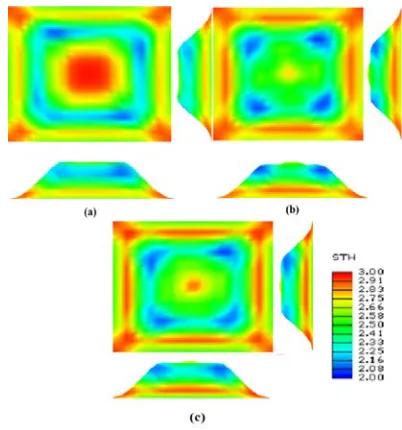
Figure 4 shows the thinning maps for the three geometries obtained from finite element model for single-pass (fig.4.a), pass method with hp=30 (fig.4.b) and two-pass method with hp=25 (fig.4.c) .
We can note that the minimal values of thickness are located near the fillets and corners for all formed shapes.
Fig. 4 Thinning maps for the three geometries in SPIF FE simulations: (a) Single-pass SPIF method, (b) two-pass SPIF method with hp = 30mm,
(c) two-pass SPIF method with hp = 25mm.
In order to investigate the thickness variation in the formed shapes, cuts according vertical median plans at 0° and 45 ° with plan (XZ) are made to ascertain the thickness variation with the geometric profile.
Fig. 5 Thickness variation along the median plane in the final shapes produced with different height hp.
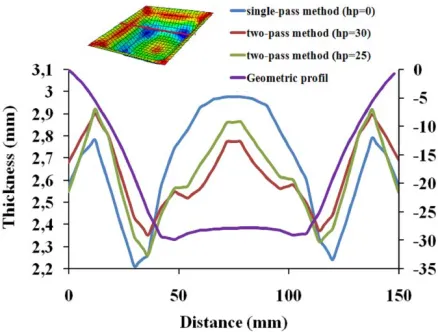
Thickness and geometric profile measured for the formed shapes, according vertical median plane at 45° with plan (XZ) are illustrated by Fig. 6. It can be noted that thickness does not change between the two methods from the edge to a distance of 26.6 mm from the edge. After that, the two-pass SPIF method makes the thickness smaller in comparison with single-pass one.
Fig. 6 Thickness distribution according the vertical median plane at 45° in the final shapes produced with different height hp.
Fig.5 shows that the thickness reaches a minimal value of 2.22 mm at a depth of 24.5 mm for the single-pass. Using the two-pass method this value decrease with about 2.3 % and the corresponding areas moves to downward of the pyramid (2.14 mm at a depth of 27 mm).In this case the minimal thickness area is located near the corners.
Regarding the influence of the first pyramid depth on the thickness distribution .Figure 5 shows that the metal
quantity shifted from the centre of the sheet to the pyramid walls increases as the depth increases and thickness becomes more homogenous. Indeed, a variation of depth by 5 mm (from 25 to 30 mm) increases the minimal thickness value, at 36 mm from the side, with about 4 %.However, thickness decreases with about 3.28 % in the pyramidal base. Nevertheless, at the areas where the tool changes direction, the minimal thickness value decreases and moves to downward of pyramid as the depth of the first pyramid increase (Figure 6).
5. Conclusion
Thickness distribution of sheet metal in an incremental forming process is numerically investigated using finite element code. Product shape is a quadrangular pyramid. A two-pass SPIF method is applied to form the same product obtained with single-pass SPIF method, in order to find the effect of the first method on the thickness distribution of the final parts. The effect of the first pyramid, in a two-pass SPIF method, is also investigated. It’s concluded that: The two-pass SPIF method makes the thickness more homogenous and a critical drop in thickness in the walls can be avoided in this case. In the fillets where tool changes direction of displacement, two-pass SPIF method brings the minimal thickness areas near the corners of the pyramid, and the shape becomes thinner. As the depth of the first pyramid in a two pass SPIF method increases, the thickness of the pyramid walls increases and the minima thickness values in the fillets decreases.
References
[1] D.Xu, R .Malhotra, N. V .Reddy, J .Chen, J .Cao, Journal of Materials Processing Technology, 14, 2012, pp.487- 494. [2] J.M.Allwood, H.Utsunomiya, International Journal of
Machine Tools & Manufacture, 46/15, 2006, pp.1939–1960. [3] Yamashita M, GotohM,Atsumi S, Journal of Materials
Processing Technology, 199, 2008, pp.163–172.
[4] Wu S.H , Reis A , Andrade PiresF.M ,Santo D, Barata da Rocha A, Journal of Advanced Materials research , 1586-1591,2012,pp. 472-475.
[5] Jun-chao L, Chong L, Tong-gui Z, Transactions of Nonferrous Metals Society of China, 22, 2012, pp.54-60. [6] S.Matsubara, Journal of JSTP Plasticity and processing,
1311, 1994, pp.35–406.
[7] T.J. Kim, D.Y .Yang, International Journal of Mechanical Sciences, 42, 2000, pp. 1271–1286.
[8] M.Skjoedt,M.Bay, B.Endelt, G.Ingarao, International Journal of Material Forming,1,2008, pp.199-202.
[9] J.R.Duflou, J.Verbert, B.Belkassem, J.Gu,H.Sol, C.Henrard, A.M. Habraken, CIRP Annals - Manufacturing Technology, 57, 2008, pp. 253–256.
[11] VanHoutte P, Van Bael A, International Journal of Plasticity, 20, 2004, pp.1505-1524.
[12] Bahloul R, Dal Santo Ph, Mkaddem A, Potiron A, Advanced Materials Research , 8, 2005,pp.753-762 .
Radouane BENMESSAOUD is a mechanical engineer (2009) and a
PhD student at the National Higher School of Engineering (Crafts and Technologies, ENSAM Meknès - Moulay Ismail University, Morocco). He is currently working in the scientific field of incremental sheet metal forming process.
Mohammed RADOUANI is an associate professor at the National
Higher School of Engineering (Crafts and Technologies, ENSAM Meknès - Moulay Ismail University, Morocco). He obtained his Ph.D. thesis in Mechanical Engineering from Prestigious training college for teachers and researchers in Technics (ENS of Cachan, University of Paris-south XI - France, in 2003) and his Habilitation of supervising scientific research Dissertation from Faculty of Sciences - Meknès in 2009. His research work is dealing with specification and inspection of mechanical systems according to the ISO standards. He is also interested to products numerical engineering.
Youssef AOURA is an associate professor at the National Higher School
of Engineering (ENSAM Meknès - Moulay Ismail University, Morocco). He obtained his Ph.D. thesis in Manufacturing Processes from the National Higher School of Engineering (ENSAM - France, in 2004). His research work is dealing with optimisation of new products and manufacturing processes.
Benaissa EL FAHIME is an associate professor at the National Higher